So, what exactly is Answer Engine Optimization (AEO)?
Think of it this way: AEO is the art and science of making sure AI assistants—like ChatGPT, Gemini, and Google's AI Overviews—give the right answers about your business. It's about feeding these super-smart digital brains all the accurate, structured, and authoritative information they need to recommend you confidently.
When someone asks a question about your products or services, you want the AI to provide a correct, positive response that points right back to you.
Welcome to the New Search
Picture your next customer. They don't find you by scrolling through a page of blue links. Instead, they ask an AI assistant a direct question and get a single, synthesized answer that sends them straight to your doorstep. This isn't some far-off prediction; it's already happening, and it’s driven by Answer Engine Optimization.
The very foundation of how we find information is shifting. We're moving away from typing choppy keywords into a search bar and toward having real conversations with AI. This change is completely rewriting the marketing playbook.
Why This Shift Matters Right Now
The rise of AI-driven experiences like Google's Search Generative Experience (SGE) is what makes AEO a must-have discipline, not just a nice-to-have. To get a sense of the scale, consider this: conversational search queries exploded by a staggering 300% in 2024 alone. People are tired of endless links; they want instant, complete answers. You can get the full picture of how SGE will impact small business marketing to understand the changes coming.
This massive shift in behavior creates both a huge opportunity and a serious risk for brands:
- The Opportunity: Get recommended directly by an AI for high-intent questions like “best pizza near me” or “most reliable accounting software.” This drives customers who are ready to buy right to your business.
- The Risk: AI models can—and do—get things wrong. They can "hallucinate" incorrect business hours, misunderstand what you offer, or even make up false negative information that kills your reputation and costs you money.
In this new world, visibility isn't just about ranking #1 on Google anymore. It’s about being the most trusted and accurate source of information for the AI models that are rapidly becoming the world's go-to researchers.
To help you get a handle on these new ideas, here’s a quick rundown of the core concepts.
AEO at a Glance Key Concepts Explained
| Concept | Simple Explanation | Why It Matters for Your Business |
|---|---|---|
| Answer Engine | An AI system (like ChatGPT or Gemini) that provides direct, synthesized answers instead of a list of links. | This is the new "search engine." If you're not visible here, you're invisible to a growing audience. |
| AEO | The process of making your business information accurate and authoritative for these answer engines. | AEO ensures the AI recommends you and provides the correct information about your services and location. |
| AI Hallucination | When an AI confidently states incorrect or completely made-up "facts." | This is a major risk. An AI could invent wrong store hours or negative reviews, directly harming your business. |
| Knowledge Cutoff | The point in time when an AI's training data was last updated. It doesn't know about events after this date. | Your latest offers or location changes won't be known unless they are part of a continuous data feed. |
| AI Share of Voice | A metric measuring how often your brand is mentioned by AI compared to your competitors. | This is the new KPI for brand visibility. It tells you if you're winning or losing on the AI battlefield. |
Understanding these terms is the first step. The next is realizing just how quickly this new battlefield for visibility is expanding.
The numbers tell a clear story. Today, over 2 billion people are skipping traditional search and going straight to answer engines like ChatGPT, Perplexity, and Google AI Overviews.
This guide will break down what AEO really is, how these answer engines work, and give you practical steps to protect your brand while seizing the incredible growth opportunities on the table.
How AI Assistants Actually Generate Answers
To really get a handle on Answer Engine Optimization, you first have to understand the engine itself. At their core, AI assistants like ChatGPT are driven by Large Language Models (LLMs).
Think of an LLM as a super-librarian who has read just about every book, article, and website ever published. It's all stored in a colossal digital memory.

But when you ask this librarian a question, it doesn't just grab a book off the shelf. Instead, it synthesizes everything it's ever read to construct a totally new answer, one word at a time. It does this by making incredibly complex predictions about which word should logically come next, based on the countless patterns it learned during its training.
This predictive process is what makes AI answers feel so natural and conversational. It's also the root cause of one of the biggest risks in the AEO world: AI hallucinations. If the patterns in its data are weak, contradictory, or just plain old, the AI might confidently "predict" the wrong next word, leading it to invent information out of thin air.
The Three Information Sources AI Taps Into
An answer engine isn't just making things up. It pulls from a combination of data sources to put together its responses. Understanding these sources is the secret to influencing what the AI says about your business.
-
Foundational Training Data: This is the massive, static library the LLM was originally trained on. It includes a huge slice of the public internet up to a certain date—its "knowledge cutoff." Anything published after that point is a blind spot unless supplemented by other sources.
-
Structured Data from the Web: This is where your AEO work starts to make a real difference. AI models actively search for neatly organized information. Things like schema markup—a special code that clearly labels your hours, address, services, and FAQs—act like a perfect index card for the AI, making it far less likely to get your details wrong.
-
Real-Time Search Results: Modern answer engines aren't just relying on their old library. For many questions, they perform a live search and scan the top-ranking pages to formulate an up-to-date answer. This is the crucial link between traditional SEO and AEO. If you don't rank, the AI probably won't even see you.
A strong digital presence—built on both traditional SEO and structured data—is no longer just about getting seen by customers. It’s about being seen and correctly understood by the AI assistants that are now guiding those customers.
How an Answer Actually Gets Built
Let's walk through a quick example. A user asks, “What’s the best deep-dish pizza in Chicago?”
- First, the answer engine figures out the user's intent—they want recommendations.
- Next, it queries its internal knowledge and simultaneously runs a live web search for relevant, authoritative content. Think "best Chicago pizza" lists, food blogs, and high-ranking restaurant websites.
- The AI then synthesizes all this info, looking for patterns, consensus, and signals of authority (like tons of positive reviews or mentions in trusted publications).
- Finally, it generates a conversational answer, predicting the most logical sequence of words to summarize its findings. It will often even cite the sources it found most useful.
This whole process shows why a solid digital foundation is non-negotiable. If your business information is inaccurate, inconsistent, or invisible to search engines, you'll be completely left out of the conversation. Good Answer Engine Optimization is all about making sure your business provides the clearest, most authoritative signals for the AI to find and trust.
AEO vs. SEO: Understanding the Critical Differences
So, is Answer Engine Optimization just a fancy new name for SEO? Not quite.
While they're definitely related, thinking of AEO as a simple replacement for SEO misses the bigger picture. It’s better to see it as the next evolution—a new layer built on top of the SEO foundation you already have.
Imagine your traditional SEO work is like writing a fantastic book. You give it a compelling cover, a great title, and work hard to place it on the perfect shelf in a library so people can find it.
AEO, on the other hand, is about making sure the librarian—the AI—not only finds your book but trusts it so deeply that it quotes from it directly when someone asks a question.
A top Google ranking is often the ticket to even be considered by an AI, but it no longer guarantees anyone will see or hear your answer.
A Shift in Goals and Tactics
The core mission of traditional SEO has always been clear: rank a webpage as high as possible on a search results page to drive clicks and bring people to your website. The game is played with keywords, backlinks, and a technically sound website.
AEO plays a different game entirely. The primary goal is to become the trusted, citable source for an AI-generated answer. Success isn't measured in clicks but in mentions, recommendations, and the accuracy of the information presented about your brand. This demands a pivot from focusing on keyword density to ensuring absolute data accuracy and semantic clarity.
To really get a feel for this shift, it helps to be familiar with the established practices for optimizing content for traditional search engines. Knowing the old rules makes it crystal clear just how different the new AEO-centric world is.
How Metrics and Success Have Changed
This fundamental change in goals completely flips how we measure success. We're now in a world of zero-click answers, where users get what they need right from the AI without ever visiting a webpage. When 60% or more of searches end without a click, your Google Analytics dashboard simply can’t tell you the whole story.
In the AEO framework, success is not just about bringing a user to your website. It’s about bringing your brand's correct information directly to the user, wherever they are asking their question.
This reality forces us to adopt a new set of Key Performance Indicators (KPIs) and find different ways to prove the value of our marketing efforts.
Traditional SEO vs. Answer Engine Optimization (AEO)
To make the distinction really pop, let's put the two disciplines side-by-side. The table below breaks down the core differences in strategy, execution, and measurement. It shows how AEO builds upon SEO but ultimately moves beyond it.
| Aspect | Traditional SEO (Search Engine Optimization) | AEO (Answer Engine Optimization) |
|---|---|---|
| Primary Goal | Rank a webpage high in search results to earn clicks and organic traffic. | Become the cited, authoritative source for direct answers generated by AI. |
| Key Tactics | Keyword research, backlink building, on-page optimization, technical site health. | Structured data (schema), factual accuracy, conversational content, E-E-A-T signals. |
| Success Metrics | Organic rankings, website traffic, click-through rate (CTR), keyword visibility. | Brand mentions in AI answers, sentiment analysis, factual accuracy, share of voice. |
| Content Focus | Creating comprehensive content that targets specific, high-volume keywords. | Directly answering user questions with clear, concise, and well-structured information. |
As you can see, AEO forces a strategic rethink. It’s no longer enough to win the ranking game; you now have to win the trust of the AI models that are quickly becoming the new gatekeepers of information.
The High Stakes of AEO: Brand Risks and Opportunities
Answer Engine Optimization opens up a powerful new way to get customers, but it's a double-edged sword. On one side, the opportunity is massive. Imagine becoming the go-to AI recommendation for a query like "best local pizza" or "most reliable plumber near me." That's a direct line to high-intent customers ready to buy.
This isn't just about a single mention. It's about consistently showing up as the trusted, authoritative answer right when a potential customer has a problem you can solve. An AI endorsement feels like a personal recommendation, cutting through the noise and putting your business front and center.
The Dangers of AI Misinformation
On the other side of that coin lies a huge risk: AI-generated misinformation. What happens when an answer engine confidently "hallucinates" and tells a user your shop is closed on your busiest day? Or when it invents a negative review by stitching together misinterpreted data from an obscure online forum?
These aren't just hypotheticals—they're happening right now. Brands are already grappling with damaging errors like:
- Incorrect Business Data: An AI spitting out the wrong hours, address, or phone number, leading directly to lost foot traffic and seriously frustrated customers.
- Fictional Negative Claims: An LLM might synthesize a "review" that never existed, smearing a brand's reputation with completely false information.
- False Business Status: The most brutal error is an AI listing a business as "permanently closed," instantly wiping it off the map for potential customers.
These mistakes happen because AI models are pulling from a vast, messy ocean of online data. If your information is outdated, inconsistent across different directories, or just plain misinterpreted by the model, it can lead to costly errors that hit your bottom line hard.
This is the urgent problem AEO is built to solve: taking control of your brand’s story in an AI-driven world. It’s about proactively feeding AI systems the right information to protect your reputation from these damaging falsehoods.
Why You Can't Afford to Ignore AEO
The sheer scale of this new environment makes sitting on the sidelines a dangerous game. As of August 2025, ChatGPT alone was pulling in over 489 million unique monthly visitors, and a huge number of them get their answers without ever clicking through to a website. This is the new reality of the zero-click search world, where a top organic ranking no longer guarantees you'll get any traffic.
When you learn that 60% of Google queries end without a click, it becomes crystal clear that the rules have changed. For a deeper dive into these trends, you can explore the data behind why AEO matters in 2025.
The core challenge for every single business is to grab the immense opportunity of AI recommendations while actively defending against the risks. This demands a whole new strategy focused on data accuracy and consistency everywhere your brand appears online. Managing this new front is exactly what AI reputation management consultants now focus on—turning a potential crisis into a competitive edge. The stakes are simply too high to leave your brand's AI narrative to chance.
Alright, let's talk about how to get your hands dirty and actually start optimizing for these new answer engines. Knowing the risks is one thing, but building a proactive strategy to win is another. The goal is to shift from playing defense to making your brand the most trusted, reliable source an AI can find.
This means tightening up your foundational data and creating content that’s built specifically for how AI models think and process information.
The whole process can be visualized as a journey: you start by recognizing the opportunity, then you work to shield yourself from the risks, and finally, you implement a solid solution.
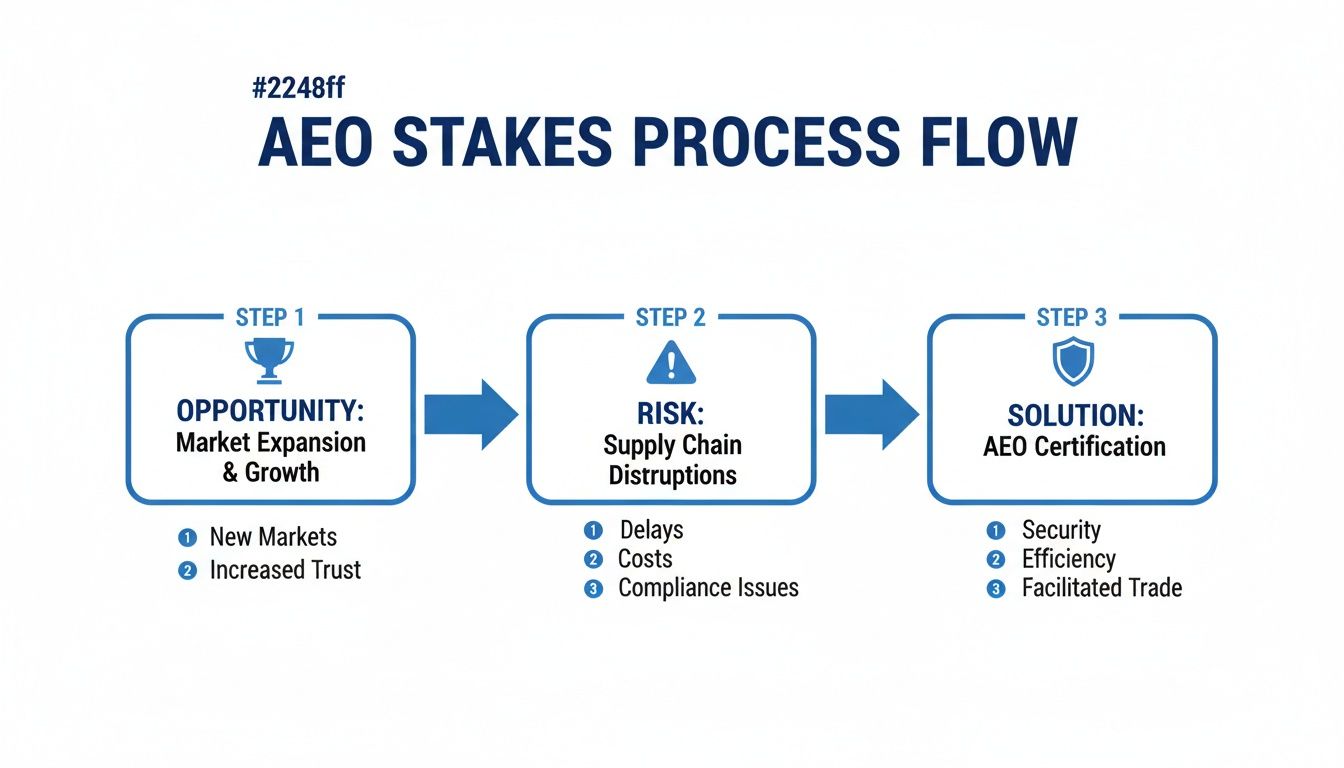
This framework helps you move from seizing the massive opportunity of direct AI recommendations to mitigating the real risk of misinformation with a smart, data-first approach.
Fortify Your Foundational Data
First things first: you have to get the basic facts about your business right. Everywhere. AI models rely heavily on trusted directories and online profiles to verify simple things like your hours, address, and what you actually sell.
Your Google Business Profile (GBP) is ground zero. For location-based AI queries, this is often the primary source of truth. Every single field needs to be filled out and be perfectly accurate—from your address down to the specific service attributes you offer.
Once that’s locked down, zoom out. Look at other major local directories and data aggregators like Yelp and Bing Places. Every platform where your business is listed contributes to the web of data an AI uses to piece together its understanding of you. Inconsistencies are poison here; they confuse the AI and can lead it to invent details or just get things wrong.
Implement Comprehensive Schema Markup
If your business data is the raw information, think of schema markup as the clear, machine-readable labels that tell an AI exactly what everything means. It’s like adding perfectly organized index cards to your website that a robot librarian can understand instantly, no guesswork required.
For effective AEO, implementing schema is non-negotiable. It cuts through any ambiguity and feeds structured, factual data directly to answer engines.
Be sure to focus on these crucial schema types:
- LocalBusiness: This explicitly defines your business name, address, phone number (NAP), hours, and even your exact geo-coordinates. It's essential for any "near me" or location-based question.
- FAQPage: This markup highlights the question-and-answer sections on your site. It makes it incredibly easy for an AI to grab your pre-approved, accurate answers to common customer questions.
- Product & Offer: This provides structured data on your products, covering everything from names and descriptions to pricing and stock levels. This is your best defense against an AI making up incorrect prices or features.
By structuring your data this way, you make it computationally simple for an AI to trust and use your information. It’s one of the most direct ways you have to influence what the models say about your business.
Create AEO-Friendly Content
With your foundational data rock-solid, the next layer is creating content that directly answers your customers’ most urgent questions. An AEO content strategy isn't about chasing broad keywords; it’s about addressing very specific user intent with absolute clarity and authority.
Put yourself in your customer’s shoes. What are they actually typing into that chat box? Use tools like Google’s "People Also Ask" or AnswerThePublic to find their exact phrasing.
Then, build your content to deliver a direct hit.
A key principle of AEO content is to answer the question first, then provide the supporting details. Place a concise, complete answer right at the top of the relevant section, often in the first paragraph.
This front-loading approach makes your answer incredibly easy for an AI to spot, extract, and cite. You'll also want to back this up with strong signals of Expertise, Authoritativeness, and Trustworthiness (E-E-A-T). That means adding author bylines, citing your sources, and keeping all your information fresh and up-to-date.
Finally, you need to know what the AI is saying about your competition. Understanding where they’re winning—and losing—in AI-generated answers can expose huge opportunities for you. Using specialized competitor AI analysis tools lets you see which brands are getting recommended for key queries, giving you a clear benchmark for your own AEO efforts.
Monitoring and Measuring Your AEO Performance
So, you’ve beefed up your business data and structured your content for AI. The big question is, how do you know if any of it is actually working? Your traditional analytics tools won't give you the answer. They can’t peek inside a private AI chat to see what’s being said about your brand.
This creates a massive blind spot. When a potential customer gets an answer from an AI and never bothers to click through to your site, that entire interaction is invisible to tools like Google Analytics. You could be losing business to bad information or missing out on key recommendations without a clue.
To win in this new channel, you need a completely new way to measure what’s going on inside these answer engines.
New KPIs for a New Channel
Measuring AEO means shifting your focus from clicks and traffic to mentions and accuracy. The KPIs that really matter are built to track your brand’s reputation inside AI-generated answers, giving you a clear scorecard of your performance.
Here are the key metrics you need to be tracking:
- BrandRank: Think of this as the new "share of voice" for the AI era. It measures how often your brand gets mentioned or recommended for key customer questions compared to your competition.
- Sentiment Analysis: This goes a step beyond just counting mentions. It analyzes the context of what the AI is saying. Are the comments about your brand positive, negative, or just neutral?
- Factual Accuracy: This is probably the most critical metric of all. It’s all about tracking how accurately AI models are repeating your core business information—things like your hours, services, and locations.
These metrics give you the hard data you need to figure out if you're winning or losing on the AI battlefield. The problem is, trying to track this by hand is nearly impossible. Answers can change between AI models, or even from one user session to the next.
Automating AEO Monitoring
This is where specialized AEO monitoring platforms become absolutely essential. They take on the mind-numbing work of tracking your visibility across multiple LLMs automatically.
An effective AEO platform acts as your eyes and ears inside answer engines, systematically querying different AI models to capture, analyze, and report on every mention of your brand.
These tools serve up the actionable data you need to prove your ROI and fine-tune your strategy. For example, a platform can shoot you an instant alert if an AI suddenly starts telling people your business is "permanently closed," letting you hunt down the source of the bad data before it does real damage.
This screenshot shows what a dashboard designed to track these new AEO metrics looks like.
The platform visualizes BrandRank, sentiment, and accuracy, giving teams a clear and immediate understanding of their performance in AI conversations.
The need for these tools is growing fast, mirroring a major shift in user behavior. Globally, 31% of Gen Z and Gen X now count AI tools among their top three search methods, and OpenAI's products alone pull in over 400 million weekly users.
Automated monitoring turns the overwhelming challenge of measurement into a manageable, strategic advantage. It lets you see what’s working, spot what your competitors are up to, and protect your brand’s reputation at scale—a process that is vital for agencies needing LLM visibility tracking for their clients.
Common AEO Questions Answered
Once you start digging into Answer Engine Optimization, a few practical questions always pop up. Let's tackle the most common ones to clear up any confusion and give you some straightforward, actionable insights.
How Long Does It Take to See AEO Results?
This is a big one. Unlike traditional SEO, where you might wait months to see any real movement, the effects of AEO can sometimes show up surprisingly fast. But it really depends on what you're trying to do.
Correcting your factual data is almost always the quickest win. If you update your store hours in your Google Business Profile or fix a mistake in your website's schema markup, AI models can pick up on that change and reflect it in their answers within a few weeks. It's direct, it's factual, and it's a relatively easy signal for them to process.
However, becoming the top-recommended brand for a broad, subjective question—like “best software for small businesses”—is a much longer game. That kind of trust isn't built overnight. It requires consistently strengthening your entire digital footprint and your E-E-A-T signals, which means putting in the work over time. The key here is continuous monitoring to track your progress and watch those gradual improvements add up.
Can I Just Focus on ChatGPT for My AEO Strategy?
Putting all your eggs in the ChatGPT basket is a risky and incomplete strategy. The AI world is fragmented, and your customers are scattered across a bunch of different platforms. They're asking questions on Google's Gemini (both in AI Overviews and its standalone app), Perplexity, Claude, and plenty of others.
Each answer engine uses slightly different training data, algorithms, and real-time data sources. An answer about your brand on one platform can be completely different on another.
A real AEO strategy means optimizing for and monitoring your brand’s reputation across all the major answer engines. It’s the only way to make sure your brand's story is consistent and accurate everywhere your customers are looking for answers. Anything less leaves you with dangerous blind spots.
Is AEO Only Important for Local Businesses?
AEO is an absolute game-changer for local businesses that live and die by "near me" searches and accurate location info. No question about it. But it's just as critical for e-commerce stores, B2B companies, and national brands.
Think about the kinds of questions people are asking AI assistants every day:
- Product comparisons before making a purchase online.
- Software recommendations to solve a specific business problem.
- Answers to complex industry questions during their research phase.
For these kinds of businesses, AEO isn't about getting directions right. It's about being cited as the most authoritative source, winning those priceless "best of" recommendations, and making dead certain that all your product or service information is correct across the entire ecosystem of answer engines.
Ready to stop guessing what AI is saying about you? The TrackMyBiz platform gives you complete visibility into your BrandRank, competitor mentions, and factual accuracy across all major answer engines. Start a free scan to see your current standing in minutes.
