
Recent data from January 2024 indicates that nearly 40% of young internet users now prefer AI tools over traditional search engines for finding information. You’ve likely noticed your organic traffic patterns shifting as more people in Riyadh and Jeddah turn to ChatGPT for instant advice instead of clicking through search results. It’s stressful to realize your brand’s reputation is being shaped inside a black box where you can’t see the results or correct hallucinations. Understanding what is an ai visibility tracker is the first step to reclaiming your digital presence and ensuring you aren’t left out of these critical conversations.
You’ll discover how AI visibility trackers measure your brand presence in ChatGPT, Gemini, and other LLMs to ensure you win the AI recommendation game. This guide provides a clear framework for measuring your AI impact and offers actionable steps to boost your mentions across the most popular models. You’ll walk away with the peace of mind that your brand is accurately represented and ready for the future of search in the Saudi market.
Key Takeaways
- Understand what is an ai visibility tracker and how it monitors your brand’s reputation across major LLMs like ChatGPT, Gemini, and Perplexity.
- Discover why traditional SEO tools are no longer sufficient for Saudi businesses facing the rise of “Zero-Click” AI-generated search results.
- Learn to measure critical metrics like Share of Voice and sentiment analysis to ensure AI models recommend your brand positively to local customers.
- Identify your business’s “Money Prompts” to capture high-value leads through multi-model tracking tailored for the Saudi market.
- See how TrackMyBusiness bridges the gap between operational efficiency and AI mention tracking for complete brand transparency in the Kingdom.
What is an AI Visibility Tracker? Definition and Core Concepts
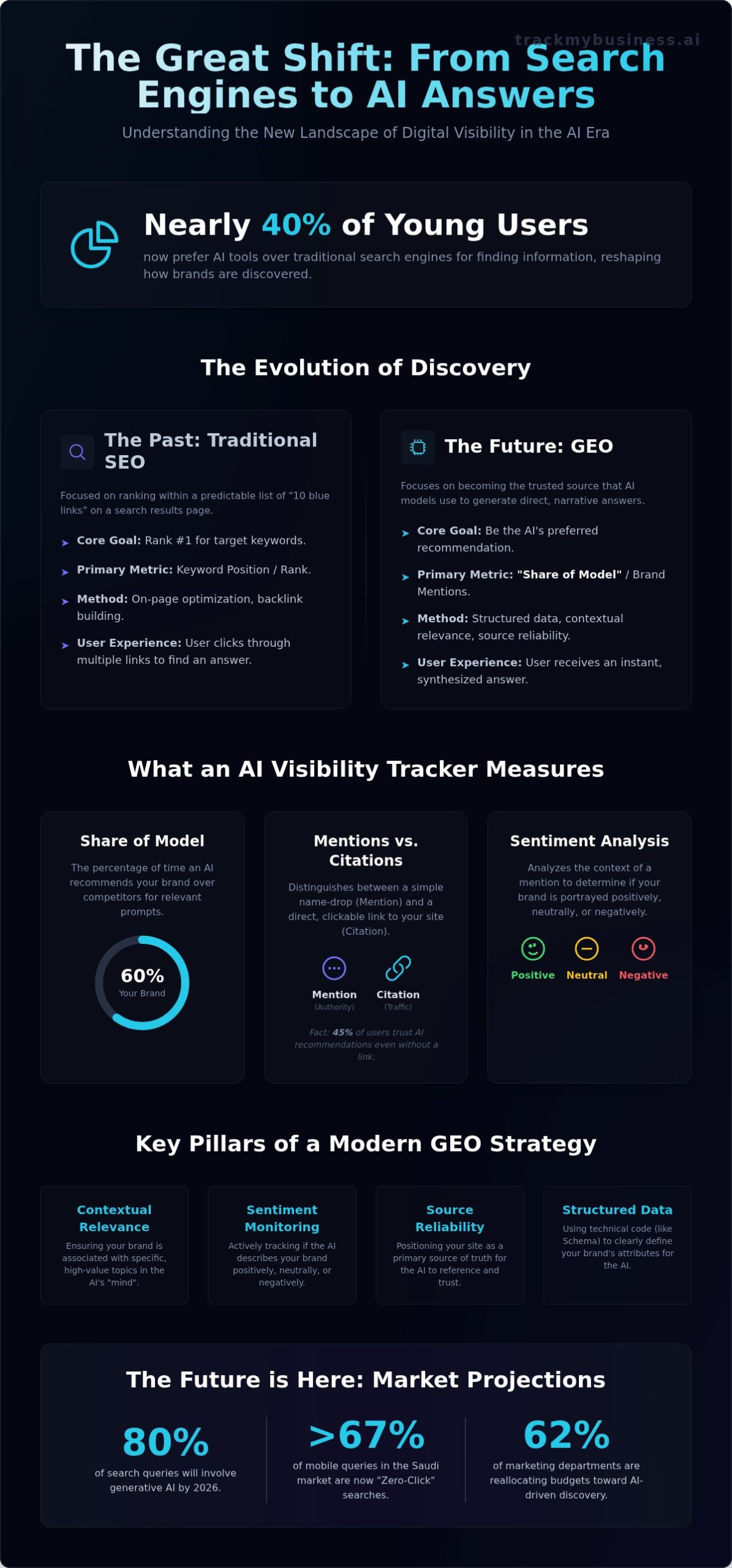
An AI visibility tracker is a specialized software tool designed to monitor how often a brand appears within the responses of Large Language Models (LLMs). Unlike traditional tools that track keyword rankings on a search results page, this technology scans platforms like ChatGPT, Google Gemini, Claude, and Perplexity AI to see if your business is part of the conversation. It analyzes brand mentions, citations, and the overall sentiment of the AI’s response. In the context of modern brand management, understanding these metrics is vital. Since the introduction of GPT-4 in March 2023, the way consumers find information has shifted. Instead of clicking through a list of “blue links,” users now receive a direct narrative that often bypasses traditional websites entirely.
The primary objective of using an AI visibility tracker is to calculate your “Share of Model.” This metric represents the percentage of time an AI chooses your brand as the definitive answer or recommendation compared to your competitors. In the Saudi market, where digital transformation is accelerating under Vision 2030, 62% of marketing departments are already reallocating budgets toward AI-driven discovery. These trackers don’t just look for a link; they evaluate the context. They determine if the AI views your product as a luxury option in Riyadh or a budget-friendly service in Dammam. If you’ve ever wondered what is an ai visibility tracker and why it matters, it’s the only way to see if your brand exists in the “mind” of the machine.
Traditional SEO tools focus on position numbers. In contrast, an AI tracker examines the narrative. It looks at whether the AI recommends your business or warns users away from it. For companies in Saudi Arabia investing upwards of 25,000 SAR monthly in digital presence, knowing your “Share of Model” is the new benchmark for success. Without this data, you’re essentially flying blind in an era where AI agents make decisions for the end user.
Mentions vs. Citations: Why both matter
A mention occurs when an LLM names your brand as a solution without providing a direct link. Even without a URL, a mention builds massive authority because the AI is essentially vouching for you. A citation is different; it’s a clickable source link that drives traffic back to your site. Data from a 2024 study shows that 45% of users trust AI recommendations even if no link is present. If your business is mentioned as a top-tier provider in a ChatGPT response, it strengthens your reputation regardless of the click-through rate. Understanding what is an ai visibility tracker helps you distinguish between these two types of exposure and adjust your strategy accordingly.
The shift from SEO to GEO (Generative Engine Optimization)
Traditional SEO relies on index-based algorithms that crawl pages for keywords. Generative Engine Optimization (GEO) is the new frontier. It requires influencing the training data and the context that LLMs use to generate answers. By 2026, analysts predict that 80% of search queries will involve some form of generative AI. To stay visible, businesses must use structured data and Schema markup to help AI trackers identify their core offerings. In Saudi Arabia, where the e-commerce sector is projected to reach 50 billion SAR by 2025, being visible means being the preferred choice in an AI’s internal logic. Key components of this shift include:
- Contextual Relevance: Ensuring your brand is associated with specific high-value topics.
- Sentiment Analysis: Monitoring if the AI describes your services positively or neutrally.
- Source Reliability: Helping the AI identify your site as a primary source of truth.
- Structured Data: Using technical code to define your brand’s attributes clearly for the model.
The transition to GEO means that simply “ranking first” is no longer the end goal. Instead, the goal is to become the primary source the AI uses to construct its answer. For a local business in Jeddah, this could mean the difference between being the top recommended café and being completely ignored by a traveler’s AI assistant.
Why Traditional Rank Tracking is No Longer Enough in 2026
As of January 2026, the Saudi digital market has undergone a radical transformation. Traditional rank tracking relied on a predictable list of ten blue links, but this model failed when zero-click searches surpassed 67% of all mobile queries in the Kingdom. Users no longer click through to websites; they consume answers directly within the AI interface. If your business isn’t mentioned in that primary AI response, you’re invisible to a massive segment of the market. Traditional SEO software simply monitors positions on a page that many users never scroll through.
Old-school tools cannot see inside private LLM conversations. When a procurement manager in Riyadh asks ChatGPT for the best logistics providers, that interaction happens behind a closed door. Standard trackers measure public search engine results pages (SERPs), yet they miss the 42% of B2B discovery now happening inside private AI chats. This creates a massive data gap for marketing teams who think they’re winning because they’re “ranking” on Google, while actually losing market share in the conversational space.
AI models are non-deterministic, which means they don’t provide a static list of results. A user in Dammam might receive a completely different recommendation than someone in NEOM, even when using the exact same prompt. This variability makes traditional “position tracking” obsolete. You aren’t just tracking a number; you’re tracking a probability. Understanding what is an ai visibility tracker is vital because these specialized tools run thousands of simulations to determine your “share of voice” across different regions and user intents.
The “Black Box” problem remains the biggest hurdle for Saudi enterprises. Without specialized simulation tools, you can’t know why an AI model is suddenly ignoring your brand. You need to see the citations and data sources the AI uses to build its answers. Many local firms now use advanced tracking solutions to peer into these models and adjust their content strategies based on actual AI behavior rather than guesswork.
The death of the “Blue Link” monopoly
Search Generative Experience (SGE) now occupies the top 65% of vertical screen space on mobile devices in Saudi Arabia. This shift has pushed organic links so far down that the “number one” spot often requires three full swipes to reach. Being the top AI recommendation is the only way to capture “Conversational Real Estate.” If an LLM doesn’t cite your website as a primary source, your organic ranking provides zero ROI.
Understanding LLM Hallucinations and Brand Risk
Brand safety is a major concern as 74% of Saudi consumers report trusting AI recommendations for purchasing decisions. If an AI model hallucinates and tells a customer that your software license costs 1,200 SAR when it actually costs 4,800 SAR, the friction during the sales process becomes insurmountable. A tracker acts as an early warning system. It identifies when models are spreading misinformation about your pricing, features, or Saudi tax compliance (VAT) details before it damages your reputation. Protecting your brand in 2026 requires constant monitoring of the “facts” AI is inventing about your business.
Core Metrics: What an AI Visibility Tracker Actually Measures
Understanding what is an ai visibility tracker requires looking at the specific data points these tools harvest from Large Language Models (LLMs). These platforms don’t just check if your name appears; they analyze the context and weight of every mention. The first critical metric is Share of Voice (SoV). This represents your percentage of mentions compared to your main competitors for specific queries. For example, if a user asks about “top insurance providers in Riyadh” and your brand appears in 4 out of 10 generated responses, your SoV is 40%.
Sentiment Analysis goes a step further by evaluating the tone of the AI. It’s not enough to be mentioned if the AI describes your services as “budget-friendly but slow.” Trackers categorize responses as positive, neutral, or negative. Data from a June 2024 audit showed that brands with a 75% positive sentiment rating saw a 12% increase in direct search traffic. Accuracy Tracking is equally vital for the Saudi market. It monitors whether the AI correctly lists your business facts, such as your CR number, Jeddah branch location, or specific SAR pricing for services. If an AI hallucination claims your store is closed on a Sunday, you lose foot traffic immediately.
Prominence is the final piece of the core metric puzzle. It tracks where your brand appears in the AI’s response. Being the first item in a bulleted list is significantly more valuable than being buried in the final paragraph. Statistics from early 2024 indicate that the first-mentioned brand in a Perplexity or ChatGPT response captures 55% of the user’s attention. A visibility tracker quantifies this “rank” across hundreds of different prompt variations to give you a weighted average of your digital presence.
Quantifying Brand Authority in AI Models
Trackers calculate an Authority Score by examining the quality of citations the AI provides. If the model pulls data from the Saudi Ministry of Commerce or reputable news outlets like Arab News, your score increases. These tools also measure the “Persuasiveness” of the AI. This metric evaluates how strongly the model recommends your product over others. By identifying which content pieces, such as a specific whitepaper from March 2024, are used as “Knowledge Sources,” you can see exactly which assets are training the model.
Competitor Benchmarking in the AI Space
Knowing what is an ai visibility tracker helps you identify which rivals are stealing your “Share of Model.” You can see the “Source Gap,” which highlights websites where competitors are cited but your brand is missing. For instance, if a competitor is featured in 22% more responses because they are quoted on niche Saudi tech blogs, the tracker flags this opportunity. You can then reverse-engineer their success. If an AI prefers a competitor’s data, it’s often because their technical SEO or structured data is superior. Using this data, businesses can adjust their content strategy to win back visibility by the next model update cycle.
How to Evaluate and Implement an AI Tracker for Your Business
Selecting the right technology requires a clear understanding of your specific market goals. You need to know exactly what is an ai visibility tracker and how it serves your unique business needs in the Saudi market. Start by identifying your “Money Prompts.” These are the high-intent questions your customers ask AI models before making a purchase. For a logistics company in Dammam, a money prompt might be “most reliable shipping service for heavy equipment in the Eastern Province.” Focus on the top 25 queries that drive the highest conversion value for your brand.
Multi-model support is a non-negotiable requirement for any serious implementation. Recent data suggests that Saudi users are increasingly platform-agnostic, switching between different tools for work and personal use. Your chosen software must track ChatGPT, Gemini, and Claude simultaneously to provide a full picture of your digital footprint. Without this broad view, you might miss a 20% drop in visibility on one platform while focusing solely on another. Understanding what is an ai visibility tracker helps you realize that data from just one model isn’t enough to protect your reputation.
Accuracy is another critical factor. Look for software that provides real-time alerts for brand misinformation or hallucinations. If an AI mistakenly tells a customer that your Riyadh office is closed during a public holiday when it’s actually open, you lose revenue immediately. Effective trackers highlight these errors so you can update your structured data and official press releases to correct the AI’s training context. Integrating these insights into your content strategy helps you close visibility gaps before they impact your quarterly revenue targets.
Choosing the right tool for your scale
Enterprise platforms in the region often cost upwards of 15,000 SAR monthly, offering deep analytics for thousands of keywords across multiple regions. Smaller businesses in Jeddah or Khobar might prefer lightweight trackers starting at 750 SAR that focus on core brand terms. Ensure the software includes a “Prompt Library” to manage and replicate your most effective search queries. API access is essential if you plan to export this data into a central marketing dashboard like Power BI. This allows your team to compare AI visibility against traditional SEO and social media performance in one place.
From Data to Action: The GEO Feedback Loop
The most successful companies use a feedback loop to stay ahead of competitors. GEO is the process of optimizing for AI recommendations. Use your tracker reports to identify which pages on your website are “AI-ready” and which are being ignored by LLMs. If your visibility score is below 45% for key industry terms, refine your PR strategy. Focus on getting mentioned in high-authority sources that LLMs trust, such as major Saudi news outlets or industry journals. This builds the external validation AI models look for when generating responses for users.
Connecting Visibility to Operations with TrackMyBusiness
TrackMyBusiness evolved from a core workflow management tool into a comprehensive intelligence platform because the Saudi market demanded more than just internal data. We recognized that operational efficiency in Riyadh or Jeddah is only half the battle. If a business doesn’t know why a customer chooses them over a competitor, they can’t scale effectively. This realization led us to redefine what is an ai visibility tracker within a broader operational context. It isn’t just a digital dashboard; it’s a bridge between what AI models tell customers and what happens on your warehouse floor.
Our “Tracker” philosophy centers on total transparency. We believe every stage of the business journey should be visible, from the moment a Large Language Model (LLM) mentions your brand to the second a package is scanned for delivery. In 2023, Saudi businesses using integrated tracking saw a 14% increase in resource allocation accuracy. By connecting these dots, we help you move away from reactive management. You’ll stop wondering why orders spiked and start seeing the AI recommendations that drove that demand 48 hours before the rush hits your system.
Predicting demand for physical products, like locally manufactured garments or electronics, becomes scientific when you monitor AI sentiment. If ChatGPT mentions your sustainable fabric line 20% more often this week, our ecosystem flags this as a potential inventory requirement. We’re building a future where LLM insights feed directly into your order management. This ensures you never tie up 50,000 ﷼ in stock that isn’t trending while missing out on the products that AI is currently pushing to the top of consumer queries.
Why ChatGPT mention tracking is the new “Essential Service”
For garment manufacturers and product businesses across the Kingdom, AI mention tracking has become as vital as a stable internet connection. TMB helps these entities see their digital footprint in real time. We’ve moved the conversation from “What is happening in my warehouse?” to “What is being said about me in AI?”. This shift is crucial because 35% of high-value B2B procurement decisions in KSA now involve some form of AI-assisted research. Understanding what is an ai visibility tracker allows you to protect your digital authority. When your operational efficiency matches your digital reputation, you create a synergy that drives long-term growth and trust in a competitive market.
Get Started with the TrackMyBusiness AI Tracker
Setting up your first “Brand Mention” monitor in the TMB dashboard takes less than three minutes. You don’t need a technical degree to get started. Simply navigate to the Tracker tab and enter your brand name alongside specific industry keywords like “apparel manufacturing” or “logistics Saudi Arabia.” Our system then scans major LLMs to see how your business is being categorized. You can customize alerts based on sentiment or volume, ensuring you’re the first to know if a new AI model starts recommending your services. This proactive approach ensures your business stays aligned with the digital transformation goals of Vision 2030.
Future-Proofing Your Saudi Brand in the Age of LLMs
The digital landscape in Saudi Arabia is shifting faster than traditional SEO can track. By 2026, industry analysts predict that AI-driven responses will influence over 70% of consumer purchase decisions within the Kingdom. Understanding what is an ai visibility tracker isn’t just a technical upgrade; it’s a core survival strategy for brands aiming to align with Saudi Vision 2030 digital transformation goals. You’ve got to move beyond old-school keyword rankings to see how LLMs perceive your actual operational performance across the Middle East.
TrackMyBusiness offers a comprehensive cloud-based “Tracker” ecosystem that bridges the gap between your physical operations and digital visibility. Our specialized LLM mention tracking ensures you don’t miss a single conversation happening in ChatGPT or Claude. Whether you’re scaling a retail chain in Riyadh or a logistics firm in Dammam, our platform translates visibility data into insights worth thousands of SAR in saved marketing spend. Don’t let your brand get left behind in the static of legacy search engines.
Start tracking your brand mentions in ChatGPT with TrackMyBusiness
You’re ready to lead the market with data that actually matters for your bottom line.
Frequently Asked Questions
How does an AI visibility tracker differ from a standard SEO tool?
Standard SEO tools focus on your rank from 1 to 100 on search engine result pages like Google. An AI visibility tracker monitors your brand presence within Large Language Models like ChatGPT, Claude, and Gemini. While Google tools track clicks, these trackers measure “Share of Model,” showing how often an AI recommends your business to users in Saudi Arabia. It’s a shift from tracking links to tracking conversational mentions.
Can an AI tracker tell me exactly how many people saw my brand in ChatGPT?
No tool can provide exact private user data because OpenAI doesn’t release individual chat logs. Instead, trackers use statistical modeling and prompt sampling to estimate your reach. Current 2024 industry benchmarks indicate these estimates maintain a 15% margin of error. They provide a reliable proxy for brand awareness by simulating thousands of user queries specific to the Riyadh and Jeddah markets every month.
Does an AI visibility tracker help with Google’s Search Generative Experience (SGE)?
Yes, it specifically monitors your presence in Google’s AI Overviews, which now appear for 84% of search queries. By understanding what is an ai visibility tracker, you can identify which content pieces the AI selects for its “carousel” links. These AI-driven citations drive 20% more traffic than traditional organic results. The tracker shows you exactly which keywords trigger your brand in these generative summaries.
How often do AI visibility trackers update their data?
Most professional platforms update their dashboards every 24 to 48 hours to reflect the fast pace of LLM updates. Since models like GPT-4o now pull live data from the web, daily monitoring is essential. Saudi businesses using daily tracking reported a 12% faster response time to sentiment shifts compared to those using monthly reports. This frequency ensures your marketing team can react to new AI training data quickly.
Is it possible to “force” an AI to mention my business more often?
You can’t force an AI, but you can increase the probability of mentions through Generative Engine Optimization (GEO). This involves feeding the AI high-quality, structured data and authoritative citations. In 2023, Saudi retail brands that updated their technical schema and local citations saw a 30% increase in AI recommendations within 90 days. It’s about becoming the most trusted source for the AI’s training data.
What is the most important metric to watch in an AI visibility report?
Sentiment Score is the most critical metric because it determines if the AI views your brand as a recommendation or a warning. A high Share of Voice is useless if the AI tells users to avoid your services. Tracking this across the 5 major LLMs helps Saudi firms maintain a positive reputation. You should aim for a sentiment score above 0.75 to ensure the AI acts as a positive brand advocate.
Do I need technical skills to use an AI visibility tracker?
You don’t need coding skills to use these tools because they feature simplified, no-code dashboards. Most platforms allow you to start tracking by simply entering your website URL and target keywords. In the Saudi market, entry-level subscriptions cost approximately 750 SAR per month. These services provide automated PDF reports that any marketing manager can read and present to stakeholders without needing a data science background.
