The real power of earned media isn’t just about getting your name out there; it’s about building genuine trust and authority. This kind of credibility drives real business results in a way that paid ads simply can't, making it one of the most valuable assets a modern brand can have.
Understanding the Real Value of Earned Media
We live in a world drowning in ads. Because of that, earned media has become the signal that cuts through all the noise. Think about it this way: a friend tells you, with genuine excitement, about a new restaurant they loved. Now, picture seeing a flashy billboard for that same place. Which one actually makes you want to go?
That friend's recommendation? That's earned media in its purest form. It’s authentic, it wasn't paid for, and it's incredibly persuasive. This is the core difference that sets earned media apart from its counterparts in the POEM framework.
The POEM Framework Explained
To really get why earned media is so important, it helps to see where it fits in the bigger marketing picture. The POEM framework breaks media down into three simple categories:
- Paid Media: This is straightforward—it's any channel where you pay to play. Think social media ads, Google search ads, TV commercials, or sponsored articles. You have total control over the message, but your audience knows you paid for their attention.
- Owned Media: These are the channels you control completely, like your website, company blog, email list, and official social media pages. This is your home turf, where you tell your story.
- Earned Media: This is the big one. It's the organic attention you get from other people's efforts. We're talking about news articles, glowing customer reviews, social media shoutouts, and recommendations from influencers who genuinely love your product. You don't pay for it, and you don't control it.
While paid and owned media are the foundation of any good strategy, earned media is the ultimate validator. It provides powerful, third-party proof that your brand is the real deal, which in turn makes your owned content more believable and your paid ads more effective.
Earned media is what people say about you when you're not in the room. It's the ultimate measure of brand resonance and public trust, turning passive audiences into active advocates.
To put this into perspective, let's compare the direct impact of paid versus earned media side-by-side.
Comparing Paid vs Earned Media Impact
This table offers a clear, at-a-glance comparison of the core attributes and business impact of paid versus earned media, highlighting earned media's unique value.
| Attribute | Paid Media (Advertising) | Earned Media (Organic Mentions) |
|---|---|---|
| Trust & Credibility | Low. Consumers are skeptical of paid messages. | High. Seen as an authentic, unbiased third-party endorsement. |
| Cost | High. Pay-per-click, impression, or placement. | Low/None. The "cost" is in the effort to be remarkable. |
| Control | High. You dictate the message, placement, and timing. | Low. You have no direct control over what is said or where. |
| Longevity | Short-term. Visibility stops when you stop paying. | Long-term. A good article or review can drive traffic for years. |
| Audience Intent | Interruptive. Often reaches people who aren't actively looking. | High-intent. Often reaches people actively seeking solutions or opinions. |
| Impact on SEO | Indirect. Can drive traffic, which is a ranking signal. | Direct & Powerful. High-authority mentions and links are major ranking factors. |
As you can see, while paid media offers control and scale, earned media delivers something far more scarce and valuable: authentic trust.
Why Its Influence Has Skyrocketed
The influence of earned media has exploded for one simple reason: people don't trust ads anymore. We're tired of being sold to. We crave proof from people we trust and unbiased experts. In fact, a single positive review from a respected publication or creator can build more lasting credibility than a multi-million dollar ad campaign.
This shift makes it absolutely essential to track and understand what people are saying about you. Today, this goes way beyond simple Google Alerts. Smart companies are now using sophisticated tools for things like AI brand tracking for SaaS companies to capture, analyze, and act on these invaluable conversations.
At the end of the day, this authentic validation isn't just a nice bonus—it's a critical engine for reputation, customer loyalty, and revenue.
How to Measure the Financial Impact of Earned Media
Connecting your team's PR efforts directly to the bottom line is the holy grail for any communications pro. While old-school metrics give you a starting point, they rarely tell the whole story of financial impact. Proving the real value of earned media means going way beyond surface-level numbers and adopting methods that actually make sense to a CFO.
It’s all about shifting the conversation from fuzzy "brand awareness" to concrete business outcomes. That requires a smart strategy for tracking how a feature in a major publication or a shout-out from a trusted creator actually turns into website traffic, qualified leads, and—most importantly—revenue.
This diagram shows how marketing efforts naturally progress from paid and owned media to the highly-trusted earned media that truly validates your brand.
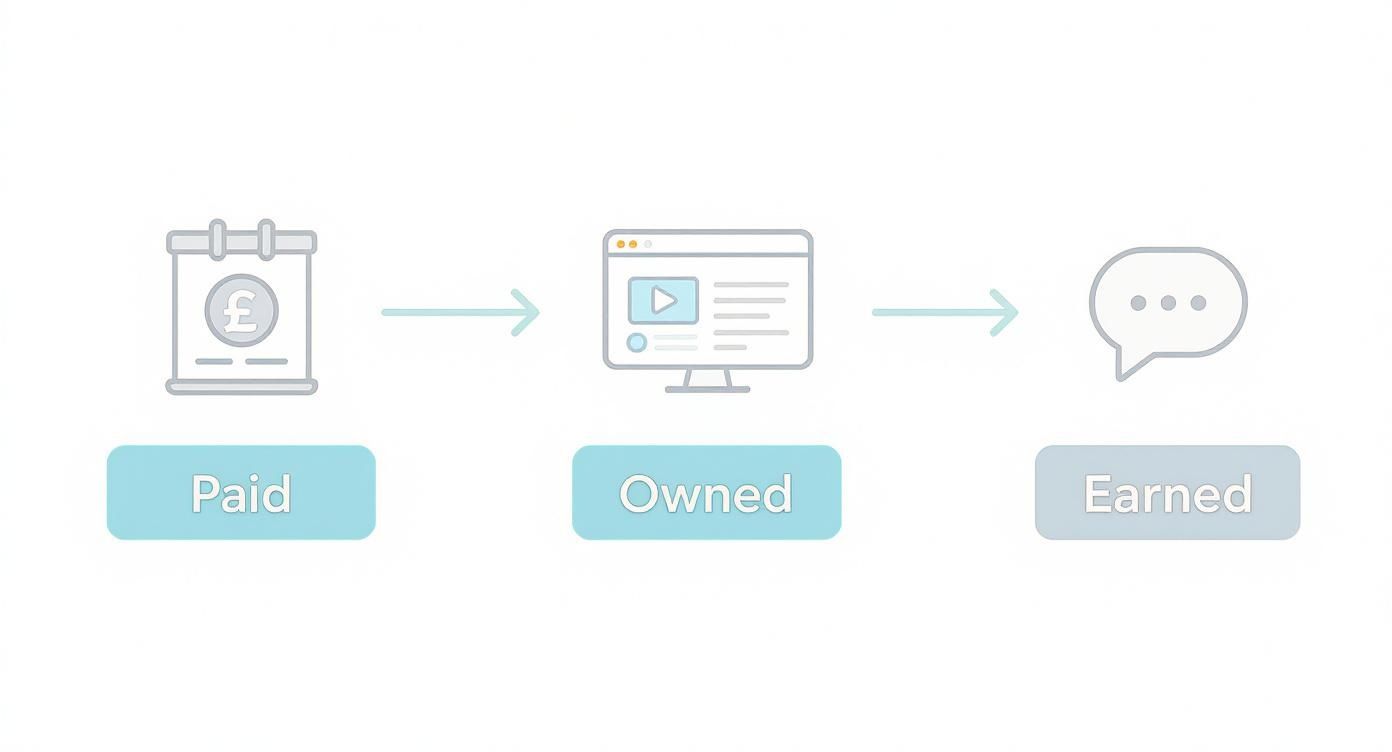
As you can see, paid efforts kick things off by driving people to your owned assets. When those assets are compelling enough, they generate authentic earned media, closing the loop on a powerful marketing cycle.
Moving Beyond Traditional Metrics
For years, the go-to metrics were Advertising Value Equivalency (AVE) and Earned Media Value (EMV). AVE is a simple calculation of what an earned media placement would have cost if you'd bought it as ad space. It’s a straightforward concept, but most of the industry now sees it as outdated. Why? Because it wrongly assumes an unbiased editorial mention holds the same value as a paid ad—and we all know they are two very different things.
EMV came next, trying to assign a dollar value to unpaid brand mentions. But even EMV is getting a much-needed upgrade. The smartest models now fold in qualitative factors like positive tone, message alignment, and long-term visibility. For instance, a placement with a traditional EMV of $3,600 might be re-evaluated at $8,925 once you account for this crucial context, giving you a much truer sense of its strategic worth. You can find more details about how EMV models are evolving on Mentionlytics.com.
While EMV can provide a directional estimate, it doesn't answer the most critical question your leadership has: "How did this media placement contribute to our business goals?" Answering that requires a more direct approach to measurement.
Tying Earned Media Directly to Revenue
If you want to build a business case that gets nods in the boardroom, you have to connect earned media to real financial outcomes. This is where modern analytics and attribution tools become your best friends, letting you trace a customer’s journey from a media feature all the way to a sale.
Here are the most effective ways to do it:
- UTM Parameters: These are simple codes you tack onto a URL to track its source, medium, and campaign. Whenever you give a link to a journalist or influencer, use UTMs. You'll see exactly how much referral traffic that specific placement sends to your site.
- Dedicated Landing Pages: Got a big campaign or a major partnership? Create a unique landing page just for it. This isolates traffic from that one source, making it dead simple to measure the conversions, sign-ups, or demo requests generated by that single piece of coverage.
- Coupon Codes: This is as direct as it gets. Offer an exclusive discount code to the audience of a specific publication or podcast. It creates an undeniable line connecting that earned media mention straight to sales.
For a deeper dive, check out this guide on measuring public relations effectively. By using these direct tracking methods, you can walk into a meeting with a clear report showing that a specific article drove 500 new visitors, which resulted in 50 new leads, and generated $10,000 in direct sales. Now that's a story your CFO wants to hear.
Advanced Attribution and Analysis
Beyond direct tracking, a wider analysis helps you see the full picture. For example, multi-touch attribution models assign value to every touchpoint in a customer’s journey, not just the last click before a conversion. That earned media placement might be the very first time a customer hears about you, even if they buy something weeks later through a different channel.
Another powerful technique is to analyze your brand search lift. After a big media hit, keep an eye on the volume of people Googling your company name. A noticeable spike is a rock-solid indicator that the coverage drove brand awareness and purchase intent. It's also a great idea to use platforms with competitor AI analysis tools to see how your performance stacks up against others in your space.
This approach transforms the conversation from vanity metrics to ROI, proving that your communications strategy is a core driver of business growth.
Using the Creator Economy to Fuel Earned media
The entire game of brand trust has been rewritten by the modern creator economy. Today, creators and influencers aren't just another marketing channel; they're independent, powerful engines of genuine earned media. Their real power comes from the connection they forge with their followers, making their recommendations feel less like a paid ad and more like advice from a trusted friend.
This shift is a massive opportunity for brands. When you partner with the right creator, you’re not just buying an audience—you’re earning a piece of that hard-won trust. A single, honest feature from a respected creator can build more credibility and drive more action than a slick, high-budget ad campaign ever could.

This dynamic creates a potent and scalable source of brand validation, showing the immense value of earned media in real-time.
The Shift From Sponsorship to Authentic Partnership
The best creator collaborations have moved far beyond simple, transactional relationships. Instead of just paying for a one-off sponsored post, smart brands are empowering creators with the freedom to share their honest experiences. It’s this authenticity that hits home with audiences and generates true earned media.
This approach means you need to:
- Grant Creative Freedom: Let creators use their own unique voice and style. The content will feel genuine, not like a scripted commercial.
- Focus on Experience: Give creators your products or services to try without a list of rigid talking points. This encourages the kind of honest feedback their audience actually trusts.
- Build Long-Term Relationships: Nurturing ongoing partnerships leads to a deeper brand understanding and more natural, consistent mentions over time.
When a creator genuinely weaves a product into their content because they actually believe in it, the resulting praise is a powerful piece of earned media. This is the third-party validation that modern consumers crave.
Quantifying the Impact of Creator-Driven Earned Media
The economic value of this kind of earned media is no longer a mystery. For every $1 spent on influencer marketing—a primary driver of this earned media—brands see an average return of $5.78 in earned media value or sales. That stat alone shows how creator content can deliver nearly six times its initial cost.
It's no surprise the market has exploded from $1.7 billion in 2016 to an estimated $32.5 billion today, a meteoric rise fueled by consumer trust in peer recommendations.
The true ROI of creator partnerships isn't just in the initial sponsored post; it's in the ripple effect of organic shares, positive comments, and follow-up content that multiplies the initial investment many times over.
This effect creates a compounding cycle of trust and visibility that paid ads just can't replicate.
Real-World Examples of Earned Media Wins
Imagine a tech startup sends its new software to a handful of niche YouTubers known for their brutally honest reviews. One of them creates an in-depth, unsponsored video showing exactly how the tool solved a nagging problem for them.
That one video can set off a chain reaction of earned media:
- Immediate Audience Response: The creator’s loyal followers watch the review, trust the recommendation, and start flooding the startup’s website.
- Social Amplification: Viewers share the video across X and Reddit, exposing the brand to completely new communities.
- Industry Buzz: Tech bloggers and journalists see the video gaining traction and write articles about the "hot new" software, citing the creator's review as proof.
In this scenario, the simple act of seeding a product resulted in massive earned media wins that dwarfed the initial cost. When tapping into the creator economy, the ability to track and prove the value of these organic mentions is key. It's a similar discipline to Modern Influencer Marketing Measurement, and it's how you connect creator-led initiatives to real business outcomes, proving the immense value of earned media to your bottom line.
How Earned Media Shapes Search and AI Discovery
Getting noticed today isn't just about ranking on Google anymore. It's about being the definitive answer an AI assistant gives to a curious customer. Earned media is the very foundation of your digital authority, influencing both old-school search algorithms and the new wave of AI-powered discovery.
Think of every high-quality article, positive review, and media mention as a powerful vote of confidence for your brand. These endorsements create the high-authority backlinks and brand signals that search engines crave. Each one is like a signpost telling Google, "Hey, this brand is credible and relevant." The more trusted sources point your way, the higher you'll climb in search results, driving organic traffic long after the initial buzz has died down.

This digital footprint gets a massive boost from the booming creator economy. With a global value already somewhere between $250 billion and $480 billion—and forecasts predicting it could hit a staggering $1.49 trillion by 2034—creators are the primary engine for modern earned media. Their authentic content provides the exact kind of social proof that both search engines and AI models are built to recognize and reward. You can find more stats on the explosive growth of the creator economy on inbeat.agency.
Optimizing for AI and Large Language Models
The new frontier of discovery is happening inside chatbots like ChatGPT, Gemini, and Claude. These Large Language Models (LLMs) are trained on colossal amounts of public data—news articles, reviews, forum discussions, and blog posts. This is the very stuff earned media is made of.
So, when a user asks, "What's the best software for project management?" the AI doesn't crawl the web in real-time. Instead, it synthesizes an answer from the information it has already learned. If your brand is consistently cited, reviewed, and praised in trusted online publications, the AI learns to associate your name with authority and quality. That makes it far more likely your brand will be the one it recommends.
Securing a strong presence in the training data of LLMs is the new SEO. Brands that accumulate high-quality earned media today are future-proofing their visibility for the age of AI-powered search.
This means the value of earned media now extends directly to how an AI perceives and ultimately represents your brand to the world.
Protecting Your Brand in AI-Generated Answers
While this creates a massive opportunity, it also opens the door to a new kind of risk. LLMs can misinterpret information or surface outdated negative press, leading to inaccurate or damaging recommendations about your brand. This is why monitoring your brand's presence in AI conversations is absolutely essential.
Without a proactive strategy, you’re basically leaving your reputation to chance. A dedicated approach is no longer negotiable.
- Monitor Your Mentions: You have to know what AI models are saying about you. Are they recommending you or your competitors? Is the information they're giving out even accurate?
- Identify Inaccuracies: LLMs are known to "hallucinate" incorrect facts, like getting your business hours wrong or making up false claims. Catching these errors fast is vital.
- Correct the Record: By generating new, positive earned media and making sure your own digital properties are up-to-date, you can help correct the AI's understanding over time.
Securing this digital footprint is no longer just a good idea; it's essential for your brand's future. For agencies looking to offer this critical service, understanding the nuances of LLM visibility tracking for agencies is the first step toward protecting clients in this new landscape.
Actionable Strategies to Increase Your Earned Media
Knowing earned media is valuable is the easy part. Actually getting it? That’s a different game entirely. It requires a shift in mindset, moving from passively hoping for a mention to actively driving the conversation. This isn't about getting lucky; it's about being so valuable that journalists, creators, and your audience can't help but talk about you.
Forget just blasting out press releases. The real goal is to build a reputation as the go-to, credible source in your industry. When you consistently offer real expertise and great stories, people start coming to you. That's how you build an earned media engine that runs on its own.
Build Authentic Relationships Before You Need Them
The best earned media almost always comes from real relationships, not cold, transactional pitches. Let’s be honest, cold outreach has a terrible success rate. It lacks the trust and context needed to get anyone’s attention. The smarter play is to build your network of media contacts and creators before you need something from them.
Think of it as a long-term investment. You're turning a potential interruption into a welcome contribution.
- Follow and Engage: Pinpoint the key journalists, bloggers, and influencers in your space. Follow them on social media, leave thoughtful comments on their work, and share their content when it makes sense for your audience.
- Offer Value First: Position yourself as a resource, not a marketer. If a journalist is looking for a source on a topic you know inside and out, offer a helpful insight or connect them with someone—with no strings attached. This builds incredible goodwill.
- Personalize Everything: When it's finally time to reach out, prove you've done your homework. Reference a specific article they wrote or a topic they’re passionate about. Generic, copy-paste emails are the fastest way to get deleted.
Building relationships is like planting a tree. The work you do today won't produce shade tomorrow, but with consistent effort, you'll eventually have a powerful asset that provides lasting value.
Laying this groundwork ensures that when you do have big news, your message lands with a familiar, receptive audience, not a skeptical stranger.
Create Media-Worthy Assets People Want to Share
Journalists and creators are always on the hunt for a fresh angle, unique data, or a story that makes their audience stop and think. You can skyrocket your chances of getting coverage by creating assets that are designed to be newsworthy. Your product itself might not be a story, but the data and insights you can pull from it often are.
Think beyond the standard announcement. Focus on developing content that gives a reporter something genuinely valuable to share.
Here are a few ideas that work like a charm:
- Original Data and Research: Run a survey or analyze your own internal data to uncover compelling trends. A report with a headline like, "78% of Consumers Now Prefer Brands That…" is infinitely more powerful than another product launch. It instantly positions you as an expert and gives others a unique stat to cite.
- Thought Leadership Content: Don't be afraid to have a strong, even controversial, opinion on what’s happening in your industry. A well-argued article or whitepaper that challenges the status quo can spark debate and pull in a ton of media attention.
- Visual Content: A great infographic, a sharp chart, or a short, explanatory video can bring complex information to life. Visuals get shared like crazy and are often embedded directly into articles, earning you a brand credit and a valuable backlink.
Master the Art of the Compelling Pitch
You’ve built the relationship and created a fantastic asset. The final piece of the puzzle is the pitch itself. A journalist's inbox is a warzone for attention, and you have about three seconds to make an impression.
Your pitch needs to be short, sharp, and laser-focused on why their audience will care. A winning pitch always nails these elements:
- A Killer Subject Line: Be specific and intriguing. Ditch generic titles like "Story Idea" and try something like, "New Data: Remote Work Is Driving a 45% Shift in [Industry] Spending."
- The Core Hook: Get straight to the point in your first sentence. What’s the single most surprising or important takeaway? Why does it matter right now?
- Essential Context: Briefly explain who you are and why you're the right person to talk about this. Link directly to your data or report so they can see it for themselves.
- A Clear Call to Action: Make it easy for them to say yes. Offer to connect them with an expert for an interview, provide the full data set, or simply ask if they'd like more info.
By combining strong relationships with valuable assets and a sharp pitch, you create a repeatable system for generating high-impact earned media. This is how your brand stops just joining the conversation and starts shaping it.
Reporting the Value of Earned Media to Leadership
All your hard work securing earned media means nothing if you can't prove its worth. Getting great press is one thing; connecting it to real business results is the final, most critical step. Without a clear story, even your biggest wins can get lost in the noise and go completely unnoticed by leadership.
The goal is to stop talking about placements and start demonstrating tangible impact. You need to build a narrative that speaks the language of the C-suite, blending hard numbers with insightful context to paint the full picture. This is how you show that communications and reputation management aren't just a cost center—they're a direct contributor to the bottom line.
Building Your Executive Dashboard
An executive dashboard is your best friend here. It needs to be visual, straight to the point, and laser-focused on the metrics that actually matter to business leaders. Forget the vanity metrics that only comms people care about; this is all about business impact.
Your dashboard should tell a story at a glance, mixing quantitative data with the qualitative "why" behind it.
Here’s what you need to make your report impossible to ignore:
- Quantitative Business Impact: This is the hard data that ties directly back to revenue. We're talking referral traffic from media hits, new leads generated from specific articles, and the conversion rates of those leads.
- Qualitative Performance Indicators: This is where you add the color and context. Track metrics like share of voice against your top competitors, sentiment analysis (how much of your coverage is positive versus negative), and message resonance—proof that your key talking points are landing.
Combining these gives you a much richer story. You can show that a single article didn't just drive 1,000 visitors (quantitative), but that it also had 95% positive sentiment and perfectly echoed your core message about product innovation (qualitative).
Safeguarding Your Reputation with Media Monitoring
Beyond proving ROI, a huge part of your job is protecting the brand. In today's 24/7 news cycle, sitting back and waiting for stories to break is a recipe for disaster. Proactive media monitoring isn't optional anymore; it's absolutely essential for managing your reputation.
This means keeping a constant watch on every mention of your brand across online news, blogs, and social media. This vigilance is what allows your team to get ahead of the story, responding strategically and swiftly to whatever comes your way.
A strong monitoring program transforms your team from reactive firefighters into proactive reputation guardians. It empowers you to jump on positive stories to amplify them and get in front of negative ones before they spiral out of control.
Without it, you're just flying blind, leaving your brand's reputation completely to chance.
Telling a Powerful Story with Data
Now, pull all those data points together into a single, compelling story. Your report should be more than just a dump of charts and figures; it needs a narrative that shows progress, impact, and strategic value. Always frame your results in the context of the company's bigger goals.
For example, don't just say, "We secured 20 media placements."
Instead, frame it like this: "Our strategic outreach in Q3 landed 20 key media placements, boosting our share of voice by 15% and driving $50,000 in attributable sales pipeline. This directly supported the company's primary goal of revenue growth."
This kind of framing does three crucial things:
- It ties your work to what leadership actually cares about: revenue, market position, and growth.
- It shows you're thinking strategically, not just checking off tactical tasks.
- It justifies your budget by proving a clear and undeniable return on investment.
When you report like this, you elevate your team from a line item on a budget sheet to a critical engine for business success. You prove the undeniable value of earned media in a language the entire organization can understand and get behind.
Frequently Asked Questions
When you're digging into earned media, a few common questions always seem to pop up. Getting the answers straight is the key to building a strategy that actually works—and proving its value when it's time to report back.
What Is the Difference Between Earned and Shared Media?
It's easy to get these two tangled up, but the distinction is pretty important. They're related, but not the same thing.
Think of it this way:
Earned media is when someone else talks about you on their platform. A journalist from a major publication writes a feature story about your company's latest launch, or a respected industry blogger publishes an in-depth, independent review of your product. You pitched them, you inspired them, but you didn't control the final cut.
Shared media is a slice of that pie, happening specifically on social networks. It’s when your audience does the work for you—sharing your latest blog post, retweeting an announcement, or posting a photo of themselves using your product (user-generated content, or UGC). You created the original spark, but your community fanned the flames.
So, a feature in a trade magazine is earned media. A customer's glowing Instagram post tagging your brand is shared media. Both are gold, but they come from different places.
How Can Small Businesses Get Earned Media?
You don't need a six-figure PR retainer to get incredible press. For small businesses, it's all about being scrappy, smart, and genuinely helpful.
- Become the Go-To Local Expert: Local news outlets are always looking for experts to comment on stories. Position yourself as the authority on your industry in your city or town.
- Find Your Niche Influencers: Forget the mega-celebrities. Connect with micro-influencers and bloggers who have smaller but fiercely loyal followings in your specific niche. Their recommendation can be incredibly powerful.
- Create Your Own Data: Journalists love a good statistic. Run a simple survey with your customers, package the findings into a short report, and you've got a unique story no one else has.
- Tell a Human Story: Sometimes, the most newsworthy thing about your business isn't a product—it's your story. A compelling founder's journey or a unique mission can grab headlines just as effectively as a new feature launch.
It all comes down to giving reporters something of real value. Do that, and you'll get noticed.
For small businesses, earned media is the ultimate equalizer. A killer story or a piece of unique data can land you the same front-page coverage as a competitor with a multi-million dollar budget.
Is Negative Earned Media Always Bad?
Nobody likes seeing a bad review or a critical article. But before you panic, remember that it's not automatically a disaster. Handled the right way, negative press can actually be a gift.
It's raw, unfiltered feedback from the market. A critical mention shines a bright light on where your product is falling short or where your customer service needs to improve.
Even better, responding to that criticism publicly and honestly can build an incredible amount of trust. It shows everyone you're listening, you care, and you're committed to making things right. While you should never aim for negative coverage, seeing it as a chance to show your company's character can turn a potential crisis into a moment that strengthens customer loyalty. The key is to be fast, transparent, and constructive.
Ready to see what AI chatbots are really saying about your brand? TrackMyBiz gives you the visibility you need to protect your reputation and turn AI-driven discovery into your next acquisition channel. Start your free scan today at https://trackmybusiness.ai.
