Let's be honest, finding the right trending hashtags on Facebook used to feel like a complete shot in the dark. For years, they were an afterthought—a feature that never quite landed with the same impact as it did on platforms like Instagram.
But that's changed. Dramatically. In today's crowded feed, a smart hashtag strategy is one of the most effective ways to make sure your content actually gets discovered.
Why Facebook Hashtags Matter Now More Than Ever
User habits are evolving. People are starting to use Facebook search more deliberately, and hashtags are the signposts that guide them—and the algorithm—to your content. They're no longer just decorative; they are powerful discovery tools.
Think of them as keywords for your social posts. They categorize your content, making it searchable and pushing it into the feeds of users interested in your niche. This isn't just about joining a conversation anymore; it’s about ensuring people who don't already follow you can find you in the first place.
Before we dive into the "how," let's set the stage with a quick cheat sheet on what works and what doesn't.
Facebook Hashtag Strategy at a Glance
This table breaks down the core principles of an effective hashtag strategy, helping you sidestep common mistakes right from the start.
| Effective Strategy (What Works) | Ineffective Strategy (What to Avoid) |
|---|---|
| Using 1-3 highly relevant hashtags. | "Hashtag stuffing" with 10+ generic tags. |
| Mixing broad, niche, and branded tags. | Using only wildly popular, broad hashtags. |
| Researching trending & community-specific tags. | Guessing or using the same tags on every post. |
| Creating a unique branded hashtag for campaigns. | Jumping on unrelated trends for quick views. |
| Monitoring hashtag performance and adjusting. | "Set it and forget it" without tracking results. |
Keeping these simple do's and don'ts in mind will give you a massive head start. Now, let's explore how to put this into practice.
Amplify Reach and Connect with Communities
When you get them right, hashtags can seriously expand your reach. They tap into existing communities and ongoing conversations, placing your brand directly in front of a receptive audience.
A local bakery, for instance, could use a tag like #ShopLocalSupport to connect with users actively looking to support small businesses in their area. It's targeted, intentional, and far more effective than just shouting into the void.
A winning strategy often blends a few different types of hashtags:
- Broad Community Tags: These connect with larger interest groups (e.g.,
#SustainableFashion). - Niche-Specific Tags: Perfect for reaching a super-targeted audience (e.g.,
#VintageVibes). - Branded Tags: Excellent for building brand recognition and collecting user-generated content (e.g.,
#[YourBrandName]Challenge).
The real goal is to move beyond just tacking on popular words. A purposeful hashtag strategy should align perfectly with your content, resonate with your ideal audience, and directly support your bigger marketing goals.
The Hidden Risks in a Connected World
But here's something most people overlook: the power of hashtags comes with a responsibility to monitor the conversations they spark. A hashtag that goes viral can take on a life of its own, and all the content associated with it can influence what AI assistants, like ChatGPT, learn about your brand.
If misinformation or negative sentiment gets tied to a hashtag you're using, it could inadvertently shape your brand's reputation in AI-generated answers. This is why ongoing brand monitoring is no longer optional. Tools like TrackMyBiz help you see how these online conversations impact what AI says about you, ensuring the visibility you gain from trending hashtags on Facebook is the kind you actually want.
Finding Trending Hashtags People Actually Use
Jumping on a popular hashtag is easy. Finding the ones that will genuinely connect with your audience? That takes a bit more digging. The goal isn't just to find what's popular, but what's popular with the right people. Real success with trending hashtags on Facebook comes from mixing a little on-platform research with some smart external analysis.
Your first stop should always be Facebook itself. Its search bar is a surprisingly powerful, real-time tool.
Start typing a hashtag related to your industry—say, #SustainableFashion—and just watch the autocomplete suggestions pop up. Those aren't random; they're what other users are actively searching for right now. Clicking on one takes you to a dedicated feed where you can get a quick read on the conversation's volume and vibe. Is it a lively, relevant discussion, or is it just a wall of spam? This first check is crucial for avoiding the wrong crowds.
Digging Deeper with Social Listening
While Facebook search gives you a quick snapshot, dedicated social listening tools offer the full panoramic view. These platforms go way beyond simple post counts, giving you hard data on a hashtag's reach, user demographics, and overall sentiment. This is how you stop guessing and start making data-driven decisions.
For example, a tool might show you that #ShopLocalSupport sees a 30% spike in engagement on weekends. Armed with that knowledge, you can schedule your posts to hit that peak interest window, maximizing your visibility without any extra effort. You just can't get that level of insight from the native tools alone.
Don't just look at the volume of a hashtag; analyze the context. A trending tag might have high numbers but could be tied to a negative news story. Always investigate the "why" behind the trend before you attach your brand to it.
Learning from Your Competitors and Industry
One of the most effective, yet weirdly overlooked, strategies is to just observe what's working for others in your space. Take a look at the posts from your top three competitors.
- Which hashtags are they using on their posts with the most engagement?
- Are they jumping on broad trends or sticking to niche community tags?
- Have they cooked up their own branded hashtags that are actually getting some traction?
This isn't about copying them. It's about spotting patterns. If a competitor is consistently crushing it with #HomeWorkout, that’s a strong signal that this community is active and ready to engage on Facebook.
This infographic breaks down the core flow of a solid hashtag strategy, from that initial push to ongoing monitoring.
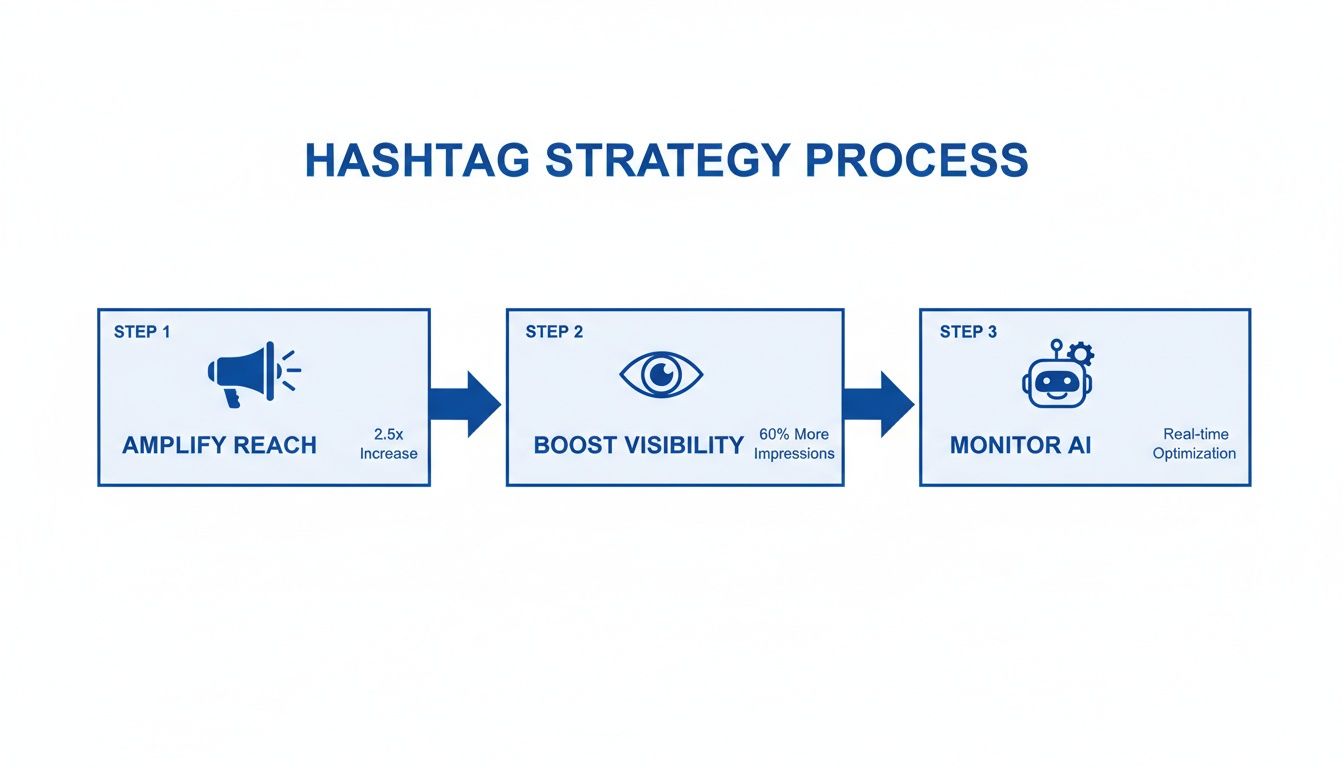
As you can see, boosting reach and visibility naturally leads to the critical step of AI monitoring, which helps ensure your brand's reputation stays positive. To really nail down which hashtags are resonating right now and figure out how to use them, it’s worth exploring proven strategies to find trending hashtags. When you combine these outside resources with your own research, you build a powerful approach that keeps you one step ahead.
Choosing the Right Hashtags for Your Brand
It’s tempting to slap a trending hashtag on a post and hope for the best. But that’s a recipe for getting lost in the noise. Real success comes from picking tags that actually align with your goals, not just what's popular for the next five minutes.
Think of it less like shouting into a crowd and more like joining the right conversation at the right table. The trick is understanding that not all hashtags are created equal—they each serve a very specific purpose in your strategy.
Understanding the Four Core Hashtag Types
A solid hashtag strategy is all about the mix. To get the best results, you need to pull from different categories, with each one playing a unique role in getting your message out there.
- Brand Hashtags: These are uniquely yours, like
#[YourBrandName]or a catchy tagline you own. They're perfect for building a recognizable brand identity and making it easy to find all your content (and your fans' content) in one place. - Community Hashtags: These are the niche tags that connect people around a shared passion or location. Think
#ShopLocalChicagoor#VeganBakers—they help you tap into a highly engaged and relevant audience that’s already looking for you. - Campaign Hashtags: You create these for a specific marketing push, like a product launch or a holiday sale (e.g.,
#[YourBrand]HolidayGiveaway). They’re temporary by nature but incredibly powerful for creating focused buzz and tracking the results of a single initiative. - Trending Hashtags: These are tied to whatever is exploding in real-time. While they offer a massive, short-term burst of visibility, you have to be careful. Only jump in if the trend is genuinely relevant to your brand’s voice, otherwise, you risk looking out of touch.
The most effective strategies blend these types. You might use one community tag, one campaign tag, and your own brand tag in a single post to cover all your bases—attracting new eyes while reinforcing your brand.
A Quick Framework for Vetting Hashtags
Before you add any hashtag to your post, run it through this quick mental checklist. This simple evaluation can save you from wasting time on tags that won't deliver.
Here are the three questions I always ask:
- Is It Genuinely Relevant? Does this hashtag make sense for my post, my brand, and my audience? Using an unrelated tag just to chase views is a fast way to damage your credibility.
- What's the Reach vs. Competition? A tag like
#summerhas millions of posts, meaning your content will be buried in seconds. A more niche tag like#SummerStyleTipshas a smaller audience but far less competition, giving your post a real chance to be seen and engaged with. - Who Else Is Using It? This is crucial. Click on the hashtag and see what pops up. Is the content high-quality and on-brand for you, or is it spammy? You’re checking out the neighborhood before you decide to move in.
For example, a local bakery launching a new line of cupcakes could blend #CupcakeLove (broad reach), #SupportLocalBakeries (community), and #BerryBlissCupcakes (campaign-specific). It’s a smart mix that attracts a wide audience, targets a specific community, and builds buzz around a new product.
Peeking at what hashtags your competitors are using can also be a goldmine of information. Using powerful competitor AI analysis tools can seriously speed up this research, helping you spot opportunities and sharpen your own strategy.
Weaving Hashtags into Your Content Strategy
Alright, you've found the right hashtags. That's half the battle. Now comes the part where strategy meets execution: knowing how to use them effectively on Facebook.
Unlike other platforms that seem to reward a "more is more" approach, Facebook’s algorithm is a bit more refined. It favors precision over volume. Overloading your posts with a dozen tags can make your content look spammy, and ironically, it might even throttle your reach.
From what we've seen, posts with 1-3 highly relevant hashtags consistently hit the sweet spot for engagement. Each tag should have a clear job. One might target a specific community, another could be your unique branded tag, and a third can tap into a timely, trending conversation. This focused approach gives the algorithm a crystal-clear signal about who needs to see your content.
Optimizing Hashtag Placement And Readability
Where you put your hashtags matters more than you might think. It's tempting to weave them directly into your sentences—a common practice elsewhere—but on Facebook, this can really disrupt the flow of your message and make it harder to read.
The best practice is simple: place your hashtags at the very end of your post. Think of them as a quiet power-up after your main message has landed. This keeps your caption clean, conversational, and focused entirely on the reader.
Let’s look at a quick example for a local coffee shop.
Before (Less Effective):
"Come try our new #icedlatte on this beautiful #summer day! It's the perfect treat to cool you down. #coffeeshop #local"
This just feels cluttered and a little desperate, doesn't it?
After (More Effective):
"Beat the heat with our brand new iced latte! It's the perfect treat to cool you down on this beautiful summer afternoon.#SummerSips #ShopLocalSupport #YourCafeName"
The second version is far more natural. It strategically targets relevant communities and interests without sacrificing readability one bit.
Adapting Hashtags Across Different Formats
Your hashtag game needs to adapt to the content format you're using. What works for a standard text-and-image post isn't necessarily what's best for a Reel or a Story.
- Standard Posts: Stick to the 1-3 rule. Focus on a mix of community, brand, and niche tags.
- Facebook Stories: You have a bit more room to be playful here. Using a trending sticker hashtag can give your Story a nice little visibility boost within that specific ecosystem.
- Facebook Reels: This is where trending hashtags on Facebook have the most impact. The magic formula here is pairing a trending hashtag with trending audio. When you hit both marks, you can see some seriously explosive reach because the algorithm is actively looking for that combination to promote.
Ultimately, the goal is to integrate hashtags so seamlessly that they enhance your content instead of detracting from it. A thoughtful approach ensures your posts get discovered without compromising the experience for your followers. For a deeper look at how online conversations define your brand, our guide on ChatGPT for brand monitoring in ecommerce breaks down how AI-powered reputation is shaped.
Measuring Hashtag Performance and Protecting Your Brand
Using the right hashtags is a huge step, but how do you know if your strategy is actually moving the needle? Just throwing tags onto a post without tracking their impact is like shouting into the wind. To really refine your approach, you have to connect your efforts to real-world results and, just as importantly, safeguard your brand from the unexpected side effects of going viral.
Your first stop for performance data is right inside Facebook itself. Facebook Insights offers a solid baseline for figuring out what's working. While it won’t give you a neat report that says, "this hashtag got you X results," you can absolutely spot the correlations.
Start by looking at the Reach and Engagement metrics for each post. If you notice that posts using a particular set of hashtags, like #ShopLocalSupport, consistently get higher reach than those without, that's a powerful clue. You're tapping into an active discovery stream. It’s a simple but effective way to validate your choices.
Monitoring Key Performance Metrics
To get a clearer picture, you’ll want to track a few key data points for any post where you're testing new hashtags:
- Impressions: How many eyeballs saw your post? A big spike here suggests your hashtags are successfully pushing your content into more feeds.
- Engagement Rate: Are people just scrolling past, or are they actually stopping to interact? Likes, comments, and shares are the ultimate validation that you got it right.
- Profile Clicks: Did the post make someone curious enough to check out your Page? This is a great signal that your content was relevant enough to spark deeper interest.
Tracking these metrics over time helps you move from guessing to knowing. You’ll begin to see which hashtags consistently deliver engaged viewers versus those that just generate empty impressions. This data is the foundation of a truly smart strategy.
Protecting Your Brand in the Age of AI
Here’s a critical blind spot for most marketers: what happens when a hashtag campaign takes on a life of its own? A viral hashtag—even a positive one—generates a massive amount of public conversation. Here's the catch: AI assistants like ChatGPT and Gemini learn from all that public data.
If that conversation gets messy with misinformation, negative sentiment, or user-generated content that misrepresents your brand, it can directly influence the answers AI gives about you.
For example, a fun campaign hashtag could be hijacked by disgruntled customers. Suddenly, AI models might start associating your brand with those negative discussions, damaging your reputation in ways traditional analytics can't even see. This is where proactive brand monitoring becomes non-negotiable. To help manage discussions and protect your brand's reputation around trending hashtags, you might consider tools like Facebook Moderation Assist.
This new reality requires a new set of tools. Platforms like TrackMyBiz are designed specifically to tackle this challenge. They monitor what AI assistants are actually saying about your brand, cross-checking the information for accuracy and sentiment.
This lets you spot and fix issues—like a chatbot incorrectly stating your business hours or repeating a false claim—before they do real damage. To get a better handle on this, learning more about AI brand tracking for SaaS companies can offer some valuable perspective, no matter what industry you're in. By actively monitoring your AI reputation, you turn the unpredictability of trending hashtags on Facebook into a manageable and reliable asset for growth.
Common Questions About Facebook Hashtags
Even with a solid plan, a few questions always seem to pop up about the finer points of using trending hashtags on Facebook. Think of this as your quick-reference guide to bust some common myths and help you sharpen your strategy.
Let's dig into the most frequent questions we hear from marketers and business owners.
How Many Hashtags Should I Use on a Facebook Post?
On Facebook, less is almost always more. Time and time again, the data shows that posts with just 1-3 highly relevant hashtags get the best results. While other platforms might reward you for casting a wide net with lots of tags, Facebook's algorithm definitely prefers a focused, precise approach.
Using too many hashtags can make your post look cluttered and spammy, which can actually hurt its reach. The goal here is precision, not just piling on tags. A good rule of thumb is to stick to one or two well-researched hashtags that nail your topic and audience, and maybe add one branded tag for consistency.
Can I Use the Same Trending Hashtags on Facebook and Instagram?
You can, but it's not always the best move. User behavior, what's trending, and even the whole vibe of a hashtag can be wildly different between the two platforms. A tag that’s blowing up on Instagram might have zero traction—or a completely different meaning—over on Facebook.
Before you copy and paste your hashtag set, always take a minute to check out its performance and context directly on Facebook. This simple check ensures the conversation you're joining is the right one for your brand.
What’s the Difference Between Trending and Community Hashtags?
Getting this distinction right is key to building a balanced strategy. A trending hashtag is one that sees a sudden, massive surge in popularity, usually tied to a real-time event, a news story, or a viral moment. Its relevance is intense but often very short-lived.
On the other hand, a community hashtag is a niche tag used by a specific group to connect around a shared interest, identity, or location—think things like #ShopLocalSupport or #SustainableFashion. These tags have a longer shelf life and connect you with a passionate audience.
- Trending Tags: Offer huge, but temporary, reach.
- Community Tags: Provide targeted, sustained engagement with a dedicated audience.
The most powerful strategies often use a smart mix of both. You can use a community tag to forge a targeted connection and then add a relevant trending tag for a timely visibility boost.
Do Private Facebook Posts with Hashtags Show Up Publicly?
Nope, they don’t. The privacy setting of your post always wins. If you share a post with a hashtag but set the audience to 'Friends,' only your friends will be able to see it. It won't pop up in public search results for that tag, no matter how popular it is.
For a hashtag to actually do its job of increasing your post's public visibility and reaching new people, the post itself must be set to 'Public.'
Ready to stop guessing what AI assistants are saying about your brand? TrackMyBiz gives you the insights you need to monitor your AI reputation, correct misinformation, and turn AI-driven discovery into a reliable growth channel. Start your free scan today at https://trackmybusiness.ai.
