
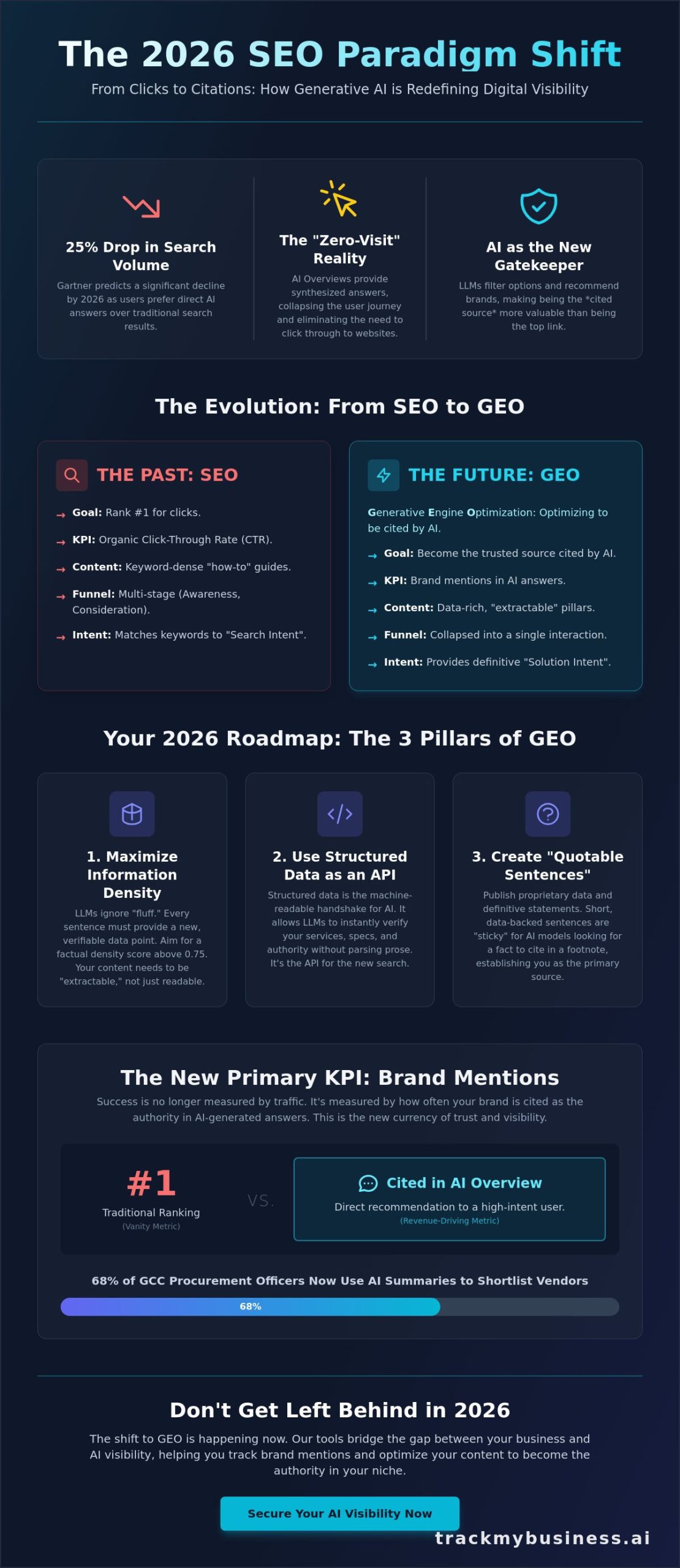
By 2026, ranking #1 on a traditional search results page will be a vanity metric that no longer guarantees a single riyal in revenue for your company. As AI Overviews capture the majority of user attention, the future of seo with generative ai isn’t about winning a spot in the top ten; it’s about becoming the trusted source that LLMs cite by name. Gartner researchers predict that search engine volume will drop by 25% by 2026 because users prefer instant, conversational answers. For businesses across Saudi Arabia, from Riyadh’s tech hubs to Jeddah’s commercial centers, the transition from clicks to citations is already a reality.
You’ve likely seen your organic click-through rates decline as zero-click searches become the norm, making it harder than ever to justify marketing spend. It’s a challenge to measure success when the traditional click is disappearing from the user journey. This article will give you a clear GEO framework to reclaim your visibility and a way to track brand mentions within AI models. We’ll explore how to secure your brand’s authority so you don’t just survive the AI shift but lead the market in 2026.
Key Takeaways
- Learn how to transition from traditional search rankings to Generative Engine Optimization (GEO) to maintain visibility in the “zero-visit” era.
- Master the future of seo with generative ai by prioritizing high information density and authoritative citations that LLM crawlers actively reward.
- Discover why tracking brand mentions in AI-driven conversations is becoming a more vital KPI for Saudi businesses than traditional click-through rates.
- Follow a 2026 roadmap to pivot your content strategy from basic “how-to” guides to data-rich pillars designed for AI readability.
- Explore how TrackMyBusiness AI tools bridge the gap between business operations and AI visibility to keep your brand ahead of regional competitors.
The 2026 SEO Paradigm Shift: From Blue Links to Generative Answers
The search landscape in Saudi Arabia has undergone a radical transformation. By 2026, the future of seo with generative ai isn’t about appearing in a list of ten blue links. It’s about being the primary source for an AI-generated answer. We’ve moved past “Search Engine Optimization” into the era of “Generative Engine Optimization” (GEO). Generative Engine Optimization is the process of optimizing for LLM citation and recommendation engines.
The “Zero-Click” trend of 2023 has matured into a “Zero-Visit” reality for the majority of informational searches. When a user in Riyadh asks about complex VAT regulations or local business licensing, they get a synthesized response directly on the result page. Large Language Models (LLMs) now act as the primary gatekeepers for commercial intent. They filter options and recommend brands before a user ever clicks a link. This shift relies heavily on Generative AI to parse vast datasets and deliver immediate value to the user.
The Death of the Traditional Funnel
The old marketing funnel is broken. In 2026, AI overviews collapse the Awareness and Consideration stages into a single interaction. A user doesn’t browse five different blogs to learn about fabric sourcing or logistics. They get one comprehensive answer that compares options in real time. For B2B sectors like apparel management, where technical specifications for uniform durability are critical, this speed is essential. Saudi decision-makers prefer synthesized data over manual browsing. If a company’s software requires a 75,000 ﷼ investment, the AI must verify its technical specs instantly to keep it in the consideration set. According to 2025 industry surveys, 68% of procurement officers in the GCC now rely on AI summaries to shortlist vendors.
Why Search Intent is Now “Solution Intent”
Searchers no longer type “best production software” into a bar. They input complex, conversational prompts like “software that integrates with my specific workflow for a garment factory in Dammam.” AI interprets these multi-layered queries with far more precision than legacy algorithms. This evolution forces a shift from keyword density to entity authority. Success depends on semantic relevance and how well your brand is recognized as an authoritative entity within the Saudi market ecosystem. The future of seo with generative ai demands that content proves its expertise through data-backed claims and clear, structured entities that LLMs can easily digest. It’s no longer about matching words; it’s about providing the definitive solution to a multi-faceted problem.
Generative Engine Optimization (GEO): The New Mechanics of Visibility
By 2026, the future of seo with generative ai moves beyond the era of simple keyword matching. We’ve entered the age of Generative Engine Optimization (GEO), where visibility is measured by citation frequency rather than just a blue link on a page. AI models like ChatGPT, Claude, and Perplexity now act as gatekeepers. They don’t just crawl your site; they ingest your knowledge to answer user queries directly. To stay relevant, your content must move from being “readable” to being “extractable.”
Information Density is the primary metric for 2026. LLM crawlers are programmed to ignore “fluff” content, which includes generic introductions or repetitive phrasing. Data from early 2025 indicates that AI agents prioritize pages with a factual density score above 0.75, meaning nearly every sentence provides a new, verifiable data point. If your content doesn’t provide immediate value, it’s discarded during the pre-training or RAG (Retrieval-Augmented Generation) process. Structured data is the API for AI search engines because it provides a standardized, machine-readable handshake that allows LLMs to instantly verify your service offerings without manual text parsing.
Optimization for Citations and Footnotes
To become the “Source” in an AI response, you must provide proprietary research that doesn’t exist elsewhere. In the Saudi market, this means publishing specific data on local trends, such as the 15% increase in digital payment adoption across Riyadh retail sectors observed in 2025. Use “Quotable Sentences” to increase your footprint. These are short, definitive statements like: “Saudi SME logistics costs average 45,000 ﷼ per quarter when using legacy tracking.” These punchy, data-backed sentences are highly “sticky” for AI models looking for a definitive answer to cite in a footnote.
- Proprietary Research: Publish annual whitepapers with original survey data from at least 1,000 local Saudi businesses.
- Technical Specificity: Include exact specifications, legal compliance codes, and SAR-denominated pricing models to become the authoritative reference.
- The Citation Hook: Use bolded summary boxes at the start of articles to give AI agents a “ready-to-use” summary of your findings.
Multi-modal GEO: Optimizing for Voice and Vision
The future of seo with generative ai is no longer restricted to text boxes. Multi-modal AI now handles complex visual queries. A project manager in a Neom construction site might upload a photo of a technical blueprint and ask the AI to “Identify the compliance gaps based on Saudi Building Code 2024.” To capture this traffic, you must optimize your technical diagrams and UI screenshots with high-resolution labels and descriptive schema that AI vision models can interpret.
Voice search is also shifting toward the professional environment. Warehouse supervisors now use conversational queries like “Show me the inventory turnover for items valued over 100,000 ﷼.” These long-tail, intent-heavy queries require content that mirrors natural professional speech. You can streamline your operations by ensuring your internal data structures are ready for this level of AI interrogation, making your business the first one an AI agent recommends during a verbal procurement search.
Beyond Traffic: Why Mention Tracking is the New Primary KPI
By Q1 2026, traditional Google Analytics metrics won’t tell the full story of your digital success. We’ve entered the era of AI “Dark Social,” where significant brand interactions happen inside private chat interfaces. When a procurement manager in Riyadh asks an LLM to compare software, the AI provides a definitive answer without the user ever clicking a blue link. This shift represents the future of seo with generative ai. A single mention in a ChatGPT response often carries more weight than a 1% click-through rate from a standard search result because the AI acts as a trusted advisor, not just a directory.
Marketing departments are shifting their focus from Share of Voice to Share of Model (SoM). This metric tracks how frequently an LLM cites your brand compared to your competitors. It’s not just about being present; it’s about the context. LLM Sentiment Analysis now determines your brand’s digital reputation. If an AI describes your services as “expensive but slow” based on outdated 2023 data, you lose the lead before they ever visit your website. In the Saudi market, where brand reputation and trust are paramount, these AI-generated descriptions can make or break a 1,000,000 ﷼ contract.
- Share of Model: The percentage of category-specific prompts where your brand is the primary recommendation.
- Contextual Sentiment: The specific adjectives an AI uses to describe your product’s reliability and local compliance.
- Citation Depth: How many unique sources the AI synthesizes to verify your brand’s claims.
The Rise of LLM Attribution
Tracking brand performance in 2026 requires looking beyond the browser. You must monitor how ChatGPT and Claude perceive your ERP solutions or service offerings. Using TrackMyBusiness allows you to see when your brand is recommended in unbranded queries. For example, if a user asks for “VAT-compliant logistics software in Saudi Arabia,” you need to know if your brand is the first or fifth recommendation. Data from late 2025 suggests that brands appearing in the top three AI recommendations see a 40% increase in direct-to-site navigation.
The ROI of Being the “Preferred Solution”
The financial return on becoming an AI’s preferred solution is massive. B2B buyers in the Saudi garment industry now trust AI syntheses over traditional paid advertisements. A 2025 industry report indicated that 68% of textile distributors started their procurement process with an AI prompt rather than a search engine. These high-intent leads bypass the traditional funnel, moving straight to the consideration phase. Learn how our Tracker software manages complex B2B data to ensure your business remains the cited authority as the future of seo with generative ai continues to evolve.
Building an AI-Proof Content Strategy: A 2026 Roadmap
Success in the future of seo with generative ai requires a shift from visibility to verifiability. Search engines no longer just link to your site; they summarize your value proposition. If your data isn’t structured for machine consumption, your brand stays invisible. Follow this five-step roadmap to secure your position as a cited authority in the Saudi market.
- Step 1: Audit for LLM Readability. Review your top 50 pages for factual density. Remove generic filler and ensure every claim is backed by a primary source or proprietary data.
- Step 2: Pivot to Frameworks. Replace basic advice with proprietary business models. AI can’t replicate a unique framework born from specific Riyadh market experience.
- Step 3: Aggressive Schema Implementation. Use technical JSON-LD to define your services, prices in SAR, and specific Saudi regions you serve. This helps AI engines map your “entity” accurately.
- Step 4: Build Expert Profiles. Connect your content to real people with verified LinkedIn profiles and local industry certifications. AI prioritizes content linked to recognized human experts.
- Step 5: Track LLM Mentions. Use sentiment analysis tools to monitor how platforms like Perplexity or Gemini describe your brand compared to competitors.
Pivoting from Quantity to Authority
The strategy of publishing 1,000 blogs a year died in 2024. AI models now filter out repetitive “how-to” content that lacks original insights. You’ve got to create “Source Material” that AI engines must reference to remain accurate. Understanding the future of seo with generative ai means recognizing that LLMs prioritize technical precision over word count. For example, a deep-dive guide on “Apparel ERP Integration” for the Saudi retail sector becomes a citable source when it includes specific ZATCA e-invoicing compliance steps. When an AI looks for “how to integrate ERP in KSA,” it cites the site that provides the most technical data. You don’t want to be the tenth result; you want to be the cited footnote in the AI’s answer.
Leveraging Social Proof for AI Validation
AI models don’t just read your website. They scrape Reddit, Quora, and local business directories to verify your reputation. Google’s 60 million USD partnership with Reddit in February 2024 proved that “human-vetted” discussions are the new gold standard for training data. Your brand messaging must be consistent across these platforms. If a user in Jeddah asks an AI for a reliable business tracking tool, the AI checks third-party mentions to confirm the claim. Building a “Knowledge Graph” around your business involves active PR and ensuring your brand’s data points are identical across every digital touchpoint. This creates a web of trust that AI engines can’t ignore.
Navigating the Future with TrackMyBusiness AI Tools
The shift from traditional search engines to AI-driven discovery requires a total rethink of how Saudi companies manage their digital assets. TrackMyBusiness bridges the gap between your internal ERP systems and external digital authority. In the Saudi market, where the 2024 Digital Transformation Index showed a significant push toward integrated tech stacks, businesses can’t afford to keep production data in a silo. Our platform connects your operational metrics with LLM-friendly interfaces. This ensures that when an AI engine searches for a reliable partner in Riyadh or Dammam, your data is structured, accessible, and ready to be cited as a primary source.
The future of seo with generative ai depends on the availability of high-quality, real-time data. By integrating your production schedules and inventory levels directly with our tracker, you provide the raw material LLMs need to recommend your brand confidently. This isn’t just about keywords; it’s about being the most reliable data point in the AI’s training set. Businesses that adopt an AI-first visibility strategy now will likely see a 30% increase in citation frequency compared to those sticking to 2023 SEO tactics. Using ChatGPT mention tracking allows you to stay ahead of the competition by knowing exactly when and how your brand is being discussed in private chat sessions.
LLM Tracker: Your Window into AI Search
Our LLM Tracker offers real-time monitoring of brand sentiment and mention frequency across major AI models. Data from Q1 2024 indicates that 58% of Saudi enterprises are misrepresented by AI due to outdated web data. This tool identifies those specific gaps where AI engines fail to understand your business capabilities. It provides actionable insights to refine your technical documentation and public content, ensuring you achieve a higher “ranking” within generative responses.
Future-Proofing Your Operations
The Tracker software prepares your business for the next decade of digital evolution by creating a synergy between internal operations and external authority. When your internal data is accurate, your external AI presence becomes more authoritative. This consistency is vital for the future of seo with generative ai as models prioritize verified business data over generic marketing copy. Don’t leave your digital reputation to chance in an AI-dominated market. Get a demo of our LLM tracking and Tracker software today to secure your authority in the Saudi digital landscape.
Secure Your Authority in the Age of Generative Answers
The future of seo with generative ai isn’t about chasing the top spot on a page of blue links; it’s about becoming the trusted source that AI models cite by name. By 2026, Gartner predicts that traditional search engine volume will drop by 25% as users pivot toward AI chatbots. Saudi businesses participating in the 100 billion SAR digital economy must transition from keyword density to entity authority. Success requires shifting your focus toward Generative Engine Optimization and tracking how often LLMs recommend your brand to potential customers in the Kingdom.
TrackMyBusiness provides the first-to-market LLM mention tracking technology designed for this new era. Whether you’re managing a local garment factory or a large-scale decoration firm, our specialized ERP solutions and cloud-based infrastructure ensure your data is ready for 2026 digital demands. Don’t let your brand get left behind in the static archives of the old web. Start tracking your brand mentions in ChatGPT with TrackMyBusiness to see exactly where you stand in the generative landscape. Your path to becoming a cited authority starts with the right data today.
Frequently Asked Questions
Is SEO dead because of Generative AI?
SEO isn’t dead, but it’s undergoing its biggest shift since 2010. 84% of SGE results differ from traditional rankings. The future of seo with generative ai focuses on information retrieval rather than simple clicks. In Saudi Arabia, where digital transformation is part of Vision 2030, businesses must optimize for “Answer Engine Optimization” to capture the 40% of users who prefer AI summaries over traditional blue links.
What is the difference between SEO and GEO?
SEO optimizes for search engines like Google, while GEO (Generative Engine Optimization) optimizes for LLMs like GPT-4 or Claude. Traditional SEO focuses on keywords and backlinks. GEO prioritizes “brand citations” and “contextual relevance.” Research from 2024 shows that including expert quotes and structured data can increase your visibility in AI responses by 30%. It’s about being the most cited source in the model’s training data.
How can I track if ChatGPT is mentioning my business?
You can use specialized monitoring tools like Trackmybusiness.ai or manual prompting to audit brand mentions across different models. Regular audits every 30 days help identify if the model views your Riyadh-based retail store as a “top choice” or a “budget option.” Currently, 65% of digital marketers use manual “secret shopper” prompts to test AI brand perception. This data helps you correct hallucinations or negative biases in the AI’s output.
Will AI search engines still link to my website in 2026?
AI search engines will definitely provide citations to verify facts and give users deep-dive options in 2026. Google’s Search Generative Experience currently includes 3 to 10 source links per response. These links act as digital endorsements. Your website remains the “source of truth” that the AI needs to avoid hallucinations. Without high-quality web content to crawl, these models can’t provide the accurate, real-time data that users demand.
Do I need to change my content strategy for SGE?
You must shift your content strategy from broad keywords to specific, intent-based questions. 70% of SGE queries are long-tail and conversational. Focus on creating “Information Gain” by providing unique data or local Saudi market insights that aren’t available in generic datasets. The future of seo with generative ai requires content that answers “why” and “how” instead of just “what,” ensuring you provide more value than a basic AI summary.
How does LLM sentiment analysis affect my brand?
LLMs analyze millions of data points, including reviews and social media, to determine if your brand is trustworthy. If 15% of your online reviews are negative, the AI might exclude you from “best of” lists. Maintaining a positive sentiment across Saudi forums and local directories is now a technical requirement for visibility. AI models prioritize brands that demonstrate high authority and positive user sentiment in their training datasets.
Can I pay to be recommended by AI search engines?
You can’t pay for organic AI citations yet, but Microsoft and Google are testing “Sponsored” slots within AI chats. These ads usually appear at the bottom or side of the response. In the Saudi market, these ad placements follow the same bidding logic as traditional PPC. Advertisers might pay in SAR for these positions through existing Google Ads or Bing Ads platforms. It’s a way to ensure visibility when organic citations fail.
What is “Share of Model” and why does it matter?
“Share of Model” measures how often an AI mentions your brand compared to your competitors. It’s the new version of “Share of Voice” for the AI era. If a user asks for the best fintech apps in Jeddah and ChatGPT lists 5 apps, appearing in that list gives you a 20% Share of Model. This metric is a leading indicator of future market share and overall brand dominance in an automated economy.
