
Let’s be honest, the old playbook for social media is dead. It’s no longer enough to just post content, rack up a few likes, and call it a day. If your social media isn't actively bringing new customers through the door, it's just a hobby.
True social media lead generation is about turning your platforms from a simple billboard into your most effective handshake. It’s a strategic shift away from shouting into the void and toward starting meaningful conversations with people who genuinely need what you offer.
Think of it like this: a billboard on the highway hopes the right person drives by. A savvy social media strategy, on the other hand, is like being at a local community event, overhearing someone complain about a problem you can solve, and walking over to introduce yourself with a helpful solution. It’s targeted, personal, and it just works better.
What Social Media Lead Generation Really Means Today
The game has changed. Social media platforms didn't start as business tools; they were built for human connection. But their incredible reach and the smart data behind them have turned them into absolute powerhouses for local and multi-location businesses.
This isn’t about tricking people into a sales funnel. It's about building a genuine presence where your future customers are already hanging out.
- Go Where the People Are: With billions of users scrolling every day, social media is the biggest room you can walk into. It’s your chance to get in front of a massive audience and build real brand recognition.
- Stop Guessing, Start Targeting: Forget scattershot marketing. Modern tools let you connect with people based on their location, interests, and what they actually care about. This turns your casual followers into highly qualified leads.
- Get More Bang for Your Buck: Compared to old-school advertising, social media is often way more affordable and scalable. Plus, you get real-time feedback, so you know exactly what’s working and can put your money where it counts.
- Understand Your Audience Better: The analytics are a goldmine. You get direct insight into what your customers respond to, helping you sharpen your strategy and get better results over time.
The path to purchase now starts with a scroll. In fact, research shows that a whopping 76% of people say social media has directly influenced their buying decisions. It's no longer a side-channel; it's a core part of how people discover and choose businesses.
It’s a Journey, Not a Trap
Great lead generation on social media feels less like a sales pitch and more like a guided tour. It starts the moment someone discovers your brand—maybe through a helpful video, a compelling customer story, or a targeted ad that speaks directly to them.
From that first touchpoint, every single interaction is designed to build trust and show them you understand their needs.
This means you need a mix of tactics working together seamlessly. You’ll use organic posts to prove your expertise, run paid ads to reach a very specific local audience with a can't-miss offer, and slide into the DMs to answer questions and build a one-on-one connection.
The goal is to create an experience that feels helpful, not pushy. When you blend great content with smart targeting and a smooth user journey, you stop being just another ad in their feed. You become a trusted resource, turning casual scrollers into loyal customers.
Building a Lead Generation Funnel That Actually Works
The word "funnel" gets thrown around a lot in marketing, but it's really just a simple roadmap. Think of it as guiding someone from being a total stranger scrolling on their phone to a genuinely interested lead who’s ready to talk.
This journey isn't a straight shot. It's about building trust and proving your value, step by step. A solid social media lead strategy hinges on creating content that meets people exactly where they are in that journey.
Let's walk through the three key phases of this process, using real-world social media examples to show how it all connects.
The Awareness Stage: Getting on Their Radar
This is the top of your funnel (ToFu), where you cast a wide net. People at this stage aren't looking to buy anything. They're just killing time, looking for something interesting or helpful. Your goal isn't to sell—it's to simply introduce your brand and show off your expertise without being pushy.
The content here needs to be valuable, engaging, and easy to share. You’re giving away great stuff for free, no strings attached.
- Engaging Videos: Think short, snappy videos on Instagram Reels or TikTok. A quick tip, a behind-the-scenes look at your shop, or a "common mistakes to avoid" clip works perfectly.
- Informative Infographics: Post a visually clean graphic on Facebook or LinkedIn that breaks down a confusing topic into bite-sized pieces.
- Relatable Blog Posts: Share a link to an article that hits on a common problem, like "5 Signs You Need a New…"
Today's lead generation is a cycle: you listen to what your audience is talking about, engage them with content that actually helps, and then offer a clear path to the next step.
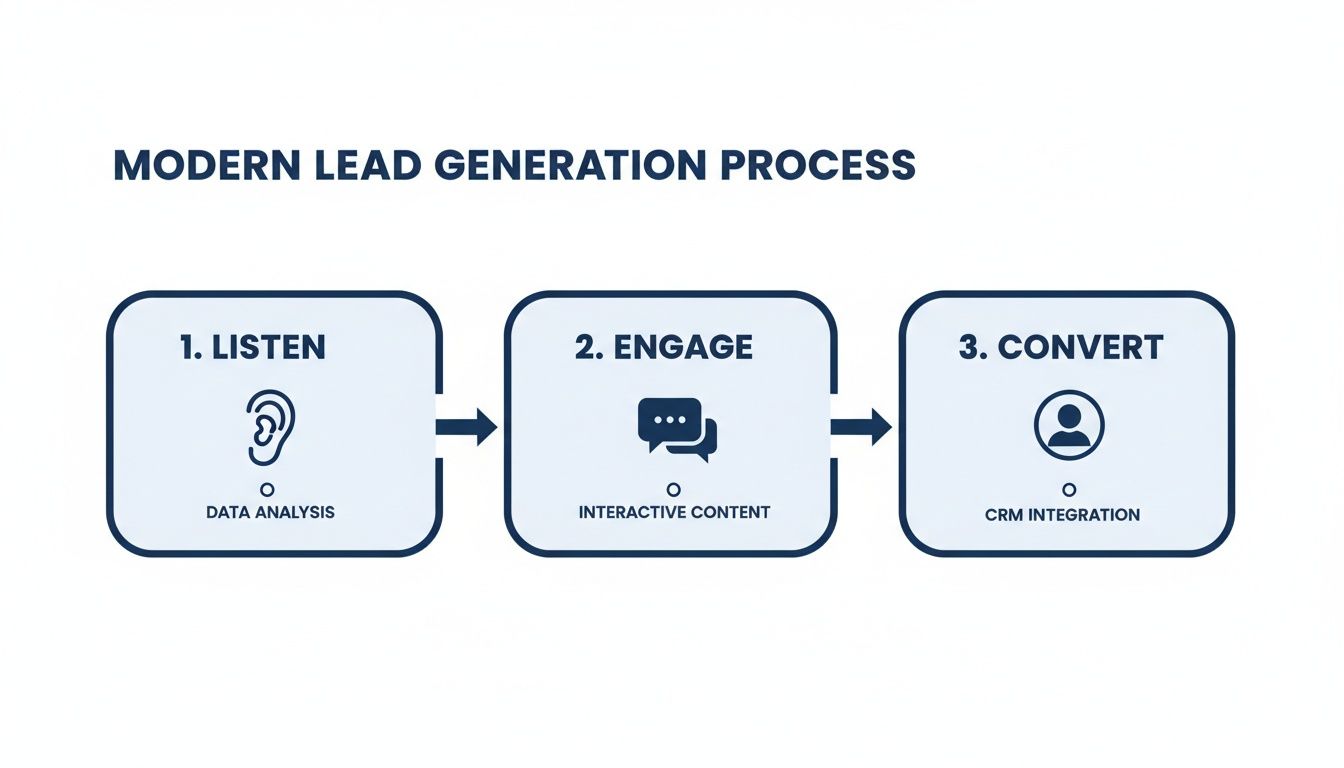
This flow shows that a winning funnel starts with understanding the conversations already happening online, long before you ever ask for a sale.
The Consideration Stage: Nurturing Real Interest
Okay, you’ve got their attention. Now it’s time to nurture that initial curiosity. This is the middle of the funnel (MoFu), where potential leads know they have a problem and are actively looking for solutions.
At this point, you can ask for a small commitment—like an email address—in exchange for more detailed, high-value content. This is the moment a passive follower turns into a real lead.
You're no longer just another brand in their feed; you're becoming a trusted resource. Your job is to educate and empower them, positioning your business as the obvious guide to help them solve their problem.
This is where you introduce a lead magnet. Good examples for this stage include:
- Downloadable Guides: Offer a detailed PDF guide or a handy checklist through a LinkedIn ad in exchange for their email.
- Exclusive Webinars: Promote a live training session on Facebook that requires registration.
- Case Studies: Share success stories that show exactly how you helped a customer just like them.
The Decision Stage: Driving Action and Conversion
Finally, we get to the bottom of the funnel (BoFu). Anyone who makes it this far is a high-quality lead. They're ready to make a choice. They've seen your content, they trust your expertise, and now they're weighing their options. Your content here needs to be direct, persuasive, and make it incredibly easy for them to say yes.
Your calls-to-action (CTAs) get much more specific and sales-focused. The goal is to remove any final hesitation.
- Free Consultations or Demos: Run a targeted ad offering a one-on-one strategy call or a personalized demo of your product.
- Special Offers and Discounts: Create a little urgency with a limited-time promotion or an exclusive coupon code just for your social media followers.
- Customer Testimonials: Use powerful video clips or quotes from happy customers to build that final layer of trust and social proof.
It’s also important to be realistic. While 68% of marketers generate leads from social media, many of them need time. Industry data shows that up to 79% of leads may never convert without a consistent follow-up plan, which is why this funnel approach is so critical. For businesses that want to protect their reputation through this entire journey, learning how to use AI brand tracking for SaaS companies adds an essential layer of oversight.
Choosing the Right Platforms for Your Business
Trying to generate leads on social media without a plan is like showing up to a party you weren't invited to. You might make a friend, but you'll probably just waste a lot of time and energy. The secret isn't being everywhere; it's about showing up where your ideal customers are already hanging out.
This isn’t about chasing the platform with the most users. It’s about understanding user intent. Why is someone scrolling LinkedIn at 2 PM on a Tuesday? Their mindset is worlds apart from someone browsing TikTok on a Friday night. Matching your business to that specific mindset is the first, most critical step.
Align Audience With Platform
Think of each social media platform as a different type of gathering. LinkedIn is a professional conference, Facebook is a sprawling community block party, and Instagram is a visual art gallery. You wouldn’t try to pitch enterprise software at the block party, right?
With 5.24 billion people on social media, the scale is massive, but the audiences are siloed. It’s no surprise that 68% of marketers now pull leads directly from social, but their success hinges on picking the right venue. For instance, while Facebook has incredible consumer reach, LinkedIn is the undisputed champion for B2B lead quality.
As you figure out where to play, you need to get serious about choosing the right social media platforms for growth. This means digging deep into who your customers are, what they do, and where they spend their time online.
To help you get started, here’s a quick breakdown of the major players and how they fit into a lead generation strategy.
Platform Breakdown for Social Media Lead Generation
| Platform | Primary Audience | Best For | Key Lead Gen Feature |
|---|---|---|---|
| B2B Professionals, Decision-Makers | High-ticket services, B2B software, professional networking, corporate recruiting. | Lead Gen Forms: Pre-fills user data for frictionless conversions. | |
| B2C Consumers (Broad Demographics) | Local businesses, e-commerce, community building, events, broad consumer products. | Lookalike Audiences: Finds new customers similar to your existing best ones. | |
| B2C Consumers (Visually-Driven, Younger) | E-commerce, fashion, food, travel, lifestyle brands, visual services (e.g., design). | Stories Ads with CTAs: Immersive, full-screen ads that drive direct action. | |
| TikTok | Gen Z & Millennials (Entertainment-focused) | Brands with a creative/visual angle, trend-based products, building massive awareness. | Lead Generation Objective: Captures leads directly through in-feed video ads. |
| Planners & Shoppers (Female-skewed) | Home décor, DIY, recipes, weddings, travel—anything with a long planning cycle. | Shopping Pins & Catalogs: Turns visual discovery directly into purchase intent. |
This table is just a starting point. The real magic happens when you dive into the unique features each platform offers and align them with your specific business goals.
The B2B Powerhouse: LinkedIn
For any B2B company, LinkedIn isn't just a social network; it's an essential business development tool. People are there with a professional mindset, actively looking to solve business problems. This makes it a goldmine.
Its targeting capabilities are second to none for B2B, letting you zero in on audiences by:
- Job Title: Reach a specific decision-maker like "Director of Marketing."
- Company Size: Target businesses with 50-200 employees.
- Industry: Focus on sectors like "Healthcare" or "Financial Services."
- Professional Groups: Engage with active communities centered on specific topics.
LinkedIn’s native Lead Gen Forms are a game-changer. They pre-fill a user's profile information, drastically reducing friction and sending conversion rates sky-high.
B2C Goldmines: Facebook and Instagram
For most B2C businesses, the Meta ecosystem (Facebook and Instagram) is the center of the universe. These platforms are built on powerful, interest-based targeting that’s perfect for reaching consumers where they live and breathe.
Meta’s strength is its deep understanding of user behavior. You can build audiences based on everything from life events (like "Newly Engaged") to purchasing habits ("Engaged Shoppers"). This allows local businesses to connect with customers in a deeply personal and visually stunning way.
Key features for B2C lead generation include:
- Lookalike Audiences: Upload a list of your best customers, and Meta’s algorithm will find new people just like them.
- Instagram Stories Ads: Use immersive, full-screen visuals with clear calls-to-action like "Learn More" or "Sign Up."
- Facebook Lead Ads: Just like LinkedIn’s version, these ads let users hand over their info without ever leaving the app.
Emerging Opportunities: TikTok and Pinterest
While the giants get most of the attention, don't sleep on the specialists. Platforms like TikTok and Pinterest offer unique angles for lead generation, especially for brands with a strong creative streak.
TikTok’s algorithm is a discovery engine, making it incredible for brand awareness that you can then channel into leads. Authentic, user-generated-style content is king here. Meanwhile, Pinterest acts more like a visual search engine where people are actively planning future purchases. A well-placed Pin can capture a lead at the very beginning of their buying journey.
Proven Tactics for Organic and Paid Campaigns
Once you know where to play, it's time to actually get in the game. A winning social media lead gen strategy is a tale of two forces working in harmony: the slow-burn trust you build with organic content and the immediate, targeted strike of paid ads.
Think of it like building a fire. Organic content is the kindling and wood—it takes time to stack, but it’s what sustains the flame. Paid ads are the match, giving you that instant spark to get things going.
One really can’t work without the other. Great organic content makes your ads feel less like ads and more like helpful advice. In turn, paid campaigns give that great content the rocket fuel it needs to reach a whole new audience overnight. Let's break down how to master both sides of the coin.
Mastering Organic Lead Generation
Organic social media is the long game. It's all about building relationships and earning trust, one helpful post at a time. This is where you prove you’re the expert, making your brand the obvious choice when someone is ready to buy.
This approach doesn't require a big ad budget, but it absolutely demands consistency and a genuine focus on helping people, not just pitching them.
-
Turn Your Profiles into Lead Magnets: Your social media profiles are your digital storefronts. Make sure every single element—your bio, your cover photo, your pinned post—screams exactly what you do and who you do it for. Crucially, give people a clear next step with a compelling call-to-action (CTA), like "Download our free checklist" or "Book a 15-minute strategy call" right in your bio.
-
Create Content That Solves Problems: Stop selling. Start helping. The best content zeros in on your ideal customer's biggest headaches and offers a real solution. This could be a quick "how-to" video, a simple checklist, a customer success story, or an insightful text post that makes them think, "Wow, they really get it."
-
Become a Fixture in Your Community: Don't just post on your own page. Find out where your audience hangs out—think Facebook Groups, LinkedIn Groups, or niche subreddits—and become a trusted voice there. Answer questions, share your expertise freely, and build real connections without a sales agenda. When you establish yourself as the go-to expert, people will naturally seek you out.
Once you've flagged a few hot prospects on social, the next move is often getting their contact info. Learning how to find someone's email from LinkedIn is a great skill for moving those valuable conversations into your sales pipeline.
Building High-Converting Paid Campaigns
Paid advertising is your accelerator pedal. It lets you skip the line and put a specific, irresistible offer directly in front of your perfect customer, right now.
While just "boosting" a post is easy, real lead generation means building campaigns laser-focused on one thing: conversion.
The goal isn't just to get clicks; it's to get qualified leads. This requires a shift from broad awareness campaigns to hyper-targeted ads designed to capture information.
Here’s how to build paid campaigns that actually deliver.
-
Define Your Offer: What are you giving away that's so valuable someone will trade their email address for it? This lead magnet could be a webinar, a detailed guide, a free trial, or an exclusive discount. Whatever it is, it has to be a no-brainer for your target audience.
-
Write Copy That Stops the Scroll: You have about two seconds to grab someone's attention. Your ad copy needs a strong hook that hits on a known pain point, quickly explains the benefit of your offer, and finishes with a crystal-clear, urgent CTA.
-
A/B Test Everything: Never assume you know what will work. Always be testing. Pit images against videos, test different headlines, and try various angles in your ad copy. Let the data, not your gut, tell you what resonates with your audience.
Using Platform-Specific Lead Forms
One of the most powerful tools in the paid social toolkit is native lead forms. Platforms like Facebook and LinkedIn have ad formats that let users hand over their info without ever leaving the app.
These forms are a game-changer. They often pre-fill with the user's profile data (like their name and email), reducing the entire submission process to just a couple of taps. This simple change removes the single biggest point of friction—sending people to an external landing page where they can get distracted and drop off.
The numbers don't lie. LinkedIn’s Lead Gen Forms report an average conversion rate around 13%, blowing the typical 2–3% for landing pages out of the water. On the flip side, Facebook ads can see a cost per lead hovering around $20–$25, which is why blending paid campaigns with a strong organic foundation is so critical to managing costs and quality.
By weaving a consistent organic presence with strategic paid campaigns, you create a predictable, sustainable lead generation machine. As you grow, you can even explore how brand monitoring for eCommerce with ChatGPT can help you spot new lead opportunities hidden in online conversations.
Measuring Your Success and Optimizing for Growth
Launching a campaign is just the start. The real magic in social media lead generation happens when you stop guessing and start measuring. This is where you turn raw data into a clear roadmap for growth, making sure every dollar and minute you spend is actually working for you.
Think of your first campaigns as a rough draft. You put your best ideas out there, but now it’s time to listen to what the audience is telling you with their clicks. By tracking the right numbers, you can systematically sharpen your approach, turning good results into great ones.
Focusing on Metrics That Matter
It’s incredibly easy to get distracted by "vanity metrics" like likes, shares, and follower counts. While they might feel good, they don't pay the bills or tell you if you're actually getting leads. For a serious lead generation strategy, you need to zero in on the key performance indicators (KPIs) that connect directly to your business goals.
These are the core metrics you should obsess over:
- Cost Per Lead (CPL): This is your bottom-line efficiency number. It tells you exactly how much you're spending to get one new potential customer in the door. If your CPL is consistently dropping, you know your targeting and creative are hitting the mark.
- Conversion Rate: This is the percentage of people who saw your post or ad and actually did the thing you wanted them to do (like filling out your form). A high conversion rate is a clear sign that your offer and your message are compelling.
- Return on Ad Spend (ROAS): For every dollar you put into paid ads, how much revenue did you get back? ROAS is the ultimate report card for your paid campaigns, telling you if they're truly profitable.
Keeping a close watch on these three numbers will help you cut through the noise and make decisions based on facts, not feelings.
Using Platform Analytics to Your Advantage
You don't need to shell out for expensive tools right away. Platforms like Facebook and LinkedIn have incredibly powerful, built-in analytics dashboards that are packed with valuable information.
These tools let you dig deep into what’s working and what’s falling flat. Inside Facebook Ads Manager, for example, you can see a complete performance breakdown by age, gender, location, and even by the specific ad creative. You might find that your video ads are bringing in leads at half the CPL of your static images—a crystal-clear signal to go all-in on video.
Don't just glance at the summary dashboard. The real gold is found when you start segmenting your data. Comparing performance across different audiences, ad placements, and creative variations is how you uncover the specific levers to pull for better results.
Demystifying Attribution and Continuous Improvement
One of the trickiest parts of measurement is attribution—figuring out which specific touchpoint gets credit for a lead. A customer might see your ad on Facebook, watch your Instagram Story, and then finally click a link in a LinkedIn post to convert. So, which channel did the heavy lifting?
While modern analytics tools help solve this puzzle, a simple, practical approach is to look for trends. If you see a reliable spike in leads every time you run a specific type of Instagram campaign, that’s a pretty strong clue about what's driving results.
This entire process of measuring and refining should be a continuous loop.
- Analyze the Data: Check in on your CPL, conversion rates, and ROAS at least weekly.
- Identify Top Performers: Find the ads, audiences, and content delivering the best bang for your buck.
- Optimize and Iterate: Pause the duds and shift that budget over to your winners. Test new headlines or images for your most successful ads to see if you can make them even better.
This cycle is the engine that powers a successful social media lead generation machine. As you grow, it's also smart to keep an eye on how your brand is being talked about in wider online conversations. Using competitor AI analysis tools can uncover new opportunities and help protect your reputation. By consistently applying this framework, you'll systematically lower your costs, improve your lead quality, and build a predictable pipeline of new customers.
Common Questions About Social Media Lead Generation
Even with a killer strategy, it's totally normal to have a few questions before you dive headfirst into social media lead gen. You're probably wondering about timelines, how much to spend, and what success actually looks like. Let’s cut through the noise and tackle these common questions with some straight, practical answers.
Think of these questions not as roadblocks, but as signposts. Getting them answered just helps you set the right expectations and build a strategy that can go the distance.
How Long Does It Take to See Results?
This is the big one, and the honest-to-goodness answer is: it depends. Your results will come from two different speeds—the quick wins and the long-term growth. You need both for a healthy flow of leads.
Think of it like planting a garden. Paid campaigns are your annuals; they sprout fast and you can see results in days. Organic strategies are more like planting an oak tree. It takes a while to set down roots, but it’ll be a source of value for years to come.
-
Paid Campaigns: With platforms like Facebook or LinkedIn, you can see leads start trickling in within hours of launching a sharp, well-targeted ad. The first few weeks, though, are really about testing and learning. Give it 2-4 weeks to really dial in your ads, optimize for cost, and find that perfect mix of creative and audience.
-
Organic Strategies: Building a community and earning trust with great content is a long game. You should plan on putting in consistent effort for 3-6 months before you start seeing a predictable stream of inbound leads. That initial period is all about building momentum and authority.
What Are the Most Common Mistakes to Avoid?
So many businesses trip over the same few hurdles right out of the gate. If you can sidestep these common pitfalls, you’ll shorten your learning curve and save yourself a ton of time and money.
The single biggest mistake? Treating social media like a megaphone instead of a conversation. People want connection and value, not a constant sales pitch.
Here are the top mistakes we see all the time:
- Pushing a Hard Sell Too Soon: You wouldn't propose on the first date, right? Don't ask for the sale the second someone follows you. Give, give, give value first.
- Neglecting Your Landing Page: A brilliant ad that clicks through to a clunky, confusing, or slow landing page is a conversion killer. It has to be seamless, especially on mobile.
- Using Overly Broad Targeting: Targeting "everyone" is the same as targeting no one. Burning through your budget showing ads to people who don't care is the quickest way to fail.
- Failing to Follow Up Quickly: Speed is everything. A lead’s interest cools dramatically with every passing minute. If you don't follow up within the first hour, you've lost most of your advantage.
- Putting All Your Eggs in One Basket: Going all-in on a single platform is risky. An algorithm change could wreck your whole system overnight. Spread your efforts across at least two channels to build a more resilient lead engine.
Do I Need a Big Budget to Get Started?
Absolutely not. While a bigger budget lets you test more aggressively and scale faster, you can get real results with a surprisingly modest starting fund. It’s not about outspending the competition; it’s about outsmarting them.
Remember, organic lead generation is mostly an investment of your time and creativity, not your cash.
For paid ads, you can start small with a daily budget of just $10-$20. That’s enough to get your first batch of data, test a few messages, and see which audiences are biting. The goal isn’t to have the biggest budget; it's to get the best Return on Ad Spend (ROAS).
Once you find a winning ad-and-audience combo, you can scale your budget with confidence, knowing that every dollar you put in is likely to bring more back.
How Do I Know if a Social Media Lead Is High Quality?
A hundred low-quality leads are worth less than one great one. Lead quality is way more important than lead quantity. A great lead isn't just someone who’s interested—they fit your customer profile and actually have the intent to buy.
Here's a quick checklist to gauge the quality of a lead:
- ICP Fit: Does this person match your Ideal Customer Profile? Check out their job title, company size, location, or whatever criteria matter for your business.
- Content Engagement: What did they do to become a lead? Someone who downloaded a detailed pricing guide is much hotter than someone who entered a contest to win a t-shirt.
- Lead Scoring: Set up a simple scoring system. Assign points to different actions (e.g., +10 for a demo request, +3 for a newsletter signup). This helps your sales team prioritize who to call first.
But the ultimate test of lead quality is simple: the lead-to-customer conversion rate. Tracking which social campaigns actually end in a sale is the only way to know for sure what's really driving your business forward.
Monitoring what AI chatbots like ChatGPT and Gemini say about your business is now a critical part of protecting your brand and uncovering new leads. TrackMyBiz gives you the tools to see exactly how you're being recommended, flag dangerous misinformation, and ensure your reputation is safe in the new age of AI-driven search. Start a free scan today and see where you stand.
