
Social media crisis management isn't just a buzzword; it's the playbook you use to handle brand-threatening situations on social platforms before they blow up and cause real damage. This is no longer just a task for the PR team. It’s a core business function, essential for survival when a single angry post can trigger a global backlash in minutes.
Why You Can't Afford to Ignore Crisis Management Anymore
In an age where online stories build and spread with terrifying speed, the old "wait and see" approach is a surefire way to damage your reputation and your bottom line.
A single bad customer experience, a poorly worded tweet from an employee, or a piece of AI-generated misinformation can ignite a firestorm before most teams even smell smoke. What happens on TikTok or X doesn't stay there. It bleeds into public perception, spooks investors, and hits your revenue hard.
This makes having a formal, ready-to-go social media crisis plan an absolute must. For a broader look at the discipline, these comprehensive crisis management resources provide some great context.
The Alarming Preparedness Gap
Too many businesses are running on a false sense of security, thinking they can just wing it when a problem pops up. The data tells a very different—and much scarier—story.
A serious reality check comes from Capterra’s Crisis Communications Survey, which found that only 49% of U.S. companies actually have a formal crisis plan in place. That leaves more than half of all businesses completely exposed. This is especially troubling when you consider it takes an average of 18 hours and 57 minutes from the first warning sign to the story hitting the news. That’s a huge window for a crisis to spin wildly out of control.
Let's be blunt: without a plan, you aren't managing the crisis; the crisis is managing you. Your team is left scrambling, your messaging becomes a mess, and you lose customer trust with every minute of confused silence.
A Modern Framework for Taking Back Control
An effective crisis response today is about much more than just putting out fires. It’s a structured, proactive system built on three core pillars: proactive monitoring, rapid communication, and strategic recovery.
Here’s a quick breakdown of what this modern framework looks like in action.
| Phase | Core Objective | Key Actions |
|---|---|---|
| Proactive Monitoring | Detect threats before they escalate | Use social listening tools to track brand mentions, sentiment, and negative trends. Set up alerts for specific keywords and monitor competitor issues. |
| Rapid Communication | Control the narrative with speed and clarity | Activate a pre-approved response plan. Deploy templated statements. Brief internal teams and spokespeople. Engage with the public on key channels. |
| Strategic Recovery | Rebuild trust and repair reputational damage | Follow up on promises made during the crisis. Share lessons learned and corrective actions. Launch positive campaigns to shift the narrative. Measure sentiment and brand perception post-crisis. |
| The Modern Crisis Management Framework At A Glance |
Each of these pillars is critical for building a resilient brand. Let’s dig into what each one means in practice.
-
Proactive Monitoring: This is your early warning system. It means using social listening tools to keep an ear to the ground, tracking brand mentions, spotting shifts in sentiment, and catching negative themes before they gain momentum.
-
Rapid Communication: When a crisis hits, speed and clarity are everything. This pillar is about having pre-approved statements ready to go, clear internal communication channels, and a designated team prepared to face the public head-on.
-
Strategic Recovery: Once the immediate threat is contained, the work isn't over. The focus shifts to rebuilding trust and repairing your brand’s reputation. This involves transparent follow-up, demonstrating accountability, and engaging in long-term reputation-building activities.
Building Your Early Warning System
The best way to manage a social media crisis is to see it coming before it ever makes landfall. A proactive detection system isn't just a nice-to-have; it's your brand's most critical line of defense. This is about more than just tracking brand mentions. It's about building a sophisticated social listening command center that acts as a true early warning signal for potential trouble.
If you’re waiting for news outlets or an angry mob in your comments to flag a crisis, you've already lost control of the narrative. The real goal is to catch those faint whispers of discontent before they become a deafening roar. A modern system should use intelligent alerts that trigger when specific conditions are met, buying your team precious time to assemble and prepare a measured response.
Setting Up Your Social Listening Command Center
Think of your command center as a digital radar, constantly scanning the social media horizon. It needs to go beyond simple keyword tracking by layering in more nuanced signals. This is how you learn to tell the difference between everyday customer grumbling and the start of a genuine crisis.
Here are a few of the key signals we always monitor:
- Sudden Volume Spikes: An unexpected surge in mentions, even neutral ones, often means a story or issue is starting to pick up steam.
- Rapid Sentiment Shifts: A sharp dip from positive or neutral sentiment into negative territory is a classic red flag that a problem is brewing.
- Emergence of Trigger Words: You should always be tracking your brand name alongside high-risk terms like “scam,” “boycott,” “unsafe,” or “unethical.”
- Influencer Activity: When a high-profile account mentions your brand—for better or for worse—the potential for that message to spread like wildfire increases dramatically.
To build this system right, you need technology that can spot these risks before they escalate. For some businesses, this also means looking into proactive insider threat detection tools to identify internal vulnerabilities that could easily spill into the public domain.
This simple framework shows where proactive monitoring fits into the bigger picture—it's the essential first step.
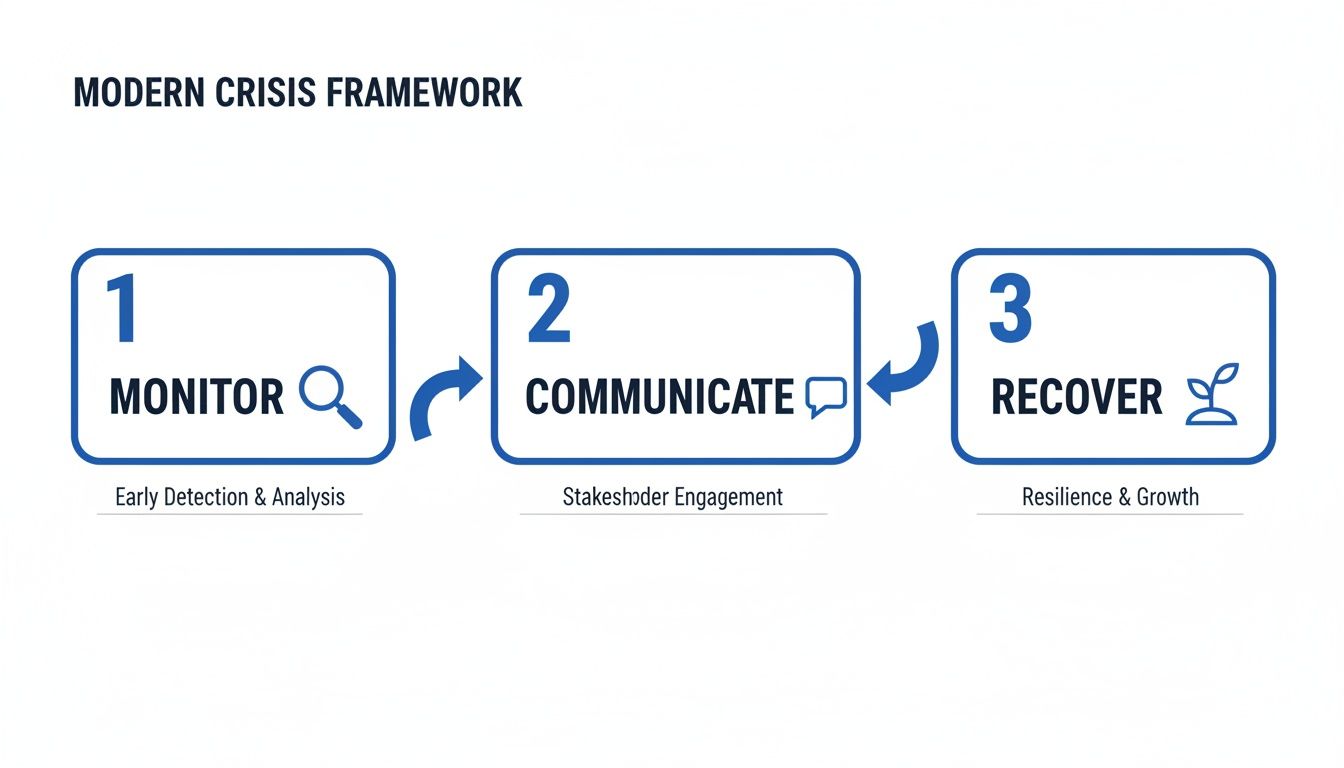
As you can see, everything flows from that initial monitoring. It’s what informs your communication and, ultimately, your recovery.
The New Frontier: AI Misinformation
There’s a growing threat that most legacy monitoring tools are completely blind to: AI-generated misinformation. Large Language Models (LLMs) can "hallucinate" incorrect information about your brand, creating false narratives out of thin air. They can claim your business is permanently closed, fabricate entire scandals, or invent safety issues with your products.
Imagine an AI chatbot confidently telling a user your product contains a harmful ingredient it doesn't, citing a source that doesn't even exist. If that user shares a screenshot on X (formerly Twitter), you suddenly have a reputation fire to put out.
This is exactly why modern brand monitoring has to extend beyond social platforms and into what AI assistants are saying. Tools like TrackMyBiz are built specifically to scan these models, flagging dangerous inaccuracies before they take root. Our guide on ChatGPT brand monitoring for eCommerce dives deeper into how to protect your brand in this new environment.
The most dangerous threats are the ones you don't see coming. If you aren't monitoring AI-generated content about your brand, you have a massive blind spot in your social media crisis management strategy.
Triaging Threats Like a Pro
Not every negative mention is a five-alarm fire. A crucial skill for any crisis team is threat triage—the ability to quickly assess a situation and determine its potential impact. This keeps you from overreacting to minor issues while ensuring the major threats get escalated immediately.
Here’s a simple framework for triaging potential crises:
| Threat Level | Characteristics | Recommended Action |
|---|---|---|
| Low | Isolated negative comment, minor customer service issue with limited reach. | Standard community management response. Monitor for escalation. |
| Medium | A cluster of related complaints, negative post from a mid-tier influencer. | Acknowledge publicly, activate the response team for review. |
| High | Viral negative story, involvement of major media, safety concerns, legal issues. | Immediate escalation to the full crisis team and leadership. |
| A Simple Triage Framework |
By sorting incoming alerts this way, you empower your frontline team to handle routine complaints efficiently. This saves senior-level attention for the situations that truly threaten your brand’s reputation. A structured approach like this turns your early warning system from a noisy alarm into a precise, actionable intelligence tool.
Executing a Rapid and Strategic Response
When your early warning system flags a real crisis, the clock starts ticking—and it's loud. The moves you make in that first hour often decide whether you contain the situation or it spirals into a full-blown reputational disaster. This is the moment your plan stops being a document and becomes a live, coordinated effort to grab control of the narrative.
The very first step is to get your core crisis team together. This isn't a company-wide all-hands meeting. It’s a small, empowered group of decision-makers who can act fast. Your team needs key players from social media, PR, and legal, plus a senior executive who has the authority to make the final call. This structure bypasses the dangerous delays that come from endless approval chains.
This core group’s immediate priority is establishing a single source of truth. It could be a private Slack channel, a shared doc, or any dedicated virtual "war room." The point is to make sure every single team member is working from the same facts and approved messaging. This eliminates the risk of sending out contradictory public statements that will only pour fuel on the fire.
Crafting Your Initial Holding Statement
You won’t have all the answers right away, but you still have to say something. Silence is almost always seen as guilt or, even worse, incompetence. A holding statement is your first, crucial piece of communication. It’s designed to buy you time while showing your audience that you’re aware and taking action.
It doesn’t need all the details, but it absolutely must be empathetic and clear. The goal is to acknowledge the issue without admitting fault before you’ve had a chance to investigate fully.
A solid holding statement always includes these elements:
- Acknowledgment: State clearly that you're aware of the situation. ("We are aware of the reports concerning…")
- Action: Briefly mention that you're actively looking into it. ("We are investigating this with the utmost urgency.")
- Empathy: Show concern for anyone who might be affected. ("Our primary concern is for the well-being of our customers.")
- Commitment: Promise you’ll share more information. ("We will provide an update as soon as we have more facts.")
Your first response sets the tone for everything that follows. A quick, empathetic acknowledgment can immediately lower the temperature and show people you're taking their concerns seriously. It’s about being present, not perfect.
Once you have this statement, you need to get it out there. Adapt and deploy it across all the social channels where the conversation is happening. It’s smart to customize the message slightly for each platform—maybe a more direct tone on X versus a slightly more detailed post on Facebook.
The Power of a Rapid Response
The speed of your first communication has a direct, measurable impact on public perception. If you hesitate, you create a vacuum that misinformation and negative narratives will happily fill, making your job exponentially harder.
The data backs this up. Companies that respond within the first hour of a crisis see up to 50% better sentiment recovery rates compared to those that wait more than six hours. American Airlines offered a powerful case study when they activated their social media crisis protocol within an hour of a major incident, providing real-time updates and support. This decisive action let them control the narrative early and stop false information from spreading, a lesson detailed in these insights on social media crisis management.
Developing Platform-Specific Playbooks
How you respond on TikTok is worlds apart from how you should handle a crisis on LinkedIn. Your social media crisis management strategy has to include channel-specific playbooks that outline the right tone, format, and tactics for each platform.
Example Scenario: A Product Recall
Let's say a popular skincare brand finds a contaminant in one of its best-selling face creams. A multi-channel response needs to be coordinated but tailored.
Here’s how that might look:
- X (Twitter): Post a short, factual thread. The first tweet is the holding statement. Follow-up tweets should provide direct links to an official press release, an FAQ page, and customer service contacts. Pin this entire thread to the top of your profile so it’s the first thing people see.
- Instagram: Post a simple, static image with bold text summarizing the recall. Use the caption for a more detailed, empathetic message. To funnel all questions to a single, managed channel, disable comments on this post—but be transparent about why you’re doing it.
- Facebook: Create a more comprehensive post. Include the full statement, a link to the press release, and maybe an embedded video from the CEO expressing sincere regret and explaining how to get a refund. Your community management team needs to be on high alert here, ready to respond to comments.
- TikTok: The key here is authenticity. Post a short, direct-to-camera video from a spokesperson or the CEO. The tone should feel human and serious, not like a polished corporate ad.
By having these playbooks ready to go, your team doesn't have to waste precious time debating strategy in the heat of the moment. They can simply execute the plan, ensuring your response is not only fast but also strategically sound for each audience.
Navigating Post-Crisis Recovery and Reputation Repair
So, the immediate storm has passed. Your rapid response team managed to contain the initial damage from the social media crisis, but let's be honest—the real work is just getting started. This next phase is all about long-term recovery, and it's where your actions will leave a permanent mark on your audience.
We're moving beyond simple damage control now and into proactive reputation repair. Trust isn't rebuilt with a single apology post. It's earned back through consistent, transparent actions that prove you’ve actually learned something. The goal shifts from putting out the fire to rebuilding the entire structure, stronger than it was before.
Conducting a Transparent Post-Mortem
The very first step in any real recovery is a brutally honest internal review. A post-mortem isn't about pointing fingers; it’s a fact-finding mission to figure out exactly what went wrong, why it happened, and how your team held up under pressure. Getting this right is the only way to prevent a repeat performance.
Your analysis needs to dig into every stage of the crisis:
- Detection: How quickly did your early warning systems catch the issue? Were there signals you missed?
- Assessment: Did your team correctly gauge the threat level, or did you overreact—or underreact?
- Response: How did that initial statement land? Did your channel playbooks actually work in the real world?
- Coordination: Were there communication breakdowns between the legal, PR, and social media teams?
Pull together both the hard data (sentiment scores, response times) and the firsthand feedback from every team member involved. This process will shine a light on the weak spots in your social media crisis management plan that need to be shored up.
The point of a post-mortem isn't just to close the book on a bad week. It's to wring every possible lesson out of the experience to make your entire organization more resilient. Real accountability starts in-house.
Communicating Your Corrective Actions
Once you know the root cause, you have to communicate the concrete steps you're taking to fix it. This is non-negotiable for rebuilding trust. A vague promise to "do better" is completely hollow; your audience needs to see a clear, actionable plan.
For example, if the crisis was sparked by a product defect, your follow-up should detail the new quality control measures you're putting in place. If it was an insensitive marketing campaign, share how you're overhauling your internal review process and investing in diversity and inclusion training.
Don't hide this information. Share it proactively and publicly—write a blog post, film a short video from your CEO, or post an update on the very same channels where the crisis erupted. That kind of transparency shows genuine commitment and can turn a major negative into a powerful demonstration of your company's character.
Leveraging Real-Time Data for Reputation Repair
The recovery phase isn't static. Public sentiment will shift, and you have to be ready to adapt your messaging based on what people are saying right now. This is where continuous social listening becomes your most important tool.
Tesla, for instance, provided a masterclass in this during a tragic incident. They completely redefined crisis comms by using real-time sentiment analysis. By tracking the public backlash closely, they could adjust their messaging on the fly and swiftly shut down misinformation as it popped up. This agile, data-driven approach helped their post-incident sentiment recover 30% faster than the industry average for similar events.
Monitoring sentiment tells you if your recovery efforts are actually working. Are people accepting your apology? Are they responding well to your corrective actions? If not, you might need to change your tone or provide more detail. It’s an ongoing conversation, not a one-and-done announcement. For this, many brands now turn to specialists; you can learn more about how AI reputation management consultants use these strategies to repair a brand's image.
Ultimately, this recovery phase is your chance to prove what your brand is really made of. By embracing transparency, showing true accountability, and listening intently to your audience, you can repair the damage and emerge with stronger, more loyal customer relationships than before.
Turn the Crisis into a Catalyst for Improvement

The immediate danger has passed. Your team navigated the storm, and it’s tempting to just breathe a sigh of relief and move on. But the most resilient brands know this is where the real work begins.
Every social media crisis is a real-world stress test. It’s an unflinching look at the hidden weaknesses in your processes, your tools, and your team’s coordination. A thorough post-mortem analysis is what transforms a reactive mess into a proactive masterclass.
The goal isn't to point fingers or assign blame. It's a collaborative mission to wring every single valuable lesson out of the experience so you're stronger for the next one.
Structuring Your Post-Mortem Analysis
A structured review is the only way to prevent crucial details from slipping through the cracks. You need a balanced look at both the hard data and the human feedback to get the complete picture of what really went down.
Start by digging into the numbers. Don't just glance at high-level metrics; you need to find the story behind the data.
- Detection Speed: How long was the gap between the first warning sign and your team officially acknowledging it? Be honest.
- Response Metrics: What was your average first-response time? How long did it take to actually resolve customer issues?
- Sentiment Recovery: How many days or weeks did it take for public sentiment to climb back to its pre-crisis baseline?
- Message Resonance: Which of your public statements actually worked? Look at the engagement. Which ones fell completely flat?
Next, you have to layer in the qualitative feedback from everyone who was in the trenches. Host a "blameless" debrief with the entire crisis team. Ask what went right, what felt chaotic, and where the real friction points were. This human perspective is gold—it’s the stuff data alone can never tell you.
A crisis playbook is a living document. The insights from your post-mortem are the essential updates that keep it relevant and effective, turning hard-won experience into institutional knowledge.
Auditing Your Tools and Protocols
The pressure of a real crisis is the ultimate test for your tech stack and workflows. Did your social listening tools give you timely alerts, or were you flying blind in those critical opening hours?
This is the time to evaluate if your monitoring was truly comprehensive. Were you just tracking keywords on social media, or did you have a way to spot AI-driven misinformation spreading about your brand? These gaps are a massive vulnerability.
To get ahead of the curve, it's smart to explore how modern competitor AI analysis tools can show you what AI models are saying about your entire industry—not just your brand directly.
Refining Your Playbook for Future Resilience
The final, tangible output of your post-mortem is a refined, battle-tested social media crisis management plan. Use everything you learned to make concrete improvements that will make your team faster and more coordinated next time around.
Identify specific areas that need work:
- Update Response Templates: Ditch the messages that didn't land. Revise your pre-approved statements based on what actually resonated with your audience this time.
- Refine Escalation Paths: Was there confusion about who needed to be looped in and when? Streamline the chain of command to kill those bottlenecks.
- Conduct Targeted Training: If the crisis exposed a specific skill gap—like handling Instagram DMs with the right tone or knowing when to go "off-script"—schedule a training session to fix it.
By treating every crisis as a chance to learn and adapt, you build a culture of continuous improvement. This mindset doesn't just help you survive the next challenge; it ensures you emerge from it with a stronger reputation and a far more resilient organization.
Got Questions About Social Media Crisis Management?
Even the best playbook can leave you with questions when you're in the thick of it. In a crisis, confusion is the enemy, and a slow response can be fatal. Let's clear up some of the most common sticking points before you're on the clock.
Getting these answers straight now will save you precious time when a real crisis hits.
Who Should Be on the Core Crisis Team?
One of the classic mistakes is building a crisis committee that's too big to make a decision. Speed is everything. Your core team needs to be small, empowered, and built for decisive action, not endless debate.
Think of it as a rapid-response unit. This group usually includes:
- Social Media Lead: This is your person on the ground. They're monitoring the feed, flagging sentiment shifts, and are ready to publish approved statements.
- Head of Communications/PR: They own the official story. This person is in charge of drafting the statements, handling any media calls, and making sure everyone is singing from the same hymn sheet.
- Legal Counsel: Absolutely essential. Every public statement needs their sign-off to make sure you aren't creating a legal mess while trying to solve a PR one.
- Senior Executive/Decision-Maker: You need someone with the authority to give the final "go." This eliminates bureaucratic bottlenecks and allows the team to act fast.
This tight-knit group can move quickly. You can always pull in people from customer service or product teams as needed for specific information, but the core team drives the strategy and the response.
When Should We Stop Posting Scheduled Content?
The second you confirm a crisis is happening, kill all scheduled social media content. Immediately. This is one of the easiest—and most damaging—things to forget.
Picture this: your brand is facing a major service outage, and angry customers are flooding your X feed. Meanwhile, your Instagram account auto-posts a cheerful, pre-scheduled meme. The backlash will be instant and brutal. You’ll look clueless, tone-deaf, and completely out of touch.
Nothing destroys public trust faster during a crisis than appearing oblivious. Hitting pause on scheduled content isn't just a tactical step—it's a sign that you're taking the situation, and your audience's concerns, seriously.
Get your social media manager to halt everything across every single platform. The only messages coming from your brand should be the official crisis communications until the core team gives the all-clear.
Should We Ever Delete Negative Comments?
Let me make this simple: No. Almost never. Deleting negative comments during a crisis is like throwing a bucket of gasoline on a bonfire. It makes you look guilty.
It screams that you're hiding something, censoring your customers, and refusing to listen. People notice. They take screenshots. And suddenly, the act of deleting comments becomes a second, self-inflicted crisis that can be even worse than the first one.
Instead of deleting, you respond. You acknowledge the feedback. If it's a specific customer issue, you take the conversation to DMs to get it resolved.
The only time you should even consider deleting a comment is if it clearly violates your community guidelines for things like:
- Hate speech or direct threats
- Obvious spam with malicious links
- Sharing someone's private information (doxxing)
In those rare cases, you're not censoring—you're protecting your community. For everything else, transparency is your only move. Acknowledge, address, and show you're listening. That's how you manage.
Protecting your brand goes beyond social media. What are AI chatbots like ChatGPT saying about you? TrackMyBiz is your early warning system for AI-generated misinformation, helping you detect and correct harmful hallucinations before they become the next crisis. Start a free scan and see your BrandRank at https://trackmybusiness.ai.
