
Here’s the deal: the difference between Share of Voice and Share of Market is really about looking forward versus looking back.
Share of Voice (SOV) is all about your brand’s presence in the conversation. It's a leading indicator that helps you predict future success. On the other hand, Share of Market (SOM) is your current slice of the sales pie—a lagging indicator of what you’ve already achieved.
One measures your influence and visibility; the other measures cold, hard revenue.
Defining Share of Voice and Share of Market
To really own your market, you have to get a handle on the metrics that define it. SOV and SOM are two sides of the same coin, giving you a complete picture of your brand's health and where it's headed.
Share of Market is the more straightforward of the two. It’s simply the percentage of total sales in your market that your company brings in. Think of it as a clear, historical snapshot of your performance, calculated by dividing your revenue by the total market revenue.
Share of Voice, however, is about measuring your brand’s visibility and dominance within the ongoing consumer conversation. A solid first step is to understand, for example, What Is Share of Voice? and why it's such a critical predictor of market share. Traditionally, it just meant tracking ad spend, but today it’s much broader than that.
Modern SOV Channels
These days, SOV measurement has to cover a whole range of digital interactions where your brand shows up.
- Organic Search Visibility: Where you rank for the search terms that matter.
- Paid Media Impressions: How often your ads are seen compared to everyone else's.
- Social Media Mentions: The volume of chatter about your brand across social platforms.
- AI and LLM Mentions: Your brand's presence and recommendations in AI chatbots like ChatGPT.
The core distinction is simple: SOM tells you where you’ve been, while SOV helps you predict where you’re going. Investing in SOV is a direct investment in future SOM growth.
This proactive mindset reframes SOV from just another marketing metric into a powerful tool for shaping your future leadership in the market.
SOV vs SOM at a Glance
To make this crystal clear, here’s a quick side-by-side comparison. It breaks down the core differences in what each metric focuses on and how it functions.
| Attribute | Share of Voice (SOV) | Share of Market (SOM) |
|---|---|---|
| Focus | Brand visibility and conversation dominance | Actual sales revenue and unit sales |
| Indicator Type | Leading: Predicts future growth | Lagging: Reflects past performance |
| Primary Goal | Build awareness and influence | Generate and measure revenue |
| Measured Via | Mentions, impressions, keyword rankings | Sales data, market reports |
Ultimately, this table shows that while both are vital, they serve very different purposes. SOV is your strategic lever for growth, while SOM is the scoreboard showing your results.
How Share of Voice Predicts Market Share
The connection between how much people talk about your brand and how much they buy from you isn't just a marketing theory—it's a measurable, proven link. When you understand this relationship, Share of Voice (SOV) transforms from a simple vanity metric into a powerful tool for predicting and capturing future market share. The magic is in the gap between your brand's presence and your current sales.
This gap has a name: Excess Share of Voice (ESOV). It’s the difference between your SOV and your Share of Market (SOM). When your ESOV is positive, it’s one of the strongest signals of future growth you can have. It means your brand’s visibility is punching above its weight, setting the stage for more sales down the line.
The Proven ESOV Formula
The predictive power of SOV isn't just talk; it's backed by decades of research. A landmark 2009 study by Nielsen on fast-moving consumer goods (FMCG) established a golden rule that brands still lean on today. Their analysis found that a 10-point excess share of voice (ESOV) over your share of market (SOM) typically leads to 0.5% extra annual market share growth. You can dig into the original findings on the Nielsen website.
This data proves that a sustained investment in making your brand known directly fuels real business results. By consistently maintaining a higher SOV than your SOM, you are effectively pre-loading your sales pipeline.
The rule of thumb is clear: for every 10 points of ESOV your brand maintains, you can expect to grow your market share by an additional half a percentage point each year. This makes SOV a powerful lever for growth.
This chart visualizes that exact idea—Share of Voice as a leading indicator of influence, and Share of Market as a lagging indicator of sales.
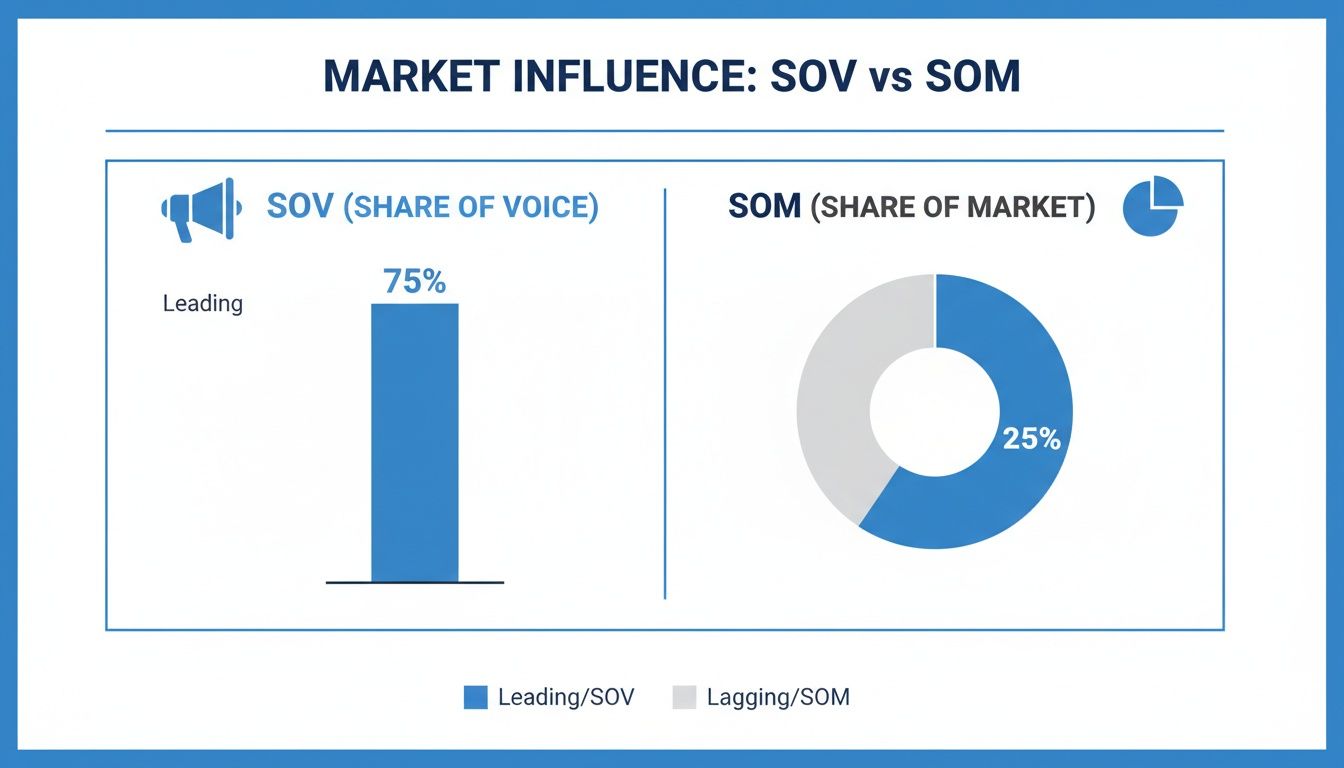
It shows how a brand can dominate the conversation (high SOV) long before it captures the equivalent piece of the market (SOM), laying the groundwork for future gains.
How Visibility Drives Sales
The mechanics behind this are pretty simple and tied directly to how people think and make decisions. When a brand achieves a higher SOV, it becomes more familiar and prominent in the minds of potential customers. This increased visibility works in a few key ways to boost market share over time.
- Boosts Brand Recall: When it’s time to buy, people remember the names they’ve seen and heard over and over. A high SOV puts your brand at the top of that mental list.
- Shapes Consumer Preference: Familiarity breeds trust. Constant exposure makes consumers more comfortable with your brand, gradually steering their preference your way over less visible competitors.
- Drives Purchase Decisions: Ultimately, better recall and stronger preference lead directly to sales. A strong SOV essentially shortens the consideration phase for buyers, pointing them straight to your product or service.
Measuring SOV in Today's World

You can't grow what you don't measure. The first step to making SOV a real growth driver is getting reliable data from every single channel where customers form opinions. It means moving past simple vanity metrics and taking a much more holistic view of your brand's presence.
Measuring Share of Market (SOM) is the easy part. It’s a straightforward calculation based on hard sales data. You just divide your total revenue by the total market revenue for a specific period, and that percentage is your share. Done.
Share of Voice (SOV), on the other hand, is a different beast entirely. It demands a multi-channel approach that has evolved dramatically over the last few years. A modern SOV calculation has to account for all the different ways your brand gets discovered and discussed online.
Key Channels for SOV Measurement
To get an accurate picture, you have to track your visibility across several key battlegrounds. Each one gives you a different angle on your brand's presence compared to your competitors.
- Organic SEO Visibility: This is your turf on the search engine results pages (SERPs). You're tracking where you rank for critical keywords and your overall impression share against your rivals.
- Paid Media Impression Share: In channels like Google Ads, this metric tells you the percentage of times your ads were shown out of all the possible times they could have been shown. It's a direct measure of your paid advertising muscle.
- Social Media Listening: This involves monitoring mentions, hashtags, and the general sentiment around your brand across social platforms. The sheer volume of conversation about you versus the competition is your social SOV.
A critical piece of the puzzle is tying this visibility back to revenue. This involves understanding revenue attribution models so you can connect your SOV gains with actual sales and prove the value of your marketing spend.
The biggest shift in SOV is the rise of AI. Your visibility is no longer just about what appears on a Google page; it’s about what AI assistants like ChatGPT and Gemini say about you when asked for recommendations.
The New Frontier: AI and LLM Mentions
As more and more consumers turn to AI chatbots for answers, your brand’s presence in those conversations has become a crucial—and often completely overlooked—part of your SOV. These platforms are the new word-of-mouth, shaping perceptions and influencing buying decisions before a user even thinks about visiting a website.
An SOV calculation that ignores AI leaves a massive blind spot in your strategy. Your competitors might be getting recommended directly to potential customers while your brand is invisible. Worse, you could be misrepresented by an AI "hallucination," and you'd never even know.
That's why it's essential to use modern competitor AI analysis tools to monitor what these models are saying. Tracking your AI SOV isn't just a "nice-to-have" anymore; it's the only way to get a complete picture of your brand's true influence today.
Tailoring Your SOV Strategy Across Industries
The link between Share of Voice and Share of Market is anything but a universal constant. It’s a fluid relationship that changes dramatically based on your industry’s unique landscape. If you set a generic SOV target without looking at your specific market, you're trying to navigate without a map—you might be moving, but you won't know if it's in the right direction.
Things like market maturity, the sheer number of competitors, and typical buying behaviors all shape how effectively a bump in visibility turns into actual sales. In a fast-moving, trend-driven industry, a small gain in SOV can deliver surprisingly quick results. But in a mature, stable market, you might need a much bigger investment just to see a noticeable shift in market share.
The Impact of Market Maturity and Competition
The intensity of competition directly affects how well SOV converts to SOM. A crowded market demands a much louder voice just to be heard, while a niche market lets a smaller brand dominate the conversation with far less effort.
E-commerce data makes this crystal clear. A deep dive into Amazon data by Momentum Commerce revealed that in the hyper-competitive makeup category, a 1% increase in total SOV drives a significant 0.325% gain in market share. But in the more mature men's shoes category, that same 1% SOV lift only nudges market share up by 0.12%.
This data brings home a critical strategic point.
The "cost" of buying market share with your voice varies wildly. Your strategy has to account for whether you're fighting for a sliver of attention in a crowded stadium or building a presence in a less saturated space.
Setting Realistic SOV Goals by Industry
Understanding these differences is the key to setting achievable goals and spending your budget wisely. For a SaaS company, the conversation plays out across channels like industry blogs and review sites. A local restaurant, on the other hand, lives and dies by local search and social media chatter. Effective planning demands a deep understanding of your specific environment, which is where AI brand tracking for SaaS companies becomes essential for mapping out a winning strategy.
Here’s a practical way to frame your thinking based on your industry type:
- High-Competition Industries (e.g., CPG, Cosmetics): Brace yourself for a lower SOV-to-SOM conversion rate. You'll need to achieve a high Excess Share of Voice (ESOV) to grow, and that means a substantial, sustained investment across both paid and organic channels.
- Niche or Emerging Industries (e.g., specialized B2B tech): Here, a smaller SOV investment can punch well above its weight, delivering a higher relative gain in market share. The goal is to dominate the key conversations and channels where your very specific audience lives.
- Mature, Stable Industries (e.g., automotive parts): Brand loyalty is often rock-solid, making it tough to move the needle on market share. In this arena, SOV efforts are often more about defending your position and capturing small, incremental gains from new customers entering the market.
Winning the New Frontier of AI Share of Voice
The battleground for brand visibility has decisively shifted. While traditional SEO and social media listening still matter, the new frontier is AI-powered search. Consumer behavior is quickly moving toward conversational queries with assistants like ChatGPT and Gemini, making your brand’s presence on these platforms a critical piece of your overall Share of Voice.
Ignoring this channel is no longer an option. Any modern comparison of share of voice vs share of market has to account for your visibility within Large Language Models (LLMs). This is an emerging space that carries both immense opportunity and significant risk.
The Dangers of AI Hallucinations
One of the most urgent threats brands face in this new arena is the phenomenon of AI "hallucinations." These are confident, plausible-sounding, but entirely false statements generated by an AI. The consequences can be immediate and damaging.
An AI might incorrectly state your business hours, make up negative customer reviews, or even claim you’re permanently closed. Because these answers are delivered with such authority, they can instantly erode customer trust and directly hit your bottom line. Defending your brand means you have to be proactive.
The greatest risk in the age of AI isn't just being invisible; it's being misrepresented. An AI hallucination can undo years of brand-building in a single, incorrect answer, making active monitoring essential for survival.
This makes tracking your AI SOV a defensive necessity. Without it, you’re flying blind to potentially harmful misinformation being spread about your brand.
Turning AI Visibility Into a Competitive Advantage
Beyond just playing defense, the AI channel offers a powerful new way to build your brand and capture market share. When a potential customer asks an AI for a recommendation—"What's the best local pizza place?" or "Which software is best for project management?"—the answer directly influences their next move.
Securing a positive mention in these responses is the modern equivalent of a top Google ranking or a glowing word-of-mouth referral. This requires a new set of strategies focused on ensuring the AI has accurate, positive, and comprehensive information about your brand. Many marketing firms are already figuring out how to optimize for this, and you can learn more about LLM visibility tracking for agencies to see how professionals are tackling the challenge.
The way we measure brand visibility is changing. While keywords and social mentions are still part of the picture, the context and sentiment of AI-generated answers are becoming just as important.
| Metric | Traditional SEO/Social | AI/LLM SOV |
|---|---|---|
| Visibility | Keyword rankings, SERP features | Direct mentions in AI answers |
| Source | Search engine results, social feeds | Synthesized information from training data |
| Sentiment | Social media sentiment analysis | Analysis of tone in AI responses |
| Competition | Competitor keyword rankings | Brands recommended instead of you |
| Control | On-page SEO, link building | Influencing training data, content authority |
This new landscape requires a new playbook. To win on this frontier, brands must actively monitor AI models to track:
- Brand Mentions: How often and in what context is your brand being mentioned?
- Competitor Recommendations: When and why is an AI recommending a competitor over you?
- Sentiment Analysis: What is the overall tone (positive, negative, neutral) of the conversation around your brand?
By gathering this critical data, you can move from a reactive, defensive stance to a proactive strategy. You can correct inaccuracies, identify the content gaps that are causing competitors to get recommended, and actively shape the AI's understanding of your brand. This transforms AI from a potential threat into a predictable and powerful channel for growth, directly influencing your future share of market.
An Actionable Plan to Grow Your SOV and Market Share

Turning insights into outcomes starts with a clear roadmap. If you're serious about growing your Share of Voice (SOV) and, by extension, your Share of Market (SOM), you need a structured plan that nails the fundamentals while also tackling new frontiers like AI visibility.
Any good strategy begins with an honest audit. You have to measure your current SOV across every channel that matters—organic search, social media, paid ads, and now, AI mentions. This gives you a benchmark, a starting point to set realistic growth targets. Without this initial data, you're just guessing.
Foundational SOV Growth Strategies
With your baseline in hand, it's time to focus on proven tactics that get you seen and heard. These efforts build a solid foundation for growth by making your brand more discoverable and authoritative.
- Create High-Value Content: Don't just publish content; develop resources that directly solve your audience's biggest problems. This is what earns organic mentions, backlinks, and top keyword rankings—the absolute building blocks of a strong SOV.
- Optimize Paid Media Spend: Use your SOV data to see where competitors are outspending you. Reallocate your budget to gain impression share on the high-impact platforms where your ideal customers actually spend their time.
- Engage in Relevant Conversations: Show up where your audience is. Actively participate in discussions on social media and industry forums. Starting and contributing to conversations keeps your brand top-of-mind and builds a real community.
Across almost every industry, the pattern is clear: when SOV outpaces SOM, growth follows. Research consistently shows SOV as a leading indicator of future market gains. For instance, if your brand secures 100 mentions out of 1,000 in a channel (10% SOV), and that number is higher than your current market share, it’s a strong signal of impending growth. If it's lagging behind, you're likely stagnating. You can read more on the SOV and SOM correlation to dig deeper.
Integrating AI into Your Action Plan
Ignoring AI is no longer an option when you’re trying to close the gap between share of voice vs share of market. Your brand’s presence in LLM responses is a critical, and often overlooked, part of modern SOV.
An actionable AI plan isn't just about monitoring; it's about actively managing your brand's narrative. This means setting up alerts for brand mentions and inaccuracies and having a process to correct harmful AI-generated responses.
Start by monitoring your brand’s visibility in AI with a tool like TrackMyBiz to see exactly where you stand. Set up alerts that notify you the moment you get a new mention or a damaging hallucination, like incorrect business hours or completely false claims about your services. By actively correcting this information, you're not just protecting your reputation—you're turning a potential risk into a reliable channel for market growth.
Frequently Asked Questions
How Often Should I Measure My Share of Voice?
It really depends on the channel. For things like social media and SEO, a monthly or quarterly check-in is usually enough to see how your campaigns are performing and spot any meaningful trends.
But when it comes to AI channels, the game changes. LLM responses can be wildly unpredictable and influential, so you need to be watching them continuously—ideally, daily. This is the only way to catch and react to what they're saying about you in near real-time.
Can a Small Business Effectively Increase Its SOV?
Absolutely. This is one area where big budgets don't always win. Small businesses can make huge gains by dominating niche organic channels where quality and relevance are what truly matter.
Instead of trying to outspend giants, focus your energy. Create hyper-targeted content, become a trusted voice in specific online communities, master your local SEO, and be militant about ensuring your brand's information is accurate in AI chatbots.
Is Share of Voice More Important Than Share of Market?
They’re two different tools for two different jobs. Think of Share of Market as your report card—it tells you how you did and where you stand right now based on past performance.
Share of Voice, on the other hand, is more like a crystal ball. It’s a predictive metric that helps you see where the market is heading and gives you the insights to shape your future performance. If your team is focused on growth, SOV is the far more actionable metric of the two.
TrackMyBiz provides the critical AI visibility data you need to turn this new frontier from a risk into a repeatable acquisition channel. Start a free scan to see your current standing in minutes.
