
Picture your market as a giant, noisy room where everyone is talking at once. Share of voice marketing is simply a way to measure how well your brand’s voice cuts through that noise compared to your competitors. It's not about who shouts the loudest; it's about who is actually being heard.
What Is Share of Voice and Why It Matters Now
At its heart, share of voice (SOV) is a pretty straightforward idea: it’s your brand’s visibility shown as a percentage of the total visibility for your entire industry. For a long time, this was a simple math problem based on ad spend. If you bought $10,000 in TV ads and the total market spend was $100,000, your share of voice was 10%. Easy.
But that conversation has gotten a lot more complicated. Today, that "noisy room" is filled with countless digital channels, each with its own chatter. Your SOV isn't just tied to your ad budget anymore; it’s a measure of your presence everywhere customers might find or talk about you. This includes places like:
- Organic Search: How often do you show up on the first page of Google for key searches versus your rivals?
- Social Media: What slice of the social media pie—mentions, conversations, hashtags—in your niche actually belongs to your brand?
- Paid Media: In Google Ads or on retail sites, what’s your impression share for the most important terms?
- AI Conversations: When people ask AI assistants like ChatGPT, Gemini, or Claude for recommendations, is your brand part of the answer?
That last point is the new frontier. If a customer asks an AI for "the best local pizza" and your name doesn't come up, you're invisible to a huge and growing part of the market. Any modern share of voice marketing strategy has to account for this massive shift toward AI-driven discovery.
From Megaphones to AI Mentions
The way we measure SOV has had to change right alongside marketing itself. It started with who had the biggest ad budget, then it became about who owned the digital conversation, and now it includes who is influencing AI recommendations.
The journey has been a big one, moving from a simple one-way broadcast model to a complex world where brand visibility is earned through great content, real engagement, and now, high-quality data that AI models can trust.
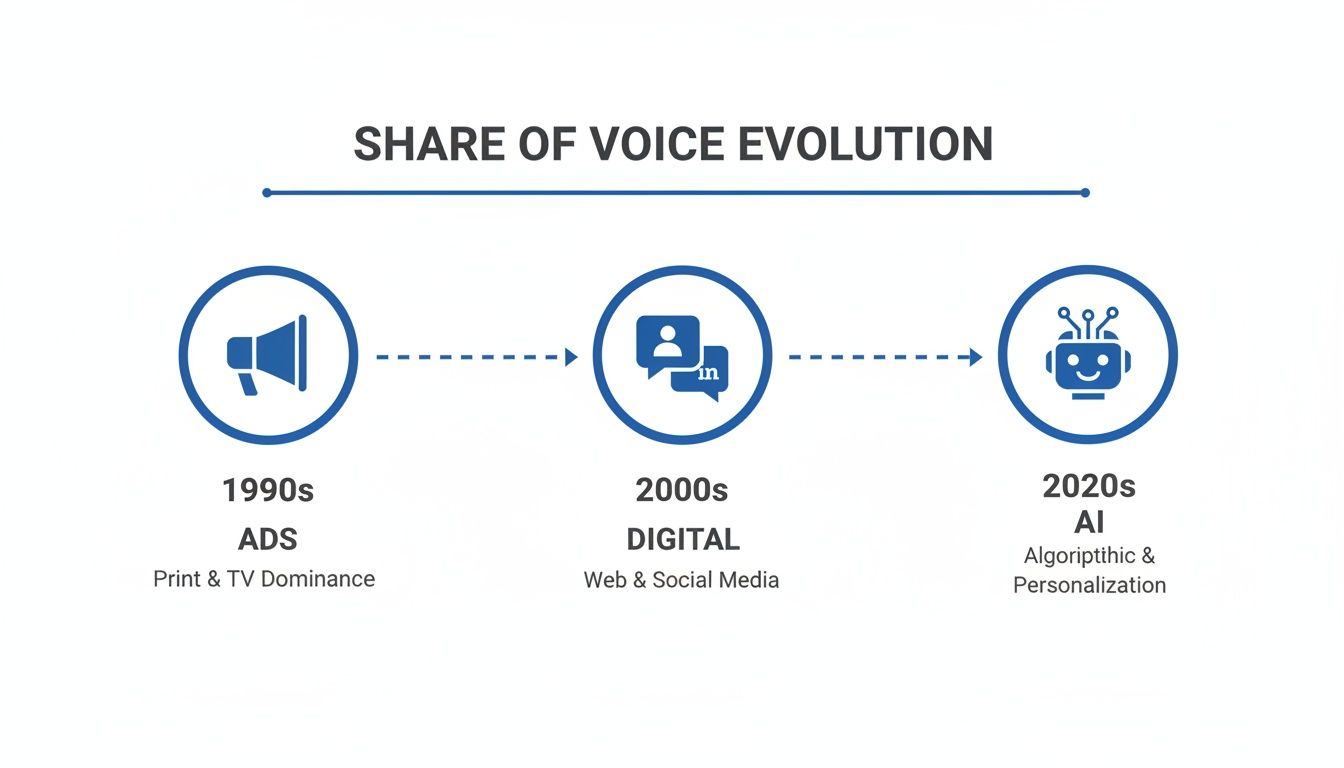
This shift highlights a crucial change: we've gone from shouting at customers to being a valuable part of a conversation, where our authority is built, not bought.
To really grasp this evolution, it helps to see the metrics side-by-side.
The Evolution of Share of Voice Measurement
| Era | Primary Channels | Key Metrics | Primary Challenge |
|---|---|---|---|
| Traditional (1990s) | TV, Radio, Print | Gross Rating Points (GRPs), Ad Spend | High cost, limited targeting, difficult to measure direct impact. |
| Digital (2000s-2010s) | Search Engines, Social Media, Blogs | Keyword Rankings, Social Mentions, Impression Share | Fragmented data, keeping up with new platforms, rising ad costs. |
| Modern (2020s & Beyond) | Conversational AI, Voice Search, Niche Communities | AI Recommendations, Unlinked Brand Mentions, Sentiment Analysis | Influencing closed AI models, ensuring data accuracy, tracking unstructured conversations. |
The move from traditional to modern SOV isn't just about new channels; it's about a fundamental change in how brands build and maintain relevance in a world where answers are increasingly delivered by algorithms.
Why SOV Is a Leading Indicator of Growth
Tracking your share of voice is far more than a vanity metric—it’s one of the most reliable predictors of future market share. The connection is so strong that it has its own name: Excess Share of Voice (ESOV). This is the gap between your SOV and your current market share.
A brand whose share of voice is higher than its share of market is very likely to grow its market share in the following year. Conversely, a brand with a SOV lower than its market share is likely to shrink.
This isn't just theory; it holds up in the real world. Research by Binet and Field found that a 10% excess share of voice can lead to a 0.5% bump in market share. That connection is getting even more important as voice commerce takes off. Valued at USD 34.21 billion in 2023, the global voice commerce market is expected to skyrocket to USD 286.87 billion by 2033. You can explore more data on the voice commerce boom to see just how big the financial impact is of being the brand that gets recommended.
Ultimately, a strong SOV gives your brand a defensive moat. It protects you from market swings and competitive attacks by keeping you top-of-mind, building the authority you need to attract customers, and driving real, sustainable growth.
How to Measure Share of Voice Across Channels

Measuring your share of voice isn't just about tallying up ad spend anymore. We live in a world with endless customer touchpoints, so a real share of voice strategy means looking at every single channel where people talk about and discover brands. The goal is to piece together the full puzzle of your brand's visibility.
The old-school formula is still a great way to grasp the core concept:
(Your Brand Metric ÷ Total Market Metric) x 100 = Your Share of Voice %
The trick is to get creative and adapt what "metric" means for each channel you’re looking at. Let's dig into how this works in the places that matter most.
Organic Search SOV
When it comes to organic search, SOV is all about search visibility. It’s not enough to be #1 for a single keyword. True visibility is about how often your brand shows up across a whole basket of relevant searches compared to everyone else. When you have a high SOV here, you are the go-to answer in your market.
You can get a rough idea by tracking your impression share for a specific set of keywords right inside Google Search Console. For a deeper dive, specialized SEO tools will give you a "visibility score" that factors in your rankings and the search volume of those keywords.
- Formula: (Your Brand's Impressions for Target Keywords / Total Impressions for Target Keywords) x 100
- Example: A local bakery is tracking 50 keywords, from "best birthday cakes near me" to "sourdough bread." They get 20,000 impressions in a month, while the total market impressions for those same keywords hit 100,000. Simple math gives them an organic search SOV of 20%.
Social Media SOV
On platforms like Instagram or Twitter, share of voice is literally how much of the conversation you own. This goes way beyond your follower count. You're measuring every single mention of your brand—tagged or not.
You'll be tracking things like brand mentions and campaign-specific hashtags. This tells you exactly how much of the social chatter in your industry is about you versus your rivals.
- Formula: (Your Brand Mentions / Total Competitor + Brand Mentions) x 100
- Example: A coffee shop spots 500 mentions of its brand on Instagram in a month. At the same time, its two biggest competitors were mentioned a combined 1,500 times. Their social SOV is (500 / 2000) x 100 = 25%.
PPC Impression Share
With paid ads, share of voice has a direct and clean metric: impression share. It's sitting right there in your Google Ads dashboard, telling you what percentage of possible ad impressions you actually captured.
A low impression share is a red flag. It means competitors are either outbidding you or your budget is tapped out, causing you to vanish from valuable searches.
- Formula: (Your Ad Impressions / Total Eligible Ad Impressions) x 100
- Example: A retailer's Google Shopping campaign has an impression share of 40%. This means for every 10 times a potential customer could have seen their ad, they only showed up 4 times. A competitor sitting at 60% is absolutely dominating that ad space.
The New Frontier: AI Share of Voice
The most critical—and most ignored—channel today is conversational AI. When a potential customer asks ChatGPT, Gemini, or a voice assistant for a recommendation, the answer they get is the new "page one." Your AI share of voice is how often your brand gets mentioned in these AI-generated responses.
This new battleground is mission-critical. The voice and speech recognition market was valued at USD 20.25 billion in 2023 and is on track to hit USD 53.67 billion by 2030. Despite this, only a tiny 13% of marketers are even thinking about voice search optimization, leaving a massive blind spot in their strategy. You can read the full research on voice recognition trends to see just how fast this is growing.
Trying to track this manually is a fool's errand. AI responses are incredibly variable. This is where dedicated tools come into play. Using competitor AI analysis tools automates the process, scanning different AI models to see how you and your competitors are being talked about. It's the only way to get a clear picture.
- Formula: (Your Favorable Brand Mentions in AI Responses / Total AI Responses for a Query) x 100
- Example: A hotel chain prompts various AI models 100 times with "best family-friendly hotels in Orlando." Their brand is recommended in a positive light 30 times. For that specific query, their AI SOV is 30%.
Navigating the Impact of AI on Your Brand Voice
The way customers find businesses is changing right under our feet. For years, the battle for visibility was fought on the Google search results page—that familiar list of blue links. But that landscape is quickly being redrawn by conversational AI assistants like ChatGPT, Gemini, and Claude.
In this new world, the stakes are much, much higher.
When someone asks an AI for a recommendation, they don't get a page of options to sort through. They often get a single, confident-sounding answer. If your brand isn't that answer, you're invisible at the most critical moment in the customer's journey. This shift fundamentally changes the rules of share of voice marketing.
The High Cost of an AI Blind Spot
The danger here isn't just being ignored; it's the very real threat of misinformation. Large Language Models (LLMs) are well-known for "hallucinations," which is a gentle way of saying they sometimes make things up and state them as facts. For a business, this can be an absolute disaster.
An AI could invent a fake scandal, list the wrong business hours and send a customer to your locked door, or even tell someone your business has closed for good. Every one of these mistakes is more than a simple error—it’s a direct hit to your reputation and the trust you've built, chipping away at your market share with every false answer.
This dashboard shows how a brand's visibility and sentiment can be tracked across different AI models.
Keeping a close eye on these AI-driven conversations lets you spot and shut down harmful hallucinations before they do serious damage.
Protecting Your Brand in the Age of AI
Being proactive isn't a luxury anymore; it’s a core business function. Brand and reputation managers have to treat AI monitoring with the same seriousness as social media listening. A single negative or flat-out wrong mention from a popular AI can undo years of hard work building customer trust.
AI hallucinations aren't just a tech quirk; they're a direct business risk. An AI inventing a negative story about your brand is the modern version of a damaging rumor spreading through a small town—except it happens instantly, on a global scale, and with the seeming authority of advanced technology.
This makes daily monitoring essential for protecting your brand's integrity. And this space is growing explosively. The voice biometrics and assistants market, valued at USD 2.30 billion in 2024, is expected to skyrocket to USD 15.69 billion by 2032.
Developing a Proactive AI Monitoring Strategy
Waiting around for a customer to complain about something an AI said is a recipe for lost revenue and a damaged reputation. A modern share of voice strategy must have a dedicated plan for managing your brand's presence in AI conversations. To get ahead of this, a deep understanding of Generative Engine Optimisation (GEO) is quickly becoming essential.
This new discipline is all about making sure your brand shows up accurately and positively in AI-generated answers. It’s a strategy with a few key parts:
- Continuous Scanning: You have to regularly ask the major AI models questions about your brand, your products, and your industry. It’s the only way to catch bad information or negative mentions as they pop up.
- Accuracy Verification: Check what the AI says against your official sources, like your website and Google Business Profile. Immediately flag anything that doesn't match, from wrong pricing to an old phone number.
- Competitor Benchmarking: See how often your competitors are getting recommended and in what situations. This shows you where you're falling behind and where the gaps are in your own visibility.
- Sentiment Analysis: Don't just count mentions; analyze the tone. Is the AI portraying your brand in a positive, neutral, or damaging light?
Putting a solid system in place for LLM visibility tracking is the only real way to stay on top of this. By treating AI as a primary channel where customers find you, you can shield your brand from serious risks and turn this new technology into a powerful tool for growth.
Actionable Strategies to Increase Your Share Of Voice

Grasping your share of voice is like plotting out your territory on a map. Actually boosting it means claiming more of that real estate in your audience’s conversations.
It isn’t about yelling the loudest. It’s more like playing the right notes at the right time—being helpful, strategic, and present when your customers are listening. The tactics below serve as a coordinated playbook, so every team can pitch in toward owning the conversation.
For SEO And Content Marketing Teams
Think of your content as a library full of volumes people can’t stop quoting. Your goal is to become the go-to reference in your niche.
A holistic approach often lives inside a broader, well-defined digital content strategy. That way, every article, guide, or data report has a clear purpose.
• Create Citable, Authoritative Content: Invest in original research, deep-dive guides, and data-driven articles. When peers link to you, it boosts those all-important backlinks and authority signals both search engines and LLMs trust.
• Target Conversational Keywords: Go beyond single words. Chase the complete questions your audience asks. When you answer those fully, you increase your chances of landing in search snippets and AI responses.
• Optimize for Entities And Topics: Modern SEO is less about stuffing keywords and more about staking your claim as a recognized expert on specific subjects. Structure your content around core themes so AI and readers alike see you as the definitive source.
For Public Relations And Communications Teams
PR is your brand’s megaphone in the wider world—and high-authority mentions are the notes that stick in the minds of both algorithms and people.
Securing a feature in a top industry outlet does more than spark chatter. It becomes a permanent data point in AI knowledge bases, cementing your credibility over time.
Make these your focus:
- Secure High-Authority Media Placements: Aim for interviews, guest articles, and features in outlets that AI models routinely crawl. One mention on a respected site outweighs dozens of minor placements.
- Promote Key Executives As Thought Leaders: When your leaders speak at conferences or get quoted in articles, your entire brand gains an expertise halo.
- Monitor And Manage Brand Narrative: Keep an eye on how your story unfolds online. Quickly correct inaccuracies and reinforce positive angles to maintain a strong sentiment score in AI-driven mentions.
For Social Media And Community Managers
Social channels are your brand’s town square. Here, conversations breathe life into your share of voice, and organic mentions become your best billboard.
Authentic engagement is your secret weapon. Rather than push messages at your audience, spark two-way discussions that matter to them.
• Foster Authentic Community Engagement: Build forums or groups where customers feel heard. Ask questions, run polls, and reply to comments to turn followers into passionate advocates.
• Encourage User-Generated Content (UGC): Launch hashtag campaigns or contests that prompt people to share their own stories. UGC acts as social proof, instantly broadening your reach and voice.
• Leverage Influencer Partnerships: Work with creators whose followers trust them. A genuine endorsement from the right influencer can introduce your brand to fresh audiences and fuel new conversations.
For Local And Multi-Location Businesses
When you have physical storefronts, winning SOV means owning the local dial. AI assistants, map apps, and directory services all look to your digital footprint to guide customers in real life.
Your ultimate goal? Be the first name that pops up when someone asks, “Who’s best in my neighborhood?”
• Optimize Google Business Profiles (GBP): Treat your GBP like a digital storefront—complete every field, add high-quality photos, update hours regularly, and encourage positive reviews to flow in.
• Build Local Citations: Be consistent. Your business name, address, and phone number (NAP) must match exactly across Yelp, Apple Maps, industry directories, and every other online listing.
• Generate Local-Specific Content: Craft blog posts or social updates that spotlight each location—think local events, community partnerships, or neighborhood guides that resonate with nearby customers.
Real-World Examples of Share of Voice Mastery

It’s one thing to talk about share of voice in theory, but seeing it deliver cold, hard results is another story entirely. When you get it right, a smart share of voice marketing strategy does more than just get your name out there—it builds a competitive moat around your business, protecting your revenue and opening up entirely new customer pipelines.
These real-world examples show a direct line from clever tactics to market dominance. They prove that you don’t need the biggest budget to win; you just need to own the right conversations.
The Local Pizza Chain That Beat The Nationals
Picture a regional pizza chain with a dozen shops, constantly drowned out by the multi-million dollar ad campaigns from national giants. Instead of trying to outspend them on TV, they went where the big players weren't looking: AI-powered local search.
Their strategy was laser-focused. They obsessively optimized every single Google Business Profile with drool-worthy photos and a steady stream of positive reviews that mentioned phrases like "family-friendly" and "best local pizza." At the same time, their content team started a blog all about local family events and sponsored little league teams, weaving their brand into the fabric of the community.
The payoff was huge. When people in their area asked their AI assistants for "the best pizza for a family night," the local chain popped up as the top recommendation. They successfully carved out a huge share of voice for the high-intent, local queries that lead directly to sales.
The E-commerce Brand That Owned A Niche
An e-commerce startup selling sustainable home goods was entering an incredibly crowded market. To cut through the noise, they decided to become the definitive source on one specific topic: eco-friendly cleaning. They went all-in, creating deep-dive guides comparing cleaning ingredients and even publishing their own research on household plastic waste.
Their content was so solid that major lifestyle and environmental blogs started citing their work, which built up a treasure trove of high-authority backlinks. This directly influenced LLM knowledge bases, which began to recognize the brand as a true expert. Before long, AI-driven queries for product recommendations consistently put their products at the top of the list.
To protect their hard-won position, they used specialized tools for ongoing ChatGPT brand monitoring for e-commerce, making sure no competitor could sneak in and steal their crown.
This approach demonstrates a key principle of modern SOV: becoming the source of truth in a specific niche is more powerful than being a minor voice in a broad category.
By creating citable, authoritative content, the startup became the default answer, driving a ton of organic traffic and establishing unshakable credibility in their market.
SOV Strategy And Impact Analysis
These stories aren't just inspiring; they reveal a repeatable pattern for success. Each brand identified a market weakness, applied focused pressure, and managed to secure a dominant share of voice where it mattered most.
Here’s a quick breakdown of how their strategies translated into real-world wins.
| Brand/Industry | Primary Strategy | Channels Dominated | Key Business Outcome |
|---|---|---|---|
| Regional Pizza Chain | Hyper-Local SEO & Community Content | AI Local Search, Google Maps | Increased foot traffic and direct orders, protecting revenue from national chains. |
| E-commerce Startup | Authoritative Content & PR | Organic Search, AI Recommendations | Became the top product recommendation, driving a 40% increase in qualified leads. |
As you can see, a well-defined SOV strategy isn't just a marketing metric—it's a direct driver of business growth. By choosing the right battlefield, even smaller players can achieve massive impact.
Your Top Share of Voice Marketing Questions, Answered
Even after getting the hang of the core concept, putting a share of voice marketing plan into action always brings up a few practical questions. Let's tackle the most common ones head-on, so you can move from theory to confident execution.
What Is a Good Share of Voice Benchmark?
This is always the first question, and the answer is refreshingly simple: there’s no magic number. A "good" share of voice is completely relative to your market, how crowded your industry is, and what you’re trying to achieve.
A 15% SOV could make you the undisputed leader in a niche market with only a handful of players. That same 15% would be a barely audible whisper in a packed category like consumer packaged goods.
The real goal is to achieve Excess Share of Voice (ESOV). This is the gap between your share of voice and your actual market share. If you hold 10% of the market but command 15% of the conversation, your +5% ESOV is a powerful signal that you’re set up for growth.
The objective isn't hitting some universal benchmark. It's about making sure your brand's voice is consistently louder than its current market position. That's the pressure that fuels growth.
How Often Should I Measure My Share of Voice?
The right measurement cadence depends entirely on how fast the conversation is moving on a given channel. Your tracking rhythm needs to match the channel's velocity.
Here’s a straightforward guide for scheduling your SOV checks:
- Continuous or Daily: This is non-negotiable for high-speed channels like social media and AI chatbot mentions. A competitor's campaign can explode overnight, and daily tracking is the only way to react in time.
- Weekly or Bi-Weekly: This pace is perfect for monitoring PPC impression share and the performance of your key content. It’s frequent enough to spot trends without getting bogged down by tiny daily blips.
- Monthly or Quarterly: For foundational channels like organic search rankings and high-authority media mentions, you need a higher-altitude view. Looking at this data monthly or quarterly helps you see the meaningful, long-term shifts in your market authority.
Can a Small Business Compete with Large Brands on SOV?
Absolutely. In fact, smarts can beat budget here. Trying to out-spend a global brand on a national stage is a fool's errand. But winning share of voice isn’t about being everywhere—it's about owning a specific, valuable conversation.
Smaller businesses win by being more focused. Instead of fighting for a tiny slice of a massive topic, they can completely dominate a smaller piece of it.
Here’s how they do it:
- Niche Domination: Go deep on a specific product or a unique customer problem that big competitors gloss over.
- Geographic Focus: Own the local conversation. Become the automatic answer when someone asks for a recommendation in your city or region.
- Long-Tail Keywords: Target those super-specific, multi-word search phrases that signal someone is ready to buy.
How Is SOV Different from Brand Awareness?
They're related, but they measure two very different things. Think of it like a political election.
Brand awareness is just name recognition. Do voters (your customers) know a candidate (your brand) even exists? It’s a basic measure of familiarity.
Share of voice, on the other hand, is about who is dominating the actual campaign. It measures how often your brand is being discussed in the debates, news coverage, and town halls compared to everyone else when people are actively making a choice. It’s a measure of influence within a competitive arena. One can lead to the other, but SOV is a much clearer indicator of who’s actually winning the conversation right now.
Ready to stop guessing what AI assistants are saying about you? TrackMyBiz gives you the complete picture of your AI share of voice. See your BrandRank, monitor competitor recommendations, and catch costly AI errors before they damage your reputation. Start your free scan today at https://trackmybusiness.ai and turn AI from a risk into a revenue driver.
