
Imagine a giant, bustling marketplace. Every brand is yelling, trying to get customers' attention. Your share of voice is simply how loud your brand's voice is compared to everyone else's. It's a quick gut check on your brand’s visibility and a critical sign of your influence in the market.
Why Share of Voice Still Defines Market Leaders
Don't mistake share of voice (SOV) for a simple vanity metric. It’s one of the most reliable predictors of future market share and a true cornerstone of smart brand strategy. Back in the day, SOV was dead simple—it was just your ad budget versus the total ad spend in your category. If you bought more TV commercials, you won.
But the world has changed, and so has the way customers find and connect with brands. Today, the concept of SOV has stretched to cover a much wider, more complex world of customer touchpoints. It now includes everything from:
- Organic Search: How often you show up when people search for what you sell.
- Social Media: The buzz around your brand—mentions, hashtags, and conversations.
- Paid Media: How much of the ad space you own in paid search and social campaigns.
- Public Relations: How often your brand gets name-dropped in news articles and media coverage.
This shift is so important because visibility has a direct, undeniable link to growth. When your brand is consistently where your audience is looking, you build familiarity. You build trust. And when it comes time to buy, you become the default, no-brainer choice.
The definition and measurement of Share of Voice have changed dramatically over the years. What started as a simple calculation of ad spend has become a complex measure of digital presence.
Here's a quick look at how things have evolved:
How Share of Voice Evolved From Traditional to Digital
| Era | Primary Channel | How It Was Measured | Example Metric |
|---|---|---|---|
| Traditional Media Era | TV, Radio, Print | Ad Spend vs. Total Category Spend | Gross Rating Points (GRPs) |
| Early Digital Era | Display Ads, Paid Search | Impression Share vs. Total Available Impressions | Impression Share (%) |
| Social Media Era | Facebook, Twitter, Instagram | Brand Mentions vs. Total Competitor Mentions | Volume of Mentions |
| Modern Digital Era | Organic Search, Social, PR, AI | A blended measure of visibility across all channels | Keyword Rankings, Mention Volume, Impression Share, AI Recommendations |
Understanding this evolution is key. It's not just about being seen anymore; it's about being present and authoritative wherever your customers are, from Google search results to AI-powered answers.
Introducing Excess Share of Voice
This is where SOV goes from being a simple report card to a powerful tool for growth. The key concept is Excess Share of Voice (ESOV), which is the gap between your share of voice and your current market share.
The rule is simple: when your share of voice is bigger than your market share, you create the perfect conditions for growth.
Think about it. If your brand holds a 20% market share but you've managed to capture 30% of the conversation, that extra 10% is your ESOV. It's a direct investment in winning over tomorrow's customers.
This isn't just theory; it’s been proven time and time again. Extensive research shows a clear link: for every 10% excess share of voice (ESOV) a brand achieves, it can expect to see a 0.5% gain in market share. You can dig deeper into how this plays out with the rise of AI by exploring these voice search statistics.
Ultimately, investing in your share of voice isn't just about making noise. It’s about strategically positioning your brand to be the one people think of first, today and for years to come.
How to Measure Share of Voice Across Key Digital Channels
Figuring out your share of voice isn't a single, simple calculation. It’s more like a military commander getting reports from the navy, air force, and ground troops to understand the entire battlefield. You need to measure your presence across different channels, because each one tells a unique part of the story.
The whole point is to stop guessing and start making decisions based on real data. That means getting a clear picture of your visibility where it actually counts—from search results and social media chatter to paid ad campaigns.
This isn't just about vanity metrics. A strong Share of Voice (SOV), especially when it outpaces your share of market (Excess Share of Voice, or ESOV), is a proven driver of growth.
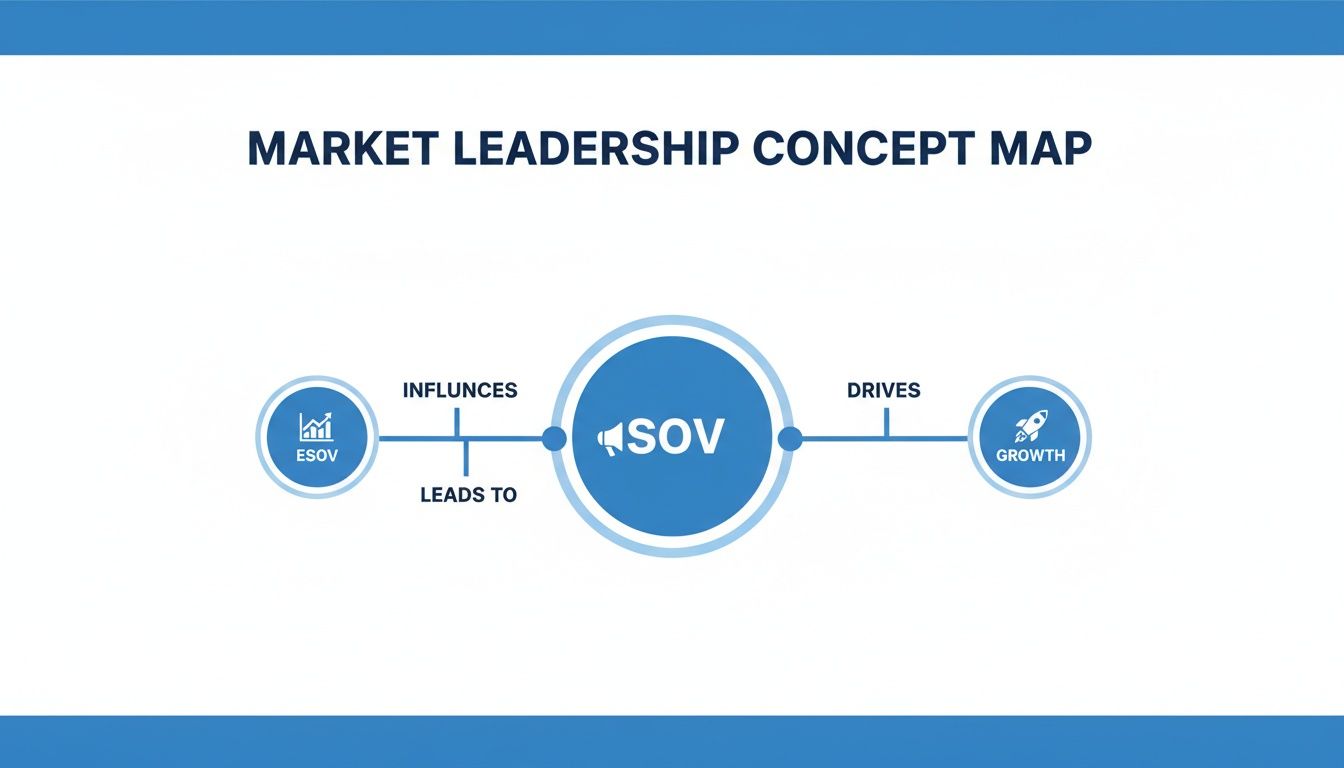
As you can see, building that visibility advantage (ESOV) directly strengthens your overall SOV, which in turn becomes a primary engine for grabbing more market share and leading your industry.
Calculating SOV in Paid Media
When it comes to paid ads, the cleanest metric you can use is Impression Share. It’s a beautifully simple number that tells you how often your ads showed up versus how often they could have shown up.
Impression Share = (Your Ad Impressions / Total Eligible Ad Impressions) x 100
Platforms like Google Ads and Microsoft Advertising hand this data to you right in their dashboards. If your Impression Share is 70%, it means you're capturing seven out of every ten possible ad views for your keywords. It also means your competitors are snapping up the other 30%.
Quantifying SOV in Organic Search
For SEO, share of voice is all about how much of the search landscape you own for the keywords that matter to your business. It’s not just about nabbing the #1 spot for a single term; it’s about dominating the entire conversation around a topic.
The formula here is a bit more involved, usually based on your rankings and the expected click-through rate (CTR) for each position.
- Step 1: First, pull together a list of your most important, commercially-valuable keywords.
- Step 2: Track your rankings for every single one of them.
- Step 3: Estimate your traffic by multiplying your search volume by the average CTR for your rank.
- Step 4: Finally, compare your estimated clicks against the total estimated clicks for all competitors ranking for that same group of keywords.
Tools like Semrush or Ahrefs can do the heavy lifting here, spitting out a "visibility score" that acts as your SEO share of voice. For SaaS companies especially, getting this right is crucial, which is where specialized AI-powered brand tracking can give you a serious leg up.
Monitoring SOV on Social Media
On social media, share of voice is a direct measure of who owns the conversation. It’s all about who’s being talked about the most.
The calculation is straightforward: it’s all about the mentions.
Social SOV = (Your Brand Mentions / Total Competitor + Brand Mentions) x 100
To pull this off, you’ll need a good social listening tool like Talkwalker or Brand24. These platforms dig through all the major social networks, tracking every mention of your brand, your competitors, and any relevant hashtags. This gives you a clear percentage of the industry conversation you own, offering a direct line of sight into your brand’s relevance and how much your audience is actually engaging.
The New Battleground for Brand Visibility in AI Search

The old ways customers find information are being completely dismantled. For years, we obsessed over the ten blue links on a search results page. Now, customers are just asking a direct question to an AI assistant like ChatGPT, Gemini, or their smart speaker.
This shift has created an entirely new frontier for measuring and winning your share of voice in marketing.
In this new conversational world, visibility isn’t about your page rank; it’s about whether an AI mentions or recommends you. It's a high-stakes, 'winner-takes-all' game. A user might scan a few options on a Google page, but an AI assistant often serves up just one or two definitive answers.
If your brand isn't the answer, you're effectively invisible for that entire conversation.
The Rise of Conversational Commerce
This isn't some far-off future. It's happening right now, especially with voice assistants. As voice commerce explodes, share of voice in voice-activated channels is the new arena where marketers must compete.
The global voice commerce market was already valued at a massive USD 42.75 billion in 2023 and is on a trajectory to hit USD 186.28 billion by 2030. Smart speakers are leading this charge, holding over 44% of the revenue share in 2023, with Amazon's Echo at the front of the pack.
This explosive growth means a huge chunk of your potential customers are asking for recommendations through conversation. Measuring your presence in these channels is no longer a "nice-to-have"—it's a critical part of your survival and growth strategy.
Why Old SEO Rules No Longer Apply
Traditional SEO has always been about climbing the ranks on a search engine results page (SERP). But AI models don't just rank links; they gather and synthesize information from countless sources to construct a single, authoritative-sounding response.
This means your brand has to become a trusted source that AI models cite. To really dominate here, you have to grasp the paradigm shift of Generative Engine Optimisation (GEO) from search engines to answer engines and figure out how to become the go-to source for AI.
Your new goal is not just to rank, but to be the answer. You must feed AI models the accurate, authoritative information you want them to repeat to customers.
From there, the next critical step is monitoring what these AI systems are actually saying about your business. You need to know:
- Product Recommendations: Is your brand being suggested when a user asks for "the best…"?
- Business Information: Are your hours, location, and services listed correctly?
- Brand Reputation: What's the sentiment of the information being shared about you?
Failing to track your share of voice in marketing on these new AI platforms means you're flying blind. You could be losing customers to competitors who are getting the AI's endorsement, or worse, you could be the victim of AI-generated misinformation and not even know it. Luckily, agencies can now use specialized tools for LLM visibility tracking to get a handle on this new reality.
How to Protect Your Brand From AI Misinformation
While growing your share of voice in marketing is all about offense, you absolutely need a strong defense. Especially when you’re up against a new and unpredictable opponent: AI misinformation.
Large Language Models (LLMs) have a strange and dangerous habit of "hallucinating"—meaning they state complete falsehoods with the confidence of a seasoned expert. This isn’t some far-off, theoretical problem. It's happening right now, and the consequences are very real.
Imagine an AI assistant telling a customer your store is permanently closed on a Saturday afternoon. Or quoting a price for your flagship product that's double the actual cost. These aren’t minor glitches; they are direct hits to your reputation and revenue, capable of causing immediate damage.
These inaccuracies completely undermine the trust you’ve spent years building. When an AI gets it wrong, the customer doesn't blame the algorithm—they blame your brand. This creates a brand-new, urgent need for a defensive monitoring system, a safety net for your business in the age of AI.
Building Your AI Safety Net
Protecting your brand demands a proactive stance. You can't afford to wait for an angry customer to tell you an AI started a false rumor about your business. The only solution is to continuously audit what these models are saying and have a system ready to flag inaccuracies the moment they pop up.
This boils down to a few critical actions:
- Establish a Single Source of Truth: Your own website and official data channels must be flawless. AI models lean heavily on this information, so it needs to be accurate, well-structured, and easy for them to access.
- Monitor Key Customer Prompts: You need to regularly ask AI assistants the same questions your customers would. Think about queries related to your hours, services, pricing, and how you stack up against the competition.
- Cross-Reference and Verify: The most effective way to do this at scale is with tools that automate the process. These platforms can systematically check AI responses against your verified company data, instantly flagging any discrepancies.
To really get ahead of the problem, understanding how to train a chatbot with accurate company knowledge is a crucial preventative step. It helps you stop misinformation at the source.
The screenshot below shows exactly how a monitoring dashboard gives you a clear, at-a-glance view of AI-driven conversations happening about your brand.
This kind of visual breakdown lets your team spot inaccuracies or negative chatter instantly, turning a potential crisis into a manageable task. By implementing a system to monitor and correct the record, you transform AI from an unpredictable threat into a protected channel. For brands looking for an expert-led strategy, working with specialized AI reputation management consultants can provide the structured approach needed to safeguard your digital presence.
Proven Strategies to Actively Grow Your Share of Voice

Simply playing defense and correcting misinformation isn't going to win you the market. Real growth comes from going on the offensive. You need to actively expand your share of voice in marketing across every single channel where your customers are forming opinions and making decisions.
This means shifting from a passive monitoring mindset to implementing proactive strategies designed to dominate the conversation. We're talking about everything from the classic Google search results to the new frontier of AI-driven discovery. The goal is simple: become an unavoidable, authoritative presence in your industry.
A truly effective approach hits three key areas: owning search conversations with killer content, using smart social media engagement to become a leading voice, and fine-tuning your entire digital footprint to become a trusted source for AI assistants.
Dominate Search with Targeted SEO and Content
The bedrock of a strong share of voice is owning the conversations happening on search engines. It's still true: when customers have a problem, their first stop is Google. Your brand has to be there with the right answer.
This requires a two-pronged attack:
- Targeted SEO: Pinpoint the high-intent keywords your ideal customers are typing into the search bar. Then, create content that answers their questions so thoroughly that they have no reason to click anywhere else. The aim isn't just to rank for one term, but to become the definitive resource for an entire topic cluster.
- Thought Leadership Content: Move beyond generic blog posts. We’re talking about creating in-depth guides, publishing original research, and offering expert commentary that cements your brand as an industry authority. This is the kind of content that earns valuable backlinks and builds the deep credibility that both people and algorithms crave.
When your brand becomes the go-to source of information in your niche, your share of voice expands automatically. You’re no longer just a participant in the conversation; you are the one leading it.
This authority is the foundation for influencing not only human searchers but also the AI models that are constantly learning from the web.
Become an Indispensable Source for AI Assistants
The next evolution of share of voice is all about LLM Optimization. This is the art and science of structuring your online presence so AI assistants like ChatGPT and Gemini don’t just find your brand—they trust it enough to recommend it.
Think about it. These AI models synthesize information from countless sources to come up with their answers. To earn their recommendation, you have to feed them a steady diet of consistent, authoritative, and accurate signals about your brand. This means ensuring your website’s data is perfectly structured, your expertise is showcased through top-tier content, and your brand is frequently cited by other reputable sources. The goal is to make your brand the most logical, reliable, and helpful answer to any relevant question a user might ask.
Amplify Your Voice Through Strategic Engagement
While SEO and LLM Optimization build your foundational authority, social media and PR are where you turn up the volume. Strategic engagement transforms that passive visibility into an active, influential presence that shapes opinions in real time.
A huge part of this strategy involves using technology to understand what people are saying as it happens. For instance, the market for voice analytics is absolutely exploding—it's expected to jump from USD 1.65 billion in 2025 to a massive USD 4.7 billion by 2030. This boom shows just how seriously brands are investing in tools to get real-time SOV insights from customer conversations. You can read more about the growth of the voice analytics market and see how it's changing the game.
By combining authoritative content with active, intelligent engagement, you create a powerful feedback loop. Your content sparks conversations, and the insights you gather from those conversations inform your next strategic move. This cycle steadily grows your influence, your authority, and ultimately, your market leadership.
Still Have Questions About Share of Voice?
After digging into the formulas and strategies, a few practical questions almost always pop up when it's time to apply these ideas to a real marketing plan. Let's tackle those head-on to clear up any lingering uncertainties.
My goal here is to give you the confidence to start measuring and growing your share of voice in marketing right away, no matter the size of your budget or business.
How Can I Measure SOV With a Limited Budget?
You don’t need to shell out for expensive, enterprise-level software just to get started with SOV analysis. You can pull together some incredibly valuable data using free and low-cost tools that will give you a solid baseline of your brand's visibility.
- Google Alerts: This is the easiest, no-cost way to track mentions of your brand and your competitors across news sites, blogs, and the wider web. Simple but effective.
- Google Trends: This free tool is a fantastic proxy for search SOV. It lets you compare the search interest in your brand against others over time, showing you who's capturing the public's curiosity.
- Social Media Search: Don't underestimate a good old-fashioned manual search. Looking up brand mentions and relevant hashtags directly on platforms like X (formerly Twitter), LinkedIn, and Instagram can give you a rough but useful feel for the conversation.
Sure, these methods won't give you the super-granular detail of a paid platform, but they are more than enough to start spotting trends and figuring out where you stand.
Which Channels Should I Prioritize First?
When you're just starting out, trying to measure everything, everywhere is a recipe for getting completely overwhelmed. It's a classic mistake.
Instead, zero in on the one or two channels where your customers are most active and where the conversations genuinely impact their buying decisions.
For most businesses, that means starting with organic search. It’s the foundation of how people discover things today and is a direct reflection of what customers are looking for. Once you've got a baseline there, expand to the primary social media platform for your industry. Focusing your initial efforts this way leads to much deeper insights, rather than just collecting surface-level data from a dozen different places.
The key isn't to be everywhere at once. It's to win the conversation where it matters most to your audience.
Is Share of Voice Different for B2B vs. B2C Companies?
Absolutely. The core concept—measuring visibility—is the same, but how you apply it and the channels that matter are worlds apart. The "conversation" you're trying to win looks completely different.
- B2C (Business-to-Consumer): Here, the conversation is broad, public, and loud. It plays out on high-volume social platforms like Instagram and TikTok, in thousands of product reviews, and through mainstream media. B2C SOV is all about capturing widespread public attention and sentiment.
- B2B (Business-to-Business): The conversation is much more niche and professional. It’s happening on LinkedIn, inside industry-specific publications, at trade shows, and within professional forums. For B2B, SOV is about building authority and credibility among a very targeted group of decision-makers.
A B2B company might obsess over its share of voice in a key trade journal, while a B2C brand would be focused on dominating social media mentions and search results for everyday consumer keywords.
Ready to stop guessing what AI assistants are saying about you? TrackMyBiz gives you the data you need to monitor and protect your share of voice in the new era of AI-driven discovery. Start your free scan at https://trackmybusiness.ai.
