
Think of your market as a packed concert hall where every brand is trying to sing their song. In this noisy room, Share of Voice (SOV) is simply a way to measure how loud your brand is singing compared to everyone else. A higher share of voice doesn't just mean you're louder; it signals you're a leader and often leads directly to a bigger piece of the market pie.
What Is Share of Voice in Marketing

At its heart, Share of Voice is a vital metric that sizes up your brand's visibility against your rivals. It tells you exactly what percentage of the conversation in your industry you actually own.
Historically, the concept was pretty straightforward and tied directly to paid advertising. It was a simple calculation of your ad spend versus the total ad spend in the market. For instance, if you spent $5 million on ads in a market where the total spend was $100 million, your SOV was a clean 5%. The traditional calculation is well-documented on its Wikipedia page.
But the game has changed. The modern definition of Share of Voice has broken out of the ad-spend box to give a much fuller picture of your brand's real-world influence across all the places your customers are paying attention.
Key Areas Where SOV Is Measured Today
Today, you have to measure your presence across the entire digital landscape. This includes:
- Organic Search: How often do you show up in search results when people look for terms that matter in your industry?
- Social Media: What's the volume of chatter—mentions, hashtags, and engagement—about your brand versus your competitors?
- Paid Media: In the world of PPC, what's your impression share on platforms like Google Ads?
- Content & PR: How often is your brand featured in online articles, news stories, and relevant blogs?
Getting a handle on your performance in these areas is the first step. The next, more critical move is to use modern competitor AI analysis tools to see exactly where you stand and, more importantly, to pinpoint where the real opportunities are to make your voice heard.
How SOV Evolved Beyond Simple Ad Spend

The old marketing playbook was pretty straightforward: outspend your rivals on advertising to own the conversation. If you bought up the most billboard space and ran the most TV commercials, you dominated the share of voice. Visibility was treated like a commodity you could just buy.
But then, the explosion of digital channels ripped that playbook to shreds.
Suddenly, the "conversation" wasn't just happening on television or in magazines. It was fragmented across search engines, social media feeds, forums, and countless blogs. The landscape got a whole lot more complicated, and fast.
The Modern Definition of Share of Voice
This new reality demanded a bigger, more sophisticated understanding of visibility. A massive ad budget no longer guaranteed a win if a smaller, savvier competitor was crushing it in organic search or sparking viral buzz on social media. Marketers had to adapt.
The share of voice definition expanded to measure a brand's total presence across this fragmented world. It's no longer just about who spends the most money, but who shows up most often in the places that actually matter to customers.
Share of Voice is now a measure of a brand's share of conversation or visibility within market-related discussions, especially in digital channels. It captures the proportion of mentions, social media impressions, and search traffic a brand owns compared to its competitors.
This shift means SOV has graduated from being a simple paid media metric. It now gives you a unified view of your brand’s performance across a mix of channels. You can learn more about how digital channels impact SOV on sproutsocial.com.
Today, a true measurement of SOV includes a brand's performance across three core areas:
- Paid Media: This still includes traditional advertising and PPC impression share.
- Owned Media: This is the content you control, like your website, blog, and social profiles.
- Earned Media: This is the most authentic form of visibility, covering organic mentions, press coverage, and user-generated content.
Understanding this evolution is critical. Winning today isn’t about trying to outspend everyone else in one area; it's about strategically building your presence across all three pillars.
How Do You Actually Calculate Share of Voice?
Knowing what Share of Voice means is one thing, but measuring it is where the rubber meets the road. The great thing is that the core idea is pretty simple and works across almost any channel you can think of, making it a super flexible way to benchmark your brand's visibility.
The basic math is straightforward: you take your brand’s performance on a specific metric and divide it by the total market performance for that same metric. The result gives you a clean percentage showing how much of the conversation you actually own.
Share of Voice Formula:
(Your Brand Metric / Total Market Metric) x 100 = Your SOV %
This simple equation can be tweaked for nearly any arena where you're competing for eyeballs. The trick is picking the right metric for each platform to make sure you’re getting an accurate picture of your visibility. Let’s break down how this works in the places that matter most.
Measuring SOV in Organic Search
When it comes to organic search, your goal is to figure out how visible you are on the search engine results pages (SERPs) for the keywords that drive your business. This is often called search visibility. While you could try tracking every single keyword by hand, it’s much smarter to use tools that do the heavy lifting for you.
To calculate your organic SOV, you need to look at a few key things:
- Keyword Impressions: How often your site pops up in search results for a specific list of keywords.
- Organic Clicks: The number of people who actually click on your site from those search results.
- Overall Visibility Score: Most modern SEO platforms will give you a weighted score based on your rankings and how many people search for those keywords.
The formula here becomes: (Your Keyword Impressions / Total Market Keyword Impressions) x 100. This tells you exactly what percentage of all potential search appearances your brand is capturing.
Calculating Paid Search SOV
In the world of pay-per-click (PPC) advertising, things get even more direct. Platforms like Google Ads have a built-in metric called Impression Share that basically does the work for you. It shows what percentage of the time your ads were shown out of the total number of times they could have been shown.
If your Impression Share is 60%, it means you have a 60% share of voice for that specific set of keywords and campaigns. It’s that simple. Your ads showed up in 6 out of every 10 auctions they were eligible for, giving you a crystal-clear benchmark of your paid visibility.
Tracking Share of Voice on Social Media
On social media, SOV is all about your brand's slice of the conversation pie across platforms like X (formerly Twitter), Instagram, or LinkedIn. Here, the go-to metric is brand mentions. This includes direct @mentions, the use of your branded hashtags, and even when people mention your brand name without linking to you.
The formula is: (Your Brand Mentions / Total Competitor Mentions) x 100. To do this right, you really need a social listening tool. These platforms monitor conversations at scale, helping you see not just how much people are talking, but whether what they’re saying is good, bad, or neutral.
To make it even clearer, here's a quick summary of how the calculation works across these different channels.
Share of Voice Calculation Methods by Channel
This table breaks down the primary metrics and formulas you'll use to calculate Share of Voice across the most important marketing channels.
| Channel | Primary Metric | Calculation Formula | Example Tools |
|---|---|---|---|
| Organic Search | Keyword Impressions / Clicks | (Your Impressions / Total Market Impressions) x 100 | Semrush, Ahrefs |
| Paid Search | Impression Share | (Your Impressions / Total Eligible Impressions) x 100 | Google Ads, Microsoft Advertising |
| Social Media | Brand Mentions / Hashtags | (Your Mentions / Total Competitor Mentions) x 100 | Brand24, Sprout Social |
| AI Assistants | Brand Mentions | (Your Mentions / Total Competitor Mentions) x 100 | TrackMyBiz |
As you can see, while the specific metric changes depending on the channel, the fundamental principle remains the same. It's all about measuring your presence against the total possible presence.
Why SOV Is a Powerful Predictor of Growth
Tracking your Share of Voice isn’t just some branding exercise—it's one of the best ways to predict your company's future. There’s a direct, almost magnetic pull between a brand's share of voice and its share of the market. When one rises, the other is almost certain to follow.
This link gets especially powerful when you achieve what's known as Excess Share of Voice (ESOV). ESOV is simple: it’s when your SOV percentage is higher than your actual market share percentage. Think of it as punching above your weight class in the market conversation.
The Growth Engine of ESOV
ESOV is far more than a vanity metric. It's one of the most reliable leading indicators of growth you'll find. When you dominate the conversation, you create a kind of gravitational pull that attracts new customers, building the kind of brand recognition that leads directly to more sales over time.
For example, when a brand's SOV is higher than its market share, it’s a powerful sign that market share growth is on the horizon. During major product launches, it's not uncommon for a tech giant like Apple to command a massive 30% to 50% SOV. A single new smartphone launch has been shown to capture nearly 45% of the entire social media conversation. You can find more on how SOV drives growth at bunnystudio.com.
The main battlegrounds where SOV is won or lost are typically across Organic, Paid, and Social channels.
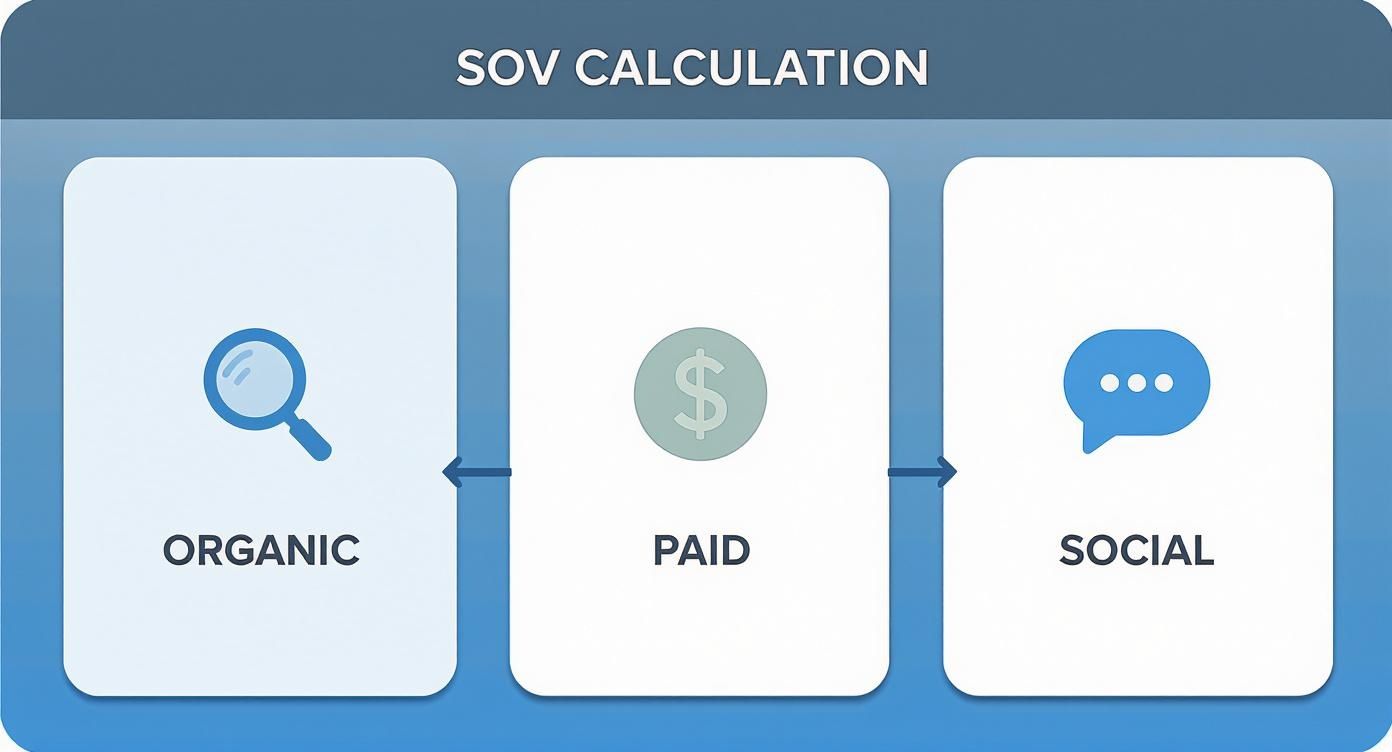
Each of these channels is its own competitive arena. Mastering your visibility across them is how you boost your overall SOV and set the stage for growth. For today's tech companies, having a smart strategy for AI brand tracking for SaaS companies is absolutely critical to accurately measure and expand your presence in these new digital frontiers.
Measuring SOV in the New Era of AI Search

The ground is shifting under our feet again. This time, it’s the rise of AI-powered assistants like ChatGPT, Perplexity, and Google’s AI Overviews that are changing the game. These tools don’t just give you a list of links; they often deliver a single, confident answer.
This new reality forces a tough question: When there's only one answer, how in the world do you measure your visibility?
It's clear that old-school SEO metrics like keyword rankings are quickly becoming obsolete. On this new frontier, the classic share of voice definition is being stretched to include visibility inside these AI-generated responses. We’re moving from a one-to-many model (a search results page) to a much more cutthroat one-to-one model (a single AI answer).
From Share of Voice to Share of Answer
Suddenly, the new benchmark for success isn’t just getting on the first page; it's being cited as the source within the AI's response. This shift has given rise to a few new ways of thinking about SOV in an AI-first world.
- Share of Answer: This is the big one. It measures how often an AI mentions or recommends your brand for relevant questions compared to your competitors.
- Share of Recommendation: A more specific slice of the pie, this tracks direct recommendations like, "What's the best pizza near me?" or "top accounting software."
- Source Citations: This metric tracks how often your website is used as the source material for an AI's answer, cementing your status as an authority.
The ultimate goal is to become the trusted source the AI relies on. Being cited in a single AI-generated response can be more impactful than ranking on the first page of a traditional search engine, as it positions your brand as the definitive answer.
Measuring this new kind of visibility is tough. AI models can feel like "black boxes," making it nearly impossible to see what's happening inside without the right tools. This is where dedicated monitoring becomes essential.
To win here, brands and agencies have to look beyond the old playbook. Having a solid strategy for LLM visibility tracking for agencies is no longer a "nice-to-have"—it's critical for protecting and growing your brand's presence in this next wave of digital discovery. You have to make sure you own the most important answer of all.
Your Share of Voice Questions, Answered
As we've unpacked what share of voice means today, a few questions tend to pop up. Let's tackle them head-on to clear things up and help you focus your strategy.
What Is a Good Share of Voice Benchmark?
This is the million-dollar question, but the answer isn't a single number. A "good" SOV is always relative to your direct competitors and your current slice of the market. There's no universal magic percentage.
However, a fantastic rule of thumb is to aim for a share of voice that's higher than your current market share. This principle is known as Excess Share of Voice (ESOV), and it's a well-established predictor of future growth. So, if your business currently holds 10% of the market, shooting for an SOV of 15% is a power move that signals you're serious about expansion.
How Does SOV Differ from Reach or Impressions?
It's easy to get these tangled up, but they measure fundamentally different things.
Think of it this way:
- Impressions & Reach: These metrics are about potential. They tell you how many eyeballs could have seen your ad or content. It’s the size of your possible audience.
- Share of Voice: This metric is about reality. It measures how much of the actual conversation in your market you truly own compared to everyone else. This is about competitive dominance, not just audience size.
Impressions alone can be misleading. You might be celebrating a huge reach, but if your main competitor's reach is ten times bigger, your voice is still getting drowned out.
A simple way to remember it: Reach tells you how big the room is. Share of voice tells you who everyone in that room is actually listening to.
Is Share of Voice Still Relevant Today?
Absolutely. In fact, it might be more critical than ever. The old-school ad metric has evolved into a full-blown health indicator for your brand's influence.
As our digital world gets more fragmented—and as AI assistants increasingly become the gatekeepers of information—knowing your true visibility is essential. SOV forces you to look beyond your own analytics bubble and see how you really stack up in the market. It's the ultimate reality check.
Curious what AI assistants like ChatGPT and Perplexity are saying about your brand right now? TrackMyBiz gives you the visibility needed to measure and protect your share of voice in the new age of AI discovery. Start a free scan today and see where you stand.
