
Ever had that sinking feeling when your traffic drops, but your trusty old SERP position tracker insists everything is fine? It’s not a glitch. It’s the new reality of search, where clinging to numbered positions means you’re missing the bigger picture.
Is Your Old SERP Position Tracker Obsolete?
For years, the deal with search engines was simple: get a high rank, get the clicks. We all knew the game. Hitting that #1 spot meant capturing a massive 27.6% of the click-throughs, a metric that tied rank directly to revenue. It was a straightforward world, and for a deep dive on why tracking was (and is) so vital, the historical data on SERP importance makes a compelling case.
But that model is cracking under pressure. The rise of AI assistants and generative search experiences, like Google's SGE, is creating a SERP that's far more complex and conversational. Your brand might get a glowing recommendation in an AI-generated answer without a single blue link in sight.
How do you track that?

The Limitations of Traditional Rank Tracking
A classic SERP position tracker is like a speedometer. It’s great at telling you how fast you’re going, but it can't tell you if the highway you're on even leads to your destination anymore. These tools were built for a world of ranked lists, not conversational AI.
They fall short in a few critical ways:
- They're blind to AI answers. They have no way of knowing when your brand is cited, recommended, or even mentioned within a generative response.
- They can't measure sentiment. A traditional tracker doesn't know if an AI is praising your product or misrepresenting it with negative context.
- They miss competitor mentions. You're completely in the dark when a competitor is recommended for your core service in an AI chat.
This visibility gap is a huge problem. Your rank for "best project management tool" might be holding steady at #3, but if an AI assistant recommends three of your competitors by name, that rank is suddenly worth a whole lot less.
The core challenge today is that visibility is no longer just a numbered rank. True search presence means being the trusted source cited inside AI-generated summaries—a metric old tools simply can't measure.
To give you a clearer picture, here's how the old and new worlds of tracking stack up.
Traditional vs Modern SERP Tracking Capabilities
This table quickly breaks down the gap between legacy tools and what modern, AI-aware solutions can do.
| Tracking Aspect | Traditional SERP Tracker | Modern AI-Aware Tracker |
|---|---|---|
| Primary Focus | Numbered keyword rankings | Brand mentions & authority |
| AI Answer Visibility | No | Yes, detects brand citations |
| Sentiment Analysis | No | Yes, tracks positive/negative context |
| Competitor Tracking | Tracks their ranks | Tracks their mentions in AI |
| Misinformation Alerts | No | Yes, flags incorrect brand info |
| Key Metric | Keyword Position | BrandRank / AI Share of Voice |
The difference is stark. While traditional tools are stuck looking at a single lane, modern trackers give you a complete map of the entire search landscape.
Introducing BrandRank and LLM-Aware Tracking
To navigate this new terrain, you need a new way of thinking. This is where the concept of BrandRank comes in—it’s a measure of your brand’s authority and presence within AI and large language models (LLMs).
Instead of just looking at keyword positions, BrandRank quantifies your actual visibility where users are now looking for answers. LLM-aware tracking is the technology that makes measuring this possible, finally giving you a complete and accurate picture of your true performance in search.
For agencies, figuring out how to apply these new metrics is a game-changer, which is why we've put together a dedicated guide on LLM visibility tracking for agencies.
Navigating the New Search Landscape
To really get a handle on what’s happening in search, you have to stop thinking about the old SERP. Remember the classic list of blue links? It was like a library's card catalog—a simple, organized list pointing you to different resources. Your only job was to get to the top of that list.
Today, AI-powered search is something else entirely. It's less like a catalog and more like a conversation with a super-knowledgeable librarian. Instead of just pointing you to the right aisle, it reads all the relevant books for you and gives you a direct, synthesized answer. This changes everything for anyone trying to measure their online visibility, and it completely redefines what a serp position tracker needs to do.
AI assistants like Google's SGE and Perplexity are fast becoming the first stop for users. They create brand-new, unique answers by pulling information from dozens of sources. They’ll often mention brands and recommend products without a single link in sight. Your company could be hailed as the best solution for a problem, and your traditional rank tracker would be completely blind to it.
The Emergence of BrandRank
This new world demands a new way to measure success. We call it BrandRank—it’s a measure of your brand’s authority and visibility inside AI-generated answers. It goes beyond chasing a #1 position and instead quantifies how often you're cited as a credible source or recommended by the AI itself.
Think of it like this: a traditional rank tracker tells you your position on the shelf, but BrandRank tells you how often the librarian recommends your book. That’s a massive difference, because trust is now being built directly within the AI's response, not just by seeing your name at the top of a list.
Your visibility is no longer defined by a number on a list. It’s defined by your presence inside the answer itself. Being mentioned as an authority by an AI is the new #1 position.
If you’re not tracking this, you’re missing a huge piece of the puzzle. You could be losing ground to competitors who are getting consistently recommended by AI, and you’d never even know it.
Why Unlinked Mentions Matter
It used to be that an unlinked brand mention was just a missed SEO opportunity. Now, it's a powerful signal of authority. When an AI like ChatGPT or Gemini mentions your brand, it's treating you as a known entity—a trusted part of the conversation.
These mentions have a real, tangible impact on your business:
- Brand Recall: People see your name presented as a solution. This builds familiarity and trust, even if they never click a link.
- Purchase Decisions: An AI recommendation can be the final nudge a customer needs to make a choice, especially for bigger-ticket items.
- User Trust: A citation from a neutral AI builds a kind of credibility that ads or even top organic rankings struggle to match.
This shift means your entire content strategy needs to evolve. The goal isn't just ranking for keywords anymore; it's about becoming such an authoritative source that AI models have no choice but to trust and cite you. To really get ahead, you have to understand how to build a presence in this new world of answer engine optimization.
At the end of the day, the search landscape has become more dynamic and far more conversational. Your tracking strategy has to keep up. It needs to measure what truly matters now: your brand’s voice and authority in these critical AI-driven discussions. The right serp position tracker isn't just about watching lists anymore; it's about listening to the new conversation.
Measuring What Matters in AI-Driven Search

As AI completely redefines what a search result looks like, clinging to old-school metrics is like trying to navigate a new city with a torn, outdated map. It just won't work. To really get a handle on your performance, you need a dashboard built for this new world—one that looks past simple keyword positions to measure your actual influence in AI-generated answers.
This means your whole focus needs to shift. Instead of chasing a single ranking number, you need to track a handful of new signals that show your brand's real authority. The goal isn't just to rank anymore; it's to be cited, recommended, and represented accurately.
Let's break down the metrics that truly define success in this new environment.
Tracking Brand Mentions in AI Answers
The most basic, fundamental metric in this new world is the Brand Mention. It's a simple count of how many times an AI assistant names your brand when answering a relevant question. Think of it as word-of-mouth marketing, but delivered by an AI at massive scale.
Every single mention, even one without a link, builds brand recall and cements your status as a key player. If you're ignoring these citations, you're missing the main way AI models signal trust and authority to users. A jump in mentions is one of the best leading indicators of growing brand equity.
Measuring Share of Voice in AI
Knowing your own mention count is a great start, but it's only half the story. You have to know how you're doing compared to everyone else. This is where Share of Voice (SoV) in AI Answers comes in.
SoV calculates the percentage of total brand mentions you own for a specific set of keywords versus your competitors. For example, if the query "best accounting software" generates 10 total brand mentions in AI answers and your brand is named three times, your SoV is 30%.
This metric gives you an immediate competitive benchmark that traditional rank tracking completely ignores. It answers the most important question: "When people ask about my industry, is the AI recommending me or my rivals?"
Understanding this dynamic is everything. Using smart competitor AI analysis tools lets you see exactly where you stand and find chances to grab a bigger piece of the conversation.
Monitoring the AI Hallucination Rate
Finally, not all mentions are good mentions. AI models can—and frequently do—get things wrong. The Hallucination Rate is a critical safety metric that tracks how often an AI misrepresents your brand, products, or services.
These mistakes can be minor annoyances, like quoting the wrong business hours, or they can be serious fabrications that wreck your reputation. An AI could invent pricing tiers you don't offer, list product features that don't exist, or even falsely report that your business is closed for good.
A modern SERP position tracker absolutely must have a way to spot these falsehoods. Monitoring your hallucination rate is non-negotiable for brand safety. It allows you to find and fight misinformation before it costs you customers and erodes trust.
How to Implement an AI-Aware Tracking Strategy
Switching to an AI-aware strategy doesn't mean you have to rip up your old playbook. Think of it as adding a new, absolutely critical chapter. A modern SERP position tracker requires a shift in mindset—moving from a narrow focus on rankings to a broader view of your brand’s presence in AI answers. It all starts with a brutally honest look at where your blind spots are today.
The first step is a frank audit of your current tracking. Look at the tools and reports you're using right now. Can they tell you if your brand was mentioned—but not linked—in an AI summary? Do they flag when a competitor gets recommended for one of your core services? If the answer is "no," you're flying blind in the new world of conversational search.
Define Your Core Brand Concepts
Once you see the gaps, it's time to define what you actually need to track. This goes way beyond a simple list of keywords. You need to map out the core concepts, products, and questions that define your brand’s entire space in the market.
Put yourself in your customer’s shoes and think about what they would ask an AI assistant. Your tracking list should include:
- Brand Keywords: Your company name, all your product names, and even the common ways people misspell them.
- Competitor Names: You absolutely have to know when and why AI assistants are talking about your rivals.
- "Best of" Queries: Track phrases like "best software for X" or "top solutions for Y" that are relevant to what you sell.
- Problem-Based Questions: Include the exact questions your customers ask, like "how to solve [common pain point]"—where your product is the answer.
For a deeper dive into finding these terms, a good guide on Mastering Keyword Position Monitoring for SEO can offer some invaluable strategies to build a solid foundation.
Configure Intelligent Alerts and Regional Checks
With your core concepts defined, you can set up your monitoring system. A truly modern SERP position tracker isn't just about rank changes; it’s about intelligent alerts that notify you of events that directly impact your brand's reputation and visibility in AI conversations.
Set up alerts for these make-or-break moments:
- New Brand Mentions: Get an instant notification anytime your brand pops up in an AI answer, whether it's good or bad.
- Sentiment Shifts: Configure triggers for when the tone or context around your brand mentions changes in a meaningful way.
- Competitor Recommendations: Receive an alert the moment a competitor gets recommended for one of your core "best of" queries.
- Misinformation Detected: This is the big one. You need an immediate flag for any instance of an AI hallucinating incorrect facts about your business. For SaaS companies, this is especially critical, and our guide on AI brand tracking for SaaS companies provides a detailed framework.
Beyond just alerts, you have to account for location. An AI might give a completely different answer about your services in New York versus London. That's why configuring regional checks is non-negotiable if you want to capture a global or even a multi-city audience.
The objective is to move from a reactive to a proactive stance. Instead of discovering a drop in traffic and trying to find the cause, you get an instant alert about the AI-driven event that preceded it.
Finally, you need a game plan. When an alert flags a negative mention or a dangerous hallucination, your team can't be scrambling. They need a clear, step-by-step protocol to address the issue, whether that’s using feedback mechanisms, pushing out new content, or taking other corrective actions. This is how you turn data from your SERP position tracker into a repeatable process for protecting and growing your brand.
Real-World Wins with Modern SERP Tracking
Theory is one thing, but the real power of a modern SERP tracker lights up when you see it in action. Let's move past the metrics for a minute and look at how actual businesses are turning AI-driven search insights into real money. These aren't just small adjustments; they're strategic moves that protect revenue and open up entirely new ways to grow.
The following examples show how an updated tracking strategy delivers clear business value, shifting from just passively watching rankings to proactively managing your brand where it matters most today. Each story dives into a specific problem created by AI search and the straightforward solution a modern tracker provides.
Uncovering Hidden Opportunities in E-Commerce
Picture this: you run an e-commerce brand selling high-end, sustainable coffee gear. Your traditional rank tracker shows your position for "best pour-over kettle" is solid, but for some reason, your organic traffic is slowly bleeding out. It's a frustrating puzzle that old-school tools just can't solve.
This is exactly where a modern tracker flips the script. By monitoring AI answers, the brand discovers it’s getting mentioned all the time in AI-generated gift guides for queries like "unique gifts for coffee lovers" and "eco-friendly kitchen gadgets." These are goldmines—valuable, high-intent mentions their keyword list was completely blind to.
Armed with this new intel, the marketing team pivots. They roll out a new series of blog posts and landing pages targeting these "gift guide" themes, doubling down on the signals the AI models are already loving. The result? A 15% lift in organic traffic the very next quarter, all from an opportunity that was completely invisible before.
Finding and acting on these AI-driven insights isn't guesswork; it can be a clear, repeatable workflow.
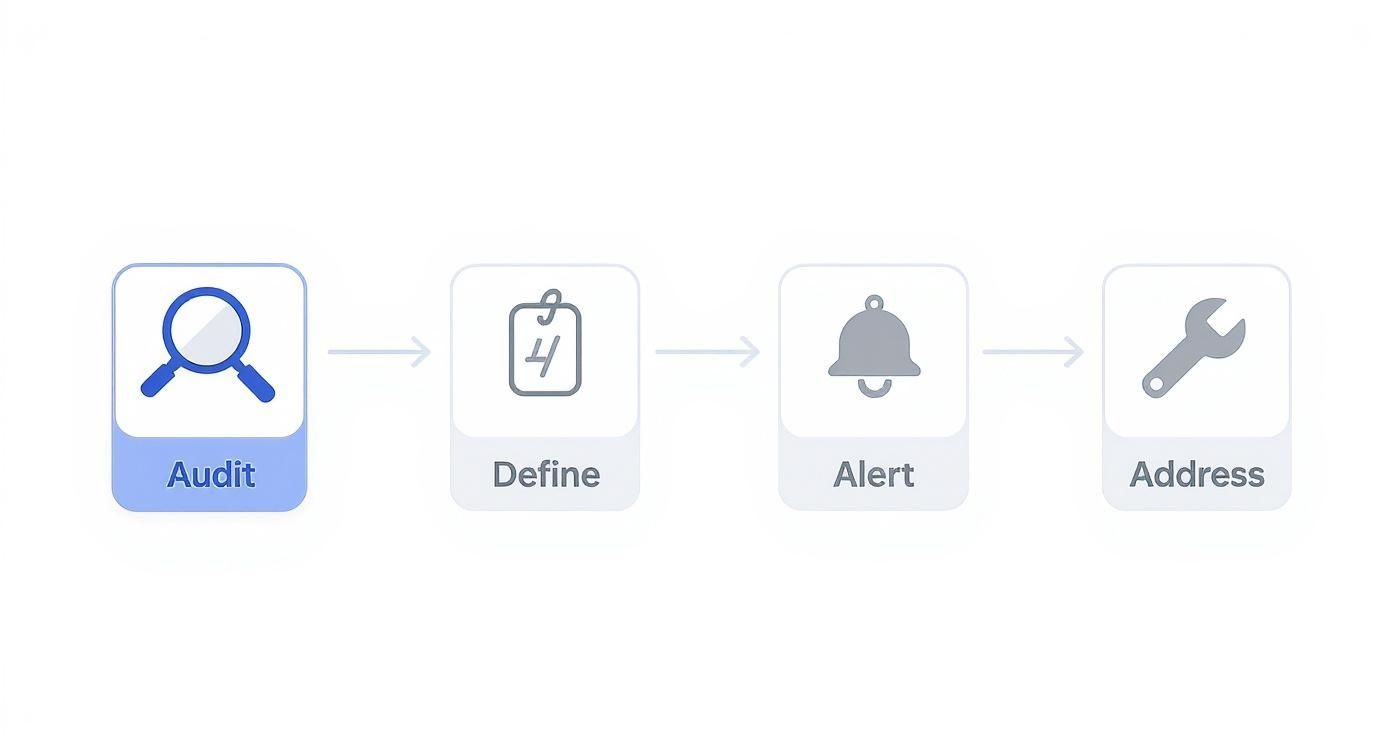
This four-stage process—from auditing your visibility to addressing issues—creates a simple loop for managing your brand in this new AI-first world.
Correcting Costly AI Hallucinations for a SaaS Company
Now, let's switch to a B2B SaaS company. They sell project management software with a simple three-tier pricing structure. Out of the blue, their support team starts getting strange questions from potential customers asking about a fourth, much cheaper "unlimited" plan. The problem? That plan has never existed.
Using a modern SERP position tracker with hallucination detection, the company pinpoints the source in minutes. For certain queries, an AI assistant was confidently inventing a phantom pricing tier, creating confusion and setting wildly false expectations. This wasn't a minor glitch; this misinformation was actively killing leads.
An AI hallucination isn't just a technical bug; it's a direct threat to your sales pipeline and brand integrity. Without a way to spot it, you're letting an algorithm rewrite your business model.
The team immediately reports the error using the AI's feedback tool and, at the same time, publishes a crystal-clear, optimized article on their own blog titled "Understanding Our Pricing." The tracker confirms the bad information is gone within days, and the confusing support tickets stop. This quick action plugged a hole in their sales funnel and reinforced their brand as transparent and trustworthy.
Dominating Local Search for a Service Business
Finally, let's look at a local plumbing company with shops in three neighboring cities. They're scratching their heads, wondering why appointment bookings are through the roof in one city but lagging in the other two, even though their local SEO seems strong everywhere.
A traditional SERP tracker confirms they're ranking well for "plumbers near me" in all three spots, offering zero clues about the performance gap. But an AI-aware tracker with regional checking tells the real story.
In their best city, AI-generated answers consistently crown them the "#1 choice for emergency plumbing." In the other two, a competitor is snagging that top mention. The AI is making a specific, authoritative recommendation that makes users act fast, and that recommendation was changing from one zip code to the next.
This hyper-local insight was the key. The business tailored their content and Google Business Profile for the underperforming cities, hammering home language around "emergency services" and "24/7 availability." This targeted tweak helped them win the top AI recommendation across all their service areas, leveling the playing field and driving appointments right where they were needed most.
Common Questions About Tracking Your Brand in the AI Era
When the search landscape shifts this dramatically, it's natural to have questions. The old rules of SEO are being rewritten, and understanding how to adapt your tracking is the first step. Let's tackle some of the most common questions teams have about monitoring their brand in this new world of AI-driven search.
A traditional SERP position tracker is simple: it tells you your rank on a list of blue links, like #3 or #8. But BrandRank is different. It measures if you're actually inside the AI-generated answer. Are you being cited as a source? Are you being recommended as a solution?
It’s the difference between knowing your product's shelf placement in a store versus knowing how often the expert staff recommends your product by name.
How Can I Start Tracking My Brand in AI Answers?
Getting started is simpler than you might think. The first step is to list the core topics, product names, and competitor brands that are central to your business. A modern SERP position tracker like TrackMyBiz takes that list and continuously scans different AI models for any mention of those terms.
This gives you a clear baseline of where you stand in conversational search today. From there, you can measure growth, spot opportunities, and protect your brand's reputation as the AI landscape evolves.
The key is to shift your focus from a narrow list of keywords to a broader understanding of the topics and questions for which your brand should be the definitive answer.
Can a Modern SERP Tracker Help with Competitor Analysis in SGE?
Absolutely. In fact, this is one of its most powerful uses. A traditional SEO tool might show you a competitor's ranking, but an AI-aware tracker shows you when Google’s SGE is actively recommending them over you.
You can instantly see things like:
- Which competitors are winning the "best of" or "top solution for" queries.
- The exact sources and language AI models are using to praise them.
- Content gaps on your own site that are causing AI to cite a competitor instead.
This isn't just ranking data; it's competitive intelligence you can act on immediately.
How Often Should I Check My Brand Visibility in AI Search?
AI answers are far more fluid than traditional search rankings. They can change day-to-day based on new data or even subtle shifts in the AI models themselves.
For your most critical brand terms and high-value customer questions, daily monitoring is essential. This is how you catch a brand-damaging "hallucination" or a new competitor mention the moment it happens. For broader, more informational topics, weekly checks can still give you a solid handle on performance trends and your overall share of voice.
Ready to see what AI is saying about your business? The TrackMyBiz platform provides the clarity you need to protect your brand and win in the new era of search. Start your free, no-obligation scan today to uncover your current BrandRank in minutes at https://trackmybusiness.ai.
