
SERP feature analysis is just a fancy way of saying you're looking at everything on a search results page that isn't a standard blue link. It means identifying and making sense of all the other stuff—Featured Snippets, Local Packs, AI Overviews, you name it—to find your next big SEO win. Why? Because those features are what grab a user's attention and, more importantly, their clicks.
Why SERP Feature Analysis Is Essential for Modern SEO
If your entire SEO strategy is still laser-focused on hitting that number one organic spot, you're playing yesterday's game. The SERP isn't a simple, ordered list anymore. It’s a dynamic, visual dashboard where traditional rankings are often just a small piece of a much bigger, more complicated puzzle.
Ignoring this reality means you're leaving a massive amount of traffic and visibility on the table. Success in modern SEO comes from understanding the entire search environment, not just one part of it. A proper SERP analysis shows you what you're really up against and lights up new paths to visibility that simple rank tracking will never reveal.

Beyond Traditional Rank Tracking
Let’s be honest: ranking number one means very little if your link is buried below a massive AI Overview, an Image Pack, and a "People Also Ask" box. Proactive analysis forces you to adapt your strategy to what searchers actually see and interact with.
When you start digging into the features, you can:
- Spot Untapped Opportunities: You might find keywords where winning a Featured Snippet or landing in the Local Pack is totally achievable, even if you can't dream of outranking the organic giants.
- Defend Your Turf: See exactly when and how a competitor steals valuable SERP real estate. This lets you dissect their content changes and mount a smart, effective counter-attack.
- Future-Proof Your Strategy: Google is always testing and rolling out new elements. Continuous monitoring ensures you're one of the first to spot, understand, and capitalize on these changes.
The real win here is shifting your mindset from a reactive "What's my rank?" to a proactive "Where can I be most visible?" It’s about owning the most valuable digital real estate, not just having the highest street address.
The Tangible Impact on Growth
This isn't just theory; it translates directly into hard business results. For example, a SaaS company saw a 312% jump in organic traffic just by optimizing its top 50 informational keywords to capture featured snippets. The crazy part? Their actual organic rank positions didn't even improve.
In another case, an e-commerce site boosted revenue by 47% through targeted optimization of visual features like image packs and shopping results. You can read more about these SERP feature growth findings if you're curious.
These examples drive home a critical point: optimizing for the format of the search results is every bit as important as optimizing for the keywords themselves. This guide will give you the framework to master this process and turn SERP insights into real, measurable growth.
Building Your SERP Analysis Toolkit and Framework
Running an effective SERP feature analysis is a lot more than just plugging a keyword into Google. If you want a real, unfiltered view of the search landscape, you need a structured game plan. This means getting the right tools, figuring out a smart way to collect data, and building a solid framework for what you’re actually going to track.
This foundation is what turns a mountain of raw SERP data into sharp, actionable SEO insights.

Without a system, you’re just spot-checking. You’re seeing a single moment in time without ever understanding the trends. Building out a proper toolkit is how you graduate from random observations to a continuous, strategic monitoring process.
Assembling Your Core Toolkit
Your analysis arsenal really breaks down into two key parts: manual checks for the qualitative, "on-the-ground" view, and automated platforms for getting quantitative data at scale. Leaning on just one of these gives you a dangerously incomplete picture.
Manual spot-checks are gold for understanding the nuance of a SERP. Firing up your browser’s incognito mode and using a VPN to spoof different locations lets you see exactly what a real user sees in a specific context. This is the perfect way to dig into the "why" behind a weird ranking or a new feature popping up.
But let's be real—manual checks are impossible to scale. For that, you absolutely need automated SERP tracking platforms. Tools like Semrush, Ahrefs, or Moz are non-negotiable for keeping an eye on hundreds or thousands of keywords over time. They provide the historical data you need to do any real trend analysis.
For a next-level view, it's worth exploring the various competitor AI analysis tools out there. They can give you a heads-up on how rivals are showing up in emerging formats like AI Overviews.
A classic mistake is getting completely lost in the automated data. Some of the best insights I've ever had came from spotting a trend in the numbers and then immediately jumping into a manual SERP deep-dive to understand the actual user experience behind it.
Defining What to Track and How to Sample
Just hoovering up data is useless; you need to collect the right data. A strong framework always starts with a well-defined sampling method. This keeps your analysis focused on what actually matters to your business goals. It all comes down to picking the right keywords and setting a realistic tracking schedule.
First, segment your keyword sets by user intent. This makes the insights much clearer. A solid starting point is to group them like this:
- Branded Keywords: Any query that includes your company or product name. Here, your job is to defend your brand's turf and make sure things like Knowledge Panels and AI Overviews are accurate.
- Informational Keywords: Think "how to," "what is," and "best way to" searches. These are prime opportunities to snag Featured Snippets and "People Also Ask" boxes.
- Transactional Keywords: These are the money-makers with high purchase intent, like queries including "buy," "price," or "for sale." For these, you need to be obsessively monitoring Shopping results, Local Packs, and product-focused Rich Snippets.
Once your keywords are segmented, decide how often you need to check them. Not every keyword is worth a daily ping.
- Daily Tracking: Save this for your most valuable, high-stakes "money" keywords and branded terms where your reputation is on the line.
- Weekly Tracking: This is the sweet spot for important informational and transactional keywords where you're actively trying to win or defend SERP features.
- Monthly Tracking: This is totally fine for broader, long-tail keyword sets where you just need to monitor general trends, not daily shake-ups.
This tiered approach keeps your tool costs in check and, more importantly, prevents you from drowning in data. It focuses your attention right where it needs to be.
Key Metrics for Your SERP Feature Tracking
To get beyond simple "yes/no" tracking, you need to monitor specific metrics that actually reveal strategic opportunities. A good dashboard doesn't just count features; it focuses on metrics that tie back to business impact.
Here's a breakdown of the essential metrics to monitor, what they reveal, and their strategic importance for your SEO efforts.
Key Metrics for Your SERP Feature Tracking
| Metric | What It Measures | Why It Matters for SEO Strategy |
|---|---|---|
| Feature Presence Rate | The percentage of your tracked keywords that trigger a specific SERP feature. For example, AI Overviews appear for 60% of your target list. | This tells you which features are most relevant in your niche, so you can prioritize where to spend your optimization time. |
| Feature Ownership | The percentage of time your domain appears inside a specific feature when that feature shows up. | This is your true "share of voice" for a given feature. It's a direct measure of how well your content is performing in that format. |
| Feature Volatility | How frequently the content—or the owner—of a SERP feature changes over a set period. | High volatility means a feature is unstable. It might be easier to win (or easier to lose), which directly informs your competitive tactics. |
| Position in Feature | For features with multiple results like Local Packs or video carousels, this tracks your rank within the feature itself. | Showing up in the Local Pack is great, but being in the #1 spot is a completely different ballgame for click-through rates. |
| Above-the-Fold Presence | Whether your organic link or SERP feature appears without the user having to scroll down the page. | This is a make-or-break visibility metric. A massive feature can push even a #1 organic ranking below the fold, killing your clicks. |
Tracking these more nuanced metrics is how you shift from basic observation to true strategic analysis.
You can finally start asking the right questions: "Are we only winning snippets for low-volatility keywords?" or "Is our main competitor starting to dominate Image Packs for our most valuable transactional terms?" Getting this level of detail is where you’ll find your next big competitive advantage.
How to Analyze Historical SERP Data for Strategic Insights
Looking at a SERP today gives you a snapshot. That’s useful, but the real strategic gold is in looking backward. Historical SERP data is like a time machine for your SEO strategy, letting you rewind the search results to see exactly how the landscape has shifted over time. It’s the difference between seeing a single frame and watching the whole movie.
This retrospective view is critical because search results are anything but static. Features pop up, vanish, or get stolen by competitors all the time. Without historical context, you're just reacting to today's fire instead of anticipating tomorrow's challenges based on clear patterns.
Uncovering Trends and Tracing Performance
When you start digging into past SERP layouts, you uncover powerful trends you would have otherwise completely missed. It connects the dots between a change Google made and a sudden dip in your traffic, finally giving you clear cause-and-effect answers.
With historical data, you can stop guessing and start answering the questions that actually matter:
- When did we lose that Featured Snippet? Pinpoint the exact week a competitor’s content update knocked you out of position zero. Now you have a clear "before and after" to analyze what they did right.
- Did a Google update kill our Local Pack visibility? Correlate known algorithm updates with historical shifts in your local rankings to see their direct impact on your business.
- Are there seasonal patterns in video carousels? You might discover that video results spike for your keywords during the holidays, giving you a perfect reason to adjust your content calendar.
Since August 1, 2021, platforms have given SEOs access to this rich historical data, allowing us to pull up snapshots of Google search results from specific dates in the past. It’s how you uncover gaps in old strategies, understand the evolution of the SERP, and pinpoint the moment a valuable feature like a Local Pack or Knowledge Panel appeared or disappeared. A single day's ranking is just noise; the historical trend is the signal. You can discover more insights about historical SERP data and what it can do for your strategy.
Historical SERP feature analysis transforms your approach from guessing to knowing. You stop asking, "What happened to our traffic?" and start saying, "Our traffic dropped on May 15th, the same day an AI Overview appeared and pushed our #1 ranking below the fold."
A Real-World Scenario for Multi-Location Brands
Let's make this real. Imagine you're running SEO for a national coffee chain with hundreds of locations. Your whole game is about driving foot traffic, so the Google Local Pack is your most valuable piece of SERP real estate. Your rank tracker says rankings are "stable," but for some reason, in-store visits are down across the entire Midwest.
So, you dive into the historical SERP data for keywords like "coffee shop near me" in cities across Ohio and Michigan. Suddenly, you spot it. Three months ago, a new local competitor started consistently grabbing the #1 spot in the Local Pack across that whole region.
This screenshot from DataForSEO shows what this kind of historical SERP timeline can look like.
The insight here is huge. The problem wasn't a vague, site-wide ranking drop. It was a targeted competitive loss in a specific feature and region that only historical data could have revealed.
Now you have a clear, data-backed action plan. Instead of a generic, company-wide "let's improve local SEO" memo, you can get surgical.
You can launch a campaign to generate positive reviews just for those underperforming Midwest locations. Your content team can create localized blog posts and optimize the Google Business Profiles for those specific stores. By using historical data, you’ve diagnosed the exact problem and can now pour your resources where they’ll have the biggest impact, building a much smarter local SEO strategy for the future.
How to Handle the Wild West of AI-Driven Search Results
Today’s search results page is nothing like it was a year ago. It's no longer a neat, predictable list of ten blue links. Instead, it’s a fluid, constantly shifting landscape, and that change is being driven almost entirely by the rapid integration of artificial intelligence into search.
If you’re serious about SEO, just understanding this volatility isn’t enough. You have to learn how to navigate it—it’s the core of the job now. New elements like AI Overviews have injected a level of unpredictability we haven't seen in years, appearing, disappearing, or completely rewriting themselves overnight.
The Unstable Nature of AI SERPs
Think traditional organic rankings are volatile? AI-driven features are in another league entirely. They are in a constant state of flux, with platforms testing and refining them on the fly. This means the sources they cite and the answers they generate can change without any warning at all.
This instability creates both a massive threat and a huge opportunity.
A recent study drove this point home, finding that over a two- to three-month period, around 70% of pages featured in AI Overviews saw their rankings change. That’s a churn rate significantly higher than what we see in traditional organic results. The data confirms what many of us have suspected: AI-driven SERP elements are far less stable and way more competitive. It also proves that AI Overview rankings and classic organic results are evolving on separate tracks. You can discover more research about search result evolution to get the full picture.
What this means for you is that a simple quarterly review of your SERPs won't cut it anymore. For your most important keywords, you need a near-real-time pulse on what the AI is saying and who it’s citing.
Spotting and Reporting AI Hallucinations
One of the biggest risks in this new world is the AI hallucination—when a large language model (LLM) spits out information that's factually wrong, misleading, or completely made up. For a brand, this can be catastrophic.
Imagine an AI Overview telling potential customers your restaurant is "permanently closed" when you’re in the middle of a busy lunch service. Or a B2B software company whose product is described with features it doesn't have. These aren’t just hypothetical scenarios; they are happening to businesses right now.
Your SERP analysis has to include a clear workflow for catching and fixing these errors. Here’s a practical way to do it:
- Establish a Ground Truth: First, create a single internal document with all your critical brand facts. This should include business hours, addresses, official product names, key features, and current pricing.
- Regularly Query AI: Use automated tools or even just manual spot-checks to ask AI-powered search engines direct questions about your brand and products. Think like a customer.
- Compare and Flag: Cross-reference the AI's answers against your "ground truth" document. Any difference, no matter how small, gets flagged immediately.
- Report Inaccuracies: Use the feedback links built into the search engine (look for "feedback" or "report an issue") to report the hallucination. Provide the correct info and, if you can, a link to the source on your own website.
The critical takeaway here is that you simply cannot assume an AI will get your brand details right. Proactive monitoring is the only way to shield your reputation from damaging, often invisible inaccuracies that could be costing you real customers.
Building an Agile Monitoring Process
To keep up, you need a monitoring process that is just as dynamic as the SERPs themselves. This isn't about tracking your rank anymore; it's about tracking your brand's narrative as told by AI.
A solid process should focus on a few key areas:
- Share of Voice in AI: Don't just track if an AI Overview shows up. Track how often your brand is cited as a source compared to your competitors.
- Sudden Layout Changes: Set up alerts for when new features—like video carousels or different AI formats—pop up for your core keywords. A new feature can instantly shove your top-ranking page below the fold.
- Feature Ownership Shifts: Monitor when a competitor snags a feature you used to own. This is a clear signal to dig into their content and figure out how to win it back.
For agencies juggling multiple clients, building a scalable system for this is absolutely essential. You can learn more about how to set up LLM visibility tracking for agencies to operationalize this process without drowning in manual checks.
By adopting this agile approach, you shift from being a passive victim of SERP changes to an active participant, ready to defend your visibility and pounce on new opportunities the moment they appear.
Putting Continuous SERP Monitoring Into Action
Gathering data is the easy part. The real work starts when you turn that constant stream of information into a decisive, repeatable process. An effective SERP feature analysis program doesn't just collect insights—it forces you to act on them. This means building a system that alerts you to changes, guides your response, and helps you communicate the business impact to stakeholders who don't live and breathe SEO.
Without this operational layer, your analysis is just an academic exercise. You need a playbook that connects the dots between a shift in the SERP and a clear, immediate action from your team. This is how you move from simply watching the landscape to actively shaping your presence within it.
This workflow boils down the core loop of continuous SERP analysis into three simple, powerful steps: Detect, Report, and Adapt.
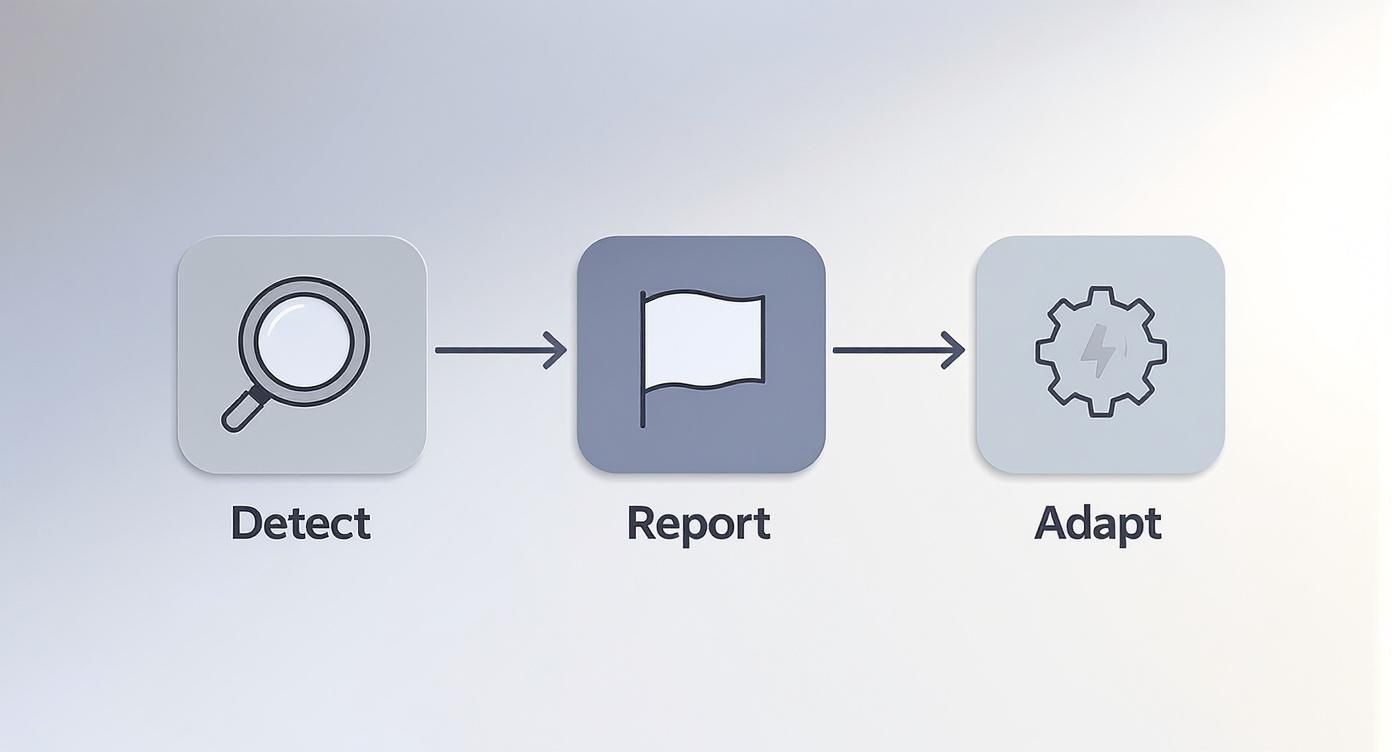
Following this cycle ensures no critical SERP change goes unnoticed or unaddressed.
Building Your SERP Monitoring Dashboard
Think of your dashboard as your command center. It needs to give you an at-a-glance view of your most critical SERP metrics, flagging both risks and opportunities without forcing you to wade through raw data. A well-designed dashboard isn't about cramming every possible metric onto one screen; it’s about telling a clear story.
Focus on visualizing these key trends:
- Share of Voice Over Time: Track your ownership percentage for key features like AI Overviews or Featured Snippets. A downward trend is your earliest warning that a competitor is gaining ground.
- New Feature Emergence: A simple chart showing when new features (like a video carousel or a new type of Rich Snippet) pop up for your target keywords can reveal emerging content opportunities you need to jump on.
- Competitor Feature Wins: Don't just track your own performance. Create a specific module showing which competitor is winning features you don't own. This is your primary source for competitive content analysis.
The goal of a dashboard isn't to present data; it's to provoke action. If you look at a chart and your immediate reaction isn't "we need to investigate that," then the visualization isn't working hard enough.
Crafting a Remediation Workflow
So, an alert fires—a competitor just stole a valuable Featured Snippet. What happens next? A clear remediation workflow removes the guesswork and ensures a swift, consistent response. Panic is not a strategy. A documented process is.
Your workflow should be a simple, standardized plan that anyone on your team can follow. It transforms a chaotic scramble into an orderly counter-attack.
Here’s a sample alert and response plan you can adapt. The goal is to have a pre-defined set of plays ready to go when the SERP landscape shifts.
SERP Monitoring Alert and Response Plan
A sample workflow for responding to common SERP feature changes, ensuring your team takes timely and effective action.
| SERP Event Trigger | Immediate Analysis Required | Actionable SEO Response |
|---|---|---|
| Competitor Wins Featured Snippet | Analyze the competitor's content structure. Look for clear, concise definitions, numbered lists, or tables that directly answer the query. | Restructure your own content to better match the snippet format. Add a "quick answer" paragraph at the top or convert prose into a scannable list. |
| New AI Overview Appears | Identify the sources the AI is citing. Analyze the sentiment and accuracy of the information presented about your brand and competitors. | Update your content with clear, factual statements. Create FAQ sections that directly answer common questions the AI is trying to address. |
| You Lose Local Pack Visibility | Check your Google Business Profile for accuracy (hours, address). Scan recent reviews for negative sentiment. Compare your profile to the new leader. | Launch a review generation campaign for that specific location. Update your GBP with new photos and respond to all recent reviews. |
By having this plan in place, you ensure that every critical SERP change triggers a specific, strategic action designed to protect or reclaim your visibility. It keeps the team focused and efficient.
Communicating Insights to Stakeholders
The final piece of the puzzle is translating your technical SERP findings into a language that executives understand: business impact. Reporting that you "lost a Featured Snippet" means nothing to them. But what about this? "A competitor now owns the top-of-page answer for our highest-converting keyword, putting 15% of our monthly lead volume at risk." That gets attention.
Frame your updates around core business metrics.
- Instead of: "Our share of voice in AI Overviews is down."
- Try: "Competitors are being recommended by AI 30% more often than we are for purchase-intent keywords, which could directly impact sales."
This translation is crucial. It connects your deep SERP analysis directly to revenue, brand reputation, and competitive positioning. For SaaS companies, in particular, showing this connection is key. To see these principles in action, check out how to build a robust system for AI brand tracking for SaaS companies.
Making this connection justifies your budget, validates your strategy, and elevates the role of SEO from a technical function to a core driver of business growth.
Got Questions About SERP Feature Analysis?
Even with a solid game plan, new processes always bring up questions. Shifting from old-school rank tracking to a deep SERP feature analysis is a big change, and it’s normal to hit a few bumps. Here are the answers to some of the most common questions we hear from teams making that leap.
Think of this as your quick-reference guide for the day-to-day realities of modern SERP monitoring. We'll clear up the practical details around how often to check, what to focus on, and how to prove your work is actually paying off.
How Often Should I Run a SERP Feature Analysis?
The honest answer? It depends entirely on how volatile your keywords are.
For your most competitive, high-stakes terms—the ones where AI Overviews and other dynamic features pop up all the time—you need to be on it weekly or even daily. A major shift, like losing a Featured Snippet that drove tons of traffic, is something you need to catch the moment it happens.
On the other hand, for more stable, long-tail informational keywords, a comprehensive deep-dive on a monthly or quarterly basis will probably do the trick. A good rhythm for agencies is to perform a major strategic analysis each quarter, but keep continuous, automated tracking running on the client's biggest money-making keywords. That way, you stay ahead of any sudden changes without drowning in data.
What’s the Most Important SERP Feature to Track?
There’s no magic bullet here. The "most important" feature is whichever one directly bridges the gap between a searcher's intent and your business goals. It's completely unique to you.
- Selling products online? Your world revolves around Image Packs and Shopping results. These are your digital storefront windows, and they're non-negotiable for transactional queries.
- A local service business? The Local Pack is everything. If you're not dominating it for "plumber near me," you're practically invisible to customers ready to pick up the phone.
- Running a B2B SaaS or content-heavy site? Featured Snippets and "People Also Ask" boxes are your bread and butter. This is where you capture top-of-funnel traffic from people looking for answers and solutions.
The best place to start is to see which features show up most often for your core keywords. That tells you where your biggest opportunities—and most immediate threats—are hiding.
Can I Do This Without Expensive Tools?
Sure, you can definitely get started with a manual analysis. Fire up your browser’s incognito mode, use a VPN to check different locations, and log what you find in a spreadsheet. It’s actually a fantastic way to get a qualitative feel for a SERP.
But let's be real: a manual approach is a massive time sink and gives you zero historical data or trend insights. For any serious, scalable effort, automated tools are a must. They give you the historical context, competitive insights, and sheer scale that you could never replicate by hand.
How Do I Measure the ROI of Optimizing for a SERP Feature?
This is the million-dollar question. To actually prove the ROI, you have to isolate the impact of winning that feature. First, you need a baseline. Dig into Google Search Console and Google Analytics to benchmark the clicks, impressions, and conversions for a specific URL before you owned the feature.
Once you’ve captured it (say, you snagged a Featured Snippet), track the change in click-through rate (CTR) and, most importantly, conversions. The pro move here is to annotate the exact date you acquired the feature in Analytics. This makes your before-and-after analysis dead simple and lets you draw a straight line from your optimization work to real business outcomes, whether that's leads, sign-ups, or sales.
As AI assistants become the new search bar, knowing what they say about you is critical. TrackMyBiz gives you the visibility you need, flagging brand mentions, competitor recommendations, and harmful hallucinations across models like ChatGPT and Gemini. See what AI is telling your customers by starting a free scan.
