
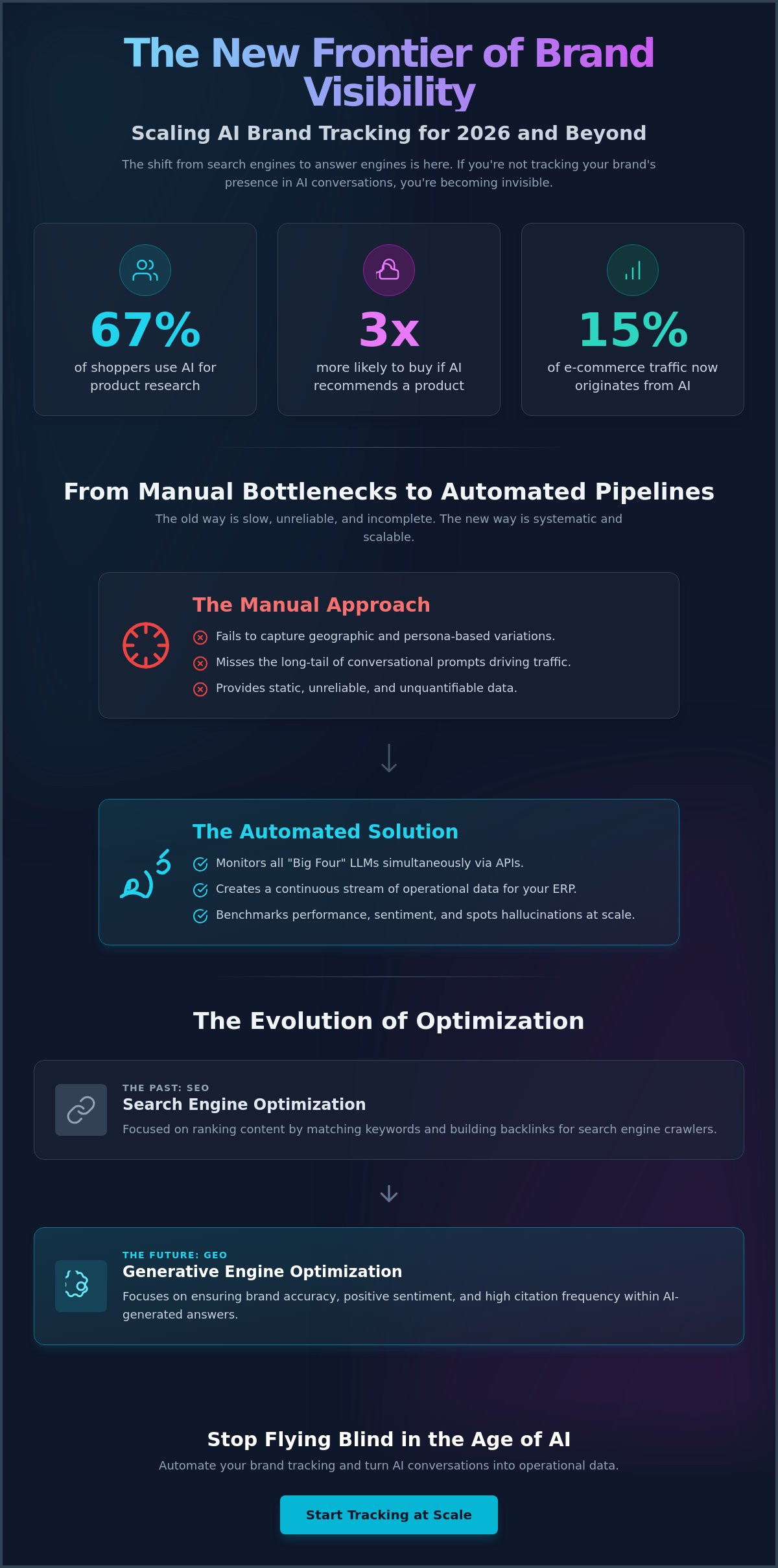
Did you know that 67% of shoppers now use AI for product research, and they’re three times more likely to buy a product if an AI recommends it? With 15% of e-commerce traffic now originating from AI platforms, the stakes for your brand’s visibility have never been higher. I’ve seen many teams struggle with manual prompting, finding it time-consuming and often failing to capture the full scope of how they’re mentioned. It’s frustrating when inconsistent answers from different LLMs make your data feel unreliable and difficult to quantify.
I believe that scaling ai brand tracking is not about running more manual searches; it’s about building an automated pipeline that treats LLM responses as operational data. You need a system that captures mentions across ChatGPT, Claude, and Gemini without the constant manual overhead. In this guide, I’ll show you how to transition to a scalable, automated system that provides clear data for your business operations. I will walk you through a repeatable framework for monitoring mentions at scale, integrating this information into your ERP systems, and benchmarking your performance against competitors within AI-generated responses.
Key Takeaways
- Learn how to move from traditional SEO to Generative Engine Optimization (GEO) by automating brand monitoring across multiple large language models.
- Understand how to utilize APIs and prompt engineering templates to query thousands of customer intents simultaneously.
- Discover the cost and accuracy advantages of scaling ai brand tracking through automation compared to manual human interpretation.
- Follow a five-step framework to audit your presence on the “Big Four” models and target the specific prompts that drive high-intent traffic to your brand.
- See how integrating LLM tracker software into your existing business operations creates a centralized hub for managing your brand’s AI reputation.
What is Scaling AI Brand Tracking and Why Does it Matter in 2026?
I define scaling AI brand tracking as the automated process of monitoring brand mentions across multiple large language models (LLMs) simultaneously. In the past, you might have logged into ChatGPT once a week to see what it said about your company. That approach doesn’t work anymore. As we move through 2026, the volume of AI-generated conversations has exploded. If you aren’t using a systematic way to track these mentions, you’re essentially flying blind in the most important discovery channel of the decade.
The shift from traditional Search Engine Optimization (SEO) to Generative Engine Optimization (GEO) is real. People aren’t just clicking links; they’re asking “Answer Engines” for recommendations. Whether it’s a B2B buyer looking for software or a B2C customer picking a pair of shoes, AI is the primary gatekeeper. Relying on manual checks is a bottleneck that prevents you from seeing the full picture of your brand’s health. Manual checks typically fail because:
- They don’t account for geographic or persona-based variations in AI responses.
- They miss the long-tail of conversational prompts that lead to your category.
- They provide a static snapshot in time rather than a continuous stream of operational data.
The Evolution from Web Scraping to LLM Monitoring
Traditional tracking focused on web scraping for specific keywords and backlink counts. Semantic mention tracking is different because it looks at how an AI model understands your brand’s identity within a conversation. Google looks for keywords, but an AI model “thinks” about your brand based on the patterns in its training data and the context of a user’s prompt. While the core goals of brand management haven’t changed, the tools we use must evolve. I define AI brand tracking as the systematic extraction of brand sentiment and citations from generative models.
Why 2026 is the Tipping Point for AI Visibility
We’ve reached a point where models like GPT-5 and Claude 4 are deeply integrated into daily workflows. We’re also seeing the rise of “Agentic” workflows. In these scenarios, an AI agent doesn’t just give a recommendation; it actually makes the buying decision for the user. If your brand isn’t visible or is being misrepresented by the model, you lose the sale before the human even knows it was an option. Business transparency is the new currency. If the AI can’t find reliable, clear information about your products, it will hallucinate or simply ignore you. This makes scaling ai brand tracking a necessity rather than a luxury for any brand that wants to stay relevant.
The Mechanics of Scaling: How Automated LLM Tracking Works
I believe that understanding the technical foundation of scaling ai brand tracking is essential for moving beyond manual guesswork. To track at scale, I use Application Programming Interfaces (APIs) to connect directly with the models. This bypasses the standard chat interface and allows for thousands of queries to be processed in parallel. It’s the difference between checking a single price tag and having a live feed of an entire stock exchange. By using APIs, I can ensure that the data collection is consistent, repeatable, and free from the session-based “memory” that can skew individual chat results.
I also employ “Prompt Engineering at Scale” to capture a wide variety of customer intents. Instead of asking one generic question, I use templates to query hundreds of variations. I might ask an AI to “recommend a solution for problem X” or “compare brand A to brand B” across different contexts. This creates a massive matrix of data. To make sense of it, I use “Semantic Reconstruction.” Since chat interfaces don’t provide traditional search volume, I reverse-engineer model preferences to see which brands appear as the most frequent and authoritative recommendations.
Scaling also helps me identify the “Hallucination Factor.” When I automate data collection, I look for recurring patterns of incorrect information. If a model consistently tells users that your product lacks a feature it actually has, that’s a systemic hallucination. Catching these at scale allows you to adjust your public-facing data so the models can “re-learn” the truth during their next crawl or update.
LLM-Native Tracking vs. Traditional Monitoring
Traditional SEO tools often fail to capture AI context because they’re looking for rigid keywords and backlinks. AI-native tracking focuses on citation frequency and sentiment analysis. I’ve stopped obsessing over “Share of Voice” and started focusing on “Share of Model” (SoM). This metric reveals how often a model chooses your brand as its primary recommendation. As discussed in the Harvard Business Review piece on How AI Can Power Brand Management, the goal is now to influence the model’s internal weights through high-quality, structured data.
Building a Multi-Model Pipeline
A reliable strategy requires tracking ChatGPT, Claude, Gemini, and Perplexity simultaneously. Each model has unique training biases. I also use “synthetic users” to simulate different personas. An AI might recommend your brand to a technical director but overlook it when speaking to a creative lead. Tracking across multiple models ensures that brand data isn’t skewed by the specific training biases or reinforcement learning of a single platform. Managing these complex variables is much more efficient when you use professional LLM tracker software to centralize your operational data.
Manual vs. Automated Scaling: A Comparative Analysis
I’ve spent hours manually typing prompts into ChatGPT, and I know how quickly that task becomes unsustainable. When you move toward scaling ai brand tracking, the first thing you notice is the dramatic drop in labor costs. A human researcher might manage twenty or thirty high-quality prompts in a day before fatigue sets in. An API-driven system handles thousands of queries across multiple models in minutes. This isn’t just about speed; it’s about the “Frequency Gap.” Manual monitoring usually results in monthly reports that act as post-mortems for problems that happened weeks ago. Automated systems provide the real-time data needed to catch a hallucination before it goes viral.
I often hear the objection that automated systems miss the “nuance” that only a human can catch. While a person is certainly better at detecting sarcasm in a single sentence, they’re physically unable to identify a subtle sentiment shift occurring across 10,000 different conversations. At scale, volume becomes its own kind of nuance. By analyzing thousands of data points, I can see patterns in how Claude or Gemini perceives a brand that a single human observation would simply miss. Human interpretation doesn’t scale; it creates bottlenecks and introduces individual bias into what should be objective operational data.
Cost-Benefit Analysis of Scaled AI Tracking
The return on investment for automated tracking is easy to see when you look at the numbers. Industry data shows that traditional brand tracking can cost between $60,000 and $300,000 per year. By transitioning to an automated AI-powered system, I’ve seen those costs drop to a range of $5,000 to $40,000. Beyond the direct software costs, I estimate that automation saves a typical brand team over 40 hours of manual research every month. This eliminates the hidden costs of “invisible” brand damage, where AI models provide incorrect information to customers without the company ever knowing a problem exists.
Data Reliability and the Human-in-the-Loop Model
I don’t suggest removing humans from the process entirely. Effective scaling ai brand tracking requires an 80/20 split. I use automation to handle 80% of the heavy lifting, such as data collection, sentiment tagging, and initial analysis. The remaining 20% is reserved for human audit. I also use AI to audit other AI responses. For example, I can prompt one model to check the factual accuracy of another’s response against a “Truth Baseline” of verified brand data. This layered approach ensures that the data remains reliable even as the volume of mentions grows into the thousands.
5 Steps to Scaling Your AI Brand Tracking Strategy
I’ve developed a clear roadmap for moving from manual checks to a professional, automated system. Implementing a strategy for scaling ai brand tracking requires a shift in how you view data. It’s no longer just a marketing exercise; it’s a core operational requirement for any business that wants to remain visible in 2026. I follow these five steps to ensure no mention goes unnoticed.
Step 1: Audit your current AI presence. I begin by running a comprehensive baseline audit across the “Big Four” models: ChatGPT, Claude, Gemini, and Perplexity. I want to know exactly how my brand is currently cited, the sentiment of those citations, and whether the models are hallucinating facts about my pricing or features.
Step 2: Identify high-intent prompts. I look for the specific conversational queries that lead customers to my category. This means moving beyond simple keywords to find the complex questions users ask when they’re ready to make a purchase decision.
Step 3: Implement automation. I use dedicated LLM tracker software to handle the heavy lifting. Manual prompting is the enemy of scale. I need a system that queries APIs daily and provides a consistent stream of data without human intervention.
Step 4: Integrate data into operations. I connect my tracking data to my internal “Tracker” system or ERP. If an AI model incorrectly tells users that a product is out of stock, that information needs to flow directly to the sales and web teams so they can fix the source data immediately.
Step 5: Optimize based on gaps. I use the reports to identify where competitors are outperforming my brand in AI responses. I then update my website and documentation to provide the structured data these models need to rank my brand higher.
Identifying Your “AI Keywords”
I find that traditional keywords don’t always translate to AI chat. Instead, I focus on “Natural Language Questions.” For example, instead of tracking “project management software,” I track “what is the best project management tool for remote engineering teams?” I also identify which prompts trigger competitor mentions. If a model recommends a rival over my brand, I analyze the “why” by mapping the customer journey through the chat interface to see which source links the AI is citing.
Integrating Tracking into Business Operations
I believe brand tracking shouldn’t live in a siloed spreadsheet. By connecting ChatGPT mention tracking to sales and inventory forecasts, I can see how AI recommendations correlate with real-world revenue. I also use AI feedback to improve physical product offerings. If models consistently mention a specific customer pain point, I pass that data to the product team. If you’re ready to move beyond manual prompting, I suggest you explore our LLM tracker software to automate your brand’s presence across all major models.
How TrackMyBusiness Bridges AI Tracking and Operations
I’ve developed TrackMyBusiness to serve as the operational hub for companies that need to move beyond simple monitoring. While other tools focus solely on visibility, I believe that scaling ai brand tracking must be tied directly to your daily business functions. My approach uses our Tracker Software to ensure that the insights you gain from AI conversations actually inform your decision-making process. This isn’t just about watching your brand; it’s about managing it with the same professional diligence you apply to your production line.
I ensure that ChatGPT mention tracking data flows directly into the Tracker ecosystem. This integration allows me to provide a “Single Source of Truth” for your business. When an AI model changes its sentiment toward your brand, that data is immediately available alongside your operational metrics. I find that this transparency helps teams react faster to market shifts. If a model starts citing your brand for a specific expertise, you can lean into that trend in your marketing and production simultaneously. It’s a proactive way to ensure your digital reputation reflects your operational reality.
LLM Tracker Software for Modern Workflows
I understand that businesses in the garment and decoration industry often operate on tight margins and strict deadlines. Incorrect AI responses regarding your turnaround times or specialized services can lead to lost contracts or mismanaged customer expectations. Our LLM tracker software is built with a modular design to adapt to the rapidly changing AI landscape. I focus on providing functional, direct tools that allow you to monitor mentions without adding unnecessary complexity to your existing workflows. This modularity ensures that as new models emerge, your tracking capabilities remain current and effective.
Taking the Next Step in Your Scaling Journey
I see the risk of waiting as a threat to long-term business health. If you aren’t tracking how models like Claude and Gemini represent you, you’re allowing the AI to define your brand’s reputation without your input. I’ve made it easy to get started with a customized bolt-on for your current Tracker setup. This methodology allows you to gain immediate insights without a total system overhaul. It’s a practical next step for any brand that wants to maintain its competitive edge in 2026. I invite you to scale your brand tracking with TrackMyBusiness and take control of your digital presence today.
Future-Proofing Your Brand in the Age of AI
I believe the shift toward Answer Engines is the most significant change in brand management since the rise of social media. I’ve outlined how scaling ai brand tracking allows you to move beyond the limitations of manual research and embrace a data-driven approach. By automating your monitoring across ChatGPT, Claude, and Gemini, you gain a clear view of your Share of Model and can correct misinformation before it impacts your bottom line. Integrating this data into your daily operations ensures that your brand’s digital reputation matches your physical production reality.
I invite you to start scaling your AI brand tracking with Tracker to unify your production and reputation data. Our modular system is specifically designed for operations-heavy businesses that need a single source of truth for inventory, production, and brand mentions. Based in Saudi Arabia, my team provides transparent, process-oriented support to help you manage your digital presence with professional diligence. I am ready to help you secure your brand’s place in the AI-driven market of tomorrow.
Frequently Asked Questions
What is the difference between SEO and AI brand tracking?
Traditional SEO focuses on optimizing your website to rank for specific keywords in search engine results pages. AI brand tracking monitors how large language models perceive and describe your brand in conversational contexts. I find that while SEO is about links and keywords, AI tracking is about semantic sentiment and the frequency of citations within an answer.
Can I track my competitors in ChatGPT at scale?
Yes, you can monitor competitor mentions by using automated prompts that ask for category recommendations. This is a primary benefit of scaling ai brand tracking. I use API-driven queries to see which brands a model suggests for specific problems, allowing you to identify exactly where rivals are gaining more “Share of Model” than you.
How often should I update my AI brand tracking data?
I recommend daily scans for most brands to ensure your operational data reflects the most current model outputs. AI models frequently update their weights or pull in new real-time data from the web. If you only check once a month, you’ll miss hallucinations or negative sentiment shifts that could impact your sales immediately.
Is AI brand tracking accurate for small, niche businesses?
AI tracking is often more critical for niche businesses because models rely on a smaller set of authoritative sources for specialized topics. I’ve seen small brands gain massive visibility by identifying exactly which niche questions trigger their mentions. Accuracy depends on the quality of your structured data, which the models use to form their responses.
What are the most important metrics for AI brand visibility?
I focus on three primary metrics: Share of Model, citation accuracy, and sentiment score. Share of Model tells you how often you are the primary recommendation. Citation accuracy tracks the “hallucination rate” of facts about your brand. Sentiment score identifies whether the AI is positioning your products as a premium solution or a budget alternative.
How does LLM tracker software handle different languages?
Modern scaling ai brand tracking utilizes the native multilingual capabilities of the models themselves. I can run queries in multiple languages to see how your brand is perceived in different global markets. This allows you to identify if a model is more accurate in English than it is in Arabic or Spanish, which is vital for international operations.
Does scaling AI tracking require a large technical team?
You don’t need an army of developers to implement this. My process uses modular LLM tracker software that handles the API connections and data processing for you. Your team only needs to focus on the analysis and the proactive steps required to update your source content based on the findings.
How do I integrate AI mention data into my existing ERP?
I integrate this data by using webhooks or API exports that push mention alerts directly into your Tracker system. This ensures that brand reputation data sits right next to your production and inventory metrics. When the AI starts recommending a specific product more frequently, your sales and inventory teams can see that trend in real-time.
