Reputation management isn't a new concept, but its center of gravity has shifted dramatically. Today, your brand's reputation isn't forged in boardrooms or glossy press releases. It’s built—or broken—in real-time, right inside the chaotic, fast-moving feeds of social media.
This is where the real work happens now.
Why Social Media Is the New Reputation Battleground
Think about it. Platforms like TikTok, Instagram, and X are no longer just places people share vacation photos. They've become the default research tool for almost every consumer decision.

Before buying, people scroll through your comments. They look at your tagged photos. They want to see real user-generated content and watch how you actually talk to your customers. Every single public interaction is either a trust signal or a massive red flag.
The Power of Online Conversations
Your audience is talking about you constantly, whether you’re listening or not. Brands get mentioned an average of 90 times per week across social channels. That’s a firehose of opinion and feedback that directly shapes perception.
The numbers don't lie. A staggering 75% of people now use social media to vet products before they even think about pulling out their wallets. Get it right, and the payoff is huge; 71% of consumers who have a good interaction with a brand on social media will recommend it to their friends and family. It's the new word-of-mouth, and it scales like crazy. You can dive deeper into these reputation management insights to see just how critical this has become.
The worst thing you can do is stay silent. Ignoring the conversation doesn’t make it go away. It just means you’re letting everyone else—customers, critics, competitors—tell your story for you.
A proactive social media reputation management strategy is your only real defense. It gives you the power to listen, engage, and gently guide the narrative, turning what could be a crisis into a chance to show you genuinely care.
The Modern Reputation Management Landscape
The game has changed. What worked in traditional PR is completely outmatched by the speed and scale of social media and the new challenges posed by AI. Here’s a quick look at how different the world is today.
| Reputation Area | Traditional Challenge | Modern Social & AI Challenge |
|---|---|---|
| Speed of Information | A story breaks over hours or days, managed via press releases. | A negative post goes viral in minutes, requiring an immediate response. |
| Control of Narrative | Brands control the message through curated media channels. | The public controls the narrative through user-generated content and shares. |
| Reach & Scale | A negative story is limited to a specific publication's audience. | A single tweet can reach a global audience, instantly and permanently. |
| Source of Truth | Journalists and official statements are the primary sources. | Peer reviews, influencer opinions, and AI summaries are seen as truth. |
| New Threats | Misquotes or negative press coverage. | AI models scraping false rumors from social media and presenting them as fact. |
As you can see, the modern landscape requires a fundamentally different mindset—one built on speed, transparency, and constant monitoring.
The Emerging AI Challenge
Just when we thought we had a handle on social media, a new threat appeared, and most businesses are completely unprepared for it.
AI assistants like ChatGPT, Gemini, and Claude are actively scraping social media conversations to build their knowledge base. That viral negative tweet? That false rumor spreading on a Facebook group? These AI models can absorb that chatter and spit it back out as a factual answer to anyone who asks about your brand.
This creates an incredibly dangerous feedback loop. Temporary social media drama can become cemented as permanent, authoritative-sounding misinformation across the web. Managing your social presence is no longer just about engaging with customers; it’s about controlling the source material for the AI assistants that are quickly becoming a primary source of information for millions.
This isn't some far-off, futuristic problem. It's happening right now. Protecting your business from this new vector of reputational damage is non-negotiable.
Understanding this new reality is step one. Now, you need a playbook to protect your brand, manage the chaos, and secure your bottom line when every post matters.
Building Your Social Media Listening Framework
Effective reputation management starts with listening. You can't manage conversations you don't see, and today, those conversations happen at lightning speed. Building a solid social listening framework isn't about buying the most expensive tools; it's about having a smart strategy to track what actually matters to your brand.
Think of this framework as your early warning system. It gives you a complete, unfiltered view of your online narrative and flags potential fires before they rage out of control. It’s the bedrock of your entire response plan.
Defining Your Monitoring Scope
First things first: you need to decide exactly what you’re listening for. Just plugging your brand name into a search bar won't cut it. To catch the full spectrum of conversation, your monitoring scope needs to be layered and specific.
I recommend tracking several key categories:
- Brand and Product Names: This is the obvious one. Include your official company name, all your products, and your service lines. Don't forget common abbreviations or even the slang terms your customers use.
- Common Misspellings: People make typos. It happens. Including common misspellings of your brand and products ensures these mentions don't slip through the cracks.
- Executive Mentions: The online reputation of your key leaders is directly tied to the company's. You absolutely should be monitoring the names and official social handles of your C-suite and other public-facing execs.
- Branded Hashtags and Campaigns: Are you running a campaign? Track any official hashtags you're using to measure sentiment and engagement in real-time. This is non-negotiable.
- Competitor Names: Keeping an eye on what people are saying about your competitors is a goldmine. It can reveal market gaps, customer frustrations you can solve, and emerging industry trends you can jump on.
By casting a wider net, you gather a much richer dataset. This gives you a far more accurate picture of how the public really sees you.
Choosing the Right Social Listening Tools
Once you know what to monitor, you need to figure out how. Your toolkit can range from simple, free solutions to sophisticated enterprise platforms. The key is to pick tools that actually fit your budget and your team's needs.
If you're just starting out, a few free tools can be surprisingly effective:
- Google Alerts: This is your baseline. It's a must-have. Set up alerts for all your keywords to get email notifications when they pop up in new web content, like blogs and news sites.
- Platform-Specific Searches: It might be manual, but directly searching platforms like X (formerly Twitter), LinkedIn, and Instagram for your keywords is a great way to see conversations as they happen.
For teams that need more firepower, paid social listening tools offer advanced features like sentiment analysis, influencer identification, and detailed analytics. Before you jump in, it's worth understanding what is social listening and how it boosts brands, as this will help you choose the right platform for your specific goals.
The goal isn’t to find the most expensive tool; it’s to build a system that delivers timely, relevant information. A simple but consistent monitoring process is far more valuable than a powerful tool that no one on your team uses effectively.
The New Frontier: Monitoring AI Assistants
Here’s a critical new layer you can't afford to ignore: monitoring what AI assistants are saying about you. Large Language Models (LLMs) like ChatGPT and Gemini are now a primary tool for product research, and they source their answers from the vast sea of online and social chatter.
A false narrative that goes viral on TikTok can be absorbed by an AI and repeated as fact.
This creates a dangerous feedback loop where temporary social media drama becomes cemented as authoritative information. Your listening framework must now extend beyond social platforms to include these AI models. You need to know if they're citing incorrect business hours, repeating false customer complaints, or even recommending a competitor over you based on skewed data.
Monitoring this new vector is no longer optional for a complete reputation management social media strategy. For a deeper dive, our guide on ChatGPT brand monitoring for ecommerce explains how to set up an alert system that flags these inaccuracies before they become widely accepted "facts." This is how you protect your brand from a powerful new source of misinformation and keep your online narrative accurate and under your control.
Crafting Your Response and Escalation Playbook
A fast, consistent response can turn a potential crisis into a masterclass in customer care. When you have a playbook ready to go, you're not scripting robotic replies; you're giving your team the power to act decisively and keep your brand voice on point, whether they're handling glowing praise or tough criticism.
Without a plan, you’re stuck with chaotic, knee-jerk reactions that almost always make a bad situation worse. This guide is your team's map for navigating the wild waters of online conversation, outlining who says what, when, and who gets pulled in when things get serious. This is what separates brands that thrive from those that just survive.
Developing Flexible Response Templates
The point of a response template is consistency, not conformity. Think of them as a solid foundation that your team can personalize for every single interaction, making sure your brand voice always sounds authentic. They're just starting points, meant to save time and prevent common slip-ups in the heat of the moment.
I recommend creating a few core categories for different types of mentions:
- Positive Feedback & Praise: The template here should express genuine gratitude. Go a step further and mention a specific detail from their comment to show you actually read it, then maybe encourage them to share more.
- General Questions: This one's straightforward. Acknowledge the question, give a direct answer or a link to a resource, and always offer to help further.
- Negative Feedback or Complaints: These are the most critical. Your template must include an apology for their bad experience, a dose of real empathy, and a clear next step—usually taking the conversation to a private channel like DMs or email.
- Misinformation or Corrections: This requires a polite, non-confrontational tone. The template should state the correct information clearly and offer to provide more details privately if they need them.
The real magic is in the flexibility. Push your team to adapt the language to match the user's tone while staying true to your brand's personality—whether that's helpful, witty, or strictly professional.
Public Replies Versus Private Conversations
Knowing when to keep a conversation public versus pulling it into DMs is a crucial skill. A bad call here can either pour gasoline on a fire or make you look like you're hiding something.
Here's a simple framework I've used to make that call:
| Interaction Type | Recommended Action | Why It Works |
|---|---|---|
| Positive Praise | Respond Publicly. Thank them and highlight their positive experience. | This is powerful social proof. Others see it and trust you more. |
| Simple Questions | Respond Publicly. Answer the question directly in the comments or replies. | Others probably have the same question, so you're helping multiple people at once. |
| Negative Complaints | Respond Publicly First, then Move to Private. Acknowledge the issue publicly, then ask them to DM you with details. | This shows everyone you're on top of it, while protecting the user's privacy and de-escalating the tension. |
| Sensitive Issues | Immediately Move to Private. If an issue involves personal data, account details, or legal matters. | This is non-negotiable. It protects both the customer and your business from sharing sensitive info. |
This whole process is part of a larger workflow. You have to listen before you can act.
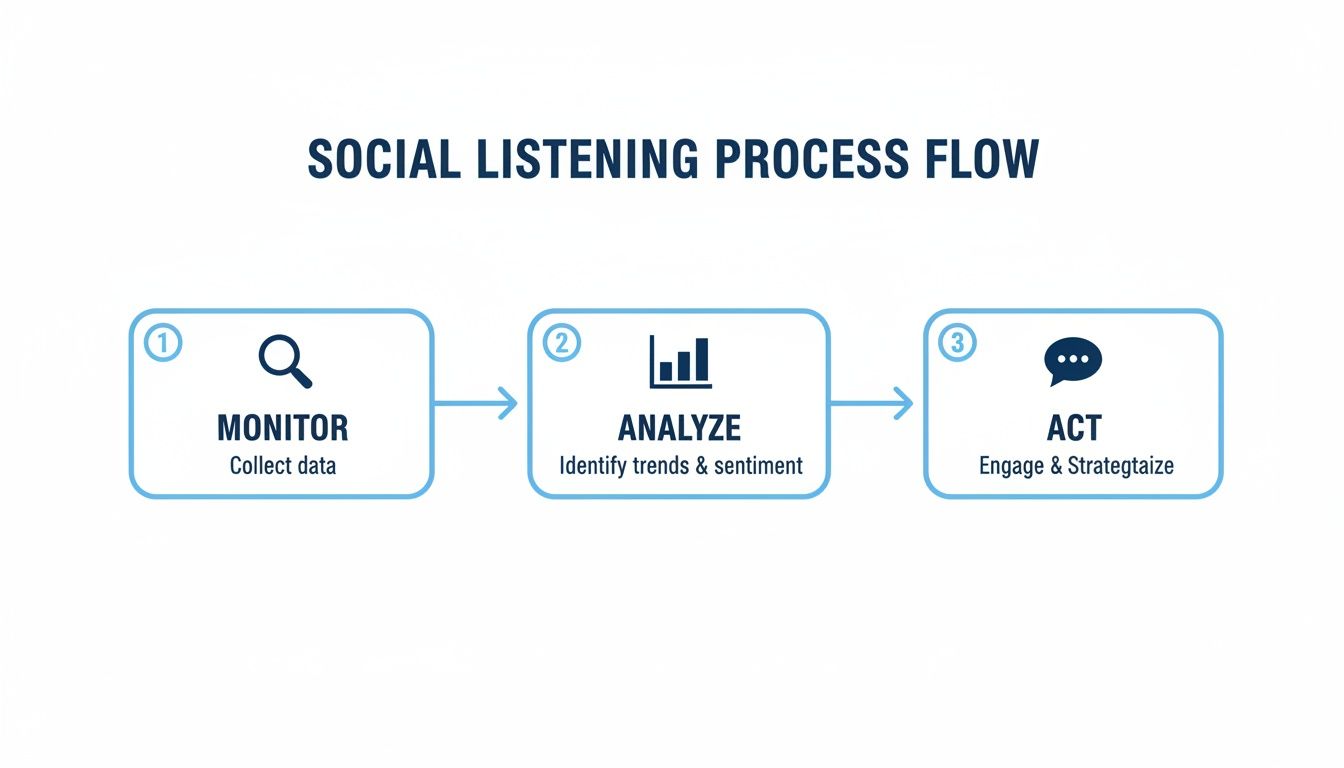
The flow from monitoring to action just reinforces that your response strategy is the final, most visible piece of a much bigger listening process.
Establishing a Clear Escalation Plan
Your social media manager can't—and shouldn't—handle every issue alone. A clear escalation plan is your lifeline, ensuring the right experts get brought in at exactly the right time. The stakes are incredibly high, as 80% of executives agree that a social media blow-up can cause real, material damage to a brand's reputation.
Your escalation plan should work like a decision tree, mapping out specific triggers that automatically loop in other departments.
When a social media mention hints at a legal risk, involves a threat to safety, or signals a massive technical failure, it stops being a social media issue—it becomes a business crisis. Your escalation plan has to reflect that severity.
Let’s walk through a real-world scenario: a service outage is hitting customers across multiple regions.
- Initial Alert: Your social media manager spots the first few complaints. They use a pre-approved template to acknowledge the issue and let users know they're investigating.
- Escalation Trigger 1 (Threshold Met): Once five or more similar reports pop up within 30 minutes, the issue is immediately escalated to the Head of Customer Support and the Technical Operations Lead. The social team now posts a public message confirming they're aware of a potential problem.
- Escalation Trigger 2 (Widespread Impact): Support confirms it’s a major outage. The flag goes up for the Communications/PR team and the Legal department. Legal reviews all public statements, while PR coordinates one unified message across every channel.
- Escalation Trigger 3 (Leadership Level): If the outage lasts for over an hour or impacts a huge chunk of your user base, the CEO or a relevant C-suite exec is briefed. They might need to personally approve a formal public apology.
This kind of proactive planning lets your team handle anything with confidence, turning potential chaos into a structured, professional response. It’s a vital part of a strategy where 65% of consumers say they trust brands more when they own up to their mistakes. You can dig deeper into the power of this kind of engagement in this detailed report on consumer behavior.
Measuring the Real Impact of Your Reputation Efforts
So, how do you prove all your hard work managing your brand's reputation is actually paying off? It's a simple truth: if you can't measure it, you can't improve it—or justify the budget spent on it.
It's time to move beyond vanity metrics like likes and follower counts. Those numbers feel good, but they don't demonstrate real business value. The goal is to tie your reputation management social media activities directly to tangible results that leadership actually cares about. This means shifting your focus to key performance indicators (KPIs) that tell a much deeper story about your brand's health and your team's efficiency.
What You Should Actually Be Tracking
To get a clear, honest picture of your performance, you need to track a balanced mix of metrics. These KPIs form the foundation of a reputation scorecard, giving you an at-a-glance health check of where your brand stands online.
Here's a breakdown of the key metrics for social media reputation management. These are the numbers that truly matter, organized to show you everything from brand health to how well your team is operating.
| Metric Category | Key Performance Indicator (KPI) | What It Measures |
|---|---|---|
| Brand Health | Sentiment Score | The ratio of positive to negative mentions. This is your primary pulse-check on overall public perception. |
| Operational Efficiency | Average Response Time | How quickly your team gets back to mentions and DMs. In social media, speed is everything for customer satisfaction. |
| Competitive Landscape | Share of Voice (SOV) | Your brand’s slice of the total conversation compared to your competitors. This shows your market presence. |
| Customer Satisfaction | Volume of Unresolved Issues | The number of negative comments or complaints left hanging. This directly highlights gaps in your support process. |
Tracking these KPIs provides a solid, data-backed foundation. You'll know instantly whether public sentiment is trending up or down, how efficient your team is, and exactly how you stack up against the competition.
Building Your Reputation Scorecard
A reputation scorecard isn't just a spreadsheet full of numbers; it's a narrative. Think of it as a simple dashboard that visualizes your most important KPIs, making it incredibly easy to spot trends and report progress to your boss.
Try putting together a weekly or monthly report that includes:
- Overall Sentiment Trend: A simple line graph showing the percentage of positive, negative, and neutral mentions over time.
- Response Time Goals: A chart showing your average response time measured against your target (e.g., stay under 1 hour).
- Share of Voice Chart: A pie chart illustrating your SOV against your top 2-3 key competitors. You absolutely need to know how you compare, and you can learn about the best competitor AI analysis tools to automate this.
This visual approach makes the data digestible and instantly flags areas that need your attention. It transforms abstract "brand management" efforts into concrete evidence of your team's impact.
The most powerful scorecards connect social media metrics to real-world business outcomes. It’s not just about improving your sentiment score; it’s about showing how that improvement leads to fewer support tickets or more loyal customers.
Connecting Reputation to Business Outcomes
This is the final, most important piece of the puzzle. This is where you demonstrate the true ROI of your work by drawing a clear, undeniable line from your reputation metrics to core business objectives.
For instance, you can show a direct correlation between an improvement in your sentiment score and a decrease in customer support ticket volume. It’s a straightforward story: when you proactively resolve issues on social media, fewer customers need to call support, which directly reduces operational costs.
Similarly, you can map a faster average response time to an increase in customer lifetime value (CLV). Customers who feel heard and valued are far more likely to stick around and make repeat purchases.
By connecting these dots, you elevate your reputation management social media strategy from a simple marketing function to a critical driver of business success. You’re no longer just managing comments; you are actively protecting revenue, boosting customer loyalty, and building a more resilient brand.
Building a Resilient Online Reputation from the Ground Up
The best social media reputation management isn't about frantically putting out fires; it's about building a brand so strong that a single negative comment barely makes a ripple. This is the art of proactive reputation building.
You’re creating a deep reservoir of positive sentiment and community goodwill. Think of it as a "reputational moat." When you have this, you’re not just playing defense—you’re building an asset that actively pulls in and keeps loyal customers.

This goes way beyond just replying to comments. It's about actively generating and amplifying the positive stories your community is already telling, turning happy customers into your most powerful marketing channel.
Spark Authentic User-Generated Content
Let’s be honest: your customers are better storytellers than you are. User-generated content (UGC) is today’s word-of-mouth, and it carries an authenticity that slick, branded content can never touch. Your job is to create opportunities for these stories to surface and then put them on a pedestal.
A fantastic way to do this is with an engaging hashtag campaign. Picture a local coffee shop launching a #MyMorningMug campaign, inviting customers to post photos of their favorite coffee creations. The shop then features the best shots on their feed. This celebrates their customers while flooding their social channels with genuine, positive content.
To make this work, you need to:
- Create a clear, memorable hashtag. It should be easy to spell and unique to your brand.
- Give people a compelling reason to join in. This doesn't always have to be a prize; simple recognition is often a powerful motivator.
- Always ask for permission before you repost a customer's content and give them proper credit. This builds trust and encourages even more sharing.
Partner with Your True Brand Advocates
Buried within your audience are customers who are more than just satisfied—they're true brand advocates. These are the people who recommend you to their friends and jump into comment sections to defend you. Finding and nurturing these relationships is one of the most valuable things you can do.
Start by listening. Use your social monitoring tools to pinpoint people who consistently mention you in a positive light. Once you find them, don't just send a generic "thanks!" Reach out personally. Maybe offer them early access to a new product or send them a small piece of exclusive merch.
The goal is to make these advocates feel seen and valued, creating a relationship that feels genuine, not transactional. These are the collaborations that build a powerful, loyal community.
The Power of Transparency and Showing Your Values
In a crowded market, people are drawn to brands that stand for something more than just profit. Being transparent and communicating your company values is a powerful way to build a following that connects with you on a much deeper level.
Share behind-the-scenes content that shows off your team and your process. If you're a sustainable fashion brand, create short videos showing how your materials are sourced. If you're a software company, introduce the engineers who built that popular new feature. This stuff humanizes your brand and forges a real connection.
Social media has fundamentally changed how trust is built. 39% of customers now say they won't trust a brand if they don't see direct interaction on these platforms. This trust pays off, as brands that show clear values alignment retain 58% more supporters.
Ultimately, engagement drives results. Companies that actively interact with their community enjoy 20-40% increases in customer spending and see retention rates up to 30% higher than their less-engaged competitors.
This proactive effort is the very core of a modern reputation management social media strategy. When you focus on creating a positive narrative, you not only insulate your brand from potential negativity but also build a foundation for long-term growth and customer loyalty. For professional branding, especially on platforms like LinkedIn, leveraging LinkedIn post generation tools can ensure your messaging consistently aligns with these strategic goals. This level of proactive management often requires expert guidance, and you can learn more about how AI reputation management consultants are helping brands build these resilient strategies.
Got Questions? We've Got Answers on Social Media Reputation
Even the best-laid plans run into real-world curveballs. When you're in the trenches, managing your brand's reputation day in and day out, practical questions are bound to pop up. Let's tackle some of the most common ones I hear from teams, with clear answers to help you navigate the tricky spots.
How Fast Should We Really Be Responding to Mentions?
The simple answer is "as fast as you can," but the smart answer is, "it depends on the context." Not all mentions are created equal.
A direct customer complaint on a fast-paced platform like X (formerly Twitter) is a five-alarm fire. The user expects immediacy. You should aim to acknowledge it within an hour, even if it's just to say, "We've seen this and are looking into it." That simple act shows you're listening and can de-escalate the situation.
On the other hand, a happy customer tagging you in an Instagram Story is a different beast. You've got more breathing room. A response within a few hours still feels personal and appreciative without being frantic.
The real trick is to prioritize. A customer locked out of their account needs your immediate attention. A general brand mention in a broader conversation? Not so much. A pro tip for managing expectations after hours is to set up a simple auto-reply: "Thanks for reaching out! Our team is online from 9-5 and will get back to you then." It’s a small touch that prevents people from feeling ignored.
What's the Best Way to Handle a Totally Wrong Negative Review?
First, take a deep breath and resist the urge to fight back. Getting into a public shouting match is a race to the bottom, and your brand will always lose, even when you're 100% in the right. The professional playbook is simple: correct publicly, resolve privately.
Your public reply should be calm, polite, and factual. Let's say a customer complains you were closed during your posted business hours, but they were looking at old information. A perfect reply is:
"We're so sorry for the frustration this caused. Our updated store hours are 9 AM to 6 PM daily, and you can always find the latest on our website."
That's it. No emotion, no accusation. Then, you immediately pivot the conversation offline. Add a line like, "We'd still love to help with your specific issue. Could you please send us a DM with your contact details?" This move shows everyone you're transparent and helpful while taking the drama out of the public square.
And if the comment is just abusive or spam? Don't engage. Just report it to the platform and move on.
Do We Really Need to Respond to Every Single Mention?
Please don't. Trying to answer every last mention is a surefire recipe for burnout, and it makes your truly important interactions less impactful. The name of the game is strategic engagement, not exhaustive coverage.
Focus your team's precious energy where it will make a real difference:
- Direct Questions: Someone is asking for information. Always answer them.
- Customer Complaints: This is your absolute top priority. Every single one needs a response.
- High-Value Praise: Acknowledge the good stuff, especially when it comes from an influential account or a loyal brand advocate.
For everything else—like neutral mentions or simple positive tags—a quick "like" is often the perfect way to acknowledge it without getting bogged down. Knowing when not to engage is just as important. Trolls and people trying to bait you into an argument? Ignore them completely. Save your energy for the conversations that build relationships.
How Does AI Monitoring Fit Into Our Social Media Strategy?
This is the new frontier of reputation management, and it's a big one. AI assistants like ChatGPT and Gemini are learning from the entire internet, including the messy, unfiltered chatter on social media. This creates a critical—and potentially dangerous—link between online gossip and what the world sees as fact.
Imagine a false rumor goes viral on social media—for example, a baseless claim that your product contains a harmful ingredient. An AI can scrape that conversation, internalize it, and treat it as credible information.
A week later, when a potential customer asks that AI about your product's safety, it might confidently repeat that falsehood. This is how temporary social media drama becomes a permanent part of your brand's story, creating a vicious feedback loop.
A modern reputation management social media strategy is incomplete if it doesn't include monitoring what AI assistants are saying. You have to know when misinformation from social has been absorbed by these models. Only then can you take steps to correct the record and protect your brand from this powerful new threat.
Ready to see what AI assistants are saying about your brand? The conversation is happening, whether you're listening or not. TrackMyBiz gives you the tools to monitor your reputation across models like ChatGPT and Gemini, flagging inaccuracies and ensuring your brand narrative stays true. Start a free scan at https://trackmybusiness.ai and take control of your AI reputation today.
