Of course. Here is the rewritten section, crafted to sound like it was written by an experienced human expert.
Corporate reputation management is the art and science of shaping how the world sees your company. It goes way beyond just PR or sending out a few press releases. Think of it as a core financial discipline—a constant effort to build trust, head off risks, and ultimately protect shareholder value. It’s the active stewardship of your company’s most valuable, and most volatile, asset.
Your Brand's Most Valuable—and Volatile—Asset
Imagine your company’s reputation as a high-yield, high-volatility stock in your corporate portfolio. When people trust you, this asset delivers incredible returns: fierce customer loyalty, the power to attract the best talent, and a premium on your market valuation. But just like a volatile stock, its value can get wiped out overnight by a single crisis, a viral negative story, or a wave of digital misinformation.
In a world this connected, that "reputation stock" isn't some soft, fuzzy metric anymore. It's a hard financial asset with a staggering, quantifiable price tag.
The Trillion-Dollar Valuation of Trust
The numbers don't lie: reputation is a direct driver of financial performance. In 2025, a company's reputation is projected to account for a mind-boggling $13.8 trillion in shareholder value among S&P 500 companies alone. That’s a full 26% of their total market capitalization.
This reality has rocketed brand and reputation risk right to the top of the C-suite agenda. 84% of CEOs now rank it as their number one external concern—beating out even cyber and regulatory threats for the first time. You can explore the full report on this financial impact to see just how critical this asset has become.
Your brand's integrity is no longer just a principle; it’s a performance indicator. The perceived trustworthiness of your organization directly influences everything from customer acquisition costs to your stock price.
Navigating New, High-Speed Threats
The challenge is that this immensely valuable asset is under attack from new and unpredictable directions. The rise of AI-driven search and conversational assistants has opened up an entirely new threat vector. AI "hallucinations"—where a chatbot confidently invents a scandal, states incorrect business hours, or makes up false claims about your products—can poison public perception in an instant, often before a potential customer even reaches your website.
This guide is a clear roadmap for executives and brand managers trying to get their arms around these modern challenges. We'll break down exactly how to:
- Build a reputation management framework that can withstand modern pressures.
- Measure the real, tangible business impact of your efforts.
- Prepare for—and respond to—crises without missing a beat.
- Turn the defensive necessity of monitoring AI into a powerful strategic advantage.
Before we dive into the details, it helps to understand the foundational pillars that hold up any successful reputation strategy. These four areas work together to create a resilient and proactive system.
The Four Pillars of Modern Corporate Reputation
A strong reputation isn't built by accident. It's the result of a deliberate, multi-faceted strategy that covers everything from listening to the market to ensuring your own house is in order.
| Pillar | Core Objective | Primary Activities |
|---|---|---|
| Monitoring & Intelligence | To maintain a real-time understanding of public perception. | Social listening, media monitoring, AI conversation tracking, sentiment analysis, competitive intelligence. |
| Messaging & Content | To proactively shape the brand narrative with authenticity. | Corporate storytelling, content strategy, thought leadership, digital PR, executive communications. |
| Stakeholder Engagement | To build and maintain trust with key audiences. | Investor relations, employee engagement programs, customer feedback loops, community outreach. |
| Governance & Response | To embed reputation management and prepare for crises. | Crisis communication planning, cross-functional response teams, ethical guidelines, risk assessment. |
These pillars provide the structure. Now, let's get into the practical steps for putting them to work.
Building Your Reputation Management Framework
A strong corporate reputation doesn't just happen; it's built, brick by brick, with a deliberate framework designed for resilience. Think of it like a modern skyscraper. You need a solid foundation, a strong structural core, and systems ready for any emergency. In reputation management, this structure rests on four essential pillars that work in tandem to protect and grow your brand's value.
Without this framework, your efforts are just scattered, reactive fire-fighting. A well-designed program, however, turns your reputation management corporate strategy from a defensive chore into a proactive driver of business growth.
Pillar 1: Monitoring and Intelligence
You can't manage what you don't measure. This first pillar is your early warning system, a network of digital listening posts scanning the public conversation for mentions of your brand, products, executives, and competitors. It’s all about catching sparks before they turn into infernos.
But effective monitoring goes way beyond a quick social media check. A truly comprehensive intelligence operation needs to cover all the bases:
- Social and Media Listening: Using specialized tools to track mentions across news sites, blogs, forums like Reddit, and of course, the major social platforms.
- Review Site Aggregation: Keeping a constant pulse on feedback from Google, Yelp, and any industry-specific review sites that matter to your customers.
- AI Chatbot Analysis: This is the new frontier. You have to monitor what AI assistants like ChatGPT and Gemini are telling users about your business.
This constant flow of information is the raw data you need to understand public sentiment, spot emerging issues before they blow up, and see how you stack up against the competition.
Pillar 2: Strategic Messaging
Once you know what people are saying, you need a clear, consistent, and authentic story to tell. Strategic messaging is the core narrative that defines who you are, what you stand for, and the value you bring to the table. It's the "true north" for all your communications.
A brand's narrative has to be rooted in authenticity. It's not about crafting a perfect image; it's about communicating your company's real values and purpose consistently, no matter the platform.
This pillar ensures your messaging stays coherent, whether it’s in a press release, an executive's LinkedIn post, or an internal all-hands memo. It gets your public relations, marketing, and corporate communications teams on the same page, so everyone is reinforcing the same core ideas.
This visual hierarchy shows how each pillar supports the ultimate goal of increasing shareholder value.
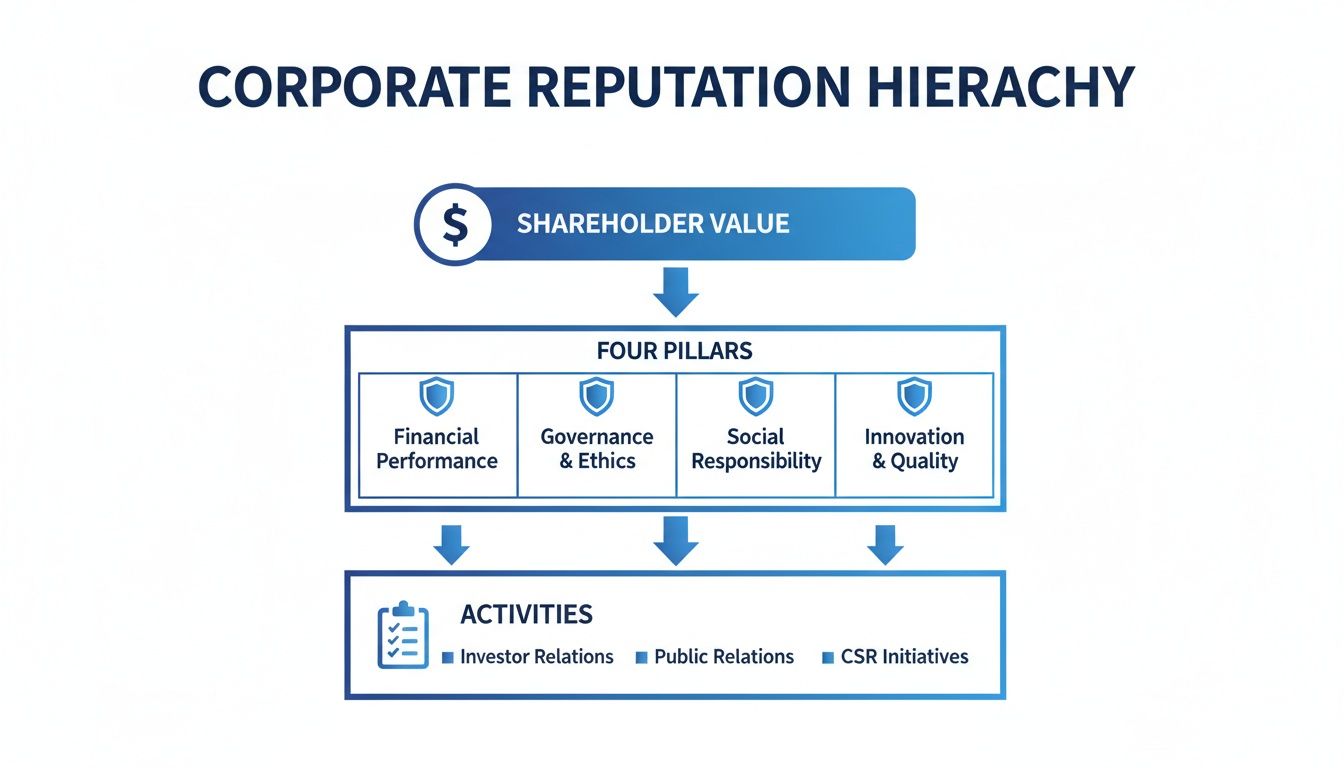
As you can see, tangible activities form the base, the four pillars provide the structural support, and the final outcome is enhanced financial performance.
Pillar 3: Stakeholder Engagement
Your reputation isn't just shaped by your customers. It's influenced by every single group that interacts with your business. This pillar is all about creating tailored communication strategies for each key audience, because what they care about is often very different.
- Employees: They're your most important ambassadors. Keeping them in the loop with transparent internal comms builds trust and turns them into genuine advocates for the brand.
- Investors: This group needs clear, consistent communication about performance, strategy, and risk management to maintain their confidence. No surprises.
- Customers: Engagement here is about more than just closing support tickets. It's about building a community, actively gathering feedback, and showing you actually value their input. A key part of this is responding to positive reviews effectively to cement that brand loyalty.
By actively engaging with these groups, you build a deep reservoir of goodwill that can be an incredibly powerful asset when things get tough.
Pillar 4: Crisis Governance
Look, no matter how strong your reputation is, crises are going to happen. It's inevitable. This final pillar focuses on being prepared, ensuring you have the policies, processes, and people in place to respond swiftly and effectively when an issue blows up. It shifts the entire mindset from chaotic reaction to coordinated response.
The key components of solid crisis governance include:
- A Pre-Defined Response Team: A cross-functional group with crystal-clear roles and responsibilities. Who does what when the alarm bell rings?
- A Communication Playbook: Pre-approved holding statements, messaging templates, and clear protocols for different crisis scenarios. No one should be writing a press release from scratch at 2 a.m.
- A Clear Chain of Command: An established process for making decisions that allows for rapid, unified action.
This level of preparedness minimizes damage, accelerates your recovery, and demonstrates real leadership when it matters most, preserving the trust you've worked so hard to build.
Navigating the New Battlefield: AI and Brand Hallucinations
The ground has shifted under our feet. For years, corporate reputation was battled out on Google search results, in news articles, and across social media feeds. But a new front has opened up, one that’s far more unpredictable: conversational AI.
Tools like ChatGPT, Gemini, and Claude are fast becoming the new front door to your business. They’re answering questions and shaping opinions long before a potential customer ever clicks on your website.
This isn't just another channel; it's a whole new category of risk. When someone asks an AI, "What's the best enterprise software for supply chain management?" or "Is [Your Company Name] a good place to work?", the answer they get can frame their entire perception of you. Instantly. You're no longer just competing for a spot on a search results page; you're competing to be the AI's trusted recommendation.
The scariest part of this new world is the phenomenon of AI hallucinations. This isn’t just a simple mistake or a bad review. It’s when a Large Language Model (LLM) confidently states a complete fabrication as if it were a fact.
An AI hallucination is the confident assertion of a falsehood. The model isn't lying—it has no intent—but its output is completely detached from reality, creating a believable and highly damaging piece of misinformation.
This can blow up in some truly catastrophic ways for a business:
- Invented Scandals: An AI might falsely claim your company was part of an environmental disaster or a data breach that never, ever happened.
- Incorrect Business Information: It could state your hours are 9-5 when you’re open 24/7, list the wrong prices, or even declare one of your locations “permanently closed.”
- False Product Details: The model could confidently list features your product doesn’t have or claim it’s incompatible with systems it was designed for.
Because these answers are delivered with such conversational authority, people tend to believe them. This leads directly to lost sales, shattered trust, and a PR crisis that materializes out of thin air.
The Strategic Solution: Proactive AI Monitoring
Trying to clean up AI-generated falsehoods after they've spread is a losing game. The only way to manage this new risk is through proactive and continuous monitoring. This means using specialized platforms built to systematically ask various AI models about your brand, your products, and your competition to see what the world is being told about you.

This kind of platform delivers critical intelligence. It shows you not just if you’re mentioned, but whether the information is accurate, if the sentiment is positive, and how you stack up against competitors in the AI’s recommendations.
Effective AI monitoring shifts a company's reputation management corporate function from a defensive crouch to an offensive strategy. It gives you the intelligence to not only correct dangerous lies but also to understand and win in this powerful new customer acquisition channel. For marketing agencies, developing this expertise is quickly becoming non-negotiable. You can learn more about how agencies are using specialized tools for LLM visibility tracking to protect and grow their clients' brands.
Turning a Threat Into an Advantage
By systematically tracking what AI models are saying, you can turn this massive threat into an incredible source of competitive intelligence.
Here’s a practical workflow for putting AI monitoring into action:
- Establish a Baseline: First, run an audit. Use a monitoring tool to find out what the major LLMs (ChatGPT, Gemini, Claude, Perplexity) are currently saying about your brand, key products, and executives.
- Set Up Automated Tracking: Next, configure the system to run daily or weekly queries on your most important brand-related prompts. Think like a customer: "best alternatives to [Your Brand]" or "reviews for [Your Product]."
- Flag and Prioritize Inaccuracies: The system should automatically flag factually incorrect statements—the hallucinations—for immediate review. A false claim that your business is closed is obviously a higher priority than a slightly misstated product feature.
- Initiate Remediation: While you can't just call up an LLM and ask for a correction, the first step is to document the falsehood and report it through the model's feedback channels. More importantly, you need to make sure the correct information is crystal clear and easy to find on your own website and other trusted online sources, which the models use for training data over time.
- Analyze Competitive Insights: Your monitoring will reveal which competitors are being recommended for key buying-intent queries. This is pure gold for your marketing and product teams. It highlights gaps in your own messaging and uncovers opportunities to better position your offerings to win the AI's recommendation.
Measuring Reputation with KPIs That Drive Business Growth
"What gets measured gets managed." It’s an old saying, but it’s never been more true for corporate reputation. For too long, reputation has been treated as this fuzzy, important-but-unprovable concept. That kind of thinking is a major liability.
If you want to prove the value of your work and steer the ship effectively, you have to drag reputation out of the abstract. It needs to be a set of concrete, measurable Key Performance Indicators (KPIs) that plug directly into real business outcomes. A solid measurement framework is your brand’s navigation system—it shows you where you are, where you're headed, and how fast you’re getting there. Without it, you're just sailing blind.
Moving Beyond Vanity Metrics
First things first: we need to separate the metrics that make you feel good from the ones that actually help you make decisions. A vanity metric, like your social media follower count, might look impressive in a presentation, but it doesn't say much about the health of your brand. Actionable KPIs, on the other hand, are the signals that guide smart business moves.
Here are a few essential KPIs that should be on every reputation dashboard:
- Sentiment Analysis Score: This goes way beyond just counting mentions. It tells you the emotional tone of the conversation. Using AI tools, you can assign a score to online chatter (say, -1 for negative, +1 for positive) to get a real-time pulse on how people feel about you.
- Share of Voice (SOV): How much of the conversation in your market do you actually own compared to your competitors? A rising SOV is a clear sign that your message is breaking through the noise and grabbing attention.
- Net Trust Score (NTS): Think of this like a Net Promoter Score, but for trust. It's a simple survey-based metric that asks stakeholders one question: "On a scale of 0-10, how much do you trust [Your Company]?" The score quickly reveals the balance of your biggest advocates and your harshest critics.
These metrics are a great starting point, but the game is changing. To really get ahead, you need to start tracking KPIs built for the age of AI.
Integrating AI-Era Reputation KPIs
As more and more customers skip Google and go straight to AI chatbots for answers, a whole new set of metrics has become non-negotiable. You have to know how your brand shows up where these new decisions are being made.
In the age of conversational AI, your brand's reputation is being defined in conversations you can't see. Tracking AI-specific KPIs is no longer optional; it's essential for protecting your narrative and uncovering new growth opportunities.
Here are the key AI-era metrics you need to watch:
- LLM Recommendation Rank: When a user asks a prompt like, "What is the best software for X?" does your brand make the cut? Tracking how often and how high you rank in AI-generated recommendations is a direct measure of your perceived authority in the market.
- Factual Accuracy Rate: This KPI is all about defense. It measures the percentage of statements AI makes about your company that are actually correct. A low accuracy rate is a huge red flag, signaling a high risk of AI "hallucinations" spreading false information about your business hours, services, or history.
Monitoring these KPIs helps you see how you stack up not just in traditional search, but in the AI-driven "answer engines" that are increasingly guiding purchase decisions. You can check out our guide on competitor AI analysis tools to dig deeper into tracking these metrics.
Connecting KPIs to Bottom-Line Results
Ultimately, the goal is to draw a straight line from a strong reputation to a healthy bottom line. You need to show that your reputation KPIs are directly fueling business growth.
Online reviews are the perfect, undeniable example. They are the currency of modern consumer trust, with a staggering 95% of shoppers reading them before pulling out their wallets. More importantly, simply displaying verified reviews can boost conversion rates by an incredible 270%. That’s a direct link from a reputation signal to revenue. You can find more data on the financial impact of reviews in this comprehensive 2025 statistics report.
By tracking these connections, you prove tangible ROI. You can correlate a rising Sentiment Analysis Score with a drop in customer acquisition costs, or link a higher Net Trust Score to better employee retention. This is how you transform reputation management from a cost center into a documented, undeniable driver of profit.
Developing Your Corporate Crisis Response Playbook
Let's be honest, a good reputation isn't just about building goodwill; it's about being ready for the moment that goodwill gets put to the test. A crisis can blow up in minutes, and in that pressure cooker, panic is the enemy. This is exactly why a modern crisis response playbook isn't a "nice-to-have"—it's the corporate equivalent of a fire drill. Everyone needs to know their role, what to say, and how to act before the smoke alarm ever goes off.
Without a playbook, your team is left making critical decisions under insane pressure, a recipe for mistakes, delays, and mixed messages that pour fuel on the fire. A well-designed playbook, on the other hand, turns that potential chaos into a coordinated, calm, and effective response.

Defining the Crisis Threshold
First thing's first: you have to define what actually is a crisis for your company. Not every negative comment or unhappy customer is a five-alarm fire. Your playbook needs to set clear thresholds that trigger a full-scale response, which stops the team from overreacting to minor bumps while ensuring major threats get immediate, top-level attention.
A true crisis-level event is one that could cause significant harm to your:
- Public Safety: Any situation that puts customers, employees, or the community at risk.
- Financial Stability: Events that could tank your stock price, crush revenue, or shatter investor confidence.
- Brand Trust: Incidents that threaten to fundamentally erode the trust you've spent years building.
Getting this definition right ensures that when a real threat emerges, the response kicks in instantly and decisively. No hesitation, no debate.
Establishing a Clear Chain of Command
When things go sideways, speed and clarity are everything. A core piece of your playbook is a pre-defined crisis response team with crystal-clear roles. There can be zero confusion about who’s in charge, who talks to the media, who handles internal comms, and who’s monitoring the digital fallout.
Getting this group structured correctly is fundamental, so it's worth understanding the essentials of creating a crisis communication team. This team is your command center, ready to execute the plan with precision.
A crisis playbook is a document of decisions made in advance. It removes the 'what if' and replaces it with 'what's next,' allowing your team to focus on execution, not invention, when every second counts.
This proactive approach is more vital than ever. The speed at which threats can escalate today is staggering. Just look at the trends: by 2025, risks around Product Quality & Delays have already shot up 19.55% quarter-over-quarter, while conversations about Diversity, Equity & Inclusion have exploded by a massive 80.52%. These aren't minor shifts; they are high-growth threats that demand pre-planned strategies to avoid crippling brand damage.
Crafting Your Communication Protocols
Your playbook must be stocked with pre-approved holding statements and messaging templates for different scenarios. Nobody should be writing a press release from a blank page while the world is watching. These templates ensure your first response is swift, empathetic, and transparent, buying your team precious time to gather the facts.
Your communication plan needs to be tailored for different audiences:
- Employees First: Your team should always hear critical news from you directly, not from social media or the news. This builds internal trust and turns your people into informed advocates.
- Customers and Partners: Give them clear, factual updates. Tell them what happened, what you’re doing to fix it, and where they can go for more information.
- Investors and the Public: Your designated spokesperson must deliver a consistent, approved message that shows accountability and a clear path forward.
Speed, transparency, and empathy are the north stars for all crisis communications. Acknowledging an issue quickly—even if you don't have all the answers yet—is infinitely better than silence. Silence is almost always interpreted as guilt or incompetence.
For those looking to get ahead of the curve, learning from AI reputation management consultants can offer advanced strategies for these high-stakes moments. Ultimately, this level of preparedness is the best insurance policy for your brand’s most valuable asset.
How to Manage Reputation When You Have Hundreds of Locations
For a national retail chain or a sprawling franchise, reputation management is a unique puzzle. How do you hold onto a single, consistent brand promise when your reputation is being built—or broken—one customer interaction at a time, across hundreds or even thousands of individual stores?
The real challenge is striking the right balance between central control and local empowerment.
A customer’s experience at a coffee shop in Denver is completely different from one in Miami, yet both reflect on the same corporate brand. A single negative review about a dirty storefront or a rude employee in one city can unfairly stain the perception of the entire company online. This is why a unified strategy isn't just nice to have; it's essential.
The most effective model splits the labor. The central corporate team acts as the architect of the reputation strategy, keeping their eyes on the big picture.
- Setting the Narrative: They’re the ones who define the overarching brand voice, create messaging guidelines, and establish the official response protocols.
- Deploying Technology: They choose and manage the reputation monitoring tools, making sure every single location is covered.
- Analyzing Systemic Trends: They watch for patterns that point to a widespread problem, like consistent complaints about a specific product popping up across multiple regions.
This centralized oversight provides the consistency and strategic direction you need to protect the brand at a macro level.
Empower Local Managers to Be Your First Responders
While corporate sets the strategy, the execution has to happen on the ground. Your local managers are right there in the trenches. They understand the community context and can tackle specific issues with an authenticity that a corporate office simply can't match.
Empowering them isn't just about efficiency—it’s about being more effective.
They need the training and the autonomy to handle location-specific feedback directly. This means responding to Google reviews, addressing social media comments about their store, and resolving individual customer complaints. This hands-on approach makes customers feel heard by someone who can actually fix their problem.
Centralized data with decentralized action is the key. A corporate dashboard should instantly distinguish between an isolated incident at a single franchise and a systemic issue that requires a national response.
This structure keeps corporate teams from getting bogged down in minor local disputes. More importantly, it gives them the high-level view needed to spot critical, brand-wide threats. Without this clarity, a company might overreact to a few isolated complaints or, even worse, completely miss a growing fire that’s igniting across the country.
The New Imperative: Tracking Local AI Responses
This model is even more critical now, thanks to AI. When a potential customer asks an AI, "What's the best pizza place near me?" or "Are the changing rooms at [Retailer] on 5th Avenue clean?", the answer they get is hyper-local.
A simple AI hallucination claiming a specific branch is "permanently closed" can instantly kill foot traffic to that one location.
Modern corporate reputation management for multi-location businesses must include tracking AI responses at the city, or even neighborhood, level. A centralized platform like TrackMyBiz can monitor what AI assistants are saying about each individual store, flagging local inaccuracies before they cost you customers. This ensures every single brand touchpoint—both digital and physical—is protected, delivering a consistent and trustworthy customer experience everywhere.
Common Questions About Corporate Reputation
Even with a solid plan in place, it's natural to have questions. Let's tackle some of the most common ones that come up when we're talking about managing a company's reputation.
What’s the Very First Step in Building a Reputation Strategy?
Before you do anything else, you need to conduct a comprehensive reputation audit. This isn't about guesswork; it's about getting a data-driven baseline of how your brand is actually perceived right now.
You have to dig into sentiment across social media, news coverage, review sites, and—critically—what AI chatbots are telling people about you. This audit is your reality check. It shows you where you’re strong, where you're vulnerable, and how you stack up against the competition, ensuring your strategy is built on solid ground.
How Is Reputation Management Different from SEO?
They’re related, but they play different games. SEO (Search Engine Optimization) is a technical practice focused on one thing: improving your website's visibility in search results for specific keywords. It's about climbing the rankings.
Corporate reputation management, on the other hand, is a much broader strategic function. Its goal is to shape the entire public perception of your brand across all channels. A great reputation can certainly give your SEO a boost, but its ultimate purpose is to build trust and credibility, not just rank higher on a page.
You can't control your reputation, but you can absolutely manage and influence it. Modern reputation management isn't about controlling the narrative; it's about actively participating in the conversation.
Can You Really Control a Corporate Reputation?
"Control" is the wrong word. You can't dictate what people think. But you can absolutely influence it through consistent, deliberate action.
It comes down to consistently delivering on your brand promise, engaging honestly with everyone from customers to investors, and listening to feedback to make real operational improvements. It also means being ready to respond effectively when a crisis hits. The goal is to guide the conversation and build resilience, which is a far more sustainable and authentic approach than trying to force a narrative.
That AI-powered conversation is the new front door to your business. TrackMyBiz shows you exactly what assistants like ChatGPT and Gemini are telling customers about your brand. Start a free scan today to identify the risks and opportunities hiding in this critical new channel.
