For years, PR professionals got away with justifying their work by dropping a thick binder of press clippings on a client's desk. The bigger the stack, the better the job. But those days are long gone. Today, if you can't connect your PR efforts to actual business goals, you're just creating noise.
What Is Public Relations Measurement and Why It Matters Now

Think of your PR campaign as a ship on a long voyage. Without a compass, charts, or a way to gauge your speed and direction, the captain is just guessing. Sure, the ship is moving, but is it getting any closer to its destination? That’s what a PR strategy feels like without solid measurement—a lot of activity with no real sense of direction or impact.
Public relations measurement is the compass for your communications strategy. It’s a disciplined process of setting clear goals, gathering the right data, and analyzing it to understand the real-world effect of your work. It finally answers the one question every executive really cares about: "What did we actually get for our investment?"
Moving Beyond Simple Clip Counting
The old "thud factor" of a heavy press book only measures outputs (what you did), not outcomes (what happened because of what you did). The conversation has completely shifted.
Effective measurement ties PR activities to tangible business results. It’s about looking at how that feature story in a major publication or a viral social media campaign actually influenced key performance indicators (KPIs) like:
- Brand Awareness: Do more people in your target market know who you are now than they did before?
- Audience Engagement: Are people interacting with your message? Are they sharing it, commenting on it, and making it their own?
- Website Traffic and Leads: Did that media placement drive qualified visitors to your site who then turned into actual leads?
- Sales and Revenue: Can you draw a credible line from your PR efforts to an increase in sales or customer growth?
The Modern Challenge: Proving Value in a Complex World
The need for robust public relations measurement has never been more critical. We’re all operating in a ridiculously crowded digital space where proving your value is the only way to secure budgets and earn a seat at the strategic table. Simply put, if you can't measure your impact, you can't prove your worth.
In this data-driven world, measurement is no longer a "nice-to-have" task you do after a campaign wraps up. It is a strategic imperative that should guide your planning, help you optimize in real-time, and demonstrate the undeniable contribution PR makes to the bottom line.
This guide gives you a clear roadmap, from foundational principles to advanced techniques, to build a measurement program that proves your impact. To keep learning and stay current, you can explore more insights and discussions on public relations measurement from other industry pros.
Building Your Foundation with Modern Measurement Frameworks
Trying to measure PR without a solid framework is like trying to build a house without a blueprint. You might get something standing, but it's going to be wobbly, inefficient, and impossible to replicate when you need to prove your success. That's why modern public relations measurement is built on established frameworks that give your work structure, credibility, and strategic direction.
These frameworks are your strategic architecture. They help you move past a random collection of data points and start building a cohesive story about your impact, ensuring your efforts are not just defensible but also aligned with widely accepted industry standards.
Adopting a Guiding Philosophy with the Barcelona Principles
First rolled out in 2010 and updated several times since, the Barcelona Principles are less a rigid checklist and more a guiding philosophy for meaningful measurement. They represent a set of seven core commitments to shift how we think about PR value.
The most critical idea they champion is the move away from tracking outputs (the stuff you did) to measuring outcomes (the results your work actually created).
An output is sending a press release or landing a news story. An outcome is the measurable shift in your audience's awareness, perception, or actions because of that story. The principles force you to ask, "So what?" about every single activity.
This fundamental distinction is the absolute cornerstone of proving real, tangible business value.
Here's a breakdown of that crucial shift:
The Critical Shift From Outputs to Outcomes in PR
This table clearly shows the difference between simply being busy (outputs) and being effective (outcomes). Focusing on outcomes is what links your PR efforts directly to business goals.
| Metric Type | What It Measures | Example | Business Value |
|---|---|---|---|
| Outputs | The immediate tactical results of your PR activity | Number of press releases distributed | Low; shows activity but not impact |
| Outputs | The volume of media coverage secured | Number of articles published | Low; indicates reach but not resonance |
| Outcomes | Changes in audience awareness or understanding | Increase in unaided brand recall | High; shows PR is building mindshare |
| Outcomes | Shifts in audience perception or sentiment | Improved trust or sentiment scores | High; proves PR is shaping brand reputation |
| Outcomes | Concrete actions taken by the audience | Website visits from earned media | Very High; directly links PR to lead generation |
| Outcomes | Measurable business results | Sales attributed to a PR campaign | Very High; demonstrates clear ROI |
Ultimately, an output is what you produce; an outcome is the change you create. Modern measurement is all about focusing on the latter.
Organizing Your Efforts with the PESO Model
While the Barcelona Principles give you the "why," the PESO model gives you the "how." Developed by Gini Dietrich, it’s a brilliant tool for organizing and integrating all your communication activities across four media types.
- Paid Media: This is anything you pay for, like social media ads or sponsored content. You get total control over the message and placement.
- Earned Media: This is what most people think of as traditional PR—the coverage you earn from others, like news articles or broadcast mentions. It's fantastic for credibility but offers you far less control.
- Shared Media: Think social media channels. This is where your brand has a two-way conversation, and success is measured in things like likes, shares, comments, and the growth of your community.
- Owned Media: These are the channels you control completely, like your website, blog, or email newsletters. This is the central hub for all your content and brand messaging.
The real power of the PESO model comes from integration. A single campaign might kick off with a blog post (Owned), which gets picked up by a journalist (Earned), promoted with some targeted ads (Paid), and then sparks a conversation on LinkedIn (Shared).
Using this model helps you see the whole picture and measure how these different channels collaborate to drive results. For agencies trying to show this integrated value, the next frontier is understanding how their clients show up in AI. You can learn more about tracking brand presence in AI for agencies in our detailed guide.
By pairing the philosophical guidance of the Barcelona Principles with the practical structure of the PESO model, you build a truly robust foundation for your public relations measurement program. This approach makes sure you’re not just tracking the right things, but you also understand how they all connect to hit those larger business goals. With this structure in place, your measurement will become more strategic, insightful, and incredibly valuable to your organization.
Choosing the Right Metrics for Your PR Campaigns
Once you have a solid framework, you can shift from the "why" of PR measurement to the "what." The next step is picking a balanced scorecard of metrics that tie directly back to what you're trying to achieve. Think of it like assembling a toolkit; you wouldn't use a hammer to saw a board, and you shouldn't rely on a single metric to measure every facet of PR success.
The smartest approach is to group your metrics into categories that mirror the customer's journey, all the way from first glance to final sale. This ensures you're telling the complete story of your campaign’s performance, not just cherry-picking an isolated data point that looks good.
This diagram shows how foundational frameworks like the Barcelona Principles and the PESO Model work together to support your entire measurement strategy.
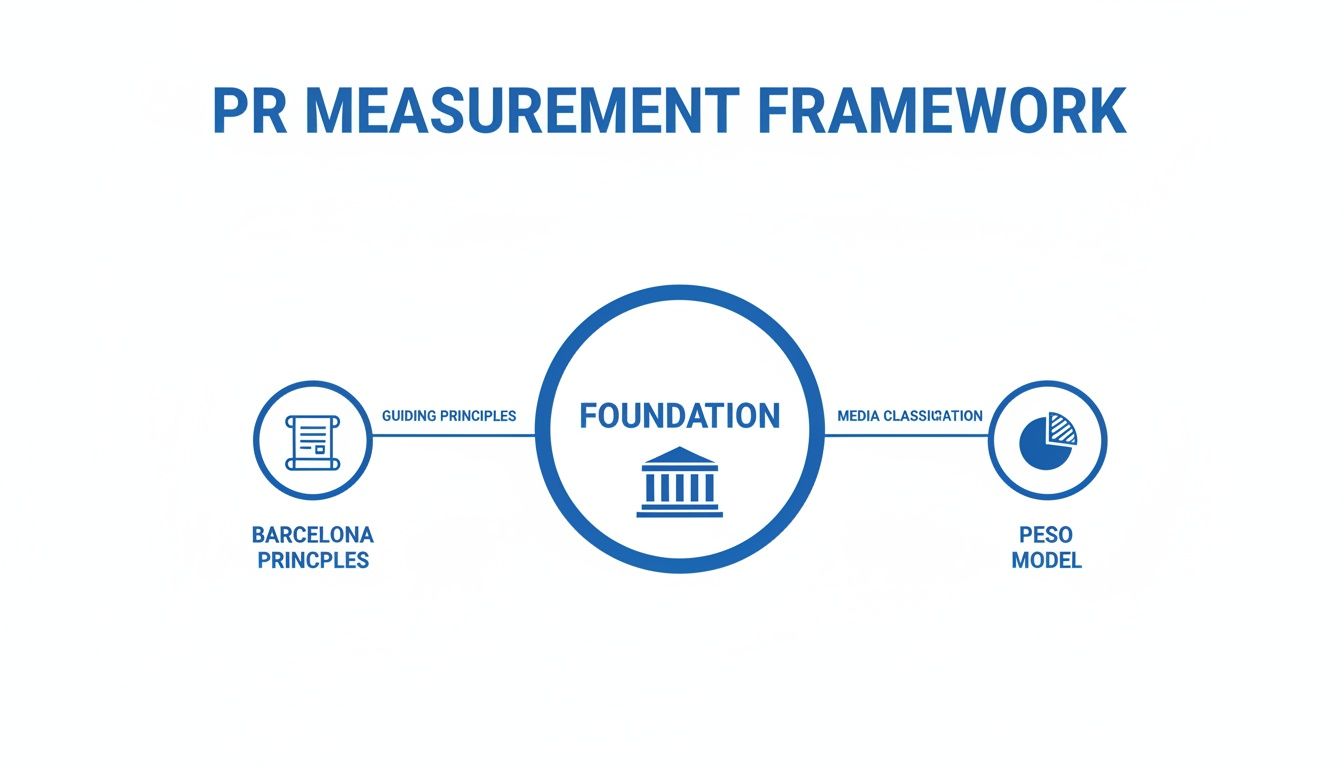
As you can see, a strong measurement program isn't random. It’s built on strategic principles that guide how you track and integrate your efforts across every channel you use.
Brand Awareness Metrics
These metrics are all about visibility. They gauge how well-known your brand is in your target market and act as top-of-funnel signals, telling you if your message is actually cutting through the noise and reaching the right crowd.
- Media Impressions: This is the potential number of times your content was seen. While it's a foundational metric, it should never stand alone. An impression doesn't guarantee someone actually read or cared about the content, but it gives you a baseline for potential reach.
- Share of Voice (SOV): SOV pits your brand’s presence against your competitors. It answers the crucial question, "Of all the chatter in our industry, how much of it is about us?" This is a vital competitive benchmark for truly understanding where you stand. You can get a handle on this with specialized competitor AI analysis tools that monitor brand mentions across the web.
Audience Engagement Metrics
Okay, so people are seeing your brand. The next question is: do they care? Engagement metrics measure how your audience interacts with your content, showing you whether your messaging is truly hitting home.
- Social Engagement: This bucket includes all the likes, comments, shares, and saves happening on social media. High engagement is a clear signal that your content is valuable enough for people to stop scrolling and take action.
- Sentiment Analysis: This metric digs deeper than just numbers to uncover the feeling behind the conversation. Sentiment analysis tools classify mentions as positive, negative, or neutral, giving you a qualitative look at how the public perceives your brand.
Business Impact Metrics
This is where PR measurement really earns its keep. These are the metrics that connect your PR activities directly to tangible business outcomes, finally answering that big question from the C-suite: "How did this affect the bottom line?"
- Website Traffic: Using a tool like Google Analytics, you can track referral traffic coming from your earned media placements. Seeing a traffic spike from an online article is a crystal-clear sign that your PR is driving real interest.
- Lead Generation: This takes website traffic a step further. It tracks how many of those visitors took a desired action, like signing up for a newsletter, downloading a guide, or requesting a demo.
- Conversions and Sales: The holy grail is tying PR campaigns to actual revenue. While direct attribution can be tricky, you can draw a clear line from coverage to cash by correlating media hits with sales lifts or by using unique promo codes in specific PR campaigns.
Key Takeaway: A balanced scorecard with metrics from awareness, engagement, and business impact gives you a complete picture of performance. No single metric tells the whole story, but together, they build a powerful narrative about your PR campaign’s true value.
Why You Must Avoid Outdated Metrics
For decades, many PR pros leaned on a metric called Advertising Value Equivalency (AVE). The idea was to calculate what your earned media coverage would have cost if you'd bought it as advertising space. The industry has now overwhelmingly rejected this metric as misleading and flat-out wrong.
AVE is deeply flawed because it assumes earned media has the same value as an ad, completely ignoring the third-party credibility that makes PR so powerful in the first place. It also doesn't account for sentiment; a scathing negative story would still be assigned a positive monetary "value." Sticking with AVEs today will only undermine the credibility of your entire measurement program.
Recent data shows what modern professionals are focused on instead. One survey found that 76% of PR pros focus on reach as their top metric, with 70% emphasizing engagement. This reflects a clear shift toward measuring audience interaction and visibility. Even more telling, 46% now use social listening to capture real-time sentiment, proving that understanding the quality of the conversation has become just as important as the quantity.
The New Frontier: Measuring Your Brand in AI Chatbots

The frameworks and metrics we've covered so far give you a solid playbook for public relations measurement, but a massive blind spot has just appeared on the field. The way people find information is changing. Fast. Instead of just punching keywords into Google, they're now asking AI assistants like ChatGPT and Gemini for direct answers and recommendations.
This creates an entirely new channel where your brand’s reputation is being defined every single second, completely outside of your view.
When a potential customer asks, "What's the best CRM for a small business?" or "Compare Brand X and Brand Y," the AI's answer can either hand you a qualified lead on a silver platter or render you completely invisible. This isn't some far-off trend; it's happening right now. Ignoring your brand's presence in these AI conversations is like ignoring media mentions in the 90s—it’s a critical gap in your understanding of public perception.
The Hidden Dangers of AI Hallucinations
The risk here goes way beyond simply being left out of the conversation. Large Language Models (LLMs) are famous for "hallucinations," a polite term for when they state completely false information with absolute confidence. For a brand, this can be a nightmare.
Imagine an AI telling a prospect that your business is permanently closed. Or that your flagship product costs twice as much as it actually does. Worse yet, what if it invents a story about a product recall that never happened? These aren't just technical glitches; they can torpedo sales and poison the brand trust you've spent years building.
AI hallucinations aren't just technical errors; they are active reputation threats. Without a system to monitor these conversations, damaging misinformation about your brand can spread undetected, poisoning public perception in a channel you can't even see.
These are not theoretical problems. They are real-world issues that can cause immediate, measurable harm to your bottom line.
Turning Risk into a Strategic Opportunity
Here's the good news: what can be monitored can be managed. A new generation of measurement tools is being built specifically to illuminate this AI blind spot. These platforms go beyond traditional media monitoring to actively track how brands are portrayed inside AI chatbot conversations.
This new form of public relations measurement lets you see what's really going on. You can:
- Track Brand Mentions: Pinpoint exactly when, where, and how your brand is being discussed across different AI models.
- Analyze Sentiment: Instantly gauge whether the AI is describing your company in a positive, negative, or neutral light.
- Monitor Competitor Presence: See which competitors are getting recommended for key queries and start to understand why.
- Detect Misinformation: Get immediate flags on AI-generated falsehoods, from wrong operating hours to fabricated scandals, so you can act.
By adding AI monitoring to your measurement stack, you can quickly spot and work to correct damaging misinformation before it spreads. This flips a massive risk into a powerful strategic advantage. It gives you the power to not only defend your reputation but to actively shape how AI perceives and presents your brand to the world.
For companies that want to build a truly resilient brand, learning more about AI brand tracking for SaaS companies can provide a serious competitive edge. It's a proactive approach that ensures your brand's story stays accurate and compelling in this new era of AI-driven discovery.
How to Build a PR Measurement Process That Actually Works
Great public relations measurement isn’t something you just do at the end of a campaign. It’s not about scrambling for numbers to justify your budget. It's a continuous cycle—a loop that informs, guides, and sharpens your strategy over time.
Think of it this way: flying a plane without instruments is just guessing. A repeatable measurement process is your cockpit. It turns measurement from a reactive chore into a proactive, strategic function that consistently proves your value. Each cycle delivers sharper insights, letting you make smarter calls for the next campaign and build a powerful story about PR's real impact on the business.
Step 1: Set Clear, Measurable Objectives
Before you track a single metric, you have to know what winning looks like. The best way to do this is with the SMART goal framework. Your objectives need to be Specific, Measurable, Achievable, Relevant, and Time-bound. Vague goals like "increase brand awareness" are impossible to measure and, frankly, useless for showing value.
A weak goal sounds like "get more press." A SMART goal sounds like this: "Increase our share of voice in the enterprise software category by 15% over the next quarter by securing five feature stories in top-tier trade publications." See the difference? It's precise, quantifiable, and tied directly to a business outcome. It gives you a clear target to hit.
Step 2: Choose Your Tools and Gather the Data
With clear objectives in hand, you can now pick the right tools to get the job done. A modern PR measurement stack isn't just one platform; it's a mix of tools that each tell a different part of the story.
- Media Monitoring Tools: Platforms like Cision or Meltwater are your eyes and ears, tracking mentions across online, print, and broadcast media.
- Web Analytics: Google Analytics is non-negotiable. It shows you who is coming to your site from your media wins and what they do once they get there.
- Social Listening Platforms: Tools like Brandwatch or Sprout Social are essential for tapping into social media conversations, tracking engagement, and understanding sentiment.
- AI Visibility Monitors: Here's the new player on the field. A tool like TrackMyBiz is crucial for modern PR, tracking how your brand is represented in AI chatbots. It flags misinformation and keeps an eye on competitors in this completely new, unmeasured channel.
The trick is to collect data that maps directly back to the SMART objectives you set in step one. Don't just collect data for the sake of it.
Your tool stack should give you a 360-degree view of your performance. It's about combining traditional media monitoring with web analytics and AI visibility to make sure you're not missing any piece of the conversation happening around your brand.
Step 3: Analyze the Data to Find the Story
Data collection is just the first step. The real magic happens in the analysis. This is where you stop reporting numbers and start interpreting them to tell a compelling story. Anyone can say, "We got 50 media mentions." An expert finds the insight behind the number.
A much better analysis sounds like this: "Our 50 media mentions drove a 30% spike in referral traffic to our product page. Sentiment analysis showed an 85% positive tone, which directly correlates with a 10% lift in demo requests during the campaign." Now you’re connecting PR output to a meaningful business outcome.
Step 4: Report Your Insights and Refine Your Strategy
The final piece of the loop is packaging your insights into a report that people will actually read and then using it to make your next move. Your report shouldn't be a data dump. It needs to be tailored to your audience, whether that's the C-suite or your marketing peers.
A solid monthly PR report should always include:
- Executive Summary: A quick, high-level overview. What happened, and why does it matter?
- Performance Against KPIs: A simple chart or dashboard showing your progress toward the SMART goals you set.
- Key Wins and Coverage Highlights: Showcase your best placements and explain why they were strategically important.
- Sentiment and Share of Voice Analysis: Give context. How is your brand perceived compared to the competition?
- AI Visibility Report: Detail how your brand shows up in AI chatbots. Note any corrections made or new opportunities you've found.
- Strategic Recommendations: Based on everything you've learned, what should the team start, stop, or continue doing next month?
This repeatable four-step process transforms public relations measurement from a painful afterthought into the very engine that drives your entire strategy forward.
Common Public Relations Measurement Pitfalls to Avoid
Even the sharpest, most well-funded PR program can get derailed by a few common and completely avoidable mistakes. Knowing what these traps look like is the first step toward building a measurement strategy that’s resilient, credible, and actually useful.
If you can steer clear of these, your data will tell a true story about the impact you're making.
The Siren Song of Vanity Metrics
One of the easiest traps to fall into is getting hooked on vanity metrics. It feels great to report a huge number, like hitting 50 million media impressions. While that figure sounds impressive on a slide, it’s hollow without context. An impression only means a potential viewing—not that anyone actually read, understood, or cared about the article.
Focusing on a number like that is like bragging about how many flyers you printed for an event without checking to see if a single person showed up. It measures activity, not effect. The fix is simple: always pair reach metrics like impressions with something deeper, like referral traffic from the article or a sentiment analysis of the coverage. That’s how you add the "so what?" and find the real story.
Measuring What You Did, Not What You Achieved
This brings us to another classic blunder: confusing outputs with outcomes. We touched on this earlier, but it’s worth hammering home because it’s so critical.
An output is the work you did—the number of press releases you sent or the articles you placed. An outcome is the tangible result of that work—a shift in what your audience knows, feels, or does.
A report filled with outputs is just a to-do list you’ve checked off. A report focused on outcomes demonstrates the value you created. Get in the habit of asking "So what?" about every piece of data you collect.
For example, reporting that you secured 10 media placements is an output. That's just noise. Reporting that those 10 placements drove a 20% jump in demo requests from your website? That's an outcome. It’s a shift that connects your PR work directly to business goals, and that’s the language leadership understands.
Inconsistency and Forgetting Where You Started
Two final traps can quietly sabotage your credibility: using inconsistent methods and failing to set a baseline.
If you measure one campaign’s success using share of voice and the next one using website clicks, you can’t compare them. You have no way of knowing which one was truly more effective or what you learned. Consistency is what allows you to spot trends over time and get smarter with every launch.
Likewise, kicking off a campaign without benchmarking your starting point is like starting a road trip without checking your odometer. Before a single pitch goes out, you need to document where you stand right now. What’s your current share of voice? What’s your baseline for branded search traffic and social sentiment? Without that snapshot, you have no credible way to prove your campaign actually moved the needle.
Avoiding these common mistakes will make your public relations measurement infinitely more powerful and respected within your organization.
Frequently Asked Questions About PR Measurement
Even with a perfect plan, you're going to have questions once you start digging into the data. Here are some straightforward answers to the questions that pop up most often when PR pros get serious about measurement.
How Often Should I Measure My PR Efforts?
There’s no magic number here—the right rhythm depends on what you're trying to accomplish. Think of it in tiers.
- Daily Checks: For anything fast-moving, a daily check-in is non-negotiable. This means keeping an eye on social media for sudden spikes in chatter and monitoring your AI tracking platform for any brand misinformation that needs to be stamped out now.
- Weekly/Campaign-Based Tracking: Got a product launch or a big push? A weekly review of your core metrics is your best friend. It gives you just enough time to see what’s working and tweak your strategy before the campaign ends, ensuring you actually hit your goals.
- Monthly/Quarterly Reporting: For the long game of brand building, monthly or quarterly reports are perfect. This cadence lets you zoom out and spot meaningful trends in things like your share of voice, referral traffic from media hits, and overall brand sentiment.
What Is the Best Way to Show PR ROI to Executives?
To get buy-in from the C-suite, you have to talk their language: business outcomes. A long list of media placements means nothing to them. You have to connect your PR wins directly to the bottom line.
Don't just report what you did; report what happened because you did it. Your job is to translate a great media mention into its real business impact, like a jump in website traffic, a surge in branded search queries, or a flood of qualified leads.
A visual dashboard is your most powerful weapon here. Imagine showing a chart where a feature story in an industry journal directly correlates with a 30% spike in demo requests the following week. That’s a story that proves value, and it's infinitely more persuasive than just showing them the article itself.
Can I Measure PR Effectively on a Small Budget?
Absolutely. Smart public relations measurement is about being strategic, not about having expensive tools. Some of the most powerful measurement resources out there are free or very low-cost.
Google Analytics is your go-to for tracking how much traffic your earned media is sending to your website and whether those visitors are turning into customers. Google Alerts can keep a basic pulse on brand mentions for free, and every social media platform has its own robust analytics baked right in.
The secret is to focus. Don't try to measure everything under the sun. Pick a handful of outcome-driven metrics that tie directly to your most critical business goals. A focused strategy will always beat a cluttered dashboard full of vanity metrics.
Ready to uncover how your brand is being represented in the new era of AI search? The insights you need are waiting. TrackMyBiz gives you a clear view of your brand's presence in chatbots like ChatGPT and Gemini, flagging misinformation and tracking competitor mentions. Start your free scan today and turn your AI blind spot into a strategic advantage.
