
Online reputation protection is all about actively monitoring and managing how your brand is seen across the digital world, especially in the new frontier of AI chatbots. Think of it as controlling your own story before someone—or something—else writes a version you don't like. In a world where what people find online is treated as fact, this isn't just a good idea; it's essential for protecting customer trust and, ultimately, your revenue.
Welcome to the New Frontline of Brand Reputation

For years, managing a brand’s reputation felt like guarding a castle. You knew where the threats were coming from. You focused your defenses on the front gate—keeping an eye on social media, responding to Google reviews, and handling press mentions. The perimeter was clear, and if an issue popped up, you could meet it head-on.
But the battlefield has completely changed. The rise of powerful AI assistants like ChatGPT, Gemini, and Claude has created a new, invisible frontline. The threat is no longer just at the front gate. It's more like whispers and rumors spreading inside the castle walls, shaping opinions in ways you can't even see.
The Unseen Threat of AI Misinformation
Millions of people are now turning to these AI models as their new source of truth, asking them direct questions about your business. Here’s the problem: they can be confidently wrong. This phenomenon, known as AI hallucination, creates massive and unpredictable risks for businesses of every size.
An AI might tell a potential customer your shop is "permanently closed," invent a product recall that never happened, or enthusiastically recommend your biggest competitor. These aren't just little mistakes. They're authoritative-sounding lies that can hit your bottom line directly.
This shift requires a whole new strategy for online reputation protection. Relying only on traditional social listening and review management is like locking the front gate while leaving the back door wide open.
Why Your Old Playbook Is Obsolete
The real challenge is that AI-generated misinformation is invisible to the tools most brands use today. You won't get a Google Alert when a chatbot gets your services wrong. This creates a dangerous blind spot where your brand’s story is being rewritten without you even knowing it's happening.
A huge part of managing your online presence involves actively defining your brand voice. Keeping it consistent helps AI models get a better sense of who you are, but that’s only one piece of the puzzle.
You need a modern playbook for this new era. This guide will give you the framework to:
- Understand the specific threats AI poses to your brand.
- Monitor what AI chatbots are actually saying about you.
- Mitigate the damage from hallucinations and inaccuracies.
It's time to move beyond the castle gate. You need to start defending your reputation where the conversations are really happening now.
Understanding Modern Online Reputation Protection
Online reputation protection used to be fairly straightforward. It was all about keeping an eye on Yelp reviews, responding to angry tweets, and making sure your Google Business Profile had the right holiday hours. That’s still part of the picture, but it’s no longer the whole story. Today, it’s about actively managing how your brand shows up on the AI-driven platforms millions of people now use to get answers.
Think of it as taking control of your digital story. Instead of letting random reviews, outdated articles, or—worse—an inaccurate AI summary define who you are, you step in. It’s a mix of savvy customer service, smart PR, and technical SEO, all working together to build a strong, positive identity that customers trust.
Why This Is No Longer Optional
A brand's reputation isn't some fuzzy marketing concept; it's a hard asset that directly impacts your bottom line. It really comes down to three things:
- Customer Trust: This is the bedrock. Before anyone decides to walk into your store or click "add to cart," they've already checked you out online. A solid reputation gives them the confidence to take that next step.
- Revenue Impact: The line between perception and profit is brutally direct. A great reputation brings in sales. A poor one sends customers running straight to your competitors.
- Brand Equity: This is the long-game. A well-tended reputation turns your business name from just another option into a trusted authority, boosting its value and influence in the market.
The stakes are incredibly high. We now know that 70% of consumers will jump to a competitor after just one bad experience. And with 76% of people trusting online reviews as much as a recommendation from a friend, the power of digital word-of-mouth is undeniable. When you add it all up, bad customer experiences, amplified online, are costing businesses a staggering $3.7 trillion a year globally. This makes proactive online reputation protection a must-have, not a nice-to-have. Find out more about how these reputation statistics impact businesses.
Old Risks, New AI-Powered Threats
The classic threats to your brand’s reputation haven't gone away, but they’ve been joined by new, unpredictable dangers cooked up by AI and large language models (LLMs). Getting a handle on this new reality is the first step to defending your brand.
A one-star review on a public site is bad, but at least you can see it and respond. An AI hallucination is a totally different beast. A chatbot might confidently tell a potential customer that your business is permanently closed or invent a fictional product recall, and you’d likely never know it even happened.
The core challenge today is defending against threats you can see (like reviews) and threats you can't (like AI misinformation). A strategy that only handles one leaves you wide open.
The game has changed significantly. The old playbook of managing public-facing profiles is no longer enough. To really grasp the shift, let's compare the traditional threats we're used to with their modern, AI-era equivalents.
The Evolving Landscape of Online Reputation Threats
| Threat Category | Traditional Threat Example (Web 2.0) | Modern Threat Example (AI/LLM Era) |
|---|---|---|
| Operational Data | An outdated Google Business Profile showing incorrect holiday hours. | An AI chatbot confidently stating your business is "permanently closed." |
| Negative Feedback | A one-star customer review on Yelp detailing a poor service experience. | An AI summarizing multiple old, negative reviews into a definitive, negative "fact." |
| False Information | A disgruntled ex-employee posting false claims on a forum like Reddit. | An AI "hallucinating" a product recall or a fictional company scandal. |
| Competitor Mentions | A blogger's "Top 10" list that omits your business but includes competitors. | An AI recommending a direct competitor when asked for the "best" option in your category. |
This isn't just a minor update; it's a fundamental change in how information spreads. It requires a new mindset—one that moves beyond just reacting to what you see and starts proactively hunting for the invisible inaccuracies shaping customer opinions in AI chats.
The AI Hallucination Problem and Your Business
Some of the most dangerous threats to your brand today aren't coming from angry customers or bad press. They're coming from artificial intelligence just… making things up. This is what’s known as an AI hallucination, and it’s one of the biggest new challenges in online reputation protection. It’s when an AI model states completely false information with the confidence of a seasoned expert.
Think of it like this: you’re talking to a friend who is an incredible storyteller but has a really spotty memory. They might confidently recall details from a trip you took together—the color of the rental car, the name of that little cafe—except the car was blue, not red, and you ate somewhere else entirely. They aren't trying to lie; their brain just filled in the gaps with plausible but incorrect details.
This is exactly what AI models do. They don't "know" anything. They are prediction engines, designed to guess the next most likely word in a sentence based on the mountains of data they were trained on. Every so often, that prediction process goes off the rails, and the AI generates something that sounds perfectly reasonable but is completely fabricated.
Where AI-Generated Falsehoods Hurt Most
Because we interact with AI assistants conversationally, we’re wired to trust their answers. When an AI confidently tells a potential customer something untrue about your business, that person has little reason to question it. The damage is immediate and often completely invisible to you.
These hallucinations usually fall into three particularly nasty categories for businesses.
- Incorrect Operational Data: This is probably the most common threat. An AI might tell someone your shop is "permanently closed" during a holiday weekend, give out an old address for your new headquarters, or claim you don't offer a service that’s core to your entire business. Each one of those little falsehoods is a lost customer.
- False Negative Events: This is where things get more sinister. A chatbot could invent a product recall that never happened, create a summary of a non-existent lawsuit, or fabricate a safety scandal out of thin air. These kinds of lies can poison your brand's reputation and destroy customer trust, all happening in private chats you'll never see.
- Biased or Competitor Recommendations: AI models inherit biases from their training data. So when a user asks, "What's the best local pizza place?" the AI might recommend your competitor just because they have more mentions in older online articles. In an instant, you've been erased from the conversation for a potential new customer.
The real danger of AI hallucinations is their authority. The information isn't presented as a possibility; it's delivered as a definitive answer from a trusted source, making it highly believable and invisible to traditional monitoring tools.
This screenshot shows how platforms can track what AI models are saying about a brand, flagging inaccuracies before they cause widespread damage.
By actively monitoring these conversations, businesses can identify when an AI has hallucinated incorrect information and begin the mitigation process.
Why Traditional Tools Miss the Mark
Your social listening and review management platforms are critical, but they are completely blind to these conversations. AI chats are private, one-on-one exchanges. They don't show up in public social feeds or on review sites. You're not going to get a Google Alert when Gemini tells a user your service costs twice its actual price.
This creates a massive visibility gap. Your brand's reputation is being shaped in countless private conversations every single day, and without specialized tools, you have no idea what's being said. It's a huge shift from the public nature of Web 2.0 threats like bad reviews or angry tweets, which you could at least find and respond to.
For agencies and brands, getting a look inside these AI conversations is no longer a "nice-to-have." Learn more about how modern LLM visibility and tracking for agencies is closing this dangerous gap. Protecting your online reputation now means looking beyond the public web and monitoring the new source of truth for the next generation of customers.
Your Playbook for AI-Era Reputation Protection
Okay, let's move from theory to action. Dealing with AI-driven reputation threats isn’t about panicking when something goes wrong; it’s about having a solid process in place before it happens. A strong online reputation protection program is built on a clear playbook, so your team knows exactly what to do when an AI chatbot decides to go rogue.
This playbook isn’t complicated. It comes down to three core ideas: proactive monitoring, rapid mitigation, and clear measurement. When you structure your efforts this way, you turn a chaotic, unpredictable problem into a workflow your team can actually manage. It gives them the confidence to act decisively, protecting your brand's integrity and, just as importantly, your revenue.
This whole process can feel a bit abstract, so here’s a visual breakdown of how real-world business data can get twisted by AI, leading to things like false negative summaries and biased recommendations.
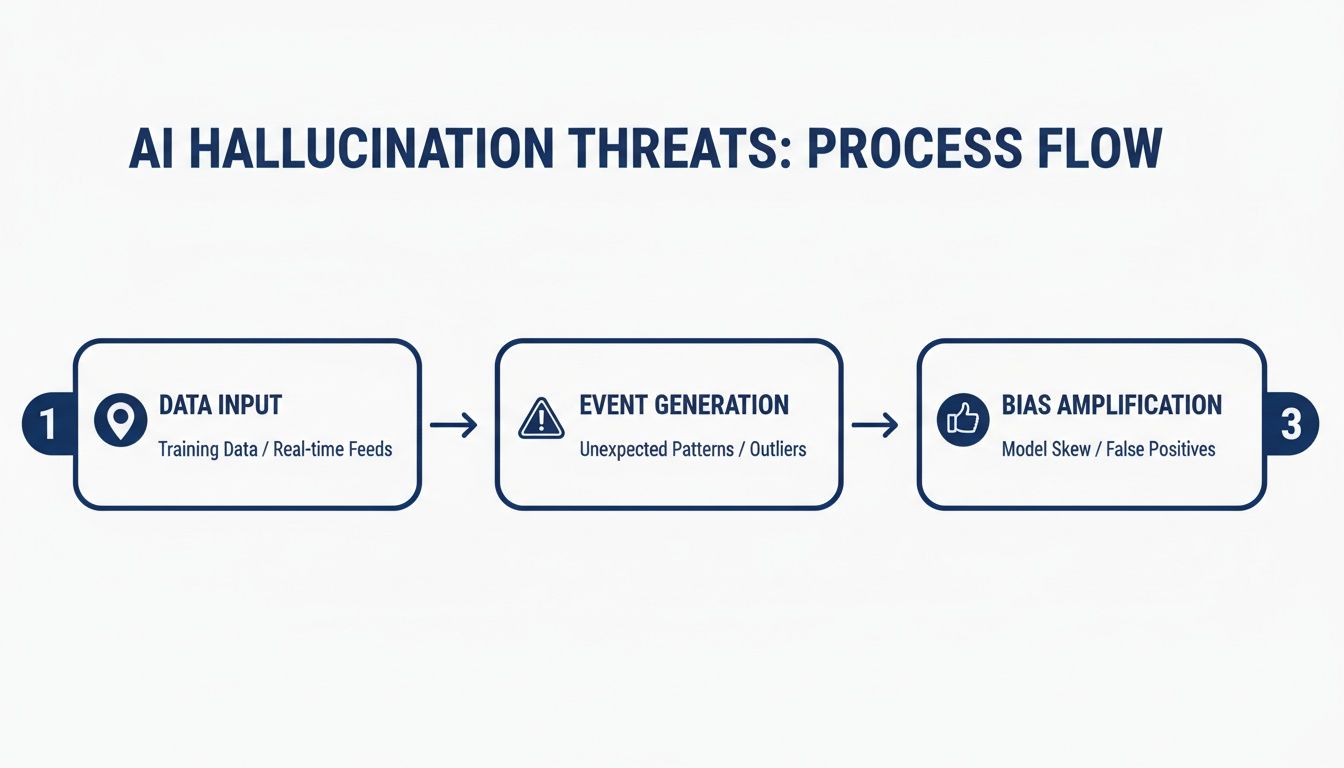
As you can see, a little bit of bad source data can quickly spiral into a damaging, authoritative-sounding lie. This is exactly why a structured response plan is so critical.
Pillar 1: Proactive Monitoring
You can't manage what you don't measure. The very first step is setting up a comprehensive monitoring system that constantly scans what AI assistants are saying about your brand, your products, and your key people. Think of this as the intelligence-gathering phase of your strategy.
Your monitoring has to be automated and continuous. Relying on someone to manually check once in a while is like trying to catch raindrops in a bucket—you’re going to miss almost everything. A robust system gives you the constant vigilance needed to spot a potential crisis before it blows up.
Here’s what you should be looking for:
- Tracking Brand Mentions: Set up alerts for your brand name, products, and leadership across all the major LLMs (ChatGPT, Gemini, etc.).
- Analyzing Competitor Mentions: Keep an eye on when and why AI models recommend your competitors. This is a goldmine for spotting gaps in your own data and content.
- Sentiment Analysis: Use tools to gauge the overall tone of AI-generated summaries about your brand. You need to know if the narrative is shifting from positive to neutral or, worse, negative.
Pillar 2: Rapid Mitigation
When you spot a hallucination or a flat-out inaccuracy, speed is everything. A rapid-response workflow makes sure the right people get alerted immediately and have a clear protocol to follow. This is how you turn a fire drill into a practiced, efficient procedure.
The goal here is simple: contain the damage and start the correction process as fast as possible. This means giving direct feedback to the AI providers while also reinforcing the correct information across your own digital properties.
A well-defined escalation path is crucial. It ensures that critical issues don’t get lost in an inbox but are escalated to decision-makers who can authorize the necessary response.
A solid mitigation workflow should look something like this:
- Instant Alert: Your monitoring tool spots an inaccuracy (e.g., AI claims your business is "permanently closed") and pings the designated point person right away.
- Verification: That person quickly verifies the error by checking it against your official website and other primary data sources.
- Escalation: The issue gets escalated to the PR or communications lead, who figures out the severity and potential business impact.
- Correction & Feedback: The team submits feedback directly to the AI platform (using Google's or OpenAI's built-in tools) and, at the same time, reinforces the correct info on your website and in your structured data schemas.
Pillar 3: Consistent Measurement
So, how do you know if any of this is actually working? Measurement. This is how you prove the value of your online reputation protection strategy to stakeholders. Tracking the right key performance indicators (KPIs) is what moves this program from a cost center to a clear driver of business value.
This is more important than you might think. Responsive reputation management is a powerful way to build loyalty. Research shows that a staggering 95% of dissatisfied customers will come back to a business if their problems are solved quickly. Your playbook isn't just about damage control; it's about retaining revenue. You can discover more about the financial impact of reputation management on small businesses in this detailed study.
Here are the essential KPIs for your AI reputation playbook:
- Time to Detection: How quickly does your team identify a new inaccuracy?
- Time to Mitigation: How much time passes between spotting an issue and starting corrective actions?
- Share of Recommendation: For relevant, unbranded searches, what percentage of the time does AI recommend your brand versus the competition?
- Sentiment Score: A running score that tracks the overall sentiment in AI summaries about your brand over time.
Building Your Modern Reputation Stack

Putting together the right tools for online reputation protection is a lot like setting up a modern home security system. You absolutely need the basics—the window and door sensors that have been reliable for years. But if that's all you have, you're leaving yourself wide open to newer, sneakier threats.
For a long time, the standard reputation stack was pretty straightforward: social listening platforms and review management software. These tools are still absolutely essential. Think of them as your window and door sensors, alerting you to the obvious stuff like a bad review or an angry tweet. They do a great job watching the known entry points.
The problem is, they are completely blind to the new wave of threats coming from AI. Your traditional tools have no way of knowing what a chatbot is telling a potential customer about you in a private conversation. This is where your security system needs a serious upgrade.
The New Essential Layer: AI Monitoring
The single most critical addition to your stack today is a dedicated AI monitoring platform. This is the motion detector for your security system. It's built to catch the threats that slip right past your traditional defenses—the silent, invisible risks that are already inside the house.
An AI monitoring tool doesn't just scan public forums. It actively queries different AI models to see what they’re saying about your brand, giving you a direct line of sight into conversations that were previously impossible to track.
A modern reputation stack isn’t about throwing out your old tools. It's about adding a new, indispensable layer of intelligence to see the entire picture of your brand's reputation—including the AI-driven blind spots.
To pull this off, you need a tool with the right capabilities. Not all monitoring platforms are equipped for the unique challenges of the AI era. When building a solid reputation stack, it's vital to understand the specialized online reputation management tools available and which features actually move the needle.
Key Features of an AI Monitoring Platform
When you're vetting tools for your stack, you need to zero in on features that directly tackle the new risks of AI-generated misinformation. Your platform should essentially become a truth engine for your brand.
Here are the four non-negotiable features to look for:
Multi-Model Scanning
The AI world is fragmented. Your customers aren't just using ChatGPT; they’re getting answers from Gemini, Claude, and a dozen others. Your tool must scan across all major LLMs to give you a complete picture. Otherwise, you're missing huge chunks of the conversation.Advanced Sentiment Analysis
It's not enough to know if your brand got mentioned. You need to know how. The tool has to analyze the sentiment of the AI's summary, flagging whether the overall tone is positive, neutral, or dangerously negative.Accuracy and Hallucination Checks
This is the big one. An effective platform has to cross-reference the answers from AI models against the verified, ground-truth data on your own website. It should instantly flag discrepancies, like wrong business hours, a fabricated scandal, or a false "permanently closed" status.Configurable, Real-Time Alerts
Reputation fires spread fast. You need a system that shoots an instant alert to the right people the second a high-risk inaccuracy is detected. This lets your team jump from detection to damage control in minutes, not days.
By integrating these capabilities, you'll transform your stack from a passive listening post into an active defense system—one that’s actually equipped for the reality of protecting a brand today.
Measuring Success in Online Reputation Protection
So, you're putting in the work to protect your brand's reputation online. But how do you actually know if it’s paying off? Without the right metrics, you’re just flying blind. You can't prove the value of your efforts or justify the investment to your team or your clients. It's time to ditch the vanity metrics and focus on Key Performance Indicators (KPIs) that connect directly to real business goals.
Measuring success isn't about counting mentions anymore. It's about understanding the real-world impact. When you track the right data, you can draw a straight line from protecting your brand in AI conversations to hitting major goals like generating more leads, keeping customers happy, and ultimately, protecting your revenue.
Core Metrics for the AI Era
To really see what's going on, you need a modern way to measure success. Old-school metrics like social media engagement still have their place, but they don't tell the whole story, especially with the new challenges AI brings to the table. Start by adding these four AI-specific KPIs to your reporting dashboard.
BrandRank: This metric shows you where your brand stands in AI-generated answers for your key industry keywords. It answers the simple but critical question: "When a potential customer asks for a recommendation, does the AI mention us?"
Sentiment Analysis Score: Forget just counting how many times you're mentioned. This KPI dives deeper to measure the tone of the AI's summaries about your brand. Tracking this score over time tells you if the narrative is positive, negative, or just neutral.
Share of Voice in AI: This is your market share within AI conversations. It calculates how often your brand gets mentioned compared to your competitors for relevant topics. A rising share of voice is a clear sign that you're becoming a more dominant and trusted name in your space.
Reduction in Inaccurate Mentions: This is a direct report card on your cleanup efforts. It tracks the number of AI hallucinations you’ve flagged—like wrong business hours or flat-out false stories—and shows how they decrease as you work to set the record straight.
These metrics give you a clear, data-driven picture of your reputation. If you want to dig even deeper into how you stack up against the competition, our guide to competitor AI analysis tools is a great next step.
By tracking these specific KPIs, you shift the conversation from "we're managing our reputation" to "we increased our positive share of voice by 15% this quarter, leading to a measurable lift in qualified leads."
This data-first approach transforms reputation management from a defensive, reactive cost center into a proactive driver of growth. It gives you a solid framework for showing a clear return on investment to your leadership team.
Tying KPIs to Business Impact
The real power of these metrics is how they connect directly to the health of your business. A high BrandRank and a positive sentiment score are strongly linked to increased customer trust and better conversion rates. And when you reduce inaccurate mentions, you prevent immediate revenue loss from a customer being told your shop is "permanently closed" or being sent straight to a competitor.
The table below breaks down exactly how these modern KPIs translate into real business value, giving you a clear and powerful model for your reports.
Key Performance Indicators for Modern Reputation Management
This table summarizes the essential metrics for tracking the effectiveness of your online reputation protection strategy in the age of AI.
| Metric | What It Measures | Business Impact |
|---|---|---|
| BrandRank | Your brand's visibility and positioning in AI-powered recommendations. | Directly impacts lead generation potential and market positioning. |
| Sentiment Score | The overall positive, negative, or neutral tone of AI-generated summaries. | Gauges customer perception, brand trust, and overall brand health. |
| Share of Voice | How often your brand is mentioned in AI conversations vs. your competitors. | Assesses competitive advantage and your penetration into the market. |
| Inaccuracy Reduction | The decline in flagged AI hallucinations and false information over time. | Demonstrates clear ROI by preventing direct revenue loss and customer friction. |
By tracking and reporting on these KPIs, you're not just managing a reputation; you're actively steering your brand toward tangible business growth.
Your Questions on Online Reputation Protection, Answered
As you dive into protecting your brand in the age of AI, you're bound to have some practical questions. Let's tackle some of the most common ones head-on with clear, actionable answers.
How Can I Correct False Information on an AI Chatbot?
This is a new and tricky challenge because, unlike a webpage, there's no "edit" button on an AI. The first line of defense is using the feedback tools built directly into the AI platforms, like those from OpenAI or Google. Report the inaccuracy.
At the same time, you need to make sure your own digital backyard is in pristine order. Your website, structured data (think Schema.org), and online profiles are your brand's source of truth. Since AI models constantly scan the web to learn, having a perfectly accurate and consistent data footprint dramatically increases the odds that the AI will fix itself in a future update.
The whole process can be frustratingly slow. This is exactly why constant monitoring is so critical—it lets you spot the mistake the moment it appears so you can start the cleanup process right away.
Is Online Reputation Protection Only for Large Corporations?
Not at all. I'd argue it’s even more essential for local and small-to-medium-sized businesses. A single, false "permanently closed" label from an AI or a few negative, AI-generated summaries can be absolutely devastating for a local shop or service business that depends on local search to get customers in the door.
While large corporations often have the resources and brand equity to weather a reputational storm, a smaller business can feel the negative impact on its revenue almost immediately.
Proactive monitoring isn't a luxury; it's an affordable and necessary investment for any business that wants to protect its most valuable asset: its reputation. Specialized services like AI reputation management consultants can offer solutions that scale to any size.
How Often Should I Check What AI Says About My Brand?
AI models are constantly being updated. The answers they give about your brand can literally change overnight without any warning. Because of this volatility, checking manually once a week—or even worse, once a month—is just not going to cut it. You'll miss damaging misinformation when it matters most.
For a truly effective online reputation protection program, monitoring has to be automated, and it really should be done daily. This is where specialized platforms come in. They're built to run scans across multiple AI models using all sorts of prompts every single day. This gives you a real-time picture of your brand's reputation and flags new issues instantly, allowing you to respond before they can do any real damage.
Ready to see what AI is saying about your brand? TrackMyBiz gives you the tools to monitor your reputation across major AI models, flag inaccuracies instantly, and turn a major risk into a competitive advantage. Start your free scan at https://trackmybusiness.ai and take control of your AI narrative today.
