Local SEO in Omaha is all about making sure your business pops up when people nearby are searching for what you offer. Think about it: when someone in Omaha pulls out their phone to find your services, you want to be the first name they see, not your competitor's. It’s that simple. The goal is to turn those local searches into actual customers.
Why Local SEO is Your Biggest Growth Lever in Omaha
Let's be honest, standing out in the Omaha market is tough. Whether you're in the historic Old Market or out in the growing western suburbs, you've got competition. Having a great service or product is the first step, but it's not enough anymore. You have to be visible the second a potential customer starts looking.
This is where a sharp Omaha local SEO strategy becomes your secret weapon for real growth. We're not just talking about vanity rankings; we're talking about tangible results that directly impact your bottom line.
Connect with Customers Ready to Buy
Local searchers aren't just window shopping—they're ready to make a move. Someone searching for "best coffee near Aksarben Village" or "emergency plumber in Millard" has a problem that needs solving right now.
A solid local SEO presence ensures you're the answer they find. It’s this direct line to motivated buyers that makes local search so powerful. You're not casting a wide, hopeful net; you're being the perfect, convenient solution for customers right in your neighborhood.
The core of local SEO is simple: Be the best and most visible answer for a local customer's problem. When you get this right, growth isn't just possible—it's inevitable.
Drive Real-World Business Results
The payoff from good local SEO isn't just about clicks and impressions; it's about real-world actions that grow your business. A well-oiled strategy leads directly to:
- More Foot Traffic: People will be asking for directions and walking right through your door.
- More Phone Calls: Your phone will start ringing with calls from qualified local leads.
- More Website Clicks: Potential customers will head to your site to learn more or book an appointment.
The demand for these services in Omaha has exploded. Between 2019 and 2024, countless small businesses finally got serious about their online presence. Some local agencies even reported client traffic increases of over 100%, with one seeing a massive 372% jump. That shows you just how much untapped potential is out there.
To truly grow your business here, you need a playbook tailored specifically for the Omaha market. To dive deeper into these tactics, explore this comprehensive guide to Local SEO Omaha strategies.
Nail Your First Impression: The Google Business Profile
Think of your website as your digital headquarters. If that's the case, your Google Business Profile (GBP) is your prime-time, main street storefront. For any business in Omaha, this is hands-down the most valuable piece of real estate in local search.
Your GBP is often the very first handshake with a potential customer. It pops up in the Map Pack and local results, giving them a snapshot of your business before they even think about clicking through to your website.
Honestly, leaving your GBP unoptimized is like having a shop in the Old Market with the windows boarded up. It makes you invisible. But a well-tended profile? That's a magnet for customers searching right now for exactly what you do.
The journey from someone searching locally to them walking through your door (or calling you up) is pretty direct. Your local SEO work is what paves that path.
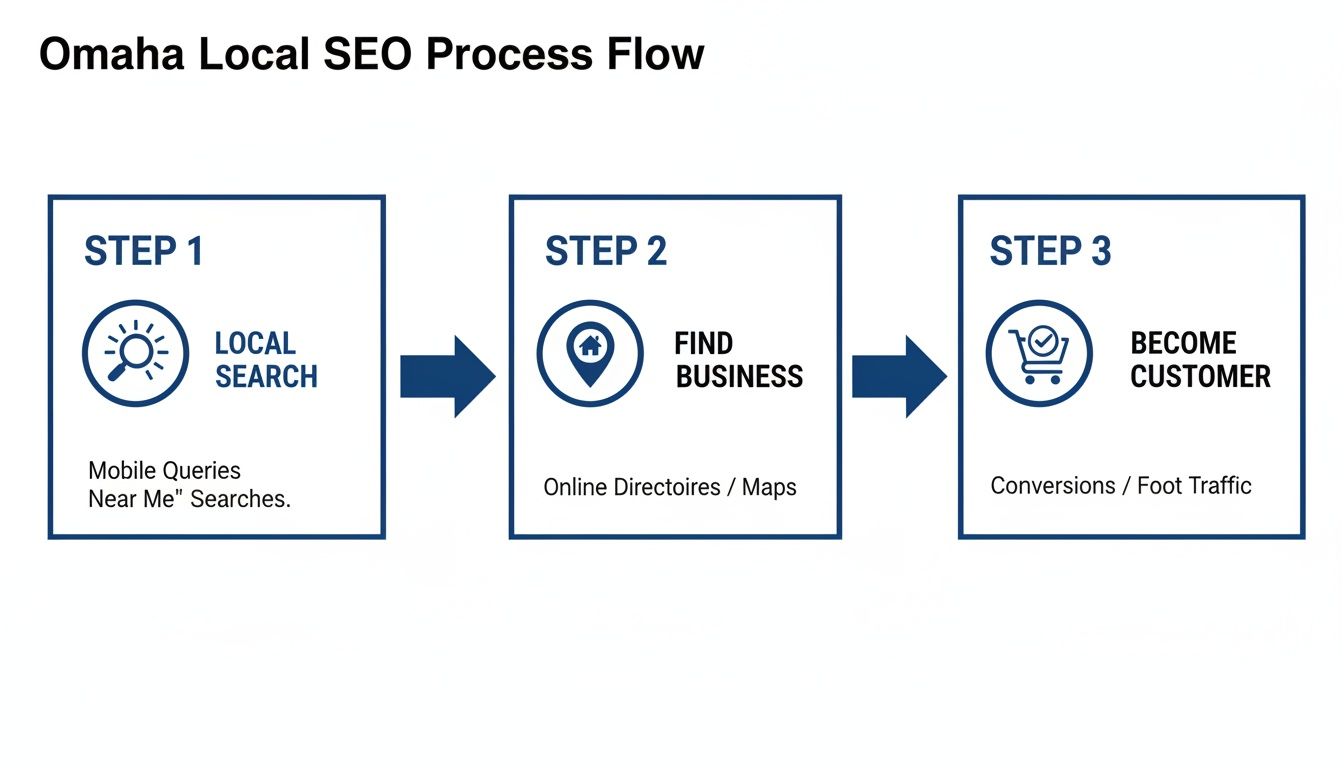
As you can see, getting seen in that first search is everything. It's the first domino to fall on the way to getting a new customer.
Choosing Your Core Categories
First things first: you have to tell Google exactly what you are. This happens in your business categories, and it's no time to get creative. Precision is the name of the game.
Your primary category is the big one. It's the main signal you send to Google about your core business. If you’re a plumber based in Papillion, your primary category is "Plumber," not "Home Services." Simple as that.
From there, you can add secondary categories for all the other things you do, like "Drain Cleaning Service" or "Water Heater Installation." Being specific helps Google connect you with people making very specific, high-intent searches.
Crafting a Hyper-Local Business Description
Your business description is where you get to add some local flavor. Don't just spit out a boring list of services. Tell your story and ground it in the Omaha community you're a part of.
Instead of a generic line like, "We are a leading coffee provider," try weaving in the local context.
"Proudly serving the Dundee and Aksarben Village neighborhoods for over a decade, we offer handcrafted espresso drinks and locally sourced pastries. We're your go-to spot for a morning boost before heading to Baxter Arena or a relaxing afternoon break."
See the difference? This approach works in key neighborhood terms and feels genuinely connected to local life. For a deeper dive, check out this excellent guide on How to Optimize Google My Business for Local Success.
The Power of Visuals and Services
People buy with their eyes. A GBP profile packed with high-quality, authentic photos will always beat one that’s a ghost town. Go beyond the standard shot of your front door.
- Team Photos: Let people see the friendly faces behind the business.
- Action Shots: Show your team doing what they do best—brewing that coffee, fixing that leaky pipe, or staging a home.
- Interior and Exterior: Give customers a real feel for your vibe before they even arrive.
Also, don't sleep on the Services feature. This is your chance to build out a detailed menu of everything you offer. A landscaper shouldn't just list "Landscaping." Break it down into "Lawn Mowing," "Fertilization," "Tree Trimming," and "Retaining Wall Installation." Every service you list is another opportunity to rank.
Keep the Conversation Going with Posts and Q&A
Your GBP is not a "set it and forget it" profile. It’s a living, breathing marketing channel that rewards activity. Google Posts are perfect for this. They're like mini-ads or social updates that show up right on your profile.
Use them to highlight:
- Special Offers: A happy hour special or a seasonal discount.
- New Products/Services: Got a new item on the menu? Shout it out.
- Upcoming Events: Hosting a trunk show or a community event? Post it.
The Q&A section is another seriously underused tool. Customers can ask questions, and you can answer them publicly. But here's the pro tip: you can seed this section yourself. Add your own common questions—about parking, accessibility, or specific services—and then answer them.
This builds a handy, on-profile FAQ that helps customers and shows Google you're an engaged, authoritative business. Consistent activity is a massive signal for a strong Omaha local SEO strategy. And for more on keeping up with search trends, the TrackMyBiz blog is a great resource.
Mastering Local Keyword Research and On-Page SEO
A perfectly tuned Google Business Profile gets people to your digital doorstep, but it’s your website that invites them in and turns them into actual customers. To make that happen, you have to speak their language—the exact words and phrases Omahans are typing into Google every day.
This is the real work of local on-page SEO. It’s about ditching broad, generic terms for the hyper-local, high-intent phrases that signal someone is ready to pull out their wallet. You’re essentially learning the local dialect of your ideal customer.
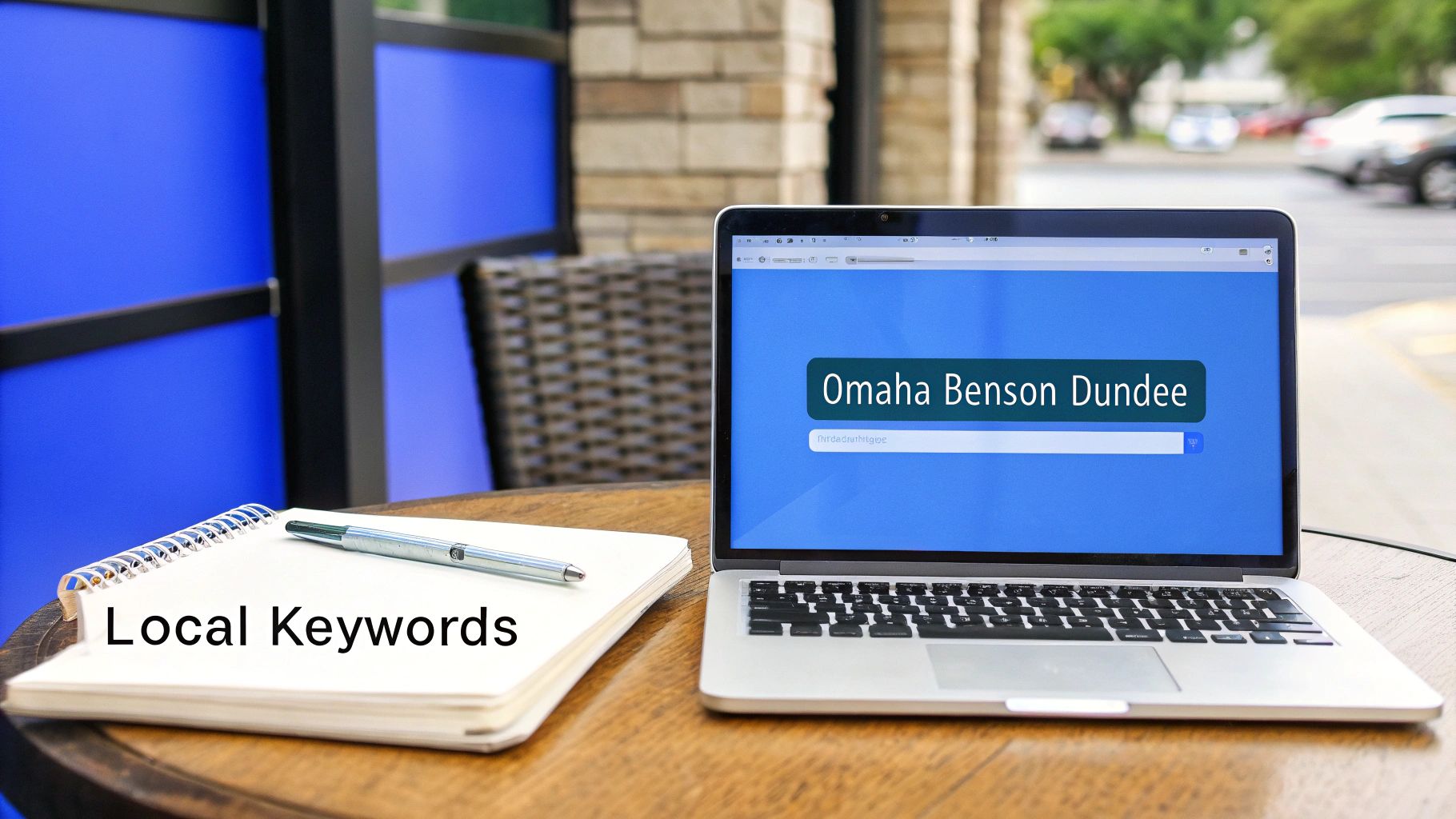
This isn’t just a "nice to have" strategy. Google’s local algorithm is a complex beast with around 149 different ranking signals, and your on-page content directly influences a massive 36% of that.
When you consider that 46% of all Google searches are for local information and a staggering 75% of those users never venture past the first page, it becomes crystal clear: getting your on-page Omaha local SEO right is non-negotiable. If you want to dive deeper into these numbers, seoprofy.com has some great insights.
Uncovering How Omaha Searches
First things first, you have to get inside your customer's head. What are they actually searching for? A home contractor in West Omaha isn't just trying to show up for "remodeler." They need to appear for the searches that bring in real, paying projects.
The trick is to brainstorm keywords that blend three key ingredients:
- The Service: What you do (e.g., "kitchen remodeling," "emergency plumber").
- The Location: Where you do it (e.g., "Omaha," "Millard," "La Vista," "Dundee").
- The Qualifier: What makes the search specific (e.g., "best," "affordable," "24-hour," "near me").
Putting these together is where the magic happens. "Plumber" is a casual search. But "emergency plumber in Millard"? That's a homeowner with a burst pipe and a credit card, desperate for your help.
To show how this works in practice, here are a few examples of how to drill down from a general service keyword to a hyper-local phrase that captures serious buyer intent.
Omaha Local Keyword Strategy Examples
| Generic Service Keyword | Omaha-Specific Keyword | Neighborhood-Level Keyword | User Intent |
|---|---|---|---|
| "roof repair" | "roof repair Omaha NE" | "hail damage roof repair in Papillion" | High. The user has a specific, urgent problem (hail damage) in a defined area. |
| "landscaping services" | "landscaping company Omaha" | "backyard landscaping design Aksarben" | High. This person is looking for a specific, creative service for their home. |
| "HVAC company" | "furnace installation near Omaha" | "24-hour furnace repair in Benson" | Urgent. The search is for an immediate, time-sensitive fix in a specific place. |
| "family dentist" | "best family dentist in Omaha" | "pediatric dentist near Dundee Omaha" | High. A user seeking a specialized service for children in a trusted neighborhood. |
These neighborhood-level keywords are where you find your most valuable leads. They're less competitive and attract customers who are ready to make a decision.
Pro Tip: Don't obsess over the exact phrase "near me." You can't really target it directly. Instead, focus on weaving strong local signals—like neighborhood names, local landmarks, and cross-streets—into your website's content. This gives Google the clues it needs to associate your business with specific geographic zones, helping you show up for those "near me" searches naturally.
Putting Your Keywords to Work on Your Website
Once you’ve got a solid list of local keywords, it’s time to strategically place them on your site. This is where you signal to Google and other search engines, "Hey, I'm the most relevant, authoritative answer for this specific search in Omaha."
Focus on integrating your keywords in these high-impact places:
- Title Tags: This is the clickable blue link in search results. Make it count. Lead with your main keyword and location, like this:
24-Hour Emergency Plumber in Millard | Bob's Plumbing. - Meta Descriptions: The short summary under the title. While not a direct ranking factor, a well-written description that includes your keyword can dramatically improve click-through rates.
- Header Tags (H1, H2, H3): Your H1 is the main headline for the page and must include your primary target keyword. Use H2s and H3s for subheadings to organize content and target related, secondary keywords.
- Body Content: This is where you can really shine. Weave your keywords in naturally. Don't just list them—talk about projects you've completed in specific Omaha neighborhoods, mention local street names, and show you're truly part of the community.
Build Hyper-Local Service Pages for the Win
If you serve different parts of the Omaha metro or offer several distinct services, creating dedicated pages for each is one of the most powerful Omaha local SEO moves you can make. Stop cramming everything onto a single, generic "Services" page.
A local roofer, for example, could create highly-targeted pages like:
omaharoofing.com/roof-repair-bensonomaharoofing.com/roof-replacement-papillionomaharoofing.com/commercial-roofing-omaha
Each of these pages can be laser-focused on that specific service-and-location combo. On the Dundee page, you could write, "We specialize in repairing the historic slate roofs found throughout the Dundee neighborhood." That kind of specific, local detail is pure gold for Google—it screams local authority.
Speak Google’s Language With Local Schema
Finally, let’s talk about a powerful, behind-the-scenes tool: schema markup. Think of it as a special vocabulary you add to your website's code that translates your business information into a language search engines understand perfectly.
Specifically, LocalBusiness schema gives Google a neatly organized file on your business, including:
- Business Name, Address, and Phone Number (NAP)
- Hours of Operation
- Service Area
- Customer Reviews and Ratings
By implementing this code, you help Google display your information correctly in the search results, often leading to "rich snippets" that show star ratings or business hours directly on the results page. It completely removes the guesswork for search engines, giving them rock-solid confidence that you are who you say you are, where you say you are. And in local SEO, that's a massive trust signal.
Earning Trust with Local Citations and Links
Think of your website and Google Business Profile as your home base. But to really build authority in the Omaha market, you need the local community to vouch for you. For search engines like Google, this "vouching" comes in the form of consistent mentions and links from other trusted websites.
Every time a reputable site points back to you, it’s another vote of confidence. This is where local citations and backlinks come in. They’re digital breadcrumbs that prove to both potential customers and search engines that you're a legitimate, established part of the Omaha landscape.
NAP Consistency: The Unshakable Foundation
The absolute bedrock of this trust-building process is your NAP: your business Name, Address, and Phone Number. This information needs to be perfectly identical everywhere it shows up online. I'm talking down to the last comma and whether you use "St." or "Street."
Why the obsession with detail? Because inconsistencies muddy the waters for search engines. If one directory has you as "Omaha Plumbing Inc." on "123 Main St." and another lists "Omaha Plumbing" on "123 Main Street," Google’s algorithm might get confused and see them as two separate businesses. This confusion erodes trust and can sink your local rankings fast.
Your NAP is your digital fingerprint. Absolute consistency is non-negotiable for a successful Omaha local SEO campaign. Even tiny variations can dilute your authority and confuse both search engines and potential customers.
Building Your Omaha Citation Portfolio
A citation is simply any online mention of your NAP information. There are thousands of directories out there, but chasing all of them is a waste of time. For an Omaha business, you need to focus on quality over quantity.
First, lock down your profiles on the big data aggregators and major platforms. Get these perfect before you do anything else:
- Google Business Profile (we’ve covered this, but it’s still the most important!)
- Bing Places for Business
- Apple Maps
- Yelp
With those handled, it's time to zero in on directories that scream "Omaha." These are the listings that send powerful signals about your local relevance. For any business here, this is your starting list:
- Greater Omaha Chamber of Commerce: A membership and listing here is a massive sign of local credibility.
- Omaha World-Herald Business Directory: Being listed with the city's main news source is a huge plus.
- Local.com and City-Data.com: These are national players, but they have strong, established Omaha sections that carry weight.
- Industry-Specific Sites: This is crucial. If you’re a contractor, you need to be on Angi and HomeAdvisor. Running a restaurant? Getting on OpenTable and TripAdvisor is a no-brainer.
Nailing these foundational citations is a critical pillar of any Omaha local SEO work. It solidifies your digital identity and makes it much easier for Google to trust—and rank—your business.
Earning Local Links That Actually Move the Needle
If citations are the foundation, local backlinks are the rocket fuel. A backlink is a clickable link from another website to yours. But here's the thing: not all links are created equal. A single link from a well-respected Omaha organization is worth more than a dozen from generic, spammy directories.
Getting these high-value links means stepping away from the keyboard and actually engaging with the local community. It’s about building real relationships that pay off with digital authority.
Here are a few proven ways to earn powerful local backlinks:
- Sponsor a Local Team or Event: Think about sponsoring a Millard United sports team or a local charity 5K. You'll almost always get your logo and a link on their website in return—a fantastic signal of community involvement that Google loves.
- Partner with a Neighboring Business: Find a non-competing business in your area, maybe another shop in the Blackstone District or Aksarben Village, and team up. You could co-host an event or run a joint promotion, then both write a blog post about the collaboration, linking to each other.
- Get Featured in Local Media: Reach out to local reporters at places like The Reader or the Omaha World-Herald. Have an interesting story about how you started? Launching something unique? A feature story not only builds your brand but almost always includes a high-authority backlink.
These aren't just quick marketing stunts; they're long-term investments in your local reputation. Every genuine local link you earn acts as a powerful endorsement, telling search engines that your business is an active, trusted, and important part of the Omaha community.
Managing Your Online Reputation and Reviews
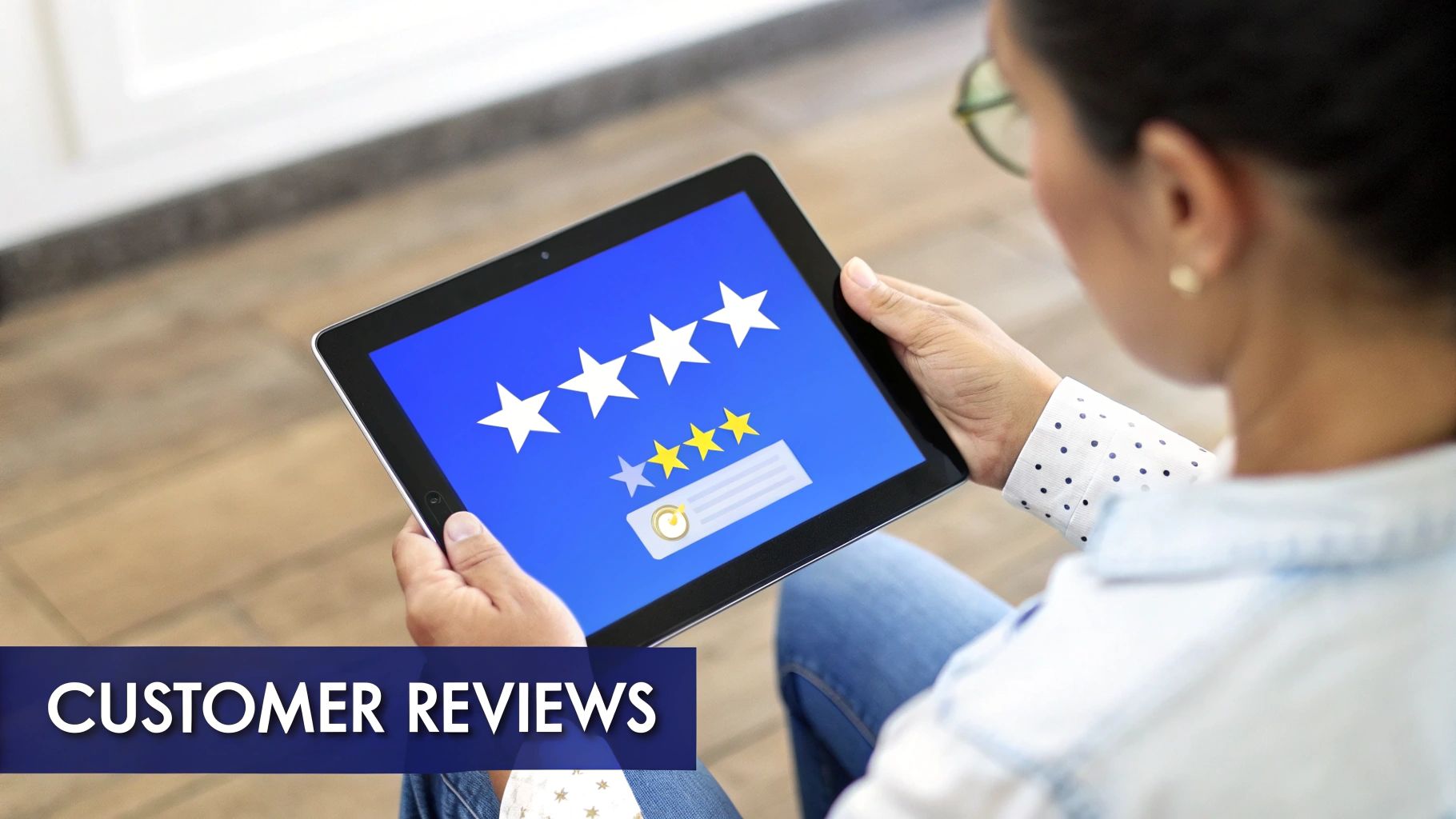
Your online reviews are a massive piece of the Omaha local SEO puzzle. Think of them as today's word-of-mouth—they provide the social proof that turns a curious searcher into a paying customer. You can't just cross your fingers and hope for good feedback anymore. You need a solid, repeatable system for getting positive reviews and actively managing your reputation.
This goes way beyond just chasing five-star ratings. It’s about showing potential customers, and just as importantly, Google, that you're dedicated to customer satisfaction. When you actively manage your reputation, you're sending a powerful trust signal that gets noticed.
Building a System for Generating Reviews
Here's the thing: most happy customers are perfectly willing to leave a review, but life gets in the way the second they walk out your door. The secret is to make it incredibly simple for them to leave feedback right when their positive experience is fresh in their mind.
"Leave us a review!" is too vague. You need to give them a direct, frictionless path. A simple QR code on a business card or receipt that links straight to your Google review page is a game-changer. If you're a service-based business, a friendly follow-up email or text a day after the job is done works like a charm.
A few ethical, effective methods I've seen work well:
- Personalized Email Requests: After a purchase or service, send a thank-you email with a direct link to your review profile. Keep it short and sweet.
- Text Message Links: For a more immediate touch, a quick SMS with a link can get a surprisingly high open and click-through rate.
- In-Person Cues: Place small, professionally designed signs with a QR code right at your checkout counter or front desk. Make it impossible to miss.
The Art of Responding to Every Single Review
Responding to your reviews isn’t optional anymore. It shows you're engaged and that you actually care about what your customers have to say. This is doubly true for negative reviews—they're a golden opportunity to publicly showcase your professionalism and problem-solving skills.
The data backs this up. One industry study found that businesses that respond to ≥32% of their reviews saw an 80% higher conversion rate than competitors who only replied to 10%. It’s a huge difference. You can dive deeper into the numbers and see the full local SEO statistics on seoprofy.com.
Pro Tip: Your response to a negative review is really for every future customer who reads it. A calm, helpful, and professional reply can completely neutralize the complaint and turn it into a win for your brand.
Crafting the Perfect Response
How you reply is everything. A canned "Thanks for your feedback" is worse than saying nothing at all. Your responses need to feel personal and genuine.
For Positive Reviews:
- Use the customer's name.
- Reference a specific detail from their review ("We're thrilled you loved the Reuben at our Dundee location!").
- End with a warm invitation to return.
For Negative Reviews:
- Acknowledge their frustration and sincerely apologize for their poor experience.
- Never get defensive. The goal is to take the conversation offline. Provide a direct contact, like, "Please call me directly at…".
- Reaffirm your commitment to getting it right.
This hands-on approach builds incredible trust. As you grow, managing this can get overwhelming. For businesses looking to scale their efforts, tools and services like AI reputation management consultants can help you manage feedback efficiently without losing that personal touch, ensuring your Omaha local SEO is backed by a five-star reputation.
Measuring Your Local SEO Success
A great strategy is only as good as its results. Pouring effort into your Omaha local SEO without tracking progress is like driving down I-80 with your eyes closed. You have to move past vanity metrics like simple website visits and really dig into the key performance indicators (KPIs) that actually mean revenue for your business.
What truly measures success are the actions that lead to a sale. Are more people calling your shop in Benson? Are you getting more requests for directions to your West Omaha storefront? Is your website traffic from local searchers actually converting into booked appointments? These are the questions that really matter.
Building Your Performance Dashboard
You don't need to break the bank on expensive software to get started. Google’s own free tools are incredibly powerful and can give you all the data you need for an effective performance dashboard.
- Google Search Console: This is where you see exactly which local search queries are bringing people to your site. You can track your average ranking for a term like "best brunch in Dundee" and see how many people are actually clicking through.
- Google Business Profile Insights: This is your goldmine for local engagement. It directly tracks how many people called your business, asked for directions, and visited your website straight from your Google listing.
- Google Analytics: Hook this up to your website to see what local visitors do once they land there. Are they navigating to your contact page? Filling out your form? This helps you understand the quality of the traffic your SEO work is generating.
By focusing on these concrete actions—phone calls, direction requests, and form submissions—you get a true picture of your return on investment. It's the difference between guessing and knowing your marketing is actually working.
Recent local case studies prove that a targeted approach delivers rapid, measurable results. One Omaha agency helped a client jump from having zero first-page rankings to scoring 7 number-one rankings and 23 top-ten spots in just five months. This drove organic traffic growth anywhere from +50% to +300% and even doubled lead volume for some businesses. You can read more about these Omaha-specific SEO results and findings.
The New Frontier: Monitoring AI and Voice Search
There's a new challenge on the horizon. As customers increasingly ask AI assistants like ChatGPT and Alexa for recommendations, it's getting harder to track where leads come from. These platforms can recommend your business—or a competitor—without the user ever visiting a website.
Worse, they can "hallucinate" and spread incorrect information, like the wrong business hours or even a fake negative review.
Monitoring how your business shows up on these platforms is quickly becoming non-negotiable. You need to know if your information is accurate and whether you're being recommended for key local prompts. This is where specialized tools come into play, helping you see what AI is saying about you and your competition. To get a handle on this, you might check out these competitor AI analysis tools that reveal what different models are telling potential customers. It’s the next step in protecting the reputation you’ve worked so hard to build.
Your Top Omaha Local SEO Questions Answered
If you’re like most Omaha business owners, you’ve probably got a few questions about how all this local search stuff actually works. Let's tackle some of the most common ones I hear all the time.
How Long Until I See Results from Local SEO in Omaha?
This is the big one, isn't it? While you can get some quick wins—sometimes in just a few weeks—by whipping your Google Business Profile into shape, a comprehensive Omaha local SEO strategy really starts to bear fruit in about 3 to 6 months.
Think of it this way: it takes time for Google to crawl your site changes, recognize the new local links you're building, and start trusting that you're a legitimate local authority. Patience and consistency are your best friends here.
Should I DIY My Local SEO or Hire an Omaha Agency?
Honestly, you can go either way, and it depends on your goals and your time. Using this guide, most business owners can absolutely handle the fundamentals like optimizing their Google Business Profile and getting more reviews.
But if you're in a super competitive Omaha niche (think plumbers, lawyers, or real estate) or you just want to grow faster, partnering with a specialized local SEO agency is a game-changer. They've got the pro-level tools, know the Omaha market inside and out, and have the connections to land high-quality local links that are tough to get on your own.
If you take only one thing away from this guide, let it be this: for nearly every Omaha business, a fully optimized and active Google Business Profile is the most powerful tool you have. It's your digital storefront right on Google Maps and the local search results.
A complete profile—we’re talking accurate info, fresh posts, great photos, and a steady stream of positive reviews—is a direct line to new customers. It's the highest-impact first step you can take and the engine that drives a massive chunk of your local visibility.
Are AI assistants like ChatGPT and Alexa recommending your business accurately? At TrackMyBiz, we monitor what AI says about you, flagging harmful "hallucinations" and tracking when competitors are mentioned instead. Protect your reputation and turn AI into a new customer channel. Start your free scan today at https://trackmybusiness.ai.
