
Imagine your market is a massive, noisy concert hall. Every brand, including yours, is a musician trying to be heard over the din.
Your marketing share of voice (SOV) is simply the percentage of the total audience's attention your music captures compared to every other musician on stage. It's a direct, no-nonsense measure of your brand's presence and authority.
But SOV isn't just a vanity metric to show off in a meeting. It’s one of the most powerful predictors of future growth you have. Instead of looking at your own metrics in a vacuum, SOV gives you a clear, competitive benchmark that reveals not just how you're doing today, but where you're headed tomorrow.
The Link Between SOV and Market Share
Here's the critical takeaway: a higher share of voice almost always leads to a higher market share. This isn't just a theory—it's a well-documented relationship that smart marketers have been using for years.
When your brand consistently owns more of the conversation, it builds awareness and trust. Over time, you become the default choice for consumers when they're ready to buy. The connection is so strong that research from Binet and Field found a direct correlation, showing that a brand’s market share typically gains 0.5% for every 10% of excess share of voice (ESOV) it holds.
What does that mean in the real world? If you hold 20% of the market but manage to push your SOV up to 30%, you can reasonably expect to see your sales and market share follow. You can discover more about how SOV drives market growth from the full study.
More Than Just Advertising Spend
In the old days, SOV was all about ad spend. You'd just compare your budget to your competitors', and that was that. Today, that definition is far too narrow. A modern understanding of share of voice has to include visibility across every touchpoint that matters.
- Organic Search: How often do you show up on the first page of Google for the terms that matter, compared to everyone else?
- Social Media: What slice of the social media pie—mentions, hashtags, and discussions—actually features your brand?
- Public Relations: Are you getting your name in top-tier publications more often than your rivals?
By tracking SOV, you're not just measuring your ad budget's impact. You're gauging your brand's cultural relevance, its authority in search results, and its overall resonance with your target audience. It's the ultimate indicator of brand health.
Ultimately, tracking this single metric gives you an honest look at your competitive position. It tells you whether your marketing is actually cutting through the noise or if your competitors are drowning you out. For any brand serious about sustainable growth, it’s an absolutely essential tool.
How to Calculate Your Share of Voice Across Key Channels
Moving the idea of "share of voice" from a boardroom concept to a number you can actually use requires a practical approach. The trick is to stop thinking of SOV as one giant, all-encompassing metric. Instead, you need to measure it where it really matters—on the specific channels your audience is using every single day.
The core formula itself is refreshingly simple:
Your Brand Metric / Total Market Metric x 100 = Your Share of Voice (%)
This basic framework is flexible enough to work anywhere, from the crowded search results on Google to the endlessly scrolling feeds of social media. Your job is to pick the right "brand metric" for each channel and get a clear, honest picture of the "total market."
This is how your current visibility connects directly to your potential for growth. It’s the bridge between abstract brand awareness and a measurable competitive edge.
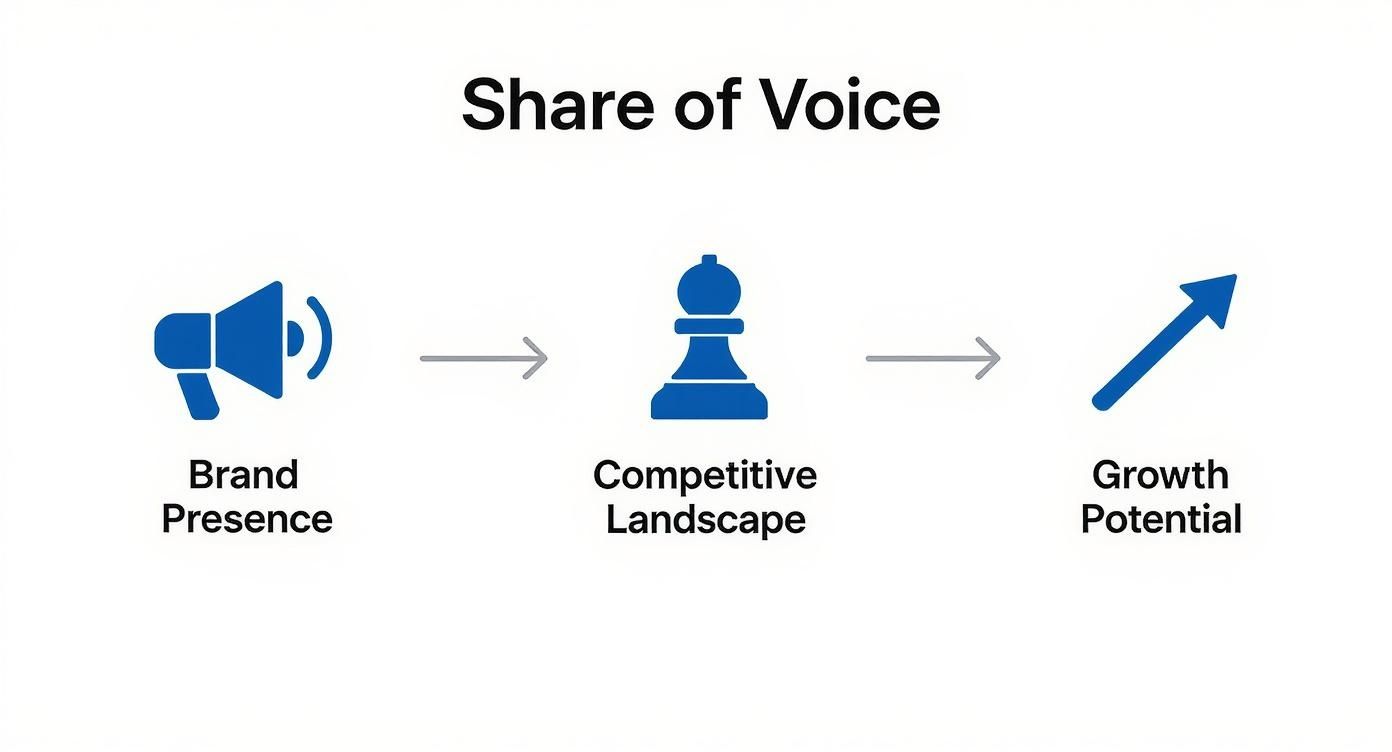
As you can see, understanding your brand’s presence within the competitive landscape is what unlocks future market gains.
Measuring SOV in Organic Search
When it comes to organic search, your share of voice is all about your visibility on the search engine results pages (SERPs) for the keywords your customers are typing in. It’s not just about whether you rank, but how often you show up compared to everyone else vying for that same attention.
To nail this down, you’ll want to look at a few specific metrics:
- Keyword Visibility: This is a measure of how often your website appears in search results for a specific basket of keywords. If you show up for 50 out of 100 target keywords, your basic visibility is 50%. But savvy tools like SEMrush will give you a weighted score, giving more credit to higher-ranking positions.
- Impression Share: Straight from Google Search Console, this metric shows you how many times your site was shown to users versus the total number of times it could have been shown. It’s a direct pulse on your SERP presence for relevant queries.
- Organic Traffic: You can also estimate your SOV by looking at traffic. If a group of keywords drives an estimated 100,000 visits a month and your site captures 25,000 of them, your share of voice for that topic cluster is a solid 25%.
Calculating Share of Voice for Paid Media
In the world of pay-per-click (PPC) ads, things get a lot more straightforward. Platforms like Google Ads give you the exact data you need, taking most of the guesswork out of the equation.
Here, the gold-standard metric is Impression Share. It tells you the exact percentage of time your ads were shown out of all the times they were eligible to appear.
Imagine you and a competitor are bidding on the same keywords:
- Your ads get 30,000 impressions.
- Your competitor’s ads get 50,000 impressions.
- The total available impressions in the market are 80,000.
Your paid share of voice is (30,000 / 80,000) * 100 = 37.5%. This number gives you an instant snapshot of how visible you are in the paid ad space. To dig even deeper, you can explore some of the best competitor AI analysis tools to see what your rivals are up to.
Finding Your SOV on Social Media
Social media is a conversation, plain and simple. So, your share of voice is measured by how much of that conversation is about you. Unlike paid ads, this means you need to track mentions, tags, and hashtags across different platforms.
The formula is the same, but the metrics pivot to engagement and discussion.
- Brand Mentions: Keep a tally of how many times your brand is mentioned directly (like @YourBrand) compared to the total mentions of you and your top competitors.
- Hashtag Usage: Measure how often your branded hashtags are used versus your competitors' or even general industry hashtags.
- Reach and Impressions: You can also analyze the potential audience size your content reaches compared to the total reach of everyone else in your market.
Let's say over one month, you track the chatter in your industry:
- Your Brand: 500 mentions
- Competitor A: 300 mentions
- Competitor B: 200 mentions
- Total Mentions: 1,000
Your social media SOV is a commanding 50% (500 / 1,000 * 100).
Manually gathering this data is nearly impossible. This is where tools like Brandwatch or Sprout Social become indispensable. They automate the monitoring of keywords and mentions across the web, turning a monumental task into a clean, actionable report.
To make these calculations easier to reference, here’s a quick summary of how to approach SOV on each key channel.
Share of Voice Calculation Methods by Channel
| Marketing Channel | Primary Metric | Calculation Formula |
|---|---|---|
| Organic Search | Keyword Visibility / Impression Share | (Your Impressions / Total Eligible Impressions) * 100 |
| Paid Media | Impression Share | (Your Ad Impressions / Total Available Impressions) * 100 |
| Social Media | Brand Mentions / Hashtag Usage | (Your Brand Mentions / Total Industry Mentions) * 100 |
By consistently measuring your SOV across these different fronts, you can piece together a complete and accurate picture of your brand's true visibility in the market.
Turning Your SOV Results into Strategic Insights
Calculating your share of voice is like checking the scoreboard during a game. It gives you a number, but that number is pretty useless without context. The real magic happens when you interpret what that SOV figure actually means for your business and turn the raw data into a real-world advantage.
A "good" SOV is completely relative. The story behind the number changes depending on where you sit in the market. A 5% share of voice might be a massive win for a challenger brand trying to muscle into a crowded space. But for an established market leader, seeing their share dip to 20% could be a major red flag signaling decline.
To make any sense of your results, you need benchmarks. These are the reference points that tell you whether your performance is strong, average, or in desperate need of a shake-up.
Setting Your Strategic Benchmarks
The first step is comparing your SOV against meaningful yardsticks. Without comparison, you're just staring at a number in a vacuum. A solid analysis means looking at your share of voice from three critical angles.
Your most important benchmarks are:
- Direct Competitors: This is the most obvious and crucial one. How do you stack up against the brands you fight with for customers every single day? If you have a 15% SOV but your top rival is sitting pretty at 40%, you’ve just uncovered a clear visibility gap you need to close.
- Industry Averages: Zooming out from your immediate rivals, how does your SOV look compared to the broader industry? This helps you understand if your whole niche is noisy or relatively quiet, which sets more realistic expectations for growth.
- Your Own Historical Performance: Are you gaining ground or losing it? Tracking your SOV over time—month-over-month or year-over-year—reveals the true impact of your marketing campaigns and tells you if your strategy is actually moving the needle.
Key Takeaway: Your SOV is a dynamic metric. It's not a static snapshot of where you are today, but a continuous story about your brand's momentum and competitive standing in the market.
What Is a Good Share of Voice?
While every industry has its own rhythm, some general patterns do emerge. Globally, the average SOV in competitive industries often falls somewhere between 10% and 30%. Leading brands usually aim to dominate the conversation with a share north of 20%.
Take the tech world, for example. Apple has been known to capture as much as 45% of the social media conversation during major product launches. In the automotive space, established players like Ford and Toyota typically hold a steady SOV between 15% and 30%, while newer electric vehicle startups might only command 5% to 10%. You can read more about these industry SOV benchmarks to see how different sectors stack up.
This just goes to show that what’s considered dominant in one market could be just average in another.
Turning Insights into Action
Once you have your benchmarks in place, you can start asking the smart, strategic questions that lead to better decisions. Your SOV analysis should directly feed into your planning for budget allocation, channel focus, and how you position yourself against the competition.
Let's walk through a few scenarios:
- Low SOV but High Engagement: Your share of the conversation is small, but the people you are reaching absolutely love you. This is a great sign. It suggests your messaging is spot-on, but your reach is limited. The strategic play here is to double down and increase your budget on the channels where you’re seeing that high-quality engagement.
- High Paid SOV, Low Organic SOV: This is a classic sign of being overly dependent on ad spend. It works in the short term, but it’s not a sustainable way to build a brand. The insight here is to start reallocating some of that budget toward long-term assets, like SEO and content marketing, to build a more stable, organic foundation of visibility.
- A Competitor's SOV Suddenly Spikes: If one of your rivals suddenly jumps in visibility, it’s a smoke signal you can't ignore. Dig in. Did they launch a killer campaign, land a huge media placement, or tap into a new viral trend? Figuring out the "why" behind their spike can reveal a huge opportunity—or a threat you need to counter, fast.
By connecting the numbers to these real-world situations, your share of voice metric goes from being a simple percentage to a powerful compass for your entire marketing strategy. It tells you where to invest, where to pull back, and where your next big opportunity is waiting.
Alright, knowing your share of voice score is the starting line. Actually improving it? That’s where the real race is won.
Boosting your marketing share of voice isn’t about shouting louder than everyone else. It’s about being smarter—joining the right conversations, creating content that resonates, and being strategically present where your audience is already looking. This is a playbook of proven, sustainable strategies designed to amplify your brand's voice and turn passive listeners into active followers.
Each approach here targets a different function—from content creation to social media and public relations—giving your entire team a clear roadmap for growth.

Dominate Search with Authoritative Content
For content teams, the path to a higher SOV in organic search is paved with authoritative, high-value content. Instead of scattering your efforts across dozens of minor blog posts, focus on creating pillar pages or massive guides that cover a high-value topic from top to bottom. This move positions you as the definitive source.
Think of it like building the most comprehensive library on a single subject. When Google sees you have the most in-depth and helpful resource, it rewards you with better rankings. Higher rankings directly translate to more visibility and a bigger slice of the search SOV pie.
To pull this off effectively:
- Identify Core Topics: Pinpoint the central themes your audience obsesses over that are also crucial to your business. These are the big ideas that can be broken down into many smaller questions.
- Create Comprehensive Resources: Develop a long-form pillar page for each core topic. This needs to be the go-to guide that answers every conceivable question a user might have.
- Build a Topic Cluster: Support your pillar page with a network of shorter blog posts that dive deeper into specific subtopics. Critically, every one of these "cluster" posts must link back to the main pillar page, signaling its importance to search engines.
Mini Case Study: HubSpot became a marketing software giant by creating an enormous library of free, authoritative content on every marketing and sales topic imaginable. Their pillar pages on subjects like "inbound marketing" and "email marketing" completely dominate search results, capturing a massive marketing share of voice among their target audience.
Engage and Amplify on Social Media
For social media managers, increasing SOV is less about broadcasting and more about strategic engagement. Your goal is to become an active, valuable participant in the conversations already happening in your industry. This means listening intently and adding real value wherever you can.
One of the most powerful ways to expand your reach is by leveraging user-generated content (UGC). When customers post about your brand, they’re handing you a microphone and an endorsement. By highlighting and sharing their content, you amplify your own voice and build a genuine community around your brand.
Here are a few actionable social media tactics:
- Join Trending Conversations: Use social listening tools to find trending topics and hashtags relevant to your industry. Find authentic ways to add your perspective without just shoehorning in a sales pitch.
- Encourage and Share UGC: Run contests, create a branded hashtag, or simply ask customers to share their experiences. Feature the best submissions on your official channels to build community and extend your reach organically.
- Collaborate with Influencers: Partner with creators who already have the attention and trust of your target audience. Their endorsement can introduce your brand to new segments and give you an immediate boost in visibility.
Secure High-Impact Media Placements
For public relations specialists, the game is all about credibility and reach. A single mention in a respected industry publication or a feature on a popular podcast can do more for your SOV than a month's worth of social media posts. These placements act as a powerful third-party endorsement.
The key is to move beyond generic press releases. Instead, focus on building real relationships with journalists and offering them unique stories, data, or expert commentary their audience will find genuinely valuable.
To boost your PR share of voice:
- Offer Exclusive Data: Conduct original research or surveys and offer the findings exclusively to a top-tier publication. Journalists are always looking for fresh data to build stories around.
- Become a Go-To Expert: Position your company's leaders as experts in their field. Make them available for interviews, quotes, and commentary on breaking news within your industry.
- Target Niche Publications: Don't just chase the biggest names. Getting featured in a smaller, highly respected niche publication can often have a greater impact on your core audience and build true authority.
By implementing these tailored strategies, you can systematically grow your marketing share of voice across every critical channel, ensuring your brand is not just seen, but heard and remembered.
The New Frontier of SOV in an AI-Driven World
For years, the game was simple: win the top spot on Google. But the way customers find information is going through a seismic shift. They're no longer just sifting through links; they're asking AI assistants like ChatGPT, Gemini, and Google’s AI Overviews for direct answers.
This changes everything for how we measure marketing share of voice. Old-school metrics like keyword rankings and impression share start to fray at the edges when there are fewer clicks to a website. The new goal isn’t just to rank on a page. It’s to become the answer—the cited source or the recommended brand inside an AI-generated response.
This is a brand new battleground for visibility. When an AI summarizes the "best running shoes," is your brand in that summary? When someone asks for "local Italian restaurants," does it pull your correct hours and location? Your share of voice is now being decided inside these conversational models.
Navigating the AI Black Box
Trying to measure SOV in this new world comes with its own set of headaches. Large language models (LLMs) can feel like a "black box," making it incredibly tough to pinpoint exactly why one brand gets recommended over another. The algorithms are a complex, constantly shifting puzzle.
This throws a few major hurdles in front of marketers:
- Source Attribution: LLMs don’t always show their work. A glowing recommendation might come from your content, but without a clear citation, you're left guessing which efforts paid off.
- Brand Misrepresentation: AI models can "hallucinate" or just get things wrong. This could be as simple as listing the wrong business hours or as damaging as fabricating negative reviews, directly hurting your reputation.
- Competitive Blind Spots: Your biggest rival might be getting recommended consistently for high-intent questions, and you’d have no idea it’s even happening without specialized monitoring.
The real problem is a massive loss of control and visibility. You can track your website traffic and social mentions, but you have no easy way to see what millions of users are being told about your brand in private AI chats. This hidden dialogue is the new frontier of share of voice.
If you’re not listening in on these conversations, you’re missing a huge piece of the modern customer journey. Keeping an eye on your brand's presence here isn't a "nice-to-have" anymore—it's absolutely essential.
Why You Must Monitor Your AI Presence
The stakes are much higher than just missing out on a mention. Bad information generated by an AI can directly torch your revenue. One study found that incorrect business info online costs local businesses billions in lost sales each year—a problem that AI can amplify at a scary new scale.
Imagine an AI telling a potential customer your shop is permanently closed. Or recommending a competitor because it scraped some outdated blog post from five years ago. These aren't just hypotheticals; they are happening right now.
Proactively managing your marketing share of voice inside LLMs is the only way to protect your brand and turn this shift into an advantage. For marketing firms, this is a critical new service; many are now offering specialized LLM visibility tracking for agencies to guide clients through this unfamiliar territory.
This isn’t about fighting AI. It’s about adapting your strategy to make sure your brand’s voice is heard clearly and correctly, wherever your audience is looking for answers. In this new world, share of voice is defined by your influence on the models that are becoming the world’s new information brokers. The brands that figure out how to monitor and shape these conversations are the ones that will win.
How to Protect Your Brand Voice in AI Conversations
When it comes to this new world of AI-driven discovery, the best defense is a good offense. You simply have to gain visibility into the conversations happening inside these AI models—conversations that were, until now, completely hidden from view. This is where specialized platforms come in, acting as your eyes and ears inside this new channel.

But this isn’t just about passive monitoring; it’s about gathering strategic intelligence. The right tool shows you exactly how your brand is being portrayed across different AI models and in response to countless user prompts. Honestly, it’s the only way to effectively measure and protect your marketing share of voice where it’s starting to matter most.
Gaining Control Over AI Narratives
By actively monitoring these conversations, you turn a potential risk into a measurable opportunity. It’s what gives you a strategic advantage, allowing you to take specific, protective actions that safeguard your brand's reputation and integrity.
Key capabilities here include:
- Tracking Brand Mentions: See every single time your brand—or a competitor—pops up in an AI response. This is ground zero for uncovering both threats and opportunities.
- Analyzing Sentiment: Instantly get a read on whether the AI’s answers are positive, negative, or neutral. Think of it as a real-time pulse check on your AI reputation.
- Identifying Misinformation: Swiftly catch and flag harmful inaccuracies before they can do real damage. We’re talking incorrect business hours, fabricated negative reviews, or false claims about your products.
Protecting your brand integrity is no longer a passive exercise. By actively monitoring AI conversations, you can uncover new visibility opportunities and adapt your content strategy to win in the age of AI-powered search.
This proactive approach lets you correct the record and make sure the information reaching potential customers is accurate and sounds like you. For anyone in retail, this is especially critical, as we break down in our guide on ChatGPT brand monitoring for eCommerce.
Ultimately, tools like TrackMyBiz provide the clarity you need to actually manage your presence. They turn the "black box" of LLMs into a transparent channel, allowing you to secure your brand’s share of voice in the conversations that are increasingly shaping buying decisions.
Common Questions About Share of Voice
Even after you’ve got a handle on the basics, a few practical questions about marketing share of voice always seem to pop up. Let's clear up some of the most common ones so you can apply these concepts with confidence.
How Often Should I Measure SOV?
The right cadence really depends on how fast your market moves. If you're in a fast-paced industry like tech or retail, you'll want to be checking in monthly. This lets you catch competitive shifts and see the immediate impact of your campaigns.
For more stable industries, a quarterly analysis is usually enough. It helps you track the bigger picture and long-term trends without getting bogged down by tiny, meaningless fluctuations. The most important thing? Be consistent. Pick a schedule and stick to it so you can build a reliable history to benchmark against.
Think of your share of voice as a dynamic indicator of your brand's health. Regular check-ups help you spot issues early and adjust your strategy before a small dip turns into a real problem.
Can a Small Brand Compete on SOV?
Absolutely. You just have to be smarter about it. A smaller brand can't outspend a market leader across every single channel, so the key is to pick your battles. Instead of fighting for broad, expensive keywords, find a corner of the market you can completely own.
- Own a Niche Topic: Become the undisputed expert on a very specific subject.
- Dominate a Local Area: Focus all your energy on winning the local search and social media conversations in your city or region.
- Lead on an Emerging Channel: Get in early and be the loudest voice on a new platform before it gets saturated.
This focused approach lets you achieve a 100% SOV within a smaller—but far more relevant—pond.
Is It Possible to Have a Negative Share of Voice?
Technically, no. The formula is based on the volume of mentions, so the lowest you can score is zero. But that doesn't tell the whole story. This is where sentiment analysis becomes critical.
If a huge chunk of your mentions are negative, your effective share of voice is severely damaged. A high volume of conversation with terrible sentiment can be far more destructive than being ignored completely. This is precisely why tracking the quality of the conversation is every bit as important as tracking the quantity.
Gain complete visibility into what AI assistants are saying about your brand. TrackMyBiz gives you the tools to monitor, analyze, and protect your brand's voice in the new age of AI-driven discovery. Start your free scan today at https://trackmybusiness.ai and turn AI from a risk into a revenue channel.
