
Marketing intelligence platforms are your company's eyes and ears on the entire market. They give you a live, 360-degree view that goes way beyond simple analytics, letting you monitor competitor moves, track customer feelings, and even see what AI chatbots are saying about you. This is about shifting from looking at old data to actively spotting new opportunities and dodging threats before they hit.
What Are Marketing Intelligence Platforms
Think of it this way: are you trying to win a race by only looking in the rearview mirror? That's what relying on traditional analytics is like. It tells you what already happened—last quarter's sales, last month's web traffic. It's useful, but it's history.
A marketing intelligence platform is your forward-facing dashboard. It shows you the entire racetrack in real-time: where your competitors are, what the audience is shouting, and what the track conditions look like up ahead. Instead of just reacting to past performance, you start anticipating what's next. You can spot a competitor’s new discount code the day it drops or catch a wave of negative reviews before it turns into a reputation crisis.
Beyond Basic Business Analytics
The real difference comes down to scope and timing. Traditional business intelligence (BI) tools are great at looking inward at your own historical data. Marketing intelligence platforms look outward, at the entire competitive landscape, right now.
They answer completely different kinds of questions.
- Traditional Analytics asks: "What were our sales in Q2?"
- Marketing Intelligence asks: "Why are our competitor's sales suddenly spiking in the Midwest, and what are customers saying about their new product?"
This external focus is what makes these platforms so powerful. They pull in and make sense of information from a huge number of sources—news sites, social media feeds, review platforms, and now, even the answers coming from AI like ChatGPT.
A marketing intelligence platform doesn't just give you the puzzle pieces. It puts the picture together for you, showing you patterns and threats you’d never see in all the noise.
Let's break down the key differences between the old way and the new way.
Traditional Analytics vs Marketing Intelligence
| Aspect | Traditional Analytics | Marketing Intelligence |
|---|---|---|
| Focus | Internal (your own data) | External (the entire market) |
| Timing | Backward-looking (historical) | Real-time and forward-looking |
| Goal | Reporting on what happened | Understanding why it's happening |
| Scope | Measures past performance | Tracks competitors, sentiment, AI |
| Decision Style | Reactive | Proactive and predictive |
As you can see, one is about accounting for the past, while the other is about preparing for the future.
The New Competitive Imperative
In a world where things can change overnight, driving your business using only historical data is a recipe for disaster. The need for real-time, external awareness isn't just a nice-to-have anymore; it's a core part of staying competitive.
The market trends back this up. The customer intelligence platform market, a key piece of this puzzle, grew from $1.9 billion in 2022 and is expected to hit $7.0 billion by 2027—that's a compound annual growth rate of 29.7%. You can dig into more data on this trend over at MarketsandMarkets.com. This kind of explosive growth signals a massive shift in how businesses operate.
Ultimately, this is all about making smarter, faster decisions. It’s about knowing an AI chatbot is incorrectly telling people your store is "permanently closed" so you can fix it before you lose a weekend's worth of business. This technology is no longer a luxury for giant corporations; it's a fundamental tool for any business that's serious about protecting its reputation and winning in its market.
The Core Capabilities That Drive Growth
To really get what a marketing intelligence platform can do, you need to look under the hood. These aren’t just fancy dashboards; they're powerful engines built to turn scattered market noise into a clear strategic advantage. Their real power comes from a few core capabilities working together to give you a complete, real-time picture of what’s happening around your business.
At its heart, a modern platform is a central data hub. It systematically pulls in information from a staggering number of digital sources—everything from news articles and press releases to social media chatter, customer review sites like Yelp or G2, and public forums. By bringing it all together, it breaks down the data silos and gives you one single place to see what the world is saying.
Competitor and Sentiment Tracking
One of the most immediate payoffs is the ability to monitor your competitors with surgical precision. Instead of waiting for their quarterly report or stumbling across a new ad campaign, you get real-time alerts. This flips the script, turning you from a reactive player into a proactive strategist.
For example, a platform can ping you the second a rival launches a new product, tweaks their pricing, or gets hit with a sudden spike in bad reviews. You can then use that intel to adjust your own game plan, maybe by rolling out a counter-promotion or shining a spotlight on what makes you different. Our guide to competitor AI analysis tools dives deeper into how to use this kind of information.
This concept map shows how a central platform connects the dots between your brand and the key forces in your market.
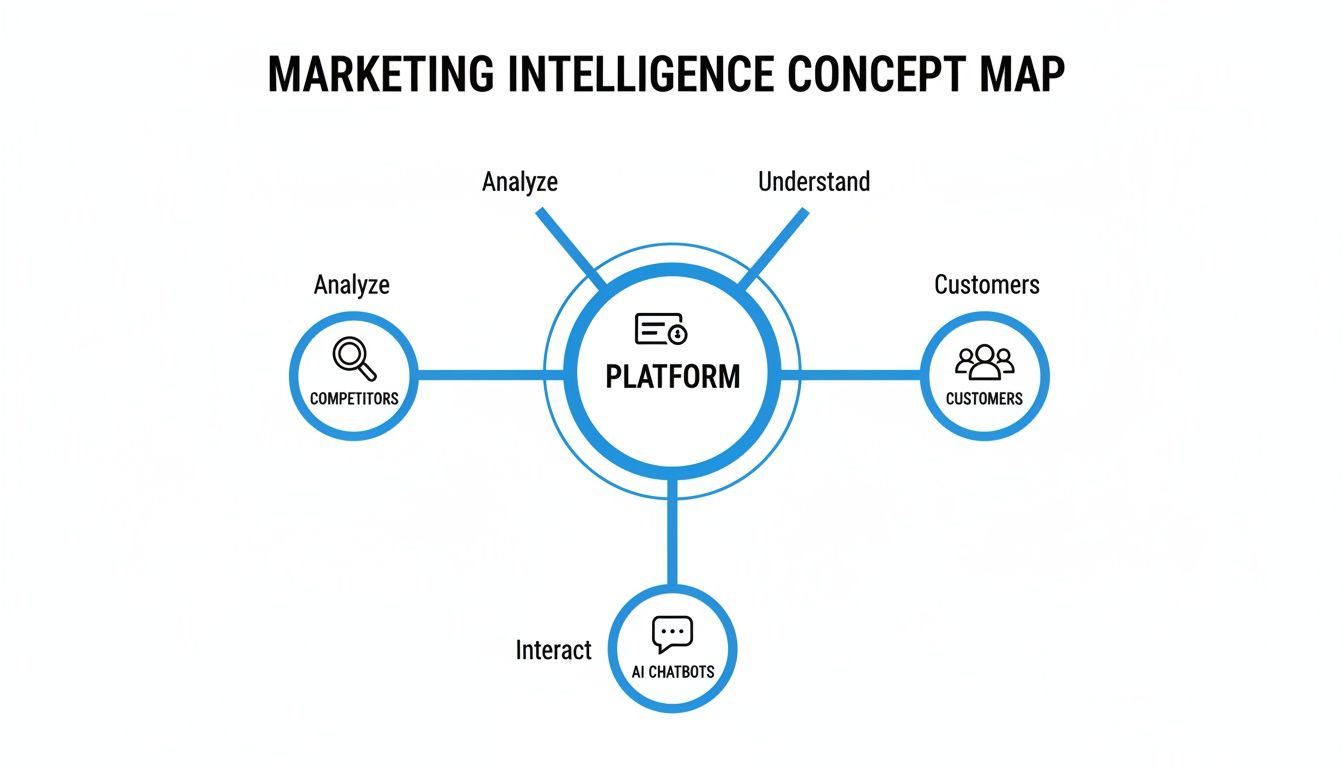
As you can see, the platform’s job is to pull together intelligence from competitors, customers, and even AI chatbots into a single, actionable view.
But it’s not just about tracking what people do; it's also about understanding the emotion behind the conversation. This is called sentiment analysis. Think of it as your brand’s emotional barometer, automatically sorting mentions into positive, negative, or neutral buckets.
By tracking sentiment, you can catch a brewing PR crisis before it explodes or find your most passionate fans and give their voices a megaphone. It’s the difference between just hearing the chatter and truly understanding the mood of the room.
The New Frontier: LLM and Chatbot Monitoring
The biggest leap forward in marketing intelligence is the ability to monitor what Large Language Models (LLMs) and AI chatbots are saying about your business. Millions of people now turn to assistants like ChatGPT, Gemini, and Claude for recommendations, so what these AIs say has become a critical customer touchpoint.
A marketing intelligence platform can track:
- Brand Mentions: Does your brand come up when users ask for recommendations in your category?
- Competitor Recommendations: Are your competitors being recommended instead of you?
- Accuracy and Hallucinations: Is the AI giving out correct info about your hours, services, or prices? Or is it “hallucinating” and making up false details, like claiming your business is permanently closed?
This isn’t just about managing your reputation; it's about customer acquisition. An AI recommending a competitor is a lost lead. An AI spitting out false, negative information is a direct threat to your revenue. Tracking these conversations isn't optional anymore—it’s essential for survival.
The market for these tools is exploding. The marketing analytics platform sector, which powers this tech, is expected to grow from $8.02 billion in 2026 to $14.55 billion by 2031. Right now, social media analytics holds the biggest piece of the pie at 37.42%, which shows just how vital it is to track online conversations and sentiment.
By pulling all these core capabilities together, marketing intelligence platforms give businesses a unified, real-time command center. It’s what allows you to make faster, smarter decisions and stay one step ahead in a market that gets more complicated by the day.
How Modern Teams Use Marketing Intelligence
Theory is one thing, but seeing how marketing intelligence platforms solve real, expensive problems is another. These tools aren't just for data scientists poring over spreadsheets; they’re practical weapons for teams on the ground, helping them protect revenue, jump on opportunities, and act with confidence. From the local shop on the corner to global brands, the impact is immediate.
The right intelligence tool shifts a team from being reactive to proactive. Instead of finding out about a major issue from an angry customer, you see the problem bubbling up in real-time conversations online. That means you can get ahead of it, protecting both your reputation and your bottom line.
Let's walk through a few real-world scenarios to see how different teams put these platforms to work every single day.
For Public Relations and Brand Teams
Imagine you're the PR manager for a popular software company. Out of the blue, an AI assistant "hallucinates" and starts confidently telling users your product has a major security flaw—one that doesn't actually exist. That kind of misinformation spreads like wildfire, causing customer panic and tanking your brand's reputation before you even know what hit you.
A marketing intelligence platform is your early-warning system.
- It actively monitors what AI chatbots and LLMs are saying about your brand 24/7.
- It sends an instant alert the second that dangerous misinformation appears.
- You can then act immediately to correct the record, issue a public statement, and work with the AI provider to fix the error before it spirals into a full-blown crisis.
This isn't just about tracking sentiment anymore. It's about neutralizing threats that can materialize out of thin air in this new AI-driven world.
For Local and Multi-Location Businesses
Now, picture a local restaurant owner heading into a massive holiday weekend. Unbeknownst to them, a popular AI assistant scraped some old, incorrect data and is now telling anyone who asks that the restaurant is "permanently closed." Every single person who gets that false answer is a lost customer, and the owner might not realize what's happening until they're staring at an empty dining room.
For a small business, a single weekend of lost revenue can be devastating. Marketing intelligence provides the visibility needed to ensure your fundamental business information—like hours, location, and services—is accurate everywhere, especially in the AI assistants that people now trust for quick answers.
The same logic applies to a multi-location retailer. A platform can spot regional promotions from competitors, alerting a store manager in Ohio that a rival down the street just dropped a surprise weekend flash sale. This gives them the chance to respond with a counter-offer right away, protecting their local market share instead of getting blindsided.
For Digital Marketing Agencies
For digital marketing agencies, marketing intelligence platforms unlock a powerful new service. Clients aren't just worried about their Google rankings anymore; they're deeply concerned about their reputation and presence on AI platforms. Agencies can now step in and offer AI presence optimization as a core service.
This means agencies are now equipped to:
- Monitor their clients' visibility and brand mentions across all major AI chatbots.
- Identify and fix harmful misinformation or negative sentiment being spread by AI.
- Track which competitors are getting recommended and build strategies to win those conversations.
This creates a powerful and undeniable value proposition. By using a marketing intelligence platform, agencies can secure their clients' brands in this new arena, prove tangible ROI, and solidify their position as indispensable strategic partners. You can learn more about how to structure these services in our guide on LLM visibility tracking for agencies.
The demand for these capabilities is exploding. Sales intelligence platforms, a close cousin to marketing intelligence, are projected to grow from $5.37 billion in 2026 to a staggering $12.45 billion by 2034. While big enterprises have led the charge, the fastest growth is now coming from small and mid-sized businesses, all thanks to more accessible and affordable cloud-based AI tools. You can dig into more of the data on this expanding market over at Fortune Business Insights.
How To Choose The Right Platform For Your Business
Picking the right marketing intelligence platform can feel like you're drowning in a sea of feature lists and technical jargon. Don't get bogged down. The best way to approach this is to ignore the noise and focus on a few critical questions that tie directly back to what your business actually needs.
The right tool isn't the one with the most bells and whistles; it's the one that solves your most expensive problems.
Think of it like buying a vehicle. A flashy sports car looks great, but it’s completely useless if your job is hauling lumber. In the same way, a powerful platform that monitors channels you don’t even use is just a wasted investment. The trick is to match the platform’s capabilities to your specific business needs, making sure it delivers sharp, actionable insights you can use to protect and grow your revenue.
To cut through the marketing fluff, here's a practical checklist. We've organized it to help you compare platforms and choose the one that best fits your strategic goals.
Marketing Intelligence Platform Evaluation Checklist
| Feature/Criteria | What to Look For | Why It Matters |
|---|---|---|
| Data Coverage | Does it monitor the specific social media, review sites, news outlets, and forums where your customers are? Most importantly, does it track what LLMs like ChatGPT and Gemini are saying? | If the platform has blind spots, so will you. Incomplete coverage means you're missing huge parts of the conversation, leaving your brand exposed. |
| Alerting Speed | How quickly do alerts arrive after a critical mention? Can you customize alerts for high-priority issues (e.g., a crisis mention or AI misinformation)? | Intelligence is useless if it's late. You need near real-time alerts to get ahead of problems before they turn into full-blown crises. |
| Data Accuracy | Does the platform have a built-in engine to cross-reference AI-generated answers against your verified company data? Can it flag hallucinations or inaccuracies? | In the AI era, you can't just trust what you see. The platform must help you validate information, not just report it. This protects you from costly misinformation. |
| Regional & Local Tracking | Can the tool monitor conversations specific to a city, state, or country? This is vital for multi-location businesses. | National-level data is too broad for local businesses. You need granular insights to understand and act on what’s happening in the communities you serve. |
| Competitor Intelligence | Can you easily track your top competitors’ mentions, sentiment, and AI Share of Voice? Does the platform help you benchmark your performance against theirs? | It's not enough to know what they're saying about you; you need to know what they're saying about your competition. This is where strategic opportunities are found. |
| User Interface & Reporting | Is the dashboard intuitive? Can you easily build reports that matter to your stakeholders without needing a data scientist? | A powerful tool that’s too complicated to use will just gather dust. The insights need to be accessible to the people who need to act on them. |
Using a structured checklist like this forces you to move beyond shiny demos and focus on the capabilities that will actually drive results for your business.
H3: Evaluate The Scope Of Data Coverage
The first question is simple: does the platform see what you need it to see? Data coverage is the bedrock of any intelligence tool. If it doesn’t monitor the channels where your customers and competitors live, its insights will be riddled with dangerous blind spots.
Zero in on the sources that are mission-critical for you:
- Social Media and Reviews: Does it cover the specific review sites (G2, Yelp, TripAdvisor) and social platforms where your audience hangs out?
- News and Press: Can it track mentions in both major news outlets and the niche industry publications that really matter in your market?
- AI Assistants and LLMs: This is the big one. Does it monitor what AI chatbots like ChatGPT, Gemini, and Claude are saying about you? This is absolutely non-negotiable for modern brand management.
A platform with deep, relevant coverage gives you the complete picture, not just a tiny, misleading slice of it.
H3: Assess The Speed And Quality Of Alerts
Intelligence is only valuable if it gets to you in time to act. A platform that tells you about a PR fire a week after it started isn't an intelligence tool; it's a history book. You need to dig deep into the alerting capabilities.
Ask vendors how fast their system can flag a critical event. If an AI chatbot starts telling people your business is "permanently closed," you need that alert within minutes or hours, not days. The best platforms offer customizable, near real-time alerts for high-priority issues, letting you snuff out sparks before they become infernos.
A great intelligence platform doesn't just deliver data; it delivers timely warnings. It acts as a smoke detector for your brand, giving you the critical seconds you need to react before a fire starts.
H3: Prioritize Accuracy And Data Validation
In the age of AI, accuracy is everything. A single piece of misinformation, whether it's from a disgruntled competitor or an AI hallucination, can directly hit your revenue. A top-tier platform has to do more than just report what it finds—it needs to help you prove whether it's true.
This is especially critical for LLM monitoring. The platform must have a built-in safety and accuracy engine that checks answers from AI assistants against your own verified business data. This allows it to instantly flag dangerous misinformation, like incorrect pricing, wrong business hours, or false negative claims. When looking for a solution, a detailed business intelligence software comparison can reveal which tools offer these essential verification features.
By concentrating on these core pillars—coverage, speed, and accuracy—you can cut right through the marketing hype. It’s how you find a true strategic partner, one that gives you the clarity to move with confidence and precision.
Implementing A Platform And Proving Its Value
Choosing the right marketing intelligence platform is a huge step, but the real work starts the moment you try to connect its power to real-world business results. The goal isn't just to buy a new tool; it's to generate a genuine return on that investment. A successful rollout isn't about flipping a switch—it’s about having a clear roadmap from day one.
The whole process kicks off by defining specific, measurable objectives. Vague goals like "improve brand awareness" are impossible to track and even harder to justify. Instead, you need to focus on concrete outcomes that directly impact revenue or protect you from risk.
This means setting crystal-clear targets, such as:
- Ensure 100% accuracy of our business information across all major AI assistants this quarter.
- Identify three new marketing channels our top competitor is using to gain traction.
- Reduce our team's response time to negative sentiment spikes by 50% within the next 60 days.
Goals like these transform the platform from a simple monitoring dashboard into a strategic asset with clear performance indicators.
Measuring ROI Your CFO Will Love
Once you have clear goals, the next step is proving the platform’s value in dollars and cents. You have to shift the conversation away from vanity metrics like "mentions" and start speaking the language of the business: revenue, cost savings, and risk mitigation. Marketing intelligence platforms aren't a cost center; they are an investment that actively protects and grows the company.
To show this, you need to track quantifiable outcomes that tie directly to the bottom line. For a comprehensive guide on integrating AI solutions like these, you can find a solid, step-by-step approach on how to implement AI in business.
A successful implementation positions your marketing intelligence platform as a revenue-generating engine. It’s not about watching dashboards; it’s about making decisions that directly contribute to financial health and competitive advantage.
Key Metrics to Track for Tangible ROI
To build a business case that no one can argue with, concentrate on metrics that show an undeniable financial impact. These are the numbers that resonate far beyond the marketing department.
1. Revenue Saved and Protected
Track every single instance where the platform helps you fix misinformation that could cause direct financial harm. A classic example is finding and correcting a false "permanently closed" listing generated by an AI assistant right before a major holiday weekend. Just calculate the potential lost revenue from that single correction, and you’ve shown immediate, powerful value.
2. Leads Gained and Influenced
Start monitoring how your brand is being recommended by AI chatbots when people ask things like, "what's the best software for X?" When you improve your visibility and start winning those recommendations over your competitors, you can directly attribute new leads and sales to your AI presence optimization efforts.
3. Operational Hours Saved
This one is simple but effective. Calculate the time your team saves by automating market monitoring. Instead of someone manually scouring news sites, social feeds, and competitor websites for hours every single week, the platform delivers curated intelligence briefs. Those saved hours represent a direct gain in operational efficiency, freeing up your team for more strategic work.
By focusing on these hard numbers, you prove that investing in marketing intelligence platforms is not an expense—it’s a critical driver of growth, protection, and operational excellence.
See Your Brand Through The Eyes Of AI

We've walked through the what, why, and how of marketing intelligence. But let's be honest, it all boils down to one critical, unavoidable truth: AI assistants are the new front door to the internet, and flying blind is no longer an option.
What these AI models say about you is your brand’s reality for millions of potential customers. A single wrong answer from an AI can do more damage than a dozen bad reviews ever could. This isn’t some far-off problem; it’s happening right now, with every single query.
Your New Digital Reality
A modern marketing intelligence platform pulls back the curtain, giving you the visibility you need to navigate this new landscape. It's about moving beyond just tracking social media chatter or competitor ad buys. It's about getting a direct line of sight into the AI conversations that are actively shaping your reputation and steering customer decisions. This shift is especially crucial for software companies, a topic we dive into in our guide on AI brand tracking for SaaS companies.
Think of it like the ultimate, unbiased focus group. You're seeing how the world’s most influential AI actually perceives your brand, your products, and your competition. That’s a strategic advantage you simply can't get anywhere else.
Instead of just telling you about the risks, we want you to see them for yourself. You wouldn't manage your company’s finances without ever looking at the bank statements, so why would you manage your brand without seeing what AI is saying about it?
This is your chance to take that first step. Run a free, instant scan to discover how AI perceives your brand at this very moment. It will give you an immediate, personal understanding of your digital reputation, turning abstract threats into clear, actionable insights.
Got Questions? We've Got Answers
Stepping into the world of marketing intelligence can bring up a few questions. That’s perfectly normal. Let's tackle some of the most common ones to clear things up and show you how these platforms are different—and more essential—than the tools you might already be using.
How Is This Different from Google Analytics?
This is the big one, and the distinction is all about perspective.
Think of it this way: Google Analytics looks inward. It gives you a fantastic, detailed map of everything happening on your own property—your website. Who’s visiting, where they came from, what pages they clicked on. It's the definitive source for understanding your own turf.
A marketing intelligence platform, on the other hand, looks outward. Its job is to be your eyes and ears across the entire market, monitoring the chatter and movements that happen beyond the walls of your website. It’s watching your competitors, listening to customer sentiment on social media, and, most importantly, keeping tabs on what AI chatbots are telling people about you.
The simplest way to put it: Google Analytics is your rearview mirror, showing you what happened on your own site. A marketing intelligence platform is your forward-facing radar, scanning the entire landscape around you to show you what’s coming.
How Quickly Will I See Results?
That depends entirely on what you're looking for. Some of the most critical benefits show up almost instantly, while the more strategic wins build value over time.
You can expect near-immediate results for putting out fires. For example:
- Catching Misinformation: A platform can immediately flag if an AI chatbot is wrongly telling potential customers you’re "permanently closed" or spitting out incorrect business hours. That’s a five-alarm fire you can extinguish right away.
- Spotting Negative Mentions: You’ll get real-time alerts when negative chatter spikes, letting you jump on a customer service problem before it snowballs into a full-blown reputation crisis.
The bigger, strategic insights are more of a slow burn. Things like mapping a competitor's entire marketing playbook, spotting a new market trend before it takes off, or methodically building a positive reputation in AI recommendations—those are goals that play out over weeks and months. The platform gives you the steady stream of data you need to make those smart, long-term decisions.
Is My Business Too Small for This?
Not anymore. It’s true that a few years ago, this kind of power was reserved for massive corporations with bottomless budgets. But that's changed.
Modern marketing intelligence platforms are built to be affordable and scalable, making them not just accessible but absolutely vital for businesses of any size.
For a small or local business, online reputation is everything—and it’s incredibly fragile. A single piece of bad information can do a disproportionate amount of damage. Think about a local shop that relies on seasonal foot traffic. An incorrect address on an AI-powered map or a false "closed" listing can be devastating.
These platforms level the playing field. They give small businesses the same kind of defensive shield and market visibility that the big players have enjoyed for years, ensuring that when customers look for you, they find the right information.
Ready to see what AI is saying about your brand? TrackMyBiz offers a free, instant scan that reveals your current AI presence, pinpoints inaccuracies, and shows how you stack up against the competition. Get your complimentary report at https://trackmybusiness.ai.
