Effective marketing for a new startup isn’t about flashy campaigns or chasing every new trend. It all comes down to getting the foundation right before you even think about launching a single campaign.
This means you have to get disciplined about understanding your ideal customer, nailing a value proposition that actually solves their problems, and knowing exactly where you fit in the competitive landscape. Get this right, and every single dollar you spend on marketing will work harder for you.
Building Your Startup Marketing Foundation
Before you spend a dime on ads or content, you need a rock-solid foundation. Skipping this groundwork is like building a house on sand—even the most creative campaigns will eventually fall apart without a clear strategy underneath.
This isn't about getting lost in abstract marketing theories. It's about making a few crucial, disciplined decisions that will guide every single thing you do from here on out.
The goal is to move from fuzzy assumptions to sharp, actionable insights. Too many founders make the mistake of thinking their product is for "everyone." The truth is, successful startup marketing starts by obsessing over a very specific, narrow segment of the market first.
Define Your Ideal Customer Profile
Your Ideal Customer Profile (ICP) is so much more than basic demographics. It’s a deep dive into the person who will get the most out of what you’ve built. What are their goals? What are their biggest frustrations? What keeps them up at night?
For example, a B2B SaaS startup with a project management tool might say they target "small businesses." That’s way too broad.
A strong ICP is more like: "Project managers at remote-first tech companies with 10-50 employees who are sick of juggling five different disconnected tools to get a simple status update." See the difference? That level of clarity tells you exactly what to say and where to say it.
A well-defined ICP is your north star. When you know exactly who you're talking to, every marketing decision becomes simpler and more effective. It ensures your message actually lands instead of just adding to the noise.
Craft a Compelling Value Proposition
Now that you know your ICP, your value proposition has one job: answer their question, "What's in it for me?" It needs to be a short, punchy statement that explains the real-world benefit you deliver. No jargon. No fluff. Just outcomes.
Instead of saying, "We offer an AI-powered synergy platform," try this: "We help remote teams cut meeting time in half by automating project updates." The second version speaks directly to a real pain point and promises a specific, desirable result.
Analyze the Competitive Landscape
Finally, you need to do some scrappy competitor analysis. You don't need a hundred-page report. Just pick 3-5 direct and indirect competitors and figure out a few key things:
- Messaging: What promises are they making? How are they positioning themselves?
- Channels: Where are they showing up? Are they all-in on SEO, paid ads, or somewhere else?
- Weaknesses: What are customers complaining about in their reviews? Where are the gaps you can exploit?
To bring it all together, here’s a quick summary of the core components you need to lock down.
Core Components of a Startup Marketing Foundation
| Component | Objective | Key Questions to Answer |
|---|---|---|
| Ideal Customer Profile (ICP) | To create a hyper-specific portrait of your perfect customer. | Who feels the pain you solve most acutely? What are their daily frustrations and long-term goals? Where do they look for solutions? |
| Value Proposition | To clearly articulate the primary benefit you offer your ICP. | What tangible outcome do you deliver? How are you uniquely better than the alternatives? Why should they choose you right now? |
| Competitive Analysis | To understand the market you're entering and find your unique angle. | Who are your top 3-5 competitors? What are their strengths and weaknesses? What market gap can you own? |
This foundational work is absolutely non-negotiable for building something that lasts. For more practical guides on refining your startup's marketing strategy, check out the resources on the TrackMyBiz blog.
Choosing Your First Acquisition Channels
Once your strategic foundation is set, the next big question is where to actually find your customers. It's a classic startup dilemma. You see a dozen options, from SEO to TikTok ads, and it’s incredibly tempting to try a little bit of everything. Don't. Spreading your limited resources too thin is a recipe for disaster.
The key isn't to be everywhere; it's to be exactly where your Ideal Customer Profile (ICP) spends their time. Resisting the shiny new trend is half the battle. Your first major bet is picking one or two channels and committing to mastering them.
This decision often boils down to a classic trade-off: speed versus sustainability. Are you desperate for immediate feedback and data, or are you in a position to build a long-term, compounding asset?
Organic Versus Paid Channels
Organic channels like SEO and content marketing are the long game. They are powerful investments that build trust and create an asset—your content—that can pull in customers for years to come. But they are a slow burn. It can easily take months before you see any meaningful traffic from search engines.
Paid channels, like social media ads or search engine marketing (SEM), are the complete opposite. They deliver immediate data and traffic, letting you test your messaging and targeting right out of the gate. The catch? The moment you stop pumping money in, the traffic disappears. A smart approach often involves using paid ads to get quick learnings and early customers while your organic engine is still warming up.
This is where your foundational work on positioning and customer profiles pays off, as it directly informs which path to take first.
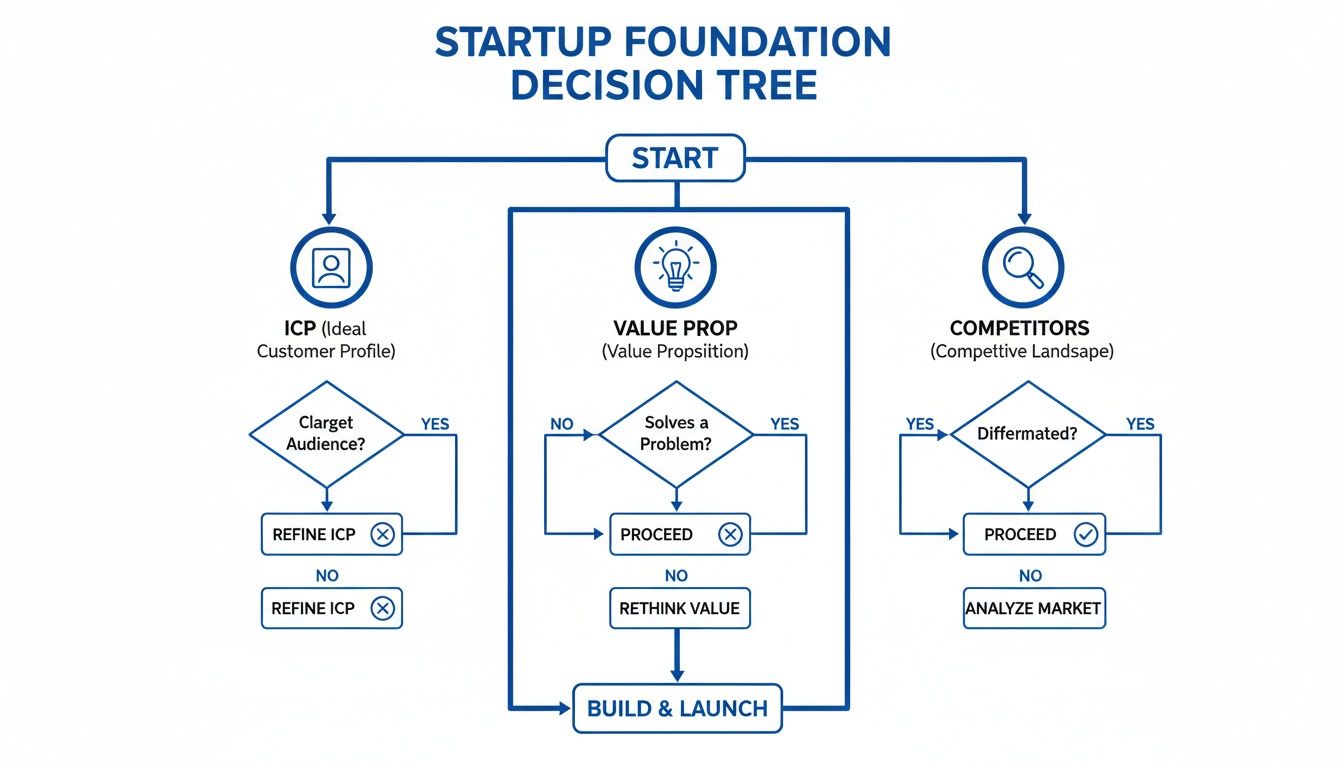
As you can see, every effective marketing strategy starts with a deep understanding of your ICP, value prop, and the competitive landscape.
Mapping Channels to Your ICP
The most reliable way to pick a channel is to work backward from your ideal customer. When they run into the problem you solve, where do they go for answers?
- Building a B2B SaaS for Developers? Your people live on GitHub, Stack Overflow, and technical blogs. Your best bet is probably content marketing with in-depth tutorials or maybe even launching a useful open-source side project.
- Launching a D2C E-commerce Brand for Millennials? They're almost certainly scrolling through Instagram and TikTok. Highly visual paid social ads and influencer collaborations are a direct line to their wallets.
Don’t just follow the crowd. The best channel for your startup might be an unconventional one your competitors are totally ignoring. Your biggest advantage is knowing your customer's daily digital habits better than anyone else.
The money flowing into these channels is staggering. The global digital marketing market ballooned from $350 billion in 2020 to $667 billion in 2024. Today, online marketing commands a massive 72.7% of total ad budgets. For a startup, mastering digital isn't just an option—it's the whole engine.
Finally, take a peek at what your competitors are up to. Using modern competitor AI analysis tools can show you where they're spending their ad budget and which pieces of content are driving their traffic. This isn’t about copying their playbook. It's about gathering intel to find the gaps they've missed—and exploiting them.
Running Smart Marketing Experiments on a Budget
You don't need a massive war chest to make a splash. Effective marketing, especially in the early days of a startup, is all about being resourceful and surgically precise with your spending. The goal is to uncover game-changing insights about your messaging, audience, and channels without lighting your cash on fire.
The key is to run lean, high-impact tests that deliver valuable data—fast.
Forget about expensive agencies or complicated software for now. Your immediate mission is to validate your core assumptions as quickly and cheaply as possible. This means designing small-scale experiments that can prove or disprove a hypothesis with a minimal budget.
Here’s a classic example: You believe a certain feature is your main selling point. Instead of guessing, you can test it for just $50. Run two nearly identical social media ads. One ad highlights Feature A, while the other focuses on Feature B. The one with the higher click-through rate (CTR) gives you a powerful, data-backed clue about what actually gets people to lean in.

Embrace Low-Cost Content Creation
Content creation doesn't have to be some high-production, Hollywood-level affair. In fact, on platforms like TikTok and Instagram Reels, authentic, lo-fi content often crushes the polished stuff. All you really need is your smartphone and a clear idea of the value you're trying to deliver.
Consider these quick wins for your first content experiments:
- Smartphone Video: Just pull out your phone and record a simple 30-second video. Explain how your product solves one specific, painful problem. No fancy editing needed.
- A Single Cornerstone Article: Go deep. Write one incredibly detailed, helpful blog post that tackles a huge question your Ideal Customer Profile is asking. Then, promote it everywhere to see if it attracts the right crowd.
- A Simple Email Sequence: Got a few new subscribers? Set up a three-part automated email series. Your goal is just to nurture that initial interest and see who's actually engaged by tracking open and click rates.
Don't aim for perfection; aim for learning. A scrappy video that gets high engagement is infinitely more valuable than a polished one that nobody watches. Your first experiments are about gathering data, not winning awards.
The importance of video, in particular, can't be overstated. Today, a staggering 89% of businesses already use it as a core marketing tool. For startups, short-form video is a goldmine, driving massive engagement for a fraction of the cost of traditional ads. With the social media user base rocketing toward 5 billion people by 2025, mastering this format is non-negotiable. You can dig into more marketing statistics on HubSpot's blog.
Examples of Clever Startup Experiments
Real-world startups have used this lean approach to unlock some serious growth. I once worked with a B2B SaaS company that was completely stuck on its primary value proposition. So, they created three different landing pages. Each one had the same design but highlighted a unique benefit: "Save Time," "Reduce Costs," or "Increase Team Collaboration."
They spent less than $100 per page driving a small amount of targeted traffic from LinkedIn ads. The results were stunning. The "Save Time" page converted at double the rate of the others.
That simple, low-cost test gave them the confidence to build their entire marketing message around that single, proven benefit. It shaped their growth for years to come. That’s the power of smart, budget-conscious experimentation in action.
Measuring What Matters for Actual Growth
Chasing likes and shares feels productive, but for an early-stage startup, it’s a dangerous trap. These are vanity metrics. They look great on a slide deck but tell you next to nothing about the actual health of your business.
The real superpower for a lean startup is tuning out that noise. You need to focus laser-like on the handful of key performance indicators (KPIs) that connect directly to revenue and sustainable growth.
This is a mindset shift. Instead of asking, "How many people saw our post?" you need to be asking, "How much did it cost us to get a new paying customer?" That’s the critical difference between activity and progress. Data shouldn't be a source of anxiety; it should be your North Star for making tough decisions with confidence.
Moving Beyond Surface-Level Metrics
To measure what really matters, you have to get comfortable with a few core business metrics. These aren't just for the finance team—they're the pulse of your marketing engine. The good news is you can track all of this for free using tools like Google Analytics 4, which is more than powerful enough for most startups just getting off the ground.
Here are the essential KPIs to build your first dashboard around:
- Customer Acquisition Cost (CAC): This is your total marketing and sales spend divided by the number of new customers you brought in. It’s the answer to one simple question: How much does it cost us to get one new customer?
- Lifetime Value (LTV): This metric forecasts the total revenue a single customer will bring in over their entire relationship with your company. It tells you what a customer is truly worth to you over the long haul.
- LTV to CAC Ratio: This is the magic number. A healthy startup should be aiming for an LTV that's at least 3x its CAC. If your ratio is 1:1, you’re literally losing money with every new sign-up.
- Churn Rate: This is the percentage of customers who cancel or don't renew over a given period. High churn can silently bleed a business dry, no matter how fantastic your acquisition numbers look.
Vanity metrics make you feel good, while action metrics make you do good. Your goal isn't to get the most likes; it's to build a profitable, sustainable business. Focus on the numbers that reflect that reality.
Using Data to Steer the Ship
Once you start tracking these core KPIs, you can stop guessing and start making informed decisions.
Is your CAC from Facebook ads suddenly way higher than from your content marketing? Maybe it’s time to reallocate that budget. Is your churn rate ticking up after a new feature launch? That's a huge red flag to go investigate the user experience.
This data-driven approach lets you confidently double down on what’s working and cut what isn’t. It’s how you steer your business toward predictable, sustainable profitability. To really get a handle on this, learning how to measure marketing ROI for real growth is the next logical step. This isn't just about spreadsheets and charts; it's about building a machine that can grow reliably.
From First Click to Loyal Customer

Getting traffic to your site feels like a huge win, but let's be honest—it’s just the starting line. The real test for any startup isn’t just getting clicks; it's turning those curious visitors into paying customers who actually stick around. This is where you shift from broadcasting your message to optimizing the experience.
It’s all about obsessing over the user’s journey after they land on your page. Every button, headline, and form field is a potential point of friction. Each tiny annoyance can push someone closer to the exit, silently killing your growth before it even has a chance to get going.
But here’s the good news: you can fix this. You don’t need a massive budget or a huge team. All it takes is a commitment to constant, small-scale testing. You’d be amazed at how minor tweaks can lead to major gains.
Optimizing Your Conversion Funnel
Conversion rate optimization (CRO) is just a fancy way of saying "make it easier for people to do what you want them to do." For most startups, this starts with the landing page, which has one job and one job only: get the conversion.
The best way to juice its performance is through simple A/B tests.
For example, take your call-to-action (CTA) button. I’ve seen a simple text change from "Sign Up" to "Get Started Free" lift conversion rates by double digits. The same goes for your headline. Pit a benefit-driven headline (“Cut Your Meeting Time in Half”) against a feature-focused one (“AI-Powered Project Management”) and see what actually grabs people.
The goal of A/B testing isn't just to find a winner. It's to gain a deeper understanding of your customer's motivations. Each test result teaches you something valuable about what they truly care about.
Once they convert, you hit the next make-or-break moment: onboarding. This is your chance to prove your product’s value and set the stage for long-term retention. A clunky, confusing, or long-winded onboarding process is the number one reason people churn early. Your goal should be to get them to their "aha!" moment—the point where they get it—as fast as humanly possible.
Building Retention and Advocacy
Here's a stat that should be burned into every founder's brain: acquiring a new customer can cost five times more than keeping an existing one. That makes retention the single most powerful, and most overlooked, growth lever you have.
Happy, engaged users don't just keep paying you. They become your best marketing channel.
Here are a few dead-simple tactics to boost engagement and turn your first customers into true advocates:
- Automated Welcome Emails: Don’t just send a generic confirmation. Create a short, automated sequence that guides new users to key features and offers genuinely helpful tips.
- Simple Community Building: You don’t need a fancy forum platform on day one. A simple Slack channel or a private Facebook group for your power users works wonders. It builds a sense of belonging and gives you a direct line for priceless feedback.
- Proactive Check-ins: If a user hasn't logged in for a week, trigger a simple, personal-sounding email asking if they're stuck or need help. These small gestures show you care and can stop churn in its tracks.
These aren't complex strategies. They're about creating a sticky product experience that transforms one-time buyers into loyal fans who go out and sell your product for you. That flywheel effect is how the best startups build sustainable, long-term growth.
Using AI for Marketing Without Sacrificing Your Brand
There's no question that artificial intelligence is a massive opportunity for startups. It lets you punch way above your weight, automating tedious tasks and personalizing customer experiences on a scale that used to require a whole team. AI tools can help you brainstorm ad copy, outline blog posts, or segment your email lists for killer campaigns.
But this power comes with a brand-new risk.
As AI assistants like ChatGPT and Perplexity become the new search engines, your brand's reputation is increasingly in their hands. These models can "hallucinate"—a polite way of saying they make things up. They might get your pricing wrong, misstate your services, or even tell a potential customer your business is permanently closed.
The New Frontier of Brand Monitoring
You can't just ignore what AI is saying about you. A single, confident-sounding (but wrong) answer can steer a perfect-fit customer away before they even think to visit your website. This makes proactive monitoring an absolute must-have for any modern startup's marketing strategy.
The answer isn't to shy away from AI. It's to build a defensive layer around your brand. You need a system that keeps tabs on what these models are saying and a clear process to correct the record when they inevitably get it wrong.
AI-driven discovery is a double-edged sword. It can become your most powerful acquisition channel or your biggest reputational risk. The difference is whether you are actively monitoring it.
Thankfully, setting this up isn't as complicated as it sounds. Tools are now available that offer specific insights into AI brand tracking for SaaS companies. This gives you a clear window into how your startup is being represented and, just as importantly, where competitors are being recommended instead of you.
To get the most out of AI, you can even learn how to use AI for faceless content and analyze TikTok performance to expand your reach. This kind of proactive approach flips the script, turning AI from a potential threat into a reliable and resilient engine for growth.
Common Questions About Startup Marketing
Founders are always asking the same handful of questions when it comes to marketing. The digital world feels vast and overwhelming, so let's cut through the noise and get straight to what matters.
How Much Should a Startup Spend on Marketing?
There’s no magic number here, but a good starting point for an early-stage startup is to earmark 20-25% of revenue for marketing.
But honestly, that's just a benchmark. If you're chasing aggressive growth and have the funding, you might push that number higher. If you're bootstrapping, your budget might be closer to zero, relying almost entirely on sweat equity—think content, SEO, and community building.
The real key is to start small. Test a few channels, obsessively measure your Customer Acquisition Cost (CAC) for each one, and then pour gasoline on what's actually working. Don't spend a dollar until you know how you'll track it.
Which Marketing Channel Is Best for a New Startup?
The "best" channel is simply wherever your Ideal Customer Profile (ICP) hangs out online. It's that simple.
If you’re a B2B SaaS company selling to developers, you need to be living on technical blogs, in GitHub discussions, and maybe sponsoring relevant newsletters. You shouldn't be wasting a second thinking about TikTok.
On the flip side, if you're a direct-to-consumer brand targeting Gen Z, visual platforms like TikTok and Instagram are your entire world.
The biggest mistake I see is founders chasing every shiny new trend. Don't do it. Pick one or two channels that perfectly align with your audience and absolutely master them before even thinking about expanding.
The most effective marketing strategy isn't about being on every platform. It's about deeply understanding where your specific customers live online and showing up there with a valuable message.
Gain a competitive edge by seeing exactly how AI assistants recommend your brand. TrackMyBiz offers a free scan to reveal your current AI brand visibility and identify hidden opportunities. Start your free scan today at https://trackmybusiness.ai.
