
Market positioning analysis used to be about figuring out how your customers see you compared to the competition. We'd run surveys, organize focus groups, and map it all out. But that playbook is now officially out of date. Today, you also have to monitor how AI chatbots like ChatGPT and Gemini are defining your brand in real-time.
Why Market Positioning Analysis Just Became Essential
The old methods for brand discovery are broken. A solid SEO strategy is no longer enough to guarantee you'll be seen when AI assistants are shaping your market position with every single answer they generate. This is a monumental shift. We're moving away from traditional browser search and into an era of conversational AI, where customers get instant information that defines brand perception, reputation, and, ultimately, your revenue.
Your traditional market positioning analysis needs a serious upgrade to handle this new reality.

This new environment is full of risks that most businesses are completely unprepared for. AI hallucinations can spit out incorrect business hours, invent damaging product flaws, or even falsely report that one of your locations is "permanently closed." The harm is immediate and tangible.
The New Competitive Landscape
The conversational AI market is exploding, projected to hit USD 41.39 billion by 2030, with huge user adoption driving that growth. This isn't a fad; it's a fundamental change in how people find information, making it critical for businesses to manage their presence on these platforms.
Proactive monitoring is the only way to stay in control of your brand's story now. But this isn't just about playing defense—it's about offense. To really get a handle on how to stand out and communicate your unique value, it helps to understand the fundamentals of What Is Strategic Positioning.
The core issue is that AI doesn't just answer questions—it forms opinions. If you aren't actively monitoring what it's saying about you, you're letting an algorithm define your brand's position in the market without your input.
This is exactly why a modern approach to market positioning analysis is so crucial. Agencies are already scrambling to adapt their services to include these new metrics. You can see how they are starting to implement https://trackmybusiness.ai/llm-visibility-tracking-agencies. By actively tracking what AI models are saying, you can correct inaccuracies before they spread, spot emerging competitors, and find opportunities to become the AI's go-to recommendation in your niche.
Setting Clear Goals for Your Analysis
Before you dive into any data, you have to know what you’re actually looking for. A market positioning analysis without a clear objective is like a road trip with no destination—you’ll burn a lot of fuel and end up somewhere you didn't mean to be.
The first and most critical step is setting specific, measurable goals. This is what turns a mountain of raw data into sharp, actionable insights that can actually drive business results.
Start by asking the right "why" questions. Are you trying to pinpoint gaps in the market that your product could fill? Maybe you need to defend your turf against an aggressive new competitor. Or perhaps sales are slumping in a key region, and you need to figure out what's really going on.
Defining Your Scope and Focus
Once you’ve landed on your primary goal, the next step is to rein in the scope. Trying to analyze everything at once is a classic recipe for getting completely overwhelmed by data. A tightly defined scope keeps your efforts focused and ensures your findings are actually relevant.
Think about narrowing your analysis to one of these common areas:
- Product-Specific: Focus on a single product or service to see how it stacks up against direct alternatives.
- Geographic: Analyze brand perception and competitive strength in a specific city, state, or country.
- Brand-Level: Take a high-level, 30,000-foot view of your entire brand's reputation and market position.
- Segment-Specific: Zoom in on how a particular customer segment—like small businesses or enterprise clients—perceives your offerings.
For instance, a local plumbing business with locations in multiple cities might run a geographically focused analysis. Their goal would be to compare their brand reputation and competitor strength in Dallas versus Houston. They'd be on the lookout for inconsistencies in how customers—and AI chatbots—perceive their service quality in each city.
The sharper your focus, the clearer your insights. A vague goal like "understand the market" leads to vague, unhelpful findings. A specific goal like "determine why our new software is losing to Competitor X among small businesses" leads to a concrete action plan.
From Business Problems to Analysis Objectives
The real magic happens when you can translate a nagging business challenge into a crystal-clear analysis objective. This process ensures your work directly addresses a pressing, real-world need.
Let's walk through a practical scenario. A digital marketing agency is struggling to prove the ROI of its new LLM optimization service to a skeptical client. The core business problem is client retention and demonstrating tangible value.
Their analysis objective could be framed like this: "To measure the change in our client's brand sentiment and share of AI-recommended voice before and after our optimization efforts, benchmarking against their top three competitors."
This objective is solid because it's:
- Specific: It targets brand sentiment and AI recommendations, not just "visibility."
- Measurable: The agency can track sentiment scores and the frequency of AI recommendations.
- Actionable: The results will directly prove—or disprove—the service's value.
- Relevant: It ties directly back to the client's business goals and justifies the agency's fee.
- Time-Bound: It's framed by a clear "before and after" comparison.
With a well-defined objective like this one, the agency knows exactly what data to collect, which competitors to monitor, and how to present the findings to their client. This structured approach moves your market positioning analysis from a theoretical exercise to a powerful strategic tool.
2. Finding Your Real Competitors and Audience
A market positioning analysis is only as good as the data you feed it. That means you have to be brutally honest about who you’re really up against and who you’re trying to win over.
Your old competitor list, the one you probably made from a few Google searches and some industry reports? It's dangerously incomplete. The real fight for your customers' attention has moved to a new arena.
The competitors that truly matter now are the ones AI chatbots are recommending to your prospects. Some of these will be the usual suspects, but you'll often discover emerging rivals or indirect players your team has never even heard of. This is where the modern analysis starts.
Who Are Your AI-Driven Competitors?
Forget your usual routine. To build an accurate competitive set today, you have to go straight to the AI models your audience is using for research. Start by having a conversation with platforms like ChatGPT and Gemini.
Ask them direct questions, just like a potential customer would:
- "What are the best alternatives to [Your Brand] for [a specific task]?"
- "Compare [Your Brand] and [Known Competitor] on features and cost."
- "I need a tool that solves [customer's core problem]. What companies should I look at?"
The names that pop up are your actual competitors in the eyes of AI. You can automate this discovery process using specialized competitor AI analysis tools that run these queries for you, giving you a live look at the competitive landscape. Jot down every single company that gets mentioned—this is your new, expanded list of rivals.
Go Deeper Than Demographics
Once you know who you're up against, you have to get radically clear on who you're fighting for. Any solid positioning strategy begins with a deep understanding of your target customer, often captured in an ideal customer profile (ICP). But an ICP is just the starting point.
You have to push past basic stats like age, job title, and location. The real gold is in the motivations that drive their buying decisions.
An audience isn't just a collection of data points; it's a group of people wrestling with specific problems, pains, and aspirations. Your positioning has to connect directly with those emotional triggers to have any real impact.
For instance, a company selling project management software might realize its ICP isn't just "small business owners." It's more specific: "overwhelmed agency founders who feel like they’re losing control over project profitability." That single insight changes everything. The focus shifts from listing features to selling the feeling of control and financial peace of mind.
This is especially true in the hyper-competitive AI assistant market. In this space, the fight for positioning is fierce, with North America projected to grab a 36.3% market share in 2025. This scramble has allowed a few giants like ChatGPT (with 68% of the market) and Gemini (with 18.2%) to create a duopoly. For any smaller brand to get noticed, its positioning has to be razor-sharp and laser-focused on a specific audience's pain.
By tying your unique value to the exact problems your ideal customers are trying to solve, you build a market position that can actually stand out and withstand the competition.
Visualizing Your Position in the Market
Raw data from your market analysis is just a starting point. The real magic happens when you turn all those numbers and notes into a clear, visual story—something your entire team can grasp in a single glance. This is how you shift from simply gathering intel to creating genuine, actionable insights.
The absolute best tool for this job is the perceptual map. Think of it as a battlefield schematic for your market, showing exactly where your brand stands next to competitors on the key attributes your customers care about most. This could be anything from price vs. quality to innovation vs. reliability.
This map shows how solid competitor research informs your market analysis, helping you pinpoint where your brand overlaps with what your audience actually needs.
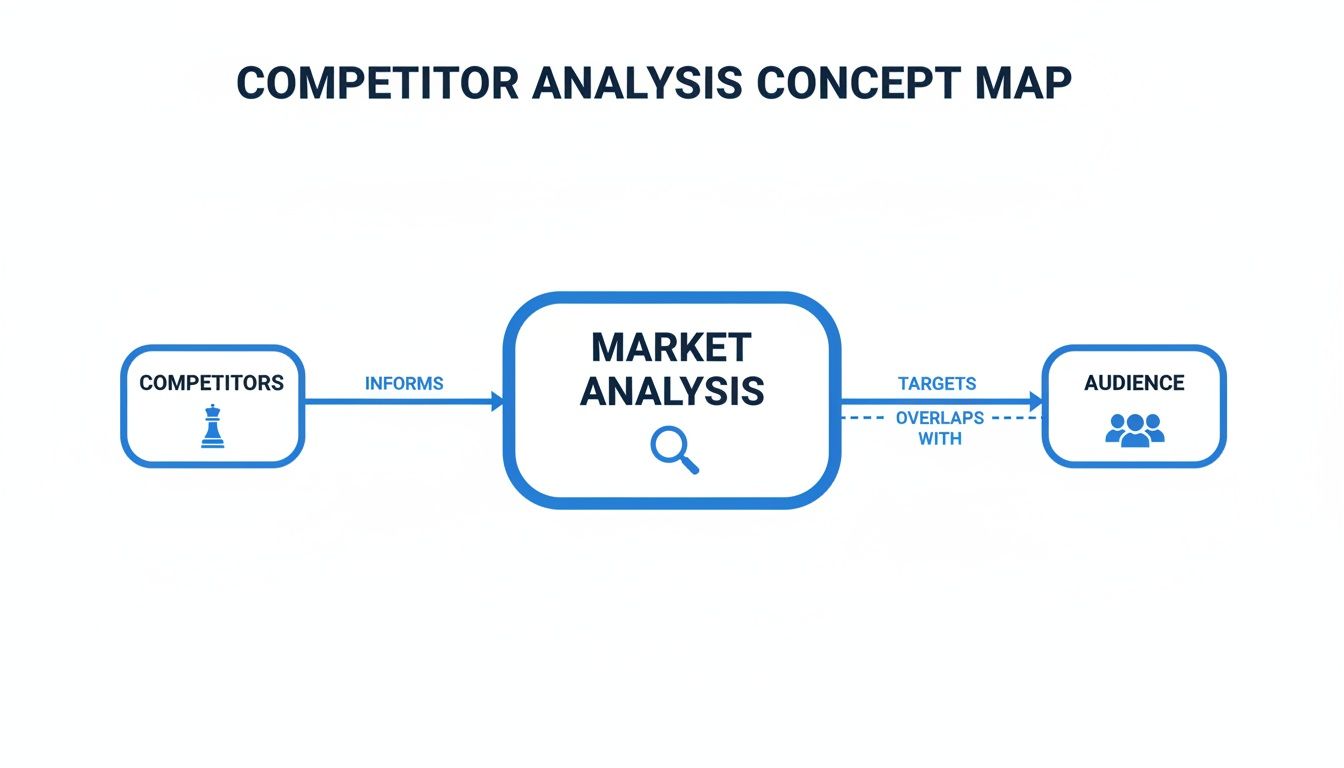
Ultimately, a winning market position lives at the intersection of what your competitors are doing and what your audience is desperately looking for.
Auditing the AI Landscape
A traditional perceptual map is still vital, but in today's world, it only tells half the story. You also have to plot what Large Language Models (LLMs) are saying. For millions of users, an AI's perception of your brand is your market reality.
Systematically querying AI models is the new frontier of competitor research. You have to measure more than just whether you’re mentioned; you need to track the sentiment and, most importantly, the accuracy of what’s being said. This process uncovers the kind of critical blind spots that traditional analytics will completely miss.
For instance, an AI might correctly label you as a "high-quality" solution but then incorrectly state your pricing is 50% higher than it really is. Just like that, you're shoved into a completely different quadrant on the map, losing out on qualified leads who think you're out of their budget.
Measuring AI Sentiment and Accuracy
Trying to manually check every AI for every possible query is a surefire way to drive yourself crazy—it's just not possible. This is where automated platforms become a necessity. For example, specialized AI brand tracking for SaaS companies can automate this entire complex process. These tools systematically scan different models to generate a BrandRank—a simple score reflecting your visibility and sentiment—while also flagging dangerous AI hallucinations.
An AI hallucination isn't just a technical glitch; it's a direct threat to your brand's reputation and revenue. A false claim that your business is "permanently closed" or a fabricated product scandal can cause immediate and lasting damage if left uncorrected.
This proactive monitoring is so important because the AI landscape, while consolidating, is still incredibly fragmented and volatile. To get a sense of how quickly things are changing, let's look at the core players.
Core AI Chatbot Market Share and Growth
The conversational AI space is in constant motion. What was true six months ago is ancient history today. This table offers a snapshot of the key players, highlighting just how quickly market share can shift.
| AI Chatbot | Market Share (Jan 2026) | Key Growth Statistic (YoY) |
|---|---|---|
| ChatGPT | 68% | Dropped from 87.2% |
| Google Gemini | 18.2% | +237% Growth |
| Claude | 5.1% | Steady Niche Growth |
| Other | 8.7% | Fragmented |
Source: Vertu.com analysis of chatbot trends.
These numbers tell a dramatic story. A year ago, you might have felt safe just spot-checking ChatGPT. Today, its market share has plummeted from 87.2% to 68%, while Google Gemini has surged to 18.2% with 237% year-over-year growth. If you're only monitoring one platform, you're blind to what a massive slice of the market is hearing about you.
Once you have this AI-driven data, you can layer it right onto your perceptual map. You could add a third dimension or use simple color-coding to represent AI sentiment for each brand. Suddenly, you'll see exactly where the AI’s perception clashes with your customers’ reality—and that gap is your new strategic priority.
Turning Your Analysis Into a Winning Strategy
An analysis is only as good as the action it inspires. Once you’ve mapped the market and audited how AI sees your brand, the real work begins: turning those insights into a concrete game plan. This is the moment your analysis stops being a report and starts being an engine for growth.
The first hurdle is always focus. Your research probably unearthed a messy mix of things—urgent threats like a chatbot spreading misinformation, alongside shiny long-term opportunities. You can't tackle everything at once.

Prioritizing Your Findings
A simple prioritization matrix is the fastest way to bring order to the chaos. It’s a tool I’ve used countless times to help teams categorize findings by urgency and potential impact, making it crystal clear where to put your resources.
Just plot your findings on a basic four-quadrant grid:
- High Impact, High Urgency: These are the fires you need to put out now. Think of an AI model incorrectly flagging your business as "permanently closed" or spreading false claims about your product's safety. This is your all-hands-on-deck quadrant.
- High Impact, Low Urgency: Here lie your big strategic plays. This is where you'll find opportunities to reposition the brand, go after that underserved market segment you discovered, or build a new messaging strategy around a key differentiator.
- Low Impact, High Urgency: These are quick wins. Maybe it's correcting your business hours on a less popular AI platform or updating a minor product detail. Get them done, but don't let them derail the bigger picture.
- Low Impact, Low Urgency: Welcome to the back burner. These are tasks worth doing eventually, but they absolutely should not distract from more critical initiatives.
This simple framework transforms a jumbled list of observations into a clear, tiered road map.
Crafting Your Positioning Statement
With your priorities straight, it's time to distill your strategy into a single, guiding principle: your positioning statement. This isn't a public slogan; it's a concise internal document that defines exactly who you serve, what makes you different, and the core value you deliver.
A strong positioning statement is the compass for every decision your marketing, sales, and product teams make. It ensures every blog post, ad campaign, and new feature reinforces the same core message about who you are and why you matter.
The classic structure works beautifully:
"For [Target Audience], [Your Brand] is the only [Category/Frame of Reference] that [Unique Differentiator/Benefit] because [Reason to Believe]."
For instance, a project management tool could land on this: "For overwhelmed agency founders, ProjectFlow is the only project management platform that guarantees project profitability because it automatically tracks time against budget in real-time."
Building a Cross-Functional Action Plan
If the positioning statement is your "why," the action plan is your "how." This is where you assign specific initiatives to different teams, breaking down the strategic vision into tangible tasks that people can actually execute.
Here’s a quick sketch of what that could look like:
- Marketing Team: Kicks off a new content series that hammers the "profitability" angle. They'll also rewrite website copy and ad creative to sync up with the new positioning.
- PR & Comms Team: Starts proactively pitching stories that reinforce the core differentiator. They’ll also fire up monitoring tools to track and stomp out any AI-generated misinformation that muddies the new message.
- Product Team: Looks at the roadmap and prioritizes features that strengthen the "real-time budget tracking" promise, making the unique position even more defensible.
This collaborative approach is what prevents your analysis from gathering dust in a folder. It becomes a living, breathing document that gets the entire organization pulling in the same direction—driving focused action to own your desired spot in the market.
Common Questions About Market Positioning
Even with a clear framework, some questions always pop up when it's time to actually put a market positioning analysis into practice. Let's run through some of the most common ones I hear from teams navigating this for the first time.
How Often Should I Perform an Analysis?
The old advice was to run a major analysis every year or two, with maybe a quick check-in each quarter. That cadence is now dangerously slow. In a world where AI models update constantly and shape customer perceptions overnight, you need a much more dynamic approach.
- Quarterly Deep Dives: You should be doing a full-blown analysis—including perceptual mapping and a comprehensive AI audit—at least once every quarter. This is your chance to spot major market shifts before they become a problem.
- Monthly AI Health Checks: At a minimum, you need to be running automated scans of key AI platforms every month, though I'd recommend weekly. This is how you catch damaging hallucinations or sudden changes in how competitors are recommended before they cost you customers.
Think of it less like a massive annual project and more like a continuous monitoring system. The market doesn't sleep, and your analysis can't afford to, either.
What Are the Best Tools for This?
A modern market positioning analysis isn't a one-tool job. You need a mix of platforms to get the complete picture. Trying to do all of this manually is not only painfully slow but guarantees you'll miss critical data points.
A solid toolkit for 2025 and beyond includes:
- Survey Platforms: Tools like SurveyMonkey or Typeform are still fundamental for gathering that direct customer feedback needed to build out your perceptual maps.
- Social Listening Software: You'll want a platform like Brand24 or Sprout Social to track brand sentiment and see what people are saying about you and your competitors across social media.
- AI Monitoring Platforms: This is the new, non-negotiable addition to the stack. A specialized service like TrackMyBiz is built specifically to automate the process of querying LLMs, tracking your BrandRank, and flagging inaccuracies across models like ChatGPT and Gemini.
Without a dedicated AI monitoring tool, you're essentially flying blind. You can't manually check every possible customer query on every platform; you need an automated system to see what your audience sees when they ask for recommendations.
How Can I Measure the ROI of Positioning?
Measuring the ROI of your positioning efforts can feel a bit abstract, but it's entirely possible if you connect it to real-world business metrics. The key is to stop tracking vague concepts like "brand awareness" and start tracking the tangible outcomes that awareness is supposed to drive.
Tie your analysis directly back to these kinds of key performance indicators (KPIs):
- Lead Quality: Are you getting more inbound leads who fit your ideal customer profile?
- Conversion Rates: As your messaging gets sharper and more aligned with the market, are more of those prospects actually turning into customers?
- Share of Voice: Track how often your brand is mentioned in AI recommendations versus your top competitors. A rising share of voice is a direct win.
- Reduction in Negative Mentions: You can actually quantify the decrease in harmful AI hallucinations or negative online chatter after you've taken corrective action based on your findings.
When you focus on these concrete metrics, it becomes much easier to draw a straight line from a strong market position to measurable business growth.
Ready to stop guessing what AI is saying about your brand? TrackMyBiz gives you the visibility you need to protect your reputation, win more customers, and turn AI into your most powerful acquisition channel. Start your free scan today.
