Managing your company's reputation isn't a passive activity—it's about proactively monitoring, shaping, and protecting how the world sees your brand. It’s a hands-on strategy that blends PR, communications, and data analysis to build trust, head off risks, and ultimately drive business value.
Why Your Corporate Reputation Needs a New Playbook

Reputation is no longer a "soft" metric owned by the comms team. It's a tangible asset with a direct, measurable impact on your bottom line. The old playbook of just issuing press releases and managing a few media relationships is completely outmatched in a world where a single tweet, a bad online review, or an AI-generated error can reshape public perception overnight.
This new reality demands a much more systematic and forward-thinking approach. The digital ecosystem is a tangled web of social media chatter, online review platforms, and now, the unpredictable answers from AI assistants. To manage it effectively, you need a new playbook built on a few core pillars.
The Financial Stakes of Reputation
Ignoring your reputation isn't just a missed opportunity; it’s a real financial risk. Some studies estimate that a company’s reputation can account for 25% or more of its total market value.
This link is obvious in market performance, where companies with top-tier reputations often see shareholder returns that are 2.5x higher than their peers. The impact on sales is just as stark. A single negative article on the first page of search results can slash potential customer acquisition by over 20%. It’s no wonder businesses are finally investing in serious reputation management programs. For more on this, check out the latest insights from industry reports.
A strong reputation is a powerful business driver. It builds a reserve of goodwill that not only attracts customers but also provides a crucial buffer during a crisis, allowing for quicker recovery.
The Pillars of a Modern Reputation Program
A resilient reputation program is built on continuous action, not just crisis response. To shift from a reactive to a proactive stance, your strategy absolutely must include these four elements:
- Comprehensive Monitoring: Actively listening across every channel—from social media and news outlets to review sites and AI chatbots—to truly understand the conversation about your brand.
- Rapid Response Protocols: Establishing clear, documented workflows for triaging and responding to issues. Speed and consistency are everything.
- Stakeholder Alignment: Making sure teams across communications, legal, marketing, and operations are coordinated and know their roles before a crisis hits.
- Data-Driven Measurement: Using concrete KPIs to track performance and prove the ROI of your reputation efforts to leadership.
This guide will break down each of these pillars into actionable steps, giving you a practical playbook to build a reputation that not only weathers challenges but actively fuels your company's growth.
Building Your Reputation Monitoring Engine
A solid reputation program starts with a simple truth: you have to know what people are saying about you, where they're saying it, and when. If you don't have a systematic monitoring engine in place, you’re flying blind—stuck reacting to crises instead of getting ahead of them. This isn't about setting up a few Google Alerts. It's about building a comprehensive listening system that captures the full, messy, modern spectrum of conversation.
To do this right, you need to think in terms of channels. Your brand’s reputation is being shaped in real-time across traditional news, chaotic social media feeds, and blunt customer review sites. Each one carries its own unique risks and requires its own playbook.
Expanding Beyond Traditional Channels
For years, media monitoring was pretty straightforward. You tracked news articles and maybe a few influential blogs. Today, that’s just table stakes. A single viral TikTok or a sudden wave of one-star Google reviews can do more immediate damage than a negative story in a legacy newspaper.
Your monitoring engine has to be built for this reality. That means configuring your listening tools to track mentions and sentiment across a much wider field:
- Social Media: Go beyond just your own handles. You need to be tracking keywords, product names, and even your executives' names across platforms like X (formerly Twitter), LinkedIn, Instagram, and especially Reddit, where unfiltered opinions thrive.
- Review Aggregators: Keep a constant pulse on sites like Google Reviews, Yelp, G2, and any industry-specific platforms. This is where customers share their direct, unvarnished experiences.
- News and Media: Keep monitoring digital and print news, but use modern tools that can analyze sentiment and reach. This helps you figure out what actually matters versus what’s just noise.
To properly manage your corporate reputation across all these digital fronts, digging into the best online reputation management tools is a must. These platforms can pull all these mentions into a single dashboard, saving you an incredible amount of time and manual effort.
The New Frontier: Monitoring AI and LLMs
The most critical new piece of any monitoring strategy is tracking what AI assistants are saying about your brand. As more and more consumers turn to chatbots like ChatGPT and Gemini for quick answers, a potent new reputation risk has emerged: AI "hallucinations."
These AI models can confidently fabricate information—stating your business hours are different, inventing scandals, or even telling customers you're "permanently closed." These aren't just minor bugs; they can cause immediate revenue loss and poison public trust before you even realize there's a problem.
This has created an urgent need for monitoring tools that are LLM-aware. It’s no surprise that a recent survey found 84% of executives now rank brand and reputation risk among their biggest worries, often placing it even higher than cyber risk. This anxiety is driving investment in monitoring programs that explicitly cover generative AI channels. To get a better handle on this new competitive space, you can check out our detailed guide on competitor AI analysis tools.
This new AI-driven visibility risk means that traditional monitoring is no longer sufficient. Real-time LLM scanning and alerting for hallucinations are now critical inputs for protecting revenue and managing your corporate reputation. Learn more about these emerging trends and their market impact.
To illustrate how these channels differ, here’s a quick breakdown of where you should be looking, what you’re looking for, and what tools can help.
Comparing Reputation Monitoring Channels
| Monitoring Channel | Primary Risk | Key Metrics | Example Tools |
|---|---|---|---|
| Traditional News/Media | Negative press, inaccurate reporting | Share of voice, sentiment, reach | Cision, Meltwater |
| Social Media | Viral negativity, customer service fails | Engagement rate, volume spikes, sentiment | Brandwatch, Sprout Social |
| Review Platforms | Poor ratings, service complaints | Star rating trends, review volume | Podium, Birdeye |
| AI/LLM Chatbots | "Hallucinations," misinformation | Factual accuracy, competitive mentions | TrackMyBusiness, AlphaSense |
Each of these channels requires a slightly different lens. What matters in a New York Times article is different from what matters in a Reddit thread, and both are different from a fabricated answer in ChatGPT. A comprehensive strategy monitors them all.
Setting Up Your Keyword and Alerting System
The core of your monitoring engine is the set of keywords and alerts you create to filter the signal from the noise. A poorly tuned system will either drown you in irrelevant mentions or, worse, cause you to miss a brewing crisis.
Start by organizing your keywords into tiers:
- Tier 1 (High-Priority): Your brand name, product names, and the names of your CEO and key executives. Any mention here should trigger an instant alert to your team.
- Tier 2 (Contextual): Industry keywords paired with your brand, your main competitors' names, and common customer pain points. These are perfect for a daily digest summary.
- Tier 3 (AI Monitoring): Specific, factual questions about your business that you can use to check for AI hallucinations (e.g., "What are [Your Company]'s business hours?" or "Is [Your Product] safe?").
Once your keywords are defined, get smart with your alerts. Don't just get an email for every single mention. Use sentiment analysis to flag only the highly negative (or highly positive) ones. Set up volume-based alerts that ping you when mentions suddenly spike—that’s often the first sign of a story that’s about to break. This focused approach ensures your team spends its time on the issues that actually move the needle on your corporate reputation.
Developing Smart Triage and Response Workflows
Once your monitoring engine is humming, you'll start seeing a constant stream of mentions, feedback, and potential issues. But just seeing them isn't enough. That's only half the battle.
Without a clear plan for what to do next, teams inevitably fall into a reactive scramble. Every alert feels like a fire drill. This is exactly where a smart triage system becomes your most valuable asset in managing corporate reputation.
Think of a triage workflow as a structured process for sorting and sizing up an issue, then getting it to the right people for a fast response. It’s what turns chaos into a predictable, efficient system. The whole point is to make sure minor customer service complaints are handled quickly by the right team, while truly brand-damaging threats get escalated to leadership immediately.
This simple flow breaks down the core loop: tracking mentions, analyzing their impact, and alerting the right people.
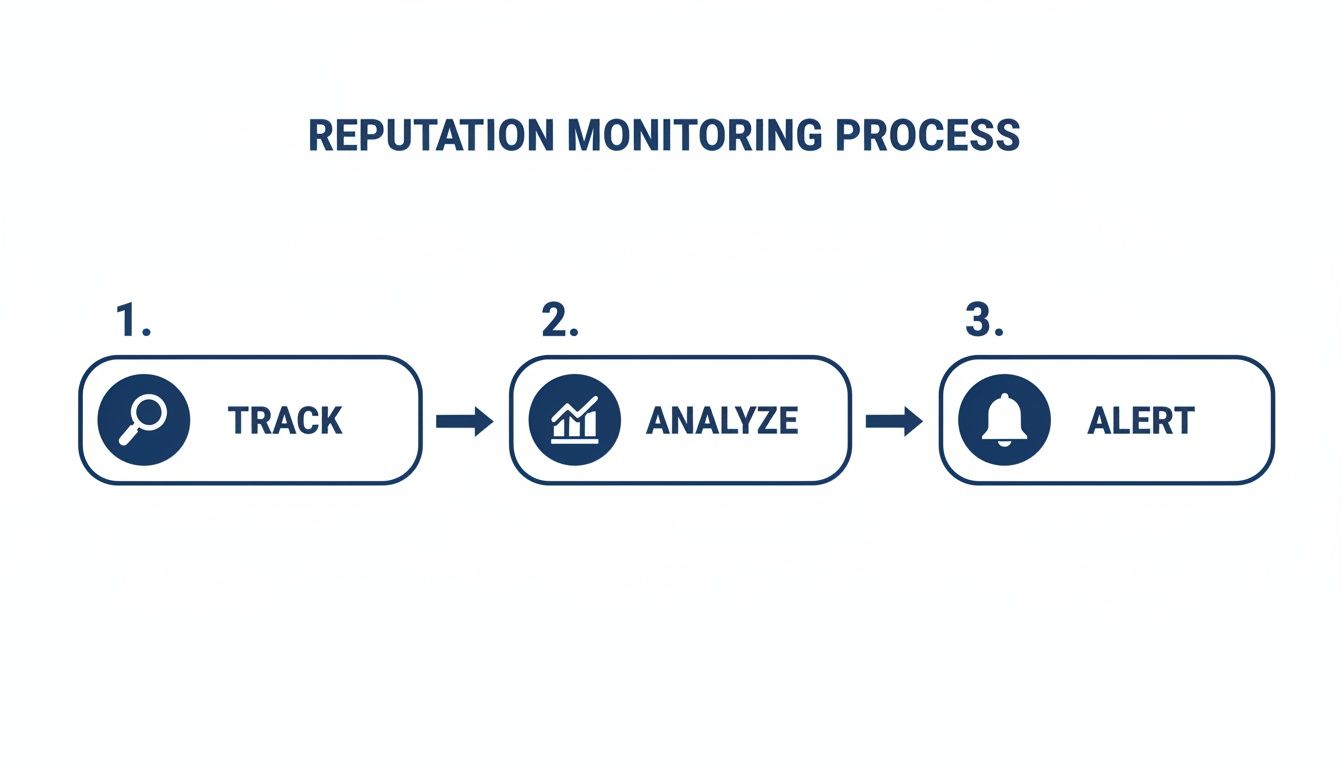
This illustrates how a successful program moves from just being aware of mentions to having actionable intelligence, making sure nothing critical ever falls through the cracks.
Creating Your Triage Framework
The foundation of any good workflow is a solid classification system. Let's be honest, not all negative mentions are created equal.
A single one-star review is a world away from an AI chatbot telling thousands of users your flagship product has been recalled. Your framework needs to categorize incoming alerts into clear severity tiers so everyone knows what they're dealing with.
Here’s a practical, three-tiered model you can steal and adapt:
- Tier 1 (Low Severity): These are your routine issues. Think individual customer complaints on social media, minor service questions, or isolated negative reviews that don't point to a bigger problem. Your frontline customer support or social media teams can usually handle these.
- Tier 2 (Medium Severity): This tier is for more serious problems that are starting to gain traction. We're talking about a cluster of negative reviews about the same product defect, an inaccurate business listing on a major map service, or a negative post from a mid-tier influencer. These require coordination between departments like marketing, operations, and customer support.
- Tier 3 (High Severity/Crisis): These are the critical, brand-level threats that demand immediate executive attention. This could be a viral scandal, a major news story spreading false information, or a dangerous AI hallucination, like a chatbot fabricating a safety warning about your product.
By categorizing every single alert, you create instant clarity. The moment an issue is flagged, your team knows exactly how seriously to take it and who needs to be looped in.
Defining Response Protocols for Each Tier
Once your tiers are set, the next step is building specific response protocols for each one. A protocol is just a simple playbook that answers four key questions: Who, What, When, and Where?
Who is responsible?
Assign clear ownership. For a Tier 1 issue, it might be the "Social Media Community Manager." For a Tier 3 crisis, it's the "Crisis Response Team," which absolutely must include people from legal, communications, and the C-suite.
What is the required action?
Define the exact steps. This could be anything from "Respond to the customer review using Template A" for a Tier 1 issue to "Activate the crisis communication plan and convene the response team" for a Tier 3.
When is the response due?
Set firm Service Level Agreements (SLAs). A Tier 1 issue might get a four-hour response time, while a Tier 3 crisis needs an internal huddle and acknowledgment within 30 minutes.
Where is the response delivered?
Specify the channel. Should the response be a public reply on X, a private DM, or an official press statement? The channel has to match the context and severity of the issue.
A well-defined response protocol removes all the guesswork when you're under pressure. When a real issue hits, your team shouldn’t be debating who owns it or how fast to act—they should be executing a plan they already know and have practiced.
A Real-World Triage Scenario
Let's walk through how this works with a common and surprisingly damaging problem: an AI chatbot incorrectly lists one of your retail locations as "permanently closed." This is a perfect example of a Tier 2 issue that could quickly escalate into a Tier 3 crisis if you don't jump on it.
Here’s how the workflow plays out:
- Detection: Your monitoring tool flags the AI-generated error.
- Triage: The on-call comms manager immediately classifies this as a Tier 2 alert. It has a direct impact on revenue and the customer experience, so it's not a minor issue.
- Action: The protocol kicks in. The comms manager notifies the store operations team to confirm the location is, in fact, open and documents the error with screenshots.
- Resolution: Following the playbook, the team reports the inaccuracy through the AI model's feedback tool. At the same time, the marketing team pushes out an update on the store’s Google Business Profile with a post confirming it's open for business.
This structured response turns a potential disaster into a series of manageable tasks.
For organizations that need a hand building out these kinds of sophisticated workflows, bringing in dedicated AI reputation management consultants can provide the expertise and guidance you need. These specialists can help fine-tune your triage system for the unique challenges that generative AI throws your way.
Creating a Modern Crisis Management Playbook
When a small issue ignites and spreads online, your best defense is a plan you made months ago. A modern crisis playbook isn't some dusty binder on a shelf; it's an agile, digital-first guide built for the speed of social media and AI.
In a firestorm, this playbook is what turns panic into a process. It takes the paralyzing question of "what do we do now?" off the table and replaces it with clear, pre-approved steps. This preparation is non-negotiable when a single viral post can derail your reputation in minutes.
Assembling Your Crisis Response Team
Before you can write a single word of the plan, you have to know who will be in the room when it hits the fan. Your crisis response team is a dedicated, cross-functional group with crystal-clear roles. This prevents any one department—especially comms—from making critical decisions in a vacuum.
A well-rounded team stops bottlenecks before they start and ensures every angle—legal, operational, and reputational—is covered.
Your core team should have a delegate from these key areas:
- Communications Lead: Usually from PR or corporate comms, this person owns the entire external messaging strategy. They draft statements, prep spokespeople, and handle all media contact.
- Legal Counsel: Legal’s job is to review every public-facing word for liability. They're there to make sure statements are factually airtight and legally sound, protecting the company without grinding communication to a halt.
- Operations Lead: This is your link to what's actually happening on the ground. Whether it's a product recall or an issue at a retail location, they feed the team the factual details needed to respond accurately.
- Executive Sponsor: A C-suite leader, like the CEO or COO, needs to be designated for final sign-off on major decisions. Their involvement shows everyone—internally and externally—that the company is taking the situation seriously from the very top.
This structure is designed for speed and accuracy. The comms lead can draft a holding statement while the ops lead verifies the facts and legal reviews it in parallel. That's how you get a responsible, coherent message out the door fast.
Preparing for AI-Specific Crises
Your playbook now needs to account for bizarre, entirely new crises spawned by generative AI. Imagine a popular chatbot confidently telling thousands of users your flagship product contains a toxic ingredient. Or what if it starts unfairly promoting a direct competitor in every single response?
These aren't your traditional PR problems. They are technical, fast-moving threats that require their own protocol.
Your AI crisis playbook needs specific steps:
- Document Everything: The first move is to capture hard evidence. Take screenshots and record the AI's output, making sure to save the exact prompts that generated the false information.
- Report It Immediately: Use the AI provider's built-in feedback or reporting tool. This creates an official paper trail and flags the issue for their technical teams.
- Correct the Public Record: Don't wait for the AI model to be fixed. Use your owned channels—your website's homepage, your social media accounts, your Google Business Profile—to proactively and clearly state the correct information.
A crisis is the absolute worst time to invent a process. Your playbook must spell out exactly who is empowered to act, what they need to do, and the order of operations for every likely scenario—especially digital-native threats like AI hallucinations.
When a security incident is involved, a modern data breach response plan becomes an indispensable part of your overall strategy. The core principles are the same, whether you're facing a breach or a damaging AI-generated rumor: rapid response, clear communication, and tight stakeholder coordination. Both demand a prepared team that can execute a plan with speed and transparency.
How to Measure Reputation and Prove ROI
Reputation work can feel thankless. You spend all your time putting out fires and building goodwill, but when budget season rolls around, you’re inevitably hit with the big question: "What's the ROI?"
To keep your program funded and get the resources you need, you have to speak the language of the C-suite. That means connecting your efforts directly to tangible business outcomes.

Successfully managing corporate reputation means getting beyond vague, "soft" metrics. While things like positive mentions are nice, they don't directly translate to the bottom line. The real goal is to build a clear, data-backed story that shows how a stronger reputation fuels core business objectives—think lead generation, customer acquisition, and sales growth.
Moving from Vanity Metrics to Business KPIs
The first move is to shift your reporting from activity to impact. Stop reporting just what you did (e.g., "responded to 100 reviews") and start reporting on the outcome of that activity (e.g., "increased our average star rating by 0.3, which correlates with a 5% lift in local store traffic").
This takes a more strategic approach to measurement. You need to identify the key performance indicators (KPIs) that truly reflect the health of your reputation. Then, draw a straight line from those KPIs to the metrics your leadership team obsesses over.
Here are the essential reputation KPIs you should be tracking:
- Sentiment Trends: Don't settle for a simple positive/negative score. Track the percentage of neutral-to-positive mentions over time. A steady increase is hard proof that your proactive efforts are changing the conversation.
- Share of Voice (SoV): How much of the conversation in your industry do you actually own compared to your competitors? A growing SoV in a positive context is a powerful indicator of market leadership.
- Average Review Ratings: This is a direct line to customer sentiment. Monitor your aggregate star rating across key platforms like Google, Yelp, and G2. Even tiny improvements here have an outsized impact on the bottom line.
- AI Inaccuracy Rate: Track how often AI models get it wrong when talking about your brand. A decreasing rate of flagged AI "hallucinations" shows your correction efforts are working and protecting your brand from costly misinformation.
The most powerful reputation dashboards don't just show data; they tell a story. They connect a rising sentiment score to a lower customer acquisition cost or a better average review rating to higher conversion rates on product pages.
This isn't just theory. Small shifts in online signals produce huge, measurable changes in customer behavior. Recent data shows that a staggering 75–92% of consumers say online reputation influences their buying choices. In fact, roughly 60% will ditch a purchase after reading just one negative review.
For local businesses, a focused program that lifts an average rating by just 0.3–0.5 stars can lead to double-digit percentage growth in foot traffic and revenue. To dig deeper into these numbers, you can explore the key statistics on reputation's impact.
Mapping Reputation KPIs to Business Impact
To really build your business case, you have to connect the dots for leadership. A simple table is often the most powerful tool for showing executives exactly how your work translates into results they care about. It reframes your program from a cost center to a revenue driver.
Mapping Reputation KPIs to Business Impact
This table connects specific reputation management metrics to their corresponding business outcomes, helping prove ROI.
| Reputation KPI | How to Measure It | Potential Business Impact |
|---|---|---|
| Improved Average Star Rating | Track aggregate rating across Google, Yelp, etc. | Increased local search rankings, higher click-through rates, and more foot traffic or online sales. |
| Increased Positive Sentiment | Use a monitoring tool to analyze the tone of online mentions. | Better brand perception, which can lead to higher lead quality and shorter sales cycles. |
| Reduced AI Inaccuracies | Monitor chatbots for factual errors and track correction times. | Prevents lost revenue from incorrect hours or pricing and protects against brand damage from false claims. |
| Higher Share of Voice | Compare your brand's mention volume to competitors. | Greater market awareness, improved brand recall, and an edge in competitive deals. |
This framework completely transforms your reporting. You're no longer just talking about managing corporate reputation; you're talking about driving the business forward.
Building Your ROI Narrative
With this data in hand, you can build a compelling story for leadership. Frame your reports around their goals. Instead of leading with "Our sentiment is up 10%," try "Our efforts to improve brand sentiment have contributed to a 7% increase in marketing qualified leads this quarter." See the difference?
This approach also makes it much easier to justify investments in new tools or people. If you can show that manually tracking AI mentions is causing you to miss revenue-damaging errors, you have a rock-solid case for investing in an automated monitoring platform.
For teams looking to scale these efforts, collaborating with specialized firms can be a game-changer. You can find more information about LLM visibility tracking for agencies to see how experts are tackling this challenge.
By consistently measuring what matters and tying it back to the bottom line, you elevate your role from a brand steward to a strategic business partner. You become the person who can prove, with data, that a strong reputation is one of the most valuable assets the company has.
Common Questions About Managing Corporate Reputation
Even with a great playbook, you're going to hit some practical hurdles when you start managing corporate reputation in the wild. Let's tackle some of the most common questions that pop up, with real-world answers to get you through the day-to-day grind of protecting your brand.
How Often Should We Be Monitoring Our Reputation?
These days, daily monitoring is the absolute minimum. A nasty review going viral or an AI chatbot hallucinating that your flagship store is closed can spiral out of control in hours, not days. Waiting a week to catch something like that is no longer an option.
Of course, this doesn't mean you need someone glued to a screen 24/7, manually refreshing a dozen websites. That's a surefire path to burnout. This is precisely where automation becomes your best friend.
Your goal should be an "always-on" system that scans and alerts you in real-time. While you might only pull together a comprehensive report for leadership on a weekly or monthly cadence, the detection has to be instant. For big consumer brands or companies in highly sensitive industries, this means near-instantaneous alerts pinging the core response team the moment a potential issue pops up.
What's the First Thing We Do if an AI Chatbot Says Something Wrong About Us?
If you catch an AI spreading bad information about your brand, your two best friends are speed and documentation. Don't panic. Just follow a clear, methodical process to get it fixed and stop the bleeding.
Your immediate response should follow these three steps:
- Verify and Document Everything: The very first thing to do is grab a clear screenshot or screen recording of the conversation. Make sure you note which AI model you're talking to (e.g., ChatGPT-4, Gemini) and the exact prompt you used to trigger the wrong answer. This evidence is gold.
- Grab Your Proof: Pull up your own official, correct information to show the discrepancy. Having this side-by-side comparison makes reporting the error incredibly straightforward and effective.
- Report the Error: Every major chatbot has a feedback mechanism, usually a "thumbs down" icon or a "report an issue" link. Use it. Report the error factually and concisely, providing the proof you just gathered.
Now, if the error is business-critical—like an AI telling people you’re “permanently closed”—you need to escalate it immediately through your crisis playbook. That ensures your legal and communications teams are in the loop from minute one.
How Can a Small Team Handle Reputation Without a Huge Budget?
For small teams, effective reputation management comes down to two things: ruthless prioritization and smart automation. You don't need an enterprise-level budget to protect your brand; you just have to be incredibly strategic.
Here’s where to focus your limited resources for maximum impact:
- Pick Your Battles: Don't try to be everywhere. Zero in on the one or two channels that matter most to your actual customers. For most businesses, that means absolutely owning your Google Business Profile and maybe one other key review site like Trustpilot or Capterra.
- Lean on Automation: Find an affordable platform that pulls all your mentions into one place and sends you prioritized alerts. This saves you from the soul-crushing work of manually checking ten different sites every single morning.
- Create Simple Templates: Build a small library of pre-approved responses for the most common questions or negative comments. This ensures your brand voice stays consistent and slashes your response time, letting a tiny team perform like a much bigger one.
The goal isn't to catch every single whisper about your brand online. It's to be consistently present and professional where your customers are actually looking, building a positive reputation with the resources you have.
How Do You Get Legal and Communications on the Same Page During a Crisis?
Aligning legal and communications has to happen long before a crisis hits. Trying to figure out your workflow when the building is on fire is a guaranteed recipe for disaster. Proactive alignment is the only way to ensure you can move fast when it counts.
The bedrock of this relationship is a pre-designated response team with key players from both legal and comms.
Your crisis playbook needs to spell out the roles crystal clear. Typically, Communications owns the public-facing messaging and strategy, while Legal reviews every statement for liability risks and factual accuracy. The real trick is building a rapid-review process so that legal approval doesn't become a bottleneck. The best way to nail this down is to practice. Running regular tabletop exercises—where you simulate a crisis together—is invaluable for building the trust and muscle memory you'll need when the pressure is real.
Protecting your brand in the age of AI requires a new kind of visibility. TrackMyBiz gives you the power to see exactly what AI assistants are telling customers about your business. Our platform monitors models like ChatGPT and Gemini to flag costly "hallucinations" and uncover competitive insights you can't find anywhere else. Don't let AI-driven discovery be a blind spot—turn it into your next customer acquisition channel. Start your free scan today.
