Localized keyword research is all about figuring out the exact words and phrases real customers are typing into search engines when they're looking for products and services in their own backyard. It’s the difference between a broad search for "coffee shop" and a high-intent query like "best iced latte downtown" or "cafe near me with outdoor seating."
This isn't just a niche tactic; it's fundamental for any business that wants to win over local customers and show up in those all-important map results.
Why Localized Keyword Research Is Non-Negotiable
Let's get one thing straight: localized keyword research isn't just another SEO checkbox. It's a core business intelligence strategy. We need to get past the obvious—"people search for things nearby"—and really drill down into the financial cost of ignoring what local customers are telling us they want. Before we dive in, getting a grip on the basics of what is keyword research will give you a solid foundation.
Think about a multi-location pizza place missing out on hundreds of daily searches for "deep dish pizza delivery" in each neighborhood it serves. Or a local plumber who keeps losing out on high-value jobs because their website never shows up for urgent queries like "emergency pipe repair in Glendale." These aren't just missed clicks; they represent real, tangible losses in revenue and market share.
The Shift to High-Intent Local Queries
The way people shop has changed. The modern customer journey almost always kicks off with a super-specific, location-based search. This pivot from generic terms to high-intent local phrases has a direct impact on your bottom line. Success is no longer measured by who gets the most website visitors, but by who attracts the right visitors—the ones who are just around the corner and ready to buy.
This isn't just a gut feeling; the data is overwhelming. An estimated 46% of all Google searches have local intent. That's a staggering amount of opportunity.
Even more compelling? 76% of people who search for a nearby business on their phone will visit a physical location within 24 hours. And to top it off, 28% of those searches lead to a sale. If you're not showing up in these moments, you're practically invisible to a massive chunk of your potential customers.
The strategic focus has to change from broad appeal to sharp, local precision. This table breaks down the shift in mindset.
Shifting Focus from General to Local Keywords
This comparison highlights the strategic differences between a traditional SEO approach and a modern, localized one.
| Focus Area | Traditional Keyword Research | Localized Keyword Research |
|---|---|---|
| Goal | Drive broad website traffic | Drive in-store visits and local sales |
| Keywords | "running shoes," "seo services" | "running shoes near me," "seo services Dallas" |
| Audience | National or global | City, neighborhood, or service area |
| Key Metric | Organic traffic volume | Map pack rankings, calls, direction requests |
| Content | Broad blog posts, general guides | Location pages, neighborhood-specific content |
The takeaway is clear: while traditional SEO casts a wide net, localized research is about precision fishing in the most profitable ponds.

This screenshot says it all. For local searches, visibility in the Google Map Pack is often far more valuable than a traditional organic ranking. It’s prime real estate for capturing immediate customer action.
Beyond Search Engines to AI Recommendations
This game isn't just about Google anymore. AI assistants and large language models (LLMs) are quickly becoming the new local discovery tools. When someone asks their AI, "Where can I find the best tacos in Austin?" the model doesn't do a live search; it pulls from its massive dataset to give a direct recommendation.
Localized keyword research is your key to unlocking visibility not just in the Google Local Pack, but within the AI-powered recommendations where today's customers are increasingly making their decisions.
This new reality makes your entire digital footprint more critical than ever. The language, keywords, and location data tied to your business online are what these AI models are trained on. A solid local keyword strategy ensures that when users ask for recommendations, your business is part of the answer.
It's also a crucial part of brand defense. A lack of clear, consistent local signals can lead to AI models sharing inaccurate information about your business. To get ahead of this, you need to understand how to manage your brand's presence in these new systems, which is the focus of https://trackmybusiness.ai/ai-reputation-management-consultants. This has moved from a technical task to a fundamental strategy for survival and growth.
Building Your Foundational Keyword List
The heart of any sharp local keyword strategy is a solid foundational list. This isn't just a spreadsheet of terms; it's your starting point for mapping out your customer's local mindset and uncovering the high-intent phrases that get them in the door.
It all kicks off with your seed keywords.

These are the most basic, direct terms for what you sell. For now, forget location or any other qualifiers. If you're a baker, your seed keywords are things like "custom cakes," "sourdough bread," and "wedding cupcakes." An HVAC company? You're starting with "furnace repair" and "AC installation."
These core terms are the "what" of the search. They’re the fundamental service or product your customer has in mind.
Layering on Geo-Modifiers
Got your seed keywords? Good. Now it's time to add the "where." This is where geo-modifiers come in, and nailing this is absolutely critical for local visibility. Don't just slap your city name on the end and call it a day—you have to think like a local.
Truly effective geo-modifiers go way deeper than the main city. You need to brainstorm a whole list that covers:
- Neighborhoods: Specific areas people actually use, like "River North" or "Wicker Park" in Chicago.
- Postal Codes: People often search by their local zip for hyper-specific results.
- Local Nicknames: Think "The Loop" in Chicago or "SoHo" in New York. Locals use them, so you should too.
- Nearby Towns: Include surrounding suburbs or smaller cities that fall within your service radius.
- Landmarks: Queries like "near Millennium Park" are conversational, common, and powerful.
Combining these gives you a much stronger base. "Custom cakes" instantly branches out into "custom cakes River North," "custom cakes 60654," and "custom cakes near Millennium Park." Each one hits a slightly different, but incredibly relevant, local audience.
Adding High-Intent Modifiers
The last piece of the puzzle is the "why" or "how"—the intent modifiers. These are the words that signal a searcher is past the browsing stage and is ready to pull the trigger. Weaving these in turns a simple search into a high-value, long-tail keyword.
A query like 'best 24-hour emergency HVAC repair in River North' tells you everything. It's not just what they want; it’s that they have an urgent, high-value problem and a specific standard they're looking for. This is the absolute goldmine of local keyword research.
Here are a few intent modifiers you should be blending with your seed and geo-keywords:
- Urgency: "24-hour," "emergency," "same-day"
- Price: "affordable," "cheap," "luxury," "discount"
- Quality: "best," "top-rated," "reviews," "expert"
- Specificity: "pet-friendly," "outdoor seating," "gluten-free"
This is how you build out your master list. The process is pretty straightforward: systematically combine your seed terms with your geo-modifiers and your intent modifiers. A simple spreadsheet works perfectly for this, quickly generating hundreds of potential long-tail phrases that reflect how real local customers are looking for you.
For a more granular look at how different modifiers perform, check out the Google Trends data above. It shows the geographic interest for "emergency plumber" versus "affordable plumber"—two related, but distinct, local searches. You can see how search interest shifts by location, which is exactly why layering both geo- and intent modifiers is so crucial for targeting the right customers in the right places.
If you want to get your hands on more raw data to validate your keyword ideas, you can check out a practical guide on how to scrape Google Search results. Pulling direct SERP data is a great way to confirm the patterns you're seeing in tools like Google Trends, making sure your foundational list is built on what's actually happening out in the wild.
Finding Hidden Gems in Competitor and AI Analysis
Your foundational keyword list is a solid start, but the real breakthroughs in local keyword research happen when you look beyond your own four walls. By digging into what your top local competitors are doing and probing how AI assistants see your market, you'll uncover high-intent keywords you'd never find on your own.
This is all about shifting from what you think customers are searching for to what they are actually searching for. It’s less about guesswork and more about smart, digital reconnaissance.

Ethically Spying on Your Local Competition
Your direct competitors are a goldmine of keyword intelligence. They're chasing the same customers in the same neighborhoods, so their digital footprint can instantly show you gaps in your own strategy. This isn't about blindly copying them; it's about learning from their wins and their misses.
First, identify three to five of your top local competitors—the businesses that always seem to pop up in the map pack or organic results for your core services. Got your list? Time to dig in.
Start with their Google Business Profile (GBP). Read everything: their business description, services list, the Q&A section, and especially the customer reviews. You're hunting for recurring phrases and specific service call-outs you might have overlooked. For example, a rival coffee shop’s reviews might consistently praise their "dog-friendly patio" or "quiet study corner"—both are fantastic, hyper-local keywords.
Next up is their website. Zero in on their local landing pages and blog posts. Pay close attention to page titles, headings (H1s and H2s), and the exact language they use to describe their offerings for a specific town or neighborhood. If this sounds like a lot of manual work, it can be. Thankfully, you can explore various competitor and AI analysis tools to speed up the process.
Using AI as Your Local Discovery Engine
Beyond old-school competitor analysis, AI assistants like ChatGPT, Gemini, and Claude represent a whole new frontier for local keyword research. For a growing number of people, these tools are the new local search engine, giving direct recommendations instead of just a list of links. Understanding the language they speak is now critical.
The trick is to prompt these models like a real customer would. Don't just feed them keywords; ask for solutions to local problems. This pivot from keywords to conversational queries reveals how AI connects what a user wants with specific business features.
By analyzing the specific terms and phrases an AI uses in its answers, you gain direct insight into what language these powerful platforms associate with local authority and trust. This is a massive competitive advantage.
Try prompting an AI with a realistic local scenario. Instead of just thinking about "pet-friendly brewery," ask it: "Suggest a few pet-friendly breweries in Austin that have a good patio and serve craft IPAs."
Now, dissect that response.
- What specific adjectives does it use? Does it mention a "spacious patio," "shady seating," or a "laid-back vibe"?
- What features does it highlight? Maybe it calls out "water bowls for dogs," "leash hooks," or even "a separate dog run."
- What related terms does it include? It might suggest searching for "breweries near Zilker Park" or "dog-friendly bars in South Austin."
Every one of those phrases is a potential keyword. They represent the natural language that AI models have learned to associate with a quality local experience for that specific need. By collecting these terms, you’re building a keyword list that's optimized not just for Google, but for the next wave of AI-driven discovery, making sure you show up wherever your customers are looking.
How to Validate and Prioritize Your Local Keywords
So you've got a massive list of keywords. That's the easy part. The real work is figuring out which ones will actually move the needle for your business. A spreadsheet packed with hundreds of phrases is just data—it's useless without a smart plan. This is where validation and prioritization come in, turning that raw data into a real, actionable local SEO strategy.
First things first, we need a mindset shift. When it comes to local keyword research, traditional metrics like search volume can be incredibly misleading. A generic term with 5,000 monthly searches nationwide is almost always less valuable than a hyper-local phrase getting just 50 searches inside your actual service area. Why? Because those 50 people are qualified, nearby customers who are ready to act.
Looking Beyond Simple Search Volume
To prioritize effectively, you need a scoring system that balances a few key factors. I like to think of it as creating a simple scorecard for each potential keyword. This little framework helps you get past gut feelings and start making data-driven decisions on where to put your time and marketing dollars.
Here’s what you should be scoring:
- Local Search Volume: How many people in your specific city or zip code are searching for this term each month? You have to use an SEO tool that lets you filter down to a granular geographic level to get a true picture.
- Commercial Intent: On a scale of 1-5, how close is this person to making a purchase? A query like "emergency plumber cost" is a clear 5—they need help now. Something like "how to fix a leaky faucet" is probably a 2, as they're still in the DIY phase.
- Business Relevance: How tightly does this keyword align with your most profitable services? A keyword that maps directly to your core business is a 5. A term for a secondary, less profitable offering might be a 2 or 3.
Once you score each keyword against these criteria, a clear hierarchy starts to take shape. The terms with high scores across the board are your top-tier targets—this is the low-hanging fruit with the biggest potential payoff.
Keyword Prioritization Scorecard
Use this framework to score and rank your localized keywords based on what truly matters for your business.
| Keyword | Local Search Volume | Commercial Intent (1-5) | Relevance (1-5) | Priority Score |
|---|---|---|---|---|
| emergency plumber near me | 50 | 5 | 5 | High |
| water heater repair cost | 30 | 4 | 5 | High |
| local plumbing services | 90 | 3 | 4 | Medium |
| how to fix leaky faucet | 20 | 2 | 2 | Low |
This process gives you a simple, visual way to separate the high-impact keywords from the noise, letting you focus your efforts where they'll count the most.
Analyzing the SERP for Customer Clues
The numbers only tell you half the story. The single most important step in validation is to manually analyze the search engine results page (SERP) for your top-priority keywords. Seriously, do not skip this. The SERP is a direct window into what Google thinks customers actually want to see for that query.
Go ahead, search for "sushi delivery downtown." What pops up?
- Is the Google Map Pack dominating the top of the page?
- Are the top organic results individual restaurant websites?
- Do you see links to third-party review sites like Yelp or TripAdvisor?
- Are delivery services like DoorDash showing up?
The layout of that page tells you exactly what kind of content and assets you need to create to compete. If the Map Pack is front and center, your Google Business Profile optimization is non-negotiable. If it's all individual restaurant sites, you know you need a killer, optimized landing page. This direct analysis kills the guesswork and aligns your strategy with proven user intent.
Localized keyword research is no longer just about ranking in blue links; it now directly influences visibility in local packs, maps, and AI-generated answers, where most local clicks and calls originate.
Multiple studies have shown that 42–44% of local clicks go straight to the Google Maps/Local Pack, while the classic organic results get only about 29%. When it comes to AI-driven local search, on-page signals, customer reviews, and GBP data are the leading factors. You can find more insights on these emerging local search ranking factors at AdviceLocal.com.
As you analyze the SERP, you also have to start tracking how your brand appears in LLM answers. This is where specialized tools for monitoring your LLM visibility for agencies and brands become absolutely essential. It ensures your prioritization efforts account for every way a local customer might find you today.
Putting Your Local Keyword Research into Action
Having a prioritized list of local keywords is a huge milestone, but let's be honest—research without action is just an academic exercise. This is where the rubber meets the road. The final, most crucial phase is to weave these high-intent phrases into the very fabric of your digital presence.
This is how your hard work translates into tangible results: more calls, more foot traffic, and a much stronger local reputation.
The goal isn't to awkwardly stuff keywords everywhere. It's about strategically placing them where they’ll have the most impact on both search engines and potential customers, signaling relevance and authority at every single touchpoint. This approach transforms your research from a static document into a dynamic growth engine for your business.
Weave Keywords into Your Digital Storefront
Your Google Business Profile (GBP) is your digital storefront. For many local customers, it's the very first interaction they'll have with your brand. It absolutely needs to be optimized with the exact language people are using to find businesses like yours.
Start with the basics:
- Business Description: Refresh your description to naturally include your top-priority local keywords. Instead of just "We are a cafe," try something like, "Visit our downtown cafe for the best espresso and pet-friendly patio seating in the 90210 area."
- Services List: Don't settle for generic service names. If your research showed "24-hour emergency plumbing" is a key term, make sure that's listed as a specific service, not just "Plumbing."
- GBP Posts: Use your secondary keywords in GBP Posts to highlight promotions, events, or new offerings. A post titled "Affordable A/C Tune-Up in West Hollywood" is far more effective than a generic "Summer Special."
These small but mighty updates directly tell Google what local queries your business is most relevant for, dramatically improving your chances of appearing in the coveted Map Pack.
Fine-Tune Your On-Page Local Signals
Your website is your home base, and every page is another opportunity to cement your local authority. I always tell clients to start by focusing on their local landing pages—those dedicated pages for each physical location or primary service area.
Make sure these key elements are dialed in:
- Title Tags: This is one of the most powerful on-page SEO factors, period. Your title tag should include your primary local keyword, like "Expert Dog Grooming in Brooklyn | Paws & Whiskers."
- Meta Descriptions: While not a direct ranking factor, a compelling meta description loaded with your keyword is what earns the click. Mentioning "top-rated dog groomer in Brooklyn with same-day appointments" can make all the difference.
- H1 and H2 Headings: Your main page heading (H1) should clearly state the page's purpose using your target keyword. Then, use subheadings (H2s) to target related, long-tail variations like "Our Puppy Grooming Services" or "Find Us in the Williamsburg Neighborhood."
- Body Content: The content itself must feel natural. Weave in your keywords by talking about local landmarks, mentioning specific streets, and directly answering the questions your research uncovered. This builds immense topical and geographic relevance.
This systematic approach ensures your website sends clear, consistent signals to search engines about who you are, where you operate, and what local problems you solve.
This flowchart breaks down the core process of validating your keywords before you spend time implementing them, making sure you're focused on volume, relevance, and intent.
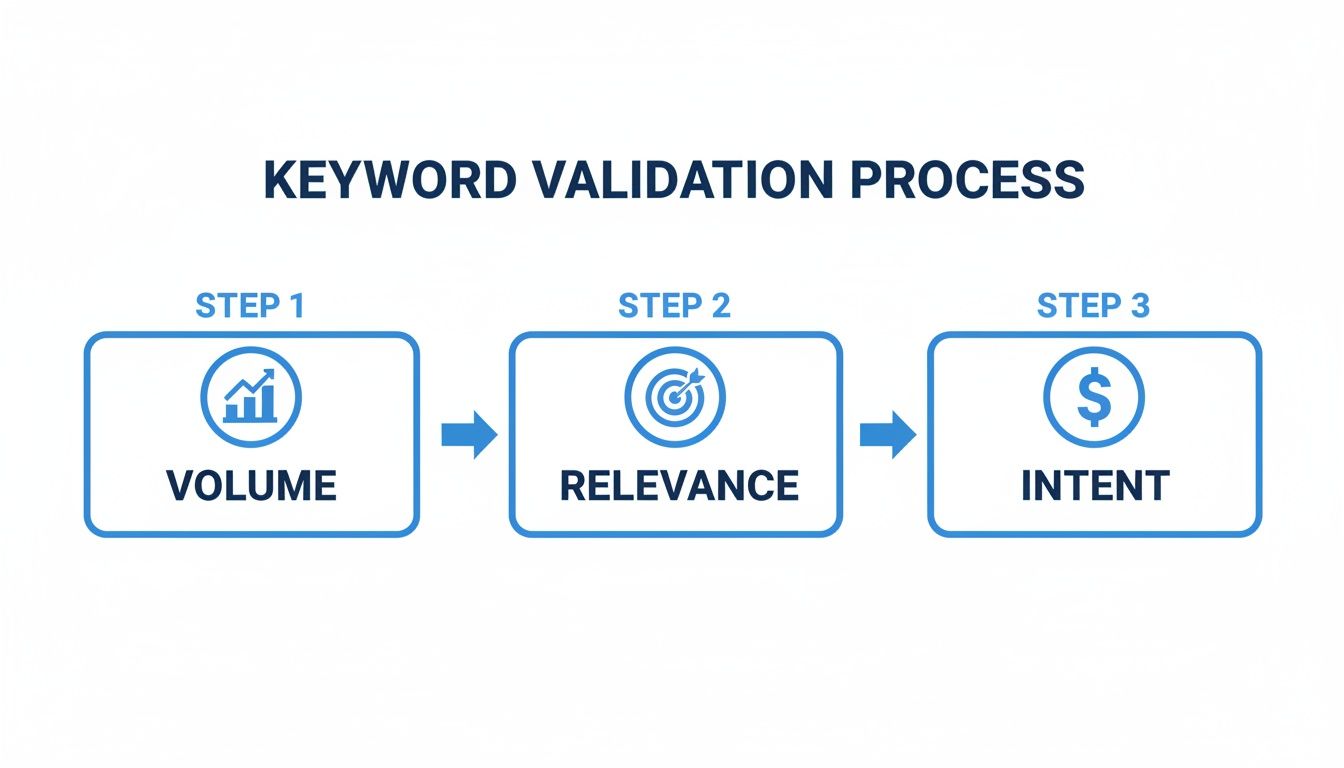
Following this process ensures you're not just implementing keywords, but implementing the right keywords that actually line up with your business goals and customer needs.
Monitor and Adapt Your Local Strategy
Here's a hard truth: localized keyword research is not a "set it and forget it" project. Local search trends change constantly, your competitors are always adapting, and new technologies are always emerging. If you're not monitoring your performance, you're falling behind.
The biggest risk in local search today isn't just dropping in the rankings. It's allowing an AI assistant to present inaccurate information about you as fact, which can cause immediate damage to your reputation and revenue.
Imagine an AI telling a potential customer your business is "permanently closed" or listing incorrect hours for your busiest day. This is exactly where modern monitoring tools become indispensable. Platforms like TrackMyBiz are built to scan AI models for mentions of your brand, flagging harmful inaccuracies so you can get ahead of the problem.
This is especially critical as search becomes more conversational. In fact, various surveys show that 58–72% of consumers now use voice search to find local business information, and about 76% of those searches are for "near me" queries. You can find more of these eye-opening local search stats on seoprofy.com.
These conversational, question-based searches are precisely what AI models are built to answer, making your factual accuracy in their systems paramount.
Your ongoing monitoring loop should include:
- Rank Tracking: Keep a close eye on your position for your top 10-15 local keywords.
- AI Monitoring: Use a dedicated tool to track what AI assistants are actually saying about you.
- Review Analysis: Regularly comb through customer reviews for new keyword ideas and service feedback.
By turning implementation and monitoring into a continuous cycle, you ensure your localized keyword strategy remains a powerful, adaptive tool that drives consistent growth.
Common Questions About Localized Keyword Research
As you move from building your initial keyword lists to fine-tuning your strategy, you're bound to run into a few practical questions. It's totally normal. Turning raw research into a repeatable process that actually drives business is where the real work begins.
Let's tackle some of the most common queries we see. Getting straight answers here will help you smooth out the bumps and refine your approach for the long haul.
How Often Should I Revisit My Local Keyword Research?
Thinking you can "set and forget" your keyword list is one of the biggest mistakes I see. Your local market isn't static—it's a living, breathing thing. Competitors pop up, new neighborhood slang takes hold, and what customers need in the summer might be completely different from what they search for in the winter.
A static strategy is a dead strategy.
Plan on doing a full, comprehensive review of your entire keyword set at least once per quarter. This is your chance to dig deep, spot emerging trends, and see how the competitive landscape has shifted.
Beyond that, quick monthly check-ins are a must, especially if you're in a seasonal business or a super competitive market. Agility is everything in local search.
And when it comes to AI-driven search? Continuous monitoring is non-negotiable. LLM answers can literally change overnight based on new data. You have to keep a constant pulse on your AI visibility to catch a bad recommendation before it does real damage.
What Are the Best Free Tools for Local Keywords?
You absolutely do not need to spend a fortune to build a rock-solid foundation for local keyword research. The trick is knowing where to look and how to connect the dots from all the free clues scattered across the web.
Here are a few of the most powerful resources that won't cost you a dime:
- Google Search Itself: This is your number one tool. Seriously. Search your main terms and obsessively analyze the "People Also Ask" and "Related Searches" boxes. These are direct pipelines into the exact follow-up questions your customers are asking.
- Google Trends: Invaluable for comparing keyword popularity across different cities, states, or even metro areas. If you have multiple locations, this helps you see which services are hotter in one part of town versus another, so you can tailor your content.
- Google Keyword Planner: It's built for advertisers and the volume numbers can be pretty broad, but it's still great for gut-checking your ideas and sparking new ones. It helps put some rough numbers behind the terms you've brainstormed.
- Your Own Customers: Never, ever forget this one. Pay close attention to the exact words people use when they call, email, or leave reviews. Ask them how they found you. This is the purest, most authentic keyword intelligence you can possibly get.
How Do I Scale This for Multiple Locations?
Scaling local keyword research across dozens—or even hundreds—of locations is all about having a system. Throwing more manpower at it won't work; you need a repeatable process that maintains consistency while still honoring what makes each market unique.
First, lock down your core service keywords. These are the non-negotiable terms that apply to every single one of your locations. Then, build a structured template for adding location-specific modifiers to each. A simple, well-organized spreadsheet is your best friend here. It lets you systematically combine core terms like "emergency HVAC repair" with cities, specific neighborhoods, and even zip codes.
But the single most important step in scaling is this: build a unique, fully optimized local landing page for every single location. Don't even think about using one generic "locations" page. A dedicated page for your Dallas shop lets you use Dallas-specific keywords in the title, headings, and content, giving you a massive relevance boost that a generic page could never achieve.
Service-Area Businesses vs. Storefronts
The core strategy of finding local keywords is pretty much the same for everyone, but how you apply them is completely different for a business with a physical storefront versus one that serves customers at their location.
A brick-and-mortar business—think a coffee shop or a retail boutique—is going to live and die by hyper-local and "near me" searches. Their keyword modifiers need to be incredibly granular, targeting specific neighborhood names ("pizza Upper East Side"), nearby landmarks ("coffee shop near Central Park"), and phrases that scream immediate proximity.
On the other hand, a service-area business like a plumber or a mobile dog groomer needs to cast a wider net. Their geo-modifiers will include all the towns, cities, and counties they cover. This directly shapes their content. The coffee shop might blog about a local street fair, while the plumber creates dedicated service pages like "Emergency Plumbing in [Town Name]" for every single area they serve.
Ready to stop guessing what AI assistants are telling customers about you? TrackMyBiz gives you the power to monitor your brand's visibility across models like ChatGPT and Gemini, flagging inaccuracies and uncovering hidden opportunities. Start your free scan today and see where you stand.
