
Local keyword research isn't just a box to tick on your SEO checklist. It’s about figuring out the exact words and phrases your neighbors use when they need your products or services right now.
This is the secret sauce that separates a generic search like "best pizza" from a high-intent, money-on-the-table query like "best deep-dish pizza in Chicago." Get this right, and you stop shouting into the void and start showing up for nearby customers who are ready to buy. For any business with a physical address, this is everything.
Why Local Keyword Research Is a Game-Changer
If you have a storefront or a defined service area, nailing local search is how you survive and thrive. It’s more than just general SEO; it’s about tapping into the powerful intent behind location-specific searches, connecting you directly with people actively looking for a solution just around the corner. We’re not just talking about clicks—we're talking about real-world actions like phone calls, quote requests, and feet walking through your door.
The proof is in the search data. People are constantly looking for local solutions.
To really grasp how local search translates into actual sales, take a look at the numbers. They paint a pretty clear picture of customer behavior.
The Real-World Impact of Local Search Intent
| Statistic | What This Means for Your Business |
|---|---|
| 46% of all Google searches have local intent. | Nearly half of all searchers are looking for a local solution. You're invisible to them without a local strategy. |
| Over 1.5 billion searches per month include "near me." | This is the clearest signal of immediate need. Capturing this traffic means getting in front of customers at the peak of their interest. |
| 76% of local searchers visit a business within 24 hours. | Local searches aren't just for casual browsing. They are direct precursors to real-world visits and purchasing decisions. |
| Local searches convert at an 80% rate. | This is an incredibly high conversion rate. The traffic you get from local keywords is far more valuable than general, untargeted traffic. |
These aren't just vanity metrics. They represent a direct line from a search query to a customer transaction, highlighting just how critical it is to get your local keyword game right.
From Driving Clicks to Protecting Your Brand
The stakes have gotten even higher with the explosion of AI assistants and chatbots. Customers are now asking conversational questions like, "What's the best brunch spot in Austin with a patio?" The answers spit out by AI are pulled from its understanding of the web. If your local SEO is weak, you simply won't be part of the conversation.
Worse, AI can get things wrong. These "hallucinations" can be incredibly damaging, telling a potential customer your business is closed on Tuesdays or doesn't offer a service you specialize in.
A sharp local keyword strategy does two critical jobs at once:
- Drives Immediate Sales: It puts you directly in the path of high-intent customers the moment they’re looking to buy.
- Safeguards Your Reputation: It feeds search engines and AI models accurate, consistent facts about your business, minimizing the risk of harmful misinformation.
By proactively owning the local terms that define your business, you're essentially training AI on why you're the best choice in town. This flips AI from being a potential risk into a powerful new channel for customer acquisition.
To get the full picture, it's worth digging into broader SEO localization techniques that build on this foundation.
Ultimately, this isn't just another task for your marketing team. It's a core business strategy for winning in a world where your digital presence directly fuels your physical foot traffic. You can explore more strategies on the main TrackMyBiz blog.
Before you even think about opening a keyword tool, the real work of hyperlocal targeting begins. It’s all about laying a solid foundation. If you don't get this part right, you’re just guessing. The goal isn't to chase rankings; it's to drive real-world actions that grow your business—foot traffic, phone calls, and quote requests.
First things first: you need to define what success actually looks like for each specific location you serve. Are you aiming for a 15% increase in foot traffic for your downtown coffee shop? Or maybe you need 20 more qualified leads per month for your plumbing services in a specific suburb.
Getting this specific turns keyword research from a vague SEO chore into a measurable business strategy.
Once your goals are crystal clear, you can get serious about defining your geographic targets. Don't just settle for "New York City." That's way too broad. Think smaller. Are your ideal customers in "downtown Brooklyn," "the Upper East Side," or even a specific postcode like "10012"? This level of detail is absolutely essential.
After all, someone searching for an "emergency plumber in SoHo" has a completely different—and far more urgent—need than someone vaguely searching for "plumbers in NYC."
This simple process shows just how directly a local search connects to a real-world purchase.
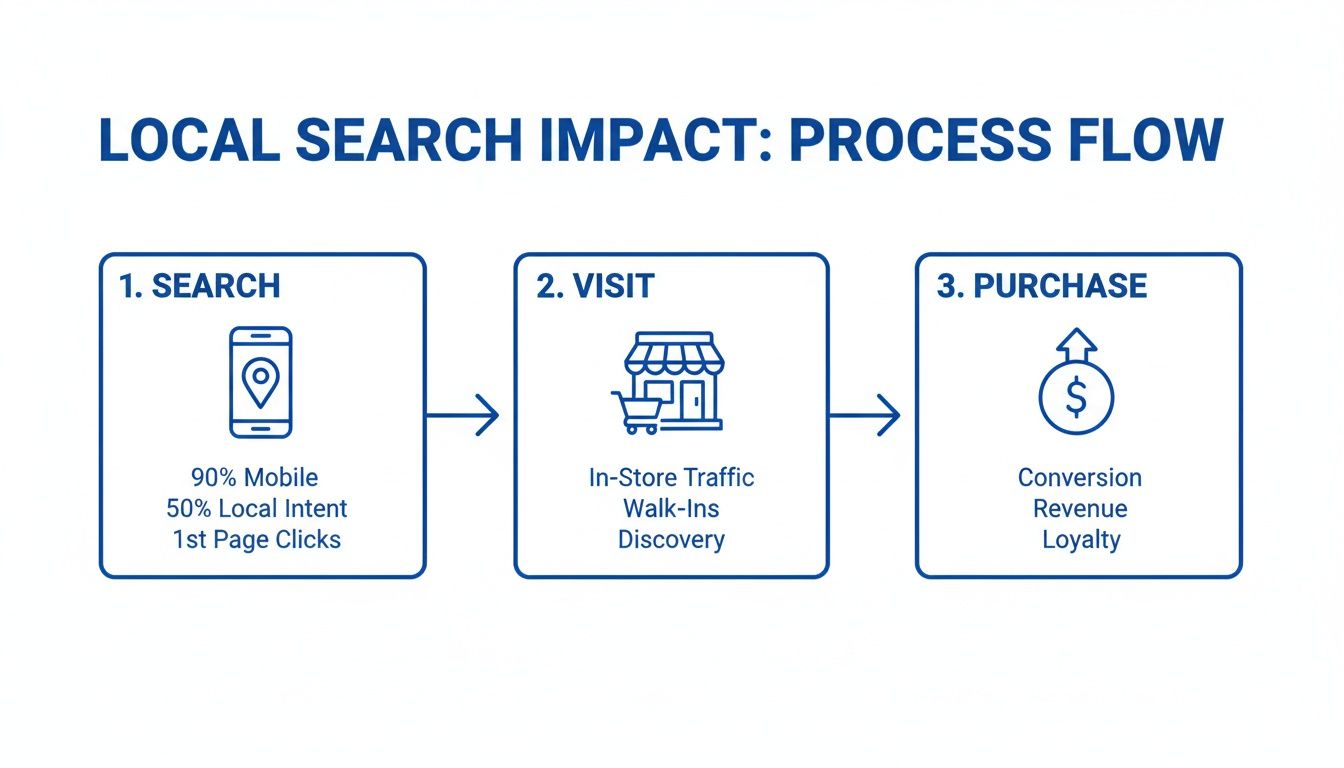
As you can see, local search isn't just about clicks and impressions. It's a direct line to customer action.
Think Like a Local
Now for the fun part. Start brainstorming keywords by mixing your core services with these geographic "modifiers." This is where you dig deep and uncover the actual language your customers are using. The trick is to put yourself in their shoes.
A common mistake I see is stopping at the city name. True hyperlocal targeting goes deeper, using landmarks ("near Central Park"), neighborhood nicknames ("the Village"), or even regional slang that generic keyword tools will never spit out.
You have to genuinely think like someone who lives there. What would they type into their phone?
- Service + Neighborhood: "24-hour locksmith Williamsburg"
- Product + Landmark: "coffee shop near the Empire State Building"
- Need + Regional Term: "car garage for MOT in Hackney" (a UK-specific term)
This initial brainstorm is your raw material. These are the authentic, location-specific phrases you’ll later test and validate with data. By starting with clear business goals and these hyperlocal nuances, you build a keyword strategy that resonates with both search engines and, more importantly, the people in your community. This groundwork makes every subsequent step more targeted, efficient, and ultimately, more profitable.
Finding Winning Keywords in a Voice and AI World
Your standard keyword tools are just the starting point. If you want to really get ahead in local search, you have to dig deeper into how real customers are searching right now—and that means conversational queries, voice assistants, and AI chatbots.

This shift in search behaviour isn't just a trend; it demands a whole new way of thinking that goes way beyond basic "service + city" keywords.
Let's be clear: this evolution directly impacts your bottom line. Globally, 30% of all Google mobile searches are hunting for something local. That simple fact forces smart businesses to weave in city names, specific neighbourhoods, and "near me" phrases into their strategy.
Why? Because it captures the 88% of local searches that result in a phone call or a physical visit within 24 hours. The entire local search model is built on that immediacy and high-intent behaviour.
Mine Your Competitors and Local Forums for Clues
A great place to start is by looking at what your top local competitors are already ranking for. Don't just glance at their homepage. Dig into their service pages, location-specific pages, and blog posts to see which local modifiers they're targeting. Are they going after certain boroughs, famous landmarks, or keywords tied to local events?
Next, jump into the actual community hubs. Check out local subreddits or neighbourhood Facebook groups. Search for your services and just listen to the natural language people use. You'll strike conversational gold—the exact phrasing and questions your potential customers are typing and speaking.
A generic tool might spit out "emergency plumber Brooklyn." But a quick scan of a local forum might show you what people really ask:
- "Any recommendations for a plumber who can fix a burst pipe in Bushwick?"
- "Who's a reliable plumber near Barclays Center?"
- "Need a plumber fast, DUMBO area, not too expensive."
These phrases are your roadmap. They let you create hyper-relevant content that speaks directly to a user's specific problem in their specific location.
Adapt for Voice and AI-Driven Search
The biggest change in local search is the pivot to long-tail, conversational queries. People don't speak to Siri or a chatbot in short, choppy keywords. They ask full, detailed questions.
Think about the difference between typing "best pizza SoHo" and asking, "Hey Google, where can I get a slice of pepperoni pizza in SoHo that's open late?" The second query is packed with detail and intent.
Your research has to anticipate these kinds of conversational prompts. Brainstorm the full questions your customers might ask, folding in details like specific features, times of day, or unique needs.
As AI keeps reshaping search, getting familiar with advanced AI keyword research tools is becoming non-negotiable for finding these new opportunities. This forward-thinking approach is critical for future-proofing your local SEO, especially when you consider the growing importance of LLM visibility tracking for agencies.
When you build a keyword list that mirrors how people actually talk, you're not just optimising for search engines—you're optimising for people. And that's a powerful advantage.
Prioritizing Keywords and Mapping Them to Content
So, you've got a long list of local keywords. That's a fantastic start, but right now, it's just raw data. The real magic happens when you turn that list into a smart, actionable content plan—one that transforms all that potential into actual traffic and sales.
This is the crucial step where you sort your keywords and strategically assign them to the right places across your entire digital footprint.
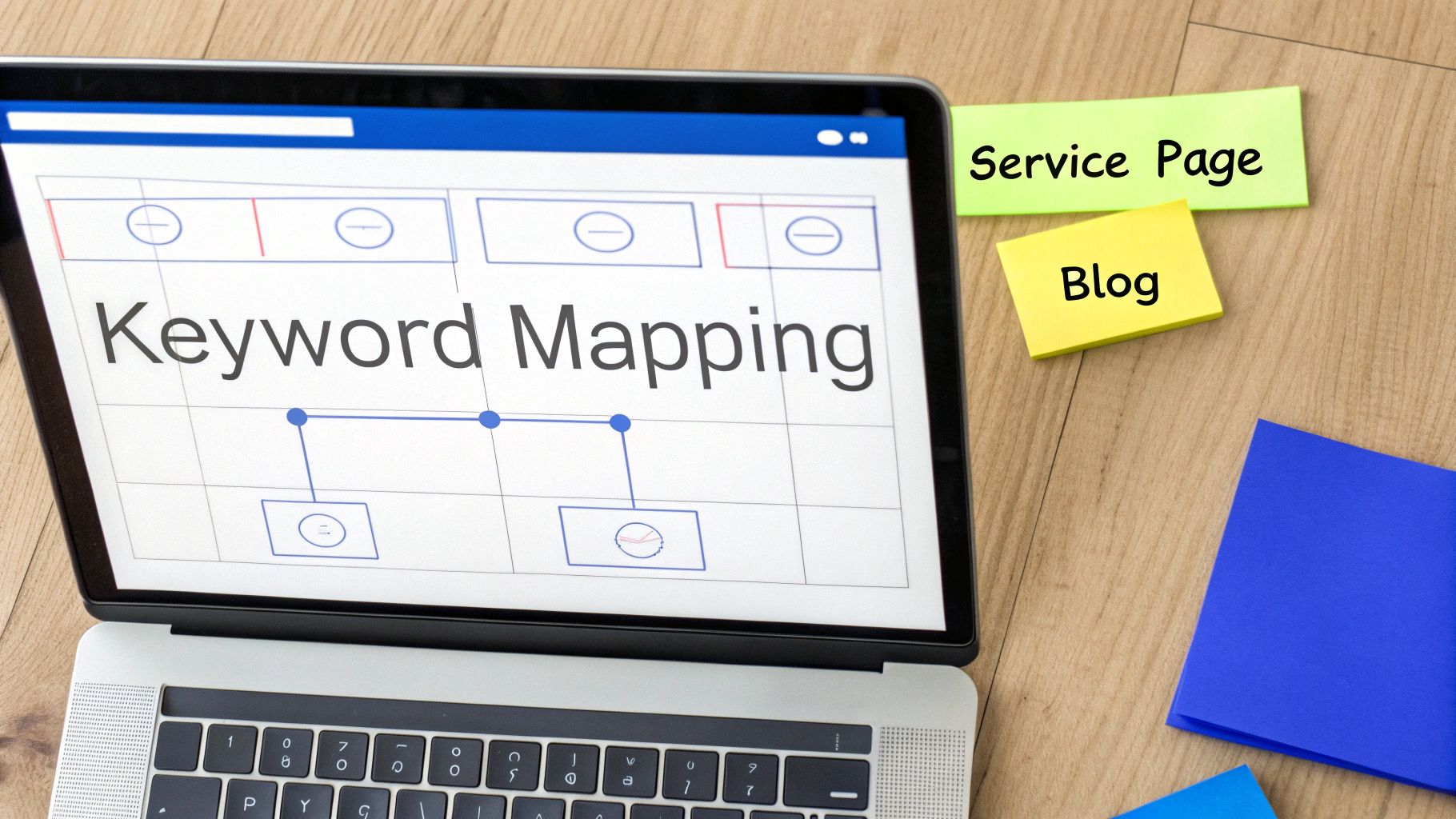
First things first: you need to prioritize. Not all keywords are created equal, and you need a simple way to separate the immediate opportunities from the long-term goals. I've found the best way to do this is by evaluating each term against three core metrics: relevance, search volume, and commercial intent.
A keyword might get a ton of searches, but if it isn’t directly relevant to a service you actually offer, it’s just noise. On the flip side, a hyper-relevant term with zero monthly searches isn’t going to move the needle either. Your sweet spot is finding that perfect balance.
Create a Simple Scoring System
To keep this process objective, I recommend a quick scoring system. For each keyword, just assign a score from 1-5 for relevance, search volume (relative to your market), and commercial intent. Add up the scores, and you'll have a clear priority ranking.
- Low-Hanging Fruit: These are your quick wins. Look for keywords with high relevance and strong commercial intent, even if the search volume is a bit lower. Think terms like "emergency roof repair downtown" or "24-hour plumber Brooklyn."
- Long-Term Targets: These are the high-volume, relevant keywords with more informational intent. They're perfect for building authority over time. Examples include "best running trails near Central Park" or "cost of kitchen remodel in Austin."
This simple tally immediately shows you where to focus your energy first for the biggest impact.
Map Each Keyword to a Specific Asset
With your keywords prioritized, the next move is mapping them to the right piece of content. This ensures every page, post, and profile you create has a clear purpose and targets a specific user need. Different types of keywords simply belong in different places.
Don't make the classic mistake of trying to stuff every keyword onto your homepage. Effective local SEO means matching user intent with the right content format. A user ready to buy is in a completely different mindset than one who's just gathering information.
A high-intent, transactional keyword like "buy running shoes SoHo" belongs squarely on a product or service page. This is where you make the sale.
But what about an informational query like "how to choose trail running shoes"? That’s perfect fuel for a blog post. This kind of content builds trust and attracts people much earlier in their buying journey.
Finally, don't forget your Google Business Profile. Transactional and navigational keywords should be woven naturally into your business description, service lists, and even your Q&A section. This directly influences your visibility in the all-important Local Pack.
To make this crystal clear, here’s a framework I use to assign keywords to the right content types.
A Practical Keyword and Content Mapping Framework
This table breaks down how to match keyword types with the most effective content on your site and local listings, ensuring every asset is pulling its weight.
| Keyword Type (Example) | User Intent | Primary Content Target | Secondary Content Target |
|---|---|---|---|
| Transactional ("buy coffee beans downtown") | Ready to purchase now | Product/Service Pages | Google Business Profile (Products) |
| Commercial ("best espresso machine for small cafe") | Researching before buying | Comparison Guides, Blog Reviews | Service Pages |
| Informational ("how to clean a grinder") | Looking for answers or education | Blog Posts, "How-To" Guides | FAQ Page |
| Navigational ("trackmybiz hours") | Trying to find a specific location or site | Homepage, Contact/About Us Page | Google Business Profile |
By assigning every valuable keyword a home, you build a powerful, interconnected SEO strategy. Each element of your online presence—from your homepage to a single blog post—is tied to a specific local search, creating a web that captures customers at every stage.
If you want to dive deeper into analyzing what your competitors are doing, our guide on competitor AI analysis tools can give you an edge.
Keep Your Finger on the Pulse: Monitoring Performance and Protecting Your Brand in AI Search
Getting your content live and your listings dialed in is a massive win, but it’s definitely not the finish line. Winning at local keyword research means embracing an ongoing cycle of monitoring, adapting, and defending your brand—especially now, as AI search rewrites the rules of discovery.
Traditional rank tracking only gives you a sliver of the story. Local visibility, as you probably know, is notoriously fickle. It's entirely possible to rank #1 in the Local Pack for someone searching on one street corner, yet be completely invisible to a potential customer just half a mile down the road. This is where geo-grid tracking becomes indispensable, painting a clear, visual map of your rankings across your entire service area.
Beyond ranks, you need to be living in your Google Search Console. This is where the rubber meets the road. Zero in on the metrics that signal actual customer engagement:
- Clicks and Impressions for Local Queries: Are people actually seeing you for high-intent terms like "best brunch spot SoHo"?
- Performance by Device: Keep a close eye on mobile performance. This is where most local searches happen.
- Queries Driving Clicks to Your GBP: This is gold. It tells you exactly which keywords are compelling users to engage directly with your listing, often leading to a call or a visit.
The New Frontier: What Happens Inside AI Chat?
Here’s the thing: all those traditional SEO metrics have a huge blind spot—AI-driven search. When someone asks an LLM like ChatGPT or Perplexity for a recommendation, your carefully tracked keyword rankings mean almost nothing. What truly matters is whether the AI mentions your business, and if it does so accurately and positively.
This is why brand monitoring in the age of AI is no longer optional for modern local SEO. It's not just about tracking keywords anymore; it's about tracking the conversations and recommendations being generated by AI.
You have to actively monitor what AI assistants are saying about your business. A single AI hallucination—claiming you're "permanently closed" when you're not, or that you don't offer a core service—can lose you customers before they even think about visiting your website. This is brand protection at its most critical.
So, how do you actually do this? The key is using regional prompts. Don't just ask, "What's the best Italian restaurant?" You need to prompt the AI just like a real local customer would: "What's the best family-friendly Italian restaurant in North London that has outdoor seating?" This level of specificity is what allows you to check for accuracy and uncover new opportunities.
This proactive approach is essential. Your localized keyword research is the engine that powers the 86% of users who rely on Google Maps to find local businesses. Nailing terms like ‘vegan restaurant near me in Sydney CBD’ is what gets you found. We already know local SEO delivers a 300% advantage in conversions over social media, and with AI platforms like Perplexity now handling 780 million queries, making sure your local keywords help you win those AI-generated "best of" lists is the next critical battleground. You can find more details behind these SEO statistics on incremys.com.
By pairing granular geo-grid tracking with disciplined LLM monitoring, you build a complete, holistic performance strategy. You'll not only see how your local keyword efforts are paying off in search results but also shield your brand and your revenue in the new, conversational world of AI-driven discovery.
Common Questions About Localized Keyword Research
Getting started with a local SEO strategy always kicks up a lot of questions. And with the line between a Google search and an AI-powered answer getting blurrier by the day, it’s smart to wonder where you should be putting your energy.
Let's clear up some of the most common hurdles you're likely to face.
How Often Should I Perform Localized Keyword Research?
The biggest mistake I see is treating this like a one-off project. It’s not. Think of it as an ongoing process, a rhythm you get into.
A full, deep dive every 6 to 12 months is a solid baseline. But the real wins come from the smaller, more frequent check-ins.
Here’s a good cadence to follow:
- Quarterly Check-ins: A quick pulse-check every three months is enough to spot new local search trends or shifts in customer language before your competition does.
- Before a Major Campaign: Are you launching a new service or a big seasonal sale? Do a fresh round of research. You want to make sure the language you're using in your ads and on your site matches what people are actually searching for right now.
- When a New Competitor Arrives: The minute a new player sets up shop in your area, take a look at what local terms they're targeting. It’s a great way to find gaps in your own strategy and adapt on the fly.
This rhythm keeps your strategy sharp and connected to what your community actually needs.
What Is the Best Tool for Local Keyword Research?
There’s no magic bullet here. The best approach is always a combination of tools, because each one gives you a different piece of the puzzle. A powerful strategy involves layering insights from a few different places.
You can start with a foundational tool like Google Keyword Planner to get rough search volume estimates for your specific city or region. Then, you can layer on data from a competitive analysis tool to see what's already working for the other businesses in your area.
But honestly, don't get lost in the tools. The most valuable insights often come from real-world sources. Pay attention to Google Maps autocomplete suggestions, lurk in local Reddit threads, and see what people are asking about in neighborhood Facebook groups. This is where you'll find the natural, conversational keywords that the big tools almost always miss.
How Do I Handle Research for Multiple Locations?
If you run a business with multiple locations, you absolutely cannot use a one-size-fits-all approach. I've seen people try, and it just doesn't work. What people search for in one city can be completely different in another, even if they're just an hour apart.
Each location needs its own dedicated keyword research, period.
For instance, "best deep-dish pizza" is a money keyword in Chicago. In New York City? Not so much. People there are searching for "best slice" or "New York style pizza."
The key is to treat every single location like its own distinct market. That means building out separate landing pages for each branch or city, each one optimized with its own unique set of locally relevant keywords, neighborhood names, and even local slang. It's more work, but it doesn't just help your search rankings—it creates a far better, more relevant experience for your customers, which is what actually drives them to pick up the phone or walk through your door.
Your visibility in AI search is the new local SEO battleground. TrackMyBiz gives you the power to see exactly what AI assistants are saying about you, flag dangerous hallucinations, and turn AI from a risk into a reliable customer acquisition channel. See your brand's AI standing in minutes.
