Local SEO keywords are simply the words people type into search engines to find businesses like yours in their area. It's often as direct as “best coffee shop in Brooklyn” or a desperate "plumber near me." These phrases are pure gold because they signal someone is ready to walk through your door or pick up the phone.
Why Your Old Local Keyword Strategy Is Failing
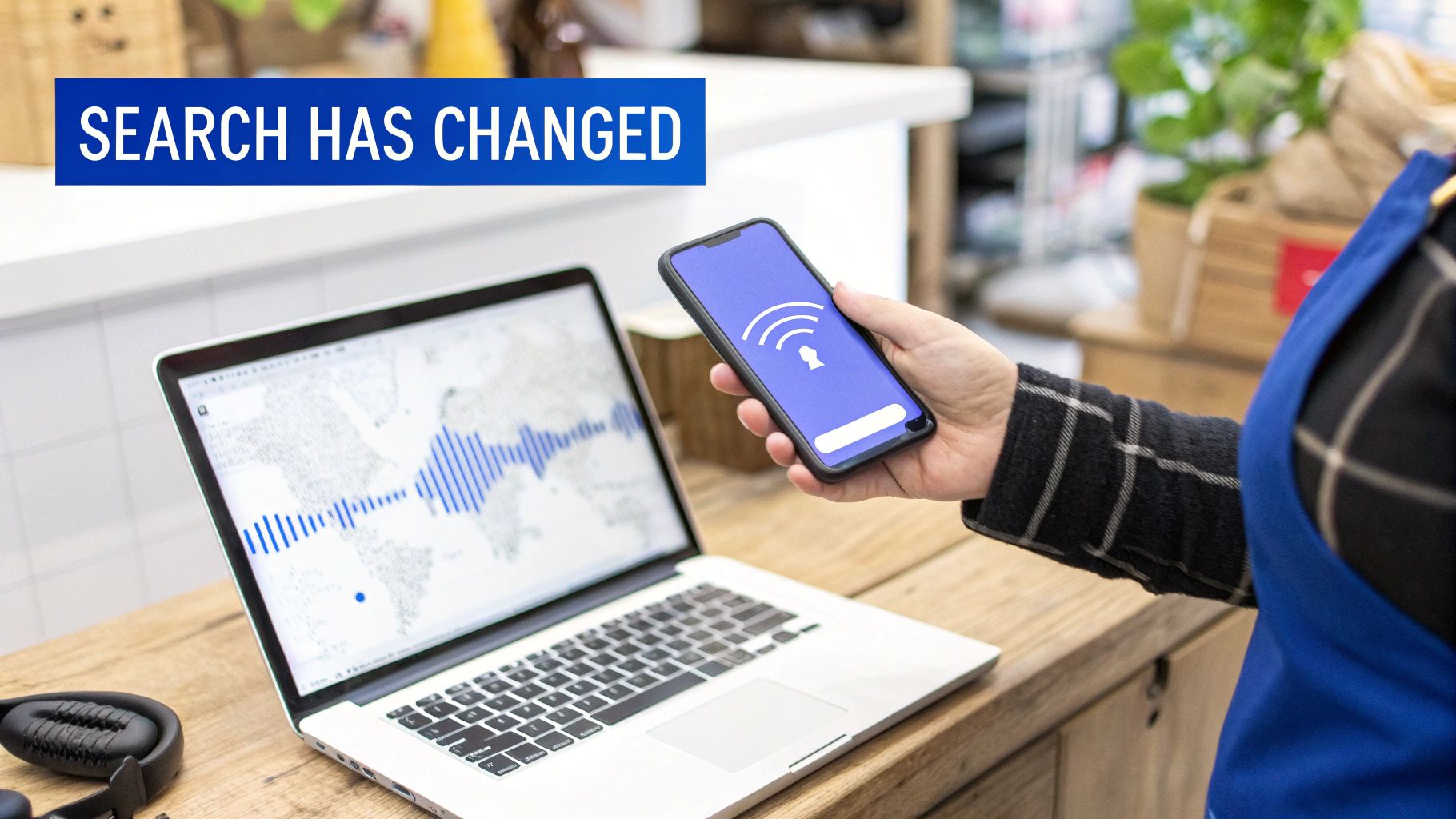
The way customers find local businesses has been completely turned on its head. If your strategy still revolves around stuffing a city name into your website's footer and calling it a day, you're falling behind. Fast.
Today's search landscape is all about mobility, voice commands, and the AI assistants in our pockets and homes. A rigid strategy focused only on generic, geo-modified terms just doesn't cut it anymore. People now use natural, conversational language and expect instant, hyper-relevant results based on their exact location.
To really get why older methods are failing, you have to understand the core local SEO ranking factors that matter to Google right now.
The Rise of Implied and Conversational Search
Search behavior today is far more nuanced. While someone might still type "plumber Austin," they're just as likely to ask their phone, "who is the best plumber near me that's open now?" This shift demands a much deeper understanding of what a customer actually wants, not just the words they use.
A few key changes are driving this new reality:
- "Near Me" Dominance: This one phrase has completely reshaped local search. It's not a small trend; there are over 1.5 billion searches every single month containing "near me." This mobile-first behavior is directly tied to revenue, with 78% of local mobile searches leading to a purchase.
- Voice Search and AI Assistants: The explosion in popularity of Siri, Alexa, and Google Assistant means people are asking full questions. Your keyword strategy has to account for this natural, spoken language, not just clunky search terms.
- Entity and Topical Relevance: Google doesn't just match keywords anymore; it understands entities—people, places, things—and how they relate. It knows that "Prospect Park" is an entity located within the bigger entity of "Brooklyn." Getting this right is no longer optional.
The game has changed. It's no longer about ranking for "service + city." It's about proving you are the most relevant, trustworthy, and prominent solution for a customer's immediate need in their specific geographic area.
The Impact on Your Business
Sticking with an outdated local keyword strategy has real, painful consequences. It leads to being invisible in the exact moments that matter most—especially in the Google Local Pack and on Google Maps, where the vast majority of high-intent customers make their final decision.
If your keywords don't align with how real people talk and search today, you're missing out on your most valuable customers. This guide will walk you through building a modern strategy that actually works.
Uncovering the Keywords Your Local Customers Actually Use
Forget about expensive tools and complicated spreadsheets for a minute. Finding the right local keywords is really about becoming a digital detective in your own community. You need to dig in and find the real, everyday language your neighbors use when they need your help right now. This is where we stop talking theory and start building a powerful list of phrases that actually make the phone ring.
The best place to start is usually the simplest: Google itself.
Go to the search bar and type in one of your main services, followed by your city or neighborhood. Now, pay close attention to the Google Autocomplete suggestions that pop up. These aren't just random guesses; they're a direct reflection of what real people are searching for, revealing the exact phrases that are on their minds.
For instance, a roofer in Chicago might type "roof repair Chicago" and immediately see suggestions like:
- "roof repair Chicago il emergency"
- "flat roof repair Chicago"
- "roof repair near me Chicago"
Each one of these is a distinct, high-intent keyword. It signals a specific customer need you can target directly.
Mine Google for Direct Customer Insights
Beyond Autocomplete, the search results page itself is an absolute goldmine. Look for the "People Also Ask" (PAA) box. This feature literally hands you the follow-up questions searchers have. A query like "best pizza Brooklyn" might show you PAA questions such as "what is the most famous pizza in Brooklyn" or "thin crust pizza near Prospect Park." These questions are perfect fuel for blog posts or FAQ sections on your website and Google Business Profile.
Here's another powerful trick that's often overlooked: go study your competitors' Google Business Profiles (GBPs). Look at the services they list. Read the language in their business descriptions. But most importantly, dig into the Q&A section. You'll find customers asking direct questions loaded with valuable long-tail keywords. Think things like, "Do you offer weekend appointments for dental cleanings?" or "Are you a 24-hour emergency plumber?" These are phrases you can lift and target immediately.
Key Takeaway: Your customers are broadcasting exactly what they want through their search habits and public questions. Your job is to listen to these digital conversations and mirror their language.
Go Where the Locals Talk
To find the most authentic phrases, you have to step outside of search engines and visit the digital "town squares" where your community hangs out. Local forums are an incredible source for raw, unfiltered customer vocabulary.
- Reddit: Find your city's subreddit (like r/Austin) and search for your services. You'll find threads where people ask for recommendations using incredibly specific, natural language. A user won't just ask for a "mechanic"; they'll ask, "who's an honest mechanic in South Austin for a Honda Civic?"
- Nextdoor: This platform is hyper-local by nature. Neighbors are constantly asking for recommendations for everything from landscapers to accountants. The language here is conversational and built on trust, giving you insight into keywords that signal reliability and community approval.
- Local Facebook Groups: Community groups are another fantastic resource. People ask for immediate help, often using phrases that scream urgency, like "need a plumber ASAP for a leak in Hyde Park."
This kind of research helps you find the long-tail and entity-based keywords that most traditional tools will miss. Phrases like "best Italian food near Prospect Park" connect your service (the entity) to a well-known local landmark (another entity), which is exactly how people actually think and search. You can learn more about how to sharpen your strategy with these competitor AI analysis tools for a deeper look at what’s working for others.
A Practical Comparison of Local Keyword Discovery Methods
Choosing the right method matters. This table breaks down different approaches for finding local SEO keywords, highlighting their strengths, weaknesses, and ideal use cases.
| Method | Best For Finding | Effort Level | Primary Benefit |
|---|---|---|---|
| Google Autocomplete | High-volume, immediate-need phrases and service variations. | Low | Quickly identifies the most popular search terms. |
| Competitor GBPs | Service-specific long-tail keywords and customer pain points. | Medium | Uncovers keywords with direct commercial intent. |
| Local Forums (Reddit/Nextdoor) | Authentic, conversational, and trust-based keywords. | Medium | Captures the natural language of your community. |
| "People Also Ask" | Question-based keywords ideal for content and FAQ pages. | Low | Helps you build topical authority by answering real questions. |
By combining these hands-on methods, you move way beyond generic terms and start building a nuanced list of local SEO keywords. This list becomes the bedrock for everything else you do, ensuring your business speaks the same language as the customers you're trying to attract.
You've done the detective work and now you’re sitting on a goldmine of phrases your local customers are using. That's a huge win. But right now, it's just a long list—raw data that needs a battle plan.
This is where you build a local keyword map. Think of it as the strategic blueprint that assigns a specific job to every single keyword you found. It’s how you turn that raw data into a real-world advantage.
A solid keyword map helps you avoid one of the most common (and costly) local SEO mistakes: trying to make one page rank for ten different things. Instead, you create a crystal-clear structure for your entire online presence. This kind of clarity is exactly what Google rewards with top spots in the local search results.
Prioritizing Your Keywords Like a Pro
Let's be real: not all keywords are created equal. Before you start assigning them to pages, you need to sort them by their actual value to your business. It's a balancing act between three critical factors, and finding the sweet spot is where the magic happens.
- Search Volume: This is the raw number of searches a keyword gets per month. It's tempting to chase the big numbers, but high-volume terms are often frustratingly broad and hyper-competitive.
- Commercial Intent: This is the money metric. How likely is the searcher to open their wallet? Phrases with words like "emergency," "for hire," "quote," or the classic "near me" are massive signals of someone ready to act now.
- Competition (or Keyword Difficulty): This tells you how tough the fight will be to rank for a term. Finding the low-competition keywords is your secret weapon for getting some quick wins and building momentum.
The real goal isn't just finding keywords with high search volume. It's about finding the ones with the highest commercial intent and the lowest possible competition. A term like "24-hour emergency plumber in downtown Brooklyn" might have a tiny search volume, but nearly 100% of those searchers are about to hire someone on the spot.
The Art and Science of Keyword Mapping
Keyword mapping is simply the process of assigning a primary keyword and a handful of related secondary keywords to each page on your site and to your Google Business Profile. When done right, you create a powerful, unified local presence where every single asset has a clear purpose.
This process isn't just about your website; it's about pulling insights from every corner of the local landscape.
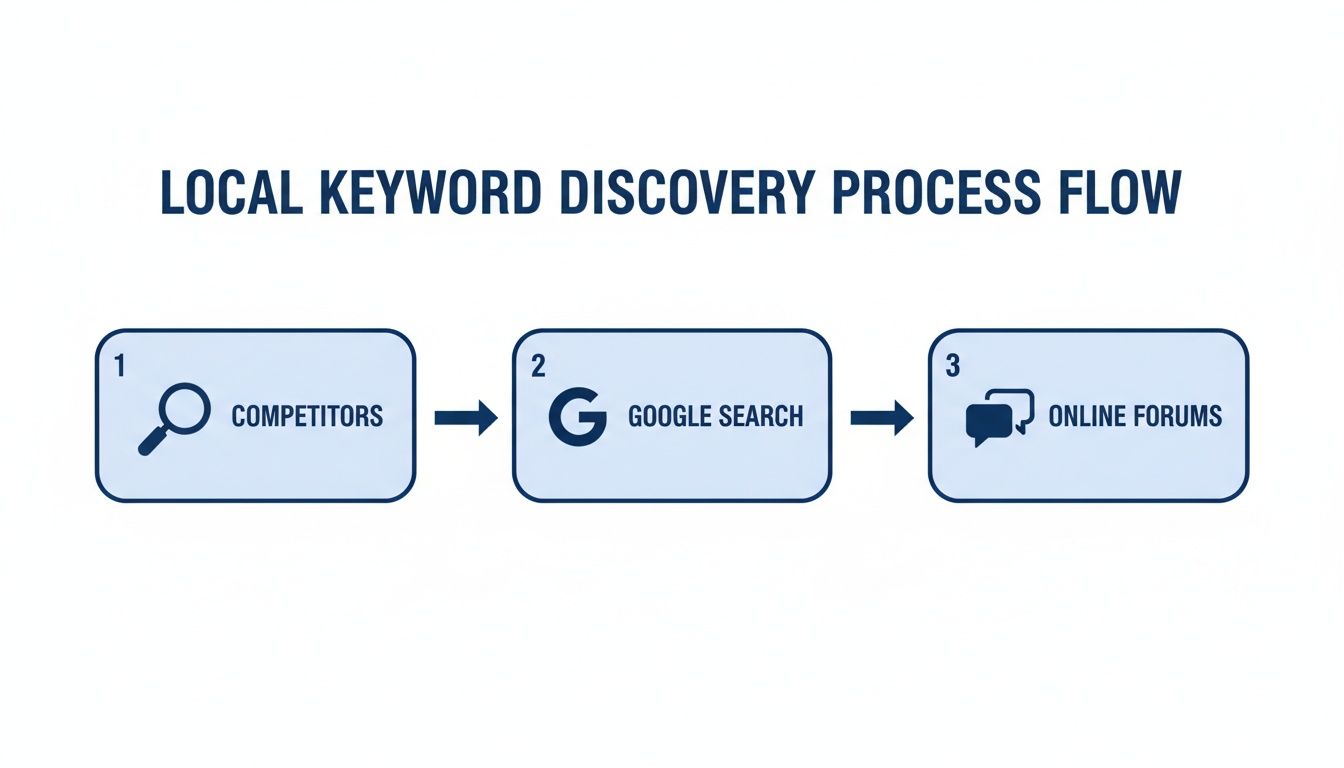
As you can see, the best keyword lists come from a mix of spying on competitors, digging into Google's suggestions, and listening to how real people talk in online forums.
Let's walk through a real-world example. Say you run a dental practice in Austin, Texas.
1. Mapping Your Homepage:
Your homepage is your digital front door. It needs to target your broadest, most valuable local keywords.
- Primary Keyword: "dentist Austin TX"
- Secondary Keywords: "family dentist Austin," "Austin dental clinic," "best dentist in Austin"
2. Mapping Your Service Pages:
Every core service deserves its own dedicated page. This is where you get ultra-specific and target those high-intent phrases.
- Cosmetic Dentistry Page: "cosmetic dentist Austin," "teeth whitening Austin," "porcelain veneers Austin"
- Emergency Services Page: "emergency dentist Austin," "24-hour dentist Austin," "chipped tooth repair Austin TX"
3. Mapping Location Pages (If You Have Them):
Got multiple offices? Each one gets its own page targeting its specific neighborhood.
- South Austin Page: "dentist South Austin," "dental implants 78704," "pediatric dentist South Austin"
If you want to go even deeper into the principles behind this, this guide to local SEO is a fantastic resource for uncovering how your customers really search.
Don't Forget Your Google Business Profile
Your Google Business Profile (GBP) is arguably your single most important local SEO weapon. Mapping keywords to your profile is just as crucial as it is for your website. You need to weave your priority terms naturally throughout your GBP to send strong relevance signals to Google.
Here’s how you do it:
- Business Description: This is prime real estate. Don't just say, "We are a dental office." Instead, try something like, "As Austin's trusted family dentist, we offer comprehensive cosmetic and emergency dental services…" See how the keywords fit naturally?
- Services & Products: Never just list "Teeth Whitening." Use the phrases you found: "Professional teeth whitening in Austin." Every service you add is another chance to rank for a specific local search.
- Q&A Section: Be proactive here. Ask and answer common questions yourself. This lets you frame the question with a long-tail keyword—"Do you offer same-day appointments for an emergency dentist in Austin?"—and then provide a keyword-rich, helpful answer.
By methodically mapping your keywords across your entire digital footprint, you create an unmistakable signal for search engines and potential customers. This structured approach makes you the most relevant answer for every kind of local query, from someone just starting their search to the person who needs your help right now.
Putting Your Local Keywords to Work

Alright, you've got your keyword map. This isn't just a spreadsheet anymore; it's your game plan. Now it’s time to weave those phrases into your digital storefront where they can actually start attracting local customers.
This is where the research pays off. The goal is to integrate these terms naturally, not to just cram them in. You want to enhance the user's experience while sending all the right signals to Google.
Optimizing Your Website's Local Pages
Think of your website as your digital headquarters. Every page is prime real estate for your local SEO keywords, especially your location and service pages. Each one needs to act as a clear beacon for the specific terms you've mapped out.
Let's start with the low-hanging fruit—the core on-page elements that search engines still lean on heavily to figure out what a page is all about.
- Title Tags: This is your page's headline in the search results. Get your primary keyword in there, and try to put it near the front. A page for emergency plumbing might have a title like: "24/7 Emergency Plumber in Brooklyn | Your Company Name."
- Meta Descriptions: This doesn't directly impact rankings, but it absolutely impacts clicks. It's your ad copy in the search results. Include your keyword and give people a compelling reason to choose your listing.
- Headers (H1, H2, H3): Your H1 tag is the main title on the page itself and should feature your primary keyword. Use H2s and H3s to break up your content and sprinkle in those secondary keywords and long-tail phrases you found.
I always tell clients to think of it like an outline for a report. The title tag is the report's main title, the H1 is the big heading on the first page, and the H2s are your chapter titles. This hierarchy makes the content easy for both people and search engine crawlers to understand.
Making Your Google Business Profile a Keyword Powerhouse
Your website is critical, but let's be honest: your Google Business Profile (GBP) is often the first thing a local customer sees. Optimizing it with the right keywords is absolutely non-negotiable, especially since the local map pack is where all the action happens.
Recent data shows the local pack—that block of three GBP listings—pulls in a massive 44% of clicks in local search results. Traditional organic links? They only get about 29%. This shift has made GBP the centerpiece of modern local SEO, with 52% of marketers calling local pack rankings a vital measure of success.
Here’s how to put your keywords to work on your profile.
Services and Products
Don't just list "Roof Repair." Get specific using the long-tail phrases you uncovered in your research.
- Instead of: "Roof Repair"
- Use: "Emergency Flat Roof Repair" and "Residential Shingle Roof Replacement"
Every single service you add is another chance to rank for a specific, high-intent search. Getting granular like this tells Google exactly what problems you solve.
Business Description
Your business description is the perfect spot to naturally work in your core keywords. Tell your story, but do it with strategy.
Example: "As Chicago's trusted HVAC experts, we specialize in 24-hour AC repair for downtown residents and provide expert furnace installation throughout the Lincoln Park area. Our team is dedicated to providing reliable and fast service."
Responding to Reviews with Keywords
Engaging with reviews isn't just good for your reputation—it's another opportunity to reinforce your relevance. When you reply, you can subtly include keywords.
If a customer praises your "quick AC repair," mirror that language in your response. Something like, "We're so glad we could provide you with a fast and effective AC repair in Scottsdale! Thanks for trusting us," reinforces the connection between your business, that service, and that location. For more advanced strategies on managing your online reputation, check out our guide on working with AI reputation management consultants. This holistic approach ensures every part of your online presence is working hard to bring in local business.
Measuring Local Performance in the Age of AI
So, how do you know if all this hard work is actually paying off? Measuring the impact of your local keyword strategy means looking way beyond a simple rank tracker.
Sure, seeing your website climb the traditional search results is a nice ego boost. But the metrics that truly move the needle for a local business—the ones that actually put money in the bank—are found elsewhere.
The real wins show up as direct customer actions. Your primary focus should be on the performance data inside your Google Business Profile. These aren't vanity metrics; they're tangible interactions that lead directly to revenue.
Here are the numbers I tell every local business owner to live by:
- GBP Clicks to Call: This is the count of how many times a customer tapped the "Call" button on your profile. It's a pure, high-intent lead delivered on a silver platter.
- GBP Direction Requests: This tracks how many people asked Google Maps to guide them to your front door. It’s the clearest digital signal of incoming foot traffic you can get.
- Website Clicks from GBP: This shows you how many people jumped from your profile to your site, usually because they want more in-depth information before making a decision.
- Local Pack Visibility: How often are you showing up in that coveted "map pack" for your most important keywords? This is your most valuable piece of digital real estate, period.
These data points tell a much richer story than any ranking report ever could. They measure actual customer engagement and prove that your local keyword strategy is hitting the mark.
The Next Frontier: Tracking AI Recommendations
As search continues its massive shift, our measurement has to evolve with it. The explosion of AI assistants like ChatGPT, Gemini, and Claude has opened up a brand new—and often completely invisible—channel for local discovery.
When a potential customer asks, "What's the best Italian restaurant near me?" or "Who can fix a leaky pipe in downtown Austin?", the AI's answer can literally make or break a sale.
The problem? Traditional SEO tools are blind here. They can't see inside these conversations. You could be bleeding customers to competitors that the AI favors, or worse, have your reputation torpedoed by bad information, and you'd be none the wiser. This is where modern monitoring platforms become non-negotiable.
Tracking your visibility in AI isn't a "nice-to-have" for the future; it's a critical component of brand and reputation management today. You have to know what these incredibly powerful models are telling potential customers about your business.
Using a specialized tool lets you systematically check how different AI models respond to your most important local queries. This proactive approach uncovers insights that are simply impossible to find by hand.
Uncovering Recommendation Gaps and Hallucinations
Monitoring AI responses helps you answer critical questions that directly impact your bottom line. It’s all about turning a massive blind spot into your next competitive advantage.
For instance, you can pinpoint recommendation gaps. This is when an AI consistently suggests your competitors for a service you absolutely offer but leaves your business out of the conversation entirely. Finding these gaps is the first step to figuring out why and fixing the underlying data or authority issues. For agencies looking to get ahead of the curve, understanding LLM visibility tracking is a crucial next step.
Even more dangerous are the hallucinations you can uncover. This is when an AI confidently states something about your business that is flat-out wrong. I've seen it all: incorrect business hours, services you don't offer, or the kiss of death—claiming your business is "permanently closed." Catching these errors the moment they happen lets you correct the public record before they can do real damage.
Finally, you can analyze regional variations. An AI might give totally different recommendations for the same question depending on the user's simulated location. By tracking responses from various neighborhoods or ZIP codes, you see exactly where your digital presence is strong and where it needs work. This allows you to fine-tune your local keyword strategy with surgical precision.
Common Questions About Local SEO Keywords
When you start digging into a local keyword strategy, theory quickly gives way to practical questions. It's one thing to know what a "geo-modified keyword" is, but another thing entirely to apply that to your own business.
Let's clear up some of the most common questions we hear from business owners just like you.
How Many Local Keywords Should I Focus On Per Page?
There's no magic number, but I've always found a "one-two punch" approach works best. Target one primary keyword and two to four closely related secondary keywords for each page. This keeps the page laser-focused on a single theme, which is exactly what Google wants to see.
Imagine you're a plumber in Austin. Your "Emergency Services" page might target "emergency plumber Austin" as its primary keyword. To support that, you'd sprinkle in secondary phrases like "24/7 plumbing repair Austin TX" or "after-hours plumber Austin." This builds strong topical authority for that specific service without ever looking like you're just stuffing keywords in.
The only real exception here is your Google Business Profile. Your GBP is different—you should list all relevant services you offer. Each one is a potential doorway for a new customer.
What Is the Difference Between Local and Geo-Modified Keywords?
This is a subtle one, but it’s an important distinction. Think of them as cousins, not twins.
- Geo-Modified Keywords: These are the obvious ones where someone explicitly names a location. A search for "electrician in Denver" is a perfect example. The user is telling Google exactly where they're looking.
- Local Keywords: This is where Google has to play detective. Based on the user's physical location or past searches, it infers they need a local result. "Best pizza near me" or even just typing "best pizza" into a phone are classic local searches.
A winning strategy has to account for both. You need to show up for people who name your city and for the ones who are just standing on a street corner expecting Google to find the best option nearby.
How Do I Handle Keywords for a Multi-Location Business?
The golden rule for any business with more than one physical location is simple: create a unique, dedicated page for each storefront. This is non-negotiable.
Each of these pages needs to be optimized for keywords specific to its city or even its neighborhood. A dental practice with two offices, for instance, should have separate pages targeting "dentist in SoHo" and "dentist on the Upper West Side."
It's absolutely critical to avoid duplicate content here. Each page needs its own unique flavor, speaking directly to that community. And just as important, every single location needs its own fully optimized Google Business Profile. It's the only way you'll show up correctly in the Local Pack when someone is searching nearby.
The goal is to build individual, hyper-local hubs for each of your locations. A generic, one-size-fits-all approach will make you invisible to the very customers you're trying to reach.
Are AI assistants like ChatGPT and Gemini recommending your business or your competitors? Stop guessing. TrackMyBiz gives you the visibility you need to protect your brand, spot harmful hallucinations, and win your share of AI-driven recommendations. Start a free scan today at https://trackmybusiness.ai.
