Local search rank tracking isn't about some vanity metric you check from your office. It’s the nitty-gritty work of monitoring how visible your business is on a specific street, in a particular neighborhood, or even down to the city block. It's about seeing your business exactly how a potential customer sees it when they pull out their phone, street by street. This is the only way to operate for any business that depends on local customers walking through the door.
Why Your Business Is Invisible a Few Streets Over
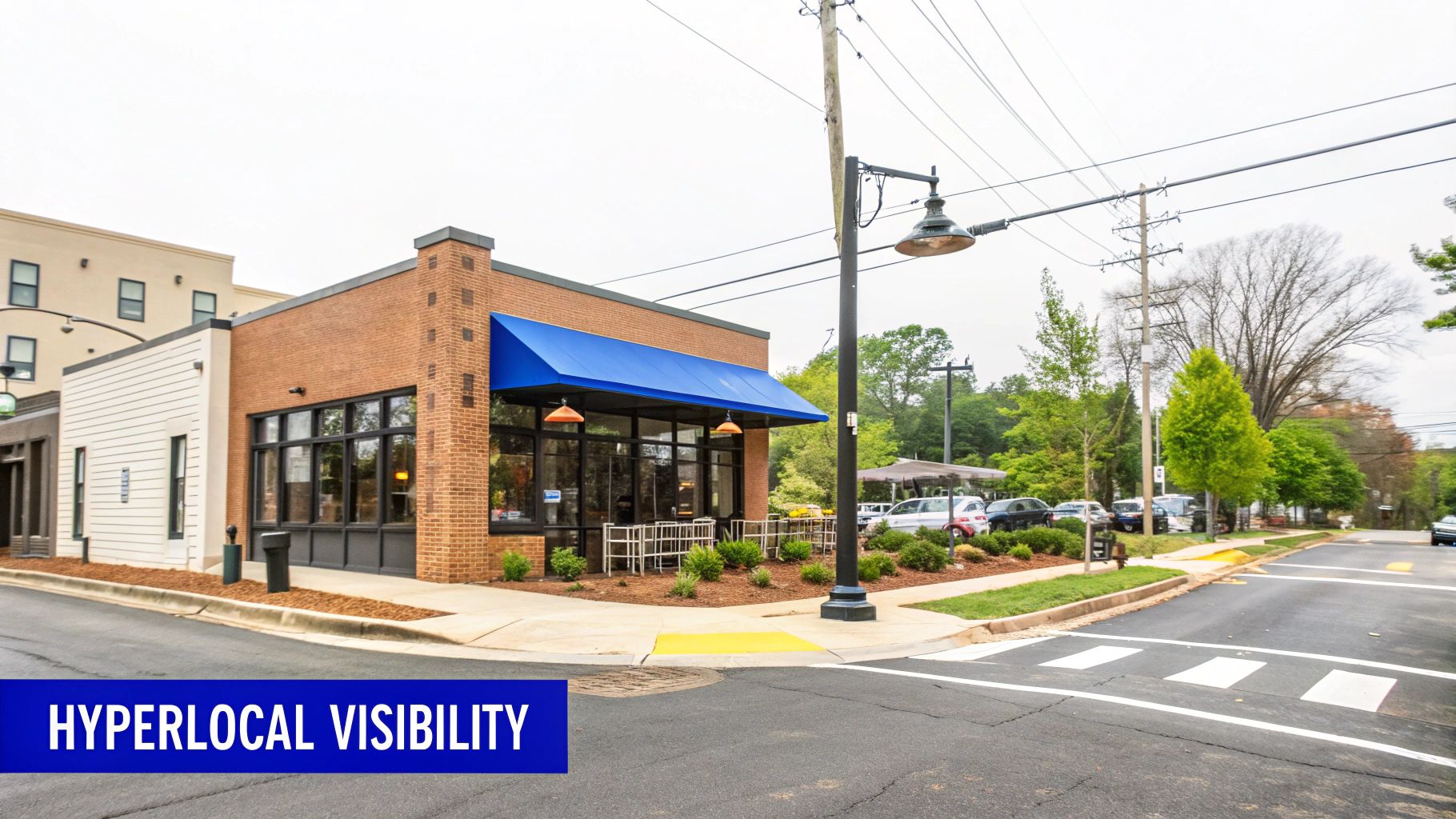
Ever checked your rankings while sitting at your desk, seen your business sitting pretty at number one, and then heard from a customer that they can’t find you online? That’s not a glitch. That’s the brutal reality of hyperlocal search.
Your visibility can plummet from one street to the next. This is a massive blind spot in far too many marketing strategies. When you rely on a single, non-localized rank check, you're getting a dangerously misleading picture of your online footprint. You might be the king of your block but a complete ghost to potential customers just a half-mile down the road.
The Coffee Shop Scenario
Let's make this real. Imagine a great local coffee shop, "The Daily Grind," in a busy downtown area. The owner checks her phone and sees she’s #1 for "coffee shop near me." Awesome, right? But she doesn't realize that result is completely skewed because she’s searching from inside the shop.
Just five blocks away, in a residential area packed with her ideal customers, the same search shows a competitor, "Java Junction," in the top spot. Why? Java Junction has more reviews from people living in that neighborhood, and their Google Business Profile is better optimized for that specific zone.
The Daily Grind is losing dozens of potential customers every single day. Not because their coffee is bad, but because their local search rank tracking is nonexistent. They are completely blind to their own invisibility where it counts the most.
This isn't just some hypothetical problem. Old-school, single-location rank tracking directly costs businesses foot traffic and revenue by creating a false sense of security. It fails to show you the business landscape as your customers actually experience it.
This is exactly why a granular, street-level approach is no longer a "nice-to-have"—it's a core part of staying in business. You have to see what every potential customer sees, no matter which street corner they're standing on.
The True Cost of Invisibility
The impact of this hyperlocal variance is huge. We know that 46% of all Google searches now have local intent, driving a ton of foot traffic for businesses that get their local rankings right.
Even more telling, a staggering 76% of people who search for something nearby on their phone visit a business within 24 hours. When you don't show up in those crucial moments, you're not just losing a click; you're losing a customer who was ready to walk in and spend money. For a deeper dive into these stats, check out these findings from Nightwatch.io.
To give you a clearer picture, here’s how specific tracking metrics translate directly into business results.
Key Local Search Metrics and Their Business Impact
| Metric to Track | What It Measures | Direct Business Impact |
|---|---|---|
| Local Pack Rankings | Your visibility in the top 3 map listings on the SERP. | Captures high-intent customers; drives direct calls and direction requests. |
| Geogrid Rank Variance | How your rank changes across multiple points in your service area. | Identifies weak spots and opportunities for hyperlocal optimization. |
| GBP Keyword Visibility | The search terms triggering your Google Business Profile. | Informs content strategy and reveals what customers actually want. |
| Review Velocity & Rating | The rate and quality of new customer reviews. | Builds trust, influences rankings, and provides crucial feedback. |
| Local Organic Rankings | Your website's rank for geo-modified keywords (e.g., "plumber in Brooklyn"). | Drives qualified traffic to your website for deeper consideration. |
These aren't just numbers on a dashboard; they are direct indicators of your business's health in the local market.
To really compete, you have to move beyond vanity checks and build a system that maps your visibility across all the tiny micro-markets that make up your service area. This guide will show you exactly how to do that.
Laying the Groundwork for Local Rank Tracking
Before you can track a single keyword, you need a blueprint. Firing up a tracking tool without a clear strategy is like starting a road trip with no destination—you'll burn through your budget but end up nowhere meaningful. A solid local search tracking program starts by defining what success actually looks like for your business.
What's the end game? Are you chasing more calls for emergency service requests? Trying to boost foot traffic to a new retail shop? Or maybe it's all about driving online appointment bookings for your clinic. Each goal demands a completely different measurement approach.
Without that clarity, you're just collecting data. With it, you start gathering intelligence.
From Business Goals to the Right Keywords
Once you know your primary objective, you can build a keyword set that actually reflects how your customers search. Let's be honest, generic keywords like "plumber Chicago" are almost useless for measuring hyperlocal performance. They don't capture the urgency or specificity of a real person with a real problem.
Your focus needs to shift to geo-modified keywords. These are the search terms that combine a service with a specific location, perfectly mirroring the queries your best customers are using.
A plumber’s keyword list, for example, should evolve:
- From: "plumber," "emergency plumber"
- To: "24-hour plumber in Bucktown," "drain cleaning Logan Square," "leak repair near Lincoln Park Zoo"
This level of detail is what separates actionable rank tracking from vanity metrics. You’re not trying to rank for a massive city; you're trying to win the block where your customer is standing right now. As you build this foundation, it helps to understand the top local SEO ranking factors that Google uses to surface results for these hyper-specific terms.
Key Takeaway: Stop building keyword wish lists filled with broad terms. Your keyword strategy must be a direct translation of your business goals into the hyper-specific, geo-modified phrases your ideal customers are actually typing into their phones.
Setting Up a Precise Geo-Grid
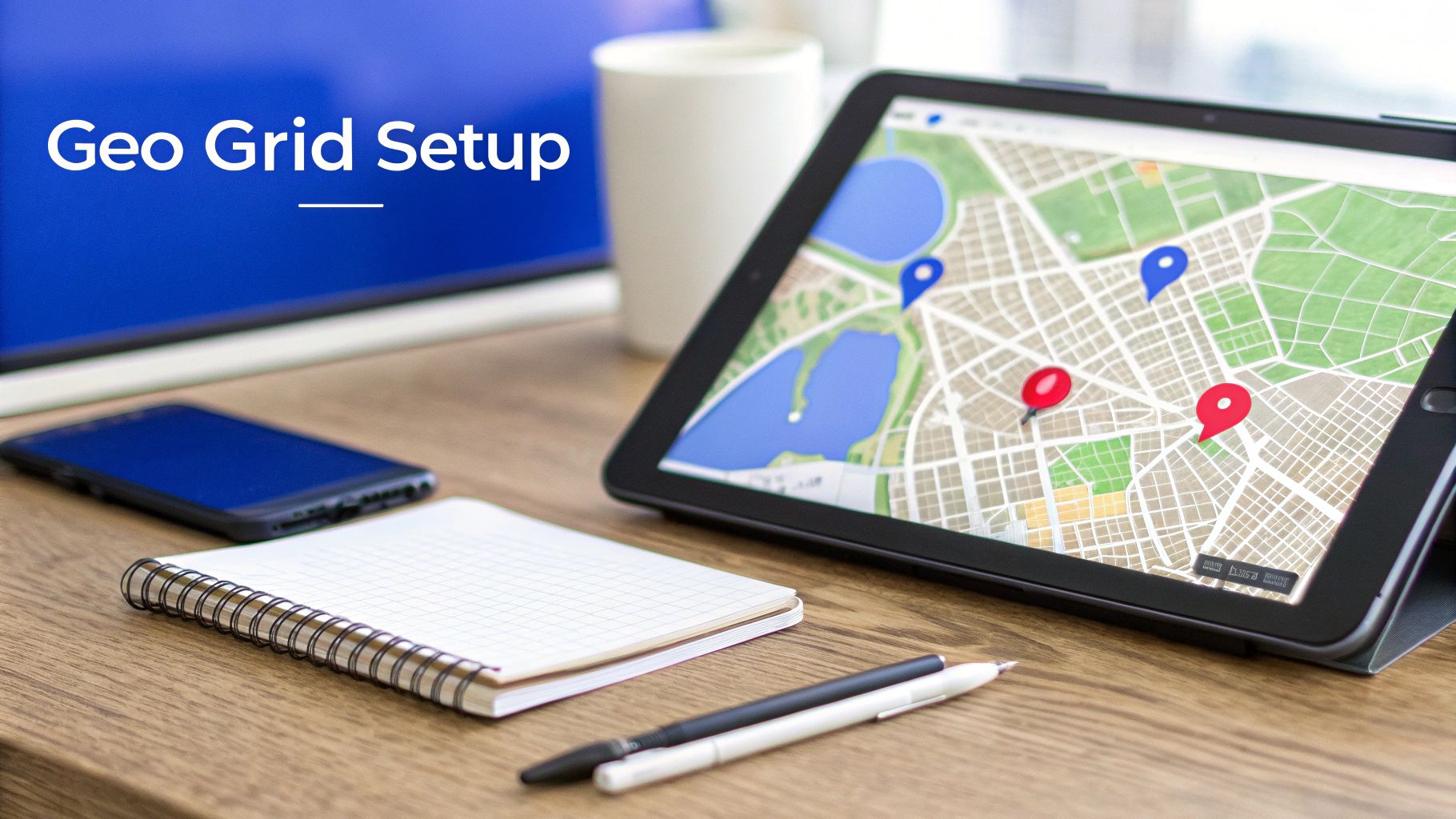
Next up is defining where you're going to track these keywords from. A single-point check from your office address is dangerously misleading. The real solution is a geo-grid, which sets up multiple tracking points across your service area to paint a true heatmap of your visibility.
This isn’t just about plugging in a few different zip codes. You need to get granular to see what real customers see. For a local business, this could mean tracking from:
- Specific Neighborhoods: The center of Wicker Park, River North, and Hyde Park.
- Major Intersections: Key crossroads with high foot traffic.
- Competitor Locations: A tracking point right on top of your main rival’s address to see how you stack up on their home turf.
A well-built geo-grid reveals exactly where you’re strong and, more importantly, where you're invisible. You might find you dominate the two blocks around your shop but are a ghost in a lucrative neighborhood just a mile away. That's the kind of insight that lets you focus your SEO efforts with surgical precision.
Configuring for How People Actually Search
Finally, your setup has to mirror real user behavior. Today, that means one thing: mobile. While people still use desktops, local intent is overwhelmingly happening on a smartphone. More than 60% of Google searches happen on mobile devices, and for "near me" type queries, that number jumps even higher.
Your tracking configuration has to reflect this reality.
Device Settings Comparison
| Setting | Importance for Local Tracking | Action to Take |
|---|---|---|
| Mobile | Critical. This is the default search environment for most local customers. | Prioritize mobile rank tracking for all geo-modified keywords. |
| Desktop | Secondary. Still relevant for research-heavy local services (e.g., lawyers, contractors). | Track key terms on desktop but treat it as a secondary data point. |
Setting your primary tracking device to mobile ensures your data reflects the actual customer journey. It accounts for mobile-first indexing and the unique SERP features that pop up on a smaller screen. By aligning your goals, keywords, geo-grid, and device settings, you build a foundation that delivers reliable, actionable insights—not just numbers on a screen. And if you're looking to monitor what new AI search tools are saying about you, you can explore LLM visibility tracking for agencies and local businesses.
Tracking What Actually Matters in Local SERPs
A top ranking in the traditional blue links feels great, but it's a dangerously incomplete picture of your local visibility. The real action—where customers are actually making decisions—happens in the dynamic, feature-rich world of the local search engine results page (SERP).
Focusing only on that single organic rank is like watching the scoreboard but ignoring the game itself. You're missing the plays that lead to the score.
Effective local search rank tracking means you have to monitor your performance across three distinct but interconnected battlegrounds: the Local Pack, Google Maps, and the local organic results. Each one operates with a slightly different set of rules, and you need a unique lens to analyze your performance in each.
Deconstructing the Local SERP
To track what matters, you first need to know where to look. Local SERPs are a mashup of different elements, each offering its own high-value real estate.
- The Local Pack (or Map Pack): This is prime territory. It's that block of three businesses shown with a map, almost always appearing at the very top of the results. Its prominence makes it the first thing most searchers see and click on.
- Google Maps Results: When a user clicks "View all" from the Local Pack or searches directly in the Google Maps app, they enter a whole different competitive environment. Here, factors like reviews, photos, and proximity get dialed up to eleven.
- Local Organic Results: These are the more traditional website listings that show up below the Local Pack. They're influenced more heavily by classic on-page SEO and backlinks, but they're still heavily weighted by local relevance.
Understanding the nuances between these is key. You could rank #1 in the Local Pack for a search but be buried on page two of the organic results for that exact same query. That isn't a contradiction; it’s just a reflection of different algorithms at play.
Your Google Business Profile: The Powerhouse of Local SEO
Your Google Business Profile (GBP) is the engine driving your visibility in the Local Pack and Maps. Honestly, just tracking your rank without monitoring the health of your GBP is like flying blind.
The activity happening on your profile sends direct signals to Google about your business's relevance, prominence, and real-world authority. Think of your GBP as a living, breathing profile of your business. Consistent, positive activity tells Google you're open, active, and engaged with your customers. And that activity directly correlates with rank improvements.
Your local search rank isn't just a reflection of your website's SEO; it's a direct outcome of your real-world business activity as mirrored on your Google Business Profile. A sudden dip in rank is often preceded by a change in your GBP signals.
To track this the right way, you must keep an eye on specific GBP performance metrics:
- Review Velocity and Rating: How many new reviews are you getting, and what’s the average rating? A sudden spike in negative reviews can absolutely tank your rankings almost overnight.
- Photo and Video Updates: Are you consistently adding new, high-quality images of your work, your team, or your location? Fresh visual content signals an active, thriving business.
- Q&A Activity: Are customers asking questions? More importantly, are you answering them quickly and accurately? This user-generated content is a goldmine of keywords for Google.
- GBP Post Frequency: Regular posts keep your profile fresh and give you another shot at sharing updates, offers, and other relevant info.
As you build out your tracking strategy, having a practical guide on how to track local SERPs with modern methods is invaluable. It helps you connect these GBP actions to tangible movements in the search results.
Connecting Actions to Rank Changes
The real power here comes from connecting the dots.
Imagine your restaurant’s Local Pack ranking for "best brunch downtown" suddenly drops from #2 to #5. By tracking your GBP signals, you notice this drop happened right after a competitor received five new 5-star reviews while you got none. That's not a coincidence; it's a clear cause-and-effect relationship you can actually do something about.
Google juggles a mind-boggling 149 different ranking factors for local searches, which makes consistent tracking absolutely essential. Google Business Profile signals dominate Maps rankings at 32%, followed by reviews at 20% and on-page signals at 15%. For local organic results, on-page factors jump to 33% and links to 24%.
This data proves that your on-the-ground business activity, reflected through your GBP, is what truly moves the needle. A comprehensive local rank tracking program monitors these signals right alongside your map and organic positions, giving you a full, actionable view of your performance. You might also want to check out our guide on AI-powered competitor analysis tools to see how your competitors are being discussed.
Creating a Smart Monitoring and Reporting Rhythm
Collecting local rank tracking data without a plan is like trying to drink from a fire hose—it’s just a messy, overwhelming flood of numbers. To turn that raw data into something you can actually use, you need to build a consistent rhythm for monitoring and reporting. This is the framework that helps you spot trends, react to threats, and prove your value.
So, how often should you be checking your ranks? The right cadence depends entirely on your market's volatility and your business goals. If you're working with restaurants in a dense city like Chicago, daily checks might be necessary to catch competitor movements in real-time. But for a local accounting firm in a quieter suburb, a weekly check-in is probably plenty to track progress and spot meaningful shifts.
This whole process is about keeping a close eye on the most valuable real estate in local search, moving from the Local Pack to Maps and then down to the traditional organic results.
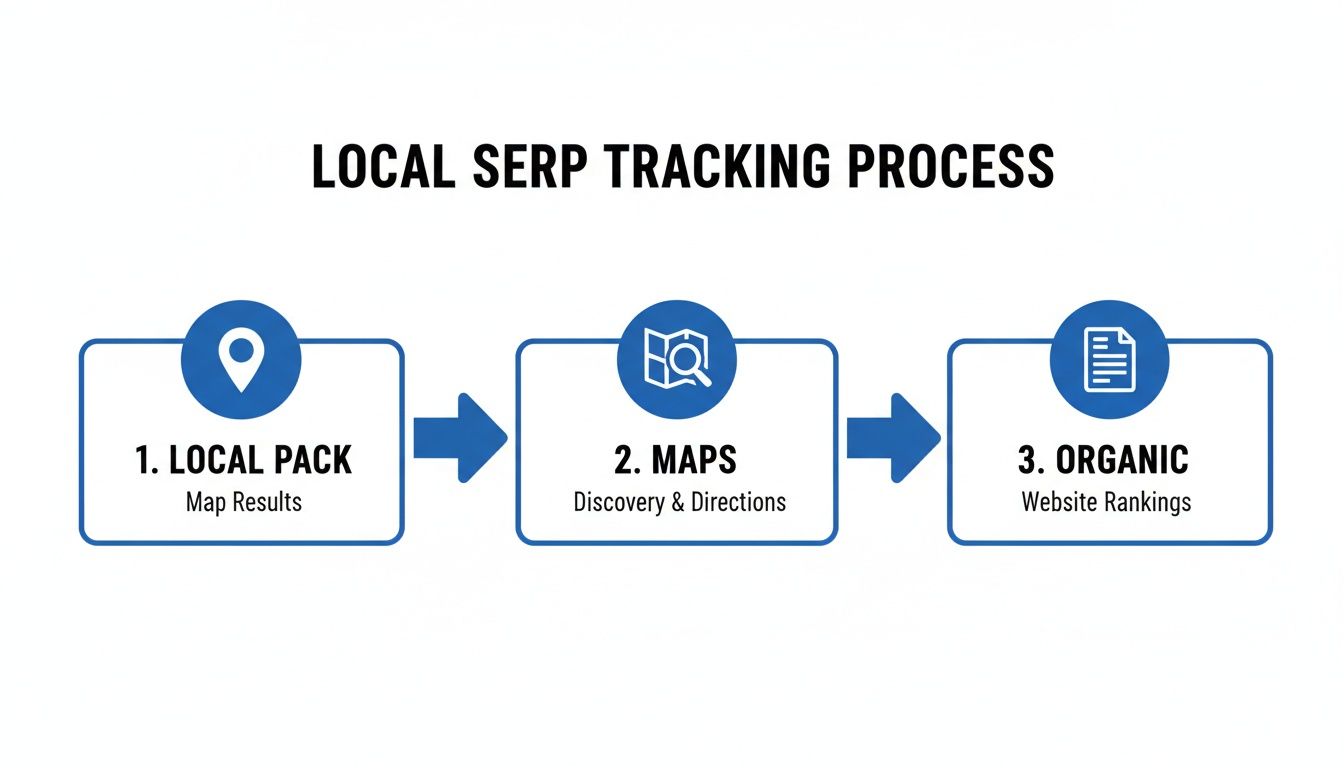
This flow shows why a complete strategy has to cover each of these interconnected channels. You need the full picture of your local visibility, not just a single piece of it.
Setting Up Intelligent Alerts
A smart monitoring system doesn't mean you have to be glued to a dashboard all day. The real power comes from setting up intelligent alerts that ping you when something important happens. This transforms your rank tracker from a passive reporting tool into an active defense system.
Think about setting up automated alerts for a few high-impact scenarios:
- Major Rank Drops: You need an immediate notification if your primary "money" keyword (like "emergency plumber downtown") falls out of the Local Pack.
- Competitor Surges: Set an alert if a key competitor suddenly jumps into the top three positions across multiple points on your geo-grid.
- Negative Review Spikes: While it's not a direct rank alert, you should absolutely integrate GBP monitoring to flag a sudden wave of negative reviews. This is often a leading indicator of a future rank drop.
These alerts are your early warning system. They give you a chance to diagnose the problem—a new competitor, a service issue, a change in your GBP data—and respond before the damage compounds.
Crafting a Report That Tells a Story
The final piece of the puzzle is the report itself. A report that’s just a spreadsheet of keyword rankings is useless noise. An effective local SEO report tells a compelling story that ties your tracking efforts directly to business goals. It has to be clear, concise, and focused on what really matters.
The purpose of a local SEO report isn't just to show data; it's to demonstrate progress, identify new opportunities, and justify continued investment. It should answer the question, "So what?" for every metric presented.
Your report needs to go beyond simple rank lists and use visual, intuitive elements that any stakeholder can understand at a glance. For instance, knowing that 44% of all clicks in local search go straight to the Local Pack—towering over organic's 29%—is a powerful statistic to include. It immediately frames why tracking Local Pack visibility is so critical for driving actual business. You can explore more local SEO statistics on seoprofy.com to find more data points like this to ground your reports in reality.
A strong local SEO report template should always include these key sections:
- Executive Summary: A brief, top-level overview of performance highlights, key wins, and urgent challenges. Keep it short and to the point.
- Geo-Grid Heatmap: A visual snapshot showing rank distribution across your service area for your most important keywords. This is often the most impactful part of the report.
- GBP Performance Overview: Key metrics like new reviews, photo views, and call-to-action clicks, correlated with any rank changes.
- Key Wins and Observations: Get specific. Detail successes like unseating a competitor in a key neighborhood or a successful review generation campaign that moved the needle.
- Challenges and Roadblocks: Be transparent about where performance is lagging. Explain what you think is causing it and what you’re doing about it.
- Recommended Next Steps: This is the most critical part. It’s a clear, actionable list of what you plan to do next to build on wins and fix what's broken.
The Next Frontier: Integrating AI and LLM Monitoring
While you've been busy perfecting your geo-grids and GBP signals, the ground has been shifting under your feet. The familiar Google SERP is no longer the only battlefield. AI assistants and Large Language Models (LLMs) like ChatGPT, Gemini, and Perplexity are fast becoming the new local search engines.
People aren't just typing "pizza near me" into a search bar anymore. They're asking chatbots, "What's the best place for a family dinner in downtown Austin?" or "Recommend a reliable plumber with good reviews in the 90210 zip code." The answers they get are conversational, dynamic, and incredibly influential.
This is a profound shift in user behavior. The problem? Traditional local search rank tracking is completely blind to this new world. You could be number one in the Local Pack but totally invisible—or worse, misrepresented—in an AI conversation that costs you a customer. This isn't a future problem; it's the new, essential layer of modern reputation management.
Why Old Metrics Fail in the AI Era
Trying to apply old-school rank tracking logic to AI is like trying to measure a river with a ruler. It just doesn't work. The mechanics are completely different.
AI models don’t spit out a static, ranked list of websites that everyone sees. Their responses are fluid and personalized. The answer one person gets can vary based on phrasing, conversation history, and the specific AI model they're using. There's no "position one" to track because nearly every query is unique. This means your strategy has to evolve from tracking ranks to tracking mentions, accuracy, and sentiment.
Discovering What AI Says About You
The first order of business is to figure out what these AI systems are saying about your brand right now. You need a process for scanning multiple models to uncover critical business intelligence.
- Competitor Recommendations: Is ChatGPT suggesting your main rival when a user asks for the "best" service in your area? You need to know when and why you're being left out of the conversation.
- Data Hallucinations: AI models are notorious for "hallucinating"—a polite way of saying they make things up. This can show up as incorrect business hours, fabricated negative reviews, or even false claims that your business is permanently closed.
- Sentiment Analysis: How is your brand being described? Monitoring the tone of AI-generated text can reveal reputational risks long before they show up in public reviews.
Imagine a boutique hotel discovering an LLM is confidently telling users it's "pet-friendly" when its policy is the exact opposite. That single hallucination could create a stream of angry customers and negative reviews, all stemming from a source the hotel wasn't even watching.
This dashboard from TrackMyBiz shows how you can monitor brand mentions and accuracy across different AI models.
The real power here is seeing not just if you were mentioned, but the accuracy and sentiment of that mention. It's a much deeper view than simple rank tracking could ever provide.
Building an AI Monitoring Program
Setting up a proactive AI monitoring program is the next logical step for any serious local SEO strategy. It requires a new set of tools and a new mindset—one focused on information integrity rather than just positional ranking.
A core piece of this is what's known as a 'Safety Engine.' This is a system that automatically cross-checks the information an LLM provides against the actual, verified data on your own website.
Key Insight: An AI Safety Engine acts as your brand's fact-checker. It continuously validates AI responses against your ground-truth data, instantly flagging dangerous inaccuracies about your hours, services, or reputation before they can mislead customers.
Here’s a practical way to start building your program:
- Identify Key Prompts: Brainstorm the questions potential customers would ask an AI to find you. Go beyond simple keywords and think in conversational terms. What problems do you solve?
- Scan Multiple Models: Don't just check one platform. Your program needs to scan responses from major LLMs like Gemini, ChatGPT, Claude, and others. They can produce wildly different results.
- Establish a Baseline: Run an initial deep scan to understand where you stand today. See which competitors get mentioned most and identify any existing factual errors about your brand. For agencies looking to do this at scale, understanding LLM visibility tracking for agencies is a great place to start.
- Implement Continuous Monitoring: Set up automated scans—daily or weekly—to track changes over time. This is how you measure the impact of your fixes and spot new issues as they pop up.
By integrating this forward-looking approach, you move beyond just tracking your position on a map. You start managing your brand's narrative in the new, conversational world where your next customer is getting their information.
Got Questions About Local Rank Tracking? We Have Answers
Alright, let's get into the nitty-gritty. Once you move from planning your local rank tracking to actually doing it, a bunch of practical questions always come up. It's one thing to talk strategy, but another to deal with the nuances on the ground.
This is where we tackle the most common questions we hear from businesses just like yours. Think of this as your field guide for building a tracking program that doesn't just collect data, but gives you real, actionable insights.
How Specific Should My Geo-Modifiers Be?
This is a fantastic question because it gets right to the heart of what makes local tracking truly useful. The short answer? It depends entirely on your service area and, more importantly, how your actual customers search.
A great place to start is with neighborhood names, since they carry so much local intent. For instance, a roofer in a sprawling city like Houston isn't just a "roofer in Houston." They're the go-to roofer for specific communities. They should be tracking terms like:
- "roof repair The Heights"
- "emergency roofer Montrose"
- "new roof installation River Oaks"
If your business is in a smaller town, maybe you'd use local landmarks or the names of adjacent towns as your modifiers. The trick is to mirror the language your customers use. Tracking "roofer Houston" is fine for a high-level view, but the granular, neighborhood-level terms are where the money is. Just don't get so specific (like "roofer on Elm Street") that you're tracking searches nobody is actually making.
Our Rule of Thumb: Choose geo-modifiers that represent distinct customer pockets or service zones you care about. If you treat different neighborhoods as unique markets in your business, your tracking should reflect that reality. That’s how you get data you can actually act on.
What’s the Difference Between Tracking on Google vs. Google Maps?
This one trips a lot of people up. While Google Search and Google Maps are deeply connected, they are two different beasts.
When we talk about tracking on "Google," we're usually referring to the main search results page (the SERP). This includes the Local Pack (the map with three listings) and the traditional organic "blue links" below it. Tracking on "Google Maps," on the other hand, means you're measuring your rank when someone searches directly inside the Google Maps app or on the Maps website.
Their ranking algorithms have a ton of overlap, but they weigh things differently.
Search vs. Maps: Where Signals Matter Most
| Environment | What Google Cares About Most | Typical User Intent |
|---|---|---|
| Google SERP | A mix of GBP signals (proximity, prominence, reviews) and traditional SEO factors (website authority, links, content). | Broader research. This is often the first step in a customer's journey. |
| Google Maps | Heavily skewed toward GBP signals. Proximity to the searcher, review count, and average rating are huge here. | High navigational intent. The user is often ready to call or drive over right now. |
You absolutely have to track both. A high rank in the Local Pack on the main SERP gets you that critical initial visibility. But a strong, consistent presence in Google Maps is what helps seal the deal when a customer is ready to pull the trigger.
How Do I Handle Drastic Rank Fluctuations?
First thing's first: don't panic. Local rankings can be incredibly volatile, especially day-to-day. A competitor getting a handful of new reviews or a tiny, unannounced algorithm tweak can bounce things around. Your job is to tell the difference between normal background noise and a real, sustained problem.
When you see a drop that’s both significant and persistent (lasting more than a few days), it's time to play detective. Run through this checklist:
- Check Your GBP First: Has anything changed? Look for unauthorized edits, make sure your profile isn't suspended, and check that no recent updates are stuck in a "pending" state. This is the most common culprit.
- Scope Out the Competition: Did a direct competitor just run a big review campaign? Did they upload a ton of new photos or post frequently? Sometimes, their positive moves can temporarily nudge you down.
- Review Your Own Recent Actions: Did you just change your primary category, update your address, or overhaul your service list? Major changes can cause Google to temporarily re-evaluate your profile, leading to some flux.
- Look for Industry Tremors: Check in with major SEO news sites and forums. Has there been chatter about a confirmed (or even suspected) Google local algorithm update? Knowing this provides crucial context.
Working through these steps systematically helps you move from a reactive panic to a structured diagnosis. It’s the only way to find the root cause and fix it.
Ready to see what AI assistants are saying about your business? TrackMyBiz gives you the tools to monitor your brand's reputation and visibility in the new world of conversational search. Start a free scan today and turn AI discovery from a risk into a revenue channel. Learn more at trackmybusiness.ai.
