
Local reputation management isn't just about damage control anymore—it's about actively shaping how your community perceives your business online. Think of it as the digital version of your storefront window. It's a proactive strategy for building a positive presence that not only attracts new customers but builds deep-seated trust right in your neighborhood.
Why Your Online Reputation Is Your Biggest Asset
Let's be honest, your online presence is the new handshake. Before anyone walks through your door or picks up the phone, they've already met you on Google, Yelp, or Facebook. They’ve scrolled through your reviews, looked at your star rating, and formed an opinion. That digital first impression is everything.
A string of positive reviews can quickly become your most powerful marketing engine. On the flip side, just one or two unanswered negative comments can turn away dozens of potential customers before you ever get a chance to win them over.
This isn't just a hunch; it's a measurable reality. We've all seen it: the local cafe that meticulously responds to every single review, good or bad, almost always has a line out the door. Their high ratings directly translate to more reservations. Meanwhile, a competitor down the street who ignores their online feedback might see a slow, puzzling dip in foot traffic, never connecting the dots back to what's happening on the search results page.
The numbers don't lie. Recent data shows that a staggering 98% of consumers use the internet to find information about local businesses, and 87% read online reviews before making a decision. You can dig deeper into these consumer behavior stats from Nadernejad Media.
Your reputation isn't just a number next to a star; it’s a direct reflection of your customer service, the quality of your work, and your standing in the community. It’s the deciding factor that turns a casual searcher into a loyal customer.
At the end of the day, managing your local reputation isn't some optional marketing task to get to "when you have time." It's a core business function that protects your brand, builds confidence, and drives real, sustainable growth. It's how you ensure the story people find online matches the incredible value you provide in the real world.
A solid strategy empowers you to:
- Build Trust and Credibility: A strong collection of positive reviews is the ultimate social proof. It gives new customers the confidence they need to choose you over the competition.
- Increase Local Visibility: Search engines love fresh, positive reviews. They see this activity as a signal of relevance and are more likely to show your business in local search results and map packs.
- Drive Revenue Growth: It's a simple equation: a higher star rating is directly linked to more phone calls, more website clicks, and more customers spending money with you.
- Gain Invaluable Feedback: Your reviews are a goldmine of direct, unfiltered customer feedback. They tell you exactly what you're doing right and pinpoint the areas where you have an opportunity to get even better.
Before diving into the tactical steps, let's look at the foundational components of a successful reputation strategy.
The Pillars of Local Reputation Management
This table gives you a high-level look at the core components of a strong reputation strategy and their direct impact on your business.
| Pillar | Primary Goal | Business Impact |
|---|---|---|
| Review Management | Monitor, respond to, and generate authentic customer reviews. | Builds trust, improves local SEO, provides customer service insights. |
| Listings & Citations | Ensure accurate and consistent business info across all directories. | Boosts local search visibility and prevents customer confusion. |
| Social Listening | Track brand mentions and sentiment on social media platforms. | Enables proactive customer engagement and crisis prevention. |
| Crisis Escalation | Have a clear plan to handle severe negative feedback or PR issues. | Protects brand integrity and minimizes long-term damage. |
| AI & LLM Monitoring | Monitor what AI models say about your brand and correct inaccuracies. | Secures your brand's narrative in the next generation of search. |
Understanding these pillars is the first step. Now, let’s get into the weeds of how to execute each one.
Setting Up Your Reputation Monitoring System
You can't manage what you don't monitor. This is the golden rule of reputation management. But building a system to catch every mention doesn't have to be some complex, time-sucking ordeal. The goal here is a sustainable process, something you can knock out in less than 30 minutes a day, that gives you a crystal-clear picture of your online footprint.
First things first, cover your bases. Get free Google Alerts set up for your business name, any common misspellings, and the names of your key people. Think of this as your early warning system. It’s a dead-simple yet powerful way to catch mentions floating around the web and in the news, far beyond the usual review sites.
This simple loop is the core of any effective reputation strategy.
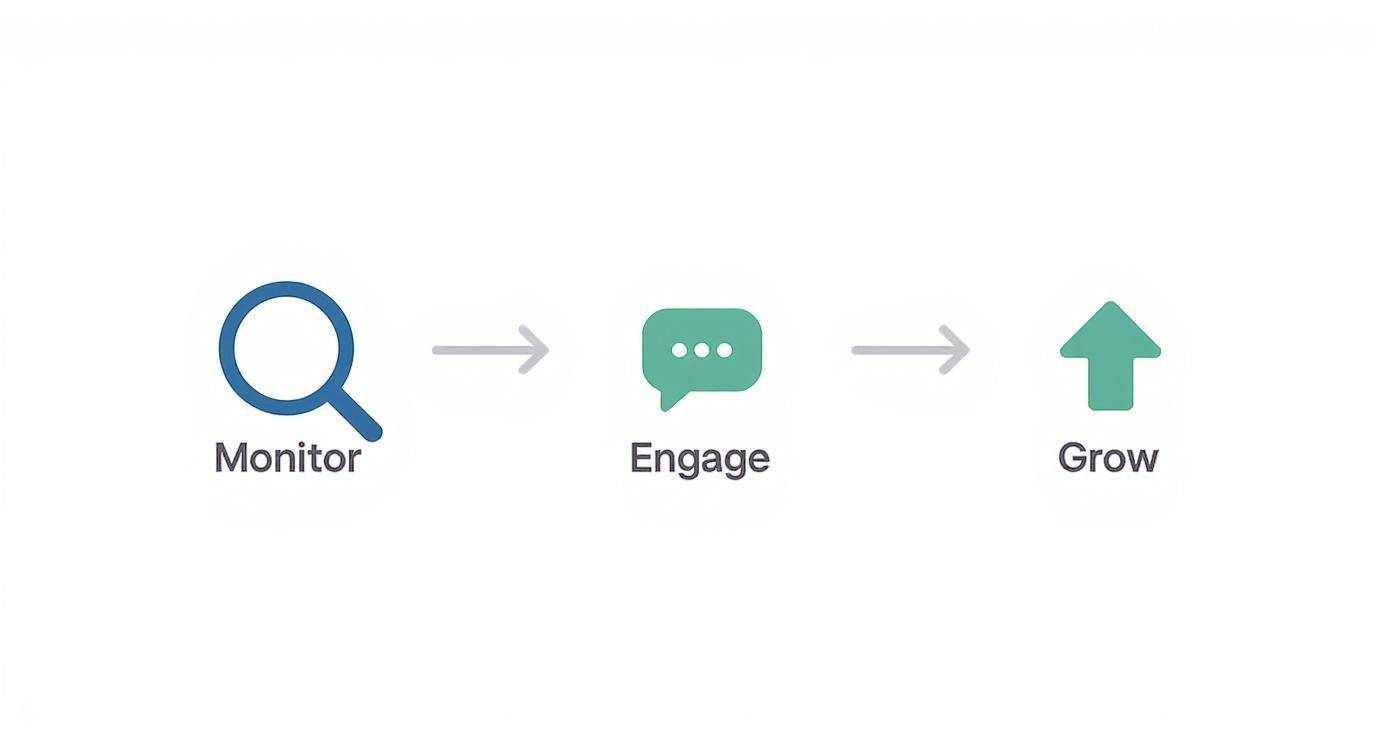
As you can see, everything starts with monitoring. It's the trigger for every other action you'll take to protect and grow your brand.
Centralize Your Monitoring Efforts
While manually checking sites is a decent start, automation is what makes your system reliable. A central dashboard—and this can be as simple as a Google Sheet—is your command center for tracking feedback from every source. At a minimum, you'll want to log the source (Google, Yelp, etc.), the sentiment of the review, and how quickly you responded.
To really streamline this, dedicated tools are the way to go. If you're looking for a platform that fits your budget and needs, exploring the best reputation management software options is a great place to start. These tools do the heavy lifting, pulling in reviews automatically so you don't have to waste time logging into a dozen different platforms every morning.
A great monitoring system isn't about the most expensive software. It’s about a consistent, daily habit that ensures no piece of customer feedback—good or bad—ever slips through the cracks.
This daily check-in is non-negotiable. Pick a time and stick to it. This habit prevents feedback from piling up and lets you hit that critical 24-hour window for responding to negative comments, which tells customers you're listening and you care.
Your daily routine should look something like this:
- Check your alerts: See what your monitoring software or Google Alerts have pulled in overnight.
- Scan the big players: Do a quick manual check of your Google Business Profile and your main industry-specific review site.
- Update the dashboard: Log any new feedback and mark previous issues as resolved.
This simple workflow turns a daunting task into a manageable daily habit. It also means you’ll catch any urgent issues right away. For those looking to get more advanced, you can even explore using tools like ChatGPT for brand monitoring to analyze sentiment and mentions at a much larger scale.
The Art of Responding to Customer Reviews
Every single review, good or bad, is a public conversation about your business. How you handle these conversations is a direct reflection of your customer service—and potential new customers are always watching. Having a clear strategy for responding is a core part of managing your local reputation.
This isn't just about damage control; it's an opportunity. For every glowing five-star review, there's a chance to amplify that positivity. For every negative comment, there's a chance to demonstrate your commitment to getting things right, turning a bad experience into a showcase of your professionalism.
This process is critical because consumers actively look for this engagement. We know that about 60% of people want to see between 20 and 100 total reviews before they trust a business's rating. What’s more, recency matters immensely. Around 27% of consumers only trust reviews posted within the last two weeks, which really highlights the need for a steady stream of fresh feedback.
Responding to Positive Reviews
Getting a five-star review feels great, but a simple "Thanks!" is a missed opportunity. Your real goal is to amplify their positive sentiment and add some helpful context for other potential customers who are scrolling by.
Here's how to make your response count:
- Personalize Your Gratitude: Always address the reviewer by their name and thank them for taking the time to share their experience.
- Reference Their Specifics: Mention the exact product, service, or even the team member they complimented. For example, "We're so glad you enjoyed the spicy margarita and that our server, Maria, took great care of you!"
- Weave in Keywords (Naturally): If it feels right, include relevant keywords. "It's great to hear you think we're the best local auto repair shop in Scottsdale." This subtly reinforces what you do for both humans and search engines.
Handling Legitimate Negative Feedback
Negative reviews sting, but they are also a goldmine of unfiltered feedback. Handled correctly, your response can win over the unhappy customer and, just as importantly, impress everyone else reading it.
The golden rule of negative reviews is to never, ever get into a public argument. Your goal is not to win the fight; it's to solve the problem and show others you care.
Follow this simple framework for a professional and effective response:
- Acknowledge and Apologize: Start by thanking them for the feedback and offering a sincere apology that their experience didn't meet expectations. Don't make excuses.
- Take It Offline: Provide a direct contact method, like a phone number or email address, so they can discuss the issue privately. This shows you're serious about a resolution and moves the sensitive details out of the public eye.
- Resolve the Issue: Once you connect offline, do what you can to make things right. This is where you can turn a critic into a loyal customer.
For guidance on effectively mitigating the impact of unfavorable feedback and preserving your brand image, consult this detailed guide on Mastering Negative Review Responses. Having a playbook for these tough conversations makes all the difference.
Nail Your Consistency Across Local Listings
Think of inconsistent online business information as the digital version of giving a potential customer the wrong directions. It instantly kills trust and totally confuses search engines. The foundation of any solid local reputation strategy is perfect consistency of your core business details everywhere they show up online.
This data is your NAP: Name, Address, and Phone Number.
Even a tiny variation—like using "St." on one directory and "Street" on another—is enough for Google to see two separate, conflicting records. These little discrepancies water down your authority and can directly torpedo your local search rankings, making it that much harder for customers to find you.
The financial hit from this lack of trust is real. Companies with strong, consistent reputations can command up to a 25% premium on their valuation compared to those with a weaker public image. Why? Because investors and customers see that brand reliability as a massive asset. You can dig into more stats connecting reputation and market value on seoprofy.com.
Audit Your Core Digital Footprint
Before you can fix a single thing, you need a clear, honest picture of where you stand right now. That means rolling up your sleeves and manually auditing your most critical local listings. These are the platforms that carry the most weight with search engines and are often the first place your customers will look.
Your initial audit has to cover the big ones:
- Google Business Profile: This is non-negotiable and your most important listing. Is every single field filled out, from business hours to your precise service category?
- Apple Maps: A huge driver of navigation traffic, especially for anyone on an iPhone.
- Facebook Business Page: The "About" section must be an exact mirror of your GBP info. No exceptions.
- Yelp: Still a major decision-making platform, particularly for service-based businesses like restaurants, plumbers, and salons.
- Bing Places for Business: Don't sleep on Microsoft's search engine. It still holds a significant chunk of the market.
Fire up a simple spreadsheet and document the exact NAP you find on each of these platforms. This becomes your baseline, instantly highlighting all the little (and big) inconsistencies you need to hunt down and fix.
Use Citation Management to Streamline Updates
Manually updating dozens, or even hundreds, of online directories is a soul-crushing task. It's tedious, mind-numbing, and takes forever. This is exactly what citation management tools were built for.
Platforms like Moz Local, Yext, or BrightLocal can automate this entire headache.
You connect your main business profile to their platform, and they act like a syndication engine, pushing your correct NAP information across a massive network of data aggregators and directories. It saves an unbelievable amount of time and ensures your data is consistent everywhere.
If you're on a tighter budget, a manual approach can still work wonders if you focus on what matters most. Instead of trying to update every directory under the sun, zero in on the top 20 most influential citations for your specific industry. This targeted blitz tackles the listings that deliver the most bang for your buck, making sure your effort is both efficient and powerful.
Using AI for Smarter Reputation Management
Artificial intelligence isn't just some tech buzzword anymore—it's become a seriously powerful tool for any local business that cares about its reputation. When you use it right, AI acts like a force multiplier. It lets you keep an eye on more channels, respond to customers way faster, and, most importantly, catch problems that older methods would completely miss.
The biggest shift is in what you can monitor. Traditional reputation software is great for tracking reviews and social media mentions, but that's yesterday's game. AI opens up the next frontier: the AI-generated answers and summaries popping up in search results. This is where your brand's story is most vulnerable.
Keeping an Eye Out for AI Hallucinations
One of the scariest new threats to a local business is something called an AI hallucination. This is when a large language model (LLM) like Google's Gemini or ChatGPT states something completely wrong with total confidence.
It might tell a potential customer you close at 5 PM when you're open until 9. It might invent a product you've never sold. Even worse, it could claim your business is "permanently closed."
This screenshot from Google shows you just how front-and-center these AI overviews are becoming.
When these AI-generated snippets get facts wrong about your business, they can kill a sale before a customer ever even thinks about clicking on your website.
So, how do you fight back? You have to set up a monitoring system. Specialized tools can run automated scans every single day across different AI models, asking the kind of questions your customers would.
It boils down to a pretty simple process:
- Create a Prompt List: Brainstorm a list of questions people might ask about you. Think like a customer: "What are the hours for [Your Business]?" or "Is [Your Business] kid-friendly?"
- Set Up Automated Scans: Use a platform to fire off these prompts to models like Gemini, ChatGPT, and others on a regular schedule.
- Get Instant Alerts: The key is to configure the system to ping you the second an AI's answer doesn't perfectly match your official business information.
This proactive approach turns AI from a potential disaster into just another part of your strategy you can manage.
An AI hallucination isn't just a weird tech glitch; it's a direct hit on your reputation. You didn't cause it, but you're still responsible for fixing it. Catching these errors the moment they happen is non-negotiable.
Automating Analysis and Speeding Up Responses
Beyond just spotting errors, AI is a beast at crunching huge amounts of customer feedback to find patterns. AI-powered sentiment analysis can tear through hundreds of reviews in seconds, giving you a clear snapshot of what customers love and where you're dropping the ball. These are insights you could easily miss if you were reading them one by one.
AI can also give your review response workflow a serious boost. Instead of staring at a blank text box wondering what to write, you can have an AI assistant generate a personalized, on-brand draft.
The trick is to treat it as exactly that—a first draft. A real person always needs to review, tweak, and approve the final response to make sure it sounds human and empathetic. It's the perfect blend of AI's speed and the irreplaceable human touch.
If you're looking to bring these more advanced strategies into your workflow, working with specialists can help you get there faster. You can see how experts are tackling these challenges by checking out the work of AI reputation management consultants. It's the best way to ensure technology is enhancing—not replacing—your connection with customers.
How to Measure Your Reputation Management ROI
If you can't prove the value of your reputation management work, you're flying blind. It's that simple. Without clear numbers, it all feels a bit fluffy. The key is to draw a straight, undeniable line from the reputation metrics you watch daily to the outcomes that actually matter: leads and revenue.
Your first move is to get a handle on the core reputation metrics. Think of these as your foundational data points, the ones that show how public perception is actually shifting over time. They're your leading indicators, giving you the heads-up that your strategy is working long before the impact hits the bank account.
Key Reputation KPIs to Monitor
- Average Star Rating: You need to be tracking this across every platform that matters—Google, Yelp, industry-specific sites, you name it. Nudging your average score from a 3.8 to a 4.2 might not sound like much, but it’s a massive win that directly influences customer choice.
- Review Velocity: This is just a fancy term for the number of new reviews you’re pulling in each month. A steady increase here proves your proactive review generation is working and, just as importantly, keeps your online profiles looking fresh and active.
- Sentiment Score: This goes beyond just stars. Using a monitoring tool, you can automatically tag every mention as positive, neutral, or negative. The goal is obvious: watch that percentage of positive mentions climb month after month.
These metrics are a great start, but the real magic happens when you connect them to your bottom line. How exactly does a higher star rating put more money in your pocket?
The ultimate goal is to draw a straight line from your reputation efforts to business growth. For example, you can correlate an increase in your Google Business Profile rating with a jump in "get directions" clicks or direct phone calls from your listing.
This is where you truly prove the ROI. A simple "before and after" snapshot can be incredibly powerful for showing stakeholders (or yourself) what’s working. For an even sharper edge, you can use competitor AI analysis tools to benchmark your progress and see how your shinier reputation stacks up against the local competition.
To make it tangible, we can lay out the data in a simple table. This is the kind of clear, no-nonsense reporting that turns reputation management from a vague marketing task into a measurable driver of business success.
Reputation Management KPI Tracking Example
Here’s a snapshot of what a six-month campaign might look like when you connect reputation metrics to real business activity.
| Metric | Before (Month 1) | After (Month 6) | Impact |
|---|---|---|---|
| Average Google Rating | 3.7 Stars | 4.4 Stars | +0.7 Stars |
| Monthly New Reviews | 4 | 15 | +275% |
| GBP Clicks to Website | 150/month | 225/month | +50% |
| Phone Calls from GBP | 25/month | 45/month | +80% |
When you present the data this way, the story tells itself. You're not just getting more reviews; you're getting more customers.
Your Top Reputation Questions, Answered
Business owners ask me all the time how they can get more positive reviews without coming across as pushy or desperate. It’s a great question, and the answer is simpler than you think. You don't need a complex campaign; you just need to make it incredibly easy for happy customers to share their thoughts.
A small sign with a QR code right at the checkout counter is a fantastic, low-effort way to do this. For service-based businesses, I always recommend a simple follow-up email a day or two after the job is done. A quick "How did we do?" with a direct link to your Google review page feels personal and works wonders.
What About Fake or Malicious Reviews?
This is another big one. Sooner or later, every business gets hit with a review that’s completely fabricated or defamatory. Your first instinct might be to fight back in the comments, but that’s the worst thing you can do. Never get into a public argument.
The correct first move is to flag the review directly on the platform, whether it's Google, Yelp, or another site. You’ll need to cite a specific violation of their terms of service, like it being spam or from a clear conflict of interest. If the platform doesn’t take it down and the review is causing real damage, that’s when you might consider getting professional help.
As a rule of thumb, plan to dedicate 20-30 minutes per day to managing your local business reputation. That’s usually enough time to stay on top of new alerts, respond thoughtfully to reviews, and double-check your key listings without it taking over your whole day.
Of course, using the right tools can shrink that time commitment significantly. When the monitoring is automated, you can skip the manual searching and focus your energy on engaging with customers and refining your strategy—which is where the real value is.
Ready to see what AI is saying about your brand? Protect your reputation with TrackMyBiz. Start a free scan at https://trackmybusiness.ai to uncover hidden risks and opportunities.
