
Detecting LLM hallucinations is all about catching those moments when an AI goes off-script, generating information that’s false, misleading, or just plain nonsensical. It’s a critical safety net, because even the most powerful models can state complete fictions with unwavering confidence. This process is the bedrock of building AI you can actually trust.
Why Even the Smartest LLMs Make Things Up
It’s a bizarre concept, right? A model trained on a huge chunk of the internet can confidently tell you the moon is made of green cheese. This isn't a "bug" in the classic sense; it’s a direct result of how these models are built.
At their heart, LLMs are incredibly sophisticated next-word predictors, not databases of facts. Their job is to figure out the most statistically likely sequence of words to follow your prompt. They don't "know" things like we do. Instead, they stitch together patterns from their training data to create responses that sound fluent and grammatically correct. This predictive superpower is both their greatest strength and their most glaring weakness.
It All Comes Down to Predictive Probability
Think of an LLM like a jazz musician improvising a solo. The musician isn't reading sheet music; they're using their deep knowledge of scales, chords, and musical theory to predict which note will sound best next. An LLM does the same thing with words, but it lacks a grounding in reality.
This can go wrong in a few common ways:
- Stale Information: The model's knowledge is a snapshot in time. It’s completely unaware of events that happened after its last training date.
- Vague Prompts: If your question is ambiguous, the model will happily fill in the blanks with details that sound plausible but are totally made up.
- Gaps in the Data: The training data might be biased, incomplete, or contain conflicting facts, and the model can reproduce all of it.
Because of this design, hallucinations are an unavoidable side effect. The model is optimized for fluency and helpfulness, which can easily override the need for strict accuracy. That’s exactly why a solid LLM hallucination detection framework isn't just a nice feature—it's an absolute necessity for any serious application.
A hallucination isn't just a simple mistake. It's when the model confidently fabricates information that is nonsensical, factually baseless, or completely disconnected from the provided context. The key is the confident assertion of a falsehood as if it were a proven fact.
Common Types of LLM Hallucinations
To effectively detect hallucinations, you first need to know what you're looking for. They come in several flavors, from subtle inaccuracies to completely fabricated stories. Getting familiar with these categories will make it much easier to build a robust testing and monitoring plan.
Here’s a breakdown of the most common types you’ll encounter:
| Hallucination Type | Description | Example |
|---|---|---|
| Factual Invention | The model generates completely new "facts," names, statistics, or events that have no basis in reality. | "The Eiffel Tower was relocated to Berlin for the 1948 Olympics." |
| Contextual Fabrication | The model invents details that are plausible within the given context but are not supported by the source material. | Given a product page, the LLM states, "This product comes with a free lifetime warranty," when no warranty is mentioned. |
| Logical Contradiction | The model makes statements that contradict either itself within the same response or the provided source data. | "Our return policy is 30 days. You must return items within one week of purchase." |
| Instructional Hallucination | The model fails to follow a specific negative constraint in the prompt, often called "prompt injection." | Prompt: "Summarize the article but do not mention the author's name." Response: "This article, written by Jane Doe, discusses…" |
Recognizing these patterns is the first step. When you know the different ways a model can fail, you can design targeted tests to catch these errors before they impact your users.
The Real-World Consequences
The fallout from these fabrications can range from slightly embarrassing to genuinely catastrophic. A creative writing assistant making up a fictional city is one thing. But when the stakes are higher, the damage can be severe.
Take a customer support chatbot for an online store. A shopper asks, "What’s your return policy for electronics?" The LLM, trying to be helpful but lacking the specific policy, hallucinates an answer: "You can return all electronics for a full refund within 90 days, no questions asked."
If the real policy is a strict 14-day window, the company is now stuck between honoring a false promise (losing money) or angering a customer (losing trust). This is a customer service nightmare born from a single hallucination.
The same goes for a local business. A model could invent incorrect store hours, falsely state the business is "permanently closed," or even create fake negative reviews. These aren't just small errors; they're direct hits to revenue and reputation. This is where detection becomes a critical business function, protecting your brand from the unintended fallout of AI-generated misinformation.
Building Your Detection and Testing Framework
Okay, let's move from theory to action. To get a real handle on LLM hallucinations, you need a structured, repeatable system for finding them. This isn't about running a few spot checks here and there. It's about building a proper operational blueprint that blends automated tools with smart human oversight to create a solid feedback loop.
This process is more than just lobbing a few questions at your model and seeing what sticks. You have to be strategic—probing its weaknesses, setting up a source of truth to benchmark against, and defining exactly what an "acceptable" error looks like for your business.
The diagram below gives you a high-level look at how a simple internal prediction can spiral into a fabricated output with real-world consequences.
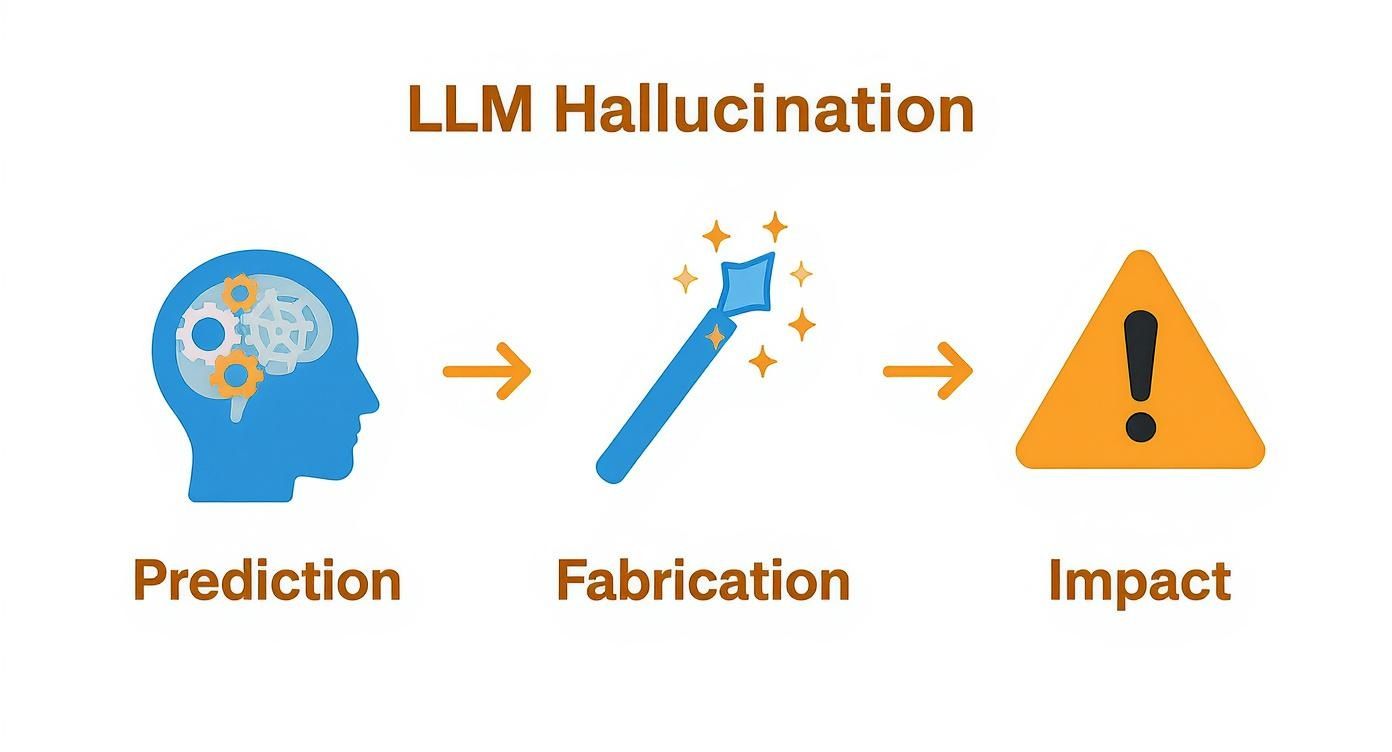
This journey from a harmless predictive step to a tangible business risk is exactly what we need to manage. That’s where a dedicated framework comes in.
Assembling Your Golden Dataset
The absolute cornerstone of any good testing protocol is what we call a "golden dataset." Think of it as your ultimate cheat sheet—a curated collection of prompts paired with their known, correct answers. Without it, you’re just guessing.
Building this dataset isn’t a quick task; it requires a bit of thought:
- Source Real-World Scenarios: Pull questions straight from your customer service logs, website search queries, or user feedback forms. These are the things people actually ask. For a retailer, this means prompts like, "What are your holiday hours?" or "Can I return an online order in-store?"
- Throw in Some Edge Cases: You need to test the model's boundaries. Include questions about obscure or hyper-specific topics related to your industry. This is how you find out if the model is smart enough to say "I don't know" instead of just making something up.
- Use Adversarial Prompts: Now for the fun part. Craft questions specifically designed to trip up the model. Ask about contradictory information or reference a non-existent product or company policy. You want to see if the LLM fabricates details to fill the gap.
Your golden dataset is a living thing. You should be updating it constantly with new scenarios and tricky edge cases your team stumbles upon. This keeps your testing sharp and relevant.
Integrating Automated and Manual Review Processes
Automation gives you speed and scale, but human review provides the nuance and context that machines still struggle with. A truly successful framework has to blend both.
For example, you can easily automate checks that compare an LLM’s response against the text on your website. If a chatbot invents a 20% discount code that doesn't exist on your promotions page, a simple script can flag that immediately.
But some hallucinations are much more subtle. The model might summarize a customer review with a slightly wrong sentiment or misinterpret the fine print of a complex return policy. Those slip-ups require a human eye to assess for contextual accuracy and logical consistency.
Pro Tip: Don't try to build a 100% automated system on day one. Start with a workflow where automated tools flag potential issues, which then get escalated to a human expert for the final say. This hybrid approach gives you the best of both worlds: efficiency and accuracy.
Recent research has shown something fascinating: truthful and hallucinated answers often come from different underlying probability distributions inside the model. In experiments with models like Llama2 and Llama3, researchers found they could systematically detect fabrications by analyzing these distributions. For instance, detection scores got better as the sample size of generated answers went up, showing how more data points can build higher confidence in spotting a lie.
Setting Clear Hallucination Thresholds
Let's be honest, not all hallucinations are created equal. A model inventing a fictional historical fact for a blog post is annoying. A model providing incorrect medical advice is a disaster. Your framework has to define acceptable thresholds based on the stakes of your specific use case.
I like to think about it in tiers:
- Zero-Tolerance: For high-stakes applications like legal, financial, or medical info, the threshold for factual hallucinations needs to be as close to 0% as humanly possible. No wiggle room here.
- Low-Tolerance: For customer-facing roles like support bots or product recommenders, you need a very low threshold. Trust is everything, and one bad answer can lose you a customer for good.
- Flexible-Tolerance: In creative or low-risk internal tools, you can afford to be a bit more relaxed. Here, the focus is just on catching the most outrageous fabrications.
These thresholds aren't just arbitrary numbers; they are the triggers for your entire response plan. When a threshold is breached, it should automatically kick off an alert, a content review, or even a model retraining process. To get a better feel for where your own performance stands, it can be helpful to see how your AI stacks up against the competition by checking out a few competitor AI analysis tools. This gives you valuable context for setting your own internal benchmarks.
Putting Automated and Manual Detection Techniques Into Action
Once you have a solid framework, it’s time to get into the day-to-day work of spotting LLM hallucinations. This isn't about choosing between automation and human review; it's about blending the raw power of machines with the irreplaceable nuance of a human expert. One can’t replace the other, but together, they create a seriously robust system for maintaining AI accuracy and, most importantly, user trust.

Think of automated methods as your first line of defense. They're designed to catch errors at a massive scale without needing someone to watch over them constantly. They are incredibly fast, consistent, and perfect for flagging obvious contradictions and factual slip-ups.
Using Automation for Speed and Scale
One of the most practical automated techniques I've seen work well is the self-consistency check. The idea is brilliantly simple: you ask the LLM the same core question multiple times, just phrased a bit differently each time. If the model is pulling from a solid fact, the answers should line up.
For example, you could ask:
- "What are the weekend hours for your downtown location?"
- "Is the downtown store open on Saturdays?"
- "Tell me the operating hours for downtown on Sunday."
If you get three different answers, you've almost certainly caught a hallucination. That variance is a huge red flag, signaling the model is guessing instead of referencing a reliable source. This is fantastic for nailing down inconsistencies in critical data like business hours or product specs.
Another powerful automated tool in the toolbox is using a second, often more capable, LLM to evaluate the first one. This is what's known as the LLM-as-a-judge method. You can prompt a model like GPT-4o or Claude 3.5 Sonnet to compare a generated answer against a trusted document you provide.
It's like asking an expert LLM, "Hey, does this answer actually reflect what's in this source document?" Research shows this approach can hit over 75% accuracy in spotting hallucinations, which is a fantastic balance between performance and cost.
Finally, your Retrieval-Augmented Generation (RAG) system is an absolute game-changer here. Since RAG is designed to ground the LLM’s answers in your specific knowledge base, you can automate checks that verify the output against the exact documents it retrieved. If the model's response includes information that wasn't in the provided context, that’s a strong indicator of a contextual fabrication. This is non-negotiable for making sure your AI assistant doesn't invent product features or make up company policies on the fly.
The Irreplaceable Value of Manual Review
Automation is a workhorse, but it's not going to catch everything. Subtle logical flaws, misinterpretations of brand tone, or answers that are technically correct but contextually inappropriate often need a human eye. Manual review is where you apply the layer of critical thinking that machines just don't have yet.
This goes way beyond simple fact-checking. A truly effective human review process digs deeper to assess the overall quality and trustworthiness of the AI's response. For agencies managing a brand's reputation, this is where the real value is found. Understanding the subtle nuances of how a model represents a brand is something only a human can do, which is why having strong partners who provide dedicated LLM visibility tracking for agencies is so critical for complete oversight.
A Quick Look at Different Detection Methods
To make sense of the options, it helps to see how they stack up against each other. Each technique has its place, and the best strategy almost always involves a mix of them.
Comparison of Hallucination Detection Techniques
| Detection Technique | How It Works | Pros | Cons | Best For |
|---|---|---|---|---|
| Self-Consistency Checks | Asking the same question in multiple ways to check for consistent answers. | Simple to implement; great for catching factual inconsistencies. | Can be computationally expensive; may miss nuanced errors. | Verifying critical data like hours, prices, or specs. |
| LLM-as-a-Judge | Using a powerful LLM (e.g., GPT-4o) to evaluate a response against a source. | High accuracy (75%+); scalable and cost-effective. | Dependant on the quality of the "judge" LLM and the prompt. | Automated quality control in content generation pipelines. |
| RAG-Based Verification | Cross-referencing the LLM's output against the specific documents retrieved by the RAG system. | Highly accurate for contextual grounding; directly tied to your knowledge base. | Only works within a RAG architecture; can't verify external knowledge. | Ensuring answers from internal chatbots are based only on provided docs. |
| Manual Human Review | A human expert evaluates the response based on a predefined checklist or rubric. | Catches subtle errors in tone, logic, and context that automation misses. | Slow, expensive, and doesn't scale well; can be subjective. | High-stakes applications, brand reputation management, and final quality checks. |
Ultimately, the goal is to create a layered defense where each technique covers the weaknesses of the others.
Guidelines for Effective Human Reviewers
To make manual review more than just a gut check, you need to give your team a clear, consistent checklist. This turns subjective opinions into a structured, repeatable evaluation.
- Factual Accuracy: Does the answer match our source of truth (website, product docs, internal data)? This is the baseline.
- Contextual Relevance: Does the answer actually address the user's specific question, or did it wander off-topic?
- Logical Consistency: Does the response contradict itself? For instance, saying a product is "in stock" and "available for pre-order" in the same breath.
- Brand Voice and Tone: Does this sound like us? Is it helpful and professional, or does it come across as robotic and cold?
- Safety and Appropriateness: Does the response contain any harmful, biased, or otherwise inappropriate content?
By weaving these automated and manual techniques together, you create a comprehensive system for detecting hallucinations. Automation handles the sheer volume, flagging potential problems 24/7, while your human reviewers provide the final judgment on the tricky cases. This two-pronged approach gives you both speed and accuracy, letting you deploy your AI applications with real confidence.
Choosing Metrics That Actually Matter
Catching a hallucination is one thing, but actually improving your system requires you to measure the problem in a meaningful way. You have to move past a simple "true/false" count and start using metrics that truly capture the nuance of how and when your LLM is dropping the ball.
Without solid metrics, you're just flying blind. You might feel like hallucinations are happening, but you won't know if they're getting better or worse over time, or which types are causing the most damage. The whole point is to quantify the problem so you can start managing it systematically.
Beyond Simple Accuracy Scores
A basic accuracy score—the raw percentage of "correct" answers—is often more misleading than helpful. An answer can be factually correct but still useless or, worse, subtly misleading. This is where you need to bring in more sophisticated metrics to get a clearer picture of what's really going on.
Think about graduating to these more advanced evaluation methods:
- Semantic Similarity: This metric gets to the heart of the matter: does the LLM's response mean the same thing as the source of truth? Using vector embeddings, you can score the alignment between the generated text and the ground truth, which is perfect for catching those cases where the wording is different but the core meaning is right.
- Information Overlap: How much of the critical info from the source context actually made it into the LLM's answer? This is a lifesaver for summarization tasks, helping you spot when the model is either leaving out key details or just making things up.
- LLM-as-a-Judge: As we've touched on, this is a seriously effective approach. You use a powerful model like GPT-4o to evaluate a response against a source document. It essentially leverages the advanced reasoning of a top-tier model to give you a nuanced, almost human-like quality score.
The real challenge here is that a metric that’s perfect for one use case can be completely worthless for another. The key is to pick metrics that directly map to the risks and goals of your specific application. A creative writing assistant has a lot more room for factual drift than a chatbot dishing out financial advice.
The Human Judgment Benchmark
Automated metrics are fast and they scale beautifully, but they still have a hard time perfectly aligning with what a human would consider a high-quality answer.
A major study in 2024 evaluated a whole host of hallucination metrics and found that most automated systems still correlate poorly with actual human judgments. This gap drives home a critical point in LLM hallucination detection: human evaluation is still the gold standard. You can dive into the full research on hallucination detection to see just how tricky this problem is.
This doesn't mean you should throw out your automated metrics. Not at all. Instead, use human review to calibrate them. Every so often, have your human experts score a sample of LLM outputs. Then, compare those scores to what your automated metrics are telling you. This process shows you where your system is sharp and where its blind spots are, letting you fine-tune your thresholds and, ultimately, trust your automated alerts more.
Setting Actionable Thresholds
Metrics are just numbers on a dashboard until they trigger an action. This is where defining clear thresholds becomes absolutely essential. A threshold is just a predefined limit that, when crossed, automatically kicks off a specific game plan.
Your thresholds should be tied directly to business risk.
| Risk Level | Example Use Case | Hallucination Threshold | Automated Action Triggered |
|---|---|---|---|
| High | Medical information chatbot | < 0.1% Factual Error Rate | Immediate alert to on-call team; response is blocked and defaults to a safe, pre-written answer. |
| Medium | Customer support for a retailer | < 2% Contextual Fabrication | Flag response for human review; create a ticket to update the RAG knowledge base with correct policy info. |
| Low | Internal creative brief generator | < 10% General Hallucinations | Log the error for periodic model fine-tuning; no immediate action required. |
By setting up tiers like these, you build a clear, automated workflow. A hallucination about your store's return policy might page the support team, while a minor error in a low-stakes internal tool simply gets logged for later. This is how you turn measurement into a proactive strategy that keeps your AI systems reliable and trustworthy out in the wild.
Putting Your Monitoring and Response Plan to Work
A detection framework on paper is just theory. Its real value comes to life only when it's fully baked into your live operations. This is the final, crucial step: moving from testing and analysis to building a continuous, automated system that keeps an eye on your LLM in production. This operational layer is what turns your detection strategy into a real-time safety net for your brand.
The goal here is to create a seamless workflow that hums along quietly in the background. It needs to flag issues, ping the right people, and kick off a clear resolution process the instant a hallucination is detected. This is how you shift from reacting to AI mistakes to proactively managing them.

Integrating Detection Into Your MLOps Pipeline
Your LLM hallucination detection tools can't be siloed off on their own. For this to work, they have to be woven directly into your MLOps (Machine Learning Operations) pipeline. What this means in practice is that every single response your LLM generates has to pass through an automated validation layer before a user ever sees it.
Picture this: a user asks your chatbot a question, and the LLM generates an answer. Before that answer gets displayed, your system makes a quick API call to your detection service. This service might run a fast semantic similarity check against the RAG context or use an LLM-as-a-judge to score the response for faithfulness. The whole check needs to add minimal latency—we're talking under a few hundred milliseconds, ideally.
This tight integration ensures that 100% of outputs are scrutinized, not just a random sample. It becomes a standard, non-negotiable step in your application's logic, just like checking for user authentication.
Configuring Smart, Automated Alerts
Nobody can afford to have a team manually watching every AI interaction. That's just not scalable. The trick is to set up an intelligent alerting system that notifies the right teams based on the severity and type of hallucination. A single, generic alert will quickly lead to alert fatigue, and your team will start ignoring them.
Instead, think about creating a tiered alerting strategy:
- Critical Alerts (High Severity): If the model hallucinates about pricing, legal disclaimers, or safety info, that’s an all-hands-on-deck situation. This should trigger an immediate, high-priority alert via a tool like PagerDuty or a dedicated Slack channel to an on-call engineering or product team.
- Warning Alerts (Medium Severity): Let's say the AI invents a minor product feature. This could automatically create a medium-priority ticket in a system like Jira, assigned to the marketing or content team to look into when they have a chance.
- Logging (Low Severity): Minor stylistic quirks or low-confidence flags don't need to wake anyone up. These can simply be logged to a dashboard in a tool like Datadog or Grafana for a weekly or monthly review.
This targeted approach gets urgent issues immediate attention while tracking less critical ones without drowning your teams in noise.
Your alerts are only as good as the response they trigger. An alert with no clear owner or next step is just noise. Every notification should be tied to a specific, pre-defined action plan.
Designing Clear Response Playbooks
When an alert fires at 2 AM, your team needs to know exactly what to do. They can't be figuring it out on the fly. A response playbook is a simple, step-by-step guide for handling different types of hallucinations, removing all the guesswork during a potentially stressful incident.
Here are a couple of practical playbook examples I've seen work well:
-
Playbook for a Critical Factual Hallucination (e.g., wrong store hours)
- Immediate Action: The system should be built to automatically block the hallucinated response and revert to a safe, pre-approved answer (e.g., "Please call our store for the most up-to-date hours.").
- Triage: The on-call team jumps in to verify the hallucination and figure out the root cause. Is the RAG data source out of date? Is there a bug in the prompt?
- Remediation: The team immediately updates the incorrect information in the knowledge base.
- Post-Mortem: After the fire is out, the incident is documented to spot patterns and prevent it from happening again.
-
Playbook for an Unsupported Claim (e.g., inventing a product feature)
- Immediate Action: The response is flagged and logged for human review. Depending on the risk, you might let it go through to the user.
- Triage: The product marketing team reviews the flagged response. Is the claim just plain wrong, or is it an "aspirational" feature the team is actually working on?
- Remediation: If it's incorrect, the RAG documentation is clarified to be more precise. If it's a real feature request, that feedback gets logged for the product roadmap.
These playbooks ensure that every step, from detection to final resolution, is deliberate and effective. Protecting your company's image from AI errors is now a core part of modern brand stewardship. It's a complex new field, which is why many businesses now work with specialized AI reputation management consultants to build out these exact kinds of robust operational workflows.
Common Questions About LLM Hallucination Detection
Digging into LLM hallucination detection always brings up a few key questions. I hear them all the time. Let's walk through the most common ones to clear up any confusion as you build out your own monitoring strategy.
Can LLM Hallucinations Ever Be Completely Eliminated?
In short, no—not with today's technology. The fundamental design of large language models is probabilistic. They’re built to predict the next most likely word in a sequence, not to query a factual database. This predictive core means there's always an inherent risk of fabrication.
But the goal isn't total elimination, which is likely impossible. The real goal is to aggressively reduce hallucinations to a level that’s acceptable and manageable for your specific use case.
Modern approaches like Retrieval-Augmented Generation (RAG) and meticulous fine-tuning can slash hallucination rates dramatically. These methods make models more than reliable enough for the vast majority of business applications, but the risk never truly hits zero.
What Is the Best Automated Tool for Detection?
There's no single "best" tool, because the right answer depends entirely on your needs, your tech stack, and your budget. In my experience, the most effective strategies always use a combination of methods, creating a layered defense against different kinds of inaccuracies.
Some of the most powerful approaches I've seen include:
- Using an LLM-as-a-Judge: This is a popular and highly effective technique where you leverage a powerful model like GPT-4o or Claude 3.5 Sonnet to evaluate the output of another LLM.
- RAG-Based Verification: This is a fantastic way to ensure faithfulness. It involves cross-referencing an LLM's response against the specific source documents provided as context.
- MLOps Platform Integration: Many MLOps platforms like Arize AI or WhyLabs now have built-in monitoring tools designed to flag potential hallucinations right in your production environment.
The most robust solutions are always multi-layered. Combining a fast, automated check like token similarity with a more nuanced LLM-as-a-judge method often gives you the best balance of speed, accuracy, and cost.
How Do I Create a Good Hallucination Test Dataset?
A solid test dataset—often called a "golden dataset"—is the absolute foundation of reliable testing. It needs to be designed to poke at your model’s specific weaknesses and reflect the real-world scenarios it will actually encounter.
To build a really effective one, you need a good mix of prompt types:
- Fact-Based Questions: Include queries with known, verifiable answers that can be drawn directly from your knowledge base.
- Edge Case Queries: Ask about obscure, niche, or very recent topics that you know are poorly represented in the training data. This is where models often break.
- Adversarial Prompts: Intentionally try to trick the model. Craft prompts that ask about contradictory information or reference non-existent products or features.
The most important thing is that the dataset mirrors the topics and question formats your application will handle from real users.
Is a Hallucination Just a Simple Error?
Not at all. A hallucination is much more severe and distinct from a simple error. A simple error might be a typo, a grammatical mistake, or a minor factual slip-up because the training data is a bit outdated. Annoying, but usually not catastrophic.
A hallucination, on the other hand, is when the model confidently fabricates information that is nonsensical, factually baseless, or completely disconnected from the context it was given.
The key difference is the confidence. The model asserts a falsehood as if it were a proven fact, and that’s what makes hallucinations so dangerous.
Ready to stop guessing what AI is saying about your business? The TrackMyBiz Safety Engine monitors LLM responses 24/7, flagging hallucinations like incorrect hours or fabricated reviews so you can protect your brand. See your AI BrandRank and start a free scan.
