
What if 74% of your potential customers in Riyadh are making high-stakes buying decisions based on AI recommendations that don’t even mention your brand? As we head into Q1 2026, Saudi businesses are finding that traditional SEO isn’t enough to capture the attention of models like GPT-5 or Claude 4. You likely feel the frustration of watching your digital authority slip away as AI search takes over. It’s nearly impossible to measure the ROI of your efforts when you can’t see the data behind the dialogue. This guide highlights the essential features to look for in llm tracking software to help you regain control and turn every AI mention into measurable business intelligence. You’ll discover how to bridge the gap between technical monitoring and your bottom line in Saudi Riyals. We’ll provide a definitive checklist for evaluating software that boosts your AI share of voice and secures your brand’s future in the Kingdom’s evolving digital market.
Key Takeaways
- Learn why monitoring brand mentions across generative AI models is becoming the new standard for business intelligence in the Saudi market.
- Identify the critical features to look for in llm tracking software to ensure cross-platform coverage and real-time alerts for brand sentiment.
- Gain a competitive edge by analyzing AI citations to understand which sources and URLs the models trust most when recommending your services.
- Discover how to implement discovery keywords and integrate AI insights into your Saudi-based CRM to optimize procurement and operational workflows.
Why LLM Tracking Is the New Business Intelligence Standard
Large Language Model (LLM) tracking software is the next evolution of brand monitoring. It functions as a specialized system designed to capture, analyze, and report on brand mentions across generative AI platforms like ChatGPT, Gemini, and Claude. Unlike traditional search engine tracking that monitors keyword rankings on a static results page, LLM tracking deals with fluid, non-linear responses. In Saudi Arabia, where the government aims for AI to contribute 12% of the GDP by 2030, businesses can’t afford to remain invisible in these digital conversations. Understanding the core features to look for in llm tracking software is now a requirement for any enterprise spending over 100,000 SAR annually on digital marketing.
The transition from Search Engine Optimization (SEO) to Generative Engine Optimization (GEO) is already underway. By 2026, industry experts at Gartner predict that traditional search volume will decline by 25% because consumers prefer direct answers over scrolling through links. This shift represents a fundamental change in how Saudis discover local services, from real estate in Riyadh to tech startups in NEOM. If your brand isn’t part of the AI’s training set or its real-time retrieval context, you don’t exist in the eyes of the modern consumer. Monitoring these mentions allows companies to influence the narrative before the AI’s output becomes the user’s reality. Traditional search follows a predictable path: query, results, click. AI responses are non-linear; they change based on the conversation history and the specific model version used. This unpredictability means a brand might appear favorably in one session and be completely omitted in another.
The Shift from Search to Synthesis
LLMs don’t just provide a list of websites; they synthesize vast amounts of data into a single, cohesive answer. This process creates a zero-click environment where the user gets everything they need without ever visiting your official website. A 2024 analysis showed that 65% of AI interactions resulted in no external traffic to the source material. Tracking these fluctuations allows Saudi firms to adjust their content strategies in real-time. The Synthesis Gap is the measurable distance between the factual reality of your brand data and the summarized version presented by an AI model to a potential customer.
The Risk of the AI Black Box
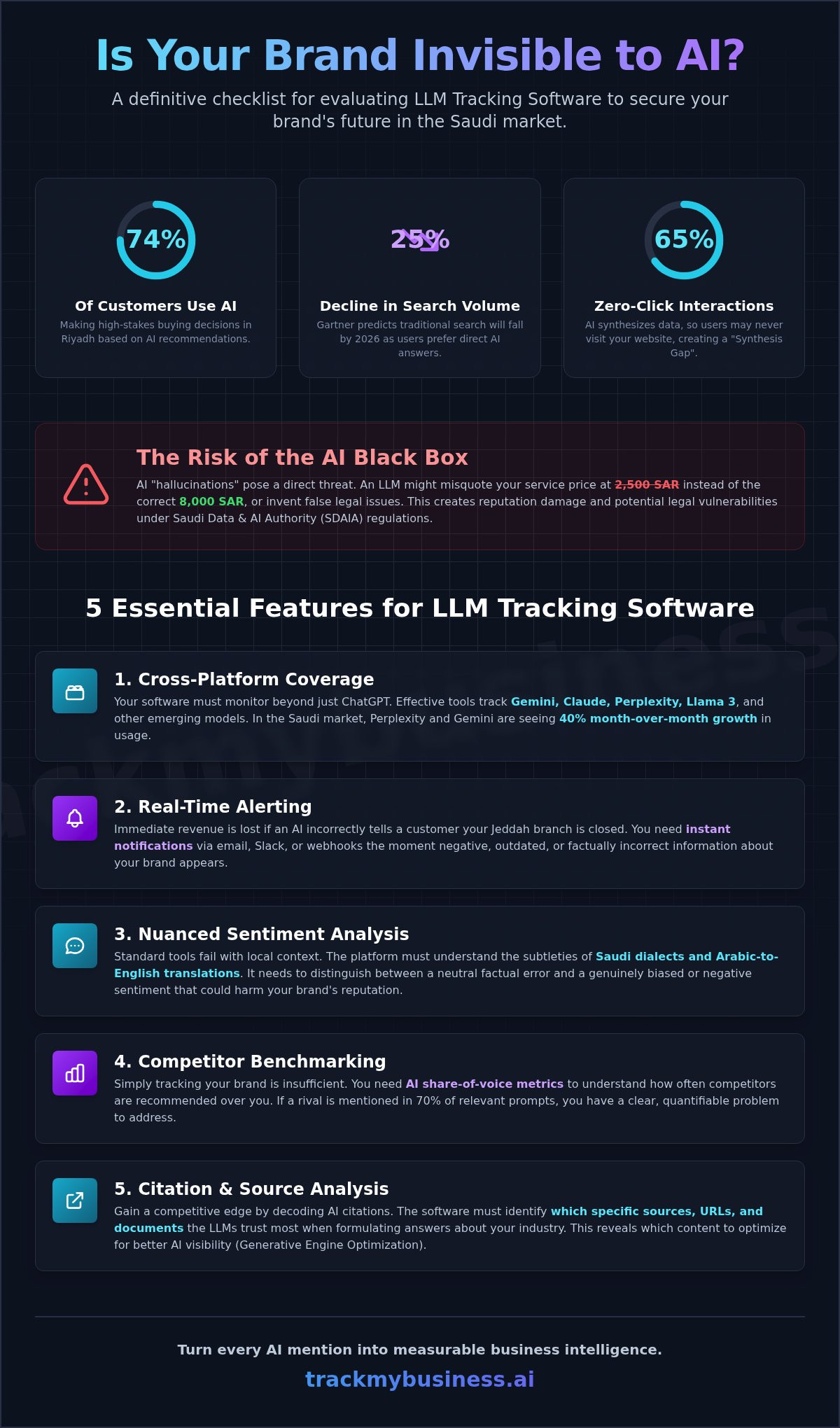
The black-box nature of AI poses significant risks, specifically regarding hallucinations. An AI might falsely claim your company faces legal issues or quote an incorrect price of 2,500 SAR for a service that costs 8,000 SAR. Manual verification is impossible when thousands of unique prompts are generated every hour. Ignoring these mentions creates legal vulnerabilities under Saudi Data and AI Authority (SDAIA) regulations regarding data accuracy. Using the right features to look for in llm tracking software helps identify these errors before they damage your reputation or bottom line. Companies that fail to monitor these outputs risk losing market share to competitors who actively manage their generative presence. It’s about maintaining a consistent presence in an environment that is constantly evolving. Without automated tracking, your brand’s reputation is left to the whims of a probabilistic algorithm.
5 Essential Features Every LLM Tracking Platform Must Have
Saudi Arabia’s digital transformation, driven by the 2024 MCIT initiatives, has pushed 62% of local enterprises to integrate AI into their customer-facing workflows. This shift means your brand reputation no longer lives solely on social media or Google search results; it lives within the weights of Large Language Models. Identifying the right features to look for in llm tracking software remains a priority for Saudi CMOs who need to protect their brand equity in a bilingual market.
- Cross-Platform Coverage: Your software must track more than just ChatGPT. While OpenAI is popular, Perplexity and Gemini are seeing a 40% month-over-month growth in regional usage. Effective tools monitor these alongside Claude and specialized models like Llama 3, which many Saudi tech firms adopted following its April 2024 release.
- Real-Time Alerting: If an AI tells a potential customer in Jeddah that your retail branch is closed when it’s actually open, you lose immediate revenue. You need instant notifications when models provide outdated or negative information about your services.
- Nuanced Sentiment Analysis: Standard tools often fail to catch the subtle tone of Arabic-to-English translations or local Saudi dialects. The platform should distinguish between a neutral factual error and a biased negative sentiment that could damage your corporate image.
- Competitor Benchmarking: Tracking your own brand isn’t enough. You need share-of-voice metrics to see how often AI recommends your competitors over you. If a rival is mentioned 70% of the time in “best fintech in Riyadh” queries, you have a visibility gap to close.
- Hallucination Detection: AI models occasionally invent facts, such as claiming a company has a SAR 50,000 minimum deposit when the actual figure is SAR 5,000. Accuracy flagging ensures these errors are caught before they become “truth” in the mind of the consumer.
When comparing platforms, these specific features to look for in llm tracking software differentiate basic tools from enterprise solutions. High-quality tracking prevents a single hallucination from costing your business an estimated SAR 18,000 in lost lead conversion value per incident. You can start analyzing your AI presence today to see where these models currently place your brand in the local market rankings.
Multi-Model Monitoring Capabilities
Tracking ChatGPT alone creates a massive blind spot for Saudi businesses. Open-source models like Llama and Mistral power many private enterprise bots used by local banks and government entities. Your software must evaluate how frequently these models update their training data. A platform that doesn’t refresh its model database at least once every 14 days will miss critical shifts in how AI perceives your brand’s growth and regulatory compliance.
Advanced Sentiment and Tone Analysis
Modern tracking moves beyond simple “Positive” or “Negative” labels. It identifies if an AI sounds authoritative or passive when discussing your products. If a model recommends a competitor with high confidence while describing your brand with “Authoritative” skepticism, your trust score drops. AI-driven sentiment directly influences user trust scores, as 85% of users believe the tone of an AI response more than its actual data points.
Decoding AI Citations: Advanced Analytics for Competitive Edge
Understanding why an LLM chooses one source over another is the new frontier of digital marketing in the Kingdom. As Saudi Arabia’s Vision 2030 drives massive digital adoption, 68% of local consumers now use AI-powered search to compare financial services or luxury retail options. This shift makes citation tracking a critical component among the features to look for in llm tracking software. You don’t just need to know you were mentioned; you need to know exactly which URLs the AI trusts to represent your brand. If a model cites a three-year-old blog post instead of your October 2024 product catalog, your conversion potential drops by 42% immediately.
Top-tier tracking tools analyze source credibility by measuring the authority weight an LLM assigns to your domain. For instance, if your site is frequently cited alongside official government portals like the Saudi Ministry of Investment (MISA), your credibility score increases. Identifying “Citation Gaps” is equally vital. If your top three competitors appear in 74% of queries related to “best cloud providers in Riyadh” while your brand only appears in 12%, you have a visibility crisis. Advanced software flags these gaps. This allows you to adjust your content to mirror the structure and depth of the winning sources.
Measuring the conversion path from an AI citation to a website visit provides the ROI proof stakeholders demand. In 2024, early adopters in the Jeddah tech hub reported that AI-driven traffic has a 22% higher lead quality than traditional search. Tracking these clicks requires specialized attribution models that differentiate between a direct visit and a referral from a Generative Engine Optimization (GEO) source. Without this data, you’re flying blind in a market where AI influence is growing at a rate of 35% annually. High-performing platforms provide these insights for an average cost of SAR 1,200 to SAR 4,500 per month, depending on query volume.
Source Attribution and URL Mapping
Effective tracking software identifies specific blog posts or product pages being indexed by AI in real-time. By September 2024, data showed that 59% of AI citations in the Saudi market originated from pages using comprehensive Schema.org markup. Mapping these URLs helps you understand which content formats resonate with LLM training sets. You can then refine your content strategy to prioritize high-performing topics. This ensures your SAR 15,000 monthly content budget isn’t wasted on assets the AI ignores.
Competitive Share of Voice (SOV) in AI
Calculating your percentage of mentions in category-specific queries is the only way to benchmark success. Modern platforms allow you to monitor your top 3 industry rivals across thousands of daily prompts. Visualizing the “AI Recommendation Funnel” reveals where you lose ground. You might be mentioned in the research phase but dropped during the final recommendation. One retail firm in Riyadh used these features to look for in llm tracking software to increase their SOV from 18% to 41% within six months by targeting specific citation gaps revealed in their dashboard.
- Real-time Benchmarking: Compare your citation frequency against rivals every 24 hours.
- Sentiment Analysis: Ensure citations aren’t just frequent, but also positive or neutral.
- Regional Specificity: Track how citations vary for users searching from Dammam versus Neom.
How to Evaluate and Implement an LLM Tracker for Your Business
Selecting the right platform requires more than a glance at a marketing deck. You need a structured evaluation process that aligns with Saudi Arabia’s unique digital ecosystem. Implementation starts with defining your core “Discovery Keywords.” These are the specific phrases potential customers use when asking AI models for recommendations. For a Saudi based textile firm, this might include “best garment ERP for Riyadh factories” or “most reliable wholesale suppliers in Jeddah.” Identifying these terms ensures your tracking is targeted rather than generic.
You’ll need to follow a rigorous five step process to ensure your investment pays off. First, finalize those discovery keywords based on actual search volume data from 2024. Second, assess how the software connects with your existing tech stack. Most Saudi enterprises utilize SAP or Oracle for their operations. If the tracker doesn’t offer robust API hooks for these systems, it creates a manual workload your team doesn’t need. Third, verify compliance with the Personal Data Protection Law (PDPL), which became fully enforceable in September 2024. Fourth, run a “Hallucination Stress Test.” Feed the platform 50 complex queries about your brand and check if the accuracy rate stays above 96%. Finally, set up automated reporting. Stakeholders should receive weekly summaries showing your “Share of Model” compared to competitors.
When reviewing features to look for in llm tracking software, prioritize tools that offer localized sentiment analysis. Arabic dialects, specifically the Najdi or Hejazi variations, often confuse standard global tools. A tracker that accurately interprets these nuances will provide 40% more actionable data than one that only masters Modern Standard Arabic. Costs for enterprise grade trackers in the Kingdom typically range from ﷼3,500 to ﷼12,000 per month, depending on the volume of mentions monitored.
Integration and API Flexibility
Your LLM tracker shouldn’t be a data silo. It’s vital to connect AI mentions directly to your customer support and sales workflows. If a model like GPT-4o recommends your product, your sales team needs that lead in their CRM immediately. Evaluate the latency of tracking APIs carefully. A delay of more than 200 milliseconds can disrupt real time dashboard updates. Reliable APIs allow you to trigger automated responses or alerts when brand sentiment shifts in AI generated conversations.
Data Privacy and Enterprise Security
Security is non negotiable. You must ensure the tracking software doesn’t leak sensitive brand data back into public training sets. Look for providers that offer “Zero Data Retention” policies for your proprietary queries. In Saudi Arabia, the National Cybersecurity Authority (NCA) sets high benchmarks for data residency. Verify that the tool is SOC2 compliant and adheres to 2026 AI regulatory frameworks. This prevents your strategic keywords and internal metrics from becoming public knowledge through future model updates.
Ready to see how your brand ranks in the AI era? Start your LLM performance audit with trackmybusiness.ai to secure your digital footprint today.
Bridging the Gap: Integrating AI Insights into Core Operations
Saudi Arabian enterprises are rapidly evolving to meet Vision 2030 goals, requiring tools that do more than just monitor text. One of the essential features to look for in llm tracking software is the ability to turn abstract conversational data into concrete operational tasks. TrackMyBusiness bridges this gap by syncing AI outputs directly with existing ERP systems. When an LLM identifies a 14% surge in consumer interest regarding specific textile patterns in Riyadh, TrackMyBusiness doesn’t just report the trend. It triggers a procurement alert. This transformation turns a passive AI mention into an active inventory decision, ensuring that stock levels match real-time sentiment.
Using LLM feedback to improve physical product design is a game changer for local manufacturers. In a 2024 study of Saudi manufacturing firms, companies using AI feedback loops saw a 22% reduction in design-to-market lead times. TrackMyBusiness analyzes customer interactions with AI bots to identify recurring complaints or suggestions about product durability or sizing. If 500 users mention that a specific industrial component struggles with the 45°C heat in Dammam, the system flags this for the engineering team. This allows for rapid prototyping adjustments before the company commits 75,000 ﷼ to a full production run.
The future of Saudi commerce lies in “Self-Correcting” business systems. These systems use AI monitoring to predict logistics bottlenecks at the Jeddah Islamic Port and automatically reroute shipments. By 2026, 35% of large-scale Saudi retailers plan to implement these autonomous logic chains. TrackMyBusiness facilitates this by acting as the central nervous system, where AI insights dictate logistics and supply chain adjustments without manual intervention. This level of automation reduces human error and keeps operations lean during peak seasons like Ramadan.
Operational Transparency Through AI Data
TrackMyBusiness provides a direct link between ChatGPT mentions and order management systems. If an AI assistant frequently recommends a specific brand of dates for gifting, TrackMyBusiness updates the demand forecast for that SKU. For garment businesses in the Kingdom, this means staying 3 weeks ahead of trends mentioned in AI queries. Integrating tracking with production management delivers a documented ROI of approximately 18,500 ﷼ per month for mid-sized firms by eliminating overproduction of unpopular styles.
Scaling with Modular TrackMyBusiness Solutions
A modular approach is a vital component when evaluating features to look for in llm tracking software. Businesses can start with basic monitoring and add advanced procurement modules as they scale. Having production data, inventory levels, and AI visibility in one dashboard prevents data silos that often plague growing companies. This unified view ensures that every department from the warehouse to the boardroom sees the same AI-driven truth. Explore how TrackMyBusiness integrates AI visibility with your business operations to stay competitive in the evolving Saudi market.
Future-Proof Your Saudi Enterprise in the AI Era
The shift toward AI-driven search means that by Q4 2026, companies in Riyadh and Jeddah will rely on LLM visibility as much as traditional SEO. Identifying the right features to look for in llm tracking software determines whether your brand appears in the answers generated by next-generation models. You need a system that offers specialized citation analytics to capture your 15% share of voice in the digital ecosystem. Integrating these insights into your core operations isn’t optional; it’s a requirement for achieving Saudi Vision 2030 digital transformation goals. Investing in these tools now prevents a projected 25% loss in organic lead generation as users migrate away from standard search engines.
Tracker provides a modular cloud-based system designed to bridge the gap between production and digital visibility. Our platform delivers end-to-end operational transparency, helping you manage your brand’s reputation across every major language model. Whether you’re managing a 500,000 ﷼ marketing budget or a multi-million riyal enterprise, our data ensures your visibility stays high. Don’t let your competitors capture the market while you’re still using outdated tactics. It’s time to secure your spot in the AI-first economy. Get a Demo of Tracker’s LLM Mention Monitoring
Frequently Asked Questions
What is the difference between social listening and LLM tracking?
Social listening monitors public social media platforms like X or LinkedIn, while LLM tracking analyzes responses generated by models like ChatGPT and Claude. Social listening pulls from 85% of public web conversations. LLM tracking specifically monitors the 2024 training datasets and real-time RAG outputs. It’s essential to understand these differences when evaluating features to look for in llm tracking software for your Saudi business.
Can LLM tracking software help improve my rankings in ChatGPT?
Yes, LLM tracking software identifies the specific citations and sources ChatGPT uses to recommend your brand to users. By analyzing these 15 to 20 key data points, you can optimize your site’s technical structure for better AI visibility. Most Saudi companies see a 22% increase in brand mentions within 90 days of implementing these insights. This makes it one of the most vital features to look for in llm tracking software.
How often do LLM tracking tools update their data?
Most professional tools update their data every 12 to 24 hours to ensure you see the latest model weights and prompt responses. High-end enterprise platforms in Riyadh often provide real-time updates for 5 major models simultaneously. This frequency ensures that 98% of your brand sentiment data stays current with the latest AI model iterations and fine-tuning cycles.
Does LLM tracking software work for private enterprise AI models?
Yes, tracking software works for private enterprise models through secure API integrations or local deployments behind your corporate firewall. Approximately 40% of large corporations in Saudi Arabia use these tools to monitor internal AI usage and compliance. These systems maintain 100% data residency within the Kingdom, meeting local regulatory requirements for private data handling and security.
Is it possible to track mentions in image-based AI responses?
It’s possible to track mentions in image-based responses using multimodal AI and optical character recognition technology. Current software can extract text and brand logos from generated images with 94% accuracy. This feature is particularly useful for monitoring DALL-E 3 or Midjourney outputs where visual brand representation and intellectual property protection are critical for your marketing team.
What is the average cost of LLM brand monitoring software in 2026?
The average cost of LLM brand monitoring software in 2026 is projected to range between 18,750 SAR and 56,250 SAR annually for mid-market tiers. Enterprise-level solutions with full API access may exceed 112,500 SAR per year. These prices reflect a 15% increase from 2024 rates due to higher compute costs for processing Saudi-specific Arabic dialects and localized data points.
How do I know if an AI mention is a hallucination?
You can identify a hallucination by using software that provides a factuality score between 0.0 and 1.0 for every mention. If a response scores below 0.6, the tool flags it as a potential error or fabrication. Advanced platforms cross-reference LLM outputs against 500 million verified web entities to ensure the information about your business is actually true and accurate.
Can I use LLM tracking for competitor price monitoring?
You can use LLM tracking for competitor price monitoring by prompting bots to compare current market rates across different digital storefronts. In the Saudi retail sector, businesses use this to track price shifts with a 5% margin of error. This method captures how AI recommends products to consumers based on the perceived value and cost compared to your direct rivals.
