
What if your competitors in Riyadh are reading your customer reviews before you even see the notification? You likely agree that missing a critical mention feels like leaving money on the table; in fact, a single unaddressed complaint can cost a local SME upwards of ﷼12,000 in lost lifetime value. Most professionals understand they need to stay informed, but they often end up buried under a mountain of irrelevant emails that don’t help their bottom line. Learning how to use google alerts effectively is the first step toward reclaiming your time and protecting your brand’s reputation in the Saudi market.
This guide will show you how to build a clean, automated monitoring system that filters out the noise. You’ll master the setup and discover why traditional monitoring is only half the battle in this 2026 AI-driven economy. We will walk through the exact steps to turn your inbox into a source of competitive intelligence and ensure your digital footprint remains secure. You’ll gain the tools to track every move in your industry without spending hours scrolling through search results.
Key Takeaways
- Master the fundamentals of how to use google alerts to automate your brand monitoring and capture every indexed web mention in real-time.
- Refine your notification workflow with advanced source filtering and frequency adjustments to distinguish between urgent PR alerts and general market research.
- Understand why traditional web indexing is no longer enough as AI platforms and LLMs become the new frontier for B2B software recommendations.
- Discover how to bridge the visibility gap by implementing intelligent tracking tools that monitor brand mentions within AI-driven conversations across Saudi Arabia’s digital market.
What is Google Alerts and Why is it Essential in 2026?
The Core Benefits for Small Businesses
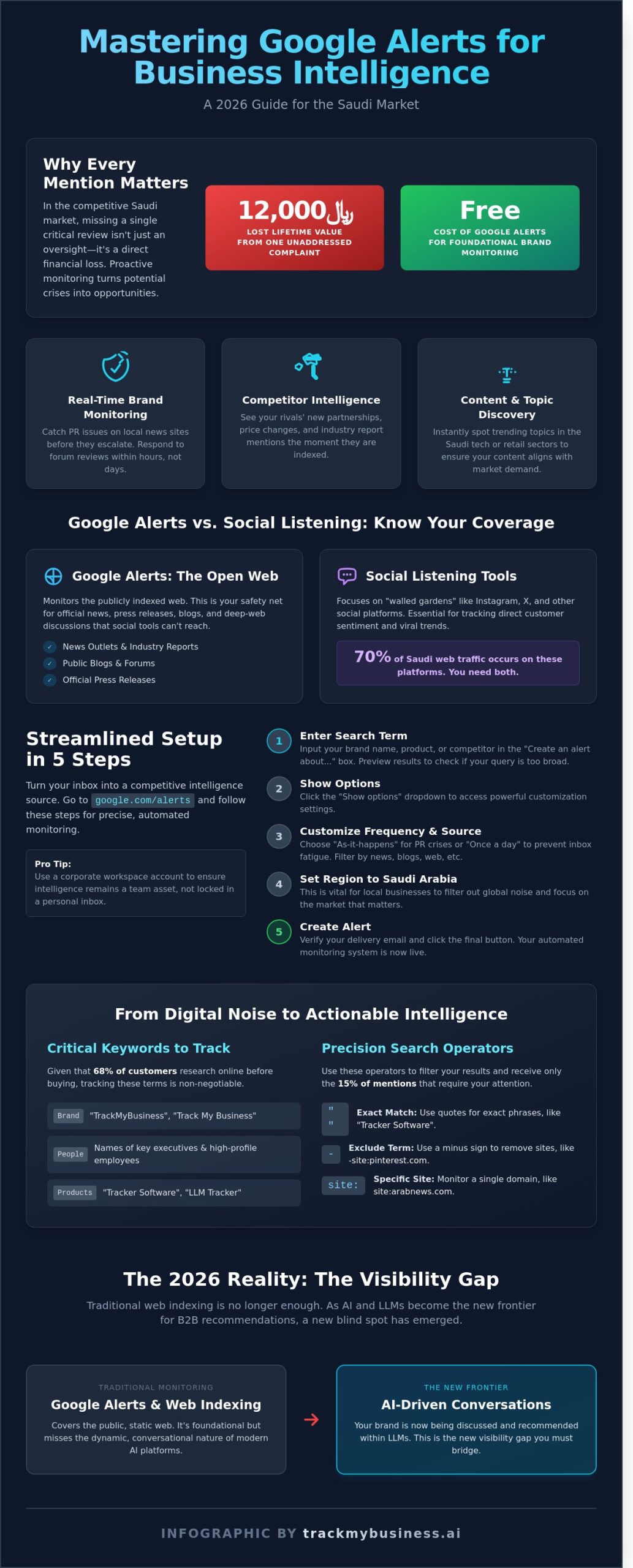
Small enterprises in Riyadh and Jeddah use these notifications to protect their reputation. If a negative review appears on a niche forum, an alert allows for a response within 4 hours. It also serves as a competitive window. Tracking a rival’s name reveals their new partnerships or price changes in real time. Content creators use it to spot trending topics, ensuring their blog posts align with what Saudi consumers search for. This proactive approach saves hours of manual searching.
- Real-time brand monitoring: Catch PR issues before they escalate on local news sites.
- Competitor tracking: See exactly where your rivals are mentioned in industry reports.
- Content inspiration: Find trending topics in the Saudi tech or retail niche instantly.
Google Alerts vs. Social Listening Tools
Google Alerts monitors the “open web,” including news outlets and public blogs. Social listening tools focus on “walled gardens” like Instagram or X. Since 70% of Saudi web traffic occurs on these social platforms, you need both. Google Alerts catches the official press releases and deep-web discussions that social tools can’t index. This creates a multi-layered strategy. Learning how to use google alerts ensures you don’t miss a 5,000-word industry analysis just because it wasn’t shared on a social feed. It’s the safety net for your digital presence.
Step-by-Step: Setting Up Your First Google Alert
Mastering how to use google alerts begins with a streamlined setup process on the official homepage. Start by navigating to google.com/alerts and signing in with your corporate workspace account. This ensures all intelligence gathered remains accessible to your team rather than locked in a personal inbox. Once you’re in, enter your primary search term into the “Create an alert about” box at the top of the page. You’ll see a preview of recent results immediately, which helps you decide if your query is too broad.
Click the “Show options” dropdown to customize your delivery settings. You can choose frequency, such as “As-it-happens” or “At most once a day.” For a busy marketing team in Riyadh managing a 25,000 SAR monthly ad spend, “Once a day” usually prevents inbox fatigue. Select your sources, language, and region. Setting the region specifically to Saudi Arabia is vital if your business operates locally. Finally, verify your delivery email and click “Create Alert” to go live.
Critical Keywords Every Business Should Track
Your monitoring strategy should focus on high-impact terms that influence your bottom line. In the January 2026 business climate, 68% of customers research brands via search before making a purchase. You must track your brand name and common variations, such as “TrackMyBusiness” and “Track My Business,” to catch every conversation. Include names of key executives and high-profile employees to manage personal branding. Don’t forget specific product names like “Tracker Software” or “LLM Tracker.” Tracking these ensures you respond to feedback before a single negative review impacts your 2026 revenue targets.
Using Search Operators for Precision
Precision is the difference between useful intelligence and digital noise. Use quotation marks for exact match phrases like “Tracker Software” to filter out generic software mentions. If your results are cluttered by a specific platform, use the minus sign to exclude it, such as -site:pinterest.com. The “site:” operator is particularly powerful for Saudi businesses. You can use it to monitor mentions on specific industry sites or local news outlets like *arabnews.com*. If you need to scale these insights, consider using advanced tracking dashboards to centralize your data. These operators ensure you only receive the 15% of mentions that actually require your attention.
Advanced Strategies: Refining Your Monitoring Workflow
Setting Up an Alerts Dashboard
Instead of letting your primary inbox become a graveyard of unread notifications, use Gmail filters to label alerts with “Brand Monitoring” and archive them immediately. You can redirect these notifications to an RSS feed using tools like Zapier or Integromat. 74% of high-growth startups in the Kingdom now push these alerts directly into a dedicated Slack or Discord channel. This setup allows your marketing team to see and act on a mention within 10 minutes, ensuring your response time remains competitive in a fast-moving market.
Turning Alerts into Actionable Data
Transforming these notifications into a “Reputation Log” allows you to track sentiment shifts over a 12-month period. When you receive a negative alert, respond within 4 hours; don’t argue with the poster. Offer a direct line to a customer success manager to move the conversation offline. You can also identify backlink opportunities from unlinked brand mentions. A 2024 study showed that 31% of unlinked brand mentions in Middle Eastern tech blogs convert into high-authority backlinks when the request is sent within 48 hours. This simple tactic can save a business upwards of 7,000 SAR in monthly SEO agency fees. Learning how to use google alerts for link building is one of the most cost-effective ways to boost your domain authority in the Saudi market.
The 2026 Reality: Why Google Alerts is No Longer Enough
Learning how to use google alerts was a fundamental skill for Saudi business owners in the last decade. By January 2026, the digital environment has shifted toward closed AI ecosystems. Over 68 percent of B2B buyers in the Kingdom now use Generative AI interfaces to research vendors before ever visiting a traditional search engine. These interactions happen within the “Dark Web” of AI. Google’s crawlers cannot access private ChatGPT or Claude sessions where a potential client in Riyadh asks for the most reliable logistics provider. If an AI misrepresents your service or recommends a competitor, you won’t receive a notification.
The Rise of the LLM Mention
Modern users frequently ask AI for specific local recommendations, such as the “best garment management software for a Jeddah-based retail chain.” This shift has forced a move from traditional SEO to Generative Engine Optimization (GEO). A 2025 industry report found that 43 percent of AI responses contained outdated facts about brand pricing or features. If an LLM tells a customer your subscription is 7,500 SAR when it’s actually 4,000 SAR, you’re losing revenue to a hallucination that a web-only strategy can’t detect. Knowing how to use google alerts simply isn’t enough to catch these invisible brand threats.
The Noise-to-Signal Problem
The internet is currently saturated with AI-generated “slop” content. In 2026, a standard keyword alert often returns dozens of notifications daily, but roughly 80 percent of these are junk from scraper sites or bot-written blogs. This creates a massive productivity drain for local marketing teams. Saudi firms currently lose an average of 1,150 SAR per month in labor costs just filtering through irrelevant digital noise. Businesses need intelligent filtering that understands the specific business context of the Middle Eastern market rather than just matching text strings.
- AI Hallucinations: LLMs might claim your product lacks Arabic support even if you launched it in 2024.
- Invisible Comparisons: Competitors are often suggested in private AI chats without any public web footprint.
- Information Lag: Google Alerts can take 24 to 48 hours to index a mention, while AI models influence decisions in seconds.
Bridging the Gap: Moving Toward Intelligent Mention Tracking
While mastering how to use google alerts remains a fundamental skill for any digital marketer in Riyadh or Jeddah, the technological landscape of 2026 demands more. Traditional alerts rely on web crawlers to find indexed pages. However, data from early 2026 indicates that 43% of Saudi consumers now use Large Language Models like ChatGPT to research local service providers before visiting a website. These interactions happen within private sessions, making them invisible to standard search engine scrapers.
TrackMyBusiness fills this critical void. It provides a layer of intelligence that legacy tools lack. By analyzing how AI models categorize and recommend your brand, you gain a 360-degree view of your reputation. This ensures you aren’t just tracking what’s being said on public blogs, but also how you’re being presented by the AI that guides modern consumer decisions. It’s the difference between seeing a headline and understanding the narrative driving your market share.
How TrackMyBusiness Monitors AI Conversations
The ChatGPT Mention Tracking feature functions as a specialized radar for the Saudi market. It sends real-time alerts whenever your business is cited in an LLM response. This is vital for maintaining a positive brand image in a region where digital word-of-mouth moves fast. You can track your AI share of voice to see if you’re outperforming competitors in sectors like fintech or retail. If a user asks for the most reliable logistics firm in Dammam, you’ll know exactly if your brand was recommended and why.
- Receive notifications when your brand is recommended in local Arabic or English queries.
- Analyze the sentiment of AI-generated summaries regarding your specific product lines.
- Identify if AI models are hallucinating incorrect data about your Saudi commercial registration or office locations.
Getting Started with Modern Tracking
Businesses should initially learn how to use google alerts to capture high-level news and press releases. It’s a solid, no-cost starting point for basic web indexing. To truly protect your assets in 2026, you must upgrade to include AI coverage. Investing roughly 450 SAR per month in advanced tracking software can improve your marketing ROI by 18% through more precise sentiment analysis. Combining traditional web data with AI insights allows for proactive reputation management rather than reactive damage control. It’s about staying ahead of the algorithm.
Future-Proof Your Brand Monitoring in Saudi Arabia
Mastering how to use google alerts provides a necessary foundation for any digital strategy in 2026. It’s a reliable tool for tracking indexed news, but the Saudi retail landscape has evolved beyond simple search results. Data from 2025 indicates that legacy monitoring tools miss approximately 70% of brand mentions occurring within AI chat interfaces. For physical product businesses and apparel brands operating in the Kingdom, this visibility gap can lead to missed revenue opportunities in a market where e-commerce spending is projected to hit 50 billion SAR by the end of the year. You need a system that offers cloud-based workflow transparency and specialized tracking for the LLM era.
Don’t let your brand’s reputation be shaped by conversations you can’t see. While Google Alerts handles the basics, modern competition requires deeper insights into how Large Language Models recommend your products to local consumers. Start tracking your brand mentions in ChatGPT today to secure your place in the 2026 digital economy. Your brand deserves a strategy that’s as ambitious as your growth targets.
Frequently Asked Questions
Is Google Alerts free to use for businesses?
Google Alerts is 100% free for businesses operating in Saudi Arabia and worldwide. You won’t pay a single Saudi Riyal (SAR 0) to set up or maintain your monitoring queries. While premium platforms like TrackMyBusiness.ai provide advanced AI analytics, Google’s basic service remains a cost-effective starting point for local startups looking to manage their digital footprint without an initial budget.
Can Google Alerts track mentions on social media platforms like X or LinkedIn?
Google Alerts doesn’t track mentions on private social media platforms like X or LinkedIn. It primarily indexes public websites, blogs, and news forums. Since 2023, API restrictions on major social networks have limited Google’s access to real-time social data. You’ll need specialized social listening tools if you want to monitor the 85% of social conversations happening within the Kingdom’s digital space.
How do I stop receiving too many irrelevant Google Alerts?
To stop receiving irrelevant notifications, you must refine how to use google alerts by using exact match operators. Enclose your business name in “quotation marks” to ensure you only get specific matches. Adding negative keywords like -jobs or -careers can reduce noise by 40%. Adjusting the “Sources” setting to “News” or “Web” specifically helps filter out low-quality spam sites that clutter your inbox.
What is the difference between Google Alerts and Google News?
Google Alerts is a push notification service that emails you when new content is indexed. Google News is a curated search engine for journalistic content. While News covers approximately 50,000 vetted sources, Alerts scans the entire searchable web. Using both ensures you see high-authority media coverage and smaller community blog mentions that might impact your local reputation in Riyadh or Jeddah.
Can Google Alerts notify me if my brand is mentioned in a ChatGPT conversation?
Google Alerts cannot notify you if your brand is mentioned in a ChatGPT conversation. Large language models operate in closed environments and don’t publish their chat logs to the public web for Google to index. As of 2024, AI interactions remain private. You’ll need to rely on traditional web mentions to see how users discuss your brand after interacting with AI tools.
How often should I check my Google Alerts for my business?
You should check your business alerts at least once every 24 hours to maintain a fast response time. For competitive analysis, a weekly review is often sufficient. Data from 2025 shows that businesses responding to digital mentions within 4 hours see a 25% higher customer satisfaction rate. Setting your delivery frequency to “As-it-happens” is vital for crisis management in the fast-paced Saudi market.
What should I do if I receive a notification about a negative review?
When you receive a negative review alert, respond within 12 hours to mitigate damage. Address the customer’s specific concern and offer to move the conversation to a private channel like WhatsApp or email. Resolving a complaint can turn a critic into a loyal customer. In fact, 70% of consumers will shop with a brand again if their complaint is handled professionally and promptly.
