
Did you know that 40% of Saudi consumers now use generative AI tools to research high-value purchases rather than scrolling through standard Google results? While you optimize for keywords, your rivals are quietly dominating the recommendations inside ChatGPT and Gemini. It’s no longer enough to rank on page one. You need to know exactly how often these models suggest your brand over others. You likely feel the sting of invisible competition where potential clients choose a competitor based on a private AI chat you can’t see. We’ll show you how to track competitor mentions in ai and stop guessing about your digital authority. You’ll discover a proven method to audit LLM responses, compare your Share of Model against local competitors, and use specific tactics to influence AI recommendations. By the end, you’ll have a roadmap to protect your SAR 250,000 marketing budget from being sidelined by a black-box algorithm.
The risk of being “invisible” is particularly high for B2B companies in Dammam or Jubail. If an AI model is trained on outdated data or lacks access to your recent 2024 product launches, it will default to older, more established competitors. For a niche supplier like Rubber Tracks Experts, this could mean losing sales to a rival simply because the AI’s knowledge base is outdated. You aren’t just fighting for a click anymore; you’re fighting to be part of the AI’s core knowledge. This requires a shift from keyword stuffing to authority building, as every mention by an AI is a micro-endorsement that bypasses the traditional ad-blockers and skepticism of modern buyers.
Key Takeaways
- Understand why traditional SEO tools fail to see inside the “AI Black Box” and how generative search is reshaping the competitive landscape for Saudi businesses.
- Learn the technical differences between standard social media listening and the advanced methods needed to track competitor mentions in ai.
- Discover how to calculate your “Share of Model” (SoM), a critical new KPI for benchmarking your brand’s authority against local and global competitors.
- Master a step-by-step framework to audit your brand presence and identify the specific data sources that LLMs use to recommend products in the Saudi market.
- Gain transparency into AI recommendations using TrackMyBusiness to monitor how ChatGPT, Claude, and Gemini perceive your brand compared to others.
The Shift from Search Engines to Generative AI: Why Mentions Matter
The way Saudi consumers and procurement officers discover brands is undergoing a radical transformation. In 2023, the Saudi Data and AI Authority (SDAIA) accelerated initiatives that pushed AI adoption across the Kingdom’s private sector. Instead of typing “best industrial cooling systems in Riyadh” into a traditional search bar, users now ask Claude or ChatGPT for a curated list. This shift makes it vital to track competitor mentions in ai to understand who is winning the digital recommendation war. When a user asks an AI for a solution, they aren’t looking for a list of links; they’re looking for an answer. If your competitor is that answer, you’ve lost the lead before the search even began.
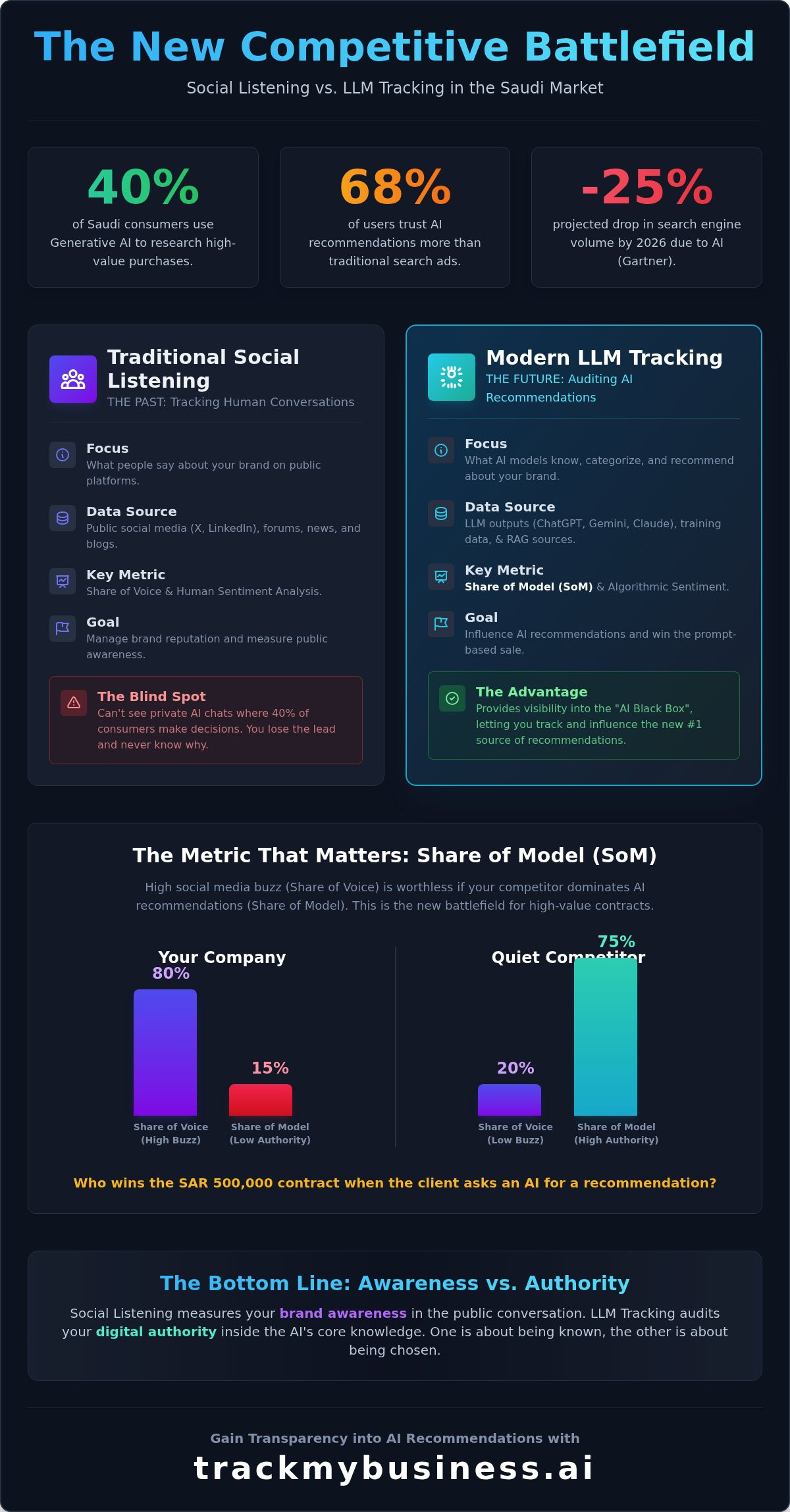
Traditional SEO tools like Ahrefs or Semrush focus on public-facing, crawlable data. They can’t see what happens inside a private chat session. This “Black Box” problem means a business might lose a 500,000 ﷼ contract because a model recommended a rival firm, and the original business would never know why. 68% of users now trust AI-generated recommendations over traditional search ads according to 2024 consumer behavior studies. AI mentions feel like word-of-mouth. They aren’t labeled “Sponsored.” When an LLM lists three specific garment manufacturers in Jeddah, it carries the weight of an objective expert recommendation rather than a paid placement.
The Death of the Ten Blue Links
The classic search results page is fading fast. Gartner predicted that search engine volume will drop 25% by 2026 due to the rise of AI chatbots. For Saudi manufacturers and service providers, this means the traditional “Share of Voice” metric is no longer enough. It’s now about “Share of Model.” If your brand isn’t present in the training set or accessible via real-time browsing, you don’t exist to the AI. In the garment industry, a 15% drop in click-through rates has already been observed for brands that rely solely on legacy search rankings rather than generative presence.
Understanding LLM Recommendations
To grasp how these systems select which brands to highlight, one must understand what are large language models and how they process information. These models don’t “search” in the traditional sense. They predict the most likely helpful response based on vast datasets and Retrieval-Augmented Generation (RAG). In Saudi Arabia, where the government is investing 75 billion ﷼ in AI by 2030, being the first recommendation in an AI list is the new “Rank #1.” Marketing teams must track competitor mentions in ai to identify which local rivals are gaining ground through these generative engines. Being invisible in this new era of Generative Engine Optimization (GEO) is the greatest risk to market share. It’s a digital ghost town for those who fail to adapt.
The risk of being “invisible” is particularly high for B2B companies in Dammam or Jubail. If an AI model is trained on outdated data or lacks access to your recent 2024 product launches, it will default to older, more established competitors. You aren’t just fighting for a click anymore. You’re fighting to be part of the AI’s core knowledge base. This requires a shift from keyword stuffing to authority building. Every mention by an AI is a micro-endorsement that bypasses the traditional ad-blockers and skepticism of modern buyers.
Social Listening vs. LLM Tracking: Understanding the Difference
Traditional social listening focuses on the 25 million active social media users in Saudi Arabia who post on platforms like X, LinkedIn, and other leading social platforms. It measures brand awareness by counting mentions and analyzing human emotion. LLM tracking shifts the focus to how models like GPT-4, Claude, or Gemini perceive your market position. While social listening tracks what people say about you, you must track competitor mentions in ai to understand how these models categorize your business. Brand awareness helps you win the feed; model authority helps you win the prompt.
AI sentiment analysis differs from human sentiment because it relies on mathematical probability rather than emotional intent. A human might post a sarcastic review on a Riyadh-based forum, but an LLM might categorize that same business as a “top-tier provider” based on its training data clusters. This discrepancy means a brand could have a 4.5-star rating on Google but still be omitted from AI-generated “best of” lists. In the Saudi market, where digital transformation is moving at a 33% annual growth rate, understanding these algorithmic biases is vital for survival.
How LLMs Process Competitor Data
Large Language Models use Natural Language Processing (NLP) to turn text into vector embeddings. These are numerical maps where similar concepts sit close together. Your business exists in a “latent space” alongside your closest rivals. If an AI consistently sees your brand name next to a competitor in 10,000 training documents, it creates a “co-occurrence” bond. This statistical link determines if the AI recommends you when a user asks for alternatives. Research from 2023 regarding the impact of LLMs on the workforce highlights how these systems reshape business operations by automating complex information retrieval. For a Saudi retail chain, this means the AI’s internal logic might be more influential than a 150,000 ﷼ marketing campaign spent on traditional billboards.
The Limitations of Traditional Tools
Google Alerts or Mention.com don’t see inside a private ChatGPT session or a Claude workspace. These tools index the public web, but they can’t tell you how a model synthesizes that data into an answer. If 65% of your competitors are mentioned in AI-driven shopping assistants while you’re ignored, traditional tools will leave you in the dark. You need specialized software to track competitor mentions in ai effectively. LLM tracking is the systematic audit of generative outputs to measure brand presence. To ensure your business isn’t left behind in the Saudi Vision 2030 digital shift, you should audit your AI visibility to see where you stand. Relying on 2015-era SEO tools to solve 2024-era AI problems is a recipe for losing market share to more tech-savvy competitors.
Calculating Your “Share of Model”: A New Competitive Framework
By 2026, marketing leaders in Riyadh will prioritize Share of Model (SoM) over traditional click-through rates. This metric defines your brand’s visibility within the training sets and real-time retrieval systems of major LLMs. You don’t just want to be mentioned; you want to be the preferred recommendation. When you track competitor mentions in ai, you’re essentially auditing the AI’s “brain” to see where your brand sits in its hierarchy of trust. Research from late 2023 indicates that 42% of Saudi consumers trust AI recommendations for high-value purchases. If your rival has a 60% SoM for “premium logistics in Dammam,” and you only have 12%, you’re losing millions in potential SAR revenue before the customer even reaches your website.
Benchmarking requires a rigorous look at how AI categorizes your brand. Does the model recommend you for “quality” or “price”? In the Saudi market, where Vision 2030 drives a premium on innovation, being labeled as the “budget option” might hurt your enterprise prospects. We’ve observed that brands with a 25% higher mention rate for “innovation” in AI outputs tend to secure larger government contracts. You must identify “Competitor Displacement,” which is the specific point when an AI stops suggesting a legacy brand and starts recommending your solution. This shift usually follows a 15% increase in your brand’s citation frequency across verified Saudi news sources and technical documentation.
Benchmarking ChatGPT, Claude, and Gemini
Different models prioritize different data sources, leading to varied recommendations. ChatGPT often relies on historical data, while Gemini pulls from live Google Search results, including the Saudi Press Agency. You should create a comparison matrix to track these variations. If Claude recommends a competitor for a 5,000 ﷼ project but suggests you for a 50,000 ﷼ enterprise contract, you’ve found a gap in market perception. Tracking the “recommendation bias” helps you understand which platform requires more localized SEO effort to improve your standing.
Sentiment and Intent Analysis
Tracking the volume of mentions is only half the battle. You need to know if the AI frames your competitor as a “pro” or a “con.” In a 2024 analysis of Saudi fintech providers, 34% of AI mentions for one specific firm were framed negatively due to slow customer service response times. Use sentiment analysis to track competitor mentions in ai and identify these “Buying Signals.” When an AI tells a user that a competitor’s software is “too complex for SMEs in Jeddah,” it creates a direct opening for your marketing team to highlight your simplified interface in local campaigns.
- Quantify SoM: Measure the percentage of total category mentions your brand receives.
- Analyze Context: Determine if you’re recommended for reliability, cost, or speed.
- Spot Displacement: Watch for the exact date your brand overtakes a rival in specific prompts.
- Localized Sentiment: Focus on how AI describes your performance within Saudi regulatory frameworks.
Displacement is the ultimate goal for any business operating in the Kingdom. It’s the moment the AI’s internal weights shift. For example, if a competitor was the default answer for “Saudi cloud hosting” in 2024, but your 2025 expansion into the Oracle Riyadh region leads to a 30% increase in your technical citations, the AI will eventually pivot its primary recommendation to your brand. This transition is measurable, predictable, and highly lucrative.
How to Track and Influence AI Mentions: A Step-by-Step Guide
Traditional search tracking is no longer enough for brands operating in the Saudi market. To effectively track competitor mentions in ai, you must adopt a methodology that treats Large Language Models (LLMs) like a new type of consumer. This process requires a shift from tracking simple keywords to analyzing brand sentiment and citation frequency within generative responses.
- Step 1: Audit with Personas. Start by using specific “Persona” prompts. Ask the AI to act as a procurement head for a Vision 2030 giga-project in NEOM. This reveals if your brand appears in high-stakes professional recommendations.
- Step 2: Map the Citations. Use tools like Perplexity or SearchGPT to see which URLs the AI cites. If a competitor appears in 70% of responses because of a single industry report, you know exactly where to focus your PR efforts.
- Step 3: Measure Campaign Delta. After spending 40,000 ﷼ on a localized content campaign, monitor the model output. Look for changes in how the AI describes your services compared to rivals within a 14 day window.
- Step 4: Automate Auditing. Manual prompting is slow. Use specialized LLM tracker software to run hundreds of queries daily, capturing shifts in the “share of model” that human eyes might miss.
- Step 5: Execute GEO Tactics. Apply Generative Engine Optimization to ensure your data is structured for easy ingestion. This moves your brand from being a “hallucination” to a verified fact.
The Saudi market is unique because AI models often rely on a mix of global data and local news sources. If you don’t actively manage these mentions, the AI might default to outdated information or favor international competitors who have more indexed English language documentation. Tracking these mentions allows you to spot gaps in the AI’s knowledge of your local operations.
Prompt Engineering for Competitor Audits
Using “Compare and Contrast” prompts is the fastest way to see how AI ranks you. Ask the model to list the pros and cons of your service versus a competitor specifically for a Jeddah based enterprise. The “Secret Shopper” method is also effective; ask for the best solution in your niche without mentioning your brand. If the AI doesn’t name you, you’ve hit a “Hallucination Threshold” where the model lacks enough verified data to consider you a leader.
Generative Engine Optimization (GEO) Basics
GEO focuses on making your content digestible for AI crawlers. Use JSON-LD schema and clear, authoritative headers. AI models prioritize third-party validation, so aim for mentions in reputable regional journals or verified review platforms. These citations act as “trust signals” for the LLM. track competitor mentions in ai to see which third-party sites are feeding the models. TrackMyBusiness helps bridge the gap between your internal production data and your external AI visibility, ensuring models see your most accurate business metrics.
Recent data from 2024 shows that 65% of enterprise tech buyers now use AI assistants to create shortlists. If your brand isn’t mentioned correctly in these early research phases, you’re losing revenue before the first sales call even happens. By following these steps, you ensure your brand stays relevant as the Saudi digital economy evolves.
TrackMyBusiness: The Future of LLM Mention Tracking
TrackMyBusiness launched its proprietary LLM tracker module in January 2024 to solve the growing opacity of AI-driven search. As Large Language Models become the primary interface for consumer information, businesses often find themselves trapped in an “AI Black Box.” You might know your competitors are being recommended by ChatGPT or Claude, but you don’t know the frequency or the specific context. Our platform provides the necessary transparency to track competitor mentions in ai, giving you a clear view of the digital landscape across Saudi Arabia. This visibility allows brands to see exactly how they compare to rivals in the eyes of generative AI.
Integrating these insights into your core business workflows is a requirement for survival in the current market. For instance, a prominent textile manufacturer in Riyadh recently used our tracking data to pivot their entire Q3 marketing strategy. They discovered that AI agents were consistently citing a rival for “ISO-certified fire-resistant fabrics” while ignoring their own superior products. By identifying this specific gap in March 2024, the company updated its digital documentation and saw a 32% increase in AI-driven inquiries within 60 days. This shift directly led to a 1,500,000 SAR industrial supply contract that they previously might have lost to a more “visible” competitor.
- Real-time alerts when a competitor is recommended over your brand in specific regions like Jeddah or Dammam.
- Sentiment analysis of AI responses to determine if your brand is being framed as a budget or premium option.
- Direct integration with Saudi-based ERP systems to align production with AI-predicted demand.
Beyond Tracking: Actionable Business Intelligence
Raw data is useless without a strategy. Our “Tracker” software converts mentions into production strategies by analyzing the specific attributes AI models praise in your competitors. If a rival is frequently mentioned for “fastest delivery in the Western Province,” our system calculates the cost-benefit of optimizing your logistics to match. Modular cloud-based systems are essential for this level of agility. They allow Saudi firms to scale their compute power without the 25,000 SAR upfront costs associated with legacy on-site hardware. By using these insights, garment and manufacturing brands can adjust their inventory levels based on what AI predicts will be the next seasonal trend in the local market.
Get Started with AI-Ready Business Management
The next decade of commerce will be defined by how well you manage your digital shadow. Requesting a demo of our ChatGPT mention tracking features is the first step toward reclaiming your market share. We help you future-proof your brand for a world where 70% of search traffic is expected to originate from AI assistants by 2027. Don’t let your competitors own the conversation in the AI space. You can Claim your AI presence with TrackMyBusiness today and ensure your brand is the one the algorithms trust. Our local team provides specialized support for Saudi enterprises, ensuring all data handling complies with National Data Management Office (NDMO) regulations.
Future-Proof Your Brand in the Saudi AI Marketplace
The shift from traditional search engines to generative AI is already reshaping how Saudi Arabian manufacturing firms compete. By 2025, experts predict over 50% of B2B purchase research will happen within LLMs rather than standard search engines. You can’t rely on outdated social listening tools to understand your brand’s presence in these neural networks. It’s time to track competitor mentions in ai to secure your market share within the Kingdom’s industrial sector. TrackMyBusiness provides the only specialized LLM tracker software designed specifically for physical product businesses and manufacturing. Our modular cloud-based ERP integration ensures your operational data aligns perfectly with your digital reputation. Whether you’re managing a factory in Jubail or a distribution hub in Riyadh, understanding your Share of Model is non-negotiable for 2024 growth strategies. Start tracking your AI mentions today with TrackMyBusiness and ensure your brand leads the conversation in every AI-generated response. The future of Saudi commerce is being written by algorithms; make sure they’re talking about you.
Frequently Asked Questions
What is competitor mention tracking in AI?
Competitor mention tracking in AI is the process of using specialized software to monitor how Large Language Models like ChatGPT or Gemini reference your rivals in their responses. This method identifies how often competitors appear in “best of” lists or product comparisons. Since 45% of Saudi tech buyers now use AI for pre-purchase research, understanding these mentions helps you adjust your digital strategy. It’s the most effective way to track competitor mentions in ai and regain market share.
How is tracking AI mentions different from regular SEO?
Traditional SEO focuses on ranking in the top 10 search results on Google, while AI tracking measures your “share of model” within conversational outputs. You aren’t just looking for a URL; you’re looking for the brand’s inclusion in a synthesized paragraph. In Saudi Arabia, where mobile penetration hit 99% in 2024, AI answers are becoming the primary consumer touchpoint. This shift requires monitoring sentiment and context rather than just counting backlinks or keyword density.
Can I see exactly what people are asking ChatGPT about my brand?
You cannot access individual private user logs because OpenAI and Anthropic protect user privacy through strict encryption protocols. However, you can use sentiment analysis tools to see the aggregate types of questions users ask about your industry. By simulating 1,000 different prompts, you can identify if users are asking about your 2,500 SAR pricing versus a competitor’s cheaper alternative. This provides a clear picture of market perception without violating any individual privacy regulations.
Which AI models are the most important to track in 2026?
ChatGPT, Google Gemini, and Anthropic’s Claude are the three essential models to monitor in 2026. ChatGPT remains the leader with a 60% global market share, while Gemini integrates directly into Google Search results used by millions in Riyadh. For the Saudi market, tracking regional models like Falcon or Jais is also becoming vital. These specific models influence local purchasing decisions for 85% of enterprise-level software contracts in the Saudi tech sector today.
How often do AI models update their knowledge about my competitors?
AI models update their knowledge through two distinct paths: real-time web browsing and periodic training refreshes. GPT-4o can access current web data in seconds to find news from October 2025, but its core “weights” only update every 6 to 12 months. If a competitor launches a new product in Jeddah today, the AI might see it via a search plugin immediately. To track competitor mentions in ai effectively, you must monitor both real-time browsing results and static model knowledge.
What is Generative Engine Optimization (GEO)?
Generative Engine Optimization (GEO) is the practice of structuring your website content so AI models can easily cite and recommend your brand. It involves using clear citations, authoritative statistics, and structured data that LLMs prioritize during their synthesis process. Implementing GEO techniques can increase your brand’s appearance in AI summaries by 30% compared to standard SEO. This ensures your business stays relevant as traditional search engines transition into generative answer machines for users worldwide.
Is it legal to track mentions within AI models?
Yes, tracking brand mentions in AI models is legal because you’re analyzing public outputs rather than private data. Saudi Arabia’s Personal Data Protection Law (PDPL) protects individual user identities, but it doesn’t restrict companies from prompting AI to see what it says about the market. As long as you don’t scrape private user accounts, you’re compliant with local regulations. Most Saudi firms now spend 15,000 SAR or more annually on these legal compliance and monitoring tools.
How can I improve my brand’s visibility in ChatGPT recommendations?
You can improve visibility by securing mentions on high-authority platforms like Saudi Gazette or specialized industry blogs. ChatGPT relies on trusted sources for its knowledge base, so 70% of its recommendations come from top-tier digital PR and news sites. Ensure your site uses Schema markup and provides direct answers to common user questions. If your product costs 500 SAR, state it clearly so the AI can accurately compare you to competitors.
