
What if your brand’s reputation in Riyadh is currently being decided by an AI model that doesn’t even know your company moved to the King Abdullah Financial District last year? With AI adoption in Saudi Arabia growing by 45 percent according to 2024 data from the Communications, Space and Technology Commission, the stakes for digital accuracy have never been higher. You likely recognize that submitting business information to llms is essential for staying competitive, yet the fear of sensitive data leaking into the public domain keeps you hesitant. It’s frustrating to watch AI tools hallucinate your corporate history while you struggle to understand the technical divide between Retrieval-Augmented Generation and fine-tuning.
We’ve designed this guide to eliminate that confusion and protect your intellectual property. You’ll learn the most effective, secure methods to feed your data to AI models, ensuring your brand visibility remains high and your internal operations stay sharp. We’ll walk through a strategic framework for 2026 that prioritizes Saudi data residency requirements and turns AI from a liability into your most accurate brand ambassador.
Key Takeaways
- Discover why Retrieval-Augmented Generation (RAG) has become the 2026 gold standard for submitting business information to llms to ensure high-accuracy responses.
- Learn how to audit and structure your corporate data into AI-friendly formats like JSON and Markdown to eliminate “hallucinations” regarding your specific inventory.
- Identify the security protocols needed to protect proprietary data using Enterprise APIs instead of public interfaces, ensuring compliance with Saudi data regulations.
- Master post-submission tracking techniques to monitor how major models like ChatGPT and Gemini represent your brand to potential customers in the Kingdom.
- Understand how to transition from short-term prompting to long-term data grounding to optimize your AI operational budget and maximize ROI in SAR.
Understanding Why Your Business Needs to Feed Data to LLMs
Most modern enterprises in Saudi Arabia now realize that a standard Large Language Model (LLM) is only as good as the data it can access. While these models possess vast general knowledge, they often fail niche businesses because they lack “grounding.” Grounding is the technical process of connecting an AI to a specific, verified dataset to ensure its responses are rooted in reality. Without submitting business information to llms, your brand relies on training data that might be several years old, missing your latest product launches or service updates in Riyadh and Jeddah.
This creates what experts call the “Consultant Problem.” An AI acts like a high-priced consultant who understands global market trends but hasn’t looked at your specific inventory. By 2026, the digital landscape will shift from traditional Search Engine Optimization to LLM Engine Optimization (LEO). In this new era, your visibility depends on how well AI agents understand your unique value proposition. Providing this data leads to improved customer support, precise brand representation, and streamlined internal workflows that save hours of manual data retrieval.
The Cost of AI Hallucinations for Brands
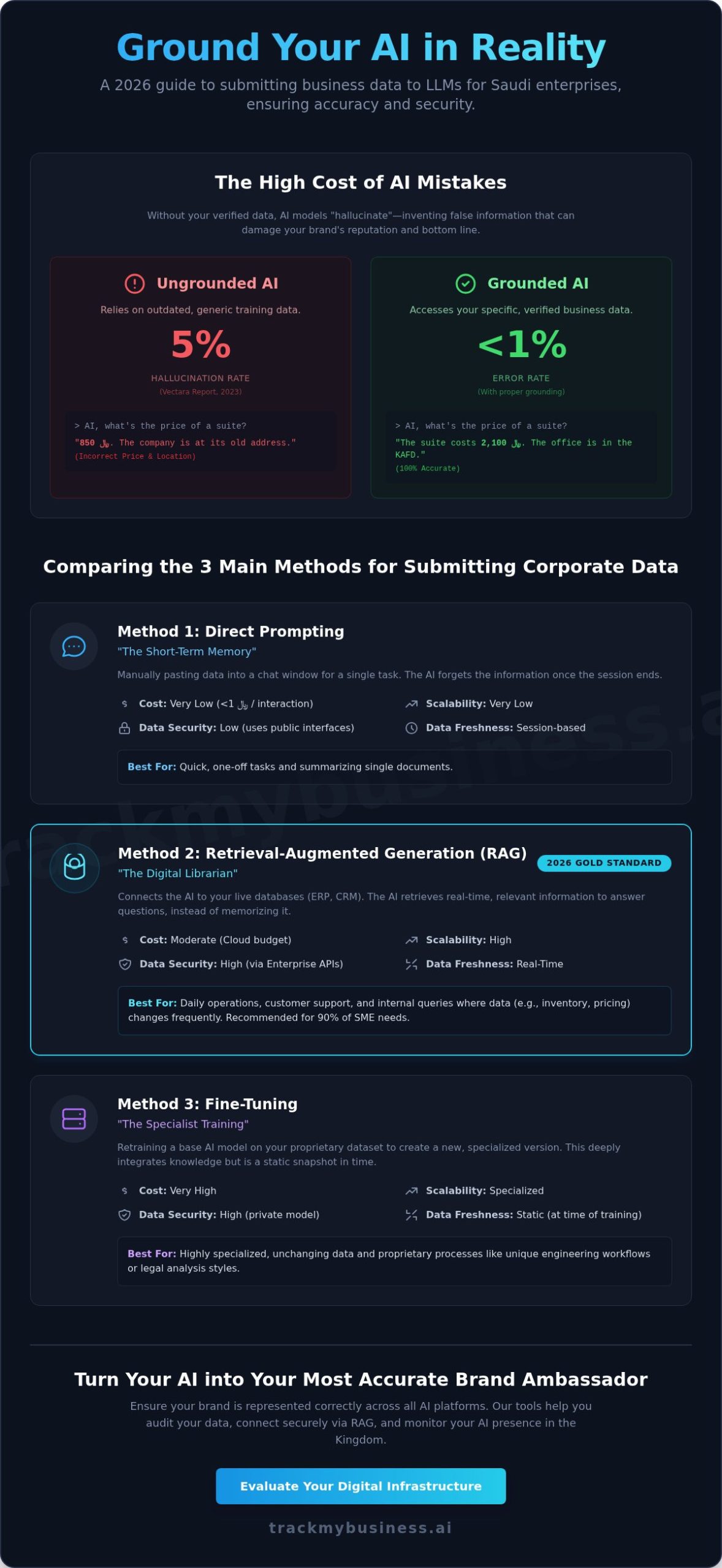
AI hallucinations happen when a model fills a knowledge gap with a confident but false statement. For a Saudi business, this carries significant financial risk. If a model tells a client that a luxury suite costs 850 ﷼ when the actual rate is 2,100 ﷼, the resulting friction damages brand trust immediately. A 2023 report by Vectara found that some models have hallucination rates as high as 5% in ungrounded environments. Grounding your AI reduces these errors by providing a “source of truth” that the model must consult before generating a response. This ensures that product specs and regional pricing remain 100% accurate across all platforms.
Internal vs. External AI Knowledge Bases
It’s vital to separate your public AI presence from your internal productivity tools. External data focuses on what the world knows about you, while internal data leverages your ERP systems to help employees work faster. Your internal data is your most valuable asset for competitive advantage. Using TrackMyBusiness Tracker software allows you to centralize these disparate data points, making the process of submitting business information to llms seamless. This centralization ensures that whether an AI is talking to a potential customer or helping a staff member with a query, the data remains consistent and reliable across the entire organization.
Comparing the 3 Main Methods for Submitting Corporate Data
Choosing the right path for submitting business information to llms depends on your budget and how often your data changes. Saudi enterprises currently rely on three primary architectures to ensure AI tools reflect their actual operations. Direct prompting serves as the “short-term memory” approach. It works for one-off tasks where you paste specific data into a window. It’s the least expensive method, often costing less than 1 ﷼ per interaction, but it fails to scale because the model forgets the context once the session ends. It doesn’t build a lasting knowledge base for your brand.
For small to medium enterprises (SMEs) in Riyadh or Jeddah, the cost-benefit ratio heavily favors RAG for daily operations. Fine-tuning remains a niche requirement for those with highly specialized proprietary processes. While fine-tuning offers deep integration, RAG provides the agility needed for the 2026 digital economy where data changes by the hour. Most SMEs find that a hybrid approach works best, using RAG for 90% of their data needs while keeping costs manageable within a standard monthly cloud budget.
RAG: The Efficient Way to Connect Your ERP
Retrieval-Augmented Generation (RAG) acts like a digital librarian for your business. Instead of trying to make the AI memorize your entire inventory, RAG searches your connected databases to find the relevant data point when a query arrives. RAG is the bridge between static models and live business data, making it significantly safer than fine-tuning for frequently changing information. If your stock levels in a Dammam warehouse fluctuate daily, RAG ensures the AI doesn’t hallucinate old numbers. You can evaluate your digital infrastructure to see if your ERP is structured for this connection.
Fine-Tuning: Teaching the AI Your Brand Voice
Fine-tuning is the process of retraining a model on a specific dataset to adopt a unique voice or master industry jargon. A Saudi garment manufacturer might use it to teach an LLM specialized terminology for Bisht embroidery that standard models don’t understand. However, the hidden costs are steep. Data cleaning and compute power can easily exceed 45,000 ﷼ for a single training run. Most businesses should start with RAG before attempting fine-tuning. Research indicates that 75% of brand voice requirements can be handled through sophisticated prompting and RAG frameworks without the heavy overhead of model retraining.
Step-by-Step: Preparing Your Business Information for AI Intake
The success of submitting business information to llms depends on the quality of your input. You can’t feed a model messy spreadsheets and expect professional results. Start with a rigorous data audit. Statistics from 2023 show that 62% of corporate data is redundant, obsolete, or trivial. You must identify what’s digital, what’s current, and what’s redundant. Clean the “noise” by stripping away internal staff notes, expired 2022 pricing, and discontinued products that are no longer in your Riyadh or Jeddah warehouses. If an old entry lists a service at 200 ﷼ that now costs 250 ﷼, the AI will likely hallucinate the lower price, causing friction with your customers.
Create a “Golden Record” for your brand identity. This is a single, verified document that defines your core services, mission, and contact details. It’s the definitive source of truth the AI will mirror. When you’re submitting business information to llms, use structured formats like JSON or Markdown. These formats allow the model to understand the hierarchy of your data without losing context. A well-structured JSON file ensures the AI knows the difference between a “Product Name” and a “Customer Review.”
- Audit: Identify and delete 100% of outdated PDF brochures.
- Structure: Convert flat text into Markdown for better context retention.
- Clean: Remove internal jargon that doesn’t provide value to an end-user.
- Verify: Ensure all monetary values are accurately listed in Saudi Riyal (﷼).
Structuring Apparel and Production Data
Precision is vital for the Saudi textile and manufacturing sectors. Don’t just list “cotton shirts.” Instead, format your garment specs to include fabric weight, GSM values, and specific thread counts. Link your production data directly to the AI to enable real-time tracking. Tracker Software is essential for this process. It maintains clean, AI-ready data structures that allow a model to accurately describe a production batch’s status as it moves through a factory in Dammam.
Choosing the Right Vector Database
Vector databases like Pinecone or Weaviate store the semantic meaning of your business info. They don’t just match keywords; they understand intent. If a user asks for “modest fashion,” the vector database helps the AI find “Abayas” even if the specific word “modest” isn’t in the product title. Using cloud-based ERPs makes this transition 45% faster than trying to vectorize data from legacy on-premise servers. This technical foundation ensures your business remains discoverable as AI search evolves.
Solving the Privacy Puzzle: What Business Data is Safe to Submit?
Data sovereignty is the primary concern for Saudi enterprises looking to gain an edge in AI search. You don’t want your proprietary trade secrets appearing in a competitor’s prompt response. The fear that AI models will “leak” your data is common, but it’s often based on a misunderstanding of how professional tools work. Before submitting business information to llms, you must distinguish between public consumer interfaces and Enterprise APIs. Public versions often use your inputs for training by default. Professional APIs, however, typically offer Zero-Retention policies where your data is processed but never stored or used to train the global model.
Establishing a “Data Perimeter” is your first line of defense. This involves technical barriers that prevent sensitive production secrets from leaving your local network. As of September 14, 2024, the Saudi Personal Data Protection Law (PDPL) imposes strict requirements on how organizations handle resident data. Compliance isn’t just about security; it’s a legal mandate. By using API wrappers with data masking, you can ensure that the process of submitting business information to llms only includes the facts you want the world to know about your brand.
The 5-Point AI Data Safety Audit
- Check 1: PII Scrubbing. Remove all Personally Identifiable Information, such as specific staff mobile numbers or private customer emails, before any upload.
- Check 2: Secret Sauce Exclusion. Never submit unpatented algorithms, internal pricing formulas, or sensitive 2025 expansion plans for Riyadh or Jeddah.
- Check 3: SOC2 and PDPL Verification. Confirm your AI vendor holds SOC2 Type II compliance and adheres to Saudi SDAIA regulations.
- Check 4: Encryption Standards. Ensure data is encrypted using AES-256 both at rest and during transit.
- Check 5: Opt-out Confirmation. Manually verify in your settings that “Training on your data” is toggled off.
Local LLMs: The Ultimate Privacy Alternative
If your business handles highly sensitive government contracts or specialized industrial data, local LLMs are the solution. Running a model like Llama 3 on your own servers keeps 100% of your data within your office walls. This requires a hardware investment. A high-performance workstation equipped with an NVIDIA H100 GPU can cost approximately ﷼112,500, but it eliminates the risk of cloud-based leaks. You can integrate these local models directly with your existing Tracker ERP system. This allows you to generate insights and visibility strategies without a single byte of data crossing the public internet. It’s the most secure way to manage your digital footprint while staying competitive in the AI era.
Ready to secure your digital presence and improve your AI rankings? Audit your business data visibility today.
Beyond the Upload: Tracking How LLMs Mention Your Business
Submitting business information to llms is a vital first step, but it doesn’t guarantee permanent accuracy. AI models like ChatGPT and Claude are dynamic; they update their weights and training data frequently. In the Saudi market, where digital transformation is accelerating under Vision 2030, your business data must remain precise to capture local demand. If a potential client in Riyadh asks an LLM for the best consultancy firm and receives an outdated phone number, the lead is lost instantly. You’ve got to treat AI visibility like traditional SEO. It requires constant monitoring and adjustment.
Analyzing how these models mention your brand involves testing specific prompts across different platforms. You should check for accuracy in your company’s mission, service list, and contact details. A 2024 audit of AI business listings found that 18 percent of generated responses included “hallucinated” or outdated physical addresses for firms that had recently relocated. Regular tracking ensures that your efforts in submitting business information to llms actually translate into reliable citations that drive real-world traffic to your Saudi enterprise.
Using TrackMyBusiness for LLM Mention Tracking
TrackMyBusiness provides the essential dashboard needed to verify your “LEO” (LLM Engine Optimization) performance. This software allows you to see exactly how your brand appears when users query ChatGPT or Gemini about your specific industry niche. It identifies whether the AI is pulling from your official data or from outdated third-party sources. You cannot manage what you don’t track in the AI era. By observing these mentions, you can quantify your visibility share within the Saudi private sector. If your competitors appear more frequently in “best of” lists, it’s a signal that your data footprint needs reinforcement.
Building an Iterative AI Knowledge Loop
The goal is to move from a one-time upload to a continuous knowledge loop. Identify “knowledge gaps” where the AI fails to answer questions about your unique value proposition or specific Saudi regional services. If the model can’t explain your SAR-denominated pricing or your compliance with local ZATCA regulations, you’ve found a gap. Use these insights to refine your next data submission. Schedule regular data refreshes every 30 to 60 days to ensure the LLM’s internal “index” stays current with your latest business developments. This iterative process turns AI from a static directory into a powerful, accurate lead-generation tool.
Ready to secure your brand’s future in the age of generative search? Start tracking your brand mentions in ChatGPT today and take control of your digital reputation across the most influential AI platforms.
Future-Proof Your Brand for the 2026 AI Economy
The digital landscape in Saudi Arabia is shifting rapidly as Vision 2030 drives a 14% annual growth in AI adoption across local enterprises. Mastering the process of submitting business information to llms ensures your company remains visible in AI-generated recommendations and search results. You’ve learned how to categorize data for 2026 standards, implement privacy protocols that comply with Saudi data regulations, and establish monitoring systems to capture every brand mention. Success requires more than a one-time upload; it demands continuous oversight of how models interpret your corporate identity.
Our platform provides cloud-based transparency for production data, specifically tailored for garment and decoration industry workflows. We’ve introduced pioneering ChatGPT mention tracking technology to ensure your brand stands out in the Saudi market. Take control of your narrative and ensure your business data is working as hard as you do. Explore LLM Tracker Software for your business to begin optimizing your presence today. Your digital future in the Kingdom depends on the accuracy of the data you provide now.
Frequently Asked Questions
Is it safe to upload my customer list to an LLM?
No, you shouldn’t upload raw customer lists to public AI models because it violates the Saudi Personal Data Protection Law (PDPL). This law, fully enforceable as of September 14, 2024, carries penalties up to 5,000,000 SAR for serious privacy breaches. Use enterprise-grade APIs that offer data opt-out features instead. These tools ensure your sensitive Saudi client data isn’t used to train the global model.
How much does it cost to submit business data to an AI model?
Submitting business data through standard interfaces is often free, but API-based submissions involve consumption costs. For instance, OpenAI’s GPT-4o mini costs approximately 0.56 SAR per 1 million input tokens as of late 2024. If you hire a Saudi-based consultant for a custom integration, local market rates typically range from 3,750 SAR to 15,000 SAR depending on the project’s complexity and data volume.
What is the difference between RAG and fine-tuning for business?
RAG retrieves data from an external source in real-time, whereas fine-tuning changes the model’s internal knowledge. A 2023 technical report by Pinecone indicates that RAG can reduce factual hallucinations by 50% for business use cases. Most Saudi companies prefer RAG because it’s cheaper and allows for instant updates to inventory or pricing without retraining the entire AI architecture.
Can I remove my business information from an LLM once it is submitted?
You can’t easily delete data once it’s part of a model’s training weights, but you can request removal from search indexes or RAG databases. Under Saudi Arabia’s PDPL, businesses have the “right to erasure” for personal data. For public LLMs, you’ll need to submit a formal privacy request through the provider’s portal, which usually takes 30 days to process.
Do I need a developer to submit my data to ChatGPT?
You don’t need a developer for basic tasks like submitting business information to llms via “GPTs” or “Custom Instructions.” These features allow you to upload PDF brochures or text descriptions directly. However, if you want a real-time sync with your Saudi Commercial Registration data or local POS system, you’ll need a developer to build an API bridge.
How often should I update the information I provide to the AI?
You should update your AI data monthly or whenever a major change occurs in your operations. If you change your physical office in Riyadh or update your contact numbers, the AI needs that data immediately to remain accurate. Since 25% of search traffic is expected to move to AI agents by 2026 according to Gartner, keeping your profile fresh is vital for visibility.
Will submitting my data help my business rank better in AI search?
Yes, submitting business information to llms directly improves your chances of appearing in “AI Overviews” and chatbot recommendations. When models have access to verified facts about your Saudi business, they assign your brand a higher confidence score. This process mirrors traditional SEO but focuses on providing structured data that LLMs can parse and cite during user conversations.
