Optimizing for voice search is about way more than just keywords. It means structuring your content to answer questions like a human would, making sure your technical SEO is airtight, and keeping your local business data obsessively clean.
It’s about becoming the single, most trusted answer that an assistant like Siri or Alexa can serve up in an instant.
Why Your Business Needs a Voice Search Strategy Now
The way your customers find you has already changed. This isn't some future trend we're talking about; it's the millions of conversations happening right now on smartphones, smart speakers, and in cars. We’ve moved far beyond just typing words into a search bar. People now ask direct, spoken questions and expect an immediate, accurate answer.
Assistants like Siri, Alexa, and Google Assistant have rewired user behavior. This shift from search to conversation has massive implications, especially for local businesses where the stakes are highest. When a potential customer asks for a recommendation "near me," being invisible means you just don't exist in that critical moment.
The Immediate Risks of Inaction
Ignoring this evolution isn't just a missed marketing opportunity—it's a direct business risk.
Imagine a customer asking their smart speaker for your store hours, only to be told you're closed based on some outdated info scraped from a random directory. That’s a lost sale and a frustrated person who probably won't try again.
The problem gets worse with generative AI. These systems can invent answers on the fly, and they often get things wrong. An incorrect AI-generated answer—a "hallucination"—could wreck your reputation by misstating your services or even making up negative information about you.
For local businesses, voice search is the new storefront. If your digital door is locked with incorrect hours or a wrong address, customers will walk right past to a competitor who has their information in order.
A Critical Shift in Customer Behavior
This isn't just a niche behavior, either. A huge 58% of consumers use voice search to find local business information. Even more telling, 76% of smart speaker users are doing local searches every single week. This is a massive, engaged audience looking for immediate solutions.
To really get a handle on this, you need to think about evolving your marketing strategy from SEO to AEO (Answer Engine Optimization). It’s not just about ranking anymore; it's about becoming the definitive answer.
This table breaks down the core differences in user behavior, making it clear why a new approach is essential.
Voice Search vs Traditional Search At a Glance
| Characteristic | Traditional Search (Typing) | Voice Search (Speaking) |
|---|---|---|
| Query Length | Short, keyword-based (e.g., "plumbers near me") | Longer, conversational (e.g., "Who's the best plumber near me that's open now?") |
| User Intent | Often research-oriented, comparing options | Highly specific, immediate action (e.g., "Call…") |
| Result Format | A list of 10 blue links (SERP) | A single, direct answer |
| Device Used | Desktop, laptop, smartphone | Smart speaker, smartphone, in-car assistant |
As you can see, the game has completely changed. Getting your voice search strategy right isn't just another marketing task—it's a core business function you need for survival and growth.
Winning Featured Snippets for Voice Answers

Here's the first thing you need to get straight about voice search: assistants like Siri and Alexa don't read you a list of options. They give you one answer. That single, definitive response is the only thing that matters, and it completely changes the game.
Where does that one answer come from? More often than not, it's pulled directly from a featured snippet—that answer box at the very top of Google's results, also known as "Position Zero." This is the grand prize. When you win the snippet, your content literally becomes the script for a voice assistant.
Deconstructing Voice Search Intent
To claim that spot, you have to think like someone talking, not typing. Voice searchers aren't piecing together choppy keywords; they're asking real, conversational questions because they need a specific answer, right now.
Someone doesn't type "plumber 24/7." They'll ask their phone, "Hey Google, which plumbers near me are open right now for an emergency?" This shift from keywords to natural language is everything. Your content has to be built from the ground up to provide direct answers to these long-tail, conversational queries.
The golden ticket to being heard is the featured snippet. Voice assistants grab answers from these "Position Zero" results about 50% of the time, making it the most critical piece of digital real estate for voice visibility. It's also worth knowing that pages ranking there load 52% faster on average, which tells you a lot about what Google values.
Uncovering Your Customers' Real Questions
So, how do you figure out what questions to answer? The best clues are probably sitting in your own business data. Your customer service logs, sales call notes, and support tickets are absolute gold mines of real-world language.
Listen to the exact phrases your customers use. What are their most common frustrations and points of confusion? Those are the questions you need to be answering clearly on your website.
Beyond your own data, you can use specialized tools to see what question-based queries people are actually asking online in your industry. These platforms give you a sense of search volume and competition, helping you pick the right battles. You might also want to explore our guide on competitor AI analysis tools to see what questions your rivals are successfully answering.
Structuring Content for Voice Readouts
Once you have your target questions, you need to format your content so search engines can instantly understand it and turn it into a featured snippet. This isn't about jamming in keywords; it's about clarity, structure, and providing an immediate, direct answer.
Google wants content that's dead simple to parse. That means using formatting that breaks information into logical, scannable chunks.
Here are the tactics I've seen work time and time again:
- Question-Based Headings (H2s & H3s): Treat your page like a mini-FAQ. The subheading should be the exact question you're targeting. "How Do I Unclog a Kitchen Sink?" is infinitely better than a vague heading like "Plumbing Services."
- The Inverted Pyramid Answer: Right below that heading, give a concise, direct answer. Aim for a single paragraph of 40-50 words. This is the perfect, bite-sized summary Google is looking for to create the snippet.
- Bulleted and Numbered Lists: After the direct answer, you can elaborate with a simple list. Voice assistants love reading lists aloud, which makes them incredibly effective for how-to steps or breaking down product features.
A Practical Content Transformation
Let's make this real. Imagine a local bakery's website has a generic paragraph about their custom cakes. It’s okay, but it's not going to win any voice searches.
Before Optimization:
"We offer a wide variety of custom cakes for all occasions, including birthdays, weddings, and corporate events. Our expert bakers can create stunning designs based on your specifications, using only the finest ingredients. Contact us for a consultation to discuss your needs."
This is fine for a human skimming the page, but it’s useless for a voice assistant. Now, let's restructure it.
After Optimization:
What Types of Custom Cakes Do You Offer?
We design and bake custom cakes for any special occasion. Our team specializes in creating unique cakes for birthdays, weddings, graduations, anniversaries, baby showers, and corporate functions, ensuring every celebration is memorable.
We can create:
- Multi-tiered wedding cakes
- Themed birthday cakes for kids and adults
- Elegant cakes for anniversaries
- Branded cakes for corporate events
- Custom cupcakes and cake pops
See the difference? By using a clear question, a direct answer, and a clean list, you've made it effortless for Google to grab your information and serve it up as the definitive voice answer. That's the secret to winning Position Zero.
Nailing the Technical Foundation for Voice Search
Let's get one thing straight: amazing content is only half the story. If your website’s technical guts aren’t in order, even the most perfect answers will never make it to a user’s smart speaker. Think of technical SEO as the plumbing. Without it, nothing flows.
You can’t just write good stuff and hope for the best. Voice assistants need to understand your site’s information instantly and without any guesswork. To do that, you have to speak their language, and their language is structured code.
The Real Powerhouse: Schema Markup
When it comes to voice search, Schema markup (also called structured data) is the most critical tool you have. It’s a special vocabulary you add to your website's code to explicitly tell search engines what your content is about.
Instead of making Google guess your business hours from a paragraph of text, you can literally label them. This eliminates all ambiguity, allowing assistants like Siri and Alexa to pull precise data with total confidence. For anyone serious about voice search, schema isn’t just a nice-to-have; it's the entire game.
Here are the non-negotiable schema types you need to focus on:
- LocalBusiness Schema: An absolute must for any company with a physical address. This is how you define your name, address, phone number (NAP), hours, and even link to your menu or services.
- FAQPage Schema: Perfect for any page that answers common questions. By marking up your FAQs, you’re basically handing Google a ready-made voice answer on a silver platter.
- HowTo Schema: Got a blog post that walks through a step-by-step process? This schema breaks down the instructions into a clean, sequential format that an assistant can easily read aloud.
Getting LocalBusiness Schema Right
For any local business, LocalBusiness schema is your direct line to "near me" searches. It's how you feed assistants the core information people are asking for on the go.
You can define everything from your address and phone number to the types of payment you accept. By implementing this correctly, you’re creating a digital business card that search engines can read and trust in a split second.
Here’s what a simple JSON-LD example looks like for a restaurant. You’d place this snippet of code in the <head> section of your website’s HTML.
{
"@context": "https://schema.org",
"@type": "Restaurant",
"name": "The Corner Bistro",
"address": {
"@type": "PostalAddress",
"streetAddress": "123 Main Street",
"addressLocality": "Anytown",
"addressRegion": "CA",
"postalCode": "12345"
},
"telephone": "+1-555-555-5555",
"openingHours": "Mo-Fr 11:00-22:00, Sa 10:00-23:00"
}
This code leaves zero room for error. When someone asks their phone, "Is The Corner Bistro open right now?" the assistant knows exactly where to find the answer.
Pro Tip: Don't just set your schema and forget it. If you change your hours for a holiday or update your menu, your structured data has to be updated immediately. Inaccurate schema is far worse than no schema at all.
Don't Forget Site Speed and Mobile Design
Beyond schema, two other technical pillars are absolutely vital: site speed and mobile-friendliness. The huge majority of voice searches happen on mobile devices, and people expect answers now. A slow, clunky site will get skipped over every time.
Google has been using mobile-first indexing for years, which means the mobile version of your site is what truly matters for ranking. Adopting a solid mobile-first design strategy is essential, as most voice queries originate from a smartphone.
Your site absolutely must be:
- Fast: Aim for a load time under 3 seconds. Use tools like Google's PageSpeed Insights to find and crush anything that's slowing you down.
- Secure: Using HTTPS is a baseline requirement. It's a matter of trust and a confirmed ranking factor.
- Responsive: Your design needs to adapt perfectly to any screen, ensuring a great experience whether it’s on a phone or a tablet.
When you combine clean, specific schema with a fast, secure, and mobile-first website, you build the kind of technical foundation that doesn't just compete for voice answers—it wins them.
Winning Local Voice Search with Perfect Business Data
When someone asks their phone, "Where's the best coffee shop near me?" or "Is there a hardware store open now?" they aren't just browsing. They're on the move and ready to buy. For most brick-and-mortar businesses, this is the entire voice search battlefield. And it's almost always local.
Your most powerful weapon in this fight isn't your website—it's your digital storefront, the Google Business Profile (GBP). This single profile is the source of truth for Google Assistant, providing the business hours, address, and phone number that gets read aloud. An incomplete or wrong GBP is like having the wrong address painted on your front door.
The Makings of a Flawless Google Business Profile
Optimizing your GBP for voice isn't a one-and-done task; it's an ongoing commitment to keeping your data spotless. Voice assistants need absolute certainty to make a recommendation, and a fully fleshed-out profile gives them that confidence.
Think of it as a checklist for getting found:
- Ironclad NAP Consistency: Your Name, Address, and Phone number need to be identical everywhere online. I'm talking character for character. No "St." in one place and "Street" in another. Even tiny variations create doubt for search algorithms.
- Get Granular with Categories: Don't just list "Restaurant." Be specific. Are you a "Pizzeria," an "Italian Restaurant," or a "Family Restaurant"? The more precise your primary and secondary categories are, the better Google can match you to those hyper-specific voice queries.
- Obsess Over Your Hours: This means regular hours, holiday hours, and any special event hours. Incorrect hours are probably the fastest way to lose a potential customer and earn a scathing one-star review.
- Own Your Q&A Section: The Questions & Answers part of your GBP is a goldmine that most businesses ignore. Your customers are asking questions right there on your profile. If you don't answer them, anyone else can. Get ahead of it by pre-populating this section with your own FAQs to control the narrative.
The Domino Effect of a Single Data Error
Let's see how one tiny piece of bad information can completely derail a customer journey.
Imagine a local spot, "The Corner Bistro." Their official GBP says they close at 10 PM. But an old, forgotten listing on a minor business directory says they close at 9 PM. A family on vacation asks their phone, "Find a family-friendly restaurant near me that's open until 10."
The assistant, seeing conflicting data, might just play it safe and leave The Corner Bistro out of its recommendation entirely. Or worse, it could pull the wrong 9 PM closing time and tell the family the bistro is already closed. Just like that, a table for four is gone.
The frustrated family heads to another restaurant. Later, they might even leave a one-star review on that incorrect directory, complaining, "Said they were open but they weren't." A single data inconsistency has now snowballed into lost revenue and a dent in their online reputation.
This is why data hygiene is non-negotiable. It’s not just about Google. Your business information must be perfectly consistent across the entire local search ecosystem—from Yelp and TripAdvisor to Apple Maps and Waze. Each platform is a potential source for a voice assistant's answer.
Building an Ecosystem of Trust
To really dominate local voice search, you have to make sure every single touchpoint a search engine might find presents the same, flawless information. This means going through the painstaking work of auditing your presence on major data aggregators and local directories, or using a listing management service to do it for you.
When a voice assistant finds your business name, address, phone number, and hours repeated perfectly across dozens of trusted sources, it builds an incredibly powerful signal of authority. This digital consensus tells the algorithm that your information isn't just a claim—it's a verifiable fact. And that’s how you become the one, definitive answer people hear.
Navigating the New Reality of AI-Generated Answers
The optimization game has completely changed. For years, we focused on winning featured snippets, assuming voice assistants would just read them out. That era is over. Now, large language models (LLMs) like Gemini, ChatGPT, and Claude are crafting custom answers about your business on the fly, and our traditional SEO toolset is utterly blind to what they're saying.
This creates a massive, unnerving blind spot. What happens if an AI confidently tells a customer you're permanently closed when you're not? Or worse, what if it fabricates a product recall that never happened? These aren’t just hypothetical scenarios; this is happening to businesses right now.
The Real Threat of AI Hallucinations
These dangerously incorrect, AI-generated answers have a name: “hallucinations.” This is what happens when an AI model, trying its best to be helpful, presents completely fabricated information as cold, hard fact. Lacking real-time, verifiable data, it just invents the most plausible-sounding response it can.
For any business, the fallout can be immediate and painful.
- A restaurant could be listed with the wrong hours, losing an entire evening's worth of customers.
- A retail shop might be described as not carrying a certain brand, sending a customer with cash in hand straight to a competitor.
- An AI could invent a negative news story or summarize one bad review as the overall consensus, torching your reputation in an instant.
The true danger of AI hallucinations is that they are delivered with the exact same tone of authority as factual information. Customers have no reason to second-guess them, making the misinformation incredibly potent and difficult to undo once it’s out there.
Shifting to Proactive Monitoring in an AI-First World
You can no longer just tweak your website, build a few links, and hope for the best. Winning in this new era requires a modern, proactive strategy to monitor and manage what AI assistants are telling people about you. That means systematically testing your brand across every major AI model.
This process is especially critical for local businesses, as AIs rely heavily on local listing data to answer location-based queries.
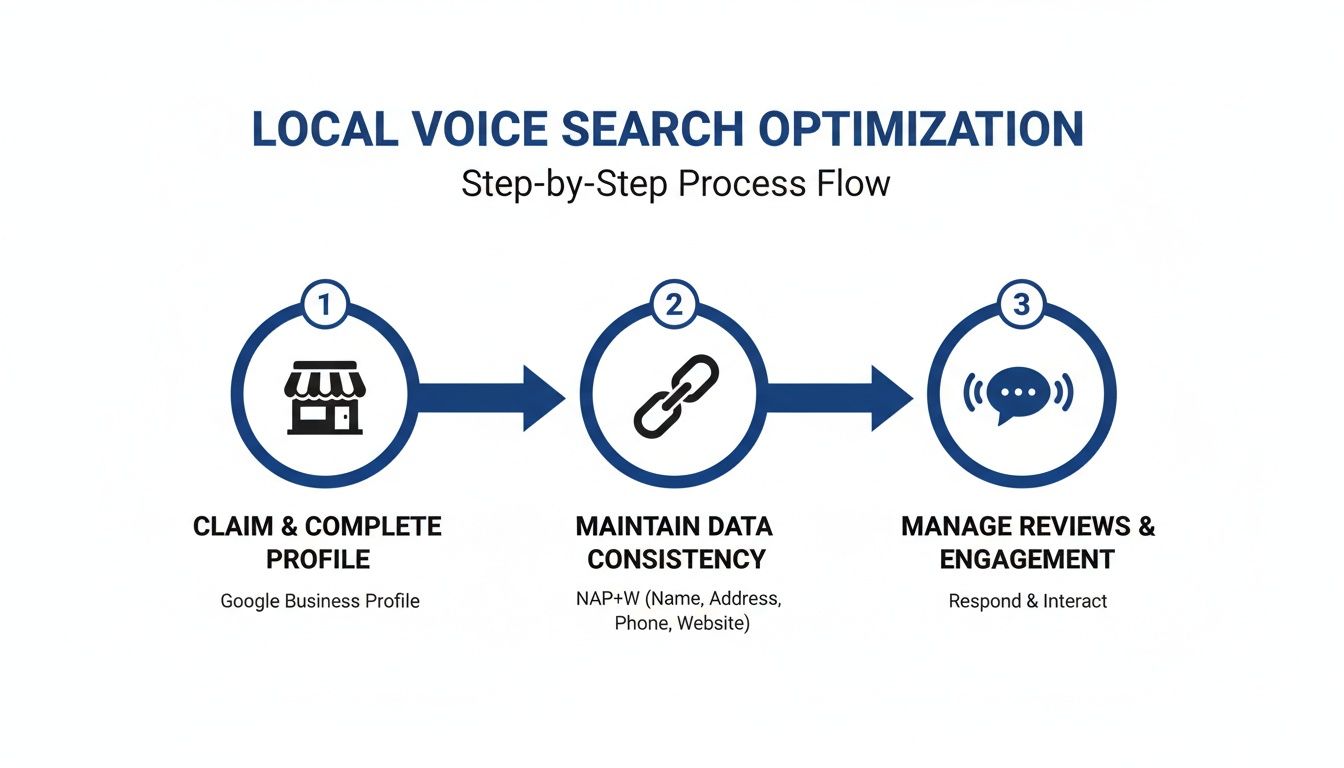
This flow—from a complete business profile to consistent data and active management—is your first line of defense. It's about feeding AIs reliable information to minimize the risk of them making things up.
Turning a New Risk into a Competitive Edge
The goal here isn't just to play defense. By actively listening to the AI conversation, you can flip this unknown risk into a powerful source of competitive intelligence. When you regularly scan these platforms, you don’t just find mistakes about your own brand; you see exactly how AIs perceive your competitors, too.
To stay on top of this, you need a repeatable operational process. Here's a simple operational checklist to get you started.
I've put together a simple table to show how you can structure this ongoing monitoring. This isn't a one-time audit; it's a new, essential part of your marketing rhythm.
Voice Search & AI Monitoring Checklist
| Task | Frequency | Tools Needed | Key Metric |
|---|---|---|---|
| Audit Core Brand Queries | Weekly | ChatGPT, Gemini, Perplexity | Accuracy of Brand Info |
| Test Competitor Queries | Bi-Weekly | ChatGPT, Gemini, Perplexity | Competitor Mentions/Sentiment |
| Check Local Service Queries | Monthly | Voice Assistants (Siri, Alexa) | Correct NAP Data (Name, Address, Phone) |
| Scan for Inaccurate Data Sources | Monthly | Google Search, Web Monitoring Tools | Number of Inconsistencies Corrected |
| Review & Update GMB/Apple Maps | Monthly | GMB Dashboard, Apple Business Connect | Profile Completeness Score |
| Log and Report Hallucinations | As Found | Internal Spreadsheet/Tracking Tool | Number of Hallucinations Detected |
By following a checklist like this, you move from a reactive position to a strategic one.
Instead of waiting for an angry customer to tell you they were sent to the wrong address, you're actively managing your brand’s story in the world of AI. For agencies that need to do this at scale, specialized LLM visibility tracking tools can automate much of this detection and analysis, making it a manageable part of your client services.
This is how you find and fix problems before they can do any real damage.
Common Questions About Voice Search Optimization
Even with a solid plan, you're bound to run into questions when you start putting theory into practice. Let's dig into some of the most common ones that pop up as businesses get their hands dirty with voice search, from content strategy to the new world of AI monitoring.
Think of this as a field guide to help you navigate the tricky spots and push past any roadblocks.
Do I Need to Create a Separate Page for Every Single Question?
Absolutely not. In fact, please don't. Creating dozens of thin, single-answer pages is an old-school SEO tactic that will do more harm than good today.
The much smarter approach is to build comprehensive, pillar-style pages that cover a whole cluster of related questions. Imagine a local plumbing service. Instead of making four different pages, they should have one powerhouse page titled "Leaky Faucet Repair."
That single page can easily answer:
- "What are the common causes of a leaky faucet?"
- "How much does it cost to fix a dripping sink?"
- "Can I repair a leaky faucet myself?"
- "When should I call a plumber for a leak?"
By grouping these queries, you create a single, authoritative resource. Google sees this as the definitive destination for the entire topic, making it far more likely to get picked for a voice search answer.
What’s the Real Difference Between Voice Search and AI Chat?
This is a critical distinction, especially now. To a user, asking Siri a question feels a lot like asking ChatGPT, but what happens behind the scenes is completely different. Your strategy needs to account for both.
- Traditional Voice Search (think Siri or Google Assistant) is on a mission to find one existing, verifiable answer from a trusted website. Winning here is all about classic SEO fundamentals: earning featured snippets and having flawless structured data.
- AI Chat Answers (from tools like ChatGPT, Gemini, or Perplexity) act more like a research assistant. They synthesize information from many different sources to create a brand-new, summarized answer. They don't just read from your page; they report the web's general consensus.
This means that for AI chat, your brand’s overall digital presence matters even more. One perfectly optimized page won't cut it if ten other websites have conflicting info about your business. Consistency is king.
I’m Overwhelmed. What’s the Single Most Important First Step?
If you don't know where to begin, start with your Google Business Profile (GBP). Seriously. For any business with a physical location, this is the single most impactful thing you can do.
Your GBP is the source of truth for Google Assistant when it comes to your hours, address, phone number, and services. An incomplete or out-of-date profile is the fastest way to become invisible in "near me" voice searches. Before you even think about website content or schema markup, make sure your GBP is 100% complete and accurate.
A perfectly optimized Google Business Profile is the foundation of any local voice search strategy. It’s a direct feed of trusted information to Google, dramatically reducing the chance that an AI assistant will pull incorrect data or "hallucinate" your business details.
How Can I Actually Measure the ROI of All This?
This is a tough one, I'll admit. The analytics tools haven't quite caught up yet, so you won't find a neat "voice search" channel in Google Analytics. The secret is to track a basket of related KPIs that, together, paint a clear picture of your progress.
Focus on tracking these three metrics:
- Increases in Featured Snippets: Use an SEO tool to see how many "Position Zero" rankings you're capturing for your target questions. More snippets often translate to more voice answers.
- Growth in "Near Me" Impressions: Dive into your GBP Insights. Are you seeing a steady climb in discovery searches or queries that include terms like "near me" or "open now"? That’s a great sign.
- Rise in Click-to-Call Actions: A jump in direct calls coming from your Google Business Profile or mobile site is a strong indicator that people are using voice search to connect with you.
By keeping an eye on these secondary metrics, you can build a compelling case for how your voice optimization efforts are driving real business. For a deeper look at measurement strategies, you can explore more on our main blog page.
What are AI assistants like ChatGPT and Gemini really telling customers about your brand? Don't guess. TrackMyBiz gives you the complete picture, scanning AI models to flag inaccuracies, track competitor mentions, and show you exactly where you stand. Start your free scan today and turn AI from a risk into your new acquisition channel at https://trackmybusiness.ai.
