
Are you tired of scrolling through endless, generic product pages on Noon or Amazon.sa, searching for that one perfect item? You’ve likely turned to AI for help, asking for the “best coffee machine for under 800﷼” or “top-rated smartphone in Riyadh,” only to receive a list that feels disappointingly familiar. The digital marketplace in Saudi Arabia is evolving rapidly, and understanding how to get product recommendations from AI is no longer just a clever shortcut-it’s a crucial skill for both discerning consumers and forward-thinking businesses fearing invisibility in this new landscape.
In this 2026 guide, we will dive deep into the art of smart discovery. I notice that many users struggle with crafting effective prompts, so we will show you precisely how to get hyper-personalized product lists tailored to your exact needs. For brands, we’ll demystify the emerging world of Generative Engine Optimization (GEO), revealing the strategies needed to ensure your products are recommended by AI and how you can begin tracking your brand’s visibility within these powerful language models. Get ready to transform how you find-and are found-online.
Key Takeaways
- Learn the ‘Context-Constraint-Criteria’ framework to craft precise prompts that deliver perfect product suggestions from AI, saving you time and effort.
- Discover how businesses must transition from traditional SEO to Generative Engine Optimization (GEO) to ensure their products are recommended in the new AI-driven search landscape.
- Understand why 2026 marks the shift to ‘Zero-Click’ discovery, a fundamental change in how consumers across Saudi Arabia will find and purchase products online.
- Mastering how to get product recommendations from ai involves using specific techniques, like assigning the AI a ‘Persona’, to receive highly tailored and accurate results.
The Evolution of Discovery: From Search Engines to AI Curators
The way we find products is undergoing a fundamental shift. Instead of typing keywords into a search bar, we are now learning how to get product recommendations from ai through direct conversation. At its core, modern AI product recommendation is a process where Large Language Models (LLMs) use Retrieval-Augmented Generation (RAG) to understand your request, retrieve relevant, up-to-date product information, and generate a tailored suggestion. This is a significant leap from the classic recommender system which relied on simpler user behavior patterns.
I notice a clear trend towards what analysts are calling ‘Zero-Click’ discovery, a concept expected to dominate by 2026. This means you get your answer-the perfect product-directly from the AI without clicking through multiple retail websites. The primary difference lies in context versus keywords:
- Traditional Ads: Show you a product because you searched for a related keyword in the past.
- AI Suggestions: Recommend a product because it understands your current, specific need, drawing from your digital footprint and the immediate context of your query.
The Death of the Keyword?
Simple, 2-3 word searches are becoming less effective. The rise of ‘conversational commerce’ means shoppers now use detailed, intent-based queries. An AI can interpret a vague request like, “Find durable workwear for an embroidery business in Jeddah,” by inferring the need for sturdy, stain-resistant fabric that can withstand machine use. It moves beyond keywords to understand user goals, making the discovery process far more efficient.
The Role of LLMs in Product Curation
Models like ChatGPT, Claude, and Gemini are evolving into personal shoppers for high-intent users. Their ability to access real-time data is crucial; it allows them to check current stock and pricing on Saudi Arabian e-commerce sites, ensuring recommendations are immediately actionable. As we approach 2026, I observe that the issue of ‘hallucinations’ or fabricated information is decreasing significantly in product-related queries, making AI a more reliable tool for anyone figuring out how to get product recommendations from ai.
Mastering the Prompt: How to Get Precise Product Recommendations
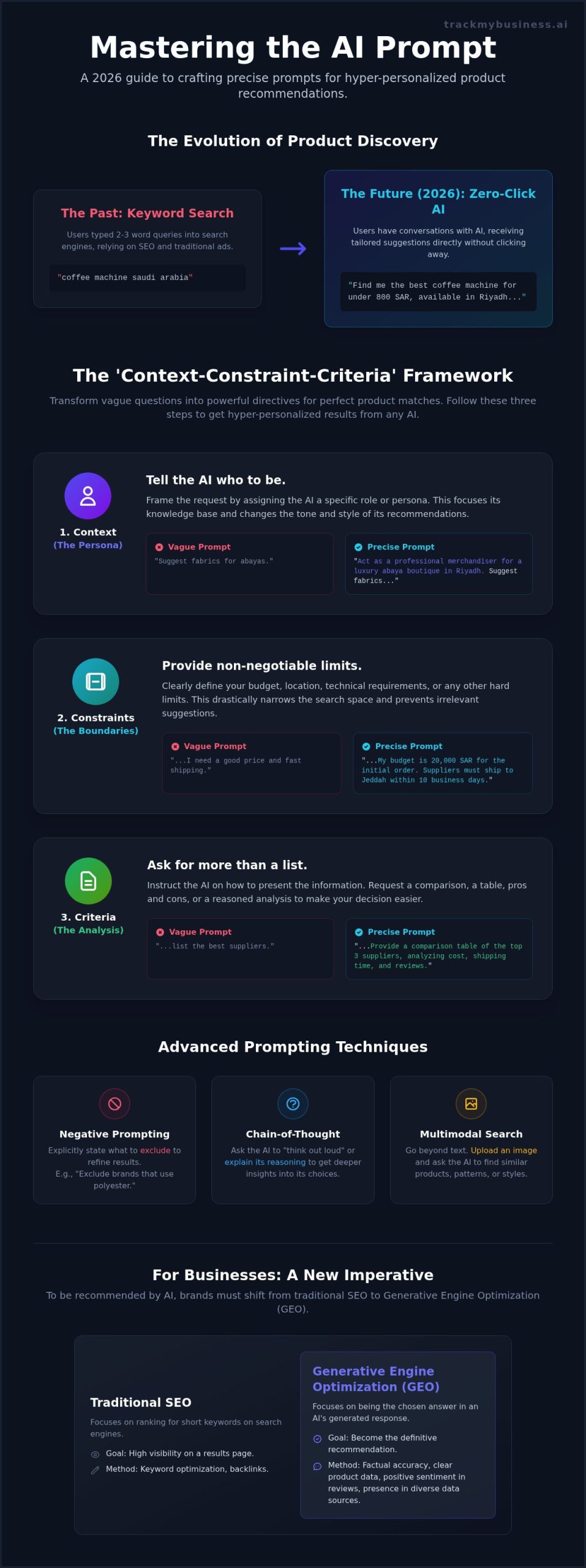
The key to unlocking an AI’s full potential lies in the quality of your prompt. Vague questions yield generic answers. To truly understand how to get product recommendations from ai, you must provide clear and detailed instructions. At its core, the AI isn’t thinking; it’s following complex patterns based on its training data. A deeper understanding of how AI recommendation algorithms work shows they thrive on specific inputs. We recommend the ‘Context-Constraint-Criteria’ framework to structure your requests for superior results.
This simple three-step process transforms a basic query into a powerful directive:
- 1. Context (The Persona): Tell the AI who to be. Instead of just asking for products, start with a role. For example, “Act as a professional merchandiser for a luxury abaya boutique in Riyadh.” This frames the entire recommendation process.
- 2. Constraints (The Boundaries): Provide specific, non-negotiable limits. This is where you define your budget, location, and technical needs. For instance, “My budget is 20,000 SAR for the initial order. Suppliers must be able to ship to Jeddah within 10 business days and provide proof of material origin.”
- 3. Criteria (The Analysis): Ask for more than a list. Request a structured comparison. For example, “Provide a comparison table of the top 3 suppliers, analyzing cost per unit, shipping time, and customer reviews.”
Additionally, use ‘negative prompting’ to refine results further by explicitly stating what to exclude. For example, you could add, “Exclude any brands that rely heavily on polyester or have a minimum order quantity above 500 units.”
Advanced Prompting Techniques for Shoppers
Go beyond the basics by asking the AI to “think out loud” with Chain-of-Thought prompting, such as, “Explain your reasoning for why Supplier A is a better fit for a new business than Supplier B.” For visual searches, leverage multimodal AI by uploading an image and prompting, “Find similar fabric patterns to the one in this photo, available from suppliers in the GCC.” You can also steer the AI away from mainstream choices by asking for “hidden gem” or “emerging” designers instead of just the “top-rated” ones.
Industry-Specific Prompt Examples
Here’s how to get product recommendations from AI using targeted, industry-specific prompts:
- Sustainable Apparel: “Act as a sustainable sourcing expert. Find three suppliers of GOTS-certified organic linen that deliver to Saudi Arabia. My budget is up to 90 SAR per meter. Compare their color options and stock availability.”
- Management Software: “As an IT consultant for a small fashion startup in Dammam, recommend the best apparel management software under 1,200 SAR per month for a team of 5. Prioritize features like inventory tracking and integration with local payment gateways like Mada.”
How AI Decides: The Logic Behind the Recommendation
To understand how to get product recommendations from AI, we first need to look inside the “black box.” I notice that Large Language Models (LLMs) don’t make random suggestions; they are sophisticated evaluation engines. They weigh signals like brand authority-how often a brand is cited as an expert-and the sheer volume of customer reviews. A deep understanding of this logic is central to the business case for AI recommendations, as it reveals a predictable system rather than a lottery.
The significance of structured data, like Schema.org, cannot be overstated. When a product page clearly labels its price (e.g., 250 ﷼), model number, and stock status in a machine-readable format, the AI can process it with higher confidence. This data is then cross-referenced with sentiment analysis from third-party reviews. The AI doesn’t just count stars; it analyzes the language of reviews from forums and e-commerce sites across Saudi Arabia to determine if the sentiment is genuinely positive, thereby building ‘trust’ in a product.
Finally, the impact of ‘freshness’ is growing. In a fast-moving market, a product review from 2024 is far less influential than a detailed discussion from last week. By 2026, we expect AI models to heavily prioritize the most recent data points, making a continuous and recent online presence more critical than ever.
Data Sources for AI Recommendations
AI models gather information from two primary sources: vast amounts of publicly scraped web data and, increasingly, licensed partnerships with data providers. In the Saudi market, social media ‘buzz’ on popular platforms provides a strong signal of a product’s current relevance. For highly specialized B2B queries, such as finding the best ‘Apparel ERP’ or ‘Production Software’, the AI often gives more weight to discussions and recommendations found within niche industry forums and professional networks where expert opinions are shared.
The Bias Factor in AI Discovery
It’s crucial to recognize that AI is not perfectly objective. Some LLMs can exhibit ‘brand favoritism’ if their training data was saturated with information about a few dominant market players. Furthermore, a model with a training data cutoff date in 2023 might be unaware of a superior, more innovative product launched recently. To combat these issues, the industry is seeing the rise of ‘Evaluator LLMs’-specialized AI systems designed to double-check the quality, relevance, and lack of bias in the recommendations made by primary models.
Business Strategy: How to Get Your Products Recommended by AI
As consumers increasingly rely on AI for discovery, the old rules of Search Engine Optimization (SEO) are evolving. The new frontier is Generative Engine Optimization (GEO), where the goal is not just to rank for keywords, but to become a trusted, verifiable source in an AI’s knowledge base. For businesses in Saudi Arabia, this means building a deep, data-rich digital presence that conversational AI can understand and recommend with confidence. The fundamental question for brands is no longer just about visibility, but about verifiability.
The core of this strategy is building a ‘Citation Moat’-ensuring your brand and products are mentioned consistently across high-authority websites, from local news outlets like Arab News to prominent industry blogs. This creates a web of trust signals. Equally critical is the data you feed the AI. A clean, integrated Retail Inventory System is essential. When an AI can see you have 50 units of a specific thobe in stock in Jeddah, with accurate dimensions and material information, it can confidently recommend it over a competitor with messy or incomplete data.
Optimizing Your Digital Footprint
To be understood by AI, your content must be structured to answer conversational questions. This involves creating a digital ecosystem that provides clear, contextual signals about your products. Key actions include:
- Building FAQ Pages: Create detailed pages that answer natural language queries, such as “What is the best material for an abaya in Riyadh’s summer heat?”
- Encouraging Visual Content: ‘Unboxing’ and ‘how-to’ videos from local influencers provide powerful sentiment and usage data for AI models to analyze.
- Strategic PR: Securing guest features and mentions on respected regional platforms helps build authoritative ‘nodes’ in the AI’s knowledge graph, linking your brand to credibility.
The Role of Operational Transparency
AI values trust and consistency. Showing your operational data builds a verifiable profile that AI evaluators favor. By linking the data from your Apparel Management Software to your public-facing product pages, you can display details about sourcing and materials, building consumer and AI confidence. It is crucial to ensure your pricing and specifications are identical across all channels-from your e-commerce site to your listings on platforms like Noon. A price discrepancy of even 10 ﷼ between channels can create confusion and erode the AI’s trust in your brand, which is a critical factor in understanding how to get product recommendations from ai.
The New Essential: Tracking Your Brand Mentions in AI
In business, you cannot manage what you do not measure. As consumers in Saudi Arabia and beyond increasingly turn to AI for advice, this principle now extends to Large Language Models (LLMs) like ChatGPT. Simply hoping for positive mentions is not a strategy. Proactive brands are now tracking their presence within AI conversations, shifting focus from the traditional ‘Share of Voice’ (SOV) on social media to the new critical metric: ‘Share of Model’ (SOM).
SOM tells you how often and in what context an AI recommends your brand versus competitors. Understanding this is the first step in influencing future recommendations. A platform like TrackMyBusiness provides the necessary visibility, showing you precisely when and why your software is being suggested, giving you a crucial advantage in a rapidly evolving digital landscape.
How AI Mention Tracking Works
Gaining control over your AI narrative involves monitoring specific patterns. This isn’t just about counting mentions; it’s about understanding the context and impact, which can prevent issues that might cost your business thousands of ﷼ in lost revenue. Key areas to monitor include:
- Sentiment Trends: Analyzing whether AI-generated mentions of your brand are becoming more positive or negative over time, allowing you to correlate changes with your marketing efforts.
- Competitor Conquesting: Identifying instances where a user asks about your product, but the AI suggests a rival instead. This is a direct signal of a competitive threat you need to address.
- Negative Hallucinations: Using a tool like TrackMyBusiness to receive alerts when an AI fabricates incorrect and damaging information about your brand, so you can take corrective action.
Taking Action on AI Insights
Data is only valuable when you act on it. The insights from AI mention tracking provide a clear roadmap for improvement. For instance, if you discover that AI consistently highlights a specific capability as your ‘Top Feature’, you can adjust your marketing copy to emphasize it. This insight is central to learning how to get product recommendations from ai to work in your favor.
Similarly, tracking can reveal gaps in your product. If users frequently ask AI for features that your Fashion ERP software doesn’t have, that’s direct, actionable feedback for your product development team. By monitoring these conversations, you move from reacting to the market to proactively shaping your product and its perception within the world’s most influential new technology.
Start tracking your AI mentions with TrackMyBusiness today.
Embrace the AI Revolution: Your Final Takeaway
The landscape of product discovery in Saudi Arabia is rapidly transforming. As we’ve explored, mastering how to get product recommendations from ai is a crucial skill for both consumers and businesses. The key takeaways are clear: craft detailed prompts for precise results, and strategically optimize your brand’s digital footprint to become a top suggestion. Success in 2026 and beyond hinges on understanding and influencing these new digital curators.
But influencing AI is only half the battle; you must also track its impact. How do you know if your brand is being recommended? TrackMyBusiness provides the answer with its real-time LLM mention tracking. Specialized for the Garment & Embroidery industry in Saudi Arabia, our modular cloud-based system gives you the visibility you need to stay ahead. Don’t guess if your strategy is working-know for sure.
See How TrackMyBusiness Tracks Your Brand in AI and step into the future of commerce with confidence.
Frequently Asked Questions
Is there a way to pay for better AI recommendations?
Yes, many platforms in Saudi Arabia offer paid opportunities for enhanced visibility. Businesses can invest in sponsored listings on e-commerce sites like Noon or Amazon.sa, which uses AI to place your products before relevant customers. Some AI-driven recommendation services may also offer premium business profiles, with costs potentially starting around 200 ﷼ per month, to ensure more frequent or prominent placement in search results and suggestions.
How often does an AI update its product recommendations?
The frequency of updates varies widely. E-commerce platforms in the region update recommendations in real-time based on your browsing, new inventory, and what other shoppers are viewing. Other AI systems, like content recommendation engines, might update daily or weekly. The key factors are the volume of new data being processed and the specific purpose of the AI model, ensuring suggestions remain timely and relevant to current market trends.
Can AI help me find wholesale suppliers for my garment business?
Absolutely. AI-powered B2B platforms are excellent tools for sourcing suppliers. You can input specific requirements for your garment business-such as fabric type, minimum order quantity, and price points-and the AI will match you with potential wholesale suppliers in Riyadh, Jeddah, or internationally. These tools analyze supplier reliability, production capacity, and reviews to streamline your procurement process and help you find trusted partners more efficiently.
What is the difference between SEO and Generative Engine Optimization (GEO)?
Search Engine Optimization (SEO) focuses on improving your website’s visibility on traditional search engines like Google. It involves keywords, backlinks, and technical site health. Generative Engine Optimization (GEO) is a newer field focused on ensuring your brand and products are accurately and positively represented in the answers provided by AI chatbots like ChatGPT. GEO prioritizes structured data, factual accuracy across the web, and positive sentiment in the AI’s training sources.
How do I know if ChatGPT is recommending my business to users?
Directly tracking mentions within AI chats is not yet possible. However, you can look for clues by monitoring your website analytics for referral traffic from unknown sources. The most practical method is to regularly query the AI yourself. Ask it questions related to your industry or products to see if your business is mentioned. This helps you understand how the AI perceives your brand when users ask how to get product recommendations from ai in your niche.
Does using specific software like ‘Tracker’ help my AI visibility?
Using brand monitoring software, which we can refer to as a ‘tracker’, does not directly boost your visibility to an AI. Instead, these tools are crucial for monitoring what is being said about your brand online. By tracking mentions and sentiment, you can identify inaccuracies or negative feedback. This information is vital for your GEO strategy, as it allows you to correct misinformation and build a stronger, more positive digital presence for AI models to learn from.
What should I do if an AI is giving incorrect information about my product?
If an AI provides incorrect details about your product, the first step is to find the likely source. AIs learn from public web data, so update your official website, Google Business Profile, and major Saudi business directories with accurate information. Ensure your product descriptions, pricing in SAR, and specifications are consistent everywhere. For some AI models, you can also use a “feedback” or “report error” feature to directly flag the incorrect information for review.
Are AI recommendations more reliable than traditional expert reviews?
AI and expert reviews offer different types of reliability. AI recommendations excel at personalization by analyzing massive datasets to match products to your specific behavior and preferences. Expert reviews, on the other hand, provide in-depth, nuanced assessments based on human experience and technical testing. For the best results, use both: leverage AI to discover options tailored to you, then consult expert reviews to verify the quality and performance before purchasing.
