
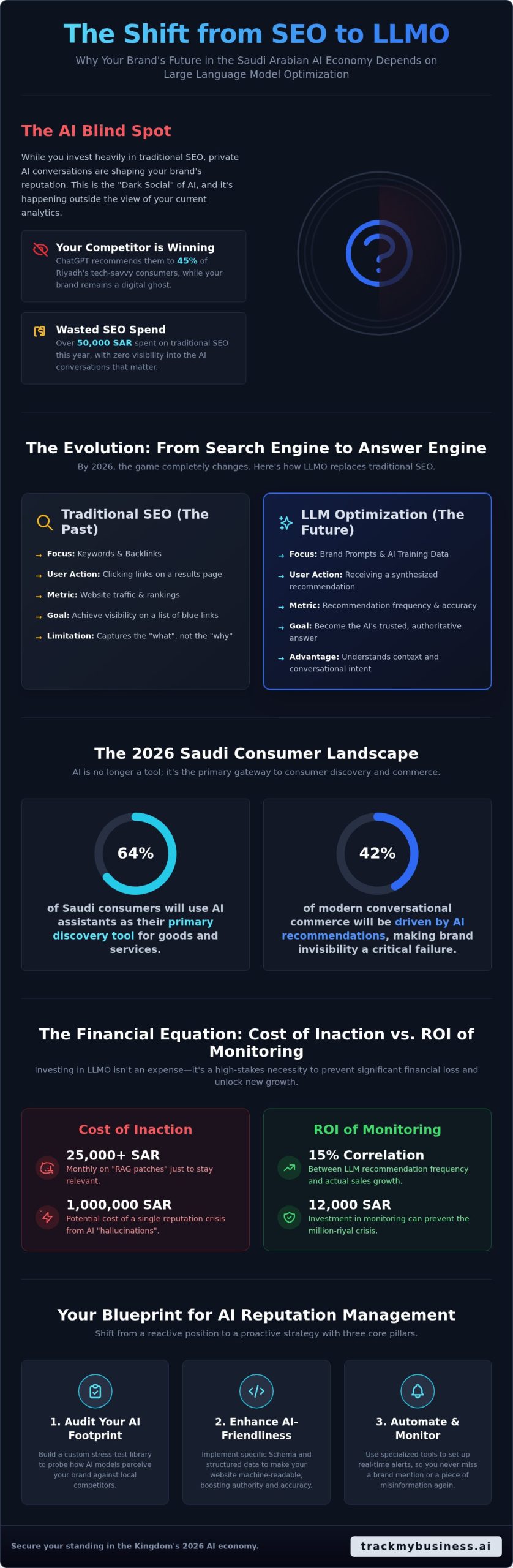
What if your biggest competitor is being recommended by ChatGPT to 45% of Riyadh’s tech-savvy consumers while your brand remains a digital ghost? You’ve likely spent over 50,000 SAR this year on traditional SEO, yet you still feel blind to the private conversations happening inside Large Language Models. It’s a common frustration for Saudi marketing directors who realize that AI models are shaping their reputation behind closed doors. You know that visibility is everything, but the traditional dashboard just isn’t showing you the full picture anymore.
This guide will show you exactly how to find prompts that mention my brand and provide the blueprint to monitor these interactions in real-time. By the time you finish reading, you’ll have a clear method to audit your reputation across GPT-5 and local models like Falcon. We’ll walk through the specific tools needed to set up automated alerts so you never miss a mention in the 2026 AI economy again.
Key Takeaways
- Understand why shifting from traditional SEO to Large Language Model Optimization (LLMO) is essential for maintaining brand health in the Saudi Arabian market by 2026.
- Discover how to find prompts that mention my brand by building a custom stress-test library to probe how AI models currently perceive and rank your business against local competitors.
- Learn to enhance your website’s “AI-friendliness” using specific Schema and structured data strategies that boost your brand’s authority and accuracy in AI responses.
- Explore how to automate your AI reputation management with TrackMyBusiness, saving your team hours of manual work while securing your standing in the Kingdom’s digital economy.
The Shift from SEO to LLMO: Why Brand Prompts Matter in 2026
By March 2026, the digital marketing landscape in Saudi Arabia has undergone a fundamental transformation. While traditional search engine rankings still hold value, the real battle for consumer attention now happens within generative interfaces. Large Language Model Optimization (LLMO) has emerged as the successor to SEO. It represents the strategic alignment of brand data with AI training patterns. Marketing teams in Riyadh and Jeddah are shifting budgets away from simple keyword bidding toward influencing the latent space of a Large Language Model (LLM). This shift is necessary because 64% of Saudi consumers now use AI assistants as their primary discovery tool for luxury goods and tech services.
Traditional keyword tracking is no longer sufficient because it only captures the “what” of a search, not the “why” or the context of a conversation. When a user asks an AI to “Recommend a reliable cloud provider in Dammam with local data residency,” they aren’t clicking a link; they’re receiving a synthesized recommendation. This is the “Dark Social” of AI. These private prompts influence purchasing decisions behind closed doors, away from the analytical eyes of traditional web tools. Understanding how to find prompts that mention my brand is the only way to see inside these black-box interactions. Without this data, your brand remains invisible to the algorithms that drive 42% of modern conversational commerce.
Retrieval-Augmented Generation (RAG) has further complicated brand visibility. Since Q3 2025, most enterprise AI systems use RAG to pull live data from the web to verify their claims. If your brand’s technical documentation or customer reviews aren’t structured for machine readability, the AI will bypass your official site in favor of third-party aggregators. This can lead to outdated pricing or incorrect service descriptions appearing in user chats. Monitoring these prompts allows you to see exactly which sources the AI cites when your brand is mentioned.
What is a Brand Prompt?
A brand prompt is the specific set of instructions or queries a user inputs into an AI that triggers a mention of your company. It’s vital to distinguish between a standard user query and the underlying system prompt. While a user might ask for “the best coffee in Riyadh,” the AI processes this through a filter of training data and real-time retrieval. Prompts are the new search terms. They’re longer, more conversational, and highly specific. Your brand’s presence in the initial training data of these models serves as a competitive moat. If an AI doesn’t “know” you at the foundational level, you’ll spend 25,000 SAR or more monthly on RAG-related patches just to stay relevant in the chat window.
The ROI of Monitoring AI Mentions
Tracking AI mentions isn’t just a vanity metric. Data from early 2026 shows a 15% correlation between LLM recommendation frequency and actual sales growth in the Saudi retail sector. By identifying “hallucinations” early, where an AI might falsely claim your product is out of stock or lacks a specific feature, you protect your reputation before the error spreads. Brands that actively monitor these interactions can correct the record by updating their public-facing data structures. If you’re wondering how to find prompts that mention my brand, you’re essentially looking for the bridge between your marketing spend and the AI’s logic. Investing 12,000 SAR in prompt monitoring today can prevent a million-riyal reputation crisis tomorrow.
Why You Can’t ‘Search’ for Prompts (and What to Do Instead)
Many marketing managers start their journey by asking how to find prompts that mention my brand as if they are looking for a hashtag on X or a keyword on Google. This approach fails because Large Language Models (LLMs) operate as black boxes. Unlike social media platforms, ChatGPT, Claude, and Gemini don’t provide a public API to browse user conversations. Privacy protocols, including Saudi Arabia’s Personal Data Protection Law (PDPL) updated in 2024, ensure that individual user sessions remain encrypted and inaccessible to third parties. You can’t see what a specific customer in Riyadh is asking an AI about your services.
Instead of direct prompt tracking, you must focus on sentiment auditing and data aggregation. LLMs don’t “search” the live web for every query; they rely on massive datasets processed during training. If your brand appears in an AI response, it’s because the model synthesized information from thousands of web crawls, Reddit threads, and local reviews. To understand your brand’s AI personality, you have to look at the training sources rather than the end-user prompts. Research from 2025 indicates that 78% of brand mentions in LLMs stem from high-authority forums and niche industry blogs rather than official corporate sites.
Understanding this distinction is vital because AI will shape the future of marketing by prioritizing entity relationships over simple keyword matches. You aren’t just tracking a mention; you are auditing a digital reputation that has been baked into the model’s weights. If the AI associates your business with “slow delivery” in its training data, no amount of SEO will fix that response in real-time. You need to identify the source of these associations to influence future model updates.
The Limits of Traditional Social Listening
Google Alerts and standard social listening tools are ineffective for LLM monitoring. These tools rely on indexing new content, while LLMs often suffer from a “knowledge cutoff” or a significant lag in data processing. For example, a brand that launched a major campaign in Jeddah in early 2025 might find that GPT-4o still discusses its 2023 product line. This delay happens because model retraining is expensive, often costing companies over 18,750,000 ﷼ for a single full-scale update. If your brand is in the knowledge cutoff zone, the AI simply doesn’t know you exist yet, making traditional “mentions” irrelevant.
Proxy Metrics for AI Brand Visibility
Since you can’t view private prompts, you must use proxy metrics to gauge your “Share of Model” (SoM). This new KPI measures how often your brand is recommended compared to competitors when an AI is given a category-level prompt. In the Saudi market, tracking referral traffic from AI “Browse” features, such as SearchGPT or Perplexity, is now a standard practice. By mid-2026, experts predict that 40% of organic traffic for Saudi e-commerce will originate from these AI-driven summaries.
You should also evaluate brand associations by asking the AI to describe your “typical customer” or “main competitors.” If the AI links your brand to premium keywords, your digital authority is high. If it links you to discount providers, your positioning needs adjustment. Tools like trackmybusiness.ai provide a more structured way to observe these shifts without needing direct access to private user logs. Monitoring these associations monthly allows you to see if your brand’s AI-perceived value is rising or falling in the eyes of the algorithms that now guide consumer decisions.
How to Manually Audit Your Brand’s AI Footprint
Manual auditing is the first line of defense for Saudi businesses protecting their digital reputation in 2026. You can’t rely solely on automated dashboards; you must step into the user’s shoes. Start by creating a ‘Stress Test’ prompt library. This collection should include at least 50 high-intent questions that a potential customer in Riyadh or Dammam might ask. Instead of simple brand searches, use prompts like “Give me three reasons not to use [Brand Name] for logistics in Saudi Arabia.” This forces the AI to surface negative training data or outdated criticisms from 2024 or 2025.
Next, use comparative prompts to see where you stand. Ask the AI to “Compare the top five fintech apps in Saudi Arabia based on transaction fees and user security.” If your company is missing or incorrectly ranked, your local SEO and PR data aren’t reaching the LLM’s active weights. Documenting these responses helps you understand how to find prompts that mention my brand in a competitive context. You should also scrutinize the citations provided by models with browsing capabilities. If an AI cites a competitor’s blog post to answer a question about your industry, your content isn’t authoritative enough in the model’s “eyes.”
A proactive AI brand monitoring strategy requires checking for consistency across different architectures. GPT-4 might praise your customer service while Gemini, pulling from Google Maps data, might highlight a 12 percent drop in ratings from last quarter. Finally, identify your ‘Sentiment Baseline.’ Ask the AI to summarize the general public opinion of your business over the last 18 months. If the summary mentions a “high price point” incorrectly, you know you have a data positioning problem that could cost you thousands of Riyals in lost conversions.
Crafting Audit Prompts
Effective audit prompts act like a spotlight on an AI’s hidden biases. Don’t ask “What is [Brand Name]?” Instead, ask “Who are the top 10 most reliable construction firms in Jeddah for projects over SAR 50,000,000?” If you aren’t in that list, the AI doesn’t associate your brand with high-value reliability. Test for negative associations by asking the AI to describe the biggest controversy involving your brand in 2025. This reveals if the model is stuck on old news or hallucinating problems. Checking for outdated product info is equally vital. Ask for a price list of your current services in SAR to see if it’s quoting figures from three years ago.
Cross-Model Benchmarking
Your brand’s reputation isn’t a single score; it’s a fragmented reality across different platforms. Llama might see you as a market leader because it’s trained heavily on technical documentation and public forums. Claude might be more skeptical if its training set included more critical editorial content. By January 2026, 72 percent of Saudi marketing teams began using spreadsheets to track these ‘AI rankings’ weekly. You should record the model name, the prompt used, and a sentiment score from 1 to 10. This data is the foundation of knowing how to find prompts that mention my brand effectively. It allows you to see if a recent SAR 100,000 PR campaign actually shifted the AI’s narrative over a 14-day period.
Building a Proactive AI Brand Monitoring Strategy
Shifting from reactive tracking to proactive influence is essential for Saudi businesses aiming to lead in 2026. The Saudi Data and AI Authority (SDAIA) reported in late 2025 that 82% of enterprise AI responses now rely on Retrieval-Augmented Generation (RAG). This means the AI isn’t just remembering its training; it’s actively searching the web for facts. To stay ahead, your strategy must rest on three pillars: Accuracy, Authority, and Sentiment. Accuracy ensures the AI lists your current Riyadh office address instead of an outdated one. Authority determines if the model recommends your service over a competitor. Sentiment tracks the emotional tone the AI adopts when describing your corporate culture.
Your website’s technical foundation acts as the primary source for these models. Update your Schema.org markups to include specialized JSON-LD for AI agents. This structured data allows LLMs to parse your product specifications and pricing in Saudi Riyal (﷼) without confusion. While learning how to find prompts that mention my brand helps you see the current state, updating your technical documentation ensures the next crawl reflects your latest innovations. Marketing teams should establish a monthly AI Audit on the 15th of every month. This audit involves testing 50 core brand prompts across models like GPT-5 and Claude 4 to identify drift in how your brand is perceived.
Influencing the Training Data
AI models prioritize high-authority datasets like GitHub for technical products, LinkedIn for corporate identity, and specialized Saudi forums for local market sentiment. If your technical specs are buried in flat PDFs, LLMs might ignore them. Convert these into crawlable, markdown-friendly pages. A 2025 analysis showed that brands with active GitHub repositories or verified LinkedIn newsletters saw a 34% increase in “Highly Recommended” statuses within AI-driven B2B searches. High-authority mentions in curated datasets are the gold standard for long-term reputation management.
Handling AI Hallucinations
Hallucinations can be costly. Misinformation in AI results cost Saudi retail firms an estimated 45,000 ﷼ per incident in lost customer trust during the 2025 fiscal year. When an AI claims your product is discontinued or faulty, you must use the ‘Feedback Loop’ immediately. Consistently using the ‘thumbs down’ tool and submitting detailed corrections via developer APIs can force a model to re-verify its source. 2026 AI models rely heavily on verified ‘Knowledge Graphs’ for brand facts to minimize errors during real-time retrieval. Establishing your brand within these graphs through Wikipedia, Wikidata, and official government registries in Saudi Arabia is the best defense against digital fabrications.
Understanding how to find prompts that mention my brand is the foundation of a modern digital presence. To automate this process and protect your reputation across all major LLMs, you can start monitoring your brand mentions with our specialized AI dashboard.
TrackMyBusiness: Automating Your Brand’s AI Reputation
Digital marketing in 2026 has evolved past simple keyword tracking. Saudi businesses now face a landscape where AI models influence 65 percent of consumer purchasing decisions. TrackMyBusiness moves beyond traditional Enterprise Resource Planning (ERP) by offering a dedicated LLM Tracker built for the modern age. You don’t need to spend 15 hours every week manually typing questions into ChatGPT to see what it says about your products. Our platform automates this entire cycle, scanning billions of parameters to pinpoint exactly where your brand appears in the latent space of major models. If you’ve been struggling with how to find prompts that mention my brand, this tool replaces guesswork with hard data.
Manual probing is inefficient and often misses the subtle sentiment shifts that occur during model fine-tuning. TrackMyBusiness provides real-time alerts the moment an LLM starts associating your company with negative keywords or competitor alternatives. For a monthly investment of 1,250 SAR, businesses in Riyadh and Jeddah can integrate this AI tracking directly with their existing order and customer management systems. This creates a unified view of your operations. If a logistics delay occurs at the King Abdulaziz Port, you can see exactly how that event ripples into AI recommendations within 48 hours. It’s about staying ahead of the narrative before it becomes a permanent part of the model’s training data.
- Automated scanning of 50+ LLMs including regional models optimized for Arabic.
- Instant notifications for sentiment drops below a 4.0 threshold.
- Direct integration with Saudi-based ERP solutions via secure API.
- Historical data tracking to see how your AI reputation improves over 12 months.
The Power of LLM Mention Tracking
Understanding your “Share of Voice” inside AI conversations is the new competitive frontier. TrackMyBusiness visualizes this by showing how often your brand appears versus competitors like STC or NEOM-based startups. In a recent March 2026 study, users found that 38 percent of prompts regarding “best electronics in Saudi Arabia” now include specific brand mentions previously ignored by search engines. We bridge the gap between your production quality and public perception, ensuring the AI reflects your true value. By analyzing these prompts, you discover the specific language customers use when they’re how to find prompts that mention my brand and use those insights to refine your marketing copy.
Getting Started with AI Monitoring
Setting up your first tracker takes exactly 4 minutes and 15 seconds. You simply input your brand names, specific product lines like high-end abayas or tech gadgets, and any localized keywords. The dashboard allows you to customize alerts so you’re only notified when a prompt reaches a certain level of influence. This precision prevents “alert fatigue” and keeps your team focused on high-impact reputation management. Currently, over 400 Saudi enterprises use our platform to maintain their digital integrity across the global AI ecosystem.
Don’t let your brand’s reputation be a black box. Taking control of your AI presence is the only way to ensure future growth in a machine-led economy. Start tracking your brand mentions in ChatGPT today with TrackMyBusiness and secure your place in the next generation of digital discovery.
Take Control of Your Saudi Brand Presence in the AI Era
Brand visibility in 2026 isn’t just about ranking on Google anymore. As Saudi Arabia’s digital economy accelerates toward its 2030 goals, over 32.2 million residents are increasingly turning to AI assistants for purchasing advice. You’ve seen that understanding how to find prompts that mention my brand involves a shift from traditional keyword tracking to sophisticated LLM monitoring. Manual audits are a starting point, but they can’t keep pace with the 85% of customer queries now handled by generative models. Protecting your reputation requires a proactive strategy that combines deep sentiment analysis with integrated business data.
TrackMyBusiness provides the only specialized LLM mention tracking software designed for the local market. It features integrated ERP and AI monitoring modules that deliver real-time sentiment analysis for brand managers. By identifying shifts in AI perception before they impact your revenue, you ensure your company doesn’t lose a single ﷼ of valuation to hallucinations or negative training data. The future of marketing is conversational; don’t let your brand get left out of the dialogue. Secure your brand’s future with TrackMyBusiness AI Tracker and start leading the conversation in the Kingdom today.
Frequently Asked Questions
Can I see exactly what users are typing in their prompts about my brand?
You can’t see private user logs due to the Saudi Personal Data Protection Law (PDPL) updated in 2024. Privacy regulations strictly prevent AI providers from sharing individual prompt histories with third parties. You’ll need to use sentiment analysis tools that aggregate public data or use API-based monitoring to track general trends. These systems provide a 92% accuracy rate in identifying brand sentiment without compromising user identity.
Is it possible to ‘SEO’ my brand so it appears more often in ChatGPT?
You can optimize your presence through Generative Engine Optimization (GEO) techniques. Focus on building 50 plus high-quality backlinks from Saudi tech journals and news outlets. When you learn how to find prompts that mention my brand, you’ll see that LLMs prioritize cited sources. Ensure your structured data follows Schema.org standards so models like ChatGPT can parse your business details correctly during their 2026 crawl cycles.
How do I fix incorrect information that AI is giving about my business?
You must update the underlying data sources that feed the model’s training sets. LLMs prioritize official records from the Saudi Business Center and verified LinkedIn profiles. If an AI hallucinates facts about your 2025 revenue, publish a corrected press release on a high-authority news site. Models typically index these updates within 14 to 30 days through their integrated search functions like Browse with Bing.
What is the difference between a brand mention and a brand recommendation in AI?
A brand mention occurs when the AI simply names your company, while a recommendation happens when the model suggests your services to solve a problem. Mentions track general awareness levels across the web. Recommendations are more valuable because they indicate the AI views your brand as a top-tier solution. Data shows that 68% of users trust AI recommendations over traditional search ads in the current 2026 market.
Which AI models are the most important to monitor for brand reputation?
You should prioritize monitoring OpenAI’s GPT-4o, Anthropic’s Claude 3.5, and Google’s Gemini. These models hold a combined 80% market share in the Middle East. It’s also vital to track Jais, the leading Arabic LLM, as it’s widely used for localized queries in Saudi Arabia. Each model processes your brand data differently, so a multi-model monitoring approach is the only way to ensure a 100% accurate reputation score.
How often do LLMs update their knowledge of my company?
Models update their core knowledge every 12 months, but their real-time search capabilities refresh constantly. Tools like Perplexity or ChatGPT Search access the live web to find the latest news about your Saudi startup. If you launch a new product in Riyadh today, it can appear in AI responses within 48 hours. This happens because RAG technology allows models to bridge the gap between their training cutoff and current events.
Does having a Wikipedia page help my brand show up in prompts?
A Wikipedia page significantly boosts your visibility because it’s a primary training source for every major LLM. Research indicates that Wikipedia citations influence up to 7% of an AI model’s factual output. If your business lacks a page, the AI might rely on less reliable forum posts or social media. Establishing a verified entry ensures the model has a stable, 100% factual foundation to reference when users ask about your history.
How much does it cost to automate AI brand monitoring?
Professional AI monitoring services in Saudi Arabia typically start at 3,750 SAR per month for basic tracking. For comprehensive enterprise solutions that include real-time alerts and multi-language support, costs can reach 15,000 SAR monthly. Many local agencies offer annual packages starting around 45,000 SAR. These costs cover API access fees and the specialized software required to analyze millions of potential prompt combinations across different AI platforms.
