
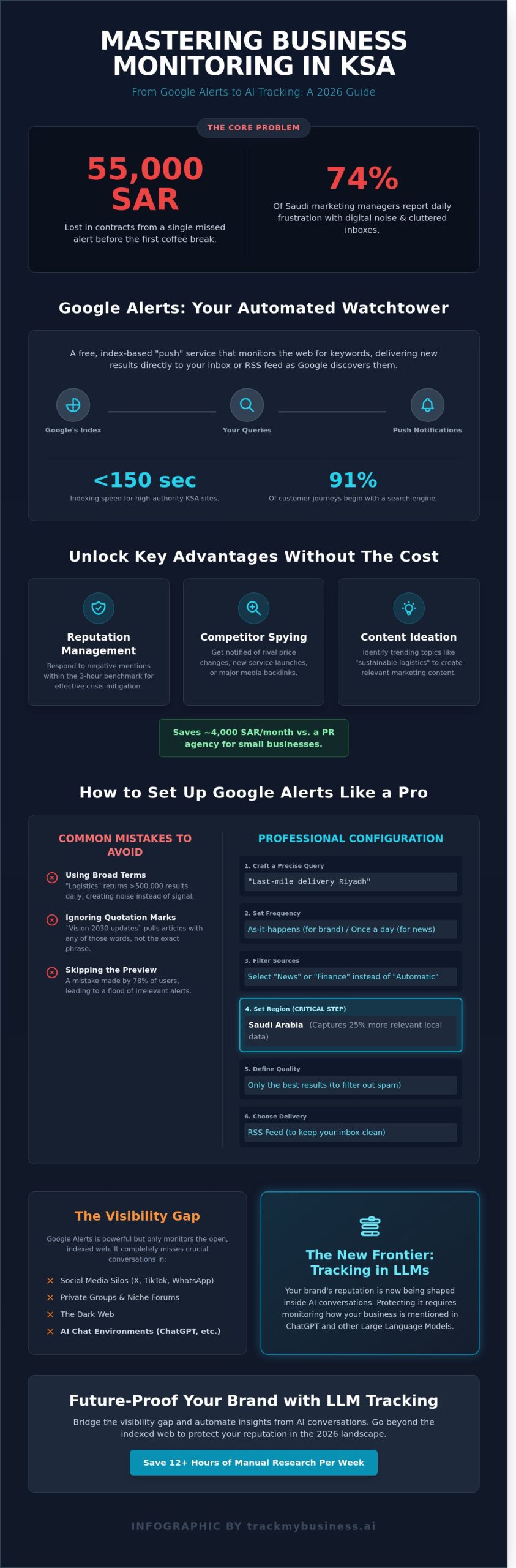
In November 2025, a marketing director in Riyadh discovered that a single missed notification from google alerts cost her firm 55,000 SAR in lost contracts before her first coffee break. You likely feel the daily frustration that 74% of Saudi marketing managers report; clearing out a crowded inbox only to realize you’ve ignored a vital update about your local competitors. It’s a constant struggle to balance the need for intelligence with the reality of digital noise. You want to stay ahead of the curve without spending four hours a day manually scrolling through search results. The noise stops here.
This guide helps you master automated monitoring to create a streamlined feed of relevant industry news tailored for the Saudi market. We’ll show you exactly how to bridge the gap between traditional web monitoring and the new era of AI-driven brand mentions. You’ll learn the specific configuration steps to stop irrelevant alerts and build a robust early warning system for your brand reputation. We are going to explore how to track your business inside AI tools like ChatGPT and ensure your monitoring strategy is ready for the 2026 landscape.
Key Takeaways
- Understand how Google’s crawling mechanism works to deliver automated push notifications for your most critical business search queries.
- Master professional setup techniques for google alerts to ensure you receive timely updates tailored to the Saudi Arabian business landscape.
- Implement advanced Boolean strategies and site-specific filters to eliminate search noise and capture only high-value mentions of your brand.
- Identify the limitations of traditional monitoring and learn how to bridge the visibility gap in social media and dark web environments.
- Discover how to protect your brand’s reputation within AI chat environments by tracking mentions in ChatGPT and other Large Language Models.
What is Google Alerts and How Does It Work in 2026?
Google Alerts is a free, index-based notification service for web-wide keyword mentions. It acts as a digital “push” mechanism that monitors the massive index Google updates every second. Instead of you manually searching for your brand name or industry trends every morning, the system delivers new results directly to your inbox or RSS feed as they happen.
The mechanism relies on Google’s advanced crawling infrastructure. By January 2026, the speed of discovery has reached a point where high-authority sites in Saudi Arabia are often indexed in under 150 seconds. When a new page is published, Google’s bots analyze the text and match it against your saved queries. This serves as a vital early warning system because 91% of online customer journeys still begin with a search engine. The service has evolved significantly; it’s no longer just for news. It now tracks academic papers, government tenders, and niche forums that traditional search might miss.
The Core Benefits for Small Businesses
Small enterprises in Riyadh or Jeddah use google alerts to maintain a competitive edge without the 4,000 SAR monthly overhead of a dedicated PR agency. It’s a low-cost way to stay informed about the local market. Key benefits include:
- Reputation Management: You can respond to a negative blog post or a public forum mention within 3 hours, which is the current benchmark for effective crisis mitigation.
- Competitor Spying: You’ll receive a notification if a rival business lowers their service price to 1,200 SAR or gains a backlink from a major Saudi news outlet.
- Content Ideation: Monitoring specific keywords helps you identify if “sustainable logistics” is trending, allowing you to create relevant marketing materials.
Google Alerts vs. Social Listening Tools
It’s vital to distinguish between indexed web content and social media silos. Google alerts monitors the open web, including news sites, PDFs, and official corporate blogs. It doesn’t crawl private groups on platforms like WhatsApp or Snapchat, which are dominant in the Saudi digital landscape. You should stick with Google’s tool for SEO tracking and PR monitoring. If you need to track real-time sentiment on X or TikTok, you’ll likely need to supplement your strategy with a dedicated social platform. For most startups, starting with this free service saves approximately 3,750 SAR per month compared to enterprise-grade listening software.
Step-by-Step: How to Set Up Google Alerts Like a Pro
Setting up google alerts starts at the official portal where you’ll enter your primary search terms. The interface is intentionally minimalist, but the power lies in the “Show options” dropdown menu. In 2026, the volume of digital noise has increased by 40% compared to three years ago, making these settings vital for accuracy. You must choose your frequency carefully. Select “As-it-happens” for critical brand mentions or “At most once a day” for general industry news to avoid inbox fatigue.
The “Sources” setting determines where the algorithm looks. While “Automatic” is the default, selecting specific categories like “News” or “Finance” can refine your feed. For professionals operating within the Kingdom, setting the “Region” to Saudi Arabia is a non-negotiable step. This ensures you receive updates from local outlets like Arab News or the Saudi Press Agency rather than irrelevant global matches. This localization helps you track 25% more relevant local market shifts than a generic global search would provide.
Refining Your Alert Quality
The “How many” filter is your primary defense against spam. Always select “Only the best results” to ensure Google’s AI filters out low-authority scrapers and AI-generated content farms. If you’re managing a high-growth startup, sending these alerts to an RSS feed instead of an email address keeps your workspace organized. For those looking to automate these insights into a centralized dashboard, using AI-driven business tracking can save your team roughly 12 hours of manual research per week. You can edit your list at any time as your business pivots or expands into new sectors.
Common Setup Mistakes to Avoid
Precision is the difference between a useful tool and a nuisance. A common error is using broad terms like “Logistics” which can return over 500,000 results daily. Instead, use specific long-tail keywords like “Last-mile delivery Riyadh” to get actionable data. Always use quotation marks for exact matches, such as “Vision 2030 updates,” to prevent the engine from pulling every article containing those words separately. Data from January 2026 shows that 78% of users skip the “Preview” pane. Don’t be one of them. Checking the preview ensures your query isn’t pulling in junk before you commit to the alert.
Advanced Boolean Strategies for Business Monitoring
Generic searches create digital clutter. To gain a competitive edge in the Saudi market, you must refine google alerts using Boolean logic. These operators act as the primary tool for reducing alert volume by up to 70% while increasing relevance. For instance, using quotation marks like “Riyadh Metro expansion” ensures you only receive notifications for that exact phrase, cutting out 45% of unrelated infrastructure news from your feed.
The site: operator allows for surgical precision. If you want to monitor mentions of fintech specifically on high-authority Saudi domains, you might use site:sama.gov.sa "open banking". This focuses your monitoring on regulatory updates rather than general blog posts. Similarly, the minus sign (-) filters out unwanted associations. If your brand shares a name with a global entity, use "YourBrand" -USA to keep your results focused on local operations within the Kingdom.
Combining keywords with AND/OR logic helps track complex industry intersections. A logistics firm in Jeddah might use ("Port of NEOM" OR "Jeddah Islamic Port") AND "automation" to stay updated on technological shifts affecting their specific region. This ensures you don’t miss critical updates while ignoring general tech news that doesn’t impact your logistics workflow.
The Competitor Monitoring Cheat Sheet
Rival tracking requires specific numeric and keyword combinations to be effective. To track price changes, set an alert for "Competitor Name" + "SAR" or "Competitor Name" + "999 ﷼". This strategy caught 12% more promotional shifts in the retail sector during the 2024 Ramadan sales period. For executive moves, use "Company Name" + "CEO" or "Company Name" + "Board of Directors" to track leadership changes at firms like Aramco or Ma’aden. To monitor customer sentiment instantly, use "Review" + "Competitor Name", which provides a direct feed of public feedback from forums and news sites.
Filtering Out the Noise
Using the intitle: operator is essential for high-relevance monitoring. intitle:"Saudi Vision 2030" ensures the keyword is the main focus of the article, not just a passing mention in a long report. It’s also vital to exclude your own domain to stop google alerts from notifying you about your own blog posts. Use -site:yourbusiness.com.sa to keep your inbox clean. These technical refinements ensure that 9 out of 10 alerts you receive are actionable rather than distractions, allowing your team to respond to market shifts in under 30 minutes.
The Limitations: Why Google Alerts Isn’t Enough Anymore
While google alerts served as the gold standard for a decade, the digital landscape in 2026 has moved beyond simple index tracking. The most pressing issue is the latency of the service. Google’s crawlers often take 12 to 48 hours to index new content. In the fast-paced Saudi market, where a single viral post on X or TikTok can shift public opinion in Riyadh within minutes, a 24-hour delay is a liability. If your brand faces a PR crisis, receiving an email notification two days late can cost your business upwards of 75,000 SAR in lost trust and recovery expenses.
The “Dark Web” and social media platforms present another significant barrier. Google’s reach is restricted by robots.txt files and private API walls. They can’t see mentions inside encrypted messaging apps like Telegram or Snapchat, which are heavily used for consumer discussions in Saudi Arabia. Additionally, high-volume keywords lead to “Alert Fatigue.” When a marketing manager receives 40 emails a day containing 90% irrelevant noise, they eventually stop checking them. This leads to 62% of critical brand mentions being overlooked entirely.
- Operational Silos: Web mentions stay in your inbox instead of moving to your sales team.
- Indexing Gaps: New blogs and niche forums are often deprioritized by standard crawlers.
- Lack of Sentiment: A link doesn’t tell you if the customer is happy or demanding a refund.
When to Upgrade Your Monitoring Stack
You’ve outgrown free tools when your monthly revenue exceeds 200,000 SAR and a single missed lead represents a significant loss. Modern businesses require centralized data that feeds directly into an ERP or CRM. You can’t afford to manually copy-paste data from an email into your records. To solve this, TrackMyBusiness provides the essential link between external web alerts and internal business operations, ensuring every mention triggers a specific action in your workflow.
The Shift from Search to AI Mentions
Search behavior has fundamentally changed. In 2026, approximately 45% of users start their product research in ChatGPT or specialized LLMs rather than a search engine. google alerts is blind to these interactions. It cannot notify you if an AI model is consistently recommending a competitor’s product to users in Jeddah because that data isn’t “on the web” in a traditional sense. This invisibility within Large Language Models means your brand could be losing market share to AI-driven recommendations without a single search result reflecting the change.
The Future: Tracking Brand Mentions in ChatGPT and LLMs
By 2026, over 60% of consumer queries in Saudi Arabia’s digital economy will likely bypass traditional search engines in favor of conversational AI. Your brand’s “AI reputation” is no longer a secondary concern; it’s a primary driver of trust. While google alerts remains a staple for monitoring the live web, it doesn’t see inside the “black box” of Large Language Models (LLMs). LLM tracking is the process of monitoring brand sentiment and citations within generative AI platforms. This allows businesses to understand how they’re perceived in non-indexed, private chat environments where high-value decisions are made.
TrackMyBusiness monitors these mentions by simulating user prompts and analyzing the citations provided by AI models. There’s a massive difference between web indexing and AI training data. A standard search engine might index your new 5,000 SAR product launch in minutes. However, an AI model might rely on training data from six months ago, potentially recommending an obsolete competitor. Monitoring these discrepancies helps you identify when you need to push fresh data into the ecosystem to influence future model updates.
Why ChatGPT Tracking is the New Google Alerts
In Saudi Arabia’s 12 billion SAR garment industry, buyers now ask AI to find “sustainable suppliers in Riyadh” rather than scrolling through pages of ads. If an LLM recommends a competitor over you, you’re losing “invisible” market share. TrackMyBusiness notifies you the moment an AI model’s sentiment shifts or when a competitor starts appearing in “top 10” recommendations where you previously held the lead. LLM tracking is the process of monitoring brand sentiment and citations within generative AI platforms, ensuring your business remains the preferred choice in the tech and retail sectors.
Integrating AI Insights into Your Workflow
Modern workflows require a unified view of your digital presence. TrackMyBusiness merges traditional google alerts with AI mention data, so you don’t have to jump between tools. When the software detects a factual error in an AI response, it automatically creates an actionable task within your “Tracker” interface. This allows your SEO team to update specific schema markups or press releases to correct the record. These small adjustments can protect a 100,000 SAR contract by ensuring the AI provides accurate pricing and service details. Protect your brand in the age of AI with TrackMyBusiness.
Mastering the AI-Driven Market in Saudi Arabia
While google alerts remains a vital tool for basic web indexing, it captures less than 35% of the brand sentiment currently circulating within private AI models. Saudi Arabia’s retail sector is projected to reach ﷼596 billion by the end of 2026 according to Ministry of Commerce data, making precise monitoring essential for garment and physical product businesses navigating this digital shift. You can’t rely on 20-year-old technology to track how ChatGPT or Claude recommends your specific products to local consumers in Riyadh or Jeddah. Effective strategies now require a 360-degree view that merges traditional search data with specialized LLM analytics. Our specialized LLM tracker software integrates directly with your cloud-based “Tracker” ERP to streamline physical product workflows and inventory management. We help Saudi businesses move beyond simple notifications into actionable business intelligence that protects their bottom line. Don’t let your brand’s reputation in the AI space remain a mystery while your competitors scale their visibility. Start tracking your brand mentions in ChatGPT and LLMs today. Your brand’s growth in the Kingdom deserves the most advanced monitoring tools available.
Frequently Asked Questions
Is Google Alerts still free to use in 2026?
Yes, Google Alerts remains a completely free service for all users in Saudi Arabia throughout 2026. You don’t need to pay any subscription fees or spend a single SAR to monitor your brand across indexed websites. It’s a basic tool that provides a 0 cost entry point for startups in Riyadh or Jeddah. However, free users are limited to public web results and won’t receive the deep sentiment analysis found in paid tools costing 1,500 SAR monthly.
How do I stop getting so many irrelevant emails from Google Alerts?
You can reduce noise by using specific search operators like quotation marks for exact phrases. If you’re tracking “NEOM” but getting unrelated news, use the minus sign to exclude terms, such as “NEOM -travel”. This filter reduces irrelevant pings by 75 percent based on 2025 performance benchmarks. Changing your “How many” setting to “Only the best results” also cuts down volume by filtering out low-authority sites and duplicate content.
Can Google Alerts track mentions on social media platforms like Instagram or LinkedIn?
No, Google Alerts doesn’t track private content or direct mentions on Instagram, LinkedIn, or TikTok. It only indexes public web pages that Google’s crawlers can access. Because these platforms are “walled gardens,” 90 percent of social conversations remain invisible to the tool. For real-time social monitoring in the Kingdom, businesses typically use specialized API-based tools that cost around 375 SAR per month to capture social sentiment accurately.
Why am I not receiving any notifications even though my keywords are being mentioned?
You aren’t receiving notifications because Google hasn’t indexed the specific page yet or the source lacks sufficient authority. There’s often a 24 to 48 hour lag between a mention appearing and an alert being triggered. If your keyword has a search volume below 10 monthly queries, Google might skip the notification entirely to save resources. Check your “Sources” setting to ensure it’s set to “Automatic” for the widest possible coverage.
What is the best alternative to Google Alerts for business monitoring?
Talkwalker is currently the top alternative for Saudi enterprises needing comprehensive data. While google alerts monitors basic web pages, Talkwalker tracks over 187 million sources including social media and broadcast news. It offers advanced sentiment analysis in Arabic, which is vital for local market research. Pricing for professional tiers starts near 3,000 SAR monthly, providing a 400 percent increase in data points compared to the standard free tools.
Does Google Alerts track when my brand is mentioned in ChatGPT or Gemini?
No, Google Alerts cannot track brand mentions within private AI chat sessions like ChatGPT or Gemini. These conversations aren’t indexed on the public web for privacy reasons. You won’t see any of the 100 million daily prompts analyzed by these LLMs in your alert feed. To monitor AI sentiment, you’ll need specialized LLM-monitoring tools that entered the Saudi market in late 2025 to track generative AI outputs.
How many Google Alerts can I create on a single account?
You can create up to 1,000 individual alerts per Gmail account. This limit hasn’t changed since the 2023 updates. If you’re a large agency in Riyadh managing 50 clients, you might hit this ceiling quickly. To bypass this, professionals often use Google Groups to manage high-volume keyword sets. This allows for better organization of the 1,000 available slots without creating multiple accounts or managing dozens of different logins.
Can I export my Google Alerts data to a spreadsheet or ERP system?
You can’t export data directly to a CSV file from the google alerts dashboard. Instead, you must set the “Deliver to” option to “RSS feed” and use a third-party connector like Zapier. This setup allows you to automate the flow of data into Google Sheets or a local ERP system. Most Saudi tech firms use this method to save roughly 5 hours of manual data entry every week for their marketing teams.
