
The rise of AI-driven search and conversational assistants has fundamentally altered how customers discover and interact with brands. Traditional SEO metrics no longer provide the full picture when models like ChatGPT, Gemini, and Google's AI Overviews are answering user questions directly. Visibility now depends on being accurately cited, recommended, and represented within these generative engines.
Failing to monitor and optimize for this new channel creates significant business risk. Brands are already losing revenue from AI-driven misinformation, such as incorrect pricing, false "permanently closed" notices, or inaccurate competitor recommendations appearing in AI-generated answers. Proactively managing your presence in these systems is no longer optional; it's a core component of modern brand reputation and customer acquisition. For a deeper dive into this new frontier of digital visibility, you can explore a comprehensive guide to Generative Engine Optimization (GEO) that covers the fundamental concepts.
This guide cuts through the noise to help you take action. We have curated a detailed list of the top 12 generative engine optimization tools designed to tackle these specific challenges. We will move beyond generic feature lists to provide practical analysis of each platform's strengths, real-world use cases, and notable limitations. Each entry includes direct links and screenshots to help you evaluate which solution best fits your needs. This resource is built to help you assemble a tech stack that protects your brand, uncovers new opportunities, and secures your visibility in the age of AI.
1. TrackMyBiz
Best for: AI Brand Reputation Monitoring & Hallucination Detection
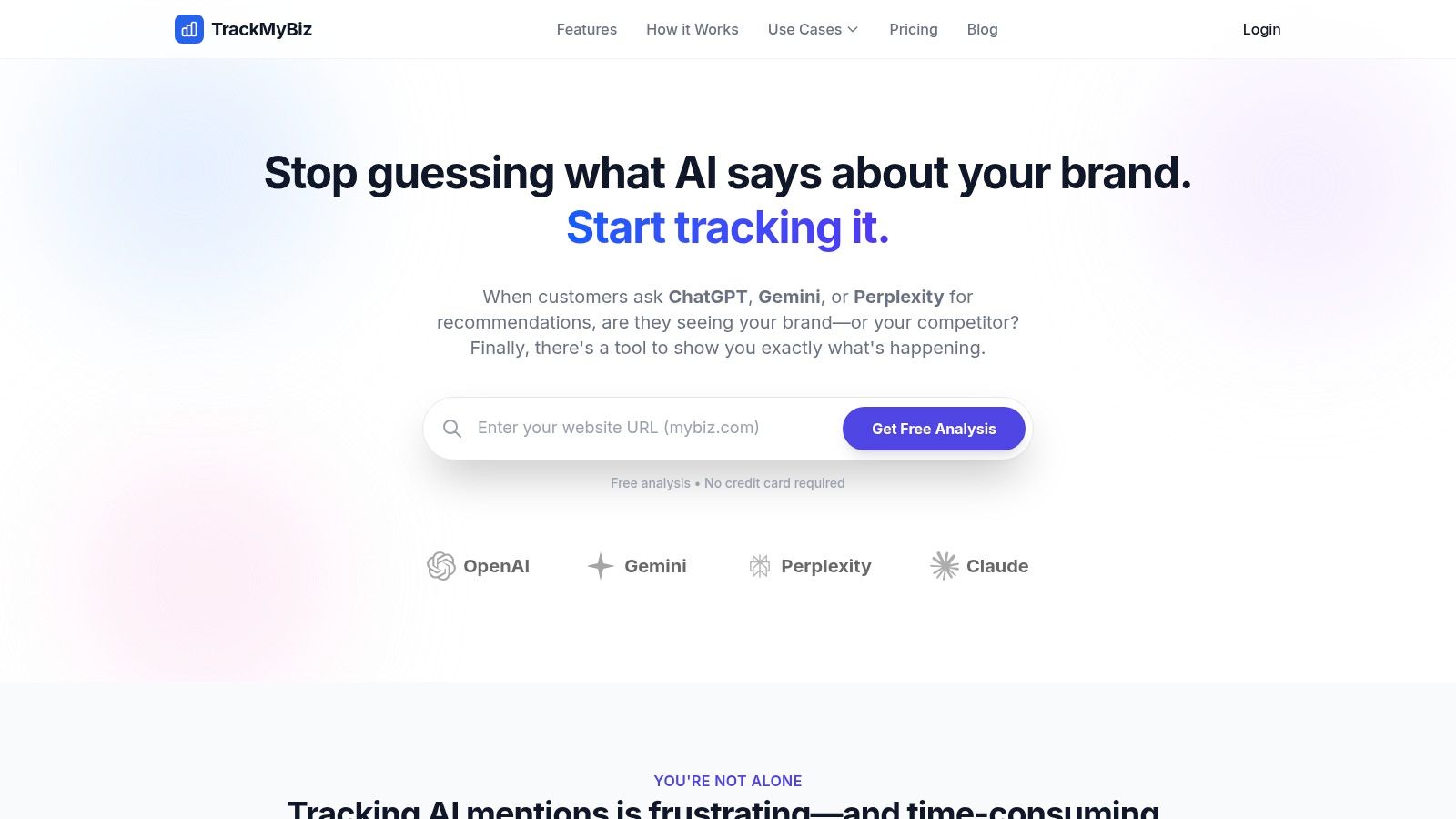
TrackMyBiz establishes itself as a premier choice among generative engine optimization tools by focusing on a critical, often-overlooked aspect of AI visibility: brand reputation management. Instead of broad analytics, it offers a laser-focused solution for businesses needing to know precisely what major LLMs like ChatGPT, Gemini, and Claude are saying about them. It automates the tedious process of manual prompting, running hundreds of queries across multiple models and regions to provide a stable, aggregated view of your brand's AI presence.
This platform moves beyond simple monitoring, providing a robust defense against AI-driven misinformation. Its core strength lies in its ability to not just track mentions but to validate their accuracy, converting the unpredictable nature of generative AI into a measurable and manageable marketing channel.
Core Features & Use Cases
- Safety Engine & Hallucination Detection: The standout feature is its Safety Engine, which cross-references LLM outputs against your verified business data. This is invaluable for brick-and-mortar businesses. For example, if an AI falsely claims your restaurant is "permanently closed" or lists incorrect operating hours, the system flags it instantly, allowing your team to address the source before it impacts foot traffic and revenue.
- Competitive & Source Intelligence: TrackMyBiz reveals which competitors are being recommended in your place and, crucially, which sources (articles, reviews, directories) the LLMs are citing. This provides a clear, actionable roadmap for your SEO and digital PR efforts. You can see exactly which outdated blog post or incorrect directory listing is poisoning the well and prioritize fixing it.
- AI Visibility Index (BrandRank): The platform synthesizes complex data into a simple BrandRank score. This metric tracks your brand's visibility and sentiment over time, offering a clear KPI for your generative engine optimization strategy and simplifying reporting for stakeholders.
Limitations to Consider
While powerful, TrackMyBiz's focus is on monitoring and alerting. It excels at identifying problems but the actual remediation often requires manual intervention. For instance, correcting a false statement may involve reaching out to a third-party site to update an old article. Additionally, its monitoring is concentrated on the major public-facing LLMs, so it may not capture conversations happening in private or specialized AI models.
Website: https://trackmybusiness.ai
2. Adobe LLM Optimizer
Adobe LLM Optimizer is an enterprise-level solution designed to measure and improve brand visibility within AI chat services and generative engine results. Positioned as a core component of the Adobe Experience Cloud, it provides large organizations with the tools to benchmark their presence in AI-generated answers, analyze citation frequency, and understand visibility trends across different LLM-powered surfaces. This makes it one of the most integrated generative engine optimization tools for businesses already invested in Adobe’s marketing ecosystem.
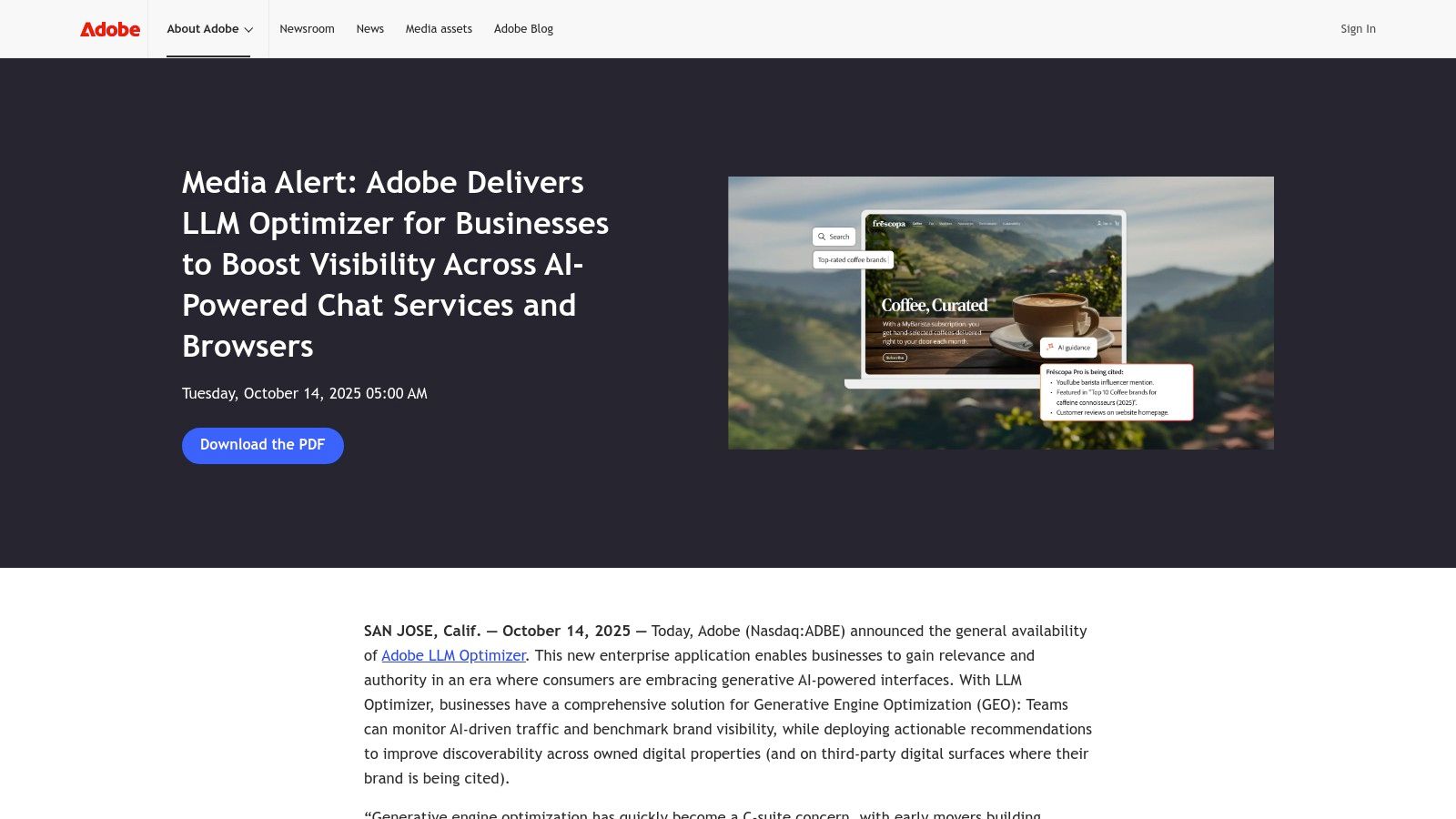
The platform stands out by leveraging Adobe's own internal use case as a success story, offering documented proof of measurable lift in visibility. Its primary function is to deliver actionable recommendations aimed at increasing brand and product citations in AI Overviews and other generative results, directly tying content strategy to AI performance.
Key Features and Considerations
The focus is squarely on enterprise needs, providing comprehensive reporting dashboards that track brand and product discoverability over time. This data helps marketing and PR teams justify their efforts and pivot strategies based on what works.
- Pros: Deep integration with Adobe Experience Cloud, concrete internal case studies demonstrating effectiveness, and robust benchmarking capabilities.
- Cons: Access is sales-led with no public pricing, making it inaccessible for smaller businesses. As a newer offering, broader, third-party proof points are still emerging.
This tool is best suited for large enterprises seeking a unified platform for digital marketing and AI visibility analytics. Organizations can find resources for specialized services and further understand how agencies are using tools like Adobe LLM Optimizer to manage visibility at scale.
Website: news.adobe.com
3. Semrush
Semrush has expanded its comprehensive SEO suite by integrating AI Overviews (AIO) tracking into its core tools, including Position Tracking, Domain Research, and Sensor. For marketing teams already using the platform for traditional SEO, this addition provides a familiar environment to monitor brand and keyword visibility within Google’s generative results. It transforms Semrush from a classic SEO tool into one of the most accessible generative engine optimization tools by layering AIO metrics directly into existing competitive and keyword research workflows.
The platform stands out by embedding AIO data where users already work, allowing them to track domain mentions, identify cited pages, and filter for keywords that trigger AI Overviews. This integrated approach helps teams understand how their content strategy impacts both classic search rankings and AI-generated answers without needing a separate, dedicated tool. The Semrush Sensor also provides market-level data on AIO volatility.
Key Features and Considerations
Semrush focuses on making AIO data an actionable part of everyday SEO tasks, providing competitive benchmarking that shows how a domain’s presence in AI Overviews compares to its rivals. This allows for a more holistic view of the search landscape.
- Pros: Integrated AIO metrics across established SEO workflows, deep competitive and keyword data, and a familiar UI for most SEO practitioners.
- Cons: Full AIO tracking capabilities are often part of higher-tier plans or require add-ons. There can be a learning curve to configure and interpret AIO-specific reports effectively.
This solution is ideal for digital marketing teams that need a unified platform for both traditional SEO and AIO visibility monitoring. You can learn more about how to leverage this data for competitive analysis to stay ahead in the evolving search landscape.
Website: www.semrush.com
4. Ahrefs (Brand Radar AI)
Ahrefs, a stalwart in the SEO industry, extends its data-centric approach into generative AI with its Brand Radar AI module. This tool is designed to track brand presence and market share across Google's AI Overviews and other LLM outputs. For marketing teams that already rely on Ahrefs’ extensive backlink and keyword data, Brand Radar offers a familiar, high-quality dataset for analyzing AI "share of voice" and citation trends, making it one of the more trusted generative engine optimization tools backed by established SEO metrics.

The platform leverages its vast crawling infrastructure to publish large-scale research on AI Overviews, providing users with insights grounded in real-world data. Its core function is to help brands monitor their visibility within AI-generated results, benchmark against competitors, and understand how their content strategy impacts their presence over time.
Key Features and Considerations
Ahrefs focuses on delivering clear, research-backed metrics for trend analysis and competitive monitoring within AI environments. The Brand Radar functionality is built to give actionable insights on how often a brand is mentioned or cited.
- Pros: Backed by Ahrefs' trusted data quality and recognized SEO tooling, provides clear AIO insights supported by public research, and offers flexibility as an add-on or standalone product.
- Cons: Brand Radar is an extra-cost add-on, potentially increasing the total subscription price. The feature set for generative engine optimization is still evolving compared to more specialized platforms.
This tool is ideal for digital marketing teams who want to integrate AI visibility tracking into their existing Ahrefs workflow. SaaS companies, in particular, can gain significant value from this integration; you can explore more on how SaaS businesses can leverage AI brand tracking for a competitive edge.
Website: ahrefs.com
5. SISTRIX
SISTRIX has integrated powerful AI Overviews analysis directly into its established SEO toolbox, allowing users to track when AIOs appear for specific keywords and which URLs are cited within them. By adding dedicated filters and reports, it transforms a familiar SEO platform into a practical tool for monitoring visibility in generative engine results. This approach makes it one of the most accessible generative engine optimization tools for SEO professionals already using the platform for traditional search analysis.
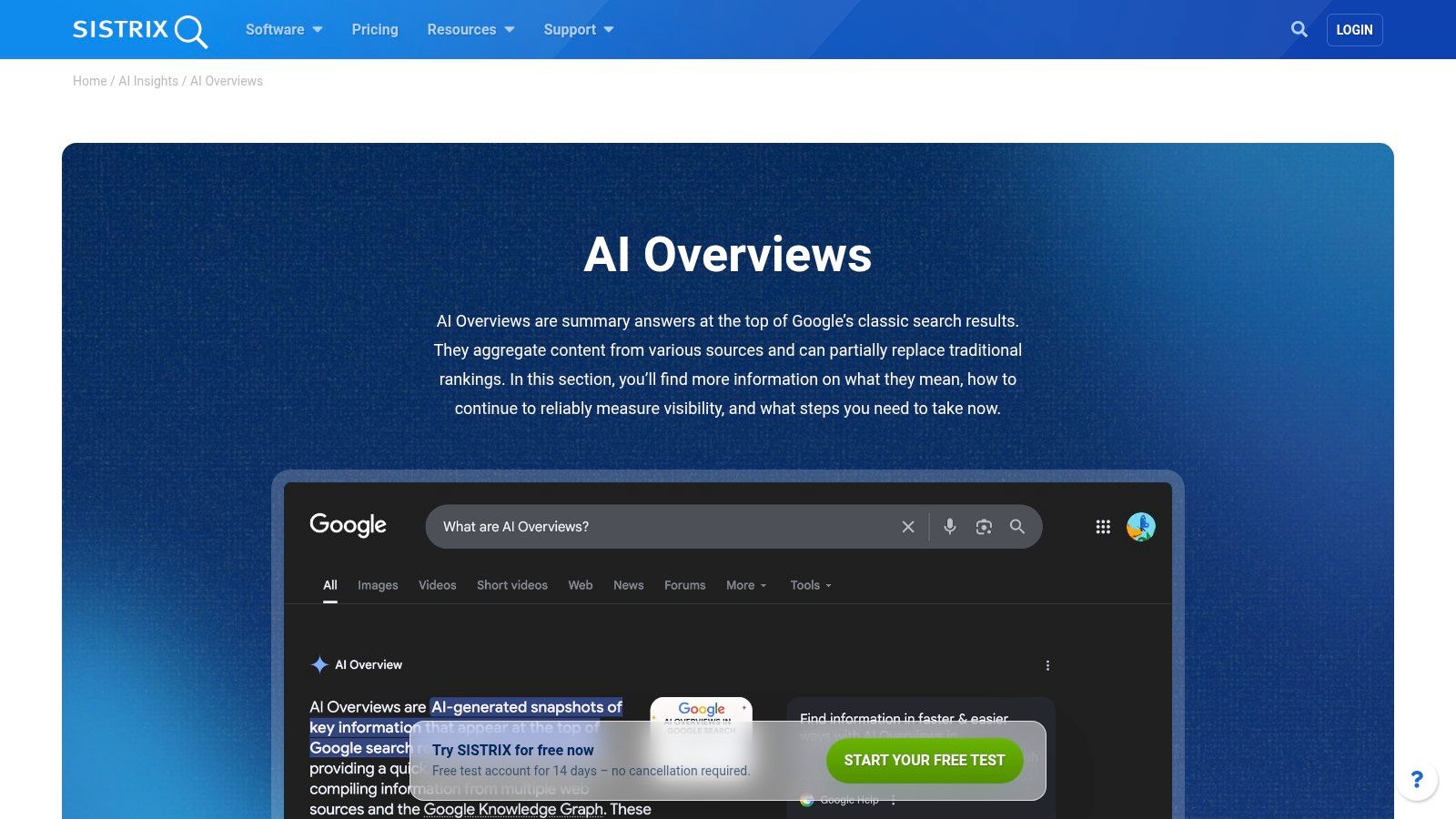
The platform’s standout feature is its comprehensive SERP archive, which captures the full content of AI Overviews, including linked sources and entities. This historical data is invaluable for conducting before-and-after comparisons, analyzing performance shifts over time, and understanding how AIOs behave differently across various countries. It provides tangible data for adapting content strategies to earn citations.
Key Features and Considerations
SISTRIX provides keyword-level flags that identify AIO occurrences and a detailed breakdown of cited sources and their positions within the generative answer box. This functionality offers clear, actionable insights for SEO teams looking to understand their performance in this new SERP feature.
- Pros: Strong SERP archiving for historical analysis, practical workflows for AIO performance tracking, and transparent pricing tiers suitable for various business sizes.
- Cons: The user interface assumes some familiarity with SISTRIX concepts, which may present a learning curve for new users. Some advanced AIO features are gated behind higher-tier plans.
This tool is best suited for SEO agencies and in-house marketing teams that need to integrate AIO performance tracking into their existing organic search workflows.
Website: www.sistrix.com/ai-overviews/
6. seoClarity
seoClarity is a mature enterprise SEO platform that has expanded its capabilities to include scalable AIO (AI Overview) tracking. It helps large organizations identify which keywords trigger AI Overviews, see whether their brand or competitors are being cited, and capture snapshots of the generative content. This makes it a powerful option for businesses needing deep crawling, traffic impact modeling, and extensive research into their generative engine performance.
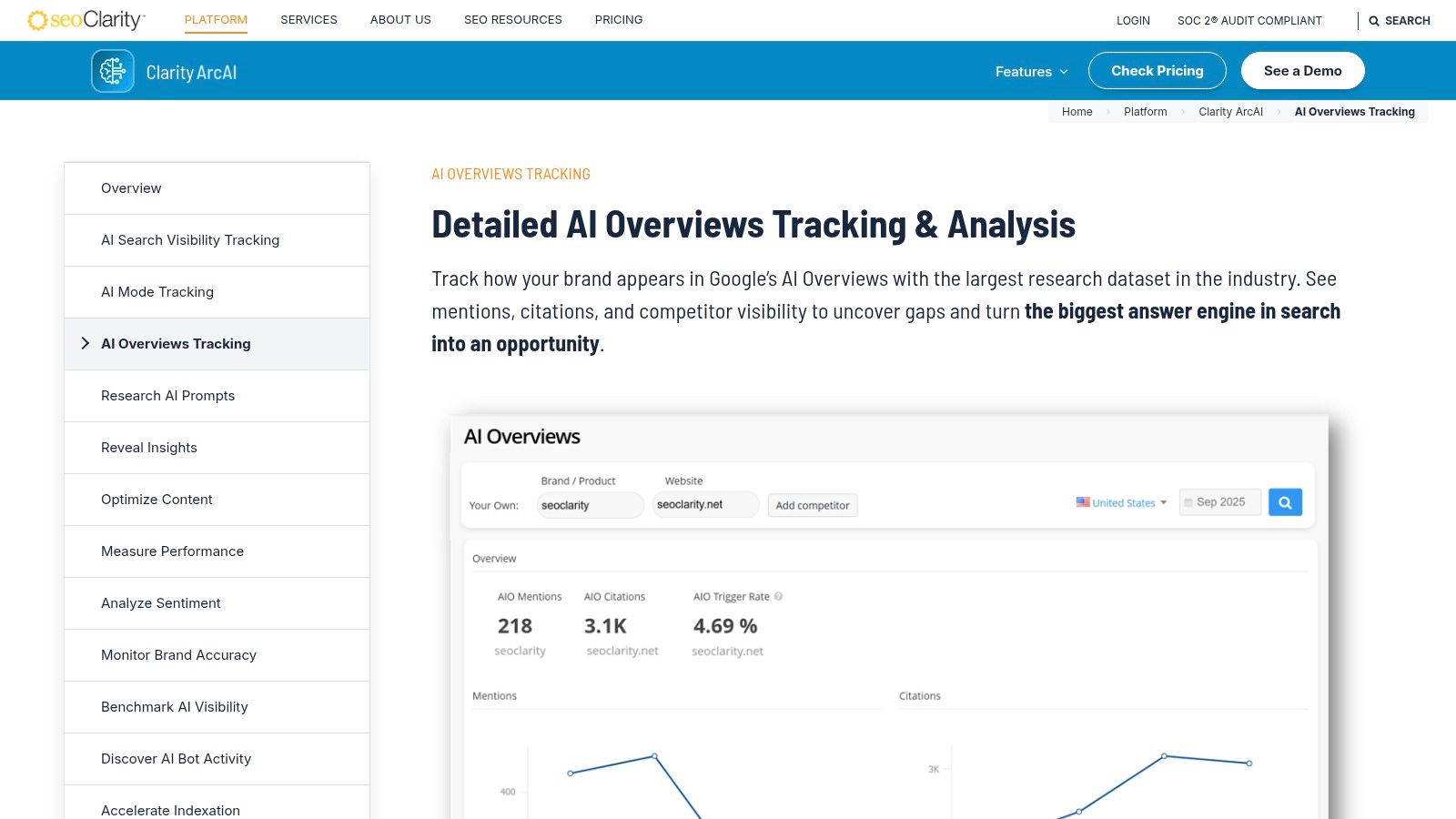
The platform distinguishes itself by integrating AIO data directly into established, enterprise-grade SEO workflows. Its large research dataset, covering hundreds of millions of keywords, provides the necessary scale for significant competitive benchmarking. This positions seoClarity as one of the most robust generative engine optimization tools for companies that require both traditional SEO and AIO visibility management in a single, unified environment.
Key Features and Considerations
The focus is on delivering actionable AIO intelligence at scale. The platform enables instant keyword-level detection of AI Overviews, tracks brand and competitor citations, and provides the raw data needed to model the potential impact on organic traffic. This allows SEO and content teams to strategically adapt to changes in the SERP.
- Pros: Mature enterprise workflows and reporting, deep AIO crawling and SERP preview capabilities, and frequent publishing of research on AIO trends.
- Cons: Access is sales-led with enterprise-oriented budgets, meaning pricing and contracts typically require a formal demo and quote process.
seoClarity is best suited for large enterprises that need to integrate AIO tracking into a comprehensive, data-driven SEO strategy. Its scalable infrastructure and deep data analysis capabilities are designed for organizations managing vast keyword portfolios.
Website: www.seoclarity.net
7. BrightEdge
BrightEdge is an established enterprise SEO platform that has integrated generative engine optimization capabilities directly into its suite. With its Generative Parser, the platform offers robust detection for when AI Overviews are present in search results, connecting this data to content creation workflows. This positions it as one of the most practical generative engine optimization tools for large teams looking to align their existing SEO operations with the new demands of generative AI, rather than adopting a separate, standalone solution.
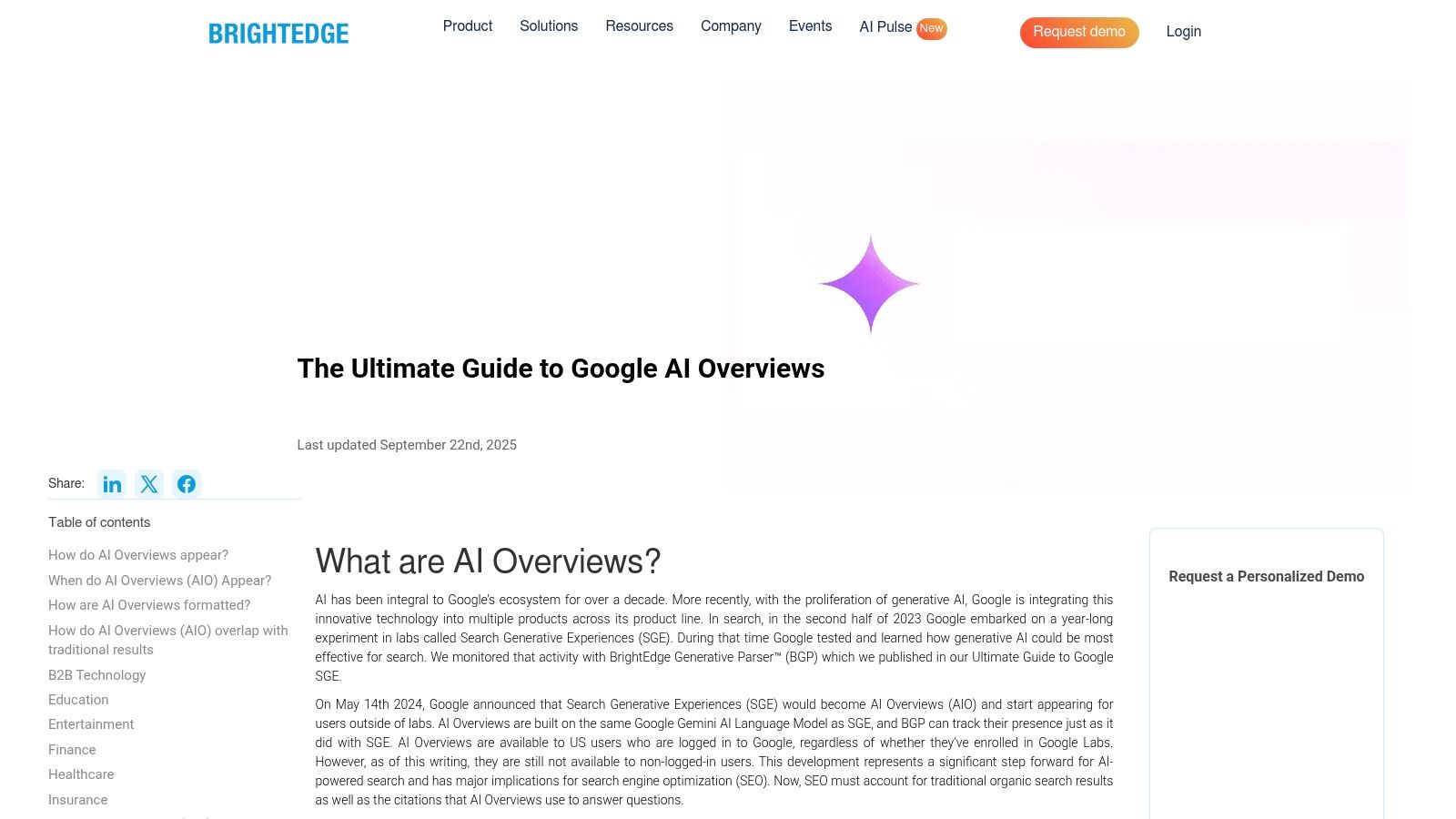
The platform’s strength lies in its ability to tie AIO detection directly to content planning and execution. Through its Copilot feature, it provides AI-driven content briefs and advisor workflows tailored to generative answer opportunities. This allows content and SEO teams to not only identify where AI Overviews appear but also to receive actionable guidance on creating content that is more likely to be featured.
Key Features and Considerations
BrightEdge provides vertical-specific insights, helping businesses understand AIO prevalence within their specific industry and make more informed strategic decisions. The focus is on turning detection into a concrete content production strategy, bridging the gap between analytics and action.
- Pros: Aligns enterprise content production with GEO/AIO opportunities, offers long-running AIO/SGE monitoring, and features enterprise-scale reporting and workflows.
- Cons: Pricing is quote-based and requires sales contact, making it inaccessible for smaller businesses and individuals. Its comprehensive nature may present a steep learning curve for teams new to enterprise SEO platforms.
This tool is best suited for mid-market and enterprise organizations that need to integrate AIO insights into a structured, scalable content creation process.
Website: www.brightedge.com
8. Nozzle
Nozzle is a powerful SERP analytics platform built for data-driven SEOs, now featuring dedicated dashboards to track and analyze Google's AI Overviews. It provides granular data on AIO incidence, brand and domain citations, and share of voice across specified keyword sets. This makes it an ideal choice for analysts who need flexible, customizable reporting and direct data exports to build their own insights and visualizations.
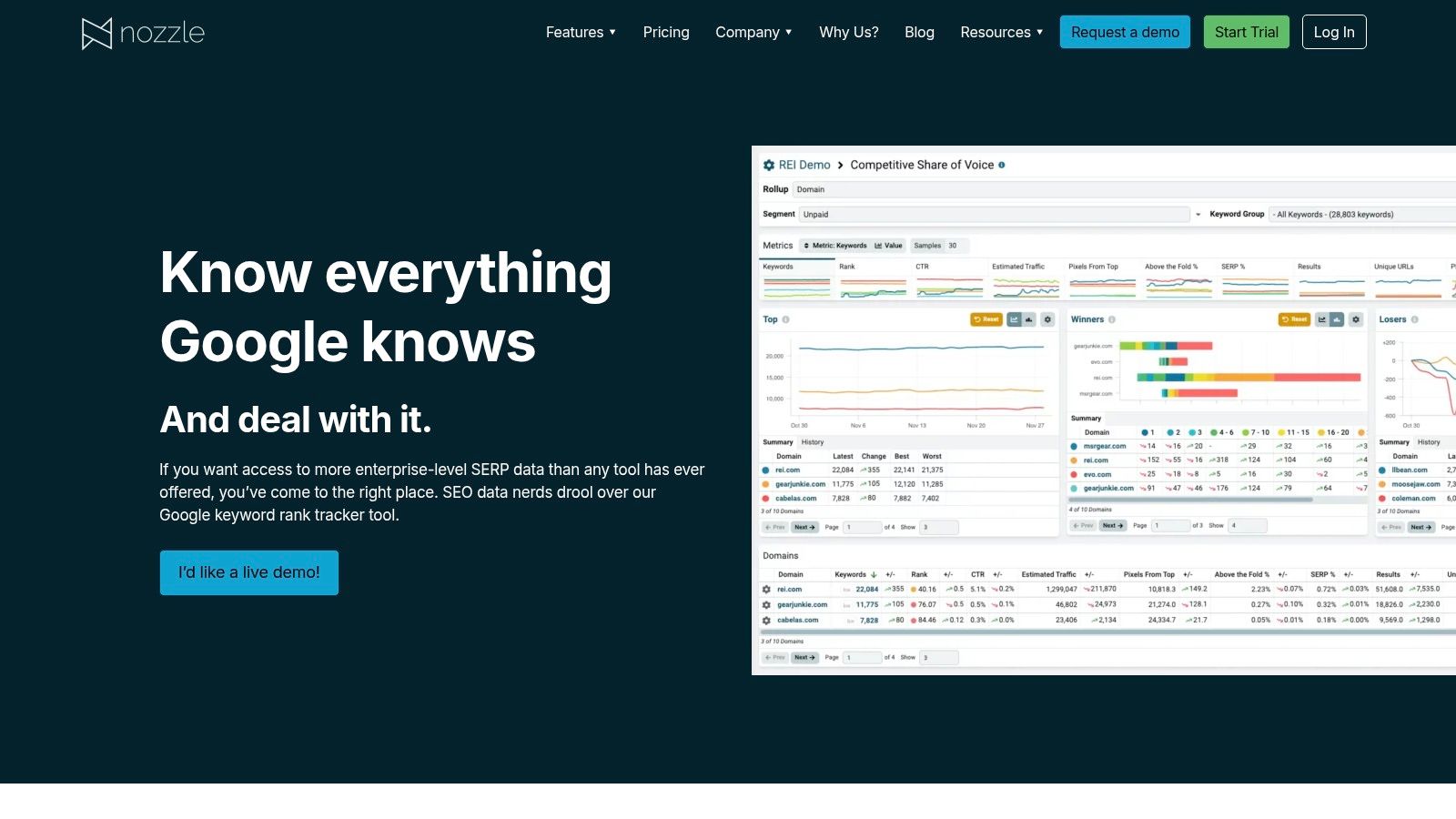
The platform stands out with its analyst-friendly approach, allowing users to slice and dice AI Overview data at the keyword group or single-SERP level. Unlike broader suites, Nozzle focuses purely on SERP data collection and presentation, offering BigQuery and API access for advanced teams to integrate this visibility data into larger business intelligence systems. This specialization makes it one of the most flexible generative engine optimization tools for custom analysis.
Key Features and Considerations
Nozzle is designed for deep dives into SERP and AIO performance rather than providing all-in-one content recommendations. Its strength lies in its raw data accessibility and detailed competitive benchmarking, helping teams pinpoint exactly where and how they appear in generative results.
- Pros: Highly flexible dashboards and data exports, usage-based pricing with a free trial available, and granular SERP and AIO slicing for precise visibility analysis.
- Cons: Requires manual configuration to capture all AIO nuances and is not a full content optimization suite; it's most effective when paired with separate content tools.
This tool is best suited for SEO analysts and agencies that require deep, customizable SERP data to power their AI visibility strategies and integrate with other platforms.
Website: nozzle.io
9. SEOmonitor
SEOmonitor is a rank- and visibility-tracking platform that has evolved to include daily AIO tracking for Google AI Overviews and optional LLM add-ons for ChatGPT and Gemini. It provides unified dashboards to monitor traditional Google search, AIO, and LLM visibility from a single interface. This positioning makes it a practical and accessible choice for agencies and in-house teams looking to integrate AI monitoring into their existing SEO workflows, establishing it as one of the more transparent generative engine optimization tools available.
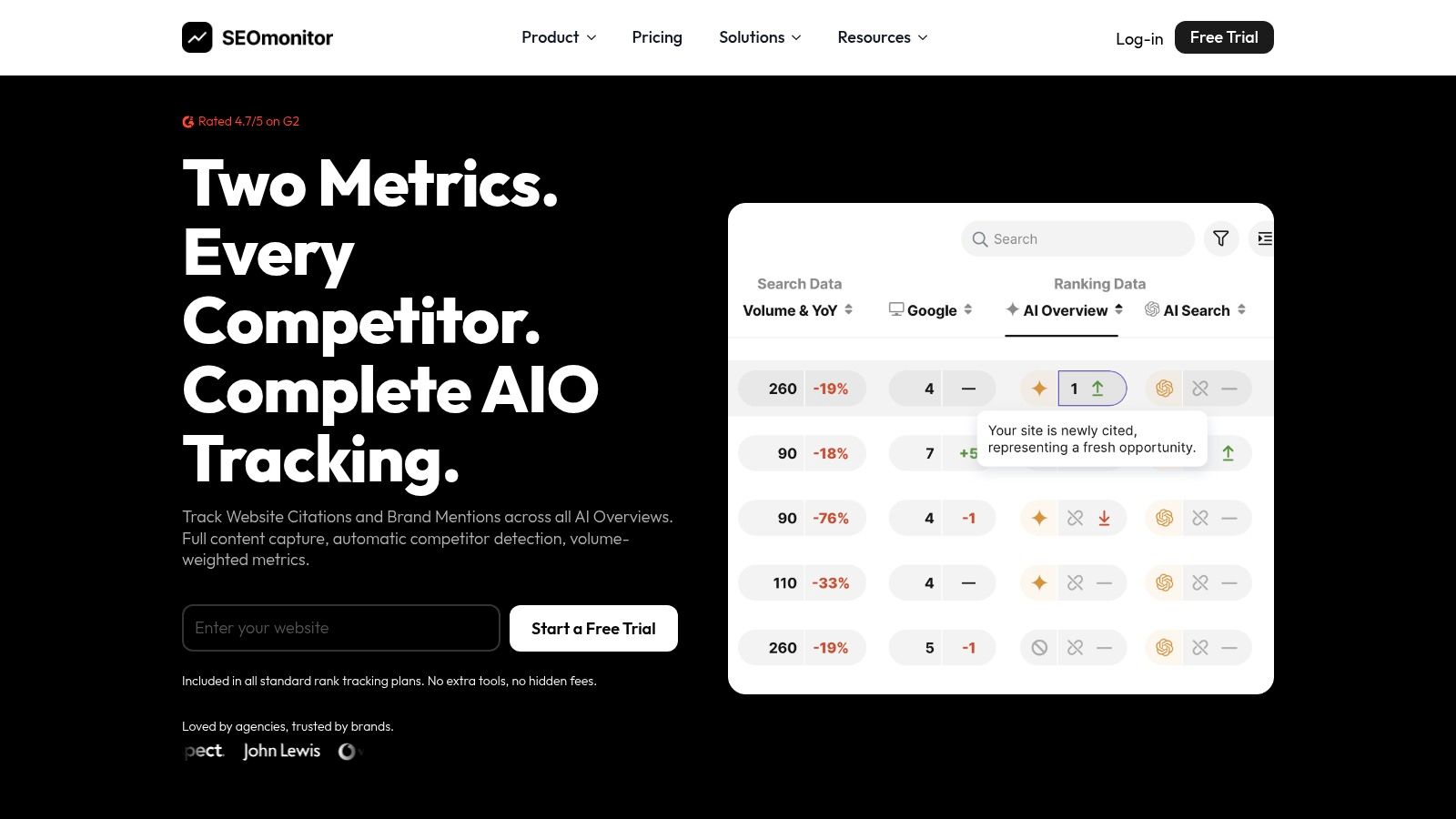
The platform stands out by capturing full AIO responses, including content hidden behind "load more" clicks, ensuring a complete picture of brand mentions and citations. Its self-serve model, clear documentation, and localized tracking capabilities across different devices make it straightforward for teams to adopt and start gathering actionable data on their generative engine performance without a lengthy sales process.
Key Features and Considerations
SEOmonitor’s strength lies in blending familiar rank-tracking metrics with new AIO and LLM data points, creating a smooth transition for SEO professionals. The platform offers API connectors for custom reporting, allowing teams to pull visibility data into their own dashboards and business intelligence tools.
- Pros: Transparent pricing with a 14-day free trial and agency-friendly plans, practical AIO metrics integrated with traditional rank tracking, and a clear self-serve setup.
- Cons: Some LLM tracking (ChatGPT/Gemini) is only on a weekly cadence as an add-on, and the platform is best suited for teams already familiar with standard rank-tracking workflows.
This tool is ideal for digital marketing agencies and in-house teams that need a reliable, easy-to-use solution for monitoring their visibility in Google's AI Overviews alongside their core SEO efforts.
Website: www.seomonitor.com/sge-tracking/
10. Authoritas
Authoritas is an SEO platform that has pivoted strongly into AI visibility and LLM tracking, monitoring brand citations across emerging AI systems. With a clear heritage in tracking Google's AI Overviews (formerly SGE), it is well-suited for teams wanting a purpose-built solution backed by early research into generative engine impacts. This specialization makes it a noteworthy contender among generative engine optimization tools for those prioritizing direct AI performance measurement.
The platform distinguishes itself by being one of the first to publish media-cited studies on AIO's impact, demonstrating a deep, early commitment to the space. Its primary value proposition is offering a focused feature set that provides clear dashboards on AI visibility across various search and LLM surfaces, helping teams understand and improve their presence in AI-generated answers.
Key Features and Considerations
Authoritas delivers tools specifically for citation and LLM monitoring, avoiding the broader, less-focused approach of some larger suites. The platform offers materials discussing prompt-based pricing and workflows designed to enhance AI visibility, providing a strategic framework for users.
- Pros: Purpose-built for AI visibility use cases, backed by early and credible research on AIO impacts, and a focused feature set for efficient citation monitoring.
- Cons: Product pages can be a mix of information and placeholder copy, suggesting a sales-led engagement is necessary. The brand has less recognition in the US market compared to more established SEO platforms.
This tool is ideal for digital marketing agencies and brand managers who need a dedicated solution for tracking and reporting on performance within generative AI results.
Website: authoritas.com
11. Surfer SEO (AI Tracker)
Surfer SEO’s AI Tracker is an add-on that integrates brand visibility and citation monitoring directly into its established content optimization workflows. It allows teams to measure their presence across multiple LLMs, including ChatGPT, Gemini, and Perplexity, with rolling support for Google AI Overviews. This makes it one of the most practical generative engine optimization tools for content teams already using Surfer to create and optimize their web pages, bridging the gap between traditional SEO and AI visibility.
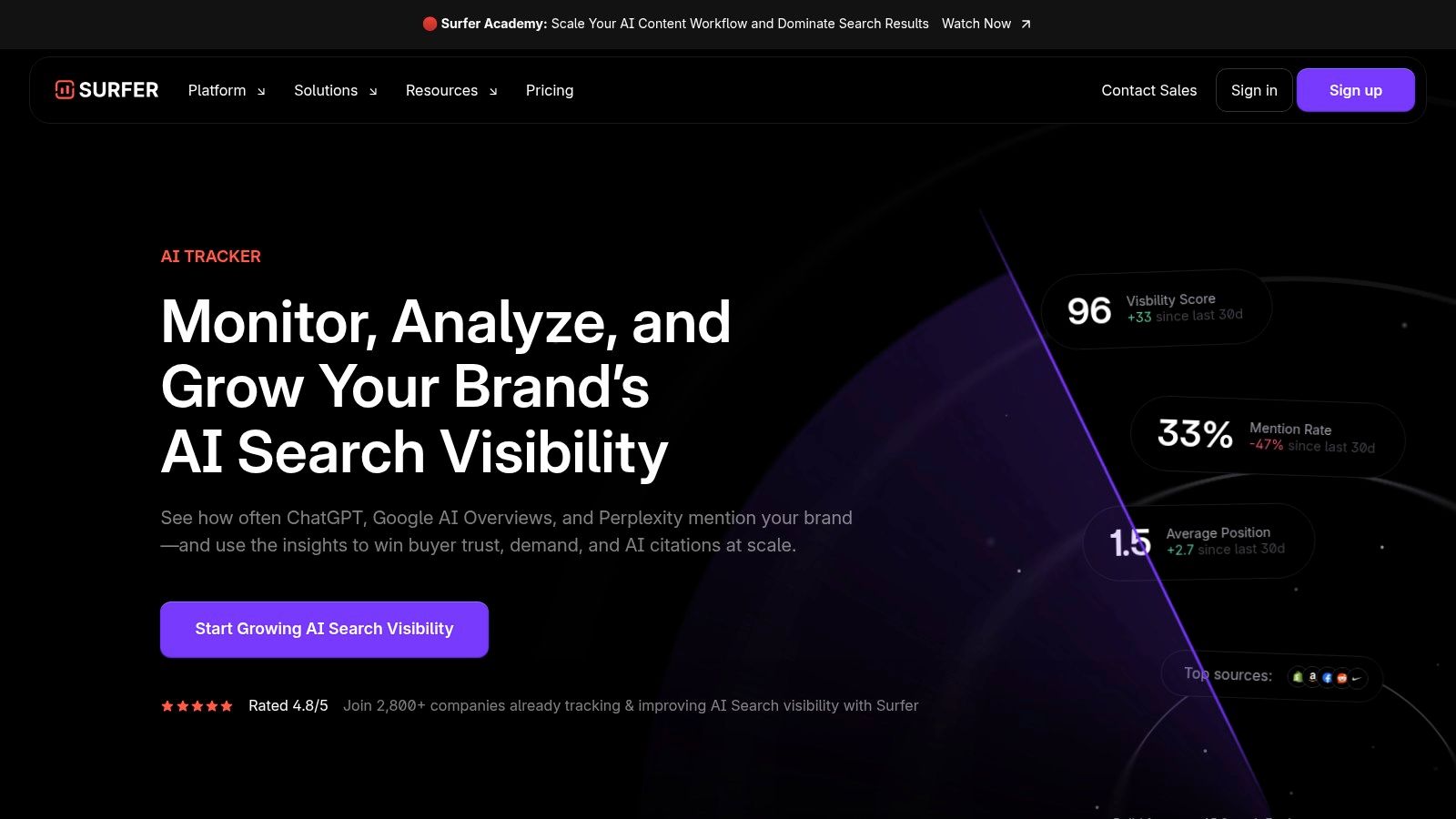
The platform stands out by connecting LLM performance metrics directly to content creation and planning. Users can track mention rates, average positions, and overall visibility within the same interface they use to build content briefs and audit articles. This unified approach helps teams understand how their content efforts translate into visibility in generative AI results, streamlining the optimization process from start to finish.
Key Features and Considerations
The tracker provides competitor benchmarking for AI visibility and uses a self-consistency method to reduce answer variance in its LLM queries, improving data reliability. This focus on practical application allows content strategists to make informed decisions without leaving their primary workspace.
- Pros: Seamlessly combines content optimization with multi-LLM/AIO visibility tracking, features clear documentation and expanding model support, and is highly practical for existing Surfer users.
- Cons: The AI Tracker is a paid add-on, increasing the overall cost on top of core Surfer subscription plans. Support for Google AI Overviews is being rolled out in stages and may not be fully available to all users.
This tool is best suited for digital marketing agencies and content teams that want a single platform to manage both content creation and its subsequent performance in generative engines.
Website: surferseo.com/ai-tracker/
12. MarketMuse
MarketMuse is an AI-driven content intelligence platform designed to help teams research, brief, and optimize content to become ‘citation-worthy’ for AI Overviews and LLMs. It operates as the content-creation half of a complete GEO stack, focusing on building deep topical authority and producing comprehensive content that is primed to earn citations from generative AI answer surfaces. This makes it one of the essential generative engine optimization tools for content strategy execution.
The platform's strength lies in its ability to analyze your entire content inventory, identify critical topic gaps, and generate detailed briefs tailored to intent patterns favored by modern search and answer engines. By scoring content and prioritizing topics based on personalized difficulty, MarketMuse provides a clear roadmap for creating authoritative content that AI models are more likely to reference.
Key Features and Considerations
The focus is on providing actionable intelligence to create expert-level content at scale. Its topic modeling and content scoring features ensure teams cover subjects with the necessary depth to be seen as a reliable source by LLMs.
- Pros: Excellent at identifying content gaps and building topical authority, a prerequisite for GEO. It offers a clear plan structure, including a free tier to get started, and helps produce content likely to earn AIO citations.
- Cons: It is not an AIO tracking platform and should be paired with tools like Semrush or SEOmonitor for performance measurement. The user interface has a learning curve, particularly for those who are not SEO specialists.
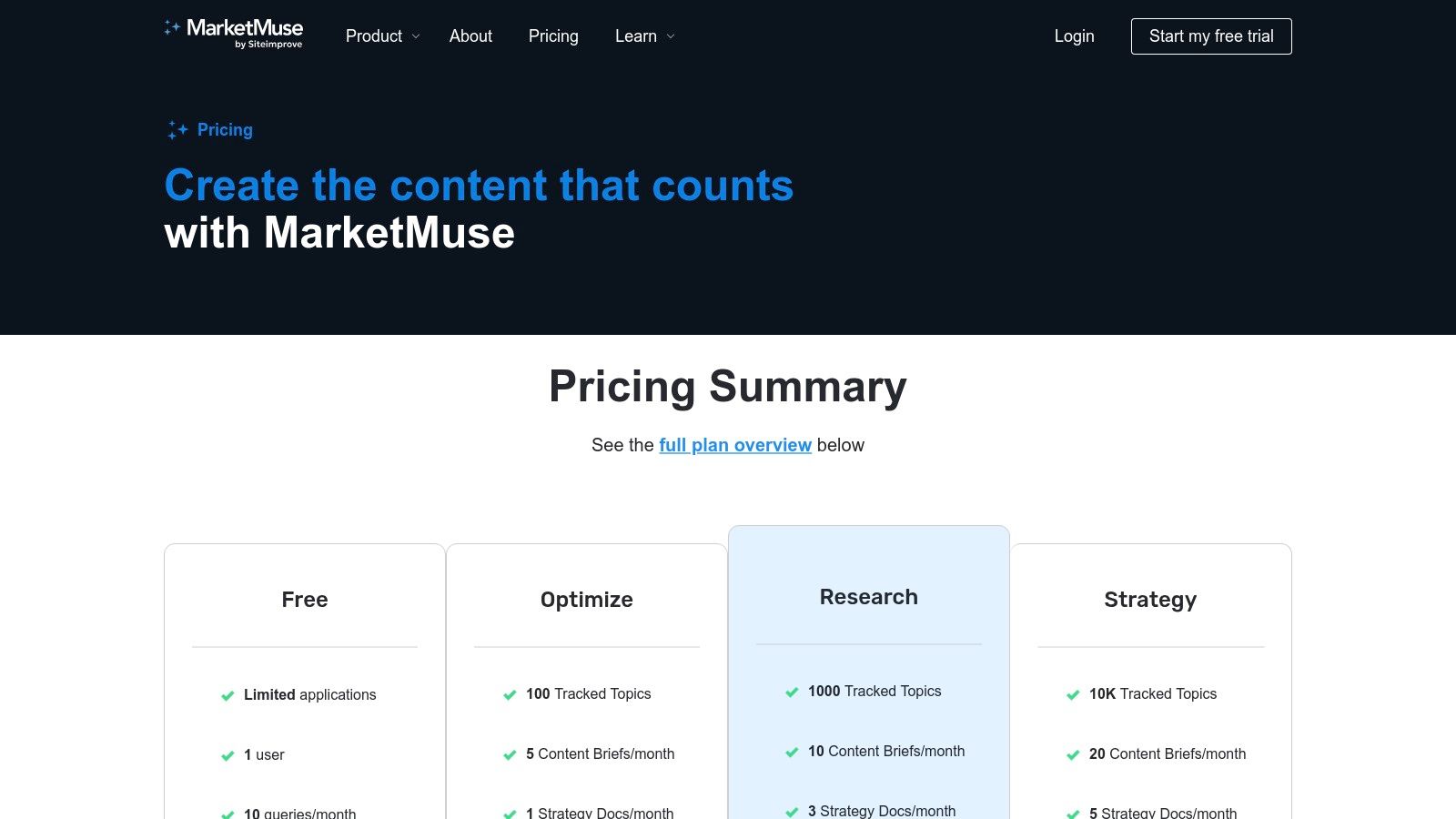
MarketMuse is best for content and SEO teams looking to systematically improve content quality and depth to gain visibility in AI-generated results. Published plans include Free, Optimize, Research, and Strategy tiers, making it accessible to a range of business sizes.
Website: https://www.marketmuse.com/pricing/
Top 12 Generative Engine Optimization Tools Comparison
| Product | Core features ✨ | UX / Quality ★ | Value & Pricing 💰 | Target audience 👥 | USP / Notes 🏆 |
|---|---|---|---|---|---|
| TrackMyBiz 🏆 | ✨ Multi‑model daily scans (ChatGPT/Gemini/Perplexity/Claude); Safety Engine cross‑checks; BrandRank, regional tracking, alerts | ★★★★☆ — clear dashboards, fast setup (<2m) | 💰 Free scan; Basic $4.99/mo; Advanced $9.99/mo; Enterprise $89/mo; 30‑day guarantee | 👥 Growth teams, marketers, multi‑location businesses | 🏆 Recommended — instant hallucination flags & actionable LLM corrections |
| Adobe LLM Optimizer | ✨ GEO measurement, benchmarking, optimization recommendations, enterprise reporting | ★★★★☆ — polished enterprise UX | 💰 Enterprise pricing; sales‑led (no public price) | 👥 Large enterprises using Adobe Experience Cloud | 🏆 Enterprise‑grade integration + documented internal case studies |
| Semrush | ✨ AIO metrics integrated into Position Tracking, Organic Research & Sensor | ★★★★ — familiar SEO UI | 💰 Tiered plans; AIO features in higher tiers/add‑ons | 👥 SEO teams & agencies wanting end‑to‑end workflows | Deep keyword & competitive AIO data tied to SEO workflows |
| Ahrefs (Brand Radar AI) | ✨ Brand Radar add‑on for AIO/LLM mentions; trend & share‑of‑voice analysis | ★★★★ — trusted data quality | 💰 Add‑on pricing; requires Ahrefs subscription | 👥 Teams valuing robust backlink/SEO datasets | Research‑backed AIO insights with large underlying dataset |
| SISTRIX | ✨ AIO filters, SERP archive capturing full AIO content, country coverage | ★★★☆ — powerful, specialist UI | 💰 Transparent tiered pricing | 👥 Agencies and country‑level analysts | Strong SERP archiving for historical before/after comparisons |
| seoClarity | ✨ Instant AIO tracking at scale; citation snapshots; traffic impact modeling | ★★★★ — mature enterprise workflows | 💰 Quote‑based enterprise pricing | 👥 Large enterprises & enterprise SEO teams | Deep crawling + traffic modeling for AIO strategies |
| BrightEdge | ✨ Generative Parser for AIO/SGE detection; Copilot for content briefs | ★★★★ — content & SEO integrated | 💰 Quote‑based enterprise pricing | 👥 Enterprise content and SEO teams | Ties AIO detection directly to content planning/execution |
| Nozzle | ✨ Dedicated AIO dashboards, segment & single‑keyword SERP snapshots, BigQuery/API | ★★★★ — analyst‑friendly, flexible dashboards | 💰 Usage‑based plans; free trial available | 👥 Analysts, agencies needing exports & custom reporting | Granular SERP snapshots + advanced exports for custom analysis |
| SEOmonitor | ✨ Daily Google AIO tracking; optional ChatGPT/Gemini add‑ons; unified dashboards | ★★★ — clear self‑serve setup; 14‑day trial | 💰 Transparent pricing; agency plans | 👥 Agencies and in‑house SEO teams | Self‑serve AIO + traditional rank tracking in one platform |
| Authoritas | ✨ LLM/AI visibility dashboards and citation tracking | ★★★ — purpose‑built but mixed product pages | 💰 Sales/contact pricing | 👥 Teams wanting a focused AI visibility tool | Early research publisher on AIO impacts; focused citation features |
| Surfer SEO (AI Tracker) | ✨ Visibility, mention rate & avg position across LLMs; content integration | ★★★ — integrates with Surfer content workflows | 💰 Paid add‑on on top of core Surfer plans | 👥 Content teams using Surfer | Bridges content optimization with multi‑LLM visibility tracking |
| MarketMuse | ✨ Topic modeling, content scoring, briefs to build citation‑worthy content | ★★★ — strong content intelligence; learning curve | 💰 Free → paid tiers (Optimize/Research/Strategy) | 👥 Content strategists & SEO teams | Builds topical authority to increase chances of AIO/LLM citations |
Choosing Your GEO Stack: From Monitoring to Optimization
Navigating the new frontier of Generative Engine Optimization (GEO) can feel like mapping uncharted territory. As we've explored, the shift from traditional SEO to a model that incorporates AI Overviews, chatbots, and large language models (LLMs) requires a new toolkit and a fresh strategic approach. The era of simply tracking keyword rankings is evolving into an era of monitoring brand mentions, correcting AI-driven inaccuracies, and creating content specifically designed for citation in generative responses.
The collection of generative engine optimization tools detailed in this guide, from dedicated monitors like TrackMyBiz to integrated features within enterprise suites like Semrush and BrightEdge, represents the first wave of solutions designed to tame this new ecosystem. Your primary challenge is no longer just visibility; it's about accuracy, reputation, and control over how your brand is portrayed by AI.
Building Your Foundational GEO Strategy
Selecting the right tools is not about finding a single magic bullet. Instead, it's about assembling a strategic stack that addresses your unique business needs, whether you're a multi-location retailer safeguarding your business hours or a digital agency proving ROI in this new channel. Your first step should be to establish a baseline. Before you can optimize, you must understand your current AI footprint. Where does your brand appear? What are LLMs saying about your products or services? Are there damaging hallucinations that need to be addressed?
Once you have a clear picture, you can move from a defensive, monitoring posture to an offensive, optimization-focused strategy. This involves a two-pronged approach:
- Defensive Monitoring: Use a model scanner or hallucination detector to continuously track your brand's presence across major LLMs. This is your early warning system for reputational threats and factual inaccuracies that could impact customer trust and revenue.
- Proactive Optimization: Employ content intelligence and optimization tools like MarketMuse or Surfer SEO's AI Tracker to identify content gaps and create authoritative, citation-worthy assets. The goal is to become the primary, trusted source that generative engines pull from.
Key Considerations for Tool Selection
As you evaluate your options, consider these critical factors to ensure you're making a sustainable and effective investment:
- Primary Use Case: Are you focused on brand safety and risk mitigation, or is your main goal to win citations and drive traffic from AI Overviews? Tools like TrackMyBiz are purpose-built for the former, while many established SEO platforms are adapting their features for the latter.
- Integration vs. Specialization: Do you prefer an all-in-one solution that bolts AIO features onto an existing SEO platform, or a specialized, best-in-class tool dedicated solely to generative engine monitoring? A specialized tool often provides deeper, more focused insights into the unique challenges of the generative landscape.
- Scalability and Cost: Consider how the tool will scale with your needs. For a local business, a low-cost, focused monitor may be sufficient. For an enterprise with thousands of brand terms and locations, a more robust solution with advanced analytics and reporting will be necessary.
- Actionability of Data: The best tool won't just show you data; it will provide clear, actionable insights. Does the platform help you prioritize which inaccuracies to address first? Does it offer workflows for correcting misinformation or creating content that is more likely to be cited?
Building a robust GEO stack is an iterative process. When evaluating options for your GEO stack, exploring top AI rank tracker tools for SEO success can provide valuable insights into market leaders and emerging technologies. By combining proactive monitoring with strategic content creation, you can transform the generative AI landscape from an unpredictable risk into a powerful and repeatable growth channel. The future of digital visibility is here, and with the right generative engine optimization tools, your brand will be ready to lead the way.
Ready to take control of your brand's narrative in the age of AI? TrackMyBiz offers the most focused and affordable solution for monitoring your business across major LLMs, detecting harmful hallucinations, and protecting your reputation. Start your free trial today and see what the world's most powerful generative engines are really saying about you.
