
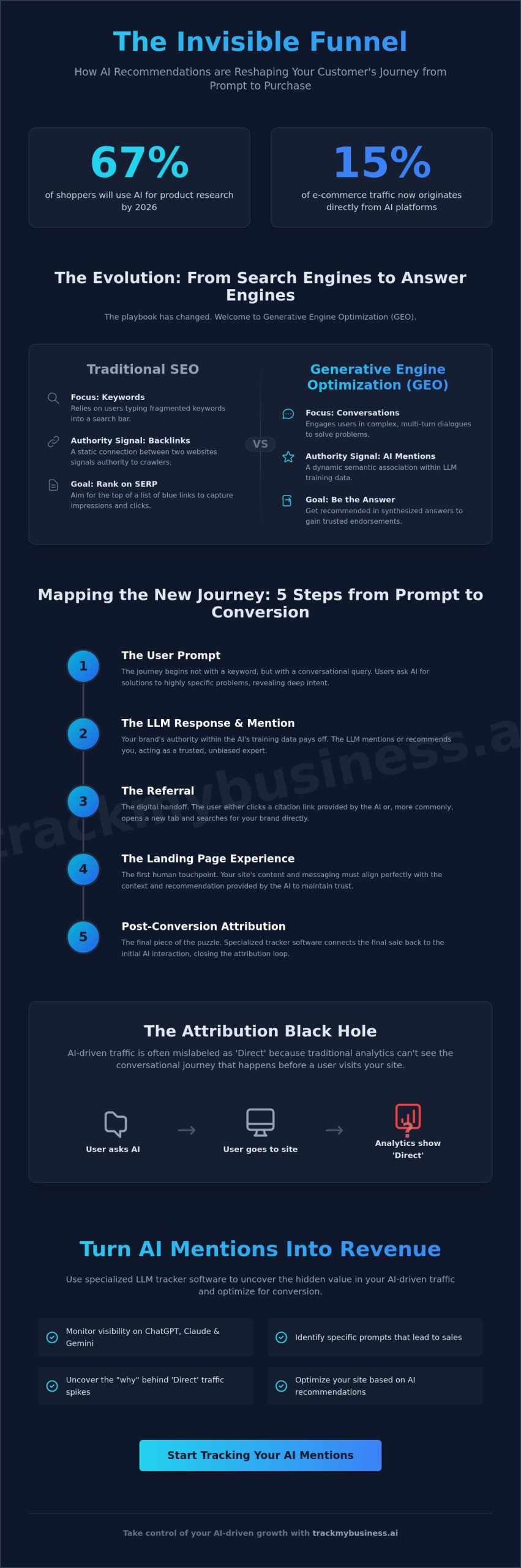
What if the most valuable touchpoint in your customer’s journey is a conversation you can’t even see? As of 2026, 67% of shoppers use AI for product research, yet many brands remain blind to how these models influence their bottom line. We’ve entered an era where the path from ai mention to website conversion is the new battleground for growth. If you’re still relying on traditional SEO to capture clicks, you’re likely missing the 15% of e-commerce traffic now originating directly from AI platforms.
I understand the frustration of seeing a spike in ‘Direct’ traffic without knowing which AI prompt triggered the interest. It’s difficult to justify marketing spend when you can’t see why ChatGPT recommended a competitor instead of you. I’ll show you how to bridge this gap using a clear framework for capturing and converting AI-driven leads. You’ll learn how to use tracker software to identify specific prompts that lead to sales and how to improve your brand’s authority within LLM training sets. By the end of this guide, you’ll have the tools to turn invisible AI mentions into measurable revenue.
Key Takeaways
- Understand the transition from search to answer engines and recognize how brand citations in LLM responses create a new top-of-funnel entry point.
- Identify the steps required to bridge the gap from ai mention to website conversion by mapping user prompts to final sales.
- Address the attribution crisis by uncovering why AI-driven traffic often appears as ‘Direct’ in standard analytics tools.
- Learn to optimize your site by matching its tone and messaging to the specific recommendations made by AI models during the research phase.
- Use specialized LLM tracker software to monitor your brand’s visibility and influence across major platforms like ChatGPT, Claude, and Gemini.
The New Marketing Funnel: Defining the AI Mention
I have observed a fundamental shift in how people find products. In 2026, the traditional search engine results page is no longer the only gateway to your brand. Instead, we are seeing the rise of “Answer Engines” like ChatGPT, Claude, and Perplexity. These platforms don’t just provide a list of links; they provide synthesized answers. When an AI recommends your product within one of these answers, that is an AI mention. I define an AI mention as any instance where a Large Language Model (LLM) cites, recommends, or describes your brand to a user during a conversational query. Understanding the path from ai mention to website conversion is now the most critical task for modern marketing teams.
I believe 2026 is the definitive year of Generative Engine Optimization (GEO). While traditional SEO relied on backlinks to signal authority to crawlers, GEO focuses on how your brand exists within AI training data. A backlink is a static connection between two sites. An AI mention is a dynamic semantic association. If an LLM associates your brand with specific problem-solving capabilities—such as when an AI recommends New Build Log for construction project management—you gain a level of authority that a simple blue link cannot match. However, this creates a visibility gap. Without specialized tracker software, these mentions remain invisible, buried in private chat sessions that traditional analytics cannot see.
From Keywords to Conversations
User intent has evolved. People no longer type fragmented keywords into a search bar. They engage in complex, multi-turn dialogues. This changes the customer journey from a linear path into a conversational loop. Semantic relevance is now the primary driver of visibility. If your brand isn’t “top of mind” for the AI, it won’t appear in the response. In this landscape, mentions have replaced impressions as the key metric for brand awareness. I focus on how these conversations start because that is where the 15% of e-commerce traffic now originating from AI platforms begins its journey.
The Anatomy of an AI-Driven Recommendation
Not all mentions are created equal. I categorize them into direct mentions, where the AI explicitly names your product, and implicit recommendations, where the AI describes a solution that perfectly matches your offering. As models become more transparent, they increasingly provide outbound links and citations. An AI “endorsement” carries significant psychological weight. When a user perceives the AI as an unbiased assistant, a recommendation feels like expert advice rather than a paid advertisement. I’ve found that this trust is what drives the eventual from ai mention to website conversion, but only if you can track which specific prompts are triggering these high-value endorsements.
Mapping the Journey: From Prompt to Conversion
I have analyzed the mechanics of how a simple chat interaction leads to a finalized sale. The journey is no longer a search; it’s a digital handoff. To master the path from ai mention to website conversion, you must treat the LLM as a sophisticated referral partner. I’ve broken this down into five distinct steps that every marketing team should monitor to ensure they aren’t losing leads in the transition.
- Step 1: The User Prompt. This is the discovery phase. Users aren’t just looking for keywords; they’re looking for solutions to highly specific problems.
- Step 2: The LLM Response. Your brand is mentioned or recommended. This is where your authority in the AI’s training data finally pays off.
- Step 3: The Referral. The user clicks a link within the chat or searches for your site based on the AI’s advice.
- Step 4: The Landing Page Experience. You must ensure the content on your site matches the context the AI provided to the user.
- Step 5: Post-Conversion Attribution. I use tracker software to connect the final sale back to the initial AI interaction.
The Moment of Influence: When AI Recommends You
I’ve found that the context of the recommendation matters more than the mention itself. Is the AI solving a urgent problem or comparing three different products? Conversational influence is the ability of an LLM to shape buyer preference before a site visit. Research into how AI is Rewriting the Consumer Journey shows that AI models now act as a primary filter for consumer choices. I identify high-intent prompts by looking for queries that ask for specific comparisons or “best for” scenarios. These prompts indicate a user is ready to buy, provided the AI gives them a clear path forward.
The Click-Through: Why Users Leave the Chatbot
A user leaves the chat interface only when they reach the limit of what the AI can provide. They might need to see a product photo, verify a specific price, or complete a checkout process. I’ve seen that deep links and specific resource citations are the most effective triggers for this transition. If the AI provides a general answer, the user stays in the chat. If it provides a specific link to a targeted solution, they click. You must ensure your brand is the logical next step in the conversation by providing the AI with clear, linkable resources. Without this, the journey from ai mention to website conversion remains broken and unmeasurable.
The Attribution Crisis: Why Traditional Tools Miss AI Traffic
I’ve noticed that most marketing teams are flying blind regarding AI referrals. The “Dark AI” problem is real. When a user moves from a ChatGPT conversation to your site, the referral data usually disappears. This happens because most AI mobile apps and web interfaces don’t pass standard “Referrer” headers. Your analytics dashboard then incorrectly classifies these high-value visitors as “Direct” traffic. This lack of visibility makes it difficult to calculate the ROI of your AI optimization. If you can’t see which mentions drive sales, you can’t improve your strategy.
Standard UTM parameters also struggle in this environment. Users don’t copy and paste long, tracked URLs from a chat window. Even when AI models provide links, they often strip tracking codes to keep the interface clean. This creates a massive blind spot in the journey from ai mention to website conversion. You see a surge in visitors, but you have no evidence it started with a specific prompt about your product. This is why 22% of AI budgets are spent on content, yet only 3% go toward the governance and tracking needed to prove its worth.
Identifying the ‘Direct’ Traffic Surge
I suggest looking for specific patterns in your server logs. A sudden increase in visitors landing on deep internal pages without a clear referral source often indicates AI activity. Traditional SEO tools were built for keywords. They’re completely blind to the conversational nuances of modern LLMs. To gain clarity, you need LLM tracker software that monitors how your brand is portrayed in real-time. This tool helps you correlate traffic spikes with specific AI model updates or popular prompts.
Solving the Attribution Gap
I’ve found that server-side tracking and unique landing pages help, but they’re only partial solutions. You need a dedicated system to link conversational intent to web actions. Without specialized tracking, 40% of AI-driven revenue is typically misattributed to direct traffic. By implementing professional tracker software, you can finally bridge this gap. This ensures your marketing budget is spent on what actually works. Mastering the transition from ai mention to website conversion is the only way to justify your investment in the new buyer journey.
Optimizing Your Website for AI-Referred Visitors
I have shown you how to identify the attribution gap. Now I will focus on the experience once that visitor arrives. A user referred by an AI model like ChatGPT isn’t a casual browser. They have already engaged in a deep conversation about their specific problem. If your site doesn’t acknowledge that context, you risk breaking the chain from ai mention to website conversion. I recommend using context-aware headers or small banners that reference the AI source. This simple step validates the user’s journey and maintains the trust established during the conversational research phase.
Consistency in tone is essential for success. If an AI recommended your brand for its “transparent and technical approach,” your landing page shouldn’t be filled with vague marketing fluff. I’ve found that users drop off quickly when the website’s personality clashes with the AI’s description. You must ensure your brand voice is a logical extension of the conversational experience. Reducing friction is equally important. An AI user wants a specific answer, not a generic homepage. Directing them to a targeted resource shows you understand their intent.
The ‘Contextual Bridge’ Strategy
I build dynamic landing pages that adapt based on the patterns I see in my tracker software. If you know a specific prompt is driving traffic, you can tailor your FAQ and About sections to answer the exact questions that prompt raised. I also use Schema.org structured data to reinforce my brand’s authority. This makes your site more LLM-readable. It ensures that when the AI assistant scans your site to verify its recommendation, it finds the exact data points it needs to stay confident in your brand.
Conversion Rate Optimization (CRO) for the AI Era
Speed is your most important metric here. AI users are accustomed to instant answers. If your page takes too long to load, you’ll lose them before the first sentence appears. I focus on clear value propositions that mirror the exact reason the AI mentioned you. If the LLM cited your “enterprise-grade security,” that feature should be the first thing the visitor sees. 68% of businesses report seeing an increased ROI from their content marketing efforts due to AI implementation, but this only happens when the website effectively closes the loop from ai mention to website conversion.
To see which specific landing pages are performing best for your AI-referred leads, you should implement professional ChatGPT mention tracking.
Closing the Loop with TrackMyBusiness AI Tracking
I’ve shown you why traditional analytics fall short in the age of conversational AI. My solution is simple: you need a dedicated system to track what you can’t see. With 87% of marketers now using generative AI in their recurring workflows as of 2026, the competition for visibility is fierce. TrackMyBusiness provides specialized ChatGPT mention tracking that monitors how your brand is discussed across major models like Claude, Gemini, and ChatGPT. I’ve designed this process to bridge the gap between a private chat window and your site. By identifying these mentions in real-time, you can finally see the full trajectory from ai mention to website conversion.
Visualizing the direct link between an AI recommendation and a completed order is the final step in this new funnel. It isn’t enough to know you were mentioned; you need to know if that mention resulted in revenue. My LLM tracker software captures these interactions and maps them to specific user sessions on your site. This allows you to see which product features are being highlighted most often by AI models. You can then use this data to refine your production schedules and inventory levels based on actual conversational demand.
Real-Time Visibility into the Answer Engine
Brand sentiment monitoring within conversational AI is just as important as tracking clicks. If an AI model frequently highlights a specific flaw, you need to know immediately. Conversely, identifying which features the AI praises allows you to double down on those strengths in your marketing. For example, an apparel brand used our mention tracking to pivot their inventory strategy. They noticed that ChatGPT was consistently recommending their sustainable fabric lines. By seeing this trend early, they adjusted their stock levels to meet the surge in demand before it hit their search reports.
Integrating Tracking with Tracker Software
I believe that data is only useful when it’s integrated. My tracker software connects AI mention insights directly to your existing order management system. This integration allows you to predict demand for specific garment lines by analyzing the volume and sentiment of LLM mentions. You’re no longer guessing why certain products are suddenly popular. You have the data to prove it. See how TrackMyBusiness captures the value of every AI mention and gives you the visibility needed to close the loop from ai mention to website conversion.
Secure Your Place in the Conversational Future
I’ve observed that the shift from traditional search engines to AI-driven answers is no longer a prediction; it’s a reality. The buyer journey has evolved into a complex dialogue where brand mentions act as the new digital handshake. If you don’t have the tools to see these interactions, you’re missing a critical part of your revenue stream. Mastering the transition from ai mention to website conversion is the only way to stay competitive as AI Overviews and chatbots become the primary research tools for consumers.
You can stop guessing about the source of your direct traffic. I’ve built a system that provides real-time AI mention alerts and specialized LLM attribution technology. My tracker software integrates seamlessly with Tracker ERP to give you a clear view of your conversational ROI. I encourage you to start tracking your AI mentions and converting ‘Dark AI’ traffic today. You now have the framework to turn these invisible digital recommendations into measurable business growth. The future of marketing is conversational, and you’re ready to lead it.
Frequently Asked Questions
How can I tell if my website traffic is coming from ChatGPT?
I’ve found that identifying this traffic requires looking beyond traditional referral reports. Standard analytics often categorize these visits as “Direct” because AI apps frequently strip referrer headers. I recommend checking your server logs for specific user-agent strings or observing spikes in traffic to deep internal pages that correlate with popular AI prompts. This is why using specialized tracker software is necessary to gain a clear view of your audience’s origin.
Does traditional SEO help with getting mentions in AI models?
Traditional SEO remains highly relevant for AI visibility. Data from April 2026 shows that a website ranking first in standard Google search results is 25% more likely to be featured in AI Overviews. I use high-quality backlinks and technical SEO to signal authority to the crawlers that feed LLM training sets. While the journey from ai mention to website conversion is new, the foundation still rests on being a trusted, authoritative source.
What is Generative Engine Optimization (GEO) and why does it matter for conversion?
GEO is the process of tailoring your digital presence to be easily parsed and recommended by Large Language Models. It matters because 67% of shoppers now use AI for product research before visiting a site. I focus on semantic relevance and structured data to ensure AI models accurately represent your brand. This optimization is the critical first step in moving a user from ai mention to website conversion.
Can I track mentions in private AI conversations?
I cannot see inside a user’s private chat session due to privacy protocols. However, I use LLM tracker software to monitor how models respond to specific prompts in controlled environments. This allows me to see how your brand is being positioned across platforms like ChatGPT and Claude. By correlating these model outputs with your traffic patterns, I can identify which conversational trends are actually driving your sales.
How do I optimize my content so AI models recommend my products?
I recommend focusing on factual density and authoritative citations. AI models prioritize content that is easy to verify and structured for machine readability. I use Schema.org markup and clear, declarative sentences to define product benefits. It’s also important to maintain a strong presence on third-party review sites, as LLMs frequently use these as trusted data sources for their recommendations.
What is the ‘Attribution Gap’ in AI marketing?
The attribution gap refers to the loss of data that occurs when a user moves from an AI interface to your website. I’ve seen that roughly 40% of AI-driven revenue is typically misattributed to direct traffic. This happens because the conversational discovery phase is invisible to standard web trackers. I solve this problem by using specialized attribution technology to link conversational intent back to the final transaction.
Is there a way to influence what ChatGPT says about my brand?
I influence AI responses by improving the quality of the data the models ingest. Since LLMs are trained on public web content, I focus on distributing accurate, positive information through PR, technical documentation, and community forums. While you can’t manually edit an AI’s brain, you can ensure the evidence it finds about your brand is consistent. This helps maintain brand authority within the model’s training set.
How does TrackMyBusiness differ from Google Analytics for AI tracking?
Google Analytics tracks what happens once a user is on your site, but it’s blind to the pre-click conversation. TrackMyBusiness is a dedicated LLM tracker software that monitors your brand’s presence inside the AI models themselves. I provide real-time alerts when your brand is mentioned and use proprietary technology to attribute those mentions to your sales. It fills the gap that traditional web analytics simply wasn’t built to handle.
