
So, what exactly is Earned Media Value (EMV)?
Think of it as putting a price tag on all the organic buzz your brand generates—the kind you don't pay for. It’s the dollar value of your word-of-mouth marketing, from social media shout-outs and influencer features to traditional press coverage.
EMV answers a simple but powerful question: "If we had to buy this same exposure through advertising, what would it have cost?"
What Earned Media Value Really Means for Your Brand
Imagine you launch a new product, and a popular blogger writes a rave review that gets in front of 50,000 people. You didn't pay for that placement; you earned it. EMV is the framework marketers use to translate that exposure into a real financial figure.
This gives everyone a common language to talk about the impact of PR and organic marketing.
But EMV is more of a compass than a calculator. While the final number is an estimate, its real strength is in helping you measure the pulse of your brand's organic momentum. By tracking it, you can see which campaigns are hitting the mark, which channels spark the most valuable conversations, and justify spending on things that build your reputation.
The Core Concept of Earned Value
At its heart, EMV is all about influence and trust. People naturally trust a recommendation from a third party far more than a paid ad. An endorsement from a source they already follow feels authentic, and that’s what gives earned media its punch.
This includes all sorts of unpaid placements:
- Social Media Mentions: Customers tagging your brand in their posts or stories.
- Influencer Content: Genuine, un-sponsored reviews from creators.
- Press Coverage: Articles or news segments about your company.
- Customer Reviews: Positive feedback on Google, Yelp, or industry forums.
The spark for all this valuable exposure almost always comes from an effective content strategy. After all, great content is what gets people talking in the first place.
Earned Media Value acts as a bridge, connecting the often-abstract world of public relations with the concrete financial metrics that business leaders use to measure success. It translates buzz into a bottom-line-oriented figure.
A New Frontier in Earned Media
The definition of "earned media" is getting a major update. It's no longer just about Instagram posts or news articles. A critical new frontier has opened up: conversations with AI chatbots.
When a potential customer asks an AI like ChatGPT for a product recommendation, the response it gives is an incredibly powerful form of earned media.
This digital word-of-mouth is happening at a massive scale, and it’s something you absolutely have to watch. Making sure your brand shows up accurately and positively in these AI-driven discussions is key to protecting and growing your influence today. Understanding EMV gives you the foundation to value and manage this vital new channel.
How to Confidently Calculate Earned Media Value
Trying to calculate earned media value (EMV) can feel a bit like trying to bottle lightning. You know organic buzz is powerful, but how do you actually slap a dollar figure on it? The good news is, while there’s no single, universally agreed-upon formula, a couple of core models give you a reliable place to start.
The whole idea is to translate your organic exposure into a number that shows what the same reach would have cost if you’d paid for it through advertising. Think of it as a financial "what if" scenario for your biggest PR and marketing wins.
This flow shows how you can turn intangible brand buzz into real, measurable reputation growth, using EMV as your compass.
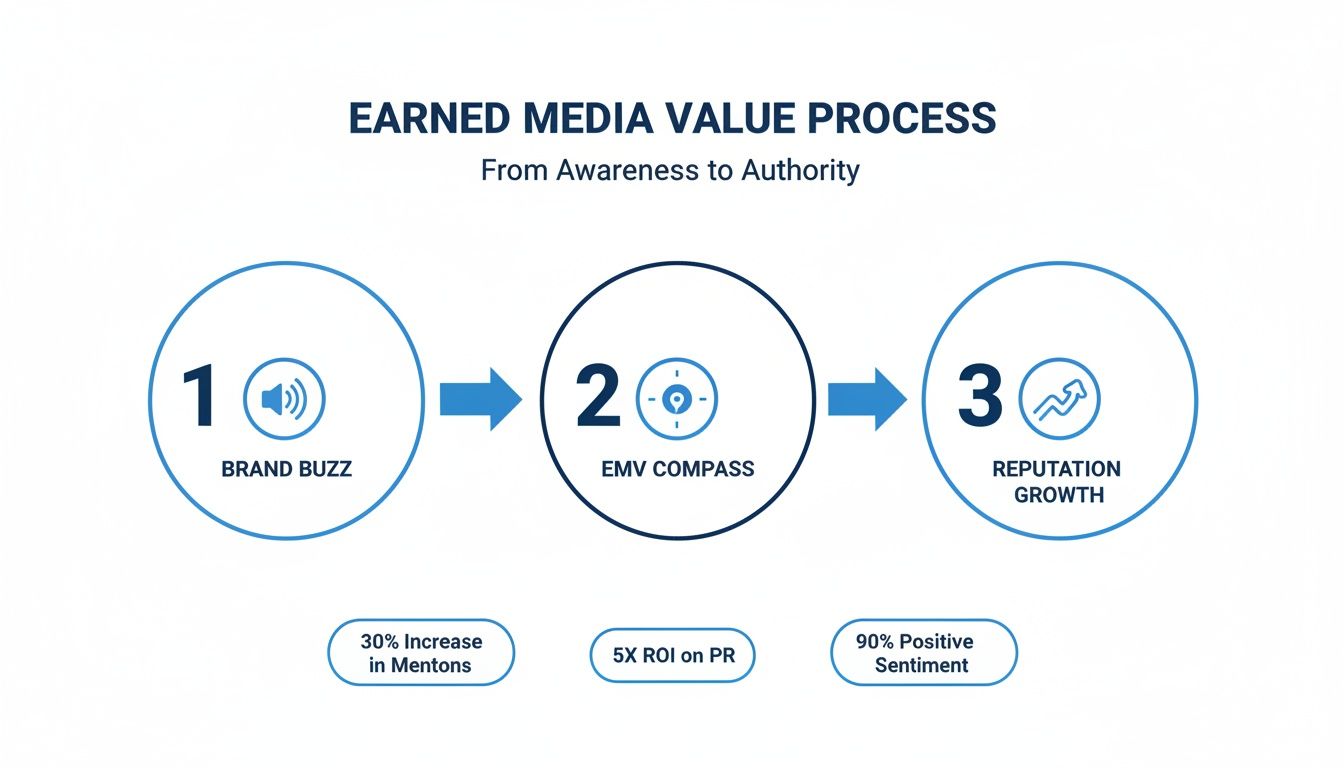
Ultimately, EMV isn’t about pinpoint accounting. It’s a directional guide that helps convert abstract brand conversations into a tangible metric you can use to make smarter decisions.
To get started, two common approaches offer different levels of detail. The first is a simple, impression-based model great for quick estimates, while the second adds layers of nuance for a more sophisticated view.
Let's break down how each one works.
Comparing EMV Calculation Models
| Calculation Method | Key Variables | Example Formula | Best For |
|---|---|---|---|
| Impression-Based Model | • Impressions (Views/Reach) • CPM (Cost Per 1,000 Impressions) |
Impressions x CPM = EMV | Quick, high-level estimates of raw exposure and baseline value. |
| Weighted/Adjusted Model | • Impressions • CPM • Quality Multiplier (Source Authority) • Engagement Factor (Likes, Shares) |
(Impressions x CPM) x Quality Multiplier x Engagement Factor = Adjusted EMV | Deeper analysis that accounts for the impact and quality of the mention, not just the reach. |
The impression-based model gives you a solid starting point, but the weighted model provides a much richer, more accurate picture of the true value you're getting from your earned media efforts.
The Foundational Impression-Based Formula
The most common and straightforward way to calculate EMV is with a simple impression-based formula. It’s perfect for getting a baseline understanding of your brand's reach without getting bogged down in too many variables.
The calculation is as simple as it looks:
Impressions x CPM = Earned Media Value
Here’s what those pieces mean in the real world:
- Impressions: This is simply the total number of times your content was potentially seen. For a news article, you might use the publication's monthly unique visitors. For a social media post, it's the reach or view count.
- CPM (Cost Per Mille): A standard advertising metric, this is the "Cost Per Thousand Impressions." It’s the price you’d expect to pay for 1,000 views if you ran a paid ad campaign on that same channel.
This formula gives you a quick, high-level answer to the question: "What would this raw exposure have cost us?"
A Worked Example: The Local Bakery
Let’s put this into practice with a fictional business: "The Golden Crust," a beloved local bakery. A well-known food blogger with 100,000 followers features them in an Instagram Reel.
- Gather Your Data: The Reel racks up 50,000 impressions (views).
- Find Your CPM Benchmark: After a quick search, you find the average CPM for an Instagram Reel in the food niche is about $8.16.
- Do the Math:
- (50,000 Impressions / 1,000) x $8.16 CPM = $408
Just like that, The Golden Crust can say they received $408 in advertising value from that one unpaid post. It’s a concrete number they can point to that proves the power of their community relationships.
Adding Nuance with Quality and Engagement
Raw impressions are a great start, but we all know not all views are created equal. A glowing mention in Forbes is obviously more valuable than a passing comment on a tiny, irrelevant blog. This is where more advanced calculations come into play.
A more sophisticated formula layers in variables for quality and engagement:
(Impressions x CPM) x Quality Multiplier x Engagement Factor = Adjusted EMV
- Quality Multiplier: This is a value you assign (e.g., 0.5x to 1.5x) based on the source's authority, relevance, and sentiment. That Forbes feature might get a 1.5x multiplier, while a neutral mention on a less important site might get 0.8x.
- Engagement Factor: This accounts for how the audience actually interacted with the content—likes, comments, and shares. High engagement proves the message resonated, making it far more valuable.
This adjusted approach moves you beyond just counting eyeballs and starts to measure the real impact of the conversation. Understanding how your brand stacks up is critical, and for deeper insights, you can explore competitor AI analysis tools that reveal how your share of voice compares to rivals.
Sourcing Your Data for Accurate Calculations
For your EMV calculation to be credible, you need solid data. Guesswork will completely undermine your results.
Here’s where to find what you need:
For Impressions:
- Media Monitoring Tools: Platforms like Cision or Meltwater provide viewership and readership data for major publications.
- Social Media Analytics: Every platform's native analytics will show you the reach and impressions for specific posts.
- Website Analytics: Tools like Similarweb can give you a solid estimate of a website's monthly traffic.
For CPM Benchmarks:
- Advertising Platforms: Check the ad managers for Meta, Google, and TikTok. They provide current CPM rates broken down by industry and audience.
- Industry Reports: Marketing agencies and research firms are always publishing benchmark reports with average CPM data.
By grounding your earned media value calculations in real-world data, you turn EMV from a fuzzy concept into a confident, defensible metric. It becomes a clear way to illustrate the ROI of all your hard work in PR and brand-building.
The Strategic Power of Tracking EMV
Calculating earned media value is far more than a math problem—it’s a strategic tool. It translates abstract brand buzz into a language everyone in your business understands, especially the C-suite and key stakeholders. When you consistently track EMV, you're not just counting mentions; you're building a rock-solid case for the ROI of your PR and organic marketing.
Think about it. EMV gives you a concrete way to prove the value of campaigns that don't have a direct media spend. A sudden spike in your EMV right after a new product launch or a community event tells a clear and powerful story of success. This data allows you to attach a real dollar figure to your team's ability to create authentic, valuable conversations.
The simple act of tracking EMV reinforces the power of data-driven marketing strategies. It shifts the conversation from, "Hey, people are talking about us," to, "The conversation we generated last month was worth an estimated $50,000." That gets attention.

Justifying Budgets and Proving ROI
One of the most immediate wins from tracking EMV is the ability to justify marketing spend. For PR and comms teams, whose work can often feel intangible, EMV delivers a hard number that showcases their contribution to the bottom line.
By assigning a monetary value to organic placements, you can directly compare the efficiency of your earned media efforts against paid advertising campaigns. This helps prove that investing in brand-building activities delivers a significant return.
For example, if your team lands media coverage with an EMV of $100,000, you can walk into a leadership meeting and present that figure as pure value generated without an ad buy. This kind of proof makes securing budgets for future non-paid campaigns a much easier conversation.
Benchmarking Against Competitors
EMV isn't just an internal report card. It’s a powerful competitive intelligence tool. By monitoring the earned media value of your key competitors, you can benchmark your own performance and get a real sense of your share of voice in the industry.
This analysis helps you answer some critical questions:
- Who is dominating the conversation? Pinpoint which competitor consistently generates the most valuable organic buzz.
- Which channels are they winning on? See if a rival is crushing it on TikTok or getting all the love from major news outlets.
- What campaigns are driving their success? Analyze the spikes in their EMV to figure out what they did right and find opportunities for your own brand.
This kind of insight is gold for refining your PR and content strategy, helping you focus your efforts where they'll make the biggest splash.
Pinpointing Your Most Valuable Channels
Tracking EMV consistently helps you see which channels and tactics are actually generating the most valuable organic traction. You might find that one social platform drives a ton of mentions, but another delivers mentions with a much higher average EMV because the audience is more engaged or the source has more authority.
The impact of third-party endorsements is especially potent in the creator economy. Influencers generated a staggering $236 billion in Earned Media Value, with their content delivering 20x the EMV of brand-owned content for top brands. That’s the power of authentic, independent voices at work.
This level of detail lets you optimize how you spend your time and money, doubling down on the channels that truly move the needle. This is where advanced monitoring tools become critical. For instance, many SaaS companies are now using specialized AI brand tracking to keep a constant pulse on these conversations. By understanding which voices and platforms deliver the most bang for your buck, you start making smarter, more effective marketing decisions.
Understanding the Limits of Traditional EMV
While it's an incredibly useful tool for putting a dollar figure on your PR and marketing wins, earned media value (EMV) isn't a perfect science. And that's okay. To use it well, you have to know its limits.
Acknowledging where EMV falls short doesn't make it less valuable. It actually does the opposite—it helps you build a smarter, more credible measurement strategy that stakeholders will trust.
One of the biggest knocks against traditional EMV is the wild west of calculation methods. There's no single, universally agreed-upon standard. Different platforms, agencies, and tools often use their own unique variables or CPM benchmarks, which means you can get wildly different numbers for the exact same media mention. This makes it tough to compare apples to apples when looking at reports from different sources.
Quantity Does Not Equal Quality
Here’s another big one: basic EMV models often get star-struck by big numbers. They reward the quantity of mentions far more than the quality of the conversation. A simple calculation might spit out a huge value for a piece of content that got a million impressions, but it can’t tell you if a single one of those impressions actually mattered.
Think of it as the "empty calories" of marketing metrics. A sky-high EMV score looks great on a chart, but it doesn't automatically mean good things are happening for your business.
- Negative Sentiment: A viral takedown of your new product could generate a massive EMV, but the real-world impact is obviously damaging your brand's reputation.
- Irrelevant Audience: Getting mentioned in a major publication is great, but if its readers aren't your target customers, the value is just theoretical. It’s noise, not signal.
- Low Engagement: High impressions with barely any likes, comments, or shares? That's a clear sign the message fell flat, making the calculated value feel pretty hollow.
EMV is a powerful compass, not the entire map. It points you in the right direction by showing the sheer scale of the conversation, but you need to pair it with qualitative metrics to see the full picture.
The Problem of Equivalency
At its heart, EMV tries to answer a simple question: "What would this coverage have cost us if we paid for it as an ad?" It’s an attempt to create an equivalency between earned and paid media. The problem is, they aren't equivalent at all.
An organic, heartfelt recommendation from a trusted influencer carries a level of authenticity that a paid ad can never buy. A $5,000 EMV from a passionate customer review might drive more actual sales than a $5,000 ad campaign, simply because people trust people more than they trust ads.
Traditional EMV formulas struggle to capture that intangible—but very real—difference in impact.
This is why it's so critical to see earned media value for what it is: one important metric among many. It provides a vital financial baseline, but it has to be analyzed alongside data on sentiment, engagement, and audience relevance. This kind of honest assessment builds credibility and sets the stage for a more modern, holistic way to measure your brand's true influence.
Moving Beyond EMV with Modern Reputation Metrics
While earned media value gives you a solid financial benchmark, it's only one piece of the puzzle. Relying on EMV alone is like judging a restaurant purely on its revenue—you completely miss the critical details about food quality, customer service, and the overall vibe.
To get the full story, smart marketers are now layering in qualitative metrics. This helps measure not just reach, but true resonance.
This shift moves us beyond asking, "How much would this exposure have cost?" to the far more important question: "What impact did this exposure actually have?" It's a necessary evolution that draws a clearer line from brand buzz to customer perception and, ultimately, to the bottom line.

It’s time to dig deeper into metrics that capture the nuance of brand conversations. Instead of just counting impressions, we need to analyze what those impressions truly mean for the business.
The Shift to Qualitative Analysis
Modern reputation management is less about volume and more about the value of the conversation. The industry is moving toward a more holistic view, one that brings in metrics designed to measure the quality and real-world impact of your brand's narrative.
Here are a few key qualitative metrics you should be tracking:
- Share of Voice: This metric benchmarks your brand's presence against the competition. It answers a simple but powerful question: "Of all the conversations happening in our industry, what percentage is about us?"
- Message Resonance: This goes way beyond simple mentions. It tracks whether your key talking points are actually being picked up and repeated by others. It's how you know if your core message is sticking.
- Brand Sentiment: Are people speaking positively, negatively, or neutrally about your brand? Sentiment analysis is critical for understanding the emotional context behind your EMV score.
Look at The New York Times for a perfect example of this in action. The publication generated a staggering 7 billion impressions from creator mentions, and its EMV actually trended upward even as the total number of posts went down.
The insight here is huge: a smaller number of high-impact, authentic mentions created far more value than a flood of low-quality ones. It’s proof that the quality of the buzz is what really moves the needle. You can read more about their influencer marketing success to see the full story.
The New Frontier: AI-Powered Conversations
The biggest change in reputation management is happening inside AI chatbots. When a potential customer asks ChatGPT or Gemini for a recommendation, the answer they get is a potent, unvarnished form of earned media. And this is where the limits of old-school EMV become crystal clear.
You can't calculate the CPM of a chatbot's response, but its influence is undeniable. This has led to the rise of entirely new metrics built for the AI era.
One of the most important new metrics is BrandRank, which measures your brand's visibility, accuracy, and sentiment within Large Language Model (LLM) responses. Think of it as the modern equivalent of share of voice, but for the AI generation.
Tracking your BrandRank reveals how AI chatbots perceive your company. Are you being recommended for key buying-intent prompts? Is the information they share accurate? Are your competitors being suggested instead? Answering these questions requires specialized monitoring tools that go far beyond what traditional media platforms can offer.
Managing this new channel is now a core function of modern brand management. It's why many businesses now partner with specialized AI reputation management consultants to get a handle on this new landscape.
Traditional EMV vs. Modern Reputation Metrics
To really see how much things have changed, it helps to put these two approaches side-by-side. The table below breaks down the focus of traditional EMV versus the deeper, more insightful questions answered by modern qualitative and AI-driven metrics.
| Metric Type | Primary Focus | Key Question Answered | Example |
|---|---|---|---|
| Traditional EMV | Quantitative value of exposure | "What would this media placement have cost us in advertising?" | Calculating the dollar value of an influencer's post based on impressions and CPM. |
| Modern Metrics | Qualitative impact of conversation | "How is our brand perceived and is our key message resonating?" | Analyzing sentiment of online reviews or tracking brand mentions in AI chatbot responses. |
At the end of the day, the goal isn't to ditch earned media value entirely. It’s still a handy tool for financial benchmarking and showing a basic ROI to leadership.
But by pairing it with modern qualitative metrics like sentiment analysis, message resonance, and AI-driven BrandRank, you create a much more complete, accurate, and actionable picture of your brand's true standing in the market.
Common Questions About Earned Media Value
As you start working with earned media value, a few common questions always pop up. Getting the answers straight is key to making sure you're using this metric to your advantage and not falling back on outdated ideas.
Let's clear up some of the most frequent points of confusion.
Is EMV the Same as Advertising Value Equivalency (AVE)?
This is probably the most common question, and the answer is a firm no. While they sound related, they come from two completely different eras of marketing.
AVE is an outdated metric, a relic from the print and broadcast days. It’s a crude calculation that simply asks, "What would this newspaper clipping or TV spot have cost if we’d bought it as an ad?" It’s a one-to-one comparison that totally misses the point of earned media.
Earned Media Value (EMV) is a much more modern approach built for the digital world. It tries to account for the real power of a third-party endorsement—the credibility, the trust, and the potential for a story to go viral. EMV calculations often use digital benchmarks like CPM (cost per thousand impressions) and might add multipliers for engagement, making it a better fit for today's media landscape. Most pros see EMV as the more thoughtful, though still imperfect, successor to AVE.
What Are the Best Tools for Tracking Earned Media Value?
There's a whole ecosystem of media monitoring platforms out there to help you track EMV. Big names like Cision, Meltwater, and Brandwatch are great at pulling in mentions from news sites, blogs, and social media. They do the heavy lifting of aggregating impressions and engagement data, which automates a huge part of the calculation process.
But here’s the thing: a critical new channel is emerging that these tools miss. For monitoring what AI chatbots like ChatGPT are saying about your brand, you need specialized platforms. These tools are built specifically to track sentiment, accuracy, and share of voice in this new frontier of earned media.
How Can a Small Business Leverage EMV?
You don't need a massive budget to make EMV work for you. For small and local businesses, it’s all about being smart and focused. Concentrate your efforts on things that move the needle in your community.
- Pitch stories to local news outlets and bloggers.
- Actively encourage online customer reviews on platforms like Google and Yelp.
- Partner with local micro-influencers whose followers genuinely trust their recommendations.
Even without fancy software, you can track this yourself. Keep a simple spreadsheet of mentions in local publications or popular blogs and apply a basic CPM formula to get a rough estimate of the value. Remember, every positive review or local shout-out is a powerful earned asset that builds priceless community trust.
Gain visibility into the most important new channel for earned media. TrackMyBiz shows you exactly what AI chatbots are saying about your brand, helping you protect your reputation and win new customers. Start your free scan today at https://trackmybusiness.ai.
