
Digital reputation management is simply the work you do to monitor and shape how people see your business online. Think of it as today’s version of word-of-mouth, but scaled up to cover the entire internet. It’s the constant effort to guide public perception across every place your brand shows up, from a Google search to an AI chatbot’s answer.
Your Online Reputation Is Your Digital Storefront

Think about your physical business location for a second. You get to control the sign out front, what’s in the windows, and how your team greets customers. Your digital reputation is that exact same storefront. The only differences are that it’s open 24/7 to the whole world, and you don’t always get to control who is standing outside talking about you.
Every single review, social media comment, news article, or AI-generated summary acts as part of that window display. When a potential customer stumbles across your business online, they form an instant impression based on all that collective feedback. This isn't just about what you say on your own website; it’s about the complete story the internet tells about your brand.
Why It Matters More Than Ever
The stakes have genuinely never been higher. Today’s customers are researchers, and their first move is almost always to go online. The power of online reviews is at an all-time high, with a staggering 93% of consumers saying what they read online directly shapes their buying decisions.
Even more telling, research shows that 92% of users will only consider businesses that have a rating of four stars or higher. A positive digital presence is no longer a "nice-to-have"—it's a non-negotiable asset. You can dig into more online reputation management statistics from a recent report that backs this up.
This new reality goes way beyond traditional review sites. Your reputation now includes what AI assistants like ChatGPT and Google's Gemini say about you. When someone asks an AI for "the best local plumber" or "top-rated marketing agencies," that answer is a direct reflection of your digital reputation.
Your digital reputation management strategy can't just be about reacting to negative comments anymore. It's about proactively building a digital presence so compelling and trustworthy that it dominates the conversation—whether that conversation is on Google, social media, or inside an AI model.
The Key Pillars of Modern Digital Reputation
Managing this "digital storefront" means keeping an eye on several key areas. Each one contributes to the overall picture a potential customer sees. We can break this down into a few core pillars.
Here’s a quick look at the components that make up a business's digital reputation today.
| Pillar | Description | Primary Impact |
|---|---|---|
| Online Reviews | Direct feedback from customers on platforms like Google, Yelp, and industry-specific sites. | Builds immediate trust or distrust with potential customers. |
| Social Media Mentions | The ongoing conversation about your brand on platforms like X, Facebook, and LinkedIn. | Shapes public sentiment and brand personality in real-time. |
| Search Engine Results | The information, articles, and knowledge panels that appear on the first page of search results. | Creates the first and often most lasting impression of your brand's authority. |
| AI & LLM Summaries | Recommendations and answers provided by tools like ChatGPT, Gemini, and Perplexity. | Acts as a powerful, third-party endorsement that can drive direct leads. |
Each of these pillars works together to form a cohesive (or chaotic) picture of your business. Neglecting one can easily undermine your hard work on the others.
Understanding the New Wave of AI Reputation Threats
For years, digital reputation management was a straightforward game. You focused on tangible, human-made problems: a nasty review here, a critical blog post there. While those classic threats haven't gone anywhere, the explosion of AI and Large Language Models (LLMs) has unleashed a totally new, sneakier class of risks that can quietly poison your brand's credibility.
These aren't targeted attacks from disgruntled customers or competitors. They’re the strange, unintended side effects of automated systems that can spread bad information at an unbelievable scale.
Think of it like this: you've spent years building a solid house (your website) and keeping your lawn neat (managing reviews). Now, AI is like a weird, unpredictable weather system that can suddenly cause a leak in your roof or make weeds sprout overnight, all without any human malice. The first step to protecting your hard-earned reputation is to understand these new forces of nature.
The Rise of AI Hallucinations
An AI hallucination is when a model like ChatGPT or Gemini generates information that sounds completely plausible but is factually wrong. It's not "lying" like a person would; it's just stitching together a statistically probable—but false—string of words based on the massive library of data it was trained on.
Imagine hiring a new tour guide for your city who seems incredibly charming and professional. But halfway through the tour, they start making things up. They point to a brand-new office building and call it a centuries-old landmark, or they invent wild stories about local business owners. The tourists, having no reason to doubt them, eat it up.
That's exactly what happens when an AI hallucinates about your business. It might confidently tell a user your French restaurant is "famous for its authentic Italian pasta." Or it could invent a non-existent "customer service award" you never won, setting an expectation you can never meet.
AI hallucinations are so dangerous because they're buried inside otherwise factual information. A potential customer might get an answer that's 90% correct and 10% pure fiction, making the fabricated parts seem just as credible as the rest.
The Problem of Incorrect Citations
Taking hallucinations a step further, we have the incorrect citation. This is when an AI summarizes something about your company and attributes it to a source that either doesn't exist or never actually said that. This can shred your credibility in an instant by linking your brand to made-up or unreliable sources.
For example, an AI might spit out a paragraph praising your software's security protocols and then cite a fictional article from a major tech journal to back it up. When a potential enterprise customer goes looking for that powerful endorsement, they find nothing. Suddenly, it’s not just the claim that looks fake—your entire brand looks dishonest for promoting a "citation" you had nothing to do with.
These kinds of errors are a nightmare to track down. For marketing agencies and brand teams, keeping tabs on these phantom mentions is a massive headache. It’s why specialized tools are becoming essential for LLM visibility tracking for agencies, helping them spot these issues before they blow up and erode client trust.
Amplified Local Listing Errors
Finally, AI assistants are masters at finding and amplifying simple data errors, which is especially painful for local businesses. LLMs scrape data from everywhere—business directories, map services, review sites, you name it. If a single, old, incorrect address or phone number for your business exists somewhere on the web, an AI can dig it up and present it as the current, correct information.
It's like a digital mapmaker creating a new map of your city but using a ten-year-old phone book for reference. That map then sends dozens of would-be customers to an empty lot where your shop used to be. The result isn't just one lost sale; it's a deeply frustrating experience that often ends with a one-star review.
Here are a few ways this plays out in the real world:
- Incorrect Hours: An AI confidently tells someone you're open 24/7, leading to an angry customer showing up to a locked door at midnight.
- Wrong Services: A model claims your bakery has gluten-free options based on a single old review, leaving customers with allergies disappointed and frustrated.
- "Permanently Closed": This is the kiss of death. An AI can pull outdated information suggesting your business has shut down, effectively wiping you off the map for potential customers.
These new AI-powered threats demand a totally new playbook for reputation management. They work at a speed and scale that manual monitoring can't possibly keep up with, quietly shaping what people believe about your brand long before you ever see the damage in your sales numbers.
How To Build a Digital Monitoring System
Taking a reactive approach to your digital reputation is a recipe for disaster. Waiting until a crisis hits your sales numbers is like noticing a fire only after the building is engulfed in flames. The only way to stay in control is to build a proactive “digital smoke alarm system”—a network of tools and processes that alerts you to threats before they become emergencies.
This system isn't just about catching a few negative reviews. It’s a comprehensive framework for tracking your brand’s story across the entire digital ecosystem, from old-school search results to the new frontier of AI-generated answers. Pulling this off requires a smart blend of automated tools and manual spot-checks, giving you both broad coverage and deep insights.
It's amazing how quickly one small AI error can spiral into significant reputation damage. This flow chart breaks down the common chain reaction.
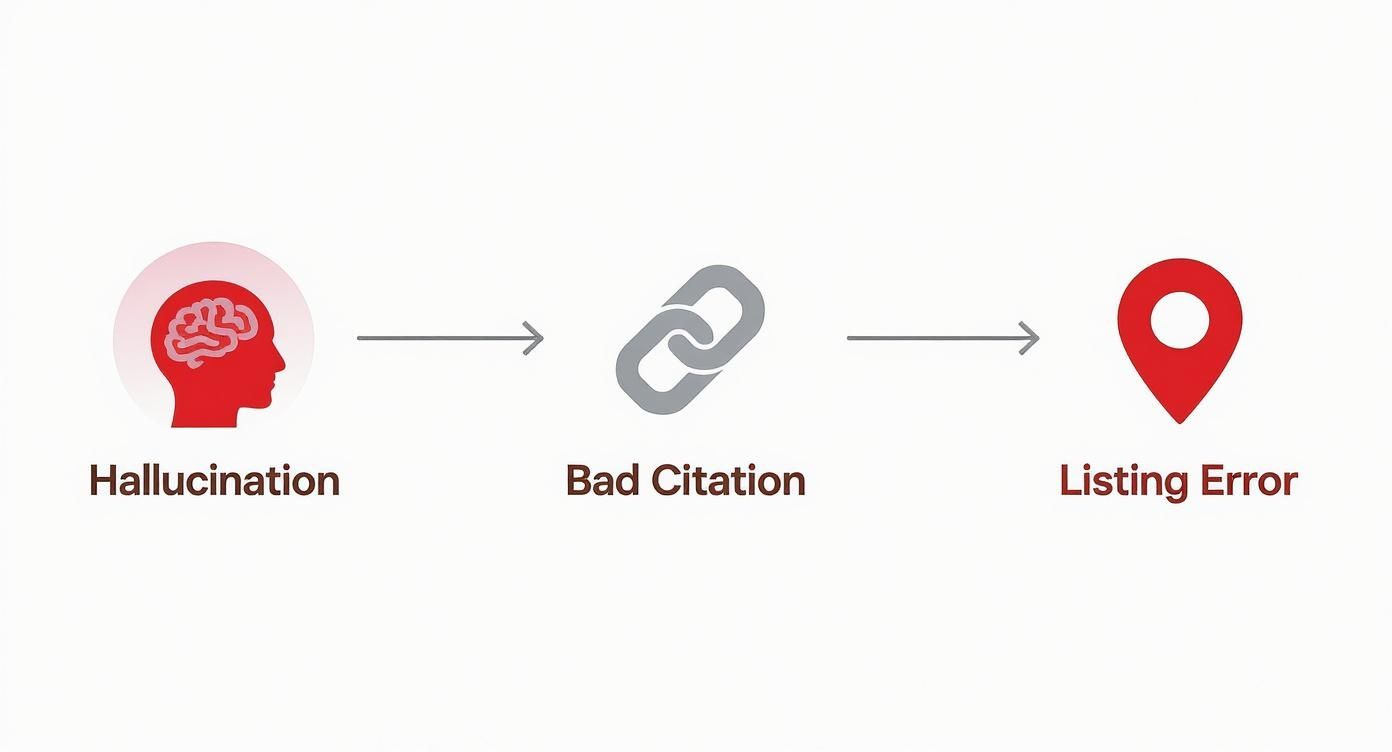
As you can see, an initial AI hallucination can easily trigger an incorrect citation. That bad info then gets scraped and amplified, eventually becoming a serious local listing error that misleads real customers.
Choosing Your Monitoring Tools
Your first step is to pick the right tech for the job. The tools you need will depend on your company’s size and goals, but they generally fall into two buckets: manual methods and automated platforms.
-
Manual Monitoring: This is the ground floor of monitoring. It means regularly Googling your brand, checking key review sites like Yelp or G2 by hand, and manually asking chatbots questions about your business. It's free, but it's incredibly time-consuming and you'll miss a lot.
-
Automated Monitoring: This is where modern reputation management really begins. These are software platforms built to do the heavy lifting. They constantly scan the web, social media, and even LLMs for mentions of your brand, competitors, and keywords, then deliver alerts and reports right to your inbox.
For most businesses, a hybrid approach works best. Use automated tools for wide-reaching surveillance, then supplement them with targeted manual checks to really understand the nuance of how your brand is being portrayed.
Core Components of Your System
A truly robust monitoring system needs to cover several critical areas. Think of these as the different sensors in your smoke alarm network, each designed to detect a specific type of threat.
-
Brand Mention & Keyword Alerts: You have to set up alerts for your company name, your key products, and the names of your leadership team. A tool like Google Alerts is a decent starting point, but dedicated platforms offer much more powerful, real-time tracking across social media, forums, and news sites.
-
Review Platform Tracking: You need to know the second a new review drops on Google Business Profile, Yelp, Trustpilot, or any industry-specific sites. Many tools integrate directly with these platforms, pulling all your reviews into a single dashboard so you can track and respond with ease.
-
AI & LLM Audits: This is the newest—and arguably most critical—component. Your system must actively query AI models like ChatGPT, Gemini, and Perplexity to see what they're saying about you. You're checking for hallucinations, incorrect service details, and whether they recommend you or your competitors for key prompts. This often requires specialized software, and you can learn more about the importance of AI brand tracking for SaaS companies in our detailed guide.
-
SERP Feature Monitoring: Keep a close eye on what appears in search engine results pages (SERPs) beyond the classic blue links. This includes the "People Also Ask" section, your Knowledge Panel, and image results, as these features have a massive influence on public perception.
A complete digital monitoring system doesn't just look for problems. It also identifies opportunities—like glowing customer testimonials you can amplify or competitor weaknesses you can capitalize on.
AI-powered tools are now essential for spotting fake reviews and analyzing customer sentiment at scale. And the stakes are high. Given that 55% of consumers see fake reviews as a growing problem and 91% rely on reviews when evaluating local businesses, having an automated system in place is crucial for maintaining trust.
Developing Effective Reputation Response Strategies
Having a robust monitoring system is like having a smoke alarm—it’s brilliant at detecting a fire. But you still need a fire extinguisher and an evacuation plan to handle the problem. Knowing about a reputation threat is only the first step; your response is what truly defines your brand and protects your bottom line.
A swift, empathetic, and strategic response can turn a disgruntled customer into a loyal advocate and neutralize misinformation before it gets a foothold. Different threats, however, demand different playbooks. A one-star Yelp review requires a different touch than a widespread AI error fabricating details about your services.
The key is to move from a reactive panic to a prepared, systematic process. This approach not only resolves issues faster but also signals to the public—and to the algorithms—that you are an engaged, trustworthy, and authoritative brand.
Responding to Negative Reviews and Feedback
When a negative review appears, the first instinct is often to get defensive. Don't. The best strategy is rooted in speed, empathy, and a commitment to resolution. A public reply isn't just for the unhappy customer; it's a performance for every potential customer who will read it later.
Here’s a simple, four-step process for handling negative feedback like a pro:
-
Acknowledge and Apologize Quickly: Time is of the essence. Respond within 24 hours. Start by thanking them for their feedback and offer a sincere apology for their poor experience. This immediately de-escalates the situation and shows you care.
-
Show Empathy, Not Excuses: Validate their feelings. A phrase like, "It's understandable why you would be frustrated with that delay," works far better than, "We were unusually busy that day." One shows you're listening; the other just sounds like you're passing the buck.
-
Take the Conversation Offline: Provide a direct contact method—a specific person’s email or a dedicated support line—to resolve the issue privately. This demonstrates a genuine desire to fix the problem and moves sensitive details out of the public eye.
-
Keep it Professional and Brief: Your public response should be concise and professional. Avoid getting into a back-and-forth debate. The goal isn't to win an argument; it's to show everyone else reading that you're responsive and responsible.
This structured approach is vital for everyone, from a local coffee shop owner on Google Maps to an agency managing dozens of client profiles. It contains the damage and showcases excellent customer service.
Correcting AI-Generated Misinformation
Fighting misinformation from AI assistants is a two-front war. You have to address the source of the error while simultaneously building a stronger foundation of correct information online.
The first, more direct tactic is submitting feedback to the LLM developers. Most AI tools, like ChatGPT and Gemini, have built-in ways for users to report incorrect outputs. While this doesn’t guarantee an immediate fix, it’s a crucial step in flagging the error for the model’s creators.
But just waiting for an AI model to be retrained is not a strategy—it's a gamble. The more powerful approach is what we call a digital displacement strategy.
The most effective way to combat bad information online is to overwhelm it with good information. Your goal is to flood the digital ecosystem with so much correct, authoritative, and consistent data about your business that AI models are more likely to scrape and surface the truth.
This means ensuring every single one of your online properties is accurate and perfectly aligned.
- Website Content: Your service pages, contact information, and operating hours must be crystal clear and correct. No ambiguity.
- Structured Data: Use schema markup on your website to explicitly tell search engines key details like your address, phone number, and services. It's like giving them a cheat sheet.
- Directory Listings: Audit and correct your information on every major directory, from your Google Business Profile to niche industry sites. Consistency is king.
- Press and Content: Generate positive, factual content about your brand through press releases, blog posts, and guest articles on reputable sites.
By creating a powerful and consistent digital footprint, you make the correct information impossible for AI scrapers to ignore. This proactive digital reputation management is your best defense against the unpredictable nature of AI.
Measuring Your Reputation Management Success
So, how do you prove any of this is actually working? Without clear metrics, you're just guessing. Good measurement moves beyond vanity numbers and focuses on the Key Performance Indicators (KPIs) that actually connect to business results. This is how you turn all your hard work into a measurable asset.
Tracking the right numbers tells a story. It shows you if customer sentiment is improving, how quickly your team is handling problems, and whether you're gaining ground on your competitors. This data is the proof you need to justify your strategy and make smarter calls moving forward.
Core Reputation Management KPIs
To get a real sense of your progress, you need to keep an eye on a handful of essential metrics. These KPIs give you a clear, data-driven picture of your online health, showing you where you're winning and where you need to double down.
-
Sentiment Score: This metric is a pulse check on your brand's public perception. It scans online mentions and sorts them into positive, negative, or neutral buckets. A rising positive sentiment score is a direct sign that your efforts to build a better image are paying off.
-
Share of Voice (SOV): How much of the conversation in your industry is about you versus everyone else? That's your SOV. A higher Share of Voice means you're dominating the discussion and grabbing more attention from potential customers.
-
Review Response Time: This one is simple: how long does it take your team to reply to a new review? A fast response time shows you're listening and that you value customer feedback, which can do wonders for how people see your brand.
-
Star Rating Velocity: This isn't just about your current average rating; it's about the direction it's heading. Positive velocity means your overall rating is trending upward, signaling to both customers and search engines that you're consistently getting better.
Measuring these KPIs is about taking reputation from a fuzzy concept and turning it into a concrete business function. It lets you prove that things like faster response times and better sentiment directly lead to a stronger, more profitable brand.
Which KPIs Matter Most to Your Team?
Not every business should obsess over the same metrics. The KPIs that matter most depend entirely on your team's structure and goals. What a local pizza shop owner cares about is worlds away from what a director at a global enterprise brand reports to their board.
Figuring out these differences is crucial for building a focused, effective strategy. To make it clearer, let’s break down which metrics matter most for different types of teams.
Here’s a look at how different teams prioritize reputation KPIs, helping you focus on what will drive the most impact for your specific business.
Digital Reputation KPIs by Business Type
| KPI | Local Business Focus | Agency Focus | Enterprise Brand Focus |
|---|---|---|---|
| Star Rating Velocity | High Priority. Directly impacts foot traffic and local search rankings, making it a primary driver of new customers. | High Priority. A key deliverable that demonstrates clear, tangible results and client value. | Medium Priority. Important, but often aggregated across many locations or product lines. |
| Review Response Time | High Priority. Fast, personal responses build community trust and can turn negative experiences around quickly. | High Priority. Shows clients the agency is actively managing their brand's daily interactions. | Low Priority. Often managed by dedicated support teams; the focus is on overall trends. |
| Sentiment Score | Medium Priority. Useful for understanding community feelings, but less critical than direct ratings and reviews. | High Priority. Essential for reporting on overall brand health and campaign effectiveness to clients. | High Priority. A critical metric for gauging public perception during product launches or crises. |
| Share of Voice (SOV) | Low Priority. Less relevant when competing locally against a small set of direct competitors. | Medium Priority. A great way to show clients how they stack up against rivals in a crowded market. | High Priority. The ultimate measure of brand dominance and market penetration. |
As you can see, a local business lives and dies by its star rating and response times, while a massive brand is more concerned with its overall Share of Voice and public sentiment during major campaigns.
Building a Simple Workflow
To make measurement a consistent habit, you need a simple, repeatable workflow. This ensures that tracking becomes part of your regular operations, not just something you do when you have extra time.
A great starting point is to use competitor AI analysis tools to benchmark your performance against others in your space. This gives you context for your own numbers. From there, you can roll out a straightforward weekly and monthly reporting schedule to keep everyone on the same page.
Weekly Workflow (The "Triage")
- Review Alerts: Team members check all new reviews and brand mentions that pop up in your monitoring tools.
- Respond to Feedback: Jump on all new negative and positive reviews within 24 hours. Speed matters.
- Flag Major Issues: Escalate any serious threats—like a nasty AI hallucination or a brewing PR crisis—to leadership immediately.
Monthly Workflow (The "Strategy")
- Pull KPI Reports: Generate reports on your Sentiment Score, SOV, and response times for the month.
- Analyze Trends: Look for patterns. Are your star ratings climbing? Is a competitor suddenly eating up more Share of Voice?
- Adjust Strategy: Use these insights to fine-tune your response tactics and plan your proactive content for the month ahead.
Your Digital Reputation Management Playbook

Theory and strategy are great, but execution is what separates brands that thrive from those constantly fighting fires. This is where the rubber meets the road. We’re going to pull everything together into a single, actionable playbook you can put to work today.
Think of this less like a dense manual and more like a simple checklist. It's designed to turn the complex idea of "reputation management" into a manageable, repeatable process for your team. We'll walk through four distinct phases, taking you from building your defenses to proactively creating a bulletproof online presence.
Phase 1: Foundational Setup
First things first, you need to build the framework. Before you can listen or respond, you have to claim your digital territory and set up your listening posts. This is about laying the groundwork for everything that follows.
-
Claim and Optimize All Profiles: Go out and secure your brand name on every platform that matters. This means your Google Business Profile, all your social media accounts, and any industry-specific review sites. The crucial part? Make sure every detail—address, phone number, hours, services—is 100% consistent across the board.
-
Set Up Automated Alerts: Get a monitoring tool in place and create real-time alerts. You need to be tracking your brand name, key products, competitor names, and the names of your leadership team. This is your early-warning system for both incoming problems and unexpected opportunities.
-
Establish a Response Protocol: Who on your team owns review responses? What's the target response time? Don’t leave this to chance. Document a clear plan so everyone knows exactly who does what when customer feedback rolls in. A swift, unified voice is key.
A solid foundation isn't just about being online; it's about owning your digital real estate. When your profiles are consistent and optimized, you make it easy for both customers and AI to find the right information about you.
Phase 2: Consistent Monitoring
With your foundation firmly in place, the next phase is all about getting into a rhythm of active listening. This isn't a one-and-done task; it’s an ongoing process that keeps you connected to what people are saying.
-
Perform Weekly Review Audits: Set aside dedicated time each week to actually read through all the new reviews on your key platforms. Look for patterns in the feedback, both good and bad. This is raw customer intelligence that can directly inform real business improvements.
-
Conduct Monthly AI Audits: You have to know what the answer engines are saying. Regularly open up ChatGPT and Gemini and ask them about your business. Use prompts like "who is the best [your service] in [your city]?" or "give me a summary of [your company]." Check for any hallucinations, factual errors, or negative sentiment.
Phase 3: Swift and Strategic Response
When an issue pops up—and it will—your response is what defines the moment. This phase is all about how to act when you detect a threat to your reputation.
-
Handle Negative Feedback: Don't panic, and don't get defensive. Use the "Acknowledge, Empathize, and Take Offline" model. Your first public reply should happen within 24 hours to show you’re paying attention. From there, provide a private channel like an email or phone number to resolve the specific issue one-on-one.
-
Correct Digital Misinformation: When you find an error, whether on a review site or in an LLM response, submit corrections directly to the source. More importantly, play offense. Execute a digital displacement strategy by publishing a wave of correct, authoritative information on your own channels to push the bad info down.
Phase 4: Proactive Growth
The best defense is a great offense. The final phase is about shifting from a defensive posture to actively building the exact reputation you want. It’s time to shape the narrative.
-
Systematically Solicit Reviews: Don’t just wait for feedback; ask for it. Create a simple, repeatable process to encourage your happy customers to leave reviews. You can use email, SMS, or even simple QR codes in-store to guide them to your most important profiles.
-
Create Authoritative Content: Become the expert. Regularly publish genuinely helpful blog posts, customer case studies, and press releases that showcase your expertise. This builds a library of positive, factual content that search engines and AI models will use as a primary source of truth about your brand.
Still Have Questions?
Jumping into digital reputation management can feel like a lot at first. Let's clear up a few of the most common questions we hear from business owners and marketing teams.
How Much Do Reputation Management Tools Cost?
The price tag really depends on what you need. A small local shop just looking to keep an eye on reviews might find simple tools in the $50-$100 per month range.
On the other end of the spectrum, agencies juggling dozens of clients or big brands that need deep analytics and AI monitoring will look at comprehensive platforms. These can run anywhere from $500 to several thousand dollars a month. The key isn't finding the cheapest option, but matching the tool's power to your actual business goals.
What’s a Realistic Time Commitment for a Small Business?
You don't need to be glued to your screen 24/7. For a small business owner, a focused and consistent effort is far more effective than trying to do everything at once.
A realistic commitment is just 3-5 hours per week. Here’s how that breaks down:
- Daily Check-ins (15-20 mins): A quick morning scan for new reviews and any urgent alerts.
- Weekly Audits (1-2 hours): Time set aside to thoughtfully respond to feedback, check what AI is saying about you, and spot any trends.
That’s it. This steady rhythm is more than enough to build and maintain a strong digital presence without derailing your entire schedule.
What Are the First Steps in a Reputation Crisis?
When something goes wrong—a viral negative review blows up or an AI starts confidently spouting nonsense about your business—your first few moves are everything.
The goal is to immediately control the narrative and pour water on the fire, not gasoline. Resist the urge to fire back with an emotional, knee-jerk response. A calm, professional, and pre-planned protocol is your best defense.
Here are the three things you must do right away:
- Acknowledge Publicly: Post a brief, calm, and empathetic statement. Don't make excuses. Just let people know you've seen the issue and you're looking into it.
- Take It Offline: Your public post should invite the person to a private channel. Offer a direct email or phone number to resolve their specific problem away from the public eye.
- Huddle with Your Team: Get your key people in a room (or on a call) to assess the damage, get the facts straight, and agree on a unified plan for the next steps.
Stop guessing what AI assistants are telling customers about you. TrackMyBiz provides the only platform that monitors your brand's visibility and accuracy across models like ChatGPT and Gemini, turning AI from a risk into a revenue channel. Start your free scan today at https://trackmybusiness.ai.
