
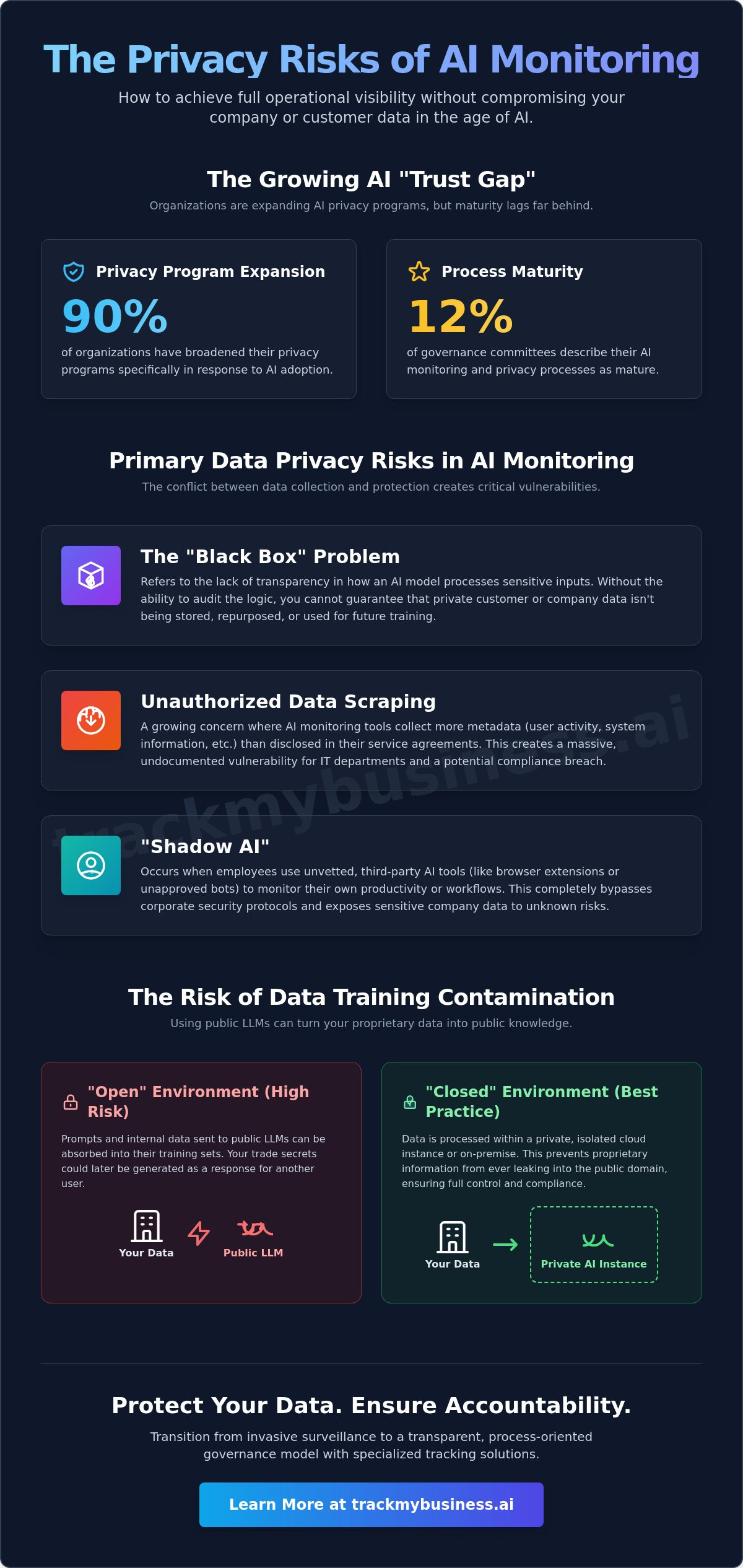
90% of organizations have expanded their privacy programs specifically because of AI, yet only 12% of governance committees describe their processes as mature. I see this gap every day as businesses struggle to maintain data privacy in ai monitoring tools while trying to keep pace with rapid technological shifts. You might worry that your proprietary data is being used to train public LLMs or feel overwhelmed by the 2026 GDPR Digital Omnibus proposal and Saudi Arabia’s PDPL penalties of up to SAR 5 million. It is a valid concern; the line between helpful oversight and invasive surveillance is thinner than ever.
I believe that effective monitoring shouldn’t come at the cost of employee trust or legal compliance. In this guide, I’ll show you how to achieve full operational visibility without compromising your company or customer data. We’ll explore the specific risks associated with AI-driven systems and provide a practical checklist for evaluating tool safety. I’ve also included a clear strategy for compliant LLM mention tracking that respects both global privacy laws and your internal data boundaries.
Key Takeaways
- I’ll show you how to identify the “Black Box” problem to prevent proprietary data from entering public AI training sets.
- I’ll help you navigate the 2026 regulatory landscape by applying the latest standards for data privacy in ai monitoring tools.
- Follow my five-step framework to audit your AI inventory and apply strict data minimization to protect sensitive information.
- I’ll demonstrate how to deploy specialized tracker software to monitor LLM brand mentions without exposing internal secrets.
- I’ll explain how to build employee trust by transitioning from invasive surveillance to a transparent, process-oriented governance model.
Defining AI Monitoring Tools and Their Privacy Implications
I define AI monitoring tools as software systems that utilize machine learning models to observe, analyze, and interpret digital activities in real time. By June 2026, the industry has shifted away from static data logs toward predictive AI monitoring. These systems don’t just record what happened; they anticipate risks by identifying patterns in vast datasets. Maintaining data privacy in ai monitoring tools is no longer a secondary concern. It’s the primary architectural requirement for any business that wants to scale without legal friction. I’ve seen many organizations struggle because they treated privacy as a checkbox rather than a foundational design principle.
The distinction between internal and external monitoring is critical for your strategy. Internal performance monitoring focuses on employee workflows and system health to optimize operations. External mention tracking, however, looks outward to see how your brand is discussed across the web and within AI models. Both require a transparent, process-oriented approach to ensure that “governing data flows” takes precedence over “watching people.”
The Evolution of AI Monitoring in 2026
We’ve moved past simple keyword alerts. Modern tools now use autonomous LLM-based analysis to understand the sentiment and intent behind every interaction. This shift has fundamentally changed our definition of “sensitive data.” In 2026, a brand’s proprietary logic or a private strategy shared with a chatbot is just as sensitive as a social security number. I recommend deploying specialized privacy-enhancing technologies to mask these inputs before they reach a model. The rise of real-time ChatGPT mention tracking is a direct response to this evolution. It allows you to protect your brand’s reputation while ensuring that the monitoring process itself doesn’t leak secrets into the public domain.
Why Data Privacy is the Foundation of AI Trust
There is a significant “Trust Gap” in modern business technology. According to Transcend.io, 90% of organizations have broadened their privacy programs specifically because of AI as of March 2026. I’ve found that when you prioritize privacy, you actually improve data quality. Employees are more likely to engage with tools they trust, and regulators are less likely to intervene when they see documented, accountable processes. Using dedicated LLM tracker software helps bridge this gap by providing a clear audit trail of what data is being tracked and why. AI privacy is the governed control over data inputs and outputs throughout the entire machine learning lifecycle.
The Primary Data Privacy Risks in AI-Driven Monitoring
I’ve found that the biggest hurdle in implementing data privacy in ai monitoring tools is the inherent conflict between data collection and data protection. If a tool needs to analyze a workflow, it needs data. But where does that data go? The primary risk is structural. Many tools are built on architectures that don’t prioritize data isolation. This leads to several critical vulnerabilities that I see businesses overlook during the procurement phase.
The “Black Box” problem is perhaps the most frustrating. It refers to the lack of transparency in how an AI model processes sensitive inputs. If you can’t audit the logic, you can’t guarantee that a customer’s private information isn’t being stored or repurposed. Unauthorized data scraping is another growing concern. Some monitoring tools collect more metadata than they disclose in their service agreements, creating a massive vulnerability for IT departments. I also see “Shadow AI” frequently, where employees use unvetted browser extensions or bots to monitor their own productivity. This bypasses corporate security and exposes the company to risks that aren’t even on the official radar. Using a dedicated tracker software can help centralize this visibility while maintaining strict security boundaries.
The Risk of Data Training Contamination
When you use a public LLM for analysis, your prompts often become part of the training set. I’ve seen instances where trade secrets were later generated as responses for unrelated users. This is why I emphasize the difference between “Open” and “Closed” monitoring environments. Closed systems process data within a private cloud instance, preventing your proprietary information from leaking into the public domain. I recommend reviewing AI privacy best practices to see how industry leaders structure these boundaries. Without these safeguards, every prompt is a potential data exfiltration event.
Surveillance Creep and Employee Rights
Beyond technical leaks, we must address the human element. “Surveillance creep” occurs when tools designed for operational efficiency are repurposed for intrusive micromanagement. I’ve noticed this often leads to a total loss of employee trust. It’s a delicate balance. Algorithmic bias can also result in unfair monitoring outcomes, where certain behavior patterns are flagged incorrectly based on flawed training data. Addressing the psychological impact of “always-on” AI oversight is essential for long-term success. I believe that maintaining data privacy in ai monitoring tools requires a commitment to transparency that goes beyond mere legal compliance.
Navigating Global and Local Regulations: From GDPR to SDAIA
I’ve observed that many global firms focus exclusively on GDPR, but by June 2026, the regulatory landscape for data privacy in ai monitoring tools has become far more fragmented. While the EU AI Act now categorizes monitoring tools by risk level, the GDPR Digital Omnibus proposal is currently clarifying the use of “legitimate interest” as a legal basis for AI data processing. I see these changes as a necessary evolution, but they require a dedicated Data Protection Officer (DPO) who understands both the code and the law. A DPO’s role in 2026 isn’t just about filing paperwork; it’s about ensuring that your AI systems respect the “right to erasure,” which the European Data Protection Board has made a top enforcement priority this year.
If you’re operating in the Middle East, the Saudi Personal Data Protection Law (PDPL) is now your primary compliance hurdle. As of 2026, the PDPL is in full enforcement after the grace periods ended on September 14, 2024. I’ve analyzed the enforcement patterns, and it’s clear that the Saudi Data and AI Authority (SDAIA) is taking a proactive stance. In 2025 and early 2026 alone, SDAIA’s enforcement committees issued 48 decisions confirming PDPL violations. This shift from legislation to active enforcement means your choice of monitoring software must align with local mandates from day one.
Understanding the Saudi AI Ethics Framework
SDAIA issued two critical regulatory documents in February 2026 regarding the licensing and accreditation of data processors. I’ve found that these rules make it much harder for unvetted international software to operate within the Kingdom without local oversight. Because SDAIA hasn’t yet published a list of “adequate countries” for data transfers, all cross-border movements require approved Standard Contractual Clauses. This effectively means your data privacy in ai monitoring tools must prioritize local data residency or use strictly governed transfer protocols to stay compliant with the Kingdom’s vision for data sovereignty.
The Cost of Non-Compliance
The financial stakes for ignoring these rules are higher than ever. Under the PDPL, penalties for non-compliance include fines of up to SAR 5 million per breach. If a violation involving sensitive data is intentional or repeated, it can even lead to two years of imprisonment. I’ve seen how a single privacy failure can cause irreversible reputational damage, especially when AI “hallucinates” false details about individuals that then enter the public record. Moving from a reactive to a proactive compliance strategy isn’t just a legal necessity. It’s a fundamental part of protecting your brand’s future in an AI-driven economy.
How to Implement Privacy-First AI Monitoring: A 5-Step Framework
I’ve found that moving from theory to practice is where most privacy initiatives fail. To maintain data privacy in ai monitoring tools, you need a structured methodology that bridges the gap between IT security and daily operations. I use a five-step framework to ensure every tool we deploy is accountable and secure. This process starts with a comprehensive inventory audit to identify every AI tool currently in use across your departments. You can’t protect what you don’t know exists. Once I’ve identified the tools, I move into data minimization, vendor vetting, transparency protocols, and continuous monitoring.
This framework isn’t a one-time setup; it’s a cycle of constant improvement. I believe that by following these steps, you can eliminate the “Shadow AI” risks I discussed earlier. My goal is to create a system where data flows are governed by design rather than by accident. This proactive approach is what separates a compliant business from one that is vulnerable to the SAR 5 million penalties I mentioned in the previous section.
Step 1 & 2: Audit and Minimise
I start by mapping the data flow from the point of collection all the way to the AI model. I’ve seen that many tools collect “just in case” data that serves no actual purpose. I prioritize data minimization by collecting only what is strictly necessary for the monitoring goal. I also use techniques for anonymizing data before it ever reaches an LLM. For instance, I strip out personal identifiers and replace them with generic tokens. Finally, I set strict “Purge” dates. In 2026, holding onto monitored information indefinitely is a significant legal liability. I ensure that data is deleted as soon as its operational value expires.
Step 3 & 4: Vetting and Transparency
Vetting your vendors is a critical step in my process. I ask software providers three direct questions: Do you use our inputs to train your public models? Where is our data physically stored? Can you provide a real-time audit log of who has accessed our data? If a provider is vague, I look elsewhere. Transparency with your stakeholders is equally vital. I draft a clear “AI Usage Policy” that explains the “Why” behind our monitoring. I use a direct, first-person perspective to tell my team: “I am using this tool to protect our brand reputation, and here is how I’ve ensured your private conversations remain private.”
If you’re ready to start monitoring your brand mentions with a tool built for these standards, you can view our tracker software to see how we handle data isolation. Step 5 is continuous monitoring. I regularly audit the AI tool itself to check for “data drift,” where the model’s behavior might change over time. Maintaining data privacy in ai monitoring tools requires this level of professional diligence to stay ahead of both hackers and regulators.
Ensuring Accountability with TrackMyBusiness AI Tracking Solutions
I’ve spent the previous sections outlining the risks and regulatory hurdles of the 2026 landscape. Now, I want to show you how I’ve built the TrackMyBusiness “Tracker” to solve these problems directly. My philosophy is simple: operational transparency shouldn’t require a security compromise. By using modular, cloud-based security, I ensure that your data privacy in ai monitoring tools remains intact even as your business scales. This is especially important for the garment and decoration industry, where complex workflows and proprietary designs need constant protection from data leakage.
I believe that accountability starts with the architecture of the software itself. My approach avoids the common pitfalls of “Shadow AI” by providing a centralized, IT-approved environment for all monitoring activities. Whether you are tracking internal production metrics or external brand health, my process focuses on isolating your sensitive inputs from the public models that might otherwise ingest them. It’s about giving you the tools to lead with professional diligence.
Privacy-Centric LLM and ChatGPT Tracking
One of the biggest gaps in the market today is the ability to monitor brand reputation within AI models without feeding those models your private data. I’ve developed a methodology for ChatGPT mention tracking that keeps your internal data siloed. My LLM tracker software scans for how your brand is perceived across public models while maintaining a strict “Do Not Train” barrier for your internal queries. This addresses the “Black Box” issue I mentioned earlier by giving you visibility without the risk of training contamination. For businesses operating in Saudi Arabia, I provide localized support to ensure that every data flow meets the SDAIA requirements we discussed in section three.
Getting Started with Secure Monitoring
Transitioning from manual spreadsheets to a secure, AI-ready ERP can feel daunting. I recommend a phased approach. Start by integrating my Tracker Software as a custom bolt-on to your existing workflow. This allows you to tailor privacy settings to your specific business needs before committing to a full system overhaul. I’ve designed these tools to be functional and direct, focusing on the methodology of safe data gathering. If you’re ready to move beyond aspirational governance and start using documented, accountable processes, you can contact TrackMyBusiness to secure your AI monitoring workflow today. I’m here to help you bridge the gap between operational visibility and absolute data integrity.
Future-Proofing Your Business with Secure AI Governance
I’ve shown you how the regulatory shift from legislation to enforcement makes 2026 a critical year for your data strategy. You now have the framework to audit your current AI inventory and apply strict data minimization techniques. By choosing specialized data privacy in ai monitoring tools, you can maintain operational visibility while respecting the right to erasure and local residency laws. I believe that moving from aspirational principles to documented, accountable processes is the only way to close the trust gap with your employees and customers.
I recommend moving away from unvetted “Shadow AI” and toward a cloud-based modular system that gives you maximum data control. I’ve built our tools to offer specialized LLM mention tracking for brand security and localized expertise specifically for the Saudi Arabian market. Please book a demo of the Tracker software to see privacy-first monitoring in action. I’m confident that with the right methodology, you can lead your industry into a more transparent and secure future.
Frequently Asked Questions
Is it possible to use ChatGPT for business without leaking data?
Yes, it’s entirely possible to use ChatGPT securely by utilizing Enterprise agreements or API-based integrations that explicitly disable model training on your data. I recommend verifying that your setup includes a “Do Not Train” clause in the service agreement. This ensures your proprietary prompts remain siloed within your private environment rather than entering the public training pool. Using specialized tracker software can help you maintain this boundary while still gaining the benefits of AI analysis.
What is the difference between data privacy and data security in AI?
Data security focuses on protecting your information from unauthorized external access, while data privacy governs how that information is legally collected, used, and shared. I’ve seen many companies with strong firewalls still fail at data privacy in ai monitoring tools because they lack clear consent protocols. Security is the lock on the door. Privacy is the set of rules deciding who gets a key and what they are allowed to do once they are inside.
Does the Saudi PDPL apply to international AI monitoring tools?
The Saudi Personal Data Protection Law (PDPL) applies to any international AI tool that processes the personal data of individuals residing in the Kingdom. Since the grace period ended in September 2024, the Saudi Data and AI Authority (SDAIA) has actively enforced these rules. I’ve noted that 48 enforcement decisions were already issued by early 2026. This makes local compliance a non-negotiable requirement for any global software provider operating in the region.
How can I tell if an AI tool is using my data to train its model?
You can identify data usage by reviewing the “Model Training” or “Service Improvement” sections of the tool’s Data Processing Agreement (DPA). I look specifically for language that mentions using “customer inputs” to refine future iterations of the model. Transparent providers will offer a clear toggle or a written guarantee that allows you to opt out of all training activities. If the documentation is vague, I treat it as a high-risk “Black Box” system.
What are the most common privacy mistakes when implementing AI monitoring?
The most frequent error I see is “Shadow AI,” where employees use unvetted monitoring tools without IT oversight. Another major mistake is failing to apply data minimization, which leads to the collection of sensitive identifiers that aren’t necessary for the monitoring goal. I believe these oversights are why 90% of organizations have had to expand their privacy programs specifically for AI as of March 2026. Proactive governance is the only way to avoid these pitfalls.
How often should we audit our AI monitoring tools for privacy compliance?
I suggest conducting a full privacy audit at least once every twelve months or whenever a vendor releases a major model update. Since the 2026 GDPR Digital Omnibus proposal and SDAIA regulations are constantly evolving, frequent checks are necessary to catch “data drift” in your systems. Maintaining data privacy in ai monitoring tools requires this steady rhythm of professional diligence. It ensures your governance stays aligned with the latest enforcement priorities from the European Data Protection Board.
