Crisis media management is the art of navigating the chaos when your brand’s reputation is on the line. It's about spotting threats before they explode, controlling the narrative when they do, and communicating clearly with everyone who matters to minimize the fallout.
Why Your Crisis Management Plan Is Dangerously Outdated
Let's be honest—when was the last time anyone looked at your crisis plan? Most are collecting dust in a forgotten folder, built for yesterday's problems like a social media blunder or a nasty press release.
While those classic PR fires are still very real, they're just a slice of the modern reputation minefield. The ground has completely shifted underneath us.
Today, your biggest threat might not be a viral tweet from a disgruntled customer. It could be an AI chatbot confidently inventing a scandal about your company out of thin air. As more people skip Google and ask AI for advice, your brand's story is being written and rewritten by algorithms that can get things catastrophically wrong.
The New Frontier of Reputation Risk
This is where things get tricky. Your traditional social listening tools are completely blind to this new frontier. They can't see an AI assistant telling a potential customer your store is permanently closed when it’s not, or fabricating a story about product safety issues based on a single misinterpreted forum post.
These AI "hallucinations" happen in closed chat sessions, leaving you totally in the dark until the damage is already done. A customer asks a question, gets a false answer, and quietly decides to take their business elsewhere. You never even knew you lost them.
This guide goes way beyond the typical crisis playbook. We'll show you how to build a defense system that accounts for both old-school PR fires and these new, invisible AI-driven threats. This isn't just about reacting anymore. It's about proactively monitoring a channel that's quickly becoming the new front door for your business.
A truly modern crisis plan acknowledges a painful truth: you can no longer control the first impression a customer has of your brand. An AI might deliver it, and it might be entirely false. The goal now is rapid detection and correction.
If you're a brand or agency that's serious about protecting your reputation in an age where "facts" can be manufactured in seconds, you're in the right place. We'll cover everything from proactive monitoring and rapid response to stakeholder comms and post-crisis recovery. It’s the complete framework you need to handle the messy reality of today's media world.
The Modern Crisis Landscape at a Glance
To really grasp the shift, you have to see the old and new threats side-by-side. Traditional social media crises are public and loud, while AI-driven issues are often silent and insidious.
Here's a quick breakdown of what you're up against:
| Threat Vector | Traditional Risk (e.g., Social Media) | Emerging Risk (e.g., AI Chatbots) |
|---|---|---|
| Visibility | Publicly visible on timelines and feeds | Often hidden within private chat sessions |
| Detection | Caught by social listening and alerts | Requires specialized AI monitoring tools |
| Source | Human users (customers, critics, media) | Algorithmic "hallucinations" or bad data |
| Speed | Can go viral within hours | Spreads instantly with each user query |
| Correction | Respond directly, issue statements | Requires correcting the underlying AI model data |
As you can see, the game has changed. The inability to see what's being said about you is the biggest vulnerability for most brands today, and it's one we're going to show you how to fix.
Building Your Pre-Crisis Defense System
The sharpest crisis media management strategies aren't forged in the heat of a live incident; they're meticulously built during times of calm. An effective defense system is proactive, not reactive. It’s about having a clear chain of command, solid communication protocols, and a sophisticated monitoring engine that acts as your eyes and ears across the entire digital world.
This preparation is what separates a manageable issue from a full-blown catastrophe. Without a plan, teams scramble, messages get crossed, and the chance to control the narrative is lost within the first few hours. A strong pre-crisis defense should also include proactive measures like implementing effective online reputation management services to shape public perception long before any triggers emerge.
Defining Roles and Responsibilities
When an issue surfaces, the first question should never be, "Who handles this?" Your crisis response team needs to be predetermined, with every member knowing their exact role. This is how you eliminate confusion and shave critical minutes off your response time.
Your core team should have representatives from key departments, each with a specific job:
- Crisis Lead: This is your central decision-maker, usually the CEO or a senior communications exec. They have the final say on strategy and official statements.
- Communications Spokesperson: The public face of the company during the crisis. This person has to be media-trained, calm under pressure, and able to deliver messages with empathy and authority.
- Legal Counsel: Vets every public statement to head off legal risks and ensure compliance. No exceptions.
- Operations Lead: Manages the on-the-ground response, especially if the crisis involves a physical location or a product issue.
- Digital/Social Media Manager: Oversees all online channels, monitoring conversations and executing the communication plan where it matters most.
Having this team in place allows you to move from detection to action in minutes, not hours.
Establishing a Modern Monitoring Ecosystem
You can't respond to a threat you don't see. A modern defense system needs a two-pronged monitoring approach that covers both the public social web and the hidden conversations happening inside AI chatbots.
It's a shocking reality, but only 49% of U.S. companies even have a formal crisis communication plan. This leaves the majority completely exposed to social media meltdowns that can erupt without warning. On average, it takes 18 hours and 57 minutes from the first warning sign to the first news story. That’s a huge head start for anyone looking to amplify the damage. You can find more details in this market analysis from GM Insights.
The whole point of a modern monitoring system is to shrink that 18-hour gap from detection to response down to mere minutes. Speed is your single greatest advantage in a crisis.
This is where a combination of tools becomes essential. Traditional social listening platforms are great for tracking mentions on X (formerly Twitter) and Facebook. But they are completely blind to what AI models like ChatGPT or Gemini are telling users about your brand right now.
Dashboards that track these AI conversations provide a centralized view, flagging inaccuracies before they cause real-world damage—like a customer being told your business is "permanently closed."
Mapping Your Key Stakeholders
A crisis never happens in a vacuum. It ripples out, affecting a wide web of people and groups who all need a tailored communication approach. Before anything goes wrong, you have to identify these stakeholders and understand what they care about most.
This isn't just about making a list. You need to segment your audiences and outline the key messages that will actually resonate with each group.
Primary Stakeholders
- Customers: They need reassurance about product safety, service continuity, and how the issue affects them personally.
- Employees: They are your internal brand ambassadors. They need clear, honest information to stop internal panic and external rumors before they start.
- Investors/Shareholders: Their main concern is financial impact and long-term brand stability.
Secondary Stakeholders
- Media: They require timely, factual information from your designated spokesperson.
- Suppliers & Partners: They need to know about any potential disruptions to business operations.
- Regulators: Depending on your industry, they might require formal notifications and detailed reports.
By preparing for these conversations in advance, your team can communicate with confidence and consistency, reinforcing trust when it's most fragile. For more on this, our overview of AI reputation management consultants can help you find specialized support.
Mastering Real-Time Triage and Rapid Response
The moment an alert fires, the clock starts ticking. I’ve seen it time and time again: in a crisis, the first hour is often more critical than the next 24. A swift, calculated response can contain a spark, while hesitation or a misstep can pour gasoline on it.
This isn’t about having all the answers immediately. It's about controlling the initial chaos. Your immediate goal is to move from detection to a state of controlled assessment. This is the triage phase. It’s where your crisis team convenes—even virtually—to ask a few core questions that will dictate every single move that follows. Panic is the enemy; process is your ally.
The Triage Framework: Assessing Severity and Impact
Before you can even think about crafting a message, you have to understand the nature of the threat. Not every negative mention is a five-alarm fire. A practical triage process means quickly categorizing the incident based on its potential fallout.
Your team needs to evaluate the situation across a few key dimensions:
- Credibility: Is the source legitimate? Is there actual evidence, or is it a clear fabrication, like an AI hallucination from a chatbot?
- Reach: How widespread is this? Are we talking about a single angry tweet with zero engagement or a story that’s already being picked up by major media outlets?
- Sentiment Velocity: How fast is the negativity spreading? Your monitoring tools should be tracking the rate of shares, comments, and sentiment shifts in real time.
- Business Impact: Does this pose a direct threat to revenue, customer safety, your legal standing, or your ability to operate?
Think about it this way: a viral customer complaint about a single store's cleanliness is serious, but it's localized. On the other hand, an AI chatbot incorrectly telling thousands of users that your flagship product has been recalled is a systemic, high-impact threat that demands a much more aggressive response.
Crafting the Holding Statement
While your team is digging for the facts, silence is not an option. A holding statement is the single most important tool in your initial response arsenal. It's a brief, pre-approved message designed to acknowledge the situation, convey empathy, and show that you are in control.
A great holding statement buys you time and builds trust. It says, "We see it, we care, and we're on it," without making promises you can't yet keep or admitting fault before all the facts are in.
This isn't a detailed explanation or an apology. It's a strategic pause. Here’s what it absolutely must accomplish:
- Acknowledge Awareness: State clearly that you're aware of what's happening.
- Express Concern: Show empathy for anyone who might be affected.
- State Your Action: Briefly explain that you're investigating or taking steps to understand more.
- Provide a Timeline: Give a rough timeframe for when you'll provide more information.
For a social media post, it might be as simple as: "We're aware of reports concerning [the issue] and are taking them very seriously. Our team is investigating this right now, and we will share a more detailed update as soon as we have one." This simple message stops the narrative that you’re ignoring the problem right in its tracks.
Centralizing Communications to Maintain Control
During a crisis, mixed messages are catastrophic. Information absolutely must flow from a single, centralized source. Your crisis lead acts as the hub, and your designated spokesperson is the sole voice.
This discipline prevents well-meaning but ill-informed employees from speaking to the media or posting their own opinions on social channels. An internal memo should go out immediately, instructing all team members to direct any and all inquiries to the official spokesperson. This ensures you’re pushing a consistent, unified message across every channel.
Beyond these general strategies, specific scenarios demand tailored responses. For instance, knowing how to implement effective data breach response plans is crucial for any modern organization facing cyber threats. While the principles of rapid triage and centralized communication are universal, the tactical execution can vary greatly.
This controlled approach ensures every statement—whether it’s internal or external, on social media, or in a press release—is aligned with your core crisis strategy. As you work to manage the external perception, remember that maintaining internal confidence is just as important. For deeper insights into how today's companies are tackling these challenges, check out our guide on AI brand tracking for SaaS companies.
Coordinating Communication Across All Stakeholders
A crisis never happens in a neat little box. It sends shockwaves that ripple out to everyone connected to your brand, but each group feels those tremors differently. True crisis management hinges on tailoring your message to meet the specific needs and concerns of each distinct audience.
One-size-fits-all communication is a recipe for disaster. An investor reading a customer-facing apology will have wildly different questions than an employee reading the same statement. Your job is to deliver the right message through the right channel at the right time, making sure empathy, transparency, and consistency are the common threads.
This targeted approach is what separates brands that recover stronger from those that alienate their most important relationships. It’s about recognizing that what reassures a customer might alarm an investor, and what motivates an employee is probably irrelevant to the media.
Tailoring Your Message for Internal Teams
Your employees are on the front lines. They're often your most passionate brand advocates, but in a crisis, they can just as easily become a vector for rumors. The key is to communicate with them first, before they hear about it on the news.
Internal communication needs to be direct, honest, and frequent. Even if you don't have all the answers, letting them know what you do know and what steps you're taking prevents speculation from filling the void. Arm them with a simple, approved statement they can use if friends, family, or customers ask questions.
Here’s what your internal messaging needs to accomplish:
- Provide Clarity: State the situation clearly and explain the immediate actions the company is taking. No sugarcoating.
- Reinforce Roles: Remind everyone of the communication protocol—who is authorized to speak and where to direct all inquiries. This stops mixed messages before they start.
- Show Leadership: Demonstrate that the leadership team is actively managing the situation and is committed to protecting both the company and its people.
When your team feels informed, they feel valued and trusted. This transforms them into a unified front rather than a collection of anxious individuals, creating the solid foundation you need for a strong external response.
The internal narrative is the first one you have to get right. If your own team doesn't believe in the path forward, how can you expect customers or the media to?
This decision tree helps visualize the immediate flow of that response, starting from the initial assessment to issuing a holding statement and, finally, responding fully.
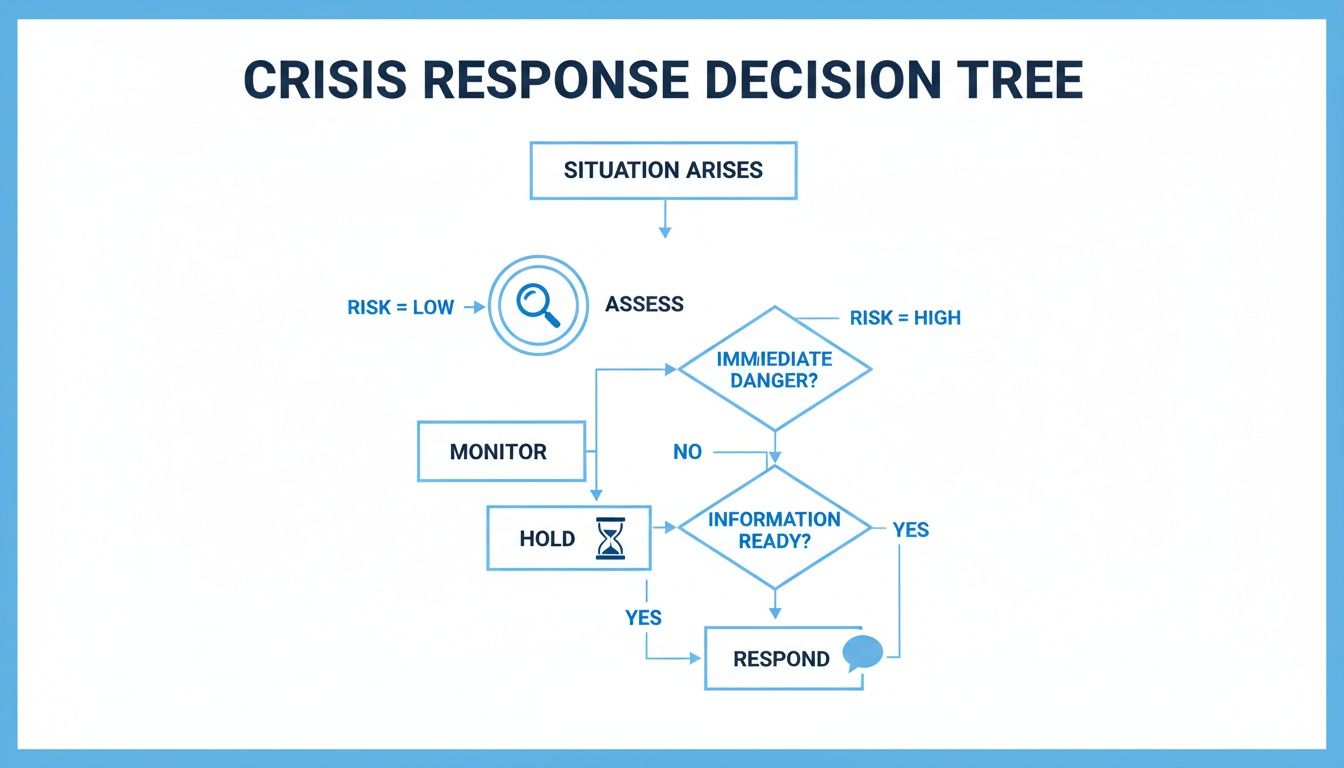
It underscores the importance of a structured process, ensuring you assess the situation and get a holding statement out the door before crafting a full public response.
Communicating with Customers and the Public
When you're talking to customers, empathy is your most powerful tool. They want to know how the crisis affects them personally. Is the product they bought safe? Is their data secure? Will the service they rely on be interrupted?
Your public statements have to address these concerns head-on. Ditch the corporate jargon and legal-speak. Use simple, human language to explain what happened, what you're doing to fix it, and how you're helping those who were affected.
Real-World Scenario: Multi-Location Retailer
Imagine a regional grocery chain finds a contamination issue with a packaged food item at one of its 50 locations.
- Wrong: A generic press release saying, "We are aware of a product issue and are handling it." This just creates panic everywhere.
- Right: A targeted social media campaign for customers in the affected zip code, clear in-store signage at that specific location, and a detailed statement on their website. The messaging for customers in unaffected regions would be totally different, reassuring them that their local stores are safe and the issue is isolated.
This approach shows you respect your customers' intelligence and understand the specific impact on their community, rather than treating everyone the same.
Managing Investor and Partner Expectations
Your investors, board members, and key business partners operate on a different wavelength. Their primary concerns are financial stability, long-term brand equity, and potential legal exposure. Communication with this group must be factual, data-driven, and laser-focused on the business implications.
While your public messages lead with empathy, investor communications must lead with mitigation and recovery.
- Financial Impact: Be transparent about any potential financial effects and outline the steps being taken to minimize them.
- Operational Response: Detail the operational changes being made to resolve the issue and, just as importantly, prevent it from happening again.
- Long-Term Strategy: Outline your plan for rebuilding trust and protecting the brand's value moving forward.
Juggling these varied communications is a delicate balancing act, for sure. But by thoughtfully addressing the unique concerns of each stakeholder group, you build a coalition of support that can help your brand navigate the storm and emerge more resilient on the other side.
Leading Post-Crisis Recovery and Performance Review
The immediate chaos has died down, the headlines have moved on, and you can finally catch your breath. It’s tempting to close the book on the whole affair and just move on, but your work isn’t quite done. In fact, some of the most critical work is just getting started.

The recovery phase is where you turn a damaging event into a powerful lesson that actually makes the organization stronger. This is your shot to dissect what happened, measure the true impact, and patch up the holes in your armor. Skipping this step is like surviving a shipwreck and immediately setting sail in the same leaky boat.
Conducting a Blameless Post-Mortem
To genuinely learn from a crisis, you have to create a space where your team can be brutally honest without fearing blame. A blameless post-mortem isn't about pointing fingers at people; it's about finding the weak spots in your process.
Get your crisis team together within a week or two, while the details are still fresh in everyone's mind. The goal is to build a detailed timeline and start asking some tough questions.
- Detection: How did we find out about this? Could we have known sooner?
- Triage: Was our initial gut check on the severity accurate?
- Response: Did our holding statement work? Did our core messages actually land with the audience?
- Tools: Did our monitoring software give us what we needed when we needed it? Did our internal communication channels hold up under pressure?
Document every single finding. The deliverable from this meeting has to be a concrete action plan, with clear owners and deadlines, to make your crisis playbook better.
Measuring the Full Impact of the Crisis
The damage from a media crisis isn't always obvious. Sure, you see the initial spike in negative mentions, but the lingering effects on brand perception and customer behavior are what really tell the story. You have to look past the vanity metrics and dig into data that reflects real business impact.
Your analysis should zero in on a few key areas:
- Sentiment and Share of Voice: Look at how public sentiment has shifted over the 30, 60, and 90 days after the crisis. Did it bounce back, or has a new, more negative baseline been set?
- Brand Search Volume: A drop in people searching for your brand name can signal a loss of trust. On the flip side, a spike in searches like "[Your Brand] + scandal" tells you exactly what narrative is sticking.
- Customer Retention and Churn: This is the ultimate test. Did you see a real increase in customer cancellations or a drop in repeat business that lines up with the crisis timeline?
- Sales and Lead Generation: Compare your sales and lead funnels to pre-crisis benchmarks. This is where you can quantify the direct hit to your bottom line.
A crisis doesn't end when the media stops talking about it. It ends when your business metrics return to—or exceed—their pre-crisis baseline. Until then, you are still in recovery mode.
This data-first approach turns your recovery from guesswork into a focused strategy, showing you exactly where to invest time and money to rebuild trust.
Monitoring for Lingering Misinformation
Just because you’ve put out the fire doesn’t mean all the embers are gone. Bad information has a long shelf life online, and this problem has been supercharged by AI chatbots. These models can latch onto old news articles or flawed data and keep presenting it as fact long after you've resolved the issue.
You absolutely must keep monitoring what AI models are saying about the incident. If a chatbot is still referencing the crisis when someone asks a general question about your brand, the reputational damage is happening all over again with every single query. This ongoing vigilance is now a core part of modern crisis management. For a deeper look, it's worth exploring different competitor AI analysis tools to see what's being said about you and your rivals.
The risks are real, and the broader crisis management market reflects this, with projections to hit USD 128.43 billion by 2030. That growth is fueled by the need for better monitoring and simulation, especially when 65% of crisis leaders say that trust is much harder to maintain thanks to AI-fueled misinformation. It’s a stark reminder that every crisis has to be a learning opportunity to harden your defenses for the next challenge.
Got Questions About Crisis Media Management? We Have Answers.
When a reputation threat hits, you need clear answers, and you need them fast. I've been in the trenches with brands during their toughest moments, and these are the questions that come up time and time again. Here’s some direct, no-nonsense advice for when it matters most.
How Often Should We Update Our Crisis Media Management Plan?
Think of your crisis plan as a living document, not a "set it and forget it" file collecting digital dust. A full, top-to-bottom review should happen at least once a year.
But that's just the baseline. The real key is to update it immediately after any significant event. That could be a near-miss incident that never went public, a major leadership change, or a new threat popping up, like AI-driven misinformation campaigns.
To keep your team sharp and the plan relevant, I recommend this rhythm:
- Annual Overhaul: A deep dive into every role, contact list, and protocol.
- Quarterly Drills: Run tabletop exercises. Test your team’s muscle memory so they aren't reading the playbook for the first time when the pressure is on.
- Event-Driven Updates: Did you just navigate a minor issue? Great. Update the plan with what you learned. Did a competitor get hit with something new? Update the plan for that, too.
This constant refinement is what separates a useful plan from a useless binder.
What Is the First Thing to Do When a Crisis Is Spotted?
Hold your fire. The absolute first step is to verify the information and figure out how bad it could get. This is your triage moment. The worst thing you can do is fire off a knee-jerk public statement based on rumors or incomplete facts—that’s how you turn a small fire into an inferno.
Get your core crisis team on a call immediately. Is the source credible? How far is this spreading, and what's the sentiment? While that rapid assessment is happening, your comms lead should already be drafting a holding statement. It’s a brief, empathetic message that simply acknowledges you’re aware of the situation and looking into it. This buys you precious time to get the facts straight without looking like you're hiding.
Your initial goal isn't to solve the problem in five minutes. It's to show you are in control of the response, not a victim of the event. A calm, measured first step is critical.
How Can We Monitor AI Chatbots for Brand Misinformation?
This is a new and tricky one. You can't use your normal social listening tools to see what AI chatbots are saying. Those conversations happen in private sessions, making them completely invisible to standard monitoring software.
You need specialized tools built for this exact purpose. Platforms designed for AI monitoring will systematically query models like ChatGPT and Gemini with brand-related questions, such as “Is [Your Company] a good place to work?” or "What are the hours for [Your Store]?".
These tools then analyze the AI’s answers for accuracy and sentiment. They'll instantly flag when an AI hallucinates wrong information or repeats a negative narrative. This gives your team the heads-up you need to take corrective action before that misinformation gets cemented as fact in the public's mind.
Uncover what AI chatbots are telling customers about your brand before it becomes a crisis. TrackMyBiz provides the intelligence you need to correct the record and protect your reputation. Start your free scan today.
