When a crisis hits on social media, you’re not just managing tweets—you're protecting your brand's reputation. At its core, crisis management social media is the game plan for how you monitor, assess, and respond to bad news blowing up online. This isn't just about damage control; it's a proactive strategy to shield your business from everything from viral takedowns to rampant misinformation.
Why Your Brand Needs a Social Media Crisis Playbook
We live in an age where a single angry tweet or a botched AI-chatbot response can ignite a PR wildfire. In this reality, "hoping for the best" isn't a strategy—it's a liability. A clear crisis management social media plan is what separates a minor hiccup from a full-blown reputational meltdown.
Without a playbook, teams panic. That panic leads to clumsy, inconsistent messaging, deadly delays in responding, and knee-jerk reactions that almost always make things worse.
This guide cuts through the corporate jargon to give you a practical, step-by-step playbook. It’s built for anyone on the front lines of a brand’s online image, whether you're a PR manager for a global company or a local shop owner trying to protect your digital storefront.
The Modern Threat Landscape
The challenges today go way beyond a simple disgruntled customer. The risks have multiplied, and your crisis plan needs to keep up.
Your playbook absolutely must account for:
- Viral Misinformation: False stories, often juiced up by bots, can contaminate your brand’s reputation in minutes.
- AI-Generated Content: LLMs and rogue chatbots can confidently spit out incorrect information about your services or hours—or even invent a scandal out of thin air.
- Employee-Related Issues: A thoughtless post from an employee's personal account can easily spiral into a corporate nightmare.
- Product or Service Failures: That one video of a negative customer experience can gain terrifying traction, quickly catching the eye of mainstream media.
The sheer speed of it all is what's truly staggering. In the world of social media, every second counts. A landmark study found that brands responding to a crisis within the first hour are about 60% more likely to fully recover their reputation compared to those who wait. For a deeper dive, you can read the full study about brand recovery strategies.
A crisis doesn't create your company's character, it reveals it. Having a playbook ensures that what's revealed is competence, empathy, and control—not chaos.
This playbook will walk you through the essential phases of modern crisis management. We’ll cover everything from early detection and rapid assessment to coordinated responses and post-crisis analysis. It's the structure you need to navigate any social media storm with confidence, turning potential disasters into a moment to prove what your brand truly stands for. Prepare now, so your team can act decisively when it matters most.
Building Your Early Warning System

The best way to manage a social media crisis is to see it coming before it makes landfall. You need to stop thinking of your monitoring setup as just a listening tool and start treating it like a digital nervous system—one that’s sensitive enough to feel the first tremors of trouble.
This is about building a proactive shield, not just reacting after the damage is done.
This system goes way beyond basic social listening, which is often just a vanity check for brand mentions. Instead, we’re focusing on identifying specific threat signals and triggers that tell you a storm is brewing. Honestly, this is the core of any modern crisis management social media strategy.
A great first step is truly understanding social media monitoring and how to use its principles defensively. Your real goal is to build a filter that can tell the difference between everyday chatter and a genuine threat that needs your immediate attention.
Setting Up Your Threat Detection Grid
Your early warning system has to be tuned to the specific keywords and sentiment shifts that actually matter to your brand. This isn't a one-size-fits-all kind of thing; it needs to be thoughtfully configured to do you any good.
Start by setting up alerts across a few key categories:
- Core Brand Monitoring: This is the obvious one. Track your brand name, product names, and key executives. Don’t forget to include common misspellings or abbreviations people use online.
- Competitor Activity: Keep a close watch on your competitors’ crises. Often, an industry-wide problem will hit them first, which can serve as an invaluable heads-up for you.
- Negative Sentiment Spikes: Don't just count mentions; track the feeling behind them. A sudden 20% jump in negative comments is a massive red flag that someone needs to investigate, fast.
- Key Issue Keywords: Monitor for your brand name paired with trigger words like "scam," "broken," "unsafe," or "lawsuit."
An early warning system isn't about trying to prevent every negative comment. It's about making sure that the one comment with the potential to go viral lands on your desk, not in a news headline you see the next morning.
This kind of structured monitoring helps you prioritize what’s coming in. It turns a chaotic flood of notifications into an actionable, color-coded dashboard of potential threats, letting your team focus their energy where it’s needed most.
The New Frontier: AI and Misinformation
Your traditional monitoring tools are great for tracking what people are saying, but they usually miss a dangerous new threat: AI-generated misinformation. Large language models (LLMs) can invent "facts," get your business details completely wrong, or even cook up false narratives about your brand.
Imagine a potential customer asks a popular chatbot, "Is TrackMyBiz a good tool for small businesses?" The AI could "hallucinate" a response claiming your service was discontinued or has a major security flaw. This information looks authoritative but is totally false, quietly poisoning your reputation.
This is where specialized tools become an essential part of a complete crisis management social media plan. For a deeper dive, you can learn more about the specifics of ChatGPT brand monitoring for eCommerce brands and see how it differs from old-school social listening.
Let’s walk through what this looks like in the real world.
- The Threat: An AI chatbot, scraping some outdated third-party review site, incorrectly lists a popular local bakery as "permanently closed."
- The Impact: Potential customers looking for directions get turned away. Weekend sales tank, and there are no obvious negative social media posts to explain why.
- The Alert: A platform like TrackMyBiz cross-references the chatbot's output against the bakery's actual website data. It spots the mismatch and flags the "permanently closed" claim as a high-priority misinformation alert.
- The Action: The bakery owner gets an instant notification. They can immediately contact the chatbot developer with proof of the error and get it corrected before an entire month's revenue is lost.
Without that specialized monitoring layer, the bakery might have never figured out where its foot traffic went. By building a robust system that accounts for both human and AI-driven risks, you create a comprehensive safety net that truly protects your brand from all angles.
Assessing the Threat Without Panicking
When an alert goes off, your first instinct is to jump in and start typing. That adrenaline surge tells you to act now. But in my experience, the fastest response is rarely the best one.
A knee-jerk reaction based on a sliver of information can turn a small brushfire into a full-blown inferno. The first real step in any solid crisis management social media plan isn't to respond—it's to assess. That brief, calculated pause is where you trade panic for strategy. You need to understand the scope, severity, and potential trajectory of the situation before you commit to a single word.
This measured approach ensures your response is proportional to the actual threat, not the one your adrenaline is screaming about.
Calculating Your Crisis Impact Score
Let's be real: not all negative mentions are created equal. A single angry comment from an account with ten followers is just noise. A viral video from a major influencer is a five-alarm fire. To tell the difference in minutes, you need a quick and dirty way to score the potential impact.
Think of it as rapid triage for your brand's reputation. A simple scoring model can be built around three core factors:
- Reach: Who is talking? An anonymous account is a low score. A verified influencer with a massive audience is an immediate red flag.
- Virality: How fast is this thing spreading? You're not just looking at the numbers, but the velocity. A post that racks up 500 shares in its first hour is way more dangerous than one that gets 500 shares over a week.
- Business Impact: Does this post threaten customer safety, break laws, or directly hit your revenue? A complaint about an unsafe product is infinitely more severe than a gripe about slow shipping.
By assigning a simple score (say, 1-5) to each of these, you get a data-driven snapshot of the threat level. This number tells you whether to just keep an eye on it, engage directly, or hit the big red button and escalate to the executive team.
Your goal in the first 30 minutes is clarity, not speed. A well-informed, slightly delayed response is always better than a rushed, inaccurate one that you'll have to correct later.
Assembling Your Core Crisis Team
A crisis is the worst possible time to be asking, "Who's in charge here?" Your core response team needs to be defined long before you ever need them, complete with crystal-clear roles and a chain of command that prevents chaos and mixed messages.
A well-structured team makes sure every angle is covered, from legal risk to customer sentiment. It also establishes a single point of truth for all communications, which is absolutely vital for maintaining a consistent narrative. As you build your playbook, it's also smart to see how others in your space have handled similar issues; competitor AI analysis tools can give you valuable context here.
Here’s a look at a typical crisis response team structure, outlining who does what when things get real.
Crisis Response Team Roles and Responsibilities
| Role | Primary Responsibilities | Key Decision Authority |
|---|---|---|
| Communications Lead | Oversees all external and internal messaging, sets the official tone, and acts as the primary spokesperson. | Final approval on all public-facing statements and social media posts. |
| Social Media Manager | Executes the response on social platforms, monitors real-time feedback, and provides sentiment reports. | Pauses all scheduled content and drafts initial response options. |
| Legal Counsel | Reviews all statements for potential liability, advises on legal risks, and ensures compliance. | Veto power over any language that creates unacceptable legal exposure. |
| Customer Support Lead | Manages one-on-one customer interactions, equips the support team with approved talking points. | Decides on the protocol for handling direct messages and customer calls. |
| Executive Sponsor | A senior leader who provides high-level strategic direction and allocates necessary resources. | Makes the final call on major business decisions (e.g., product recalls, public apologies). |
With a team like this, your workflow becomes incredibly efficient. The Social Media Manager can draft a holding statement, the Communications Lead refines it, and Legal gives it a quick once-over. This process helps you respond accurately within that critical "golden hour" without cutting corners. Setting this up ahead of time is one of the most important things you can do to build a resilient crisis management social media framework.
This is where the rubber meets the road. Your planning is done, the alerts are firing, and the crisis has officially landed. How your team acts in these next few hours will define the outcome. Executing a calm, coordinated, and multi-channel response is the single most important factor in defending your brand's reputation when things go sideways.
The first moments are governed by what we call the "golden hour." This isn't about being first to speak at all costs. It's about finding the delicate balance between the urgent need for speed and the absolute necessity for accuracy. A rushed, wrong statement just pours fuel on the fire, creating a second crisis you'll have to clean up later. Your goal is to own the narrative by becoming the most reliable source of information.
Your Central Source of Truth
Before a single tweet is drafted, your first move is to create a central "source of truth." This is nothing more than a shared, live document—a Google Doc or a similar collaborative tool—that acts as the command center for all crisis communications.
This document is your shield against disjointed messaging. It ensures everyone from the social media manager to the CEO is reading from the same playbook.
It should contain:
- A running summary of the situation: Just the facts, updated in real time as they are verified.
- Official talking points: Approved, bite-sized messages for internal teams to use.
- Approved public statements: The exact, vetted wording for social media posts, press releases, etc.
- A log of actions taken: A timestamped list of what was posted, where, and by whom.
This simple tool is the backbone of a unified response. It kills the deadly "he said, she said" confusion that plagues unprepared teams and keeps your messaging locked-in and consistent across every touchpoint.
Crafting Your Initial Public Response
Your first public statement is everything. It sets the tone for the entire crisis and signals to your audience that you are aware, in control, and taking the situation seriously. You don't need all the answers yet—in fact, you probably won't have them. What you do need is to acknowledge the issue. Fast.
A solid initial response, often called a "holding statement," needs to do three things:
- Acknowledge the issue: Show you're listening. (e.g., "We're aware of the conversation regarding…")
- State your action: Let people know you're investigating. (e.g., "Our team is looking into this to get the facts.")
- Provide a timeline: Tell people when to expect an update. (e.g., "We'll post a more detailed update here by 3 PM EST.")
The absolute worst thing you can do during a crisis is say nothing. Silence is almost always interpreted as guilt or incompetence, leaving a vacuum that misinformation will happily fill.
To make sure your message is delivered consistently across all channels, from social DMs to support emails, a good omnichannel customer service platform can be a lifesaver. It brings all your communication into a single stream, preventing messages from getting lost and ensuring your team delivers the same response everywhere.
Response Templates for Different Scenarios
While every crisis feels unique, the underlying situations often fall into familiar buckets. You can prepare adaptable templates to shave critical minutes off your response time. Think of these not as rigid copy-paste scripts, but as frameworks you can quickly customize.
Public Apology (When you're clearly at fault)
- Headline: We messed up, and we're sorry.
- Body: We acknowledge [specific issue]. This is not the standard we hold ourselves to. We are taking [specific, immediate action] to address this now. To make sure this doesn't happen again, we will be [long-term corrective action].
Direct Message to an Affected Customer
- Greeting: Hi [Customer Name], thanks for flagging this. We saw your post and wanted to reach out directly to address your concerns.
- Action: We're taking this very seriously. Could you please share [specific information, like an order number] so our team can investigate immediately? We're committed to making this right.
Knowing When to Escalate
Not every angry tweet requires a call to the CEO. A critical part of any crisis playbook is a dead-simple escalation protocol. This just defines the specific triggers that move an issue from the social media team's hands to senior leadership or the legal department.
Triggers for immediate escalation usually include things like:
- Accusations of illegal activity.
- Threats to customer or employee safety.
- A high Crisis Impact Score (as we talked about earlier).
- Incoming calls from major news outlets.
This process empowers your front-line team to handle what they can while ensuring high-stakes decisions are made by the right people, without getting bogged down in bureaucracy. Getting this structure right is something that AI reputation management consultants specialize in helping businesses build out.
The need for these skills is exploding. The social media crisis management market is already valued at USD 2.9 billion and is projected to grow at a blistering 22.5% CAGR through 2037. Yet, a Capterra survey found that only 49% of U.S. companies even have a formal plan. Worse, it takes an average of nearly 19 hours for a crisis to go from the first alert to news coverage—a dangerously long delay. This gap shows just how massive an advantage a prepared team has.
Learning and Recovering After the Crisis
The social media storm has passed, the mentions have died down, and your team is breathing a collective sigh of relief. But the work isn't over. In fact, some of the most important work in crisis management social media begins right now. This is where you measure what happened, learn from it, and fortify your defenses for the future.
Simply returning to business as usual is a massive missed opportunity. Every crisis, no matter how painful, is packed with invaluable data about your brand, your audience, and the weak points in your processes. The goal is to dissect what happened and transform those hard-won lessons into a stronger, more resilient playbook.
This cycle of Assess, Respond, and Align is the core of effective crisis management. The final "Align" phase is where the real learning happens.
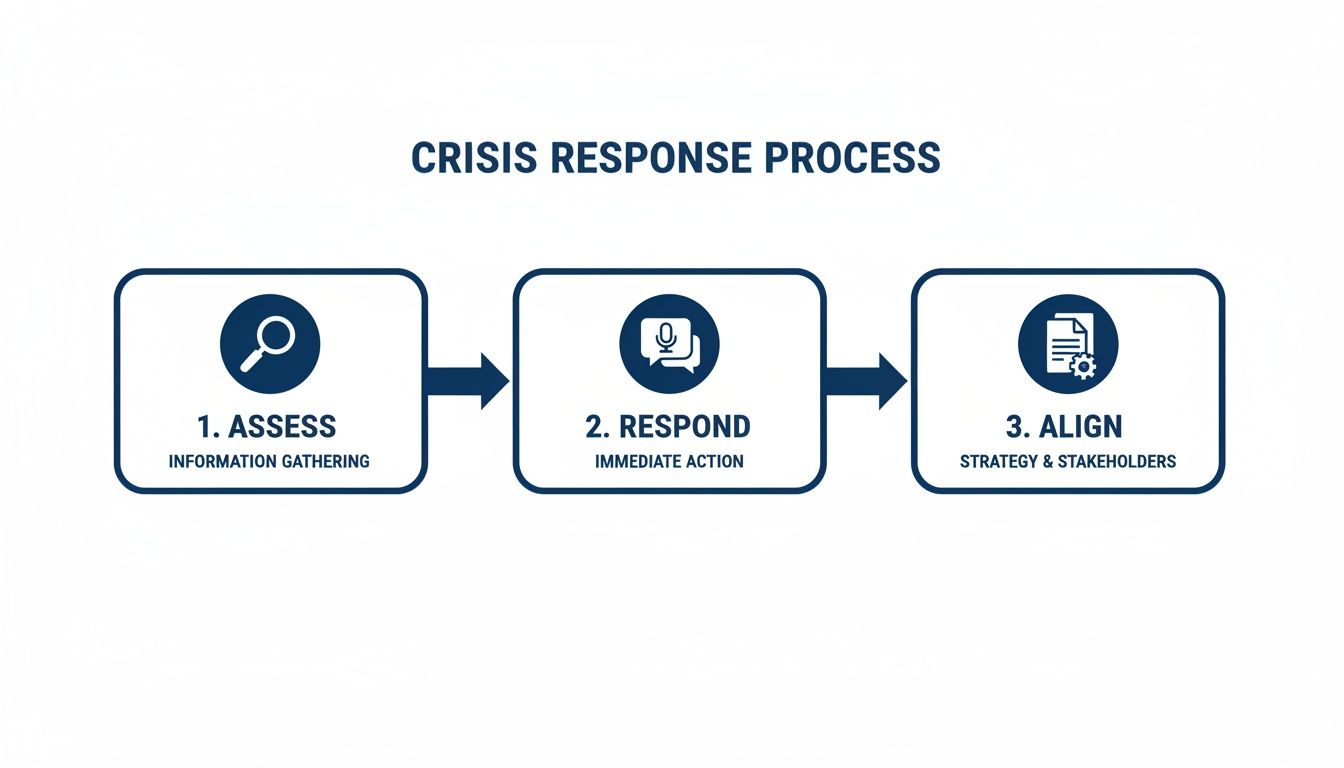
The key is realizing that response isn't a one-and-done action. It's a continuous loop that feeds back into itself, getting smarter and faster with each cycle.
Measuring the Impact of Your Response
Before you can learn, you need to measure. Gauging how well your response landed requires looking beyond simple vanity metrics. You need to track the numbers that truly reflect the shift in public perception and brand health.
Focus your analysis on these core metrics:
- Sentiment Analysis Shift: This is the big one. Did the percentage of negative mentions drop after your response? Did positive or neutral mentions start to tick back up? You're looking for a clear inflection point from negative back toward neutral.
- Share of Voice (SOV): How did the crisis affect your brand’s visibility compared to competitors? Did the negative story completely dominate your online conversation, or were you able to regain control of the narrative?
- Engagement on Response Posts: Dig into the comments, shares, and reactions on your official statements. Were people receptive? Did the tone of the comments change over time?
- Media Mentions: Track which media outlets picked up the story. More importantly, analyze the tone of their coverage before and after your team stepped in.
These data points give you a clear, objective picture of what worked and what didn't. They move the conversation from "I think we did okay" to "Our sentiment score improved by 40% within 24 hours of our apology post."
Conducting a Blameless Post-Mortem
Once you have the data, it's time to gather the crisis team for a post-mortem. The single most important rule for this meeting? It must be blameless. The goal isn’t to point fingers but to identify process failures and find opportunities to improve.
A blame-focused meeting shuts down honest feedback instantly. A process-focused meeting, on the other hand, opens the door to real, actionable insights that will make your team stronger.
The purpose of a post-mortem is to ensure that your organization never makes the same mistake twice. It's about building institutional memory and turning a reactive event into a proactive improvement.
Structure your meeting around this simple, powerful framework:
- What went well? Always start with the positives. Did the team assemble quickly? Was the initial holding statement effective? Celebrate the wins to reinforce what should be done again.
- What didn't go well? Get honest about the roadblocks. Was there a delay in getting legal approval? Did misinformation catch fire on a platform you weren't actively monitoring?
- How can we improve? This is where you build your action plan. Turn every "what didn't go well" into a concrete next step, like "Update the legal review workflow to be faster" or "Add TikTok to our primary monitoring dashboard."
Social media has become the go-to source for information during disruptions. Research shows that 70% of the US population turns to it during a crisis. On the corporate side, 72% of organizations depend on platforms like X and Facebook to monitor threats to their reputation. You can find more insights on social media's role in crisis communications from Statista.
This post-mortem process is the engine of your recovery. It transforms a one-time crisis into a permanent upgrade for your crisis management social media strategy, ensuring you are better prepared for whatever comes next.
Frequently Asked Questions
When you're in the thick of a social media crisis, the big-picture playbook is essential, but it's the small, practical questions that can trip you up. Getting the details right beforehand is what separates a smooth, confident response from a disorganized scramble.
Here are some of the most common "in the weeds" questions teams face when putting their crisis plans into action.
How Often Should We Update Our Crisis Management Plan?
Your crisis plan can't be a "set it and forget it" document gathering digital dust on a server. It has to be a living, breathing guide.
As a baseline, you need to schedule a full review and update at least once a year. People change roles, contact lists go stale, and new risks emerge. An annual check-in is the bare minimum to keep it relevant.
But the most important time to update is right after a real crisis or even a near-miss. This is when the lessons are freshest. What worked? What broke down completely? Was there a communication channel you forgot? Fold that real-world experience back into the plan while it’s still sharp in everyone's mind.
Finally, you have to revisit the plan after any major business shift—like launching in a new market, the rise of a new platform like TikTok, or changes in how your audience communicates (hello, AI chatbots). A plan from 2020 is dangerously out of date today.
A crisis plan is like a muscle—if you don't exercise it regularly through reviews and simulations, it will fail you when you need it most. Keep it current, keep it relevant, and keep it top of mind.
What Is the First Action to Take When a Crisis Emerges?
Before you do anything else, pause all scheduled social media posts. This is the absolute first move, and it's non-negotiable.
Nothing makes a brand look more tone-deaf and clueless than an upbeat, automated "Happy Friday!" post dropping in the middle of a serious issue. It will instantly escalate negative sentiment and make you a target.
Once everything is paused, your next step is to assemble your pre-defined crisis team to assess the situation using your impact framework. The immediate goal isn't to have the perfect answer, but to get the core facts straight and agree on a holding message before anyone says anything publicly. Resist that powerful impulse to fire off a reactive tweet. In the first 30 minutes, accuracy and control matter far more than speed.
Should We Delete Negative Comments During a Crisis?
This question comes up every single time, and the answer is almost always a hard no.
Deleting negative comments or legitimate criticism is like pouring gasoline on a fire. It looks like censorship and makes people assume you're hiding something. It can quickly turn a single complaint into a much bigger crisis about your company's lack of transparency.
Instead of deleting, your default should be to respond. Acknowledge the comment publicly with your approved holding statement. If it makes sense, offer to move the conversation to a private channel like DMs to sort out the specifics. This shows you're listening, not hiding.
There are, of course, a few critical exceptions where deleting is the right call:
- Comments that contain hate speech, threats of violence, or clear harassment.
- Posts that share someone's private information (doxxing).
- Obvious spam or malicious messages that are completely off-topic.
In these specific cases, you're not silencing criticism; you're maintaining a safe community space for everyone else.
How Can We Prepare Our Team for an Unforeseen Crisis?
You can't prepare a team for the pressure of a crisis just by having them read a document. The only way to get ready is to practice. The single best way to do this is by running crisis simulation drills.
These drills build the muscle memory your team needs to act decisively when the pressure is on.
Come up with a realistic, hypothetical scenario. Maybe it's a customer video that's going viral for all the wrong reasons, an announcement of a data breach, or a false rumor about your product started by an AI chatbot. Then, make your team run the entire playbook in real time.
In the simulation, your team should:
- Use your actual monitoring tools to "detect" the simulated threat.
- Assemble the crisis team and use your scoring framework to assess the severity.
- Draft response messages and push them through the real approval workflow.
- Practice the internal communication plan to keep executives and other departments in the loop.
These drills are invaluable. They expose the gaps in your plan, clarify who really does what when things get chaotic, and build the team’s confidence. When a real crisis hits, they won't be improvising in a panic; they'll be executing a plan they already know by heart.
Ready to protect your brand from AI-generated misinformation? TrackMyBiz gives you the power to see exactly what chatbots are saying about you. Start a free scan today to uncover hidden risks and opportunities. See Your Brand's AI Report.
