When things go sideways on social media, you don't have days to figure things out—you have minutes. Social media crisis management isn't just about handling a few angry customer DMs. It's the entire playbook for preparing for, spotting, and shutting down brand-threatening issues before they spiral into a full-blown reputational disaster.
This goes way beyond standard customer service. We're talking about everything from viral rumors and coordinated misinformation campaigns to massive backlash over a new product launch. If you don't have a plan, you're already behind.
Why Social Media Is the New Crisis Frontline
Let's be real: social media stopped being just a marketing channel a long time ago. Today, it’s the primary arena where your brand's reputation is either built up or torn down in real-time.
A single negative comment, a nasty rumor that catches fire, or even a weird AI-generated falsehood can escalate into a major crisis before your team has even had its first coffee. The speed at which information—both true and false—travels has completely changed the game.
The Shift in Consumer Expectations
Your customers today expect you to be on it. Immediately. A delayed or tone-deaf reply isn't just a minor slip-up anymore; it’s viewed as incompetence or, even worse, that you just don't care.
This means having a rehearsed crisis management plan isn't a "nice-to-have." It's a fundamental requirement for staying in business. People expect brands to be present, accountable, and human, especially when things go wrong.
In an environment where a shocking 49% of companies still don’t have a formal crisis communication plan, simply being prepared gives you a massive advantage. It puts you in a position to control the narrative, rather than letting the narrative control you.
The Unseen Threat of AI Misinformation
There’s a new player on the field, and it’s one most brands aren't watching: AI chatbots spreading misinformation. An AI assistant might confidently tell a user your business is "permanently closed," invent a fake scandal, or share incorrect business hours, all based on flawed data it scraped from somewhere.
These AI "hallucinations" are uniquely dangerous because they sound so credible. Thousands of users who trust the AI's answer can then repeat this bad information as fact. This modern challenge just hammers home why a robust playbook is so critical. A great starting point is to see real examples of how businesses leveraged social media tools during a critical time. Preparing for these new-wave scenarios is absolutely essential for protecting the reputation you've worked so hard to build.
Building Your Digital Early Warning System
The best way to handle a social media crisis is to see it coming before it ever makes landfall. Think of a proactive monitoring setup as your brand’s digital early warning system—it’s designed to spot trouble when it’s still a distant rumble, not a full-blown category five storm heading right for you.
Effective crisis management begins with listening, and I mean really listening. You have to tune into the conversations happening across all the platforms where your audience actually lives. That means going way beyond just your main corporate channels and keeping an ear to the ground on X (formerly Twitter), Instagram, Reddit, and even TikTok. Each one has its own unique rhythm and risk profile.
A small spark can turn into an inferno frighteningly fast if it isn't managed at the earliest stage. Most crises don't just appear out of nowhere; they follow a predictable path.
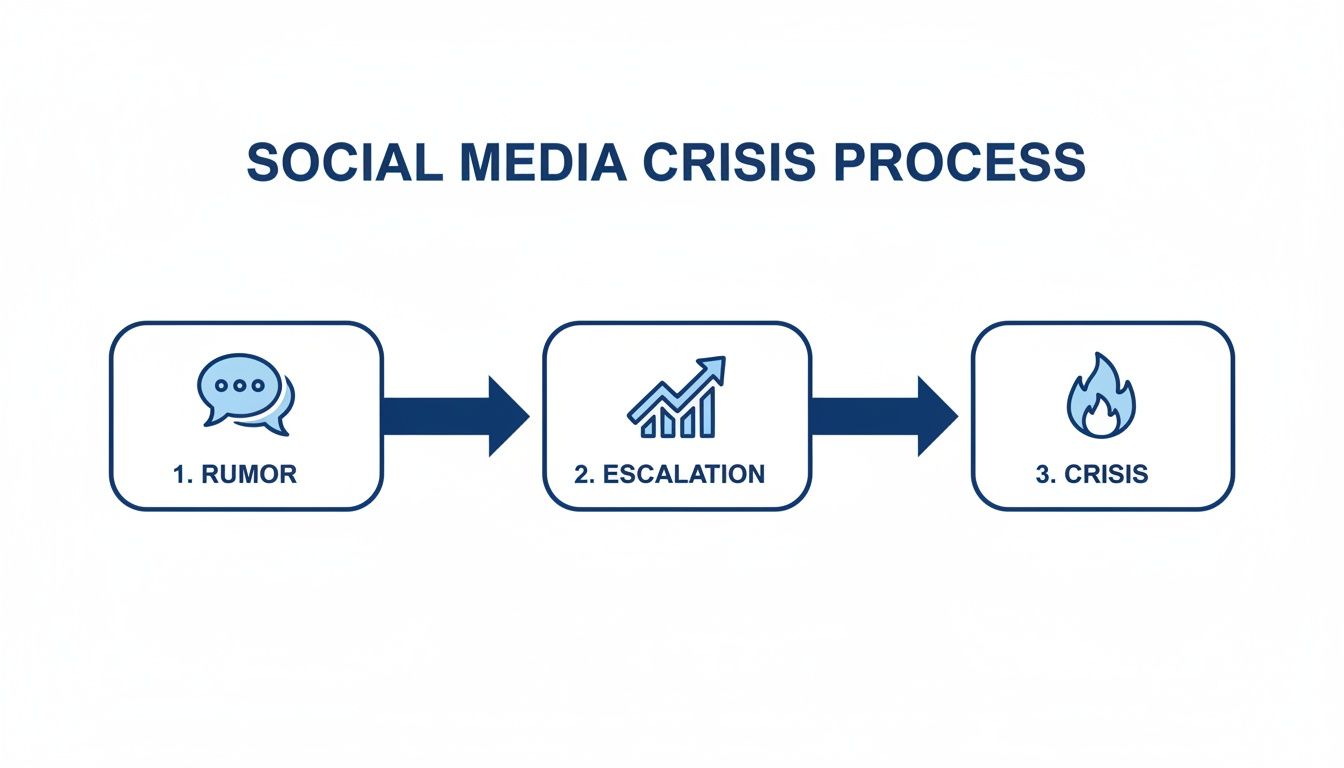
As you can see, what starts as a single negative comment or rumor can quickly gain traction, escalating until it becomes a genuine crisis that threatens your brand's reputation. Catching it in that first stage is everything.
Configuring Your Listening Dashboard
Setting up your listening tools properly is about more than just tracking your brand name. A really robust setup works like a fine-meshed net, catching mentions and whispers that might otherwise slip right through.
At a minimum, your tracking should include:
- Brand and Product Names: The obvious starting point, but don't forget to include common misspellings, abbreviations, and even product codenames.
- Executive Names: Key leaders are often targeted during a crisis. Monitoring their public profiles and mentions is non-negotiable.
- Campaign Hashtags and Slogans: You need to track the real-time sentiment around your marketing efforts, not just the vanity metrics.
- Industry Keywords: Keep a pulse on broader conversations to understand the context your brand is operating in and spot industry-wide issues before they affect you.
This comprehensive approach helps you separate isolated customer service complaints from the first real tremors of a much larger event. For a deeper dive, there's a great guide on using social listening for crisis alerts.
"The difference between a manageable issue and a full-blown crisis often comes down to a few hours. On average, it takes 18 hours and 57 minutes from the first warning sign to the first major news story, giving prepared teams a critical window to act."
This is exactly why investment in this space is exploding. The global market for social media crisis management services hit USD 1.88 billion in 2023 and is projected to grow at a staggering 21% CAGR. And yet, a shocking 49% of companies still don't have a formal plan, leaving them completely exposed. You can see the full breakdown of these trends in this GM Insights report.
The New Frontier: Monitoring AI Hallucinations
Your early warning system needs a serious upgrade for the age of AI. Traditional social listening tools are fantastic at tracking what people are saying about you on public platforms, but they are completely blind to what AI assistants are saying.
Large Language Models (LLMs) like ChatGPT and Gemini now answer questions for millions of people every single day. If an AI "hallucinates"—which is a nice way of saying it confidently makes something up—it can cause immediate and significant brand damage.
Just imagine an AI telling a potential customer:
- "Oh, that business is permanently closed."
- "Their flagship product was recalled for safety issues last month."
- "They have hundreds of unresolved Better Business Bureau complaints."
These falsehoods are incredibly dangerous because they're delivered with an air of authority, and the user has no reason to doubt them. Standard monitoring software will never catch these mentions. They don’t happen on a public X feed or a Reddit thread; they happen in private chat windows, creating a massive blind spot in your crisis detection strategy.
Integrating LLM Tracking
To close this gap, you need tools specifically designed to monitor what AI models are saying. This involves regularly prompting various AI assistants with questions about your brand, your products, and your services to see what they report back.
This isn't just a defensive tactic; it's a new, essential form of reputation management. By spotting and flagging hallucinations, you can start taking steps to correct the underlying data the AI was trained on, protecting your brand from a new and nearly invisible threat. For any team looking to get ahead of this, understanding the ins and outs of AI brand tracking for SaaS companies is the perfect starting point for building a modern, AI-proof monitoring strategy. Without this layer, your crisis plan is missing a huge piece of the puzzle.
Executing a Coordinated and Rapid Response
Once your monitoring flags a real threat, the clock starts ticking. Loudly. The first 60 minutes are without a doubt the most critical window in any social media crisis. A slow, disorganized, or tone-deaf response can pour gasoline on a small fire, turning a manageable problem into a full-blown inferno that torches your reputation.
Your first moves must be fast and decisive, and they happen long before you type a single public word.
Hit Pause on All Scheduled Content
This is your first, non-negotiable action. Go into your social media scheduler and pause everything. Immediately.
Nothing destroys credibility faster than a cheerful, pre-scheduled marketing post popping up next to a flood of angry customer comments. It makes you look oblivious at best and deeply uncaring at worst.
Imagine a fun GIF about your summer sale appearing while your customers are lighting you up over a serious product safety issue. The damage from that one ill-timed post can be catastrophic. Freezing your content calendar is a simple but powerful signal that you’re listening and taking the situation seriously. It buys you breathing room to assess the damage without digging the hole deeper.
Assemble Your Crisis Command Center
A crisis is not the time for introductions. You need a pre-defined core response team that can be activated at a moment's notice. This isn't just your social media manager—it's a cross-functional group of decision-makers.
Your rapid response team should always include leaders from:
- Social Media & PR: They manage the public-facing comms and keep a finger on the pulse of the conversation.
- Legal: They review every single word to head off potential liability and ensure absolute accuracy.
- Operations or Product: They have the technical details and can get to the root cause of the problem.
- Customer Support: They're on the front lines, handling direct inquiries and need to deliver a unified message.
This team needs a dedicated communication channel, like a private Slack channel or a group chat, to act as a "digital war room." This ensures everyone is working from the same script and prevents the chaos of conflicting messages going public.
"In a crisis, silence creates a vacuum that will be filled by speculation, misinformation, and your competitors. A swift, unified acknowledgment is the only way to begin controlling the narrative."
Crafting Your Initial Holding Statement
Here's the thing: you won't have all the answers in the first hour. And that's okay. The goal of your first public message isn't to solve the problem; it's to acknowledge it. A holding statement is a brief, human message that proves you’re listening and getting to work.
A solid holding statement does three things:
- Acknowledges the issue: It shows you're aware of what people are talking about.
- Shows empathy: It conveys that you understand people are frustrated or concerned.
- Sets expectations: It tells everyone you're investigating and will be back with more information.
Here’s an example you can adapt:
"We're aware of the conversation around [issue] and are actively looking into it. We understand your concerns and are taking this very seriously. We will share a more detailed update here as soon as we have more information."
This kind of message is crucial. It buys you time to gather the facts without looking like you're hiding. It absolutely must be run by your legal team to ensure it doesn’t prematurely admit fault. A sincere and fast response is a cornerstone of modern reputation management. Many businesses now work with experts to get these processes right, and you can see how AI reputation management consultants help companies prepare for these exact situations.
Lock Down Your Approval Workflow
With the crisis blowing up in real-time, speed is everything—but accuracy is the only thing that matters. A streamlined approval workflow prevents panicked, off-the-cuff replies that could make a bad situation ten times worse.
Every single public comment, from a major statement to a simple reply, must pass through this chain of command.
A tight workflow usually looks like this:
- The social media manager drafts a response based on the team's agreed-upon message.
- The draft goes to the PR or comms lead to check for tone and clarity.
- The final version goes to legal for a green light.
This process has to be built for speed. When KFC famously ran out of chicken in the UK, their response was a masterclass in coordination. They didn't have an immediate fix, but their witty, apologetic "FCK" ad was brilliant. It acknowledged the absurdity of the situation, showed humility, and earned them enormous goodwill while they fixed their supply chain.
That wasn't an accident. It was the result of a perfectly coordinated team turning a potential disaster into a legendary PR win.
Managing the Narrative and Correcting Misinformation

Once your initial holding statement is out, the real work begins. The crisis doesn't just stop; you've simply moved into the next, more demanding phase: actively managing the public narrative. This is where you shift from a purely reactive stance to a proactive strategy to steer the conversation back to the facts.
Nature abhors a vacuum, and so does social media. Any gap in information will be instantly filled with speculation, rumors, and outright lies. Your job is to become the single most reliable source of information out there. That means consistent, factual updates and actively stamping out misinformation wherever it pops up.
Arming Yourself with Verified Information
Before you can correct the record, you need an unshakeable foundation of facts. This is no time for guessing. Your crisis team needs to move fast to gather and verify every single piece of information that will be shared publicly.
This kicks off a rapid-fire, internal fact-finding mission. Get on the phone—or in a room—with your operations, product, and legal teams to get the exact details. The goal is to create a "single source of truth," a master document with approved facts and talking points that everyone on your response team can pull from. It’s the only way to ensure every tweet, reply, and update is consistent and accurate.
Responding with speed is crucial, but responding with inaccurate information is catastrophic. It shatters the very credibility you're desperately trying to rebuild. Take the extra hour to get it right.
Confronting Falsehoods and AI Hallucinations
Misinformation spreads like wildfire, and today it’s supercharged by both human users and AI assistants. You need a two-pronged attack to handle both.
For lies spreading on platforms like X or Facebook, a direct but careful approach works best. This isn't about getting into flame wars; it's about clear, authoritative corrections.
- Create a "Facts Page": Set up a dedicated page on your website or a pinned thread that becomes the official source of truth. Direct everyone there.
- Quote-Tweet with Corrections: When a big, false claim gets traction, use the platform's features to share it with your correction, citing your verified info.
- Use Visuals: A simple infographic or a short video explaining the facts can cut through the noise far better than a block of text.
Dealing with AI hallucinations is a whole different beast. When a chatbot like ChatGPT or Gemini starts spouting nonsense about your brand, you can't just @-reply it. For ecommerce brands, this is a massive blind spot, which makes proactive ChatGPT brand monitoring for ecommerce an essential part of any modern crisis plan.
To fix what an AI is saying, you have to engage with the systems themselves.
- Use Feedback Mechanisms: Nearly every AI tool has a "thumbs down" or feedback button. Use it. Report the inaccurate output directly to the developers.
- Update Your Structured Data: AIs love pulling from structured data. Make sure your website's schema markup, your Google Business Profile, and any Wikipedia entries are pristine and up-to-date.
Engaging Your Community and Brand Advocates
During a crisis, your comment sections can turn into a warzone. How you manage them is critical. Your aim should be constructive engagement, not getting dragged into endless, unwinnable arguments.
First, establish clear moderation rules. It’s completely fine to delete comments with hate speech, threats, or spam. But resist the urge to delete general negative feedback. That will backfire, leading to cries of censorship that just add fuel to the fire.
Next, find your advocates—those loyal followers who are already in the trenches defending you. Don’t leave them hanging. Arm them with the right information by posting clear, factual updates they can easily reference and share. A single, well-informed advocate with a link to your official statement can be far more convincing than a dozen corporate replies. By engaging thoughtfully, you can slowly start to turn the tide.
Just because the social media firestorm has died down doesn't mean your work is done. Far from it. In fact, what you do next is what separates a team that just survived a crisis from one that will dominate the next one.
A thorough post-crisis analysis turns a painful, reactive event into a powerful, proactive lesson. This isn’t about pointing fingers. It’s a clear-eyed look at what happened, how your team performed, and where the process broke down. Skipping this step is like getting your roof torn off by a hurricane and deciding not to reinforce it. You’re just waiting for the next disaster.
Moving Beyond Vanity Metrics
First things first, you need to measure the actual damage. That means looking far beyond surface-level numbers like likes and retweets, which are mostly noise in a crisis. You have to dig into the metrics that truly reflect your brand’s health and connect to real business outcomes.
Your post-crisis dashboard should tell a clear story of the event's impact.
- Brand Sentiment Analysis: How did your positive, negative, and neutral mentions shift? Good tools will show you a sentiment timeline, revealing exactly how long it took for the conversation to get back to your baseline.
- Mention Volume and Reach: Look at the peak volume of mentions compared to your average day. How far did the negative story travel? This helps you grasp the true scale of the fire you just put out.
- Website Referral Traffic: Did the crisis send a flood of traffic to your site? Even more telling is where they went. A spike in visits to your careers page might signal concern from potential hires, while a jump to your investor relations page points to an entirely different problem.
The goal here is to connect the dots between social media chaos and tangible business results. Did you see a dip in sales in the regions where negative sentiment was highest? Did your customer support team log a 200% increase in tickets related to the crisis? These numbers prove the real-world cost of a social media blow-up and get leadership to pay attention.
Running the Post-Mortem Debrief
Once the data tells its story, it’s time to gather the crisis team for a debrief. This meeting needs to be a blame-free zone focused entirely on improving the playbook. Your job is to answer a series of tough but critical questions.
Use this as a guide for your conversation:
- Detection Speed: How fast did we catch it? Did our monitoring tools flag the first whispers, or were we blindsided by an email from a reporter?
- Response Time: What was the lag time between detection and our first public statement? Where were the bottlenecks in the approval chain?
- Message Resonance: Did our messaging land the way we intended? Was the tone right? Did people actually believe us?
- Team Coordination: How smoothly did PR, legal, support, and ops work together? Were there communication breakdowns or turf wars?
- Plan Effectiveness: Did our crisis plan hold up under real-world pressure, or did we have to wing it? What parts were actually useful, and what was just corporate fluff?
A solid plan is your best defense against what can be staggering crisis costs—some estimates put the average at $4.3 million. It combines smart monitoring that cuts down on false alarms with AI tools that can actually prevent 60-70% of issues from escalating in the first place. You can discover more insights about social media crisis management on vistasocial.com to see how metrics like response time and audience retention become your ultimate report card.
Fortifying Your Defenses for the Future
The final step is to turn all these learnings into a concrete action plan. This is where the debrief moves from talk to action, ensuring you’re stronger, faster, and more resilient for whatever comes next.
This document should outline specific, tangible changes to your processes, tools, and training. Maybe it means updating your messaging templates with more empathetic language. Perhaps you need to refine the escalation protocol so a key decision-maker is looped in sooner. Or it could mean investing in new monitoring technology that can track what AI assistants are saying about your brand.
By turning analysis into action, you ensure the painful lessons from one storm become the vital defenses that protect you from the next one.
Burning Questions About Social Media Crisis Response
Even with the best playbook in hand, a real crisis throws curveballs. When the alerts are firing and the pressure is on, you need clear, decisive answers, not theory. You don't have time to second-guess yourself.
Let's cut through the noise and tackle some of the toughest questions that come up in the heat of the moment.
Should We Really Respond to Every Single Negative Comment?
The short answer? Absolutely not. But knowing which comments to engage with and which to ignore is where the real skill lies. Trying to respond to every negative post is a fast track to amplifying minor issues and completely burning out your team. Triage is everything.
A good rule of thumb is to jump in when:
- A comment is catching fire: If a negative comment is racking up likes, shares, and replies, it's turning into a public forum. You need to be there.
- It’s spreading bad information: Correcting factual misinformation about your product, service, or company isn't optional. It's essential.
- The poster has a huge audience: A negative post from a major influencer can spiral out of control in minutes. That requires an immediate, strategic response.
- It’s from a genuinely upset customer: You can spot these. A heartfelt story about a terrible experience deserves an empathetic, public acknowledgment before you take the conversation to a private channel like DMs or email.
On the other hand, it's almost always best to ignore the obvious trolls, abusive comments, or coordinated spam attacks. Engaging is exactly what they want—don't give them the satisfaction.
What’s the Right Role for Our Employees During a Crisis?
Your employees can be your most powerful allies or your biggest liability. Without clear rules, a well-meaning team member might dive into a comment thread to "defend the company," only to add fuel to the fire with an off-brand or inaccurate statement.
This is why a crystal-clear employee social media policy is something you need before a crisis ever hits.
That policy needs to be blunt and direct:
- Who is allowed to speak? Make it explicit that only the designated crisis response team can comment on the situation, whether from official accounts or their own.
- What should everyone else do? Encourage them to be your eyes and ears. If they spot concerning mentions, they should report them internally to the crisis team, not engage.
- The golden rule of silence: Train employees to refrain from commenting on, liking, or sharing any posts related to the crisis. When in doubt, staying silent is always the safest move.
By setting these boundaries, you prevent a chaotic free-for-all and keep your official message controlled and consistent. Trust me, a single rogue comment can derail your entire strategy.
Can a Small Business Really Handle a Major Crisis?
Yes, 100%. Smart social media crisis management isn't about the size of your team; it's about the quality of your plan. A small business with a tight-knit team can absolutely navigate a crisis effectively without a six-figure budget.
The trick is to lean into preparation and efficiency.
- Keep the plan simple: You don't need a 50-page binder. Start with a one-page flowchart. Who gets the first call? Where do you communicate internally? What's the first holding statement? That's it.
- Use free tools: Set up Google Alerts for your brand name, products, and key executives. It’s a free, dead-simple early warning system.
- Draft templates ahead of time: Write a few basic "holding statement" templates that can be tweaked in seconds. This saves you precious minutes when every second counts.
- Name a point person: Designate one person who has the authority to make quick calls, like hitting the pause button on all scheduled social media posts. This clarity stops confusion in its tracks.
For a small business, agility is your secret weapon. A nimble team can often approve and push out a response faster than a massive corporation stuck in endless layers of approvals.
Your brand's reputation is constantly being discussed online, and a significant portion of that conversation is now happening within AI chatbots. TrackMyBiz is your early warning system for this new frontier. Our platform monitors what AI assistants like ChatGPT and Gemini are saying about you, flagging dangerous hallucinations and misinformation before they can damage your business. Don't let your brand's narrative be written by an algorithm you can't see. Find out what AI is telling your customers and take back control. Start your free scan today at https://trackmybusiness.ai.
