Social media crisis management isn't just a buzzword; it's the art of spotting, handling, and shutting down brand-killing issues on social platforms before they spiral out of control. Think of it as a mix of real-time listening, having a battle-tested response plan, and communicating with absolute transparency to keep control of your brand's story.
Why Social Media Is the New Crisis Frontline
Welcome to the modern-day court of public opinion, where a single viral video or a poorly-worded tweet can ignite a firestorm. The old days of managing a story with a carefully crafted press release are over. Today, news breaks on Twitter, not the evening news, making social media the battlefield where your reputation is won or lost in minutes.
The speed at which information—and more importantly, misinformation—spreads has forced every brand to operate like a 24/7 newsroom. A minor customer service slip-up can morph into a trending hashtag seen by millions before you've even had your morning coffee. In this environment, a reactive, "wait-and-see" approach isn't just outdated; it's a direct threat to your business.
The Emerging Threat of AI Hallucinations
Just when you thought it couldn't get more complicated, a new danger has entered the chat: AI hallucinations.
Picture this: A popular AI chatbot, used by millions for quick answers, confidently tells a user your business is permanently closed. Or worse, it invents a fake scandal out of thin air. These AI-generated lies are uniquely dangerous because they sound so credible. A user might screenshot the chatbot's error and post it online, sparking a full-blown crisis before you even know what's happening. This playbook is designed to help you manage traditional social media flare-ups while also equipping you to monitor and correct the AI narratives that can pour fuel on the fire.
The core of modern crisis management isn't just about responding to what people say about you—it's about verifying what intelligent systems are saying, too. This dual focus is critical for protecting your brand's reputation in an automated world.
To really get a handle on these challenges, you need a solid grasp of reputation management as a whole. For a great overview, this actionable guide to reputation management in social media is a fantastic starting point. With that foundation, this playbook will show you how to turn potential disasters into moments that actually build and reinforce customer trust.
Building Your Digital Early Warning System
You can't fight a fire you don't see coming. The absolute cornerstone of managing a social media crisis is having a solid detection system—think of it as your digital smoke alarm. This goes way beyond setting up a few basic keyword alerts. We're talking about a multi-layered approach designed to catch sparks before they turn into infernos.
Your first line of defense is a set of sophisticated social listening tools. These platforms are much more than just brand mention trackers. They analyze sentiment shifts, flag weird spikes in conversation volume, and pinpoint influential accounts that are suddenly talking about you. To really get this right, you have to understand what social listening entails, because it’s the foundation for everything that follows.
But the game has changed, and our monitoring strategy has to change with it.
Integrating AI and LLM Monitoring
A new and critical layer has emerged: monitoring what large language models (LLMs) and AI assistants are saying about your brand. Misinformation doesn't need a human to get started anymore. It can be born from an AI hallucination and then spread like wildfire by users who have no idea it’s wrong.
This is where you can get ahead of dangerous falsehoods right at the source. I've seen some wild examples pop up recently:
- Incorrect Business Information: An AI could tell users your flagship store is permanently closed or list the wrong opening hours, which can directly kill foot traffic and sales.
- Fictional Scandals: I’ve seen LLMs invent negative stories out of thin air, associating a brand with controversies that never actually happened, creating a full-blown reputation crisis from nothing.
- Pricing and Product Errors: A chatbot might confidently state an incorrect price or completely misrepresent what a product does, leading to a flood of frustrated customers and angry public complaints.
By actively keeping an eye on these AI-driven conversations, you can catch these errors before they spill over onto Twitter and Facebook. For a deeper look into this, check out our guide on AI brand tracking for SaaS companies—the insights there are valuable for pretty much any industry.
This is the typical flow of a modern social media crisis, from that initial AI-driven spark to the widespread impact on your brand.
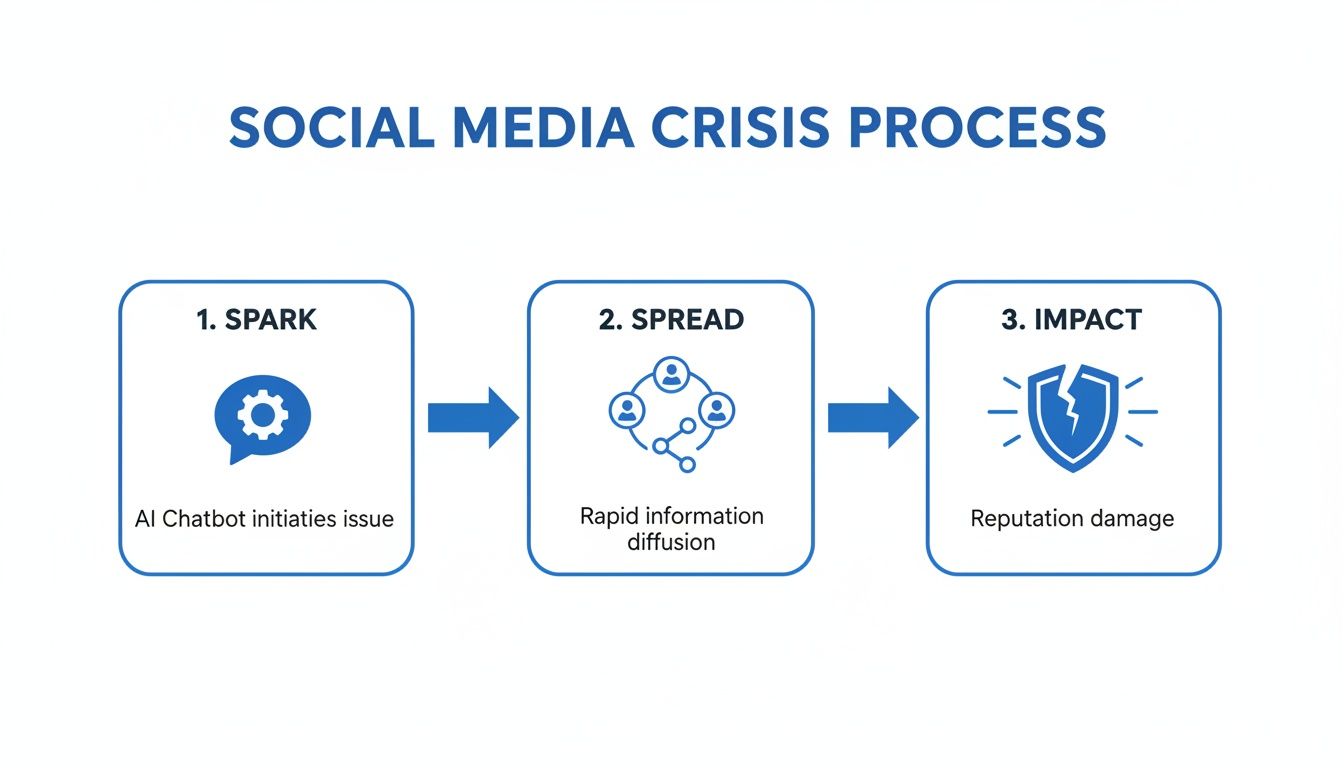
As the diagram shows, a small spark, often from an AI error or a single user post, can be amplified by social networks at an alarming speed, leading to very real brand damage.
Establishing a Rapid Triage Framework
Once your early warning system flags a potential threat, speed is everything. You need a rapid triage process to sort issues by severity and potential impact. This allows your team to respond proportionately instead of hitting the panic button for every negative comment.
Your framework has to clearly define what requires an immediate, all-hands-on-deck escalation versus what can be handled by the regular customer service team. This isn't just theory; the stakes are incredibly high. It’s no surprise that 81% of marketers now see social media as the most critical channel for real-time crisis management. We all remember the United Airlines incident, where a viral video caused their market value to plummet by $1.4 billion. The pressure is intense, especially when 72% of consumers expect a response within 24 hours.
A great triage system doesn't just categorize problems; it empowers your team to act decisively. It replaces the panicked question "What do we do?" with a clear, pre-approved action plan based on the threat level.
Create a simple but effective scale to classify every alert that comes in.
Crisis Triage Levels
| Threat Level | Description | Example |
|---|---|---|
| Level 1 (Low) | Isolated negative comments or minor inaccuracies with limited reach. | A single user complains about a product feature on their small-follower account. |
| Level 2 (Medium) | A growing number of complaints or misinformation shared by mid-tier influencers. | A local news blogger shares an incorrect report about a store closure, and it's being reshared. |
| Level 3 (High) | A viral issue, significant safety concern, or misinformation from a major source. | A major influencer or media outlet posts a damaging and false claim that is trending. |
This kind of structured approach ensures your best people and resources are focused where they're needed most. It transforms your monitoring from a passive activity into a proactive defense system, ready for whatever comes your way.
Crafting Your Rapid Response Playbook
When a social media crisis hits, the clock becomes your worst enemy. Without a plan, you're left scrambling, and every second of hesitation allows the narrative to spin out of your control. Panic and confusion lead to bad decisions, turning a small fire into an absolute inferno.
That's where a rapid response playbook comes in. This isn't about predicting every possible disaster. It's about having 80% of your response strategy figured out before you ever need it. This preparation lets your team skip the "what do we do now?" debate and focus entirely on the specifics of the situation, acting with speed and confidence when the pressure is on.

It’s shocking how many companies are flying blind. Only 49% of U.S. companies have a formal crisis communication plan, leaving them completely exposed. Think about it: 50% of consumers will post about a bad experience, and 81% will walk away from a brand that doesn't respond. The stakes are massive—the market for these services is even projected to hit USD 14.30 billion by 2032. Ignoring this is no longer an option.
Defining Your Chain of Command
A playbook is just a document until you define who actually does what. The biggest killer in a crisis is a bottleneck—one person holding up the entire response while they wait for approval.
Your crisis response team needs to be small, sharp, and empowered. This is a special ops unit, not a committee.
- The Decider: One senior leader who has the final say on every public message. No group texts, no voting. Just one person with the authority to say "go."
- The Communicator: Your social media or PR lead. They are the voice of the company, responsible for drafting and posting all communications.
- The Fact-Checker: An internal expert who knows the product or service inside and out. When a claim surfaces, they are the one who verifies if it’s true.
- The Legal Reviewer: A lawyer who is on standby and understands the assignment: review messages for liability issues in minutes, not hours.
This structure keeps things moving. It ensures everyone is coordinated without grinding the process to a halt.
Building Your Template Arsenal
You can't write a perfect response from scratch under immense pressure. That’s why templates are the heart of any good playbook. They provide a calm, pre-approved starting point that your team can adapt in the heat of the moment.
Here are the essential templates you need ready to go.
1. The Acknowledgment (The Holding Statement)
This is your immediate, first-hour response. Its only job is to show you're listening and buy yourself time to figure things out. It's not an apology or a solution—it's a placeholder.
"We are aware of the situation regarding [brief, neutral description of issue] and are looking into it right now. Our team is working to get all the facts, and we will share a more detailed update as soon as possible. Thank you for your patience."
This simple post stops the "why aren't they saying anything?!" comments and shows you're taking the issue seriously.
2. The Apology and Action Plan
If you messed up, own it. A real apology, combined with a clear plan for what you're doing about it, is the only way forward.
- Example: For a website crash.
- "We sincerely apologize for the service disruption you're experiencing. We know how frustrating this is. Our engineering team has identified the root cause and is working to restore full service. We expect to have another update for you by [Time/Date]."
3. The Factual Correction (for Misinformation)
This one is absolutely critical, especially with AI hallucinations and rumors spreading like wildfire. You need to be firm, clear, and non-defensive. For any brand trying to protect its name, understanding how to shut down false narratives is a core skill. This is particularly true when you’re dealing with things like ChatGPT brand monitoring for eCommerce.
- Example: For an AI chatbot inventing fake store hours.
- "We’ve seen some incorrect information circulating about our store hours. To clarify, all our locations are open from 9 AM to 9 PM daily. You can find official information on our website. We apologize for any confusion this may have caused."
Having these frameworks on hand means your team can act with precision and authority, turning a potential disaster into a moment where you prove you’re a brand that listens, cares, and takes responsibility.
How to Verify Information and Correct the Record
When a social media crisis hits, it feels like chaos. In that whirlwind, your most critical job is to become the single, undisputed source of truth.
Misinformation spreads like wildfire, and if you don't get out ahead of it to establish the facts, the online crowd will do it for you—and they’ll almost always get it wrong. Before you even think about drafting a public statement, your first priority has to be rigorous internal verification.
Acting on bad information is the cardinal sin of crisis management. Firing off a defensive or emotional post in response to a false claim only adds fuel to the fire. You need a rock-solid, repeatable workflow to cross-check what’s being said online against your own internal data. This has to be fast, accurate, and definitive. No room for doubt.

Cross-Checking Claims Against Ground Truth
The moment a claim surfaces, your first move isn't to open X (formerly Twitter); it's to consult your own systems. Let's say users are suddenly complaining about an unannounced price hike on your website. Your verification workflow should be immediate and clear:
- Isolate the Claim: Pinpoint the exact complaint. Is it a specific product? A particular webpage? Get the details.
- Consult Internal Data: Your engineering or product team needs to check the backend pricing database right now. At the same time, marketing can review any scheduled price changes in the CMS.
- Confirm or Deny: Within minutes, you should have a definitive yes or no. Was there an error, or is the claim completely false?
This internal alignment is non-negotiable. It stops different departments from giving conflicting answers, which would only make a bad situation ten times worse.
Leveraging an AI Safety Engine
A modern—and increasingly common—source of misinformation is AI hallucinations. A chatbot might invent a fake product recall out of thin air or confidently tell a user your business is permanently closed. Proving a negative—that something didn't happen—can be incredibly difficult.
This is where an AI safety engine becomes a game-changer. Platforms like TrackMyBiz cross-reference what LLMs are saying about your brand against your actual, real-time website data. So when a chatbot hallucinates incorrect store hours, the system can instantly flag the discrepancy.
This gives you definitive, documented proof that the AI provided false information. You’re no longer just saying, "That's not true." You're presenting evidence, which completely changes the dynamic of the conversation and positions you as the authority.
Strategies for Correcting the Record
Once you've verified the facts, you need to shift gears and disseminate the correct information clearly and widely. Your goal is to overwhelm the falsehood with the truth on every channel where the conversation is happening.
- Issue a Centralized Correction: Create a single, clear statement on your blog or a dedicated landing page that explains the situation factually. This becomes the "source of truth" you can link to from all your social posts.
- Go Where the Misinformation Is: Don't just post on your own channels and hope for the best. If the false claim is spreading on a specific Reddit thread or a Facebook group, you need to address it there directly (if community rules permit, of course).
- Engage with Key Spreaders: If a journalist, influencer, or major account shared the misinformation, reach out to them directly and politely. Provide them with your verified proof and ask for a correction or retraction. Most reputable sources will comply when presented with clear evidence.
Correcting the record isn’t about winning an argument online; it's about rebuilding trust through transparency and accuracy. By establishing a swift verification process and using clear, evidence-backed communication, you can effectively reclaim the narrative and protect your brand's integrity.
Learning From the Fire to Future-Proof Your Brand
The last urgent tweet has been sent and the immediate storm has passed. You might be tempted to breathe a sigh of relief, but the most important work in social media crisis management is just getting started. The post-mortem phase isn't about pointing fingers; it's your chance to turn a painful experience into a powerful asset that makes your entire organization smarter and more resilient.
Getting this stage right is what separates a team that just survives crises from one that learns from them. Every single incident, no matter how small, is packed with data that can strengthen your defenses. Ignoring these lessons is like surviving a fire and then deciding not to install smoke detectors. It’s a gamble you can’t afford to take.
Measuring the Full Impact
Before you can fix the process, you need a brutally honest, data-backed picture of the damage. Gut feelings and anecdotes won't cut it. Your analysis has to focus on specific metrics that tell the whole story, from the first spark to the final embers.
Here are the key performance indicators you should be tracking:
- Sentiment Recovery Score: Don't just glance at sentiment during the crisis. The real metric is how long it takes for your positive-to-negative mention ratio to return to its normal, pre-crisis baseline. A fast recovery is a clear sign of an effective response.
- Share of Voice (SOV) Fluctuation: Did the crisis cause your brand’s SOV to spike and then disappear? A successful recovery means regaining your place in the conversation for the right reasons, not just fading into silence.
- Customer Trust Surveys: Raw social data is great, but direct feedback is gold. Short, simple pulse surveys sent to your customer base give you a qualitative measure of trust that numbers alone can't capture.
- Business Impact Metrics: This is where you connect the dots to the bottom line. Look for clear correlations between the crisis timeline and changes in website traffic, lead generation, and—most importantly—sales.
This data gives you an objective foundation for your internal review. It shifts the conversation from "what we think happened" to "what the numbers show us happened."
Conducting a Blameless Post-Mortem
With the data in hand, it's time to gather the crisis response team. The absolute goal of this meeting is to analyze the process, not the people. You have to foster a culture of psychological safety. If your team members are afraid of reprisal, you’ll never get the honest feedback you need to actually improve.
A blameless post-mortem is the bedrock of institutional learning. It creates an environment where the team can dissect what broke down in the system, ensuring the same mistake doesn't happen twice.
Structure your meeting around three core questions:
- What Went Well? Always start with the wins. Acknowledge the quick thinking and seamless coordination. Was the initial holding statement out the door in under an hour? Did legal give a fast sign-off? Celebrate those moments.
- What Went Wrong? Now, dig into the friction points. Was there a delay in verifying information? Did an unapproved response slip through the cracks? Was a key stakeholder left out of the loop? Get specific and be honest.
- What Can We Do Better Next Time? This is the most critical part. Every single failure point you identify needs to be turned into a concrete, actionable improvement. This is how analysis becomes a real plan.
Updating Your Crisis Management Playbook
The output from that post-mortem shouldn't just be a meeting summary; it should be a set of direct updates to your crisis management plan. This is how you build institutional memory and make sure your team is stronger for the next go-around.
Your action items should be clear and assignable:
- Refining Response Templates: Did any of your pre-written messages feel robotic or tone-deaf when used in a real scenario? It's time to tweak the language to be more human and empathetic.
- Improving Escalation Protocols: Where were the bottlenecks? Maybe the approval chain was too long, or it was unclear who had the final say. Clarify roles and empower your frontline team to act faster. For more on this, our partners offer expert insights from AI reputation management consultants who specialize in streamlining these workflows.
- Closing Monitoring Gaps: Did the crisis bubble up on a platform you weren't watching closely? Adjust your social listening and AI monitoring tools immediately to ensure you have full coverage.
By systematically picking apart every incident, you create a powerful learning loop that constantly strengthens your brand's armor. The next time a crisis starts to brew, your team won't just be ready—they'll be one step ahead.
Got Questions? Let's Get Them Answered.
Even with the best playbook in hand, a real-time crisis always throws up new questions. Here are some of the most common ones I hear, with straight-to-the-point answers you can use right away.
How Fast Do We Really Need to Respond to a Negative Comment?
The answer is: faster than you think. In a full-blown crisis, you should be making your first public acknowledgment within one hour. Seriously.
The internet moves at the speed of outrage. While some studies say 72% of consumers expect a response within a day, that's ancient history when a problem is catching fire online. Every minute you stay silent, you’re letting speculation, rumors, and your angriest critics define the narrative for you. Silence is often mistaken for guilt or, worse, not caring.
Your first move doesn't have to be a perfect, all-encompassing solution. It just needs to be a sign of life. A simple holding statement can work wonders.
"We're aware of the conversation happening and are looking into this as a top priority. Our team is working to get the facts straight, and we'll share a full update as soon as we can. We appreciate your patience."
This one message accomplishes two critical things: it shows you're listening, and it buys you precious time to figure out what's actually going on. And whatever you do, resist the urge to just delete negative comments. Unless it's spam or hate speech, leaving it up and addressing it builds far more trust than trying to create a fake, perfect-looking comment section.
What's the Big Deal with AI Monitoring in a Crisis?
Think of it as an early warning system for a new kind of threat. We’re all used to social listening tools that track what people are saying on X or Facebook. AI monitoring, however, tracks what large language models (LLMs) like ChatGPT or Gemini are saying about you.
Why does this matter? Because AI-generated misinformation is becoming a huge source of brand fires. These models can "hallucinate" information with terrifying confidence, creating false "facts" out of thin air that sound completely believable.
- Imagine an AI telling a user that your flagship product was just recalled for safety reasons when it wasn't.
- Or a chatbot confidently stating one of your store locations has permanently closed.
- Someone sees this, believes it, and posts it on social media. Before you know it, you're knee-deep in damage control for something that never even happened.
By using a tool to monitor what these AIs are saying, you can catch these digital lies at the source—often before a human even has a chance to spread them. It allows you to get ahead of the problem, correct the AI's "knowledge," and have a response ready just in case it spills over into the public domain. You're no longer just reacting; you're preventing crises before they start.
How Do We Know If We Actually Handled the Crisis Well?
"Success" in a crisis isn't just about making the noise stop. It's about measuring your recovery and proving you’ve rebuilt trust. You need to look at a mix of hard data and qualitative feedback to get the full picture.
Here are the key things to track to see if your efforts actually worked:
- Sentiment Score: The most obvious one. Track the ratio of positive to negative mentions before, during, and after the crisis. A successful response is marked by a quick rebound to your normal baseline.
- Share of Voice (SOV): How much of the conversation in your industry is about you versus your competitors? Did the crisis make you disappear? Watch how quickly your SOV recovers.
- Engagement on Your Official Response: Don't just look at likes. Read the comments on your apology or explanation posts. Are people defending you? Saying they appreciate the transparency? That's a huge win.
- Bottom-Line Metrics: Did you see a dip in website traffic, sales, or sign-ups that coincided with the crisis? How quickly did those numbers return to normal? This is the data your leadership team will care about most.
- Media Coverage: Were you the villain in every headline? A good outcome is when the news cycle moves on, or the tone of the coverage shifts from sensational to factual.
Ultimately, a well-handled crisis is one that not only contains the damage but also restores public confidence and, critically, teaches you lessons that make your company stronger and smarter.
Are you prepared for the next wave of brand threats? See what AI assistants are saying about your business before it becomes a problem. TrackMyBiz offers a free scan to show you your current AI brand standing in minutes. Don't wait for a crisis to find out what's being said—get ahead of the narrative today. Start your free scan at TrackMyBiz.
