
Corporate reputation is the sum total of how your business is seen by the outside world—customers, employees, investors, and the general public. It's the strategic art of listening to that conversation, engaging with it, and gently guiding the narrative so it reflects who you truly are.
In simple terms, it’s about making sure the story people find about your company, both online and off, matches the story you want to tell.
What Is Corporate Reputation and Why It Matters Now
Think of your corporate reputation as a digital handshake. It's the first impression you make, long before anyone speaks to a salesperson or tries your product. This perception isn't built from a single press release; it’s a mosaic pieced together from every search result, review, and social media post out there.
Years ago, reputation was managed through carefully controlled media relations. Today, it’s a sprawling, 24/7 conversation happening everywhere at once. This shift makes proactive corporate reputation management a core business function, not just a PR cleanup job. It has a real, measurable impact on your sales, your ability to hire great people, and the confidence investors have in you.
To fully appreciate this shift, it helps to see how the game has changed.
The Evolution of Corporate Reputation Management
| Aspect | Traditional Approach (Pre-Digital) | Modern Approach (Digital & AI Era) |
|---|---|---|
| Primary Arena | Print, TV, Radio | Search engines, social media, review sites, AI chat |
| Pace | Slow, campaign-based | Real-time, 24/7 |
| Control | High (controlled press releases) | Low (democratized, user-generated content) |
| Strategy | Reactive (crisis communication) | Proactive (continuous narrative-shaping) |
| Key Metrics | Media clippings, ad value equivalency | Sentiment analysis, star ratings, search rankings |
| Tools | Media contacts, press kits | Monitoring software, analytics platforms, AI tools |
This table highlights a crucial truth: the old playbook is obsolete. Waiting for a crisis to erupt before you act is no longer a viable strategy.
The Digital Front Door to Your Business
For most people, the journey with your company starts with a simple search. Every search result, social media comment, and online review contributes to the collective perception of your brand. This digital footprint is now the main gateway through which almost everyone forms an opinion.
With Google holding a staggering 89.62% of the global search market, its results page is, for all practical purposes, the front door to your business. Ignoring this can be devastating. As ReputationX points out, negative search results can scare away up to 75% of potential customers.
Your reputation is constantly being shaped, with or without your permission. A proactive strategy is the only way to make sure the story being told is fair, accurate, and truly reflects your company's values.
From Reactive Defense to Proactive Strategy
For too long, companies treated reputation management like a fire extinguisher—locked behind glass, only to be used in an emergency. That mindset is a recipe for disaster in today's world. A modern approach to corporate reputation management means you're always working to build a resilient and positive public image.
A strong reputation is a strategic asset. It provides a buffer during tough times and a massive advantage during periods of growth. It’s built in drops and lost in buckets.
This goes way beyond simple damage control. It's about actively shaping your narrative through a consistent, multi-pronged effort:
- Positive Content Creation: Regularly publishing articles, case studies, and expert insights that showcase your company’s strengths and values.
- Stakeholder Engagement: Joining the conversation. This means actively talking with customers, employees, and investors on the platforms they actually use.
- Constant Monitoring: Using the right tools to keep an ear to the ground, tracking brand mentions and sentiment in real-time so you can spot small issues before they become big problems.
When managed well, your reputation stops being a defensive liability and becomes one of your most powerful drivers for sustainable growth. It builds the trust you need to not just survive, but thrive.
The Four Pillars of a Strong Reputation Strategy

A powerful reputation doesn't just happen by accident. It's built deliberately, piece by piece, on a solid strategic foundation. Think of it like constructing a fortress that can withstand any storm—you need more than just strong walls. A modern corporate reputation management program is built on four critical pillars that work together, creating a resilient and influential brand.
These aren't separate tasks to check off a list. They're interconnected parts of a continuous cycle. Let's break down what each one means and how they fit together to form a complete blueprint for success.
Pillar 1: Proactive Brand Building
This is your offense. Instead of waiting for others to define you, proactive building is about getting out ahead and shaping your own narrative. It’s the art of creating and distributing positive, valuable content that tells your story, on your terms.
Think of your online presence like a garden. If you don't actively plant flowers (positive content), weeds (negative reviews or misinformation) will eventually take over the space.
This pillar is all about consistent action:
- Content Marketing: Publish insightful blog posts, detailed case studies, and expert guides that showcase what your company knows and what it stands for. This cements you as a credible authority.
- SEO Dominance: Build a "digital wall" of assets you own—your website, social profiles, and press releases. The goal is to control the first page of search results for your brand name.
- Highlighting ESG Efforts: Be vocal about your company’s commitment to Environmental, Social, and Governance initiatives. This is a huge factor for modern customers who want to support ethical businesses.
By consistently creating a library of positive material, you build a strong foundation that defines your brand long before a crisis ever gets the chance.
Pillar 2: Continuous Monitoring
You can't manage a conversation you aren't listening to. Continuous monitoring is the intelligence-gathering engine of your entire strategy. It means using technology to keep a real-time pulse on mentions of your brand, products, and key executives across the entire web.
Without this pillar, you're flying blind. A single angry customer on a niche forum could escalate into a full-blown crisis, simply because nobody was watching.
Modern corporate reputation management is not a campaign; it's a constant state of awareness. Real-time monitoring allows you to move at the speed of the internet, turning potential threats into opportunities for engagement.
Effective monitoring gives you crucial data on:
- Sentiment Analysis: Is the chatter around your brand positive, negative, or just neutral? Understanding the emotional tone is key.
- Emerging Trends: Spot patterns in customer feedback or public conversation that could signal a product flaw or a major shift in how people see you.
- Competitive Intelligence: See how your brand stacks up against competitors in public conversations, giving you incredibly valuable strategic insights.
Pillar 3: Strategic Response
Knowing what people are saying is only half the battle. This pillar is about having a clear, consistent plan for how you engage with that feedback. A strategic response framework ensures your team handles both praise and criticism with professionalism and empathy, every single time.
This is where reputation is truly won or lost. How you handle a one-star review is often more important than the review itself, because it's a public performance of your company’s character.
A strong response strategy includes:
- Clear Protocols: Establish who responds to what, the appropriate tone of voice, and when it’s time to take a conversation private.
- Empathy and Resolution: Train your team to see negative feedback not as an attack, but as an opportunity to solve a problem and win back a customer for life.
- Amplifying Positivity: Don't just ignore the good stuff. Actively thank and engage with positive reviewers to encourage more of it and build a community of advocates.
Pillar 4: Performance Measurement
Finally, you have to prove it's all working. Performance measurement is what connects your corporate reputation management activities to real business outcomes. It’s about using the right Key Performance Indicators (KPIs) to show leadership how a strong reputation directly impacts the bottom line.
This pillar is what turns reputation from a fuzzy concept into a measurable asset. By tracking the right numbers, you can justify the investment and make smarter decisions about where to focus your efforts.
Key metrics to keep your eye on include:
- Sentiment Score: A hard number that quantifies public perception.
- Share of Voice: How much of the conversation in your industry is about you versus your competitors.
- Net Promoter Score (NPS): A direct measure of customer loyalty and their willingness to recommend you.
- Correlation to Business Goals: Tying shifts in your reputation metrics to changes in sales, customer retention, or market share.
Identifying and Mitigating Major Reputation Risks
A strong corporate reputation is like a well-built ship—it can weather most storms. But in today's digital ocean, threats can appear suddenly and from any direction. Proactively identifying these risks is the first step in building a truly resilient brand. It's about shifting from a defensive crouch to a predictive, offensive stance.
Understanding the modern threat landscape is everything. A single angry customer was once a manageable issue, but today’s risks are amplified by social media and the 24/7 news cycle. These aren't abstract concepts; they are tangible dangers that can escalate into full-blown crises with alarming speed.
The Most Common Reputation Threats
Threats to your corporate reputation usually fall into a few key categories. Each one demands a unique approach to both prevention and mitigation.
- Employee Misconduct: The actions of a single employee, from a public outburst to unethical behavior, can be pinned on the entire organization, causing immense damage.
- Product or Service Failures: A faulty product, a service outage, or a lapse in quality control can quickly torch customer trust and lead to a flood of negative reviews.
- Data Breaches and Cybersecurity Incidents: Mishandling customer data is one of the fastest ways to destroy trust, not to mention attract unwanted regulatory scrutiny.
- Social and Political Missteps: Taking a controversial stance—or failing to take one—on sensitive social issues can alienate huge portions of your customer base and workforce.
A critical, often overlooked, aspect of this is managing the risks posed by your external partners. Implementing a robust third-party risk management framework is essential for making sure your vendors and suppliers don't become a source of reputational harm.
From Small Sparks to Raging Wildfires
Recent data shows exactly where the biggest risks lie. The 2025 Signal AI report on corporate reputation challenges found that Fraud & Misconduct dominated risk exposure at a massive 30.89%. Meanwhile, Product Quality & Delays accounted for 10.57% but showed an explosive 19.55% quarter-over-quarter growth.
These stats prove how quickly operational lapses can become reputational wildfires. Even newer concerns like DEI issues surged 80.52%, forcing companies to get ahead of the curve with predictive management. You can find more insights into these corporate reputation challenges and their growth.
This data underscores a critical point: operational integrity and brand reputation are inseparable. A problem in your supply chain or a toxic internal culture will eventually surface publicly. The whole point of effective corporate reputation management is to address these issues internally before they have a chance to ignite online.
Building Your Mitigation Playbook
Identifying risks is just the start. Real preparedness comes from having a clear, actionable plan to tackle each potential threat. This isn't about creating a binder that sits on a shelf; it's about building living protocols that your team can execute flawlessly when the pressure is on.
Mitigation is about building firebreaks before the fire starts. It's the proactive work of strengthening internal processes, fostering transparency, and creating feedback loops that turn potential disasters into manageable issues.
Here are a few practical strategies you can put in place right now:
- Develop Clear Internal Policies: Create and enforce a strong code of conduct and social media policy for all employees. Make sure everyone understands they are brand ambassadors, whether they're on the clock or not.
- Establish Transparent Feedback Channels: Set up systems that make it easy for customers to report issues directly to you. A proactive customer service interaction can prevent a negative review from ever being written.
- Invest in Quality Assurance: Rigorous testing and continuous quality improvement are your best defenses against product-related crises. Don't wait for public complaints to discover a flaw in your system.
- Monitor Your Digital Footprint: Use technology to track mentions and sentiment in real-time. It’s also vital to know how your brand is being perceived in the ever-changing AI landscape, which is why many organizations are exploring LLM visibility tracking for agencies to stay ahead of the curve.
By putting these preventative measures in place, you build a corporate culture that values reputation at every level. The result is a stronger, more defensible brand.
Building Your Essential Reputation Management Toolkit
Trying to manage a modern corporate reputation without the right technology is like trying to listen to a million conversations at once. It's an impossible task for any human team. Just as a carpenter needs hammers and saws, a reputation manager needs a dedicated tech stack to monitor, analyze, and ultimately shape the public conversation around their brand.
Building this toolkit strategically is what separates reactive firefighting from proactive narrative control. You need tools that solve specific problems and work together to give you a complete, honest picture of your brand's health.
Core Components of a Modern Tech Stack
Your reputation management toolkit should be built around three fundamental jobs: listening, managing, and optimizing. Each category of software plays a distinct role, giving you the data and control you need to actually do something.
Here are the essential tool categories you can’t skip:
- Media Monitoring Platforms: These are your digital eyes and ears, scanning news sites, blogs, and forums for mentions of your company, executives, and products. Tools like Brand24 or Mention alert you to new coverage the moment it happens.
- Social Listening Software: This goes a level deeper than just monitoring. Platforms such as Sprinklr or Hootsuite analyze the sentiment and context behind social media chatter. They help you understand how people feel about your brand, not just that they’re talking about it.
- Review Management Systems: For any business with a physical or digital storefront, this is non-negotiable. A platform like TrackMyBiz pulls reviews from dozens of sites into one place, making it easy to respond quickly and spot recurring customer service issues before they turn into a full-blown crisis.
Take a look at this screenshot from the TrackMyBiz dashboard. It’s a perfect example of how a centralized platform can make review data instantly understandable.
This kind of visual breakdown gives you a quick, at-a-glance health check on customer sentiment, showing you exactly where you need to focus your attention.
To give you a clearer picture, here's a simple breakdown of the essential tool stack.
| Tool Category | Primary Function | Example Tools |
|---|---|---|
| Media Monitoring | Tracks brand mentions across news, blogs, and forums. | Brand24, Mention, Google Alerts |
| Social Listening | Analyzes sentiment and context in social media conversations. | Sprinklr, Hootsuite, Sprout Social |
| Review Management | Centralizes and helps manage customer reviews from multiple sites. | TrackMyBiz, Birdeye, Reputation |
| SEO & SEM Platforms | Monitors search rankings and online visibility. | Semrush, Ahrefs, Moz Pro |
| Analytics Tools | Measures website traffic and user behavior from reputation efforts. | Google Analytics, Matomo |
This table outlines the foundational pieces, but the real magic happens when they work together, feeding insights from one area into the strategy for another.
Selecting the Right Tools for Your Business
Choosing software isn't about finding the tool with the longest feature list; it's about finding the right fit for your specific goals and workflow. A global enterprise will have wildly different needs than a local restaurant chain, so a one-size-fits-all approach is doomed to fail.
A great tool doesn't just provide data; it provides clarity. It should cut through the noise of the internet and deliver actionable insights that help you make smarter decisions, faster.
Before you pull out the company card, ask yourself these critical questions:
- What problem am I actually trying to solve? Are you drowning in negative reviews, trying to decode customer sentiment, or just need to track press coverage? Be specific.
- What’s my real budget? Tools range from free options like Google Alerts to enterprise-level suites that cost thousands per month.
- How much time can my team dedicate to this? A powerful tool is completely useless if no one has the bandwidth to learn and use it properly.
- Does it integrate with our existing workflow? The best tools feel like a natural extension of the systems you already rely on.
To get a better handle on framing your needs before you even start looking at software, check out this essential online reputation management guide.
And don't forget your competition. Understanding how they are shaping their own reputations is a massive advantage. You can learn more about the landscape of competitor AI analysis tools to see what you're up against. By carefully assessing your needs first, you can build a powerful, cost-effective toolkit that turns your corporate reputation management strategy into a measurable success.
Developing a Bulletproof Crisis Communication Plan
When a crisis hits, you don’t have days to figure things out—you have minutes. Without a plan, your team will scramble, the messaging gets sloppy, and the chaos can quickly demolish the trust you’ve worked so hard to build. A bulletproof crisis communication plan is the playbook that stands between a controlled, professional response and a reputation-shattering disaster.
This isn't about trying to predict the future. It’s about preparing for the turbulence that every business eventually faces. The goal is to build a clear, actionable framework so your team can respond with speed, honesty, and empathy, no matter what’s thrown at you.
This process underpins both your day-to-day reputation work and your emergency response.
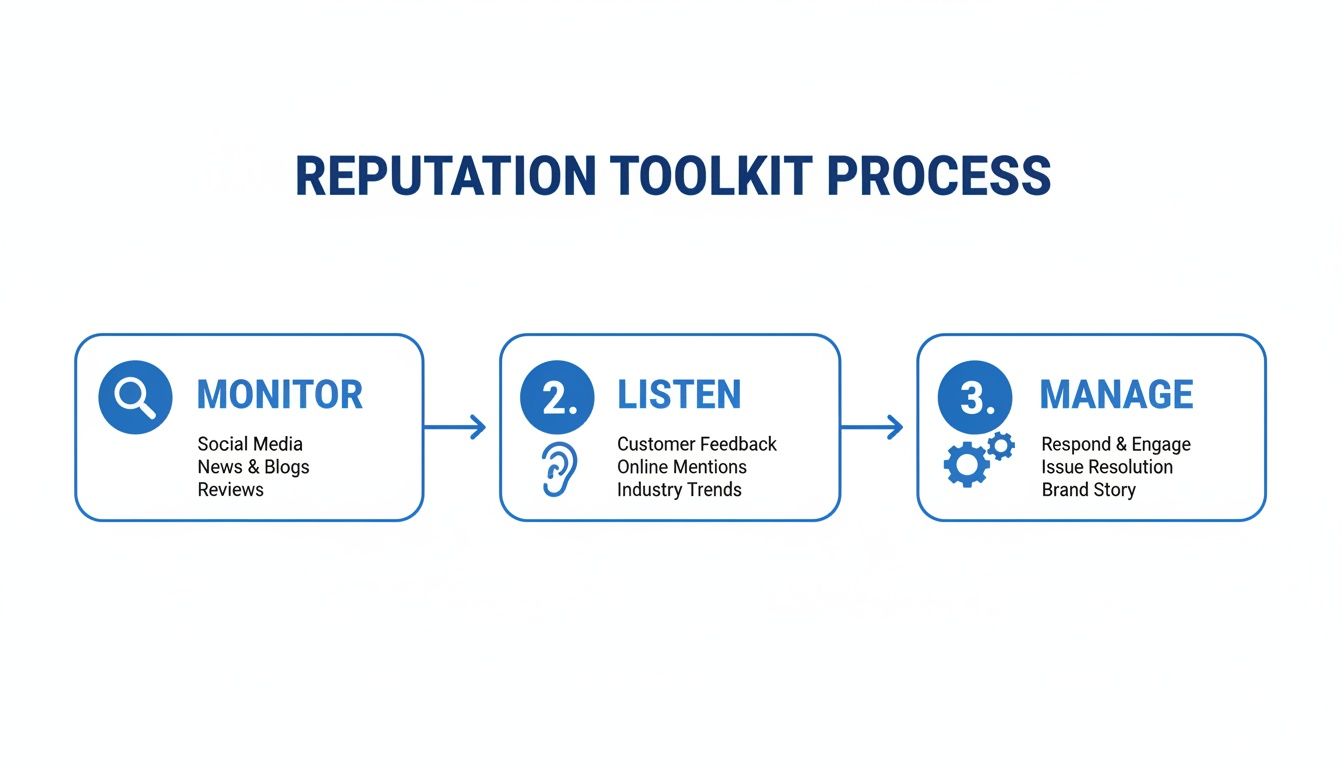
As you can see, effective management starts long before a crisis ever brews, with constant monitoring and listening to understand where public sentiment stands on a normal day.
Assemble Your Crisis Response Team
First things first: you need to know who's in charge. Designate a core crisis response team that’s small enough to be nimble but has representatives from all the key corners of your business. Clarity is everything—everyone needs to know their exact role before the pressure is on.
Your team should include:
- The Team Lead: Often from your communications or PR team, this person runs the show, making sure every action aligns with the plan.
- The Primary Spokesperson: This is the public face of the company during the storm, usually a CEO or another senior executive.
- Legal Counsel: To review every public statement and keep an eye on potential liabilities.
- Department Heads: Make sure leaders from departments relevant to a potential crisis—like product, customer support, or HR—have a seat at the table.
Define a crystal-clear chain of command and decide who has the final sign-off on any messages going out the door. This one step can prevent the deadly delays caused by internal debates when every single second counts.
Create Pre-Approved Messaging Templates
You can’t write a script for a crisis you haven't seen yet, but you can definitely anticipate the likely scenarios. Start developing pre-approved messaging templates for common situations like a product recall, a data breach, or a service outage. These aren't meant to be copied and pasted blindly; think of them as a solid foundation.
A crisis communication plan is your organizational muscle memory. By practicing the motions and preparing the messages in advance, your team can act decisively and authentically when it matters most, rather than freezing under pressure.
These "holding statements" are lifesavers. They let you communicate immediately, even before you have all the facts. A simple message acknowledging the situation and promising more information can buy you invaluable time and show the world you're in control. For really complex situations, you might need specialized help. Our guide on working with AI reputation management consultants can offer more insight into navigating those tricky waters.
Establish Clear Communication Protocols
Your plan needs to spell out exactly how you'll talk to every single stakeholder group. Each audience has different needs and requires a slightly different touch.
Example Scenario: A Product Recall
Imagine your company finds a safety defect in a popular product. A disaster, right? Here’s how a solid plan turns chaos into a controlled response:
- Internal First: The very first message is an internal memo to all employees. It explains what’s happening, what the company is doing, and provides approved talking points. This gets your entire team on the same page and stops rumors in their tracks.
- Customer Communication: At the same time, a direct email goes out to every affected customer. The message is empathetic, transparent about the risk, and gives clear instructions on how to return the product for a refund or replacement.
- Public Statement: A press release is issued and posted on your website and social media. Your spokesperson delivers a public statement expressing genuine regret and hammering home the company's commitment to customer safety.
- Media Relations: The communications team gets proactive. They engage with the media, providing regular updates to make sure the story stays accurate and focused on the solution, not just the problem.
By following a pre-written playbook, the company navigates the crisis with confidence. It not only protects its customers but also its long-term corporate reputation. This structured approach can turn a potential catastrophe into a masterclass in accountability and care.
Measuring the ROI of Your Reputation Efforts
How do you prove that a strong corporate reputation isn't just a "nice-to-have" but a core driver of your business? You have to translate your work into the language everyone in the C-suite speaks: Return on Investment (ROI).
Measuring the ROI of your reputation efforts is what turns it from a fuzzy concept into a tangible asset with a direct line to the bottom line. This isn't about guesswork. It’s about connecting specific reputation management activities to real business results, using both hard numbers and qualitative stories to make your case.
When you can draw a clean line from improved brand sentiment to a jump in sales, you've won. That’s how you get the budget and buy-in you need to build a program that lasts.
Key Quantitative Metrics to Track
Quantitative metrics are the hard numbers. They're the backbone of any ROI report, giving you an objective snapshot of your reputation's health that you can track over time to show clear progress.
Start with these fundamentals:
- Sentiment Score: This is your most direct pulse check on public perception. Tools that analyze online mentions calculate this for you, and watching it climb from negative or neutral toward positive is your primary indicator of success.
- Net Promoter Score (NPS): A classic measure of customer loyalty, NPS directly answers, "How likely are you to recommend us?" A rising NPS almost always correlates with better customer retention and powerful word-of-mouth marketing.
- Star Ratings and Review Volume: Monitoring your average star rating on Google, Trustpilot, and key industry sites gives you an undeniable gauge of customer satisfaction. Just as important is the volume of positive reviews you're getting.
- Website Traffic and Conversion Rates: A great reputation naturally sparks curiosity. Look for spikes in website traffic and higher conversion rates that line up with positive press, a crisis handled well, or a surge in glowing reviews.
Linking Reputation to Financial Performance
The ultimate goal is to tie these reputation metrics directly to financial outcomes. It’s no surprise that 84% of executives rank brand and reputation risk as their top external concern. The rewards are just as significant; one study shows a positive reputation can boost a company's valuation by up to 25% because investors weigh public perception so heavily.
This financial link is the entire point of corporate reputation management. If you want to dive deeper, you can explore how online reputation management statistics show this clear financial impact.
Proving ROI is about connecting the dots. It’s showing that a 10% improvement in your brand’s sentiment score directly contributed to a 5% lift in sales or a reduction in customer churn.
That connection isn't always a perfectly straight line, but by tracking your metrics consistently, you can build an undeniable case.
For example, you can show how a campaign that boosted your NPS also lowered your customer acquisition costs, because your happiest customers became a free source of high-quality referrals. The best way to do this is by creating dashboards that put your reputation KPIs right alongside sales and marketing data. When you do that, the connection becomes impossible to ignore.
Your Corporate Reputation Questions Answered
We get it. When you're in the trenches, managing your corporate reputation brings up some very real, practical questions. How long does this stuff actually take? Isn't this just branding with a different name? We’ve heard them all.
Here are some straight answers to the most common questions leaders have when they start putting these strategies to work.
How Long Does It Take to Repair a Damaged Corporate Reputation?
There’s no magic wand here. The timeline depends entirely on the damage. If you're dealing with a few nasty reviews, a few months of focused effort on generating positive feedback can turn the tide.
But a major crisis—the kind that shatters trust—is a different beast altogether. Recovering from that can take years of consistent, transparent action. It’s about proving, not just promising, that you’ve changed.
A reputation is built in drops and lost in buckets. The repair process is about refilling that bucket one drop at a time through consistent, positive actions that speak louder than any press release.
Think of it like rebuilding a personal relationship. A single apology is just the first step. It’s the long-term pattern of better behavior that truly rebuilds trust and restores your standing.
What Is the Difference Between Brand Management and Reputation Management?
This is a critical distinction that trips a lot of people up.
Brand management is what you say about yourself. It's your logo, your ad campaigns, and your carefully crafted messaging. It’s the story you proactively push out into the world—an inside-out activity.
Corporate reputation management, on the other hand, is what everyone else says about you. It's the sum of all their reviews, news articles, social media posts, and word-of-mouth chatter. It's the perception you earn through your actions—an outside-in reality. The ultimate goal is to get that earned reputation to align with your intended brand.
Can a Small Business Really Afford Reputation Management?
Absolutely. In fact, you can't afford not to. The core principles scale to fit any budget, and you don’t need a pricey enterprise suite to make a real impact.
You can start making a difference with a few simple, low-cost moves:
- Monitor: Set up free Google Alerts to track mentions of your business name. It’s a basic first step that costs nothing.
- Engage: Don't try to be everywhere at once. Focus on generating positive reviews on one or two key platforms that your customers actually use, like Google or a niche industry site.
- Communicate: Maintain a professional and responsive presence on your primary social media channel. Just being present and answering questions goes a long way.
Remember, the cost of a bad reputation—lost customers, trouble hiring, and a constant uphill battle for trust—is almost always higher than the cost of managing it proactively, no matter how tight your budget is.
Ready to stop guessing what AI is saying about your brand? TrackMyBiz gives you the visibility you need to protect your reputation in the new age of search. Start your free scan today.
