In modern marketing, staying ahead means understanding exactly what your competition is doing, where they're succeeding, and how they're failing. Relying on manual checks of a rival's website or social media feed is no longer enough. The speed and complexity of digital channels demand a more sophisticated approach. This is where dedicated competitor analysis tools for marketing become essential, transforming guesswork into a strategic, data-driven advantage. These platforms automate the process of tracking competitor SEO, content performance, ad spend, and even how they appear in AI-powered search results.
This guide moves beyond generic feature lists to provide a comprehensive breakdown of the best platforms available. We'll analyze each tool's specific strengths, ideal use cases, and potential limitations. Whether you're a local business protecting your online reputation, a multi-location retailer managing brand consistency, or an agency delivering cutting-edge insights, you will find a solution tailored to your needs. We'll explore everything from comprehensive suites like Semrush and Ahrefs to specialized platforms like TrackMyBiz, which monitors how your brand and competitors are represented by LLMs like ChatGPT and Google's SGE.
Each entry in this listicle is designed for quick evaluation and includes:
- A clear summary of its core function and best-fit user.
- Detailed analysis of standout features and practical applications.
- Honest pros and cons to set realistic expectations.
- Current pricing information and direct links to explore further.
This resource is your roadmap to selecting the right competitor analysis tools for your marketing strategy, helping you uncover opportunities and mitigate threats with precision. Let's find the perfect fit for your business.
1. TrackMyBiz
TrackMyBiz emerges as a pioneering force in the new frontier of competitor analysis tools for marketing: AI-powered chat. Positioned as a “Search Console for AI,” it provides an indispensable monitoring layer for how brands are represented in generative AI responses from models like ChatGPT, Gemini, and Claude. This platform moves beyond traditional SEO metrics, focusing on the critical, real-time conversations that can either build or erode brand reputation and revenue.
For marketing teams, its core function is turning the black box of Large Language Models (LLMs) into a transparent and actionable channel. Instead of manually spot-checking prompts, the platform automates hundreds of queries, aggregates the results for trend analysis, and distills the data into an actionable BrandRank and AI Visibility Index. This allows you to see precisely where you stand against competitors when users ask for recommendations.
Why It Stands Out
The platform’s Safety Engine is its most compelling feature, offering a crucial safeguard against AI "hallucinations." It cross-references LLM outputs with your website's live data, triggering instant alerts for inaccuracies like incorrect business hours, outdated pricing, or false "permanently closed" declarations. This proactive defense is vital for local businesses and retailers where such misinformation directly impacts foot traffic and sales.
Another significant advantage is its source transparency. TrackMyBiz doesn't just show you what an LLM said; it reveals the underlying sources it cited. This diagnostic capability empowers PR, content, and local SEO teams to trace misinformation back to its root and fix the problematic web pages or third-party citations, directly influencing future AI responses. This is particularly valuable for agencies and brand managers who need to justify their strategies with clear data. If you are interested in this topic, you can find more information about how this applies to different industries. For example, you can explore AI brand tracking strategies for SaaS companies.
Key Features & Benefits
- Multi-Model Monitoring: Simultaneously track your brand presence across ChatGPT, Gemini, Perplexity, and Claude to get a holistic view of your AI visibility.
- Competitor BrandRank: Quantify your performance with an AI Visibility Index, benchmarking your recommendation frequency against up to 50 competitors (depending on the plan).
- Real-Time Hallucination Alerts: The Safety Engine acts as a 24/7 watchdog, protecting your brand from costly AI-generated errors that traditional analytics would miss.
- Transparent Source Attribution: Pinpoint the exact web pages and data sources LLMs use to form their answers, providing a clear roadmap for optimization.
Practical Use Cases & Implementation
Setup is refreshingly straightforward, taking less than two minutes to get your first scans running.
- For Local Businesses: A restaurant owner can use the Safety Engine to prevent a false "closed" claim from decimating dinner service.
- For PR Teams: A communications manager can track brand sentiment in AI and instantly identify when outdated press releases are being cited.
- For Agencies: An agency can offer a new LLM optimization service, using TrackMyBiz to show clients tangible proof of their improved AI visibility and lead generation.
Pricing & Access
TrackMyBiz offers a highly accessible entry point, making it suitable for a wide range of budgets.
- Basic: $4.99/month (50 prompts, 3 competitors, weekly scans)
- Advanced: $9.99/month (100 prompts, 10 competitors, daily scans)
- Enterprise: $89/month (1,000 prompts, 50 competitors, custom frequency)
A free, no-credit-card-required scan and a 30-day money-back guarantee significantly lower the barrier to entry for testing its capabilities.
| Feature Comparison | Pros | Cons |
|---|---|---|
| Unique Selling Point | Real-time "Safety Engine" flags and alerts on costly AI hallucinations. | Diagnosis requires internal or agency effort to fix the source content. |
| Competitive Edge | Aggregated data from multiple LLMs provides stable, actionable insights. | Prompt and competitor quotas are restrictive on lower-tier plans. |
| Ease of Use | Extremely fast setup (<2 mins) and automated reporting save significant time. | Coverage is limited to the specific LLMs and prompts you choose to track. |
Website: https://trackmybusiness.ai
2. Semrush
Semrush is arguably the most comprehensive all-in-one digital marketing suite, making it a powerhouse for deep-dive competitive intelligence. While it offers a vast array of tools, its strength in competitor analysis for marketing lies in its ability to connect data points across organic search, PPC, content, and local SEO, all under a single dashboard. This integration provides a holistic view of a competitor’s entire digital strategy, from the keywords they rank for to the ads they run.
The platform excels at identifying gaps and opportunities. Using tools like the Keyword Gap and Backlink Gap, agencies and marketing teams can instantly see where competitors are outperforming them and devise a strategy to catch up. For multi-location retailers and local businesses, the Listing Management and Position Tracking tools are invaluable for monitoring local SERP and Google Business Profile (GBP) performance against nearby rivals.
Key Features & Use Cases
- Market Explorer: Ideal for PR and brand teams to understand market share, identify key players, and analyze audience demographics of competitors.
- Competitive Domain Overview: A go-to feature for a quick, high-level snapshot of a rival’s organic traffic, paid traffic, backlinks, and top keywords.
- Site Audit: Run this on a competitor's site (using their sitemap) to uncover technical SEO weaknesses you can exploit or learn from.
- Local SEO Add-ons: Essential for multi-location businesses to track map pack rankings and manage GBP consistency against local competitors.
Pricing & Implementation
- Pricing: Plans start at $129.95/month (Pro plan), scaling to $499.95/month (Business plan). Local and Market Research add-ons are available for an extra fee.
- Implementation: The interface can be overwhelming for new users due to the sheer number of tools. It's best to start by focusing on one area, like the SEO or Advertising toolkit, and expanding from there.
| Pros | Cons |
|---|---|
| Unmatched breadth of features in one platform. | Add-on costs for local SEO can increase the total price. |
| Powerful tools for SEO, PPC, and content gap analysis. | The interface has a steep learning curve for beginners. |
| Strong local SEO tools for multi-location businesses. | Potential ownership changes could impact future product focus. |
Website: https://www.semrush.com
3. Ahrefs
Ahrefs is a premier SEO platform renowned for its exceptional backlink and keyword intelligence, making it a cornerstone for any serious digital marketing competitor analysis. Its primary strength lies in its vast and frequently updated link database, which allows marketers to deconstruct a competitor's link-building strategy with unparalleled accuracy. The platform provides a clear, actionable view of a rival's digital footprint, from their most valuable backlinks to the content driving their traffic.
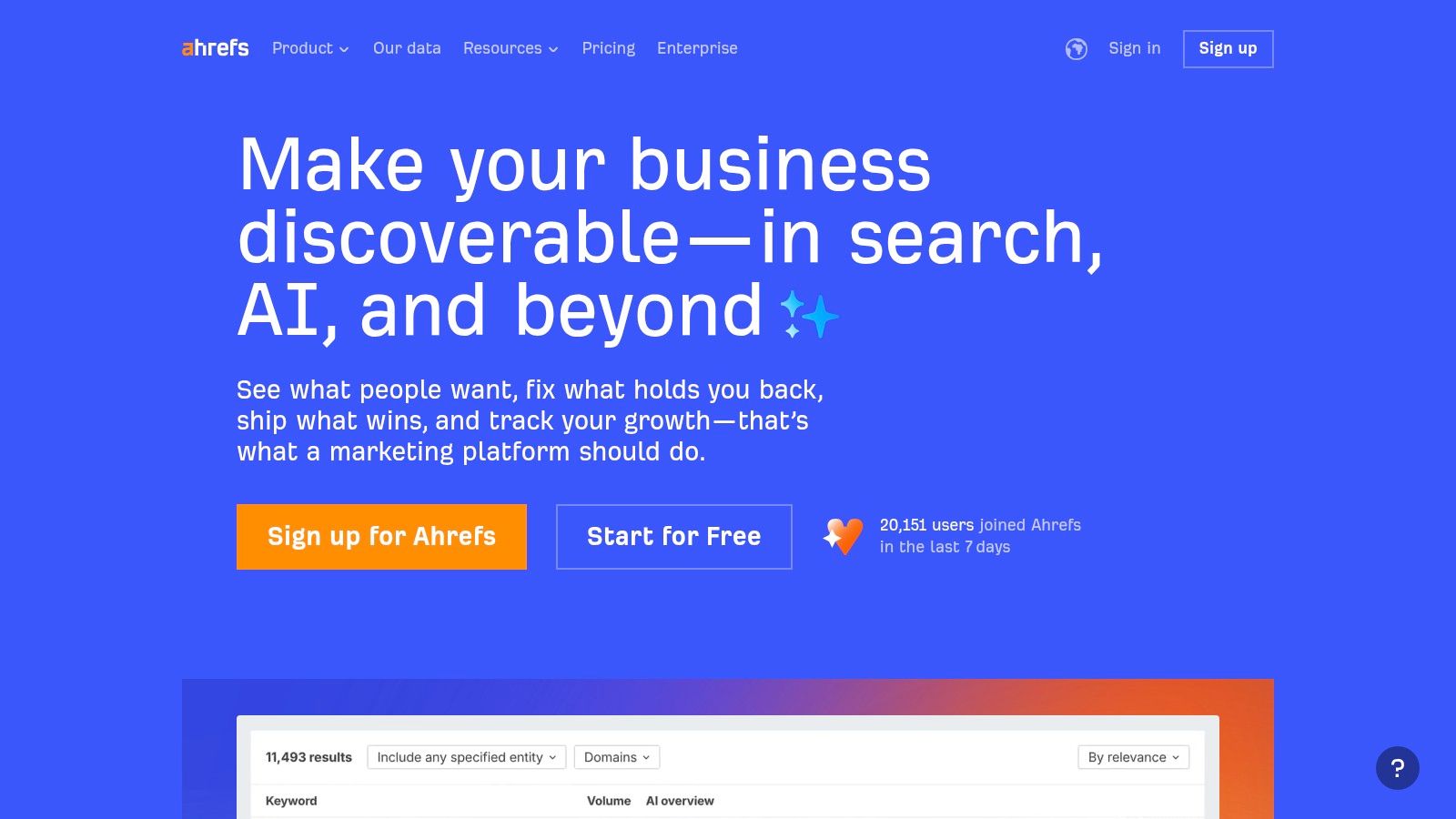
Unlike all-in-one suites, Ahrefs maintains a deep focus on SEO-centric competitive analysis. For agencies and in-house SEO teams, its Site Explorer is the command center for dissecting a competitor's domain. It reveals not just what they rank for, but why they rank, by exposing their top-linked pages and the authority of their referring domains. This focus on backlink quality and content performance helps teams build data-backed strategies to outperform rivals in organic search.
Key Features & Use Cases
- Site Explorer: The core tool for analyzing a competitor’s backlink profile, top organic keywords, and highest-traffic pages all in one place.
- Content Gap: Essential for content strategists to find valuable keywords that competitors are ranking for, but you are not.
- Top Pages Report: Ideal for identifying a rival’s most successful content pieces, which can inform your own content creation and promotion efforts.
- Rank Tracker: Use this to monitor your keyword performance daily against a list of key competitors, providing clear benchmarks and progress reports.
Pricing & Implementation
- Pricing: Plans begin at $99/month (Lite plan) and scale up to $999/month (Enterprise plan). Pricing is based on usage limits for reports and tracked keywords.
- Implementation: The interface is clean and more intuitive than some broader suites, making it easier for new users to get started. Focus first on the Site Explorer to understand a single competitor's profile before moving to comparative tools like Content Gap.
| Pros | Cons |
|---|---|
| Best-in-class backlink database with deep historical data. | Paid-only product with no comprehensive free tier available. |
| Intuitive reports that are easy for non-SEOs to understand. | Pricing can be a significant investment for small businesses. |
| Strong focus on actionable SEO and content insights. | Lacks the broader digital marketing features of all-in-one suites. |
Website: https://ahrefs.com
4. Similarweb
Similarweb serves as a high-level digital market intelligence platform, shifting the focus from granular SEO tactics to a broader view of a competitor's digital footprint. Its strength lies in its ability to estimate and analyze website traffic, audience demographics, and marketing channel effectiveness. For PR teams and C-suite executives, Similarweb provides clean, executive-friendly readouts that are perfect for market sizing, understanding audience overlap, and benchmarking your digital channel mix against the industry.
Unlike more SEO-centric tools, Similarweb excels at revealing the "how" and "where" of a competitor's traffic acquisition strategy. Marketing leaders can use its data to identify which channels (e.g., direct, referral, social, display ads) drive the most engagement for rivals, informing budget allocation and strategic pivots. This makes it one of the most effective competitor analysis tools for marketing decisions that go beyond pure search engine visibility and into overall market positioning.
Key Features & Use Cases
- Competitive Intelligence Package: Provides a comprehensive overview of a competitor’s traffic, engagement metrics, audience demographics, and traffic sources. Ideal for quarterly business reviews.
- Channel Mix Analysis: Perfect for marketing managers to understand how competitors balance their marketing efforts across paid, organic, social, and direct channels, revealing potential opportunities.
- Audience Insights: Helps brand teams identify audience overlap with competitors and discover new demographic segments to target.
- Category & Market Sizing: Essential for strategists and PR teams to understand a brand’s digital market share and identify macro-trends within a specific industry vertical.
Pricing & Implementation
- Pricing: Custom pricing is provided upon request for its main packages. There are free, limited tools available to get a feel for the data.
- Implementation: The interface is highly visual and intuitive, making it easy to generate reports and share insights with non-technical stakeholders. Onboarding is straightforward, focusing on setting up competitor sets and dashboards.
| Pros | Cons |
|---|---|
| Excellent for category and macro-trend analysis. | Data accuracy is based on estimation models, not direct analytics. |
| Easy-to-understand reports suitable for C-suite presentations. | Entry-level plans may have significant limitations on historical data. |
| Strong for analyzing a competitor's complete channel mix. | Premium features and deeper data access can be very expensive. |
Website: https://www.similarweb.com
5. SpyFu
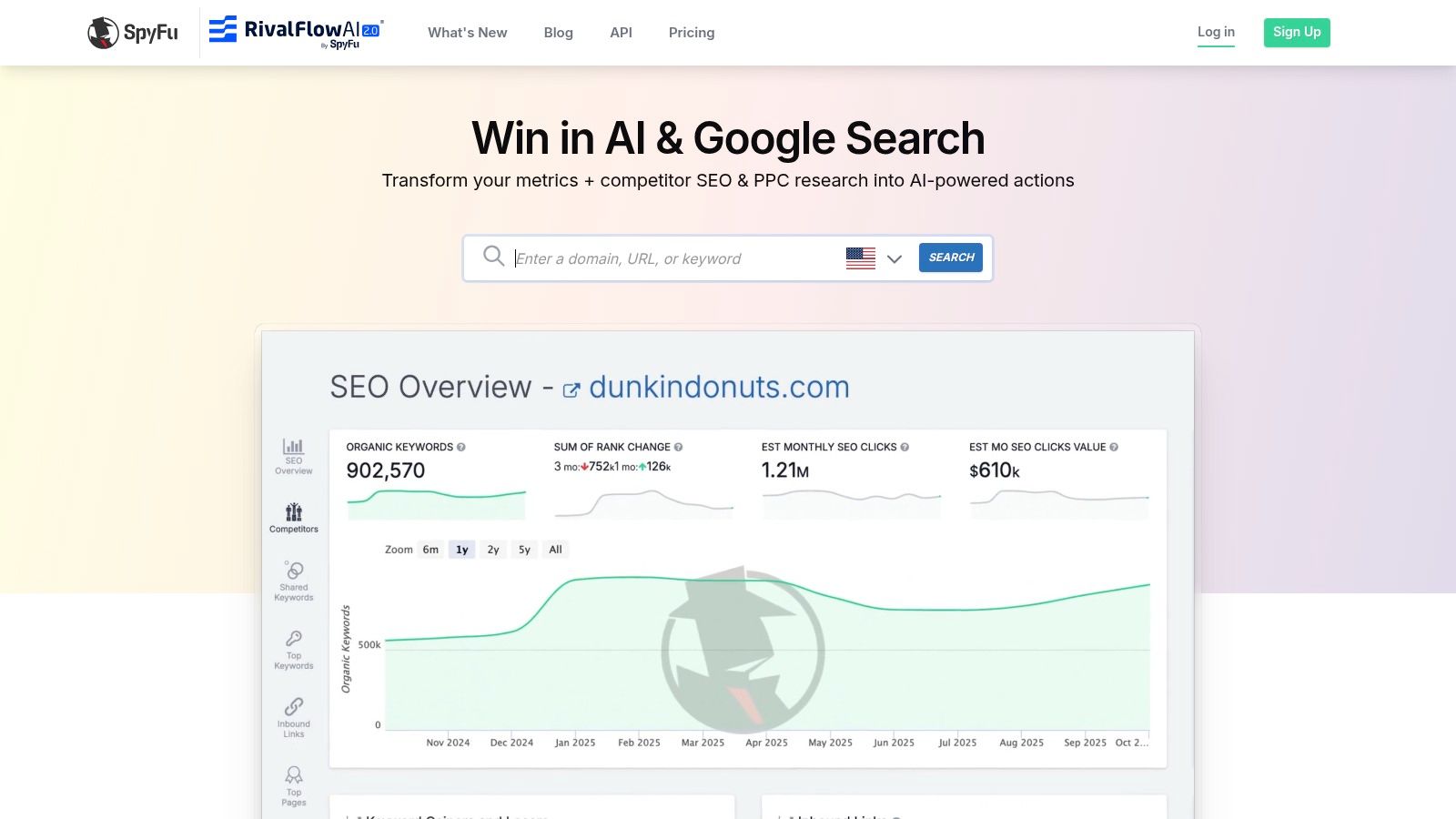
SpyFu is a highly focused and affordable competitor analysis tool that excels in the domains of PPC and SEO. Its core strength lies in its historical data, allowing marketers to "spy" on the keywords their competitors have been buying on Google Ads and ranking for organically for over a decade. This makes it an invaluable resource for small to medium-sized businesses and agencies aiming to quickly understand a competitor's paid and organic search strategies without the cost of an all-in-one suite.
The platform is designed for direct action. By inputting a competitor's domain, you instantly get a list of their most profitable keywords, ad copy variations, and estimated monthly budgets. This targeted approach to competitor analysis tools for marketing helps teams reverse-engineer successful campaigns and find keyword opportunities they may have missed, providing a clear path to gaining a competitive edge in search results.
Key Features & Use Cases
- PPC Ad History: Perfect for PPC managers to analyze historical ad copy, A/B tests, and keyword bidding patterns of rivals to inform their own campaign strategy.
- Kombat Domain Comparison: A standout feature for agencies to compare up to three domains side-by-side, quickly identifying exclusive keywords and content gaps.
- SEO Research: Provides a quick overview of a competitor's organic keyword rankings, backlink profile, and top-performing content.
- Rank Tracking: Useful for SMBs to monitor their keyword positions against a defined set of competitors on a weekly basis.
Pricing & Implementation
- Pricing: Plans start at $39/month (Basic), scaling to $299/month (Team). Annual plans offer significant savings, making it one of the most cost-effective tools.
- Implementation: The interface is straightforward and intuitive, making it easy for new users to get started. Data can be quickly exported into CSV files for deeper analysis or reporting.
| Pros | Cons |
|---|---|
| Very affordable with generous data exports on all plans. | Lacks the breadth of features found in larger enterprise suites. |
| Extensive historical data for both PPC and SEO keywords. | Geographic data and keyword volume can be less precise for non-US markets. |
| User-friendly interface is ideal for beginners and SMBs. | Backlink and technical SEO tools are not as robust as dedicated platforms. |
Website: https://www.spyfu.com
6. BuzzSumo
BuzzSumo is the quintessential tool for content marketers and PR professionals focused on deconstructing what makes content successful. Its core strength lies in its ability to quickly analyze vast amounts of content to reveal which topics, formats, and headlines are resonating with audiences in any given niche. This makes it an invaluable asset for competitor analysis in marketing, allowing teams to move beyond traffic metrics and understand the why behind a rival’s content performance.
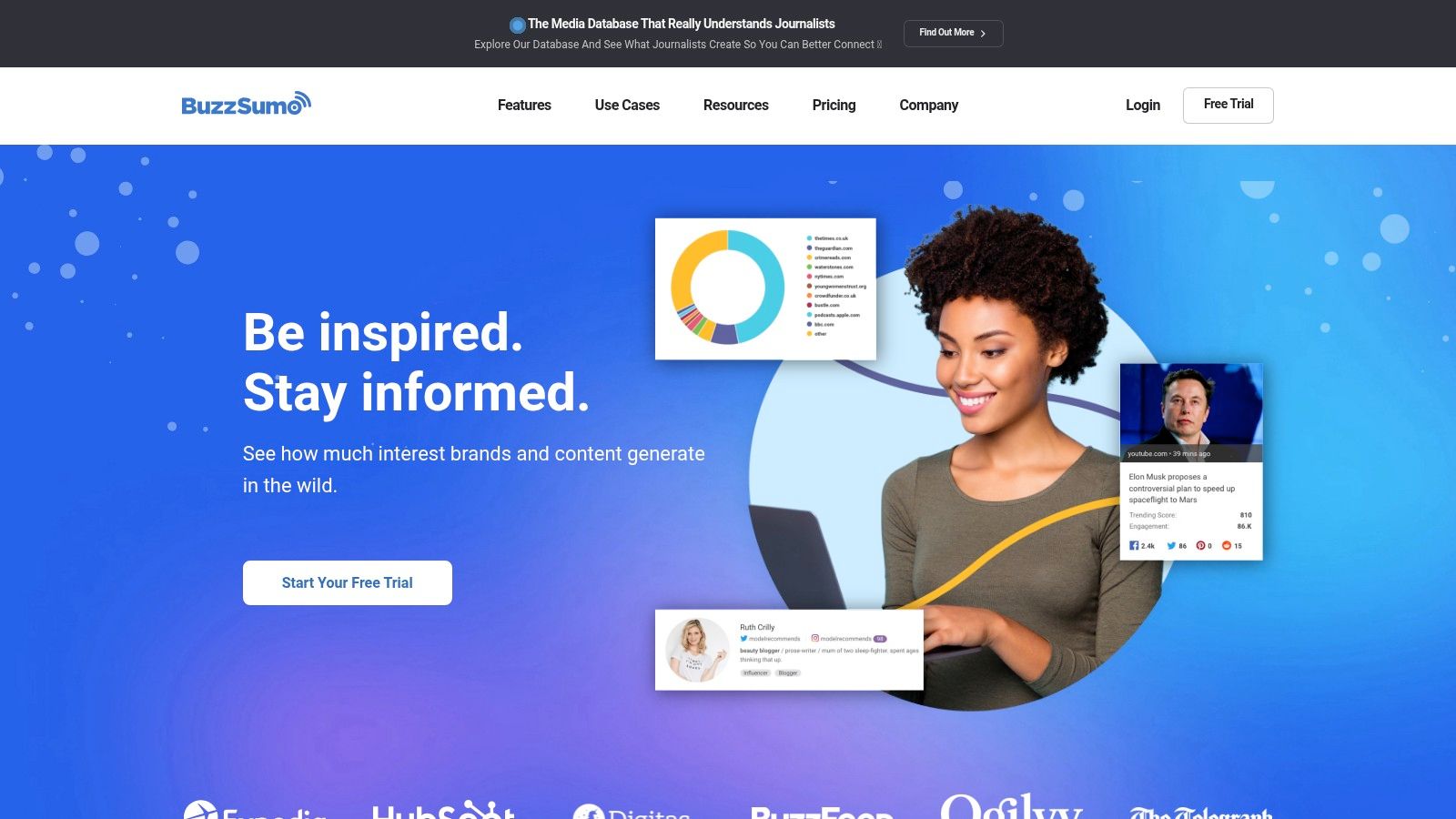
The platform enables you to see not just what your competitors are publishing, but who is sharing it and on which platforms. By setting up alerts, PR teams can monitor competitor brand mentions and journalist coverage in real-time, providing opportunities to react quickly. For content strategists, its Content Analyzer is perfect for identifying evergreen topics or trending stories that competitors are successfully leveraging, providing a clear roadmap for your own content calendar. This focus on content engagement is what sets it apart from more technically-focused SEO tools.
Key Features & Use Cases
- Content Analyzer: The go-to feature for content strategists to discover the most shared and linked-to content for any competitor or keyword.
- Trending Feeds: Ideal for PR and social media teams to spot viral topics in real-time before competitors can capitalize on them.
- Question Analyzer: Find real questions people are asking on forums like Quora and Reddit related to your industry to inform FAQ and bottom-of-funnel content.
- Alerts & Monitoring: Essential for brand reputation managers to track competitor mentions, new backlinks, or content published by key journalists. Learn more about how to leverage modern tools for brand monitoring.
Pricing & Implementation
- Pricing: Plans begin at $199/month (Content Creation plan), with the popular PR & Comms plan at $299/month. Custom enterprise plans are available.
- Implementation: The user interface is clean and highly intuitive. Most users can start getting actionable insights within minutes of signing up, especially by using the Chrome extension for on-the-fly analysis.
| Pros | Cons |
|---|---|
| Unparalleled for discovering high-performing content ideas. | Higher-tier plans are necessary for extensive monitoring. |
| Excellent for identifying key influencers and journalists. | Pricing can be steep for small businesses or solo marketers. |
| PR-focused features like media monitoring and alerts. | Less focused on technical SEO or PPC competitor analysis. |
Website: https://buzzsumo.com
7. Rival IQ
Rival IQ is a specialized competitive social media analytics platform designed for marketers who need to move beyond vanity metrics. Its core strength lies in its ability to benchmark performance against specific competitors across all major social networks, turning raw data into actionable insights. For agencies, PR teams, and multi-location brands, it provides a clear, comparative view of what’s working for rivals, from post timing and content formats to hashtag effectiveness.
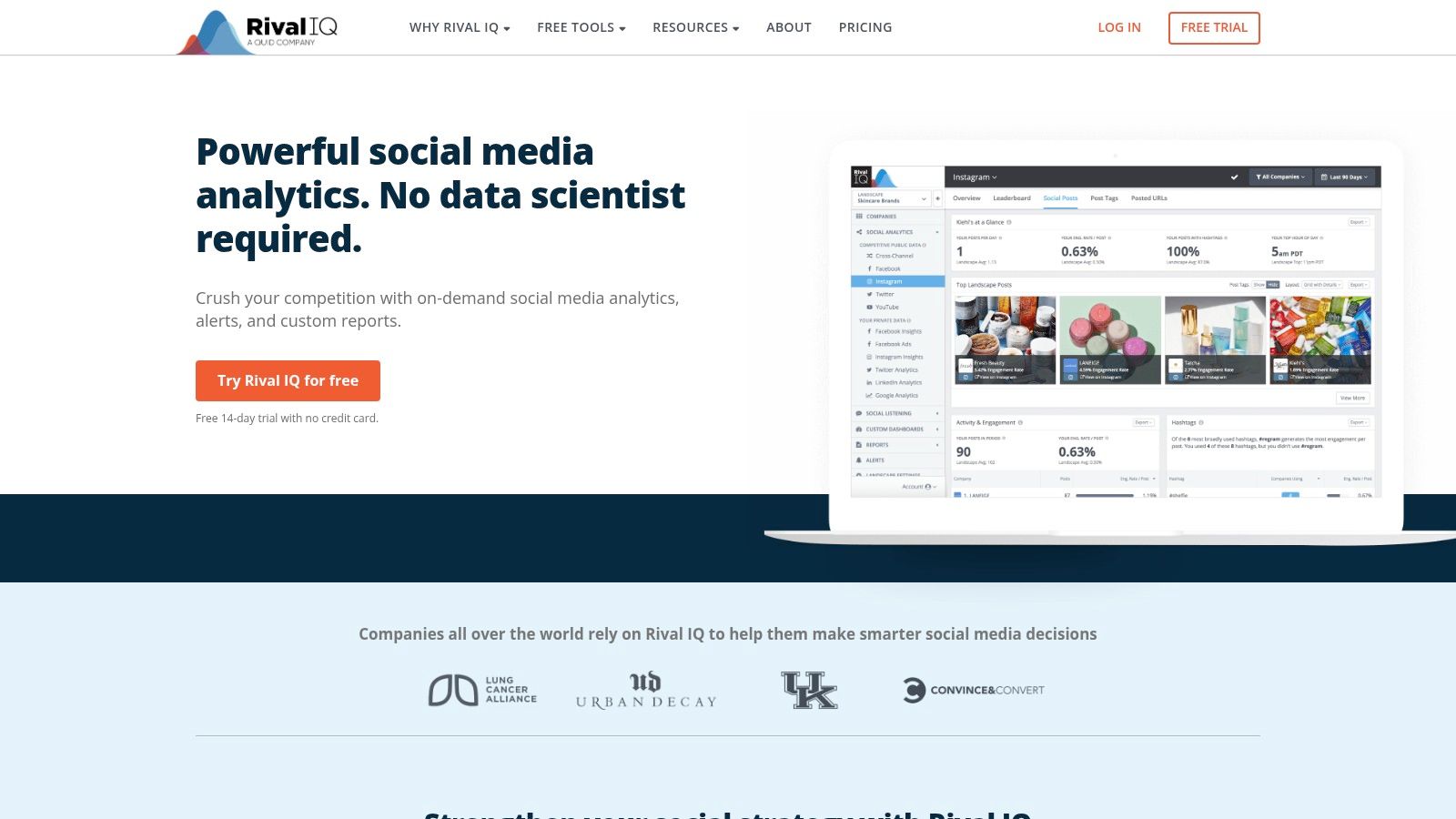
The platform excels at simplifying complex social data into presentation-ready reports. Instead of just tracking your own engagement, Rival IQ contextualizes it by showing how your top-performing posts stack up against the competition’s best content. This makes it an indispensable tool for marketing teams needing to justify strategy, prove ROI, and identify quick wins by replicating successful competitor tactics. Its alerting system also ensures you never miss a rival’s viral post or significant campaign launch.
Key Features & Use Cases
- Competitive Benchmarking: Ideal for social media managers to track follower growth, engagement rates, and posting frequency against a curated list of competitors.
- Social Post Analysis: A crucial feature for content strategists to identify which content formats (e.g., video, carousels, images) and topics drive the most engagement in their specific industry.
- Social Listening & Alerts: Perfect for PR and brand teams to monitor competitor mentions, brand sentiment, and emerging trends in real-time.
- Presentation-Ready Reports: A go-to for agencies needing to quickly generate professional, easy-to-understand reports for client meetings, complete with charts and leaderboards.
Pricing & Implementation
- Pricing: Plans start at $239/month (Drive plan), scaling to custom pricing for the Engage plan. Costs increase based on the number of companies and users tracked.
- Implementation: The platform is highly intuitive and user-friendly. Setup involves creating a "landscape" by adding your social profiles and those of your competitors, which can be done in minutes.
| Pros | Cons |
|---|---|
| Clear, presentation-ready reports and benchmarks. | Primarily focused on social media, lacking broader SEO/PPC data. |
| Generous trial and flexible monthly or annual billing options. | Costs can add up as you scale coverage and add more users. |
| Excellent for analyzing specific content and hashtag performance. | Add-ons for extra companies/users/API can increase costs. |
Website: https://www.rivaliq.com
8. Adbeat
Adbeat is a specialized competitive intelligence platform focused squarely on display, native, and programmatic advertising. It moves beyond search and social to reveal where competitors are spending their ad budgets, the specific creatives they’re running, and the publishers and networks that are delivering the most traffic. For paid media teams, this is an indispensable tool for deconstructing rival ad strategies at a granular level.
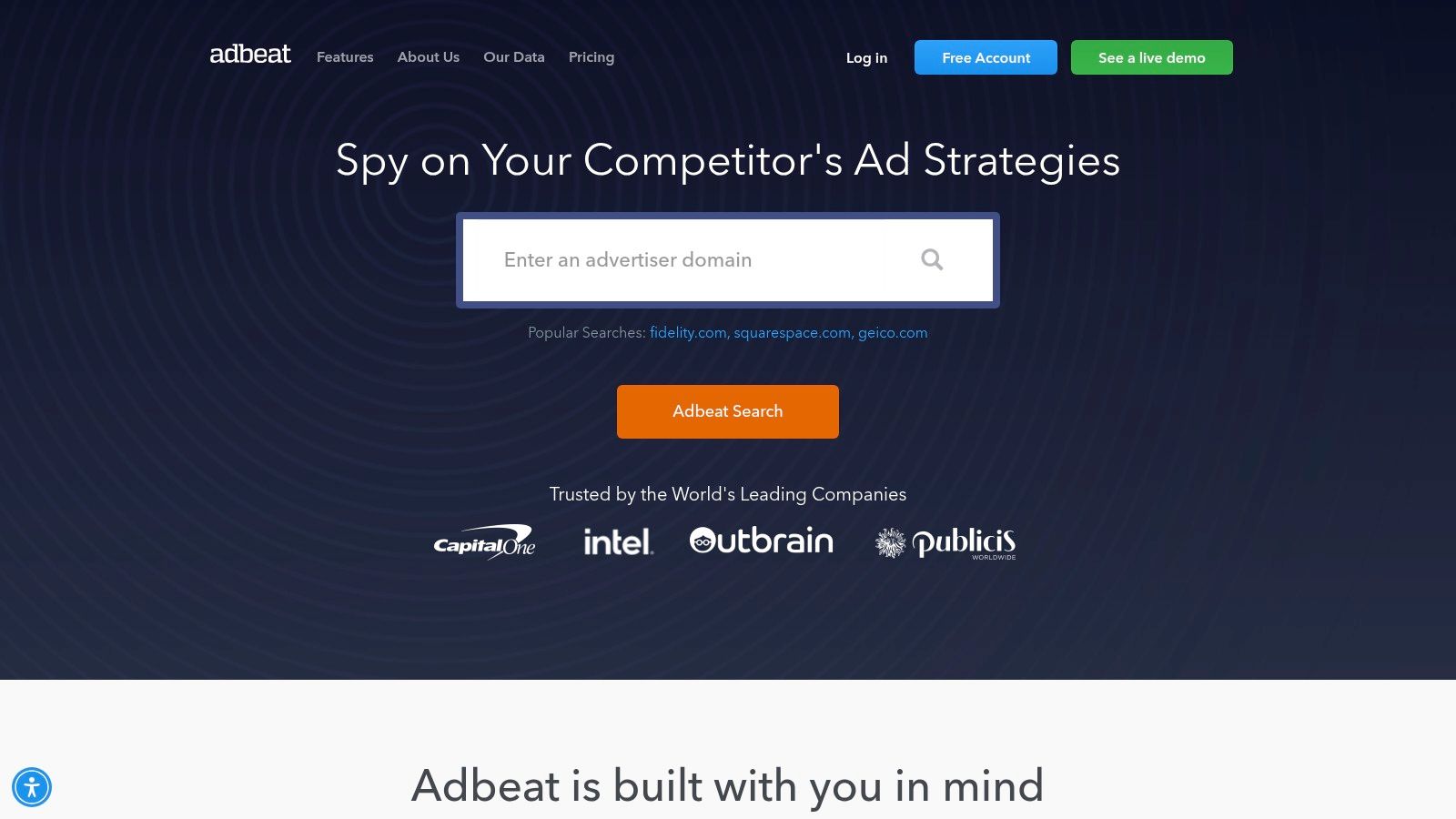
Unlike all-in-one suites, Adbeat’s strength is its depth in the display advertising ecosystem. It allows marketers to uncover successful campaigns and landing pages that would otherwise be invisible, providing direct inspiration for creative development and media planning. By analyzing a competitor’s publisher mix and ad network choices, teams can discover high-performing placements and avoid wasting budgets on ineffective channels.
Key Features & Use Cases
- Multi-Network Creative Discovery: Ideal for creative teams and media buyers to find a competitor’s top-performing display, video, and native ad creatives across dozens of networks.
- Publisher/Placement Visibility: Essential for media planners to identify the exact websites and apps where competitors are advertising, revealing new partnership and placement opportunities.
- Alerts and Creative Monitoring: Allows brand managers and campaign strategists to receive notifications when a competitor launches a new ad campaign or creative.
- API Access: Useful for agencies and large in-house teams looking to integrate programmatic ad intelligence directly into their own dashboards or data warehouses.
Pricing & Implementation
- Pricing: Adbeat offers a free Basic version with limited data. Paid plans like Standard and Advanced are available, but specific pricing requires contacting their sales team for a custom quote.
- Implementation: The platform is straightforward for those familiar with ad tech. The key is to start with your top 3-5 competitors to build a baseline understanding of their strategy before expanding your analysis to the wider market.
| Pros | Cons |
|---|---|
| Strong coverage across display, native, and programmatic ads. | No standard free trial for paid tiers; a sales call is required. |
| Free Basic tier is available for simple, quick lookups. | Full plan specifics and enterprise pricing are not transparent. |
| 30-day satisfaction guarantee offered for paid plans. | Less focused on search or social ads compared to other tools. |
Website: https://www.adbeat.com
9. BuiltWith
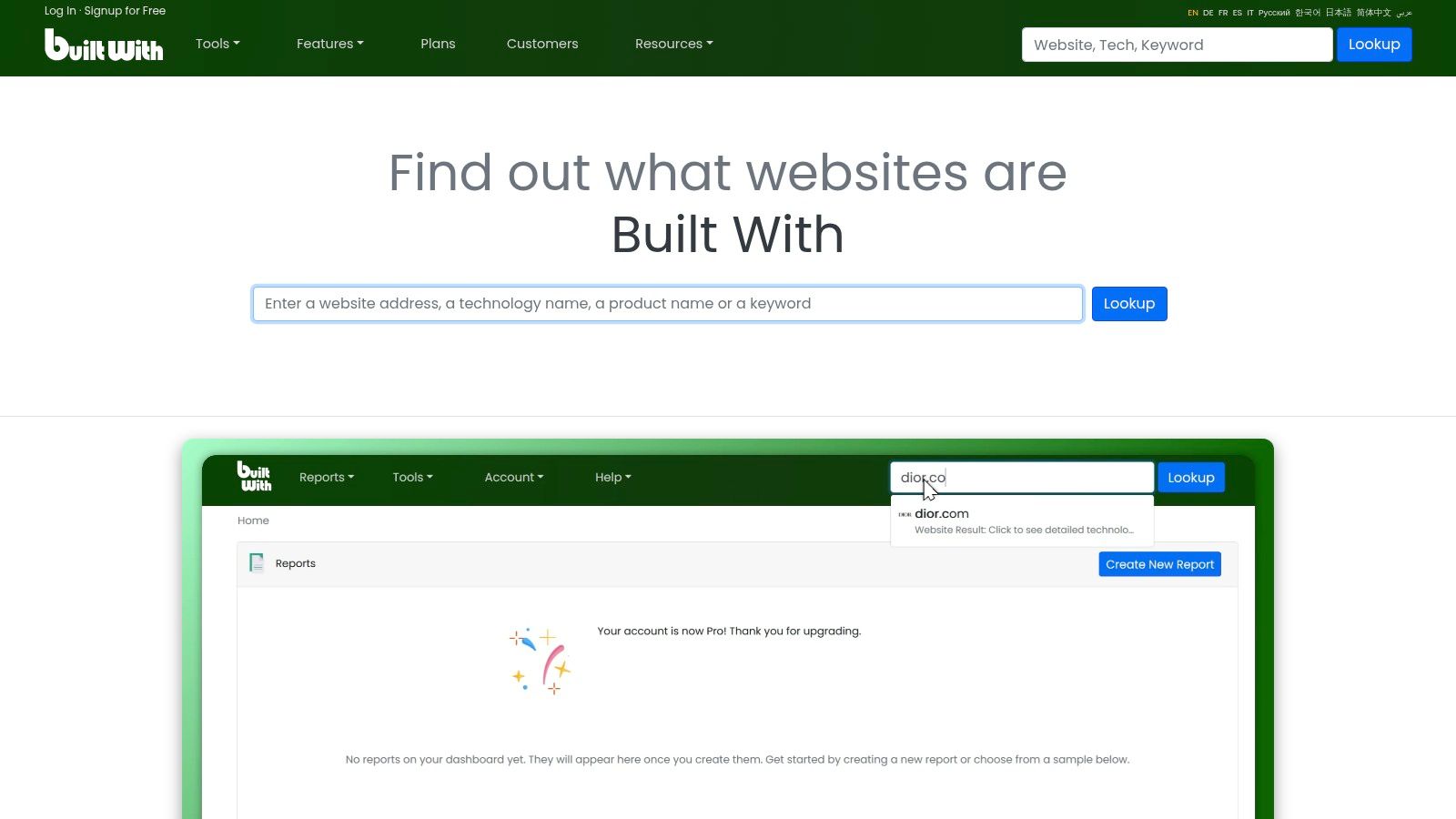
BuiltWith offers a unique angle on competitive analysis by focusing entirely on the technology stack that powers a website. Instead of analyzing keywords or backlinks, it tells you which analytics tools, widgets, frameworks, and content delivery networks your competitors are using. This intelligence is a goldmine for B2B tech companies, sales teams building prospect lists, and marketing agencies looking to understand a competitor’s operational sophistication and potential technology gaps.
For marketing teams, knowing a competitor's tech stack reveals their marketing automation platform (e.g., HubSpot vs. Marketo), their A/B testing software, or their analytics provider. This information helps you understand their marketing maturity and identify opportunities. For instance, if a key competitor isn't using a specific conversion optimization tool that you are, it could signify a strategic advantage for your team.
Key Features & Use Cases
- Technology Profiles: See a detailed list of all detected technologies on a competitor's website, complete with usage history to see when they added or removed a tool.
- Lead Generation & Market Research: Build lists of websites that use (or don't use) a specific technology. This is ideal for SaaS companies looking for integration partners or sales teams qualifying leads.
- Keyword-Based Tech Search: Find websites that rank for specific keywords and use a certain technology, creating highly targeted lists for outreach or ABM campaigns.
- API and Data Exports: Integrate BuiltWith's massive datasets directly into your own CRM or data pipelines for automated analysis and enrichment.
Pricing & Implementation
- Pricing: A limited free version is available for individual lookups. Paid plans start at $295/month (Basic) and go up to $995/month (Team), with custom enterprise options.
- Implementation: The web interface is straightforward for single-site lookups. Leveraging its full power requires familiarity with exporting data to CSV/Excel and, for advanced users, integrating with its API.
| Pros | Cons |
|---|---|
| Unparalleled insight into a competitor's technology stack. | Pricing is geared towards professional and enterprise-level users. |
| Excellent for B2B lead generation and market sizing. | Core value is highly specific and doesn't cover SEO/PPC metrics. |
| Flexible data exports and API access for custom workflows. | Free version is very limited, pushing users to paid tiers. |
Website: https://builtwith.com
10. Owler
Owler is a company intelligence platform that shifts the focus of competitive analysis from marketing metrics to corporate-level insights. It excels at tracking competitor news, funding announcements, acquisitions, and leadership changes. For PR, sales, and strategy teams, Owler acts as a real-time listening post, delivering curated alerts on the companies you choose to follow, making it one of the most direct competitor analysis tools marketing teams can use for market positioning.
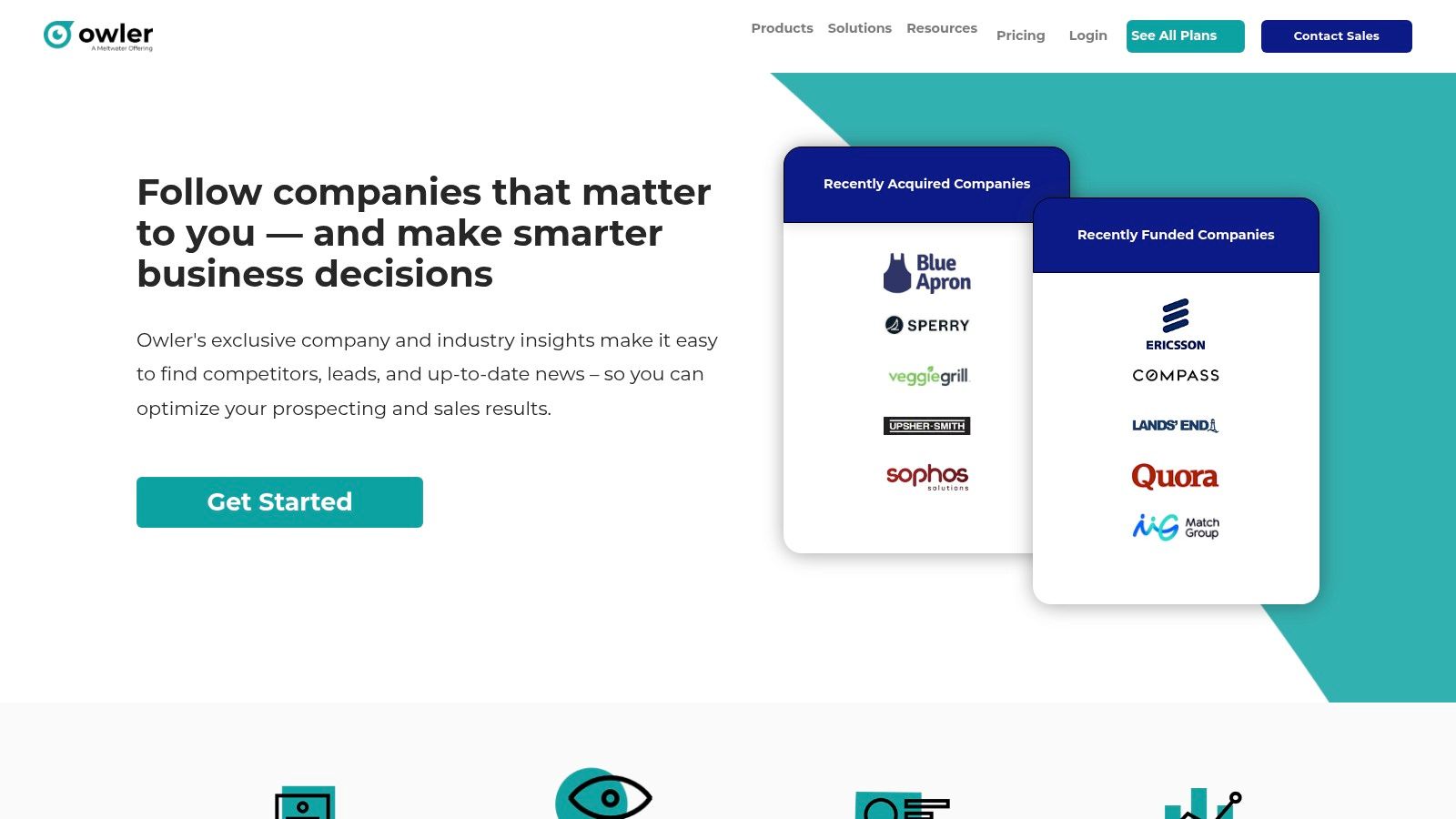
Unlike SEO-focused tools, Owler provides the "why" behind a competitor's strategic shifts. A sudden increase in a rival’s ad spend makes more sense when you see they just closed a new funding round. This makes it an invaluable resource for B2B marketers and business development representatives (BDRs) who need timely, relevant intelligence to inform their outreach and strategic planning, particularly for US-based companies.
Key Features & Use Cases
- Pro Watchlists & Real-Time Alerts: Essential for PR and executive teams to monitor competitor press releases, news mentions, and leadership changes as they happen.
- Competitor Graph: A great visual tool for marketing strategists to quickly map out the competitive landscape and identify second or third-tier rivals.
- Company & Contact Database: Useful for BDRs and sales teams to identify key decision-makers at target competitor accounts for sales prospecting.
- Browser Extension: Allows for quick access to company data while browsing competitor websites or LinkedIn profiles, streamlining the research workflow.
Pricing & Implementation
- Pricing: A free community tier is available. Paid plans, like Owler Pro, are required for advanced features, but pricing is not publicly listed and requires a demo or login. Enterprise API options are also available.
- Implementation: Setup is straightforward: create an account and start building your watchlist. The key to effective use is curating your alerts to filter out noise and focus on the most strategically important updates.
| Pros | Cons |
|---|---|
| Daily alerts are easy to digest for busy executives and BDRs. | Advanced features and transparent pricing are behind a login wall. |
| Strong coverage of companies relevant to US markets. | Lacks the deep SEO or PPC data found in other marketing tools. |
| Free community tier provides a good starting point. | Data is less focused on specific marketing campaign performance. |
Website: https://www.owler.com
11. Klue
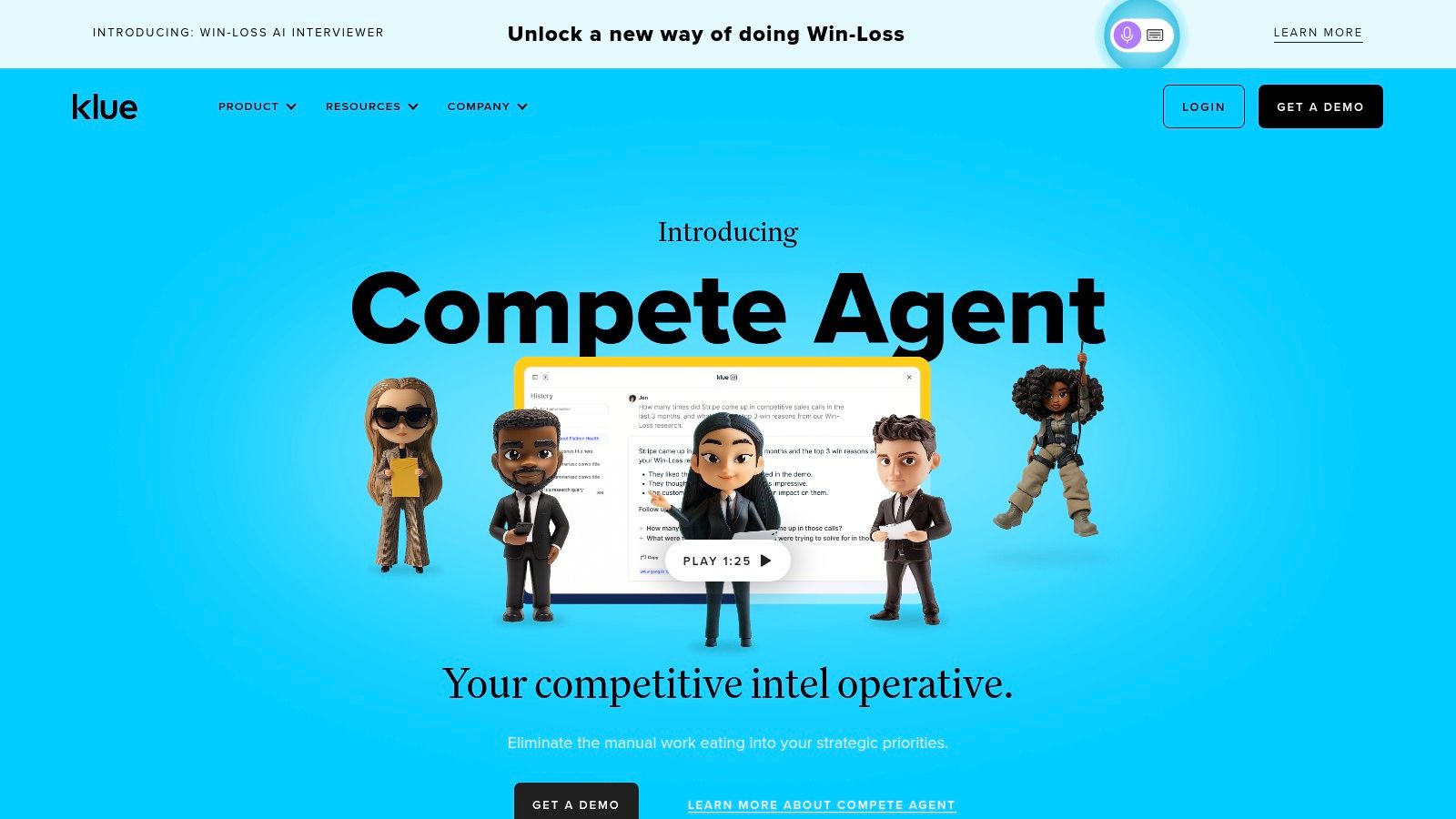
Klue shifts the focus from passive monitoring to active competitive enablement, making it a unique tool in the landscape of competitor analysis tools marketing. It’s designed less for marketers tracking SERPs and more for sales, product, and leadership teams who need actionable intelligence delivered at the moment of impact. The platform excels at collecting, curating, and distributing competitive intel across an organization, ensuring that teams have the right information to win deals and inform strategy.
Its core strength lies in translating raw data into dynamic, easy-to-digest formats like battlecards and AI-powered summaries. By integrating directly into workflows via Slack and CRM systems, Klue puts crucial competitor insights, such as win-loss analysis and positioning weaknesses, directly into the hands of sales reps when they need it most.
Key Features & Use Cases
- Dynamic Battlecards: Essential for sales teams to get on-demand talking points, objection handling tips, and direct comparisons when engaging with a prospect.
- CRM & Slack Integration: Delivers competitive intelligence directly into the daily workflows of sales and marketing teams, maximizing adoption and usage.
- Win-Loss Analysis Services: Ideal for product and strategy teams to understand precisely why deals are won or lost against specific competitors, driving product roadmap decisions. You can read more about how AI helps with these analyses to understand competitive strategies.
- 'Compete Agent' AI: Provides real-time, deal-specific competitive tips to sales reps, turning intelligence into immediate tactical advice.
Pricing & Implementation
- Pricing: Enterprise-focused, with custom pricing provided by quote only. Prospective users must contact the sales team for a demo and pricing details.
- Implementation: Setup is geared towards enterprise-level integration with existing systems like Salesforce and Slack. Success depends on establishing a clear process for intel curation and distribution within the organization.
| Pros | Cons |
|---|---|
| Excellent at activating intel for sales and product teams. | Pricing is not transparent and requires a sales consultation. |
| Mobile app allows for easy access by field sales reps. | Overkill for small businesses or marketing-only use cases. |
| Strong integrations with CRM and internal chat tools. | Less focus on traditional digital marketing metrics (SEO/PPC). |
Website: https://klue.com
12. Crayon
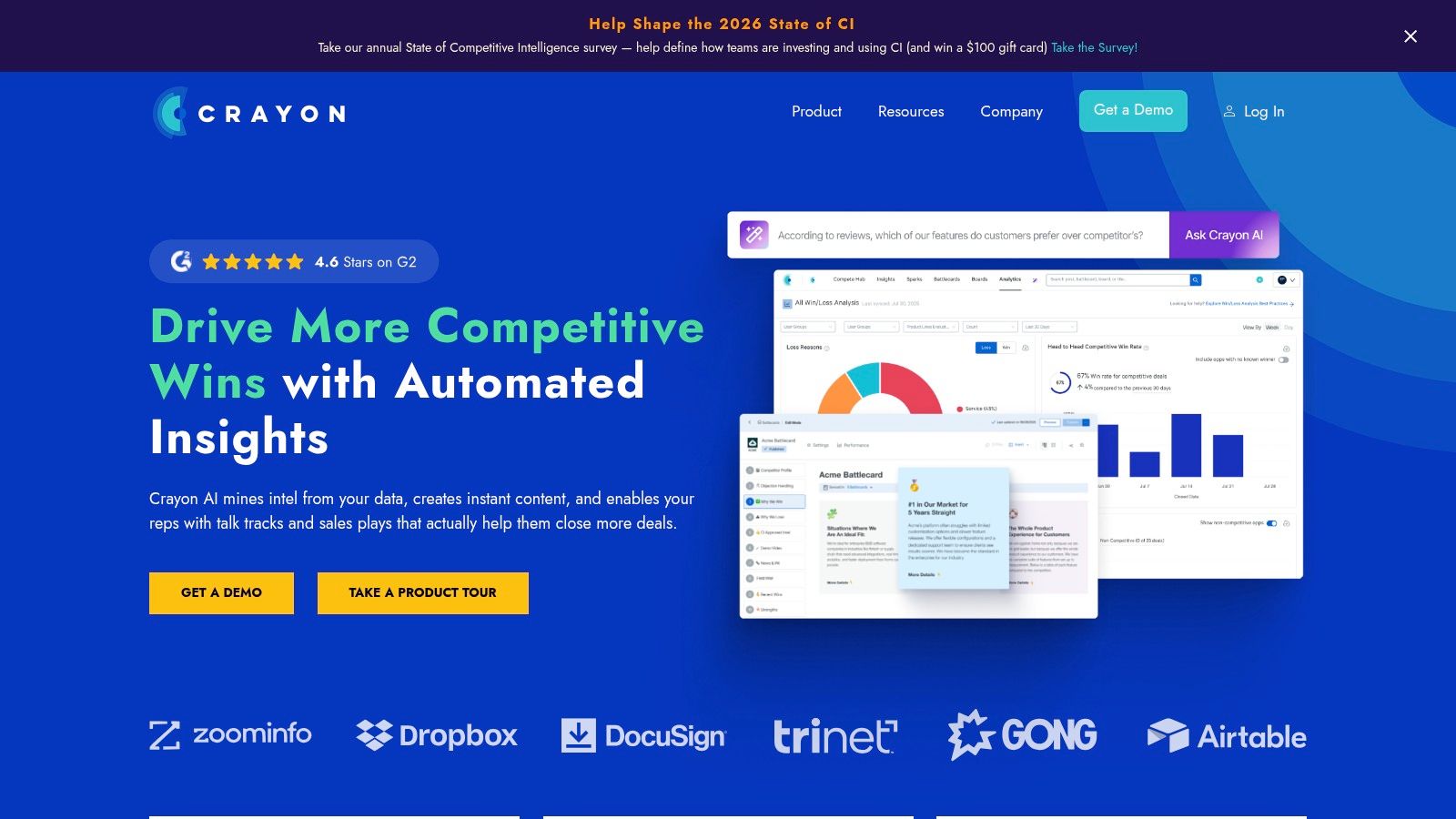
Crayon positions itself as a competitive intelligence (CI) activation platform, moving beyond simple data collection into sales enablement and measurable business impact. Its core strength lies in automating the monitoring of a competitor's entire digital footprint, from website changes and pricing updates to product reviews and news mentions. It then uses AI to score, filter, and summarize this intel, delivering curated insights directly to product marketing and sales teams.
This platform is uniquely focused on closing the loop between intelligence gathering and revenue generation. By integrating directly into workflows via Slack, Salesforce, and dynamic "battlecards," Crayon ensures that marketing and sales teams have the latest competitive information at their fingertips when they need it most. This makes it an excellent choice for organizations looking to operationalize their competitive intelligence program and prove its value through tangible metrics like win-rate lift.
Key Features & Use Cases
- Automated Competitor Monitoring: Ideal for product marketing managers (PMMs) to track every move a competitor makes online, with AI-powered summaries to cut through the noise.
- Dynamic Battlecards: A critical tool for sales enablement teams to equip reps with up-to-date talking points, objection handling, and competitor weaknesses, integrated directly into Salesforce.
- Program Impact Analytics: Perfect for CI leaders to measure the effectiveness of their program by correlating intel usage with sales performance metrics like win rates.
- Internal Communications: Use automated newsletters and Slack announcements to keep the entire organization aligned on the competitive landscape without manual effort.
Pricing & Implementation
- Pricing: Crayon uses a sales-led pricing model, so you must contact their team for a demo and a custom quote. It is positioned as an enterprise-grade solution.
- Implementation: The platform is designed for seamless integration with existing tools like Salesforce and Slack. Implementation focuses on setting up monitoring profiles and configuring distribution workflows to ensure intel reaches the right teams effectively.
| Pros | Cons |
|---|---|
| Clear workflow from intel collection to activation. | Pricing is not publicly listed and requires a sales call. |
| Directly connects CI activities to measurable revenue impact. | Primarily designed for enterprise-level needs and budgets. |
| Free educational "Academy" for CI professional development. | May be too feature-rich for small teams needing basic monitoring. |
Website: https://www.crayon.co
Top 12 Marketing Competitor Analysis Tools — Quick Comparison
| Product | Core features | Unique selling points ✨ | Target audience 👥 | Pricing / Value 💰 | Quality ★ |
|---|---|---|---|---|---|
| 🏆 TrackMyBiz | Multi‑model LLM scans, BrandRank, Safety Engine, sentiment & regional tracking | ✨ Real‑time hallucination alerts; transparent LLM source attribution; fast 2‑min setup | 👥 Local businesses, multi‑location retailers, PR & growth teams | 💰 Basic $4.99/mo; Advanced $9.99/mo; Enterprise $89+/mo; free scan | ★★★★★ |
| Semrush | Keyword & domain research, site audit, position tracking, market explorer | ✨ All‑in‑one SEO/SEM suite with add‑ons for local & market intel | 👥 SMBs → enterprises, marketers & agencies | 💰 Tiered subscriptions + paid add‑ons; moderate→high TCO | ★★★★★ |
| Ahrefs | Backlink & keyword intelligence, Site Explorer, rank tracker, audits | ✨ Deep link database & historical data depth | 👥 SEO teams, content & growth teams | 💰 Paid tiers only; higher cost for small teams | ★★★★★ |
| Similarweb | Traffic & audience insights, channel mix, market sizing, alerts | ✨ Executive‑friendly market & category readouts | 👥 PMMs, execs, market researchers | 💰 Enterprise‑priced; monthly higher than annual | ★★★★☆ |
| SpyFu | PPC ad history, keyword research, multi‑domain comparisons | ✨ Affordable ad & keyword history with generous exports | 👥 SMBs, local agencies, PPC teams | 💰 Low cost entry; good exports; mid pricing | ★★★★☆ |
| BuzzSumo | Content analyzer, trending feeds, alerts, media DB | ✨ PR & content discovery; journalist database & integrations | 👥 PR/comms, content teams, marketers | 💰 Tiered; higher tiers for heavy monitoring | ★★★★☆ |
| Rival IQ | Social benchmarking, post analysis, listening, reports | ✨ Presentation‑ready social benchmarks & scheduled exports | 👥 Agencies, multi‑location brands, social teams | 💰 Flexible monthly/annual plans; add‑ons raise cost | ★★★★☆ |
| Adbeat | Creative & placement intelligence for display/native/programmatic | ✨ Multi‑network creative discovery; API for programmatic use | 👥 Paid media teams, programmatic buyers | 💰 Free basic lookups; Pro/enterprise via sales | ★★★★☆ |
| BuiltWith | Tech stack profiles, history, exports, API | ✨ Massive site coverage for ABM lists & partner intel | 👥 Sales ops, partnerships, tech researchers | 💰 Data/API plans skew pro/enterprise | ★★★★☆ |
| Owler | Company watchlists, news & alerts, competitor graph | ✨ Easy executive alerts and company change monitoring | 👥 Execs, BDRs, sales & competitive teams | 💰 Free community tier; paid for advanced alerts | ★★★☆☆ |
| Klue | Competitive enablement, battlecards, CRM & Slack integration | ✨ Activation focus: battlecards, AI Compete Agent, mobile app | 👥 Enterprise sales, product & enablement teams | 💰 Enterprise pricing by quote (sales‑led) | ★★★★☆ |
| Crayon | Automated monitoring, AI summaries, dynamic battlecards, analytics | ✨ End‑to‑end CI -> activation with impact analytics | 👥 PMM, enablement, competitive intelligence teams | 💰 Sales‑led pricing; demo required | ★★★★☆ |
Turning Competitor Data Into Your Unfair Advantage
Navigating the landscape of competitor analysis tools for marketing can feel overwhelming. We've explored a wide array of platforms, from comprehensive SEO suites like Semrush and Ahrefs to specialized solutions for content like BuzzSumo, advertising intelligence like Adbeat, and the emerging field of LLM and AI recommendation monitoring with TrackMyBiz. The sheer volume of options underscores a critical truth: in today's digital marketplace, ignorance is not bliss; it's a liability.
The right tool doesn't just show you what your rivals are doing; it provides a blueprint for your own success. It reveals their strategic wins, their costly missteps, and the untapped opportunities they've overlooked. By dissecting their keyword strategies, backlink profiles, social media engagement, and even their technology stacks, you move from reactive tactics to proactive, data-informed strategy. You stop guessing and start executing with confidence.
Key Takeaways and Your Path Forward
As you consider the tools detailed in this guide, remember that the goal isn't just to collect data, but to synthesize it into actionable intelligence. The most successful marketing teams integrate these insights directly into their daily workflows, creating a continuous feedback loop that powers growth.
Here are the most important takeaways to guide your decision:
- Define Your Core Need First: Are you a local business worried about your Google Business Profile and AI-driven recommendations? TrackMyBiz is purpose-built for that. Are you an agency managing complex SEO campaigns? Ahrefs or Semrush is your starting point. Clearly defining your primary pain point prevents you from overinvesting in features you'll never use.
- No Single Tool Does Everything: Even the most robust platforms have blind spots. A powerful strategy often involves a "stack" of complementary tools. For instance, you might use Semrush for broad keyword and traffic analysis, BuzzSumo for content ideation, and TrackMyBiz to protect your local digital presence from AI-driven misinformation.
- Data Is Only as Good as Its Source: The accuracy and freshness of data are paramount. When evaluating tools, especially those that provide firmographic or contact information, it's wise to cross-reference their capabilities. To truly turn competitor data into your unfair advantage, it's crucial to utilize the best B2B data providers for comprehensive and accurate information that can enrich the insights you gain from your primary analysis tools.
- Implementation Is Key: A powerful tool sitting on the shelf is useless. Consider the learning curve, the integration capabilities with your existing CRM or project management software, and the internal resources required to manage it effectively. The best tool is the one your team will actually use consistently.
Choosing Your Competitive Edge
Your final choice should be a direct reflection of your business model and strategic priorities. For a local or multi-location business, the immediate threats are often hyper-local, stemming from incorrect business hours or negative AI summaries. Tools that monitor these specific, high-impact areas provide the most immediate ROI. For a digital marketing agency, scalability, robust reporting, and broad feature sets for SEO, PPC, and content are non-negotiable. For a PR or brand reputation manager, real-time alerts, social listening, and sentiment analysis are the most critical features.
Ultimately, investing in competitor analysis tools for marketing is an investment in foresight. It's about seeing the market shifts before they happen, understanding your customer's choices with greater clarity, and building a strategic moat around your business that is difficult for others to cross. Don't just watch your competitors; learn from them, anticipate their moves, and systematically outperform them. The advantage is there for the taking.
Ready to protect your most critical local marketing assets from AI-driven threats? TrackMyBiz is the only platform designed to monitor your business's presence in LLM recommendations and local search, alerting you to inaccuracies in your business hours, contact details, and brand reputation. Sign up for TrackMyBiz today and turn AI into your competitive advantage, not your liability.
