Competitive intelligence is all about understanding the world outside your own four walls. It’s the game plan you build by ethically gathering and analyzing information about your competitors, your industry, and the market as a whole.
Think of it less like spying and more like being a really, really good scout. You’re studying the other team's playbook not to steal their plays, but to anticipate their next move and build a stronger counter-strategy for your own team.
Turning Information Into a Competitive Advantage

Imagine you're coaching a championship team. You wouldn’t just drill your own players day in and day out; you’d be glued to the game tapes of your biggest rivals. That’s the heart of competitive intelligence (CI). It’s the disciplined practice of piecing together publicly available information to make smarter, faster business decisions.
This isn’t about shady back-alley deals. It’s about systematically mapping out the competitive landscape to spot opportunities before anyone else and sidestep risks that could sink you. Truly effective competitive intelligence strategies don't just collect data—they transform it into a real-world advantage that shapes everything from your next product launch to your marketing messages.
The Core Pillars of Competitive Intelligence
A solid competitive intelligence strategy is built on a few fundamental pillars. These aren't just academic exercises; they are practical frameworks for understanding what’s really happening in your market. A great place to start is with a competitive analysis SWOT, which helps you organize your findings around your competitors' strengths, weaknesses, and the market's opportunities and threats.
To help visualize how these pieces fit together, here’s a quick breakdown of what a strong CI program looks like in action.
| CI Pillar | What It Means | Business Impact |
|---|---|---|
| Competitor Profiling | Deeply understanding who your rivals are, what they sell, how they price it, and how they reach customers. | Informs your own pricing, product features, and go-to-market strategy. |
| Market Trend Analysis | Spotting shifts in customer needs, new technologies, or regulatory hurdles on the horizon. | Allows you to pivot or innovate before the market forces you to. |
| Customer Perception | Listening to what real customers say about your competitors on social media, review sites, and forums. | Uncovers competitor weaknesses you can exploit and customer pain points you can solve. |
| Strategic Planning | Using all this intelligence to guide big-picture decisions like entering a new market or repositioning your brand. | Ensures your long-term goals are grounded in reality, not just wishful thinking. |
These pillars work together to give you a complete, 360-degree view of the battlefield, so you're never caught off guard.
Competitive intelligence is not just about knowing what your competitors have done; it's about predicting what they will do next. It empowers you to move from a reactive stance to a proactive one, shaping the market instead of just responding to it.
Why CI Is More Important Than Ever
The game is moving faster, and the need for sharp, reliable intelligence has never been more intense. The proof is in the numbers. The global competitive intelligence industry hit an estimated $8.2 billion in 2023.
Even more telling, that figure is projected to more than double to $16.8 billion by 2030. This explosion is being fueled by businesses of all sizes scrambling to get—and stay—ahead.
This growth highlights a simple truth: any business can use competitive intelligence to its advantage. By methodically gathering and making sense of public data, you build a forward-looking strategy that turns what everyone can know into your unique asset. It's the difference between navigating with a map and sailing blind.
Comparing Proactive and Reactive Intelligence Approaches
Think of it like being the captain of a ship. The reactive approach is like dealing with a storm only after your sails are torn and the deck is swamped. You're bailing water, making frantic repairs, and just trying to stay afloat. It’s pure chaos.
The proactive approach, on the other hand, is like having an expert navigator who's been watching the weather patterns for weeks. You saw the storm coming, charted a smarter course, and are now sailing smoothly in clear waters while your competitors are getting battered.
One keeps you in the game. The other helps you win it. Both mindsets are part of competitive intelligence, but understanding the difference is what turns data into a real, sustainable advantage.
The Nature of Reactive Intelligence
Reactive intelligence is all about responding to things that have already happened. It's the default mode for most businesses, kicking in when a competitor makes a sudden move that forces your hand. It's triggered by immediate, obvious threats that you simply can't ignore.
You know you're in reactive mode when:
- A rival drops a surprise product that goes head-to-head with your flagship offering.
- A competitor slashes their prices, and your sales team is screaming for a response.
- Your competitor has a major service meltdown, creating a short-term window to poach their unhappy customers.
- A new, clever marketing campaign from a competitor starts stealing your audience's attention.
While you absolutely need to be able to react, a purely reactive stance means you're always playing defense. You're letting your competitors dictate the market's tempo, and you're perpetually one step behind. It's essential for damage control, but it almost never leads to breakthrough growth.
A business stuck in reactive mode is like a chess player who only thinks about their opponent's last move. You might not lose right away, but you'll never control the board and you'll certainly never achieve checkmate.
The Power of Proactive Intelligence
This is where the game changes. Proactive intelligence is about shaping the future instead of just cleaning up the messes of the present. It's a strategic mindset focused on seeing market shifts before they happen, predicting what competitors will do next, and grabbing opportunities before anyone else even knows they exist.
Instead of just reacting to a competitor's price cut, a proactive team digs deeper. They want to know why it happened. Are they struggling with excess inventory? Are they testing the waters for a new low-cost product line? Answering those questions gives you foresight, not just hindsight.
Comparing the Two Approaches
The best companies know how to do both, but they live and breathe proactivity. Your reactive capability is your safety net; your proactive engine is your rocket ship. Seeing them side-by-side makes it crystal clear where you should be investing your time and energy.
| Aspect | Reactive Intelligence | Proactive Intelligence |
|---|---|---|
| Trigger | A competitor's move (e.g., a new ad campaign) | Continuous analysis of market signals |
| Time Focus | Past and present | The future and what's coming next |
| Primary Goal | Minimize damage, counter threats | Find new opportunities, get a first-mover edge |
| Business Stance | Defensive, responsive | Offensive, predictive |
| Typical Outcome | Holding onto market share, short-term survival | Market leadership, sustainable growth |
Let’s make it real. A reactive company sees a competitor’s new feature and immediately assigns a team to build a copycat version.
A proactive company, however, has been monitoring customer feedback forums and patent filings for months. They predicted the move, understood the underlying customer need better, and have a far superior alternative ready to launch at the exact same time.
This jump from reaction to anticipation is the true hallmark of a mature competitive intelligence strategy. It’s not about what your competitor did yesterday. It's about knowing what they're likely to do six months from now—and having your winning response already in motion.
Uncovering Critical Data Sources and Signals
Effective competitive intelligence isn't about finding a single, secret document. It's about becoming a detective—knowing where to look for clues scattered across the open web and piecing them together to see the bigger picture.
Think of it as mapping your competitor's entire digital footprint. Every move they make leaves a trail, and your job is to follow it. This process turns a sea of raw data into a real strategic advantage, giving you a multi-layered view of the market so you never miss a critical shift.
Tapping into Search and Digital Advertising
One of the most revealing places to start is search. How your competitors show up on Google is a direct window into their strategic priorities. By digging into their SEO and paid ad campaigns, you can effectively reverse-engineer their entire go-to-market strategy.
Keep an eye out for these signals:
- New Keyword Targets: Are they suddenly chasing terms related to a new customer segment or product feature? That's often a dead giveaway that a strategic pivot is coming.
- Ad Copy Variations: A sudden change in messaging, like shifting from "affordable" to "premium" language, signals they're testing a new value proposition or moving upmarket.
- Landing Page Tests: Monitoring changes to their key landing pages shows you exactly what features, benefits, or pricing they're pushing to drive conversions right now.
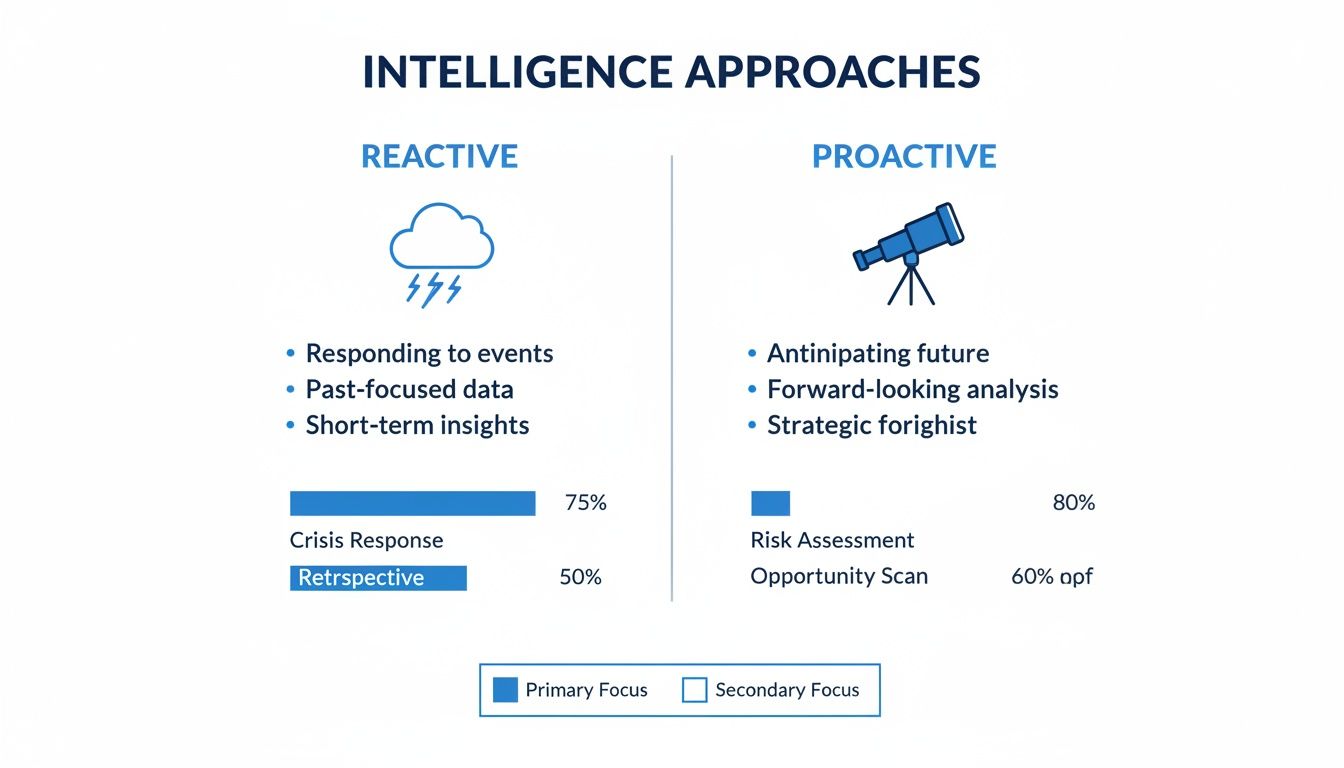
As the infographic shows, most businesses get stuck reacting to what's already happened. True market leadership comes from being proactive—interpreting these early signals to anticipate what’s next.
Listening to the Voice of the Customer
What your competitors say about themselves is one thing. What their customers are saying is often far more powerful. Social media, forums like Reddit, and review sites are unfiltered sources of truth about their real strengths and, more importantly, their weaknesses.
Look for these patterns in customer feedback:
- Recurring Complaints: If customers are consistently trashing a specific feature or their support team, you've just found a vulnerability to exploit in your own marketing.
- Feature Requests: What are people begging your competitor to build? That's a direct line into unmet market needs you can potentially fill first.
- Praise for Specific Features: Knowing what customers absolutely love about a rival's product helps you benchmark your own and identify the table stakes for your industry.
For many B2B companies, using a dedicated Competitor Price Monitoring Software is a game-changer. These tools automate the collection of vital commercial data on pricing, stock levels, and promotions—signals that are nearly impossible to track manually at scale.
To tie this all together, here’s a look at the most common data sources and how they translate into strategic value.
Competitive Data Sources and Their Strategic Value
| Data Source | Key Signals to Monitor | Strategic Application |
|---|---|---|
| Search Engines (SEO/PPC) | Keyword targets, ad copy, landing pages, organic rankings. | Reverse-engineer marketing priorities and messaging tests. |
| Social Media & Forums | Customer complaints, feature requests, sentiment trends, influencer mentions. | Identify product gaps, vulnerabilities, and unmet customer needs. |
| Review Sites (G2, Capterra) | Star ratings over time, common pros/cons, comparisons to rivals. | Benchmark product strengths and pinpoint competitive weaknesses. |
| LLM Outputs (ChatGPT, Gemini) | Brand mentions, product summaries, inclusion in "best of" lists. | Manage brand perception in AI-driven discovery channels. |
| Pricing & E-commerce | Price changes, discounts, promotions, stock levels. | Inform pricing strategy and anticipate promotional campaigns. |
Each source provides a different piece of the puzzle. Combining them gives you a durable, 360-degree view of the competitive landscape.
The New Frontier: AI and LLM Outputs
A rapidly emerging source of intelligence is the output from Large Language Models (LLMs) like ChatGPT, Gemini, and Claude. As more people use AI assistants for recommendations and research, how these models portray your brand versus your competitors has become a critical battleground.
Monitoring these AI conversations is now essential. An LLM might incorrectly describe your product, leave your brand out of a "best of" list, or even hallucinate negative information. Capturing these signals early lets you correct the record and turn a potential threat into an opportunity.
For SaaS companies especially, this new channel can't be ignored. You can learn more about navigating this terrain in our guide on AI brand tracking for SaaS companies. Understanding what AI is saying is the first step to influencing the conversation.
Building Your Competitive Intelligence Workflow

Having access to data is one thing. Turning it into a genuine competitive advantage is a whole different ballgame. The bridge between raw information and actionable insight is a solid, repeatable workflow. It's the engine that powers your entire intelligence operation.
Without a clear process, CI efforts collapse into chaos. Teams work in silos, insights get lost in the shuffle, and all that valuable data you’ve collected just gathers digital dust. A well-designed workflow ensures intelligence is consistently gathered, analyzed, and—most importantly—delivered to the people who need it, right when they need it.
This playbook lays out a proven, four-stage workflow to build a sustainable competitive intelligence function from the ground up.
Stage 1: Planning and Direction
Before you even think about collecting data, you have to know what you’re looking for and why. The planning stage is the foundation of any effective competitive intelligence strategy. It’s where you align your efforts with real business goals to avoid boiling the ocean.
Start by defining your Key Intelligence Questions (KIQs). These are the make-or-break questions your stakeholders need answers to.
- What are our top 3 competitors planning for their next product launch?
- Which customer segment is our main rival successfully capturing, and how are they doing it?
- Are there emerging market trends that could completely upend our business model?
Answering these questions gives your work scope and purpose. It ensures your team isn't just collecting data for data's sake but is actively hunting for information that supports high-stakes decisions. This directional clarity is what separates a CI program that creates noise from one that delivers real value.
Stage 2: Collection and Processing
With your KIQs as your guide, it’s time to start gathering intel. This stage involves setting up systems to monitor all the data sources we've identified—search engines, social media, review sites, and LLM outputs—and pulling in the relevant signals. The goal here is to create a reliable, steady flow of raw data.
Think of it like setting up a network of listening posts. You might use automated tools to scrape competitor websites for pricing changes, set up alerts for brand mentions on social media, or use a platform like TrackMyBiz to monitor how AI assistants are talking about your company.
The key to successful collection is automation and aggregation. Manually checking dozens of sources is a recipe for burnout. A scalable workflow relies on tools that automatically gather, filter, and centralize market and competitor signals.
This automated approach frees your team from mind-numbing manual work, allowing them to focus on the much higher-value task of analysis.
Stage 3: Analysis and Synthesis
Raw data is just a pile of facts. Analysis is where you connect the dots to find the story. This is the most critical—and often the most difficult—part of the CI workflow. It demands you move beyond what happened to understand why it happened and what it means for your business.
For example, your raw data might show a competitor just hired 10 new software engineers with AI expertise. A good analysis connects this fact with their recent patent filings in machine learning and a subtle shift in their website messaging.
The synthesized insight? They're almost certainly gearing up for a major AI-driven product launch in the next 6 to 9 months. This is how isolated data points become a coherent narrative that guides strategy.
Stage 4: Dissemination and Action
The final stage is all about making sure your hard-won insights don't die in a forgotten report. Intelligence is only valuable if it gets to the right people in a format they can actually use to make decisions.
Effective dissemination means tailoring the delivery to the audience.
- For Sales Teams: A monthly newsletter with updated competitor battlecards and key talking points, delivered right in Slack.
- For Product Teams: A quarterly deep-dive report on competitor product strategies and customer feature requests.
- For Leadership: A concise executive briefing on high-level market shifts with clear strategic recommendations, sent via email.
By customizing the format and delivery channel, you dramatically increase the odds that your intelligence will be acted upon. This step closes the loop, turning your CI workflow into a powerful decision-making engine that fuels growth and prevents nasty market surprises.
Using AI for Advanced Competitor Monitoring
Traditional competitive intelligence often feels like trying to assemble a puzzle in the dark. You’ve got all the pieces—website changes, social media posts, press releases—but seeing how they all fit together to form the big picture is a slow, manual grind.
AI completely changes the game. It’s like flipping on a floodlight that illuminates the entire puzzle at once.
AI can process and analyze staggering amounts of information at a scale and speed no human team could ever hope to match. It goes beyond just gathering data and starts connecting the dots, spotting patterns, and predicting trends that would otherwise fly right under the radar. This is what shifts competitive intelligence from a backward-looking chore to a forward-looking strategy.
The real magic of AI in modern competitive intelligence strategies is its ability to tap into new and unstructured data sources. And right now, the most important new frontier is the output from Large Language Models (LLMs) like ChatGPT, Gemini, and Claude.
Monitoring the New AI-Driven Conversations
As more and more consumers turn to AI assistants for product recommendations and information, how these models talk about your brand has become a critical battleground. It’s a place where your market perception is being shaped, whether you’re paying attention or not.
An LLM might summarize your product incorrectly, leave you off a list of top providers, or even "hallucinate" negative information that could seriously damage your reputation.
Trying to track these conversations manually is a fool's errand. This is where specialized AI monitoring tools step in, acting as an automated early-warning system.
Imagine getting an alert because an AI's summary of your product suddenly includes a competitor's key feature, or your business hours are listed incorrectly. This is the new reality of brand management, and AI monitoring is the only way to stay ahead.
These tools continuously scan various LLMs to see how your brand is being described compared to your rivals. This gives you priceless insight into how you're perceived in this new AI-driven information ecosystem. For a deeper look, check out our complete guide to competitor AI analysis tools, which covers platforms built for this exact purpose.
From Data Points to Strategic Insights
The best AI tools don't just flag mentions; they stitch all that information together to give you a clear, strategic view of where you stand. By analyzing the sentiment, context, and frequency of these mentions, they can spotlight emerging threats and opportunities long before they’d ever show up in your traditional analytics.
For instance, the TrackMyBiz platform gives you a dashboard that shows how your brand's AI-generated descriptions are changing over time relative to your competitors.
This kind of visualization immediately shows you where you're winning or losing the narrative across different AI models. These insights help you zero in on specific AIs that need attention and understand which of your competitor's messages are resonating most in AI-generated answers.
By building an AI-powered monitoring strategy, you can:
- Spot Inaccuracies Fast: Quickly find and correct factual errors or damaging "hallucinations" about your products and services.
- Track Your Competitive Position: See exactly which competitors AI models recommend most often for the key problems you solve.
- Discover Market Gaps: Uncover unmet customer needs based on the kinds of questions people are asking AI assistants in your niche.
Ultimately, integrating AI into your monitoring workflow isn't just an upgrade—it's a necessary evolution. It’s how you protect your brand's reputation and turn the exploding channel of AI-driven discovery from a potential risk into a real competitive advantage.
Measuring Success and Avoiding Common Pitfalls
So you've launched a competitive intelligence program. That's a huge step. But how do you prove it’s actually working?
To show real value, you have to look past vanity metrics like the number of reports you’ve churned out. The real question is whether your insights are making a tangible difference. It’s all about tracking impact, not just activity.
A truly effective CI strategy is measured by how it influences decisions. Are you preventing costly surprises from the competition? Are your findings directly shaping the product roadmap or helping marketing craft a sharper message? Answering "yes" to these questions is how you build a CI function that’s seen as a critical business asset, not just a cost center.
Key Performance Indicators That Matter
To measure the real-world impact of your CI efforts, you need KPIs that reflect strategic outcomes, not just busy work. These are the numbers that will prove your program's worth and secure the resources you need to keep going.
- Reduction in Market Surprises: This is a big one. Track how often your team was blindsided by a competitor's move before you had a formal CI program versus after. A steep drop-off is solid proof of better foresight.
- Influence on Strategic Decisions: Keep a log of every time CI findings directly led to a change in strategy. Did you pivot a product feature? Decide to enter a new market? Pull back from a losing battle? Document it.
- Increased Sales Win Rates: This ties CI directly to revenue. When your sales reps are armed with your battlecards and competitive intel, are their win rates against key rivals going up? That's money in the bank.
- Faster Response Times: Clock how quickly your organization can react to a competitor’s new campaign or product launch. Businesses using modern CI tools often see 10-20% faster market responsiveness, letting them protect market share before the damage is done.
There’s a reason the competitive intelligence tools market is booming, forecasted to grow by a staggering USD 27.95 billion by 2029. This growth is almost entirely driven by AI-powered tools that deliver the predictive muscle needed to hit these very KPIs.
Navigating Common CI Traps
Even the most well-intentioned CI programs can go off the rails. Knowing the common pitfalls is the best way to sidestep them and keep your strategy on track.
The greatest danger in a competitive intelligence strategy isn't a lack of data, but a failure to act. Insight without action is just expensive trivia.
This gets to the heart of the most common failure: drowning in information without a clear path forward. Here are the big traps to watch out for.
- Analysis Paralysis: This is what happens when your team gets so buried in collecting data that they never get to the "so what?"—the actionable insight. The fix? Always start with a specific business question (a KIQ) to keep your research focused and purposeful.
- Confirmation Bias: We're all human. We instinctively look for information that confirms what we already believe. You have to actively fight this. Make it a rule to seek out disconfirming evidence and build a culture where challenging assumptions isn't just allowed, it's encouraged.
- Intelligence Hoarding: Sometimes, game-changing insights get locked away in one department's silo. Set up a clear workflow for getting intelligence to the people who need it, whether that’s through newsletters, Slack updates, or tailored reports. For instance, when brand perception issues pop up in LLM outputs, insights from AI reputation management consultants can provide the specialized guidance needed to coordinate an effective response across the entire organization.
Frequently Asked Questions
Even with a solid plan, a few questions always come up when you start digging into competitive intelligence. Here are some straight answers to the most common ones we hear.
How Can a Small Business Start with a Tight Budget?
You don't need a massive software budget to get started. In fact, it's better to start small and focused.
- Free Alerts: Set up Google Alerts for your top three competitors. It's free and takes five minutes.
- Social Listening (Manual): Spend 20 minutes a day checking your competitors' social profiles and key industry hashtags. You'll quickly get a feel for their campaigns and customer feedback.
- Review Mining: Block out one hour a week to read reviews on sites like G2 or Capterra. This is a goldmine for finding their weaknesses and your opportunities.
The trick is consistency, not complexity. A focused manual effort beats an expensive tool you never log into.
What Is the Difference Between Market Research and CI?
Think of it like this: market research is studying the entire forest—how big it is, the climate, what kinds of trees grow there. Competitive intelligence is about tracking the other hunters in that forest.
Market research answers broad questions like, "What's our total addressable market?" It's about the landscape. CI is much more specific, answering questions like, "Why did our biggest rival just slash prices in the Midwest?" It's laser-focused on the moves your competitors are making right now. You need both, but they serve very different purposes.
How Do You Ensure CI Gathering Is Ethical and Legal?
This is the most important question, and the answer is simple: you act like a detective, not a spy.
Ethical CI relies 100% on public, legally obtained information. You're piecing together clues that are available to anyone who knows where to look.
The golden rule is straightforward: if you wouldn't feel comfortable telling your CEO or a journalist exactly how you got a piece of information, don't do it. Stick to public sources like company websites, press releases, social media, and industry reports. Never, ever misrepresent yourself or engage in shady tactics.
Ready to stop guessing what AI assistants are saying about your brand? TrackMyBiz gives you the visibility you need to protect your reputation and win the new battleground for customer discovery. Start your free scan today at https://trackmybusiness.ai and see where you stand.
